Record > Again! at Goethe Institute Boston

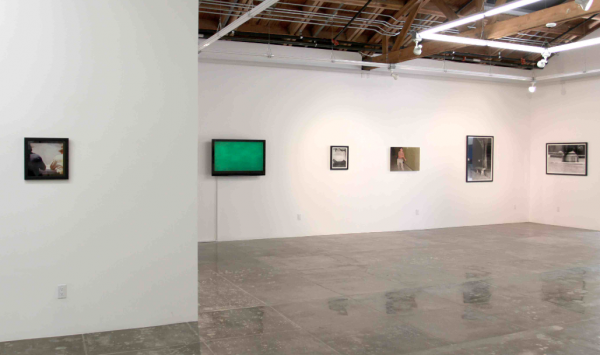
Early video is so lovable. Hidden in the low-contrast images and lost political references are rebellious experiments to find a way to express the vibrant importance of the moment. The more than 40 videos of Record > Again! at the Goethe Institute are a time capsule that hold an insight into some of the struggles and hopes of the German artists who made them.
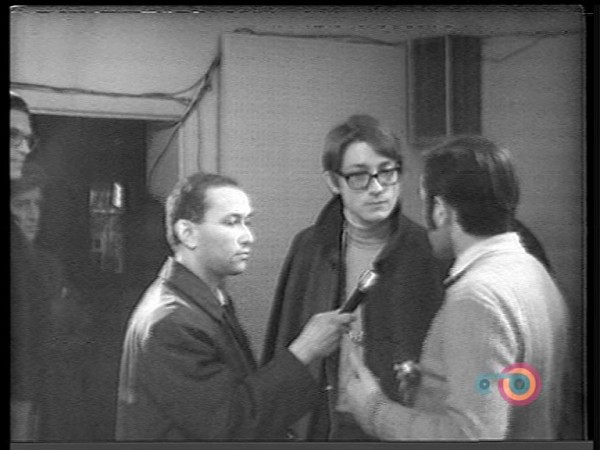
Peter Weibel-- The Public as Exhibit; 1969

These artists created radical works that questioned the role art played in society. They fought with video cameras to reclaim the world of art from the dominant cultural threat: bourgeois passivity (That sounds so utopian today). The work had to be accessible and yet inscrutable at the same time. In 1969 at the Galerie Junge Generation in Vienna, Peter Weibel had an exhibition of some electronic noise machines that worked by waving your hands around. At the opening, Weibel interviewed on camera random members of the audience about his work. These video feeds were broadcast in the gallery. The conversations that they recorded were entirely about the politics of art and society.

More recently, Paul Wiersbinski‘s King Nothing (2008), is a chaotic art walk in a warehouse squat lead by a man with a whip. The farcical group of patrons only ask how much things are and if they can buy them. The world of art is shown to be run by the evil influence and false worship of wealth.

If these works were not punk enough, then how about a performance of Einsturzende Neubauten from 1981 at the Festival of Genius Dilettantes? Complete with wooden plank and hammer for percussion, this was the sound of divided Berlin. Equally punk, is Ulrike Rosenbach‘s Good Luck for a Better Art, (1977). Rosenbach spits milk at the camera over Klaus vom Bruch‘s shoulder as he whispers the title of the video.
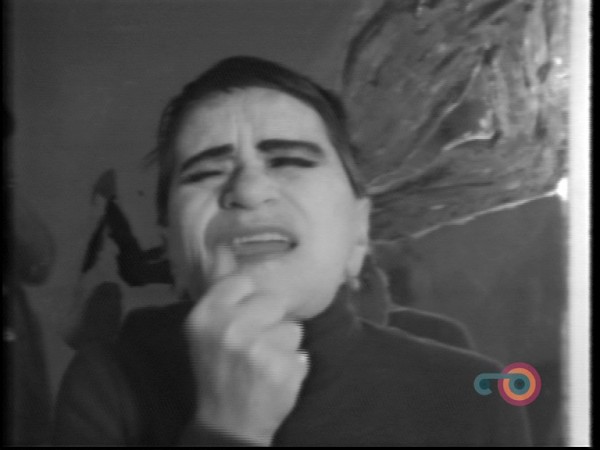
Ernst Mitzka-- Valeska Gert: The Baby, Death; 1969

In 1969, the year before receiving a life long achievement award from the Deutscher Filmpreis, Valeska Gert made a video for Ernst Mitzka that was never exhibited until now. Gert first imitates a baby then immediately acts out the moment of death. In 1981 Michael Morgner, after being smuggled into East Germany, went out with a plein-air painting group and staged what he claims to be the first video performance in the GDR by walking out into a pond and delivering a messianic message.
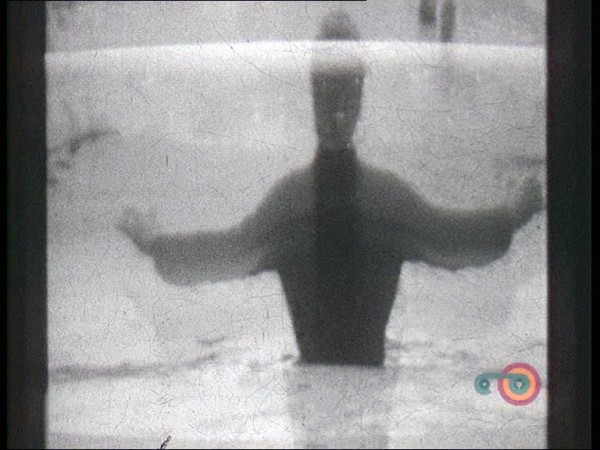
Michael Morgner-- M. Crosses the lake at Gallenthin; 1981

Wolf Kahlen‘s Warning: Filming (1980) is a chaotic mess. Kahlen filmed with a army surplus surveillance camera noisy jazz improvisations and A.R. Penck painting on glass panes that were placed over the monitor. These paintings were then turned into a silk screen portfolio and smuggled out of East Germany.
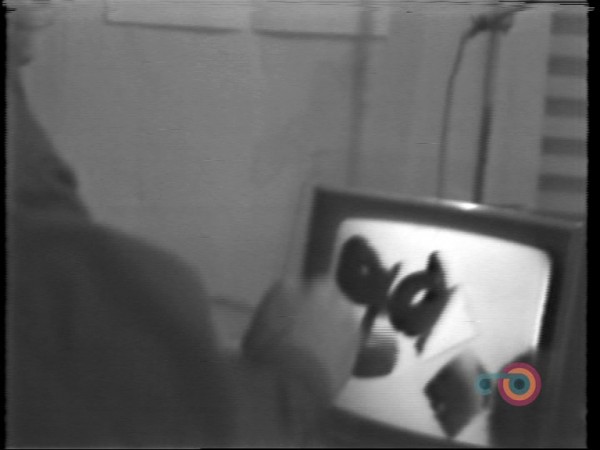
Wolf Kahlen and A. R. Penck-- Warning Filming, 1980

The concerns that these works engage echo up to us today. This is just the tip of the iceberg of unknown early videos.

Record > Again! was produced by ZKM and exhibited at the Goethe Institute, Boston from April 27—May 11, 2011. The catalog and educational copy of all 43 videos are available from ZKM and the Goethe Institute.

Share

History’s Shadow: New works by David Maisel

Today’s article is from our friends at Art Practical, where Bean Gilsdorf discusses History’s Shadow, an exhibition by the artist David Maisel currently on view at Haines Gallery in San Francisco.

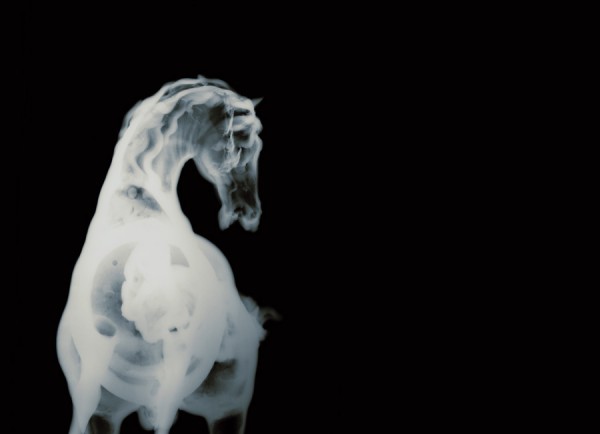
History’s Shadow GM3, 2010 C-print Courtesy of Haines Gallery

Walking into David Maisel’s exhibition History’s Shadow, at Haines Gallery, the viewer might not recognize the work as X-ray portraits of antiquities. Surprisingly, the textures, tones and effects created by this process are more enticing than clinical. Through the process of x-raying historical art objects in the collection of the Getty and of San Francisco’s Asian Art Museum, Maisel proffers a particular view of history, one that is cloudy and delicate, yet revealing in unexpected ways.

Read More…

Share

Mark Moore Gallery Wraps up Josh Azzarella: Works 2004-2011

Mark Moore Gallery will wrap up their current exhibition Josh Azzarella: Works 2004-2011 next week on May 14. The show, as the title implies, presents a comprehensive “career-to-date” survey of both Josh Azzarella’s photographic and video works. This approach seems like a particularly apt curatorial strategy on the part of Mark More Gallery, as Azzarella’s underlying conceptual framework spans both media and unites the works on view by reflecting developments in practice.

“I initially started with photography. I decided I would stay with photography for quite some time….in terms of modification and removal, I felt I needed to get handle on that before moving to video,” says Azzarella.

“I approach video as I do photography, which is to tear it apart into 24, 30 frames a second and approach each frame frame as an individual photograph. The complication becomes matching things that have moved and making sure they don’t jump….but really its the same process between the same mediums.”

Untitled #23 (”Lynndied”), 2006

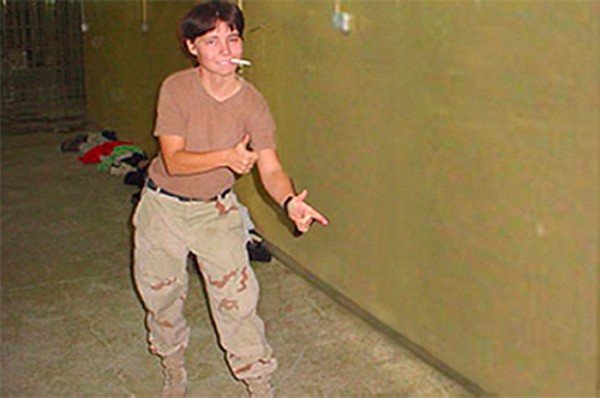
Azzarella’s early works focus on appropriating and modifying widely recognizable, or even iconic images from both historical photographs and current news media. Untitled #23 (”Lynndied”), from 2006, removes one of the subjects from the darkly controversial Abu Graib photos–leaving in its place a haunting absence.

Untitled #100, (Fantasia)

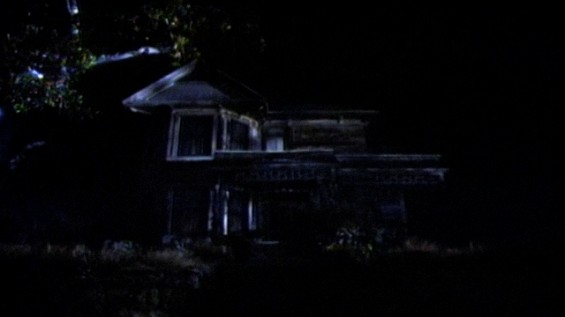
More recent works in Azzarella’s ouvre favor pop culture and commercial iconography. In the video Untitled #100, (Fantasia), Azzarella took two years to meticulously remove all but the murky rolling fog of a smoke machine and ominously ambient noises from Michael Jackson’s seminal Thriller music video. The result is a seeming post-apocalyptic landscape; robbed of its ghoulish face paint and kitsch, the video is both a humorous and frightening look at what is left behind- imbued with new symbolic meaning now that the prince of pop himself “left the building”, so to speak, in 2009, oddly enough the same year the piece was created.

Untitled #105 (SFDF)

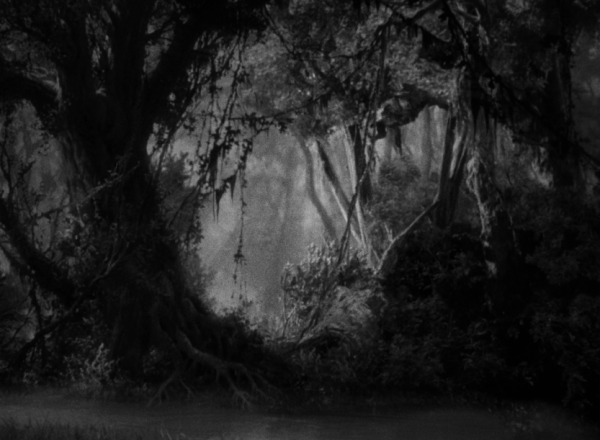
The show culminates with the debut of Azzarella’s multi-channel video installation, Untitled #105 (SFDF), another major 2 year project, which suspends three pivotal moments of “anticipation” from the iconic 1933 version of King Kong and combines them with newly captured footage by Azzarella himself. Continuing  his practice of modification and removal, the piece marks Azzarella’s first time behind the camera, reflecting a new directorial direction perhaps. Collapsing fact and fiction, the piece questions notions of authenticity and fantasy.

The exhibition itself was held in Mark Moore Gallery’s new space in Culver City, CA (after twelve successful years in their Santa Monica, CA, Bergamot Station locale). Featuring the designs of renowned architect Peter Zellner, the “new” space is actually a Historic Building (according to Culver City’s preservation program), built originally in 1925.

Upcoming exhibitions (opening May 21) include new works from Belgian artist Cindy Wright and a new installation by emerging artist Mark Fox in the project room.


Share

From the DS Archives: Tammy Rae Carland at Silverman Gallery

Bay Area based artist Tammy Rae Carland is the subject of this week’s  From the DS Archives posting. Carland will participate in the panel discussion, Queer Culture and Artists’ Circle, at the San Francisco Museum of Modern Art on Saturday, June 4th at 4:30pm. Additionally, she will be included in the upcoming group exhibition, Bay Area Now 6, at the Yerba Buena Center for the Arts.

This article was originally written by Julie Henson on October 9, 2010.

Encapsulating topics as grand as performativity and vulnerability in visual art often leaves the viewer unsatisfied. So often, concepts such as these are over-thought and over-articulated, but in Tammy Rae Carland‘s Funny Face, I Love You, this couldn’t be further from the truth. In her latest exhibition at Silverman Gallery in San Francisco, Carland takes on the role of the comedian, one could argue the most vulnerable of all creatives, as a vehicle to explore fragility and personal exposure.

I’m Dying Up Here, #6 (wood suit). Color photograph, 2010. Courtesy of Silverman Gallery.

In her most recent photographic series, I’m Dying Up Here, Carland’s isolated figures live in an unsettled state, seemingly caught mid-act. The figures rest between being obscured and exposed by the heavy dark cloaking of the background. Each background is both visible and invisible, with subtle texture only coming into focus as one approaches the photograph. Even when there is no figure present, the environments in each image lie in waiting for something, giving one the sensation of anticipation, fear and self-doubt that accompany the act of performing.

For an exhibition revolving around comedians, humor takes a surprising, and unexpected, backseat role. In so many ways, humor can be one of the best ways to protect one’s self, but in Tammy Rae Carland’s case, humor only presents itself alongside humiliation and exposure, acting as a tool to show how one is both hidden and revealed, guarded and defenseless.

Punch Line, Ink and paper, 10 × 13 Inches each, 2010. Courtesy of Silverman Gallery.

In some of the most uniquely satisfying work in the gallery, a series of ink and paper text works, entitled Punch Line, mask transcripts of famous comedians’ acts, only leaving the punch line revealed. This disguise leads the viewer to search, to postulate, and to wonder about that which is missing, only providing the feeling of being utterly incomplete, and unfulfilled. What results is a context that is lost or mistranslated, mirroring the vulnerability embedded in the I’m Dying Up Here series.

Funny Face, I love You. Various sizes. Ceramic cast and hand built objects. Courtesy of Silverman Gallery.

And, as a perfect way to complete this well articulated thought, the fragility and subtle habitation of the ceramic sculpture, Funny Face, I Love You, reveals the balance of presence and absence in all of the work in the show. As it sits in the window space of the gallery storefront, the sculpture lives both inside and outside of the space. The ethereal nature of the white ceramic simultaneously exists as the omission of a figure and as the immaterial quality of the prop to the act of performing. All of these elements combined in Carland’s well choreographed narrative leaves a place for the viewer to explore vulnerability and fear in relation to the body and mind united in the performative act.

Funny Face, I Love You will be on view at Silverman Gallery through October 23rd, 2010.

Share

The Most Beautiful World in the World

Imagine what it would be like to step into someone else’s mind – to find yourself submerged within the physical manifestations of their memories, truths and dreams? It is this exact feeling that is elicited when stepping across the threshold of the sterile gallery space into the curious world that is Friedrich Kunath’s exhibition at the White Cube in London.

Friedrich Kunath. 2011. White Cube Hoxton Square, London. © the Artist, Photo: Ben Westoby. Image Courtesy of White Cube.

Scent is the first unexpected sensorial experience encountered the moment your feet touch the wine-colored carpet. Involuntarily, as scent so fervently does, the smell of the incense that burns in the corner triggers memories of a bygone era. A curiosity that takes me back in time to those imperturbable teenage days hanging out in your friend’s parent’s basement, a generation re-enacting a previous decade so nostalgically defined by peace, love and happiness.

This is, according to the exhibition title, ‘The most beautiful world in the world’ – Kunath’s own attempt to create a improbable utopian world within a white cube space. But this utopian world is a personal one – not a collective idealism. A whimsically constructed place of illogically excavated findings – a space of hazy memories.

Next, the auditory sense is awakened as soothing sounds fill the room – melodic overtures overwritten by the sound of crashing waves and chirping birds, interrupted by the record skipping, scratching and voices speaking out. But it is all just an illusion – the records scattered throughout the room simply props in the play, as is everything that fills this obscure place.

Friedrich Kunath. White Cube Hoxton Square, London. © the Artist, Photo: Ben Westoby. Image Courtesy of White Cube.

In one corner a Henry Moore-like reclining figure is eccentrically merged with a model train that runs in a circle round and through it. Perhaps a peculiar fusion of childhood memories – a beloved toy and an earlier encounter with the Father of Modern British Sculpture. A banana-man has stepped down off his plinth to cross the gallery space and greet you at the entrance. A man leans on a speaker covered in onion-printed paper, with a bird perched on his Pinocchio-like nose, and a chair with a giraffe balancing on his head.

These strange scenes feel like snippets of lost and forgotten time, plucked from the neural space in which they float and poignantly reconstructed here. They are slivers of lives and eras that are somewhere between life, imagination, memory and dream. Like the nebulous quality of memory as time passes on, truth cannot be separated from fiction. Recollections are not reliable, nor true – the burgundy family car so vividly burned into my childhood memory, never existed, but is likely tidbits of memory combined with a vivid imagination and years of reinforcement to create something that was never really there.

Like my burgundy car, these scents, sounds and sights are retrieved from Kunath’s memory and mixed together here in a synthesis of post-production to create something that now crosses over into the realm of the real.

The lesson learned here, if we adhere to Kunath’s claims, is that the most beautiful world in the world is that which you construct within your own mind.

Share

Little Left to Lose

L.A. Expanded: Notes from the West Coast
A weekly column by Catherine Wagley

Vija Celmins, "Time Magazine Cover," 1965, oil on canvas, 22x16 in., private collection c/o Ms. Laura Bechter.

Sunday night, before we knew for certain Osama bin Laden had died, I was listening to the radio and reading an essay by Kamin Mohammadi. Called Lust, Devotion & the Binary Code (titles that rely on the power of threes—consider “Opera, Homosexuality, and the Mystery of Desire” or “Sex, Art, and Americn Culture”— make me worry an author can’t commit), the essay was published in VQR and nominated for an National Magazine Award. It begins with Mohammadi in her native Iran, with what’s supposed to be a foreboding line: “S and I arrived late to the hotel in the remote town” (S is a man, of course). It ends with her no longer in Iran, having had her love affair, and returned to the UK she’d adopted in childhood; she says, “I have lost my love and my country, and so have little left to lose.”

What comes between is a long-suffering realization on the part of the writer that restriction does not necessarily lead to naiveté. She worries that her soon-to-be lover has never been alone with a woman. (She’s wrong; he’s snuck up to girls’ windows before.) Later, she worries that their loose talk over phone lines could be picked up and lead to jail time, or worse. He laughs at her. Does she think she invented phone sex? (She does think so, actually, at least within the borders of Iran.) The essay’s ending, which I reached around the time Obama finally began his address, seemed stretched too easily to a point of lyrical closure. “I have lost my country.” It’s just hard to believe that she ever had it.

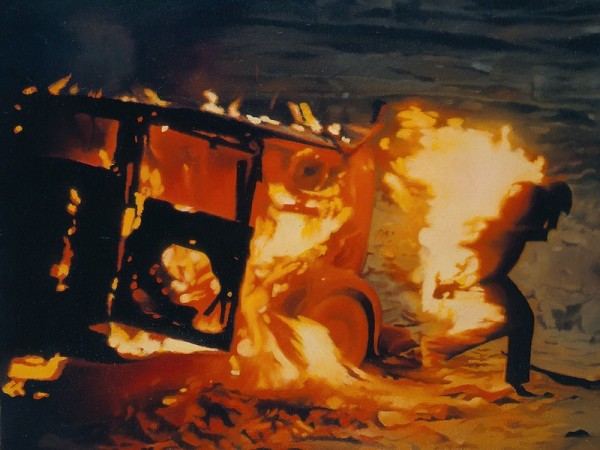
Vija Celmins, "Burning Man," 1966 Oil on canvas 20 x 22.5 inches. Private Collection, New York.

The most resonate part of Obama’s speech for me—it felt right on the whole, enough so that I began googling West Wing character Toby Ziegler, the main reference point I have for speech writing done too well—was when he asked all of us to remember that feeling of unity that blanketed us right after 9/11. He was asking us to recall just a feeling, something that had been emotional, in-the-moment and thus necessarily fleeting, not to lay claim to something bigger and broader that many of us would have never had.

Vija Celmins’ television paintings, made between 1964 and 1966 and currently on view at LACMA, may be far more underwhelming than Obama’s “bin Laden’s gone” speech. Still, they have a similar cautiousness about claiming too much. Many show disasters Celmins never experienced any place other than on the TV screen—red glow of explosions, cool gray of war planes, scenes from Vietnam and scenes from Watts, belabored but not rendered with the exquisite tightness she’d become known for later; instead, they have the looseness of a blurring screen. It’s all the opposite of an op-ed. This work doesn’t have a slant, just a sort of circumstantial being-there-ness that manages to hover between passivity and intention.

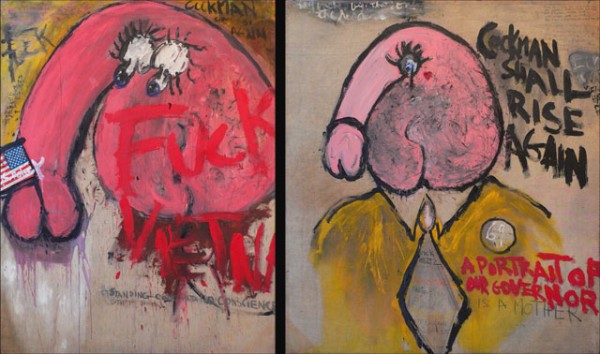
Judith Bernstein, "Cockman #1 and #2," Acrylic on canvas, 1966.

But, then, there may be another way to acknowledge how little you own beyond yourself. Intention emanates aggressively from Judith Bernstein’s current exhibition at The Box in Chinatown. Her paintings, so phallically gross and the oldest ones (made in the mid-60s) aged so unkindly that their bodily pinks and browns seem putrid, have titles like Vietnam Salute and Cockman. Their faux-edginess recalls the kind a middle schooler takes on when she realizes profanity can get a rise and lets out four-letter words like nobody’s business. This naive brashness has a kitschy humor to it, though—the “Cockmen” look like Babar, if he’d given up his ears and had a penis nose instead of a trunk. The whole show is Valerie Solanis meets Sarah Silverman: absurd, solipsistic anger that knows how to play a crowd.

I can’t even imagine Celmins and Bernstein’s work in a room together, but what it shares is a painful awareness of its own smallness, even if Bernstein finds that smallness enraging, and kicks at it with all her sass-filled might. Neither would be caught trying to pull the world together with a simple line like, “I have lost my love and my country, and so have little left to lose.”

Share

An Interview with Folkert de Jong

The figures in Dutch artist Folkert de Jong’s work are both historical totems and cautionary tales. Suggesting that our darkest impulses are unavoidably cyclical in nature, he evades didactics through a combination of period details and contemporary imagery. de Jong seems to understand that every nationalistic conquest brings with it trumpet bleats, shiny shoes and other supposed finery—things that, while often treated as symbols of greatness, are often nothing more than cover ups. His current show, Operation Harmony, at James Cohan Gallery is up through May 7th. I had a chance to catch up with him over email this past week.

FOLKERT DE JONG The Balance: Trader's Deal 9, (detail) 2010 Styrofoam, pigmented polyurethane foam Photo: Jason Mandella Copyright the artist Courtesy James Cohan Gallery, New York/Shanghai

Michael Tomeo: I’m really into the Trader’s Deal pieces. From the moment we learn about it in grade school, Americans laugh at how foolish native people were to sell the island of Manhattan for a bunch of beads. You make the pitch made to the native people seem goofily transparent and demeaning, like some sort of song and dance.  But there’s also an oddly hypnotic quality in the stares of the offerers. It’s like they’re half street hustler, half visionary. Could you elaborate on these?

Folkert de Jong: The Trader’s Deal pieces are about unfair deals, profiteering, colonialism and imperialism. I based the character on the monument for Peter de Minuit, the Dutchman who purchased Manhattan for beads and mirrors. The figures in the artwork are all copies from one character…a 16th/17th century trader, that I created out of many figures from history: The painting “The Nightwatch” by the Dutch painter Rembrandt van Rijn, and characters such as Pedro de Alvarado, Peter de Minuit and Hernan Cortes. All the figures in the artwork are copies made from one mould, from one single character. The clones are trading with themselves, their own kind, ripping off each other and facing their destiny; self-destruction.

FOLKERT DE JONG: Operation Harmony, James Cohan Gallery, 2011 (exhibition view) Photo: Jason Mandella Copyright the artist Courtesy James Cohan Gallery, New York/Shanghai

MT: Coming from the Netherlands, were you taught a different view on the di Minuit transaction than children in the U.S. are?

FdJ: Well, if you look at the propaganda machine that promoted the 400 years Dutch-New York connection, I would say that still not much has changed. The Dutch seem to be very proud of their historical conquests. For me as a kid growing up here, they are like adventurous stories, with costumed characters as in Hook and Peter Pan. What disturbs me most is the interference of governments and the Royal Families in the manipulation of the historical myths. But I guess that is what happens with all nations, if you can change the cause of history into your own advantage, it simply becomes more profitable.

MT: What’s the symbolism behind the cubes and other polygons in your work? The people in the Trader’s Deal pieces offer strings of them and the half figure in Hail the One is sort of crushed by one.

FdJ: The shapes are references to dices, or mathematical forms. I am interested in the element of chance. How science has been always trying to simplify natural processes, and how uncontrollable nature actually can be.

FOLKERT DE JONG: Operation Harmony, James Cohan Gallery, 2011 (exhibition view) Photo: Jason Mandella Copyright the artist Courtesy James Cohan Gallery, New York/Shanghai

MT: You often mix colonial imagery with contemporary objects and you combine traditional sculptural techniques with industrial materials. Is there a “those who don’t learn from history are destined to repeat it” sense of moralism at play here?

FdJ: In a way, yes. I believe that there are timeless natural cycles. The costumes and setting looks different every time, but the people and their behavior remains the same.

FOLKERT DE JONG Operation Harmony, 2008 Styrofoam, pigmented polyurethane foam, pearls 340 X 700 X 230 cm Photo: Jason Mandella Copyright the artist Courtesy James Cohan Gallery, New York/Shanghai

MT: What inspired Operation Harmony? In part, I’m getting a Goya’s Los Caprichos for the 21st century vibe…

FdJ: Yes, I am fascinated about the role of Goya as an artist reflecting upon his own time. There is a timelessness in his work that reflects upon the fear, and fascination for human nature at work.

MT: I love the works on paper in this show. Often incorporating text, they have more of an unburdened sense of humor than the sculptures.  How does your mindset change when making the drawings?

FdJ: Thank you. The drawings are coming more out of an uncontrolled stream of thoughts, flowing out on the paper, telling thing about my fascinations…more uncut maybe?

FOLKERT DE JONG The DeWitt Bodies, 2007 Marker on paper 16 1/2 X 23 1/2 inches Photo: Jason Mandella Copyright the artist Courtesy James Cohan Gallery, New York/Shanghai

MT: Do you see your sculptures as monuments of sorts?

FdJ: Not deliberately, but there is a strong reference to the powerful meaning and function of monuments in my work for sure. Maybe they’re monuments for the moral subjects that are unspoken around the glory and heroic and fame of our history and time?

Folkert de Jong’s work can also be seen in Cryptic: The Use of Allegory in Contemporary Art with a Master Class from Goya, Contemporary Art Museum St. Louis, St. Louis, MO, from May 20th to August 14th, and Shape of Things to Come: New Sculpture, The Saatchi Gallery, London from May 27th to October 16th.

Share