Johannes Kahrs

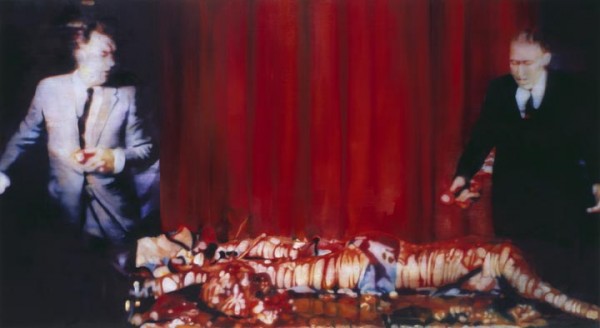
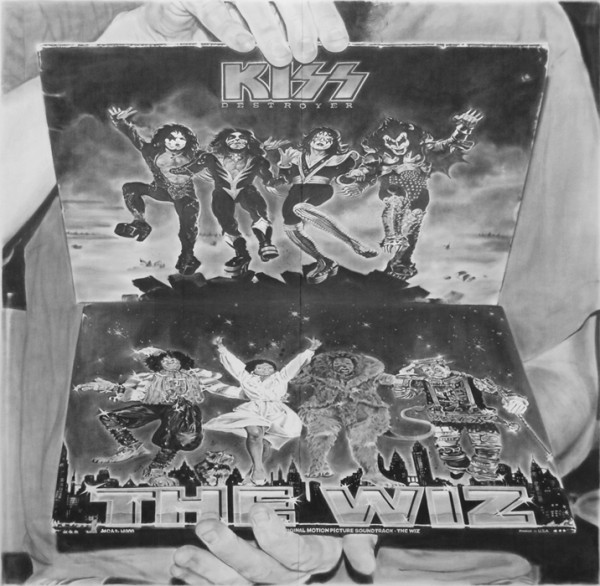
I have to admit, there is nothing more impressive to me than a well executed painting, and spending some time with the work of Johannes Kahrs has done nothing but revive this fascination. Living somewhere between film, modern news media and history painting, Kahrs’ work seamlessly merges the beauty and tradition of painting and portraiture with banal yet grotesque objectivity, seducing the viewer into a reductive, saturated palate only to confront them with an aggressive yet all too familiar imagery. Choosing images generally experienced through second hand sources of information, Kahrs infuses his paintings and drawings with the drama of film, creating a sense of constant motion and closeness within a still and fragmented plane. Claiming imagery typically referenced through our daily interaction with media sources, Kahrs builds on the diversity of photographic images infused with the seductive palette of artists such as Richter and Tuymans, but invests them with a grotesque, bodily relationship to the viewer seen in the work of Jenny Saville. Kahr’s dark and alluring palette creates an ominous sensation surrounding his shrouded, anonymous figures that instantly builds a narrative within his intentionally extracted context. Kahrs’ film-like color references the emotive palette seen in work such as Luc Tuymans’ Gaskamer, but builds another narrative context that remains familiar but unidentifiable.

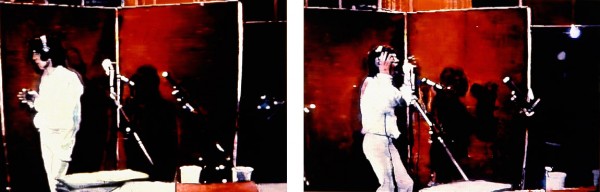
Nevertheless, it is his hybridization of media that keeps me coming back to his work. The sensation of moving film, rather than a captured photograph, comes not just from rendering from video stills, but showing sequences of images with a subtle shift in time. Kahrs employs a blurring and shifting of images, but also blurs the identity of his subjects, contributing to his seamless combination of the banal and the grotesque. This obscuring of subjects to a point of abstraction, allowing faces to melt off the subjects like those of Francis Bacon’s portraits, elevates while disguising the identity of the mundane, drawing on our cultural over saturation and disconnection from the physicality of violence. Further complicating his role in creating the image, Kahrs paintings and drawings are often shown behind glass, emphasizing the viewer’s separation from the work and further masking the artist’s hand. This masking and obscuring of time combined with the multiple references to media builds more questions than answers, giving someone a place to investigate and question both the history of painting and its relationship to modern life.

Kahrs recent exhibitions have included solo shows with Luhring Augustine in New York and GAMeC in Bergamo, Italy, in addition to several group shows at the Phoenix Art Museum, the SFMOMA and Museu Serralves in Porto, Portugal. Kahrs currently lives and works in Berlin.

Share

Interview with Mario Zoots

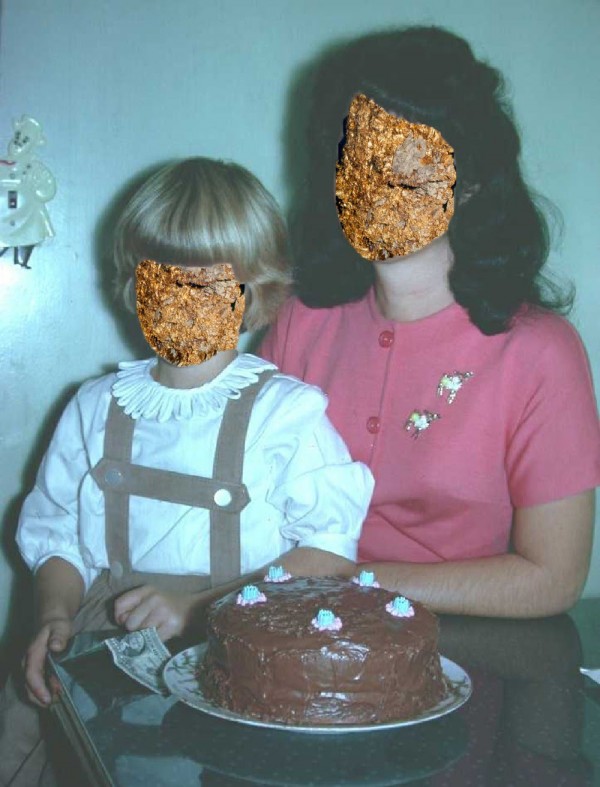
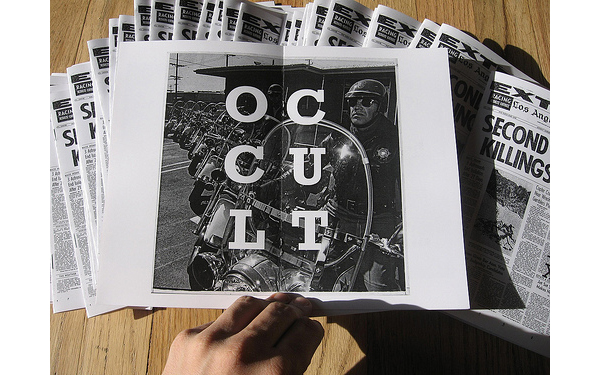
The mysterious and psychologically challenging images created by Denver-based artist Mario Zoots are produced by applying a visual barrier between the viewer and the appropriated image by way of physical paper collage and digital manipulation. Each work carefully alters an existing image that was originally existed through the Internet, print publications and photographs and challenges our perception of and relationship to everyday mundane imagery.  Likewise, up until recently, the artist’s work could only be found through similar distribution sources such web pages, small run printed zines and prints or posters. However, Zoots opened his first public show this month, offering viewers the unique opportunity to engage his images in person. I Miss Mystery is the title of the artist’s new exhibition which is currently on view at Illiterate Gallery in Denver. DailyServing founder, Seth Curcio, recently spoke to the artist over a brief phone interview to talk about how he interrupts his found images, the advantages of working online and in print, and his sound project Modern Witch.
Seth Curcio: When did you first begin to create collages and prints? What was the initial idea that got these series going?

Mario Zoots: I began making collage because I didn’t have enough space in my apartment to paint anymore. Brian Bamps was living in an attic apartment in Denver for a short time. I visited his house and saw his small American school desk that was attached to a chair where he made all of his drawings. He had a box that he’d place the finished drawings in.  I knew I must work smaller because I was at risk of losing my living space. So I began to make collage and pen illustrations. We’re not artists with studios, we’re artists with homes. I consider myself an appropriation artist and a network artist. I am interested in making pictures reflect contemporary feelings by subtracting and distorting them. I’ve been preparing for my first solo show, I Miss Mystery, which opened in Denver at Illiterate Gallery on February 5th. I printed large giclee reproductions of my collages for the show. In addition to original and printed collage, I’m showing an experimental video and creating an installation out of hundreds of pages of porn all slightly altered. It feels cinematic. My ideas for the work come from movies, long Internet conversations with my contemporary girlfriend, and my own studies of archives.
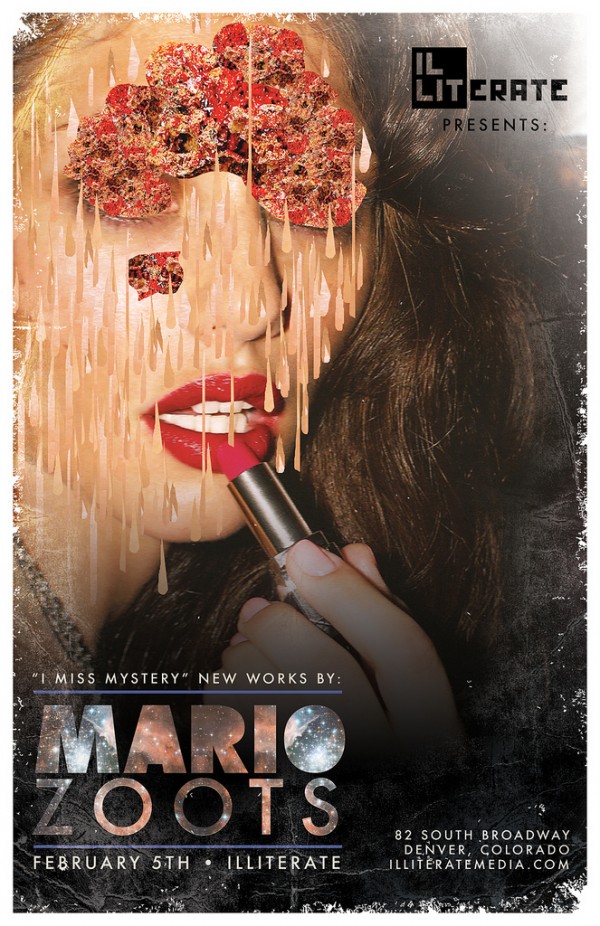
SC: There is a mix of vintage and contemporary imagery used in your work. Where do you find your source material and what qualities do you look for when selecting an image?

MZ: I find my source material in libraries, in thrift shops and on the Internet. I’m constantly working and constantly picking things up. The mix of vintage and contemporary material is not significant. I don’t feel that using baseball cards from 1971 makes them more meaningful or valuable. Thousands of the same cards were printed and are lying around in hundreds of basements. I use popular materials because I’m attracted to them. I like the idea that there are multiples of the images in existence, that others have seen them in print too. The Pop Era has existed for so long, it’s inescapable, and it’s married to reproduction, duplication, and multiples. I feel by putting my art online and working with print that I am also participating in this type of reproduction culture, albeit, digitally.
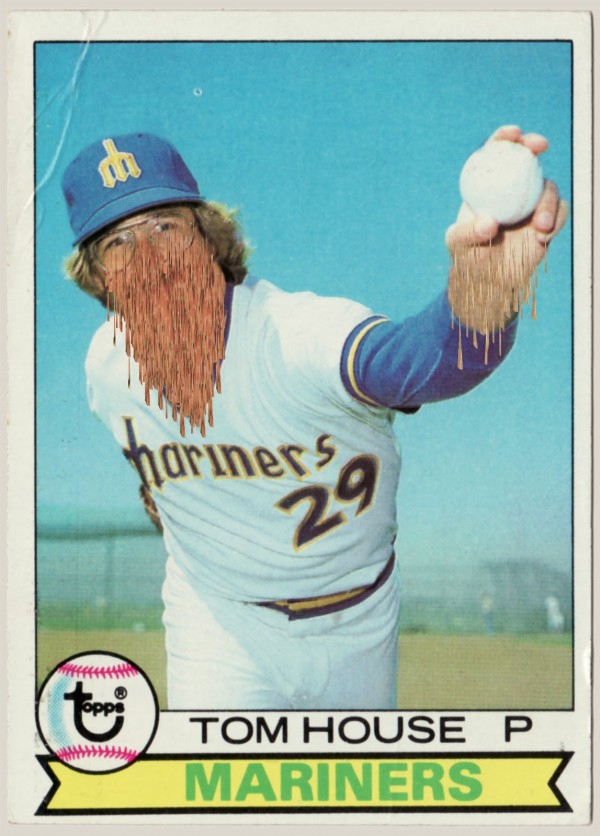
SC: In many of your works, the composition seems to be deconstructed, and sometimes even aggressively interrupted. When constructing your imagery, do you intentionally obscure your subject to heighten the mystery or psychology of the image? How is the viewer’s relationship to the original source image altered by your manipulation?

MZ: There is an inherent psychology in popular media. Magazine pages are rich with meaning that’s been devised by advertising agencies or publishing groups. I believe the meaning in popular data is always heightened by audience. I can’t say that my collage or illustration heightens the psychology because I believe it’s already there.  Change causes mystery.  When I change images, I believe the psychology of the image is still in tact for the most part but then I find the disruptions and interruptions in my art to be haunting and mysterious. Perhaps the change, the deconstruction, the mystery is what my audience feels the most.
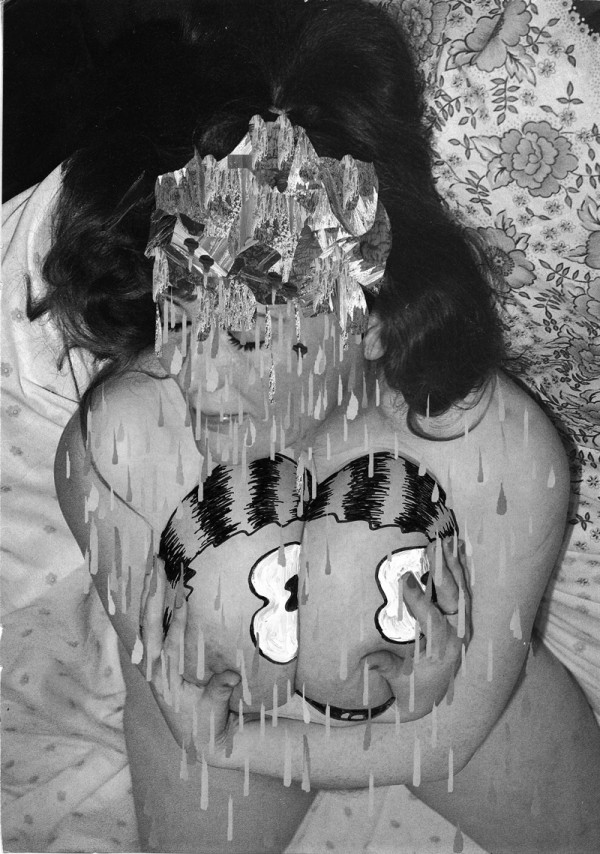
SC: Many of your works embody dark and disturbing qualities while utilizing a playful and irreverent humor. This seems to work as a tool to allure your viewers into the often absurd images, while causing them to confront their expectations of commercial imagery.  How do you want this visual jarring to effect the viewer?

MZ: I find humor in what I create but don’t necessarily feel like I need an audience to share that sensibility.  I borrowed a family portrait from the Internet and disrupted the faces. While sitting at my desk one day, I received an email from a man who said he really liked my art and that he was writing to tell me that one of the family portraits I’d used was his own.  It made the collage feel so different. It felt like a lifting of the curtain, synchronicity. Someone from this hyper multiple meme on the web spoke out. There are real people behind those faces!
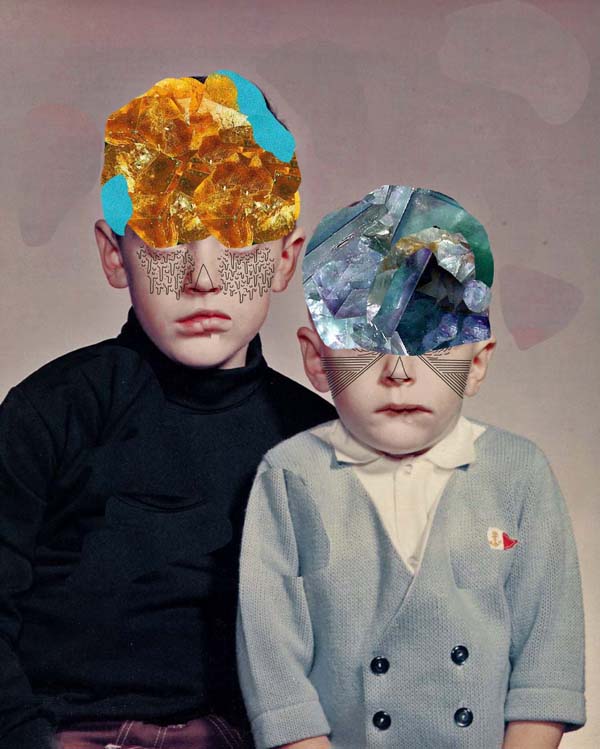
SC: Most of your artwork is displayed digitally through the Internet. It is rare to experience the work in person in a gallery setting, however you do create a series of zines that feature the works. I am curious about both the production of your zines and how you feel the work is best displayed, over the Internet, in person or as a publication?

MZ: Most of my art is viewable online. Some of the digital collage only exists on the Internet and nowhere else.  I make zines with Kristy Foom and Keenan Marshall Kellar under the publishing name Drippy Bone Books. Zine publishing gives me an opportunity to curate and work collaboratively.  I just finished printing a new zine called Rescreened that features the work of Natalie Rodgers, Daniel Hipolito and myself. It’s a book of photographs taken of televisions screens and screenshots on personal computers of youtube.  I printed thirty copies. Kristy is tabling for Drippy Bone Books at the Lancashire Zine and Multiples Fair. We’re releasing Rescreened there at the end of this month. I like working in both the online, print and gallery realms. They’re all very different. When I need a break from one, I move to the other.
SC: What are the main sources of inspiration that you constantly return to?

I’m inspired by the Internet, and the many blogs I follow on a regular basis, my Internet footprints. I watch a lot of b-films, just last night I watched Virgin Witch a film from 1972 about 2 sisters, Christine and Betty, who have dreams of becoming fashion models, they sign with an agency and go to a castle for a photo shoot, but it’s not just any photo shoot, the real reason they are there is to serve as virgins in a induction ceremony for a coven of witches! I am inspired by music too, a record I can’t stop listening to is ‘Songs’ by John Maus, it’s insanely epic.
MZ: Do you have any new projects lingering around the corner. Anything that we should look out for?

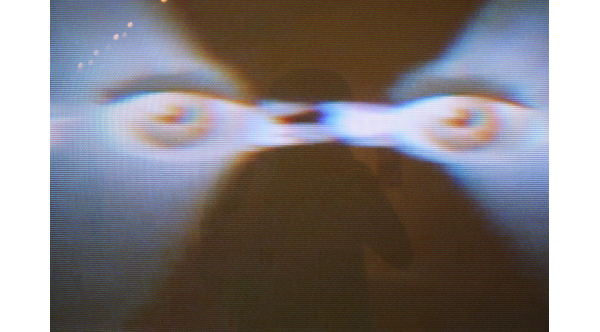
Modern Witch is my sound project. I work with artists Kristy Foom and Kamran Kahn as a band. We use electronics and synthesizers, and most times record straight to tape. We play DIY venues and art galleries.  Disaro Records is releasing our cdr!   We hope to put out a 7″ record later this year.  One of my favorite Modern Witch shows was at Show Cave Gallery in Los Angeles. I think there are special things happening in Los Angeles right now, and I’m excited to have the connection to the L.A weirdos.  We’re planning a return to Show Cave in March 2010 to perform music and curate a Drippy Bone Books group art show.  The name of the show is WE OOZE. I feel like it’s going to be a mysterious year.

Share

From the DS Archives: Folkert de Jong

Originally published on: November 18, 2008

folkert de Jong.jpg

The new James Cohan Gallery in Shanghai is currently exhibiting work by Dutch sculptor Folkert de Jong. The artist’s large scale narrative installations often reference themes of war, big business, and global greed, as well as the history of art. This particular body of work takes Darwin’s “survival of the fittest” theory and applies it to competition between the nations.

The new work, entitled Thousand Years Business as Usual, includes three sculptural tableaux composed of industrial Styrofoam and Polyurethane insulation foam. The main installation, Early Years, consists of 7 anthropomorphized monkeys arranged in a loose circle, alluding to Matisse’s The Dance of 1901. They are precariously positioned atop oil barrels, with one foot suspended in the air. Covered with a sloppy application of black pigment, these simian characters appear to be plucked from a horror movie. This circular format not only quotes a Modern master, but also references the cycle of life and evolutionary (and artistic) progression. In addition to their role in evolutionary theory, monkeys are also the most versatile sign in the Chinese zodiac. In Business As Usual-The Tower, 3 monkeys are stacked one on top of the other on an oil barrel, miming the cautionary statement “See no evil, hear no evil, say no evil.”

Folkert de Jong -11-18-08.jpg

De Jong’s choice of materials holds symbolic significance, for the insulation itself is a petroleum product. Styrofoam has no sculptural precedent and was originally used by Americans in World War II to create blue lift rafts that were barely visible on the water. After the war, Styrofoam was absorbed into our daily lives after several companies developed the “Styrofoam Plan” in the 50s, an effort to replace other materials. War leads to innovation and progress and slowly this technology is incorporated into mass culture. While both Styrofoam and Polyurethane are mixed with the same chemical components, Styrofoam has a rigid closed cell structure, while the Polyurethane foam allows the artist to develop more organic forms due to its fluidity.

Folkert de Jong studied at the Academy of Visual Arts and the Rijksacademy for Visual Arts, both in Amsterdam, where the artist currently lives and works. He has had several solo shows, one at James Cohan in New York in 2007 as well as Peres Projects in Berlin. de Jong won the Prix de Rome in 2003 for sculpture and has been influenced by artists such as George Grosz and Otto Dix.

Share

Default State Network

Currently on view at Raid Projects in Los Angeles is the group exhibition Default State Network. The exhibition is curated by artist Ryan Wallace and features works by Glen Baldridge, Alex Dodge, Chris Duncan, Elise Ferguson, Joseph Hart, Andrew Schoultz, Leslie Shows, Ryan Wallace and Will Yackulic.

As with many artist curated exhibitions, Wallace has decided to explore the interests that are inherent in his own work, such as current trends and advancements in science, technology and consciousness through the work of the group mentioned above. Borrowing its title from the network of regions in the brain that become active when “an individual is not focused on the outside world but rather in a wakeful-resting state such as daydreaming, speculating, or contemplating the past”, Default State Network playfully explores creative production through a variety of media, methods and systems. Collectively, artists exhibited offer insight into their own creative process as it derives from either premeditated thought or pure intuition that takes over during the production process. Either way it is undeniable that much of the work is built on a language that is mysterious, cryptic and visually seductive.

Default State Network will be on view at Raid Projects through February 27th. In addition, Wallace will be exhibiting new works in a solo exhibition at Morgan Lehamn Gallery in New York City which will be on view through March 20th.

Share

Carefully Orchestrated Failures

L.A. Expanded: Notes from the West Coast
A weekly column by Catherine Wagley

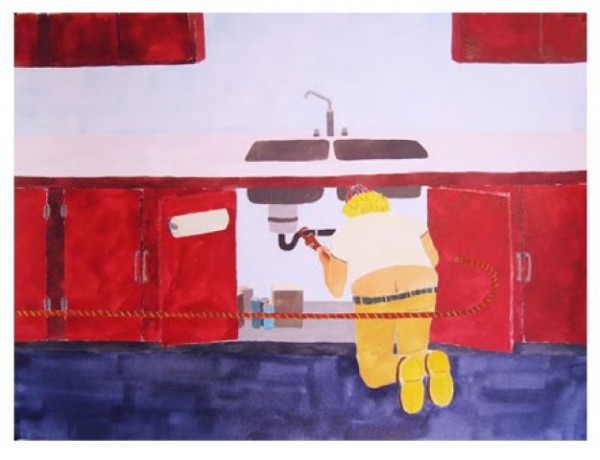
Joe Sola, "In a Kitchen", 2008

In a Bridgestone Tires ad that aired during last Sunday’s Super Bowl, a car resembling the Batmobile speeds along a dark, rainy highway. It turns a corner and slams on its breaks to avoid hitting a brightly lit roadblock set up by eccentric-looking villains. The villain in charge says, over a loud speaker, “All right here’s the deal. Your Bridgestone Tires or your life.” A shivering blond in a leather bodysuit is shoved out of the imitation Batmobile, which then spins around and speeds away. The punch line? The slighted villain whimpers, “I said ‘life,’ not ‘wife.’”

In a Dodge spot that also ran Sunday, a series of men with glazed over, submissive eyes, say things like “I will take your call,” “I will listen to your opinion of your friends,” “I will put the seat down.” But being put upon by their women can’t keep the men from making their “last stand” and driving cars they wants to drive. The ads end with a shot of a speeding car on a lonely highway. Apparently, there is only one kind of legitimate masculinity—the kind for which fast cars are metonymic—and women are its natural foils. That Super Bowl Sunday would arrive hand-in-hand with advertisement misogyny shouldn’t have surprised me, but, still, I expect more gender nuance even from my commercials.

In 2001, artist Joe Sola put himself at the mercy of a high school football team when he made the film Saint Henry Composition (2001). Included in LACMA’s 2008 exhibition Hard Targets, the film showed Sola, wearing no gear, being tackled by well equipped award winning football players. It was a weirdly contradictory performance—on the one hand, Sola had taken on an impossible task (success would have been supernaturally heroic, an alpha male triumph); on the other hand, his failure made him looked foolish, like he lacked a certain intuitive knowledge of sport that real guys should have.

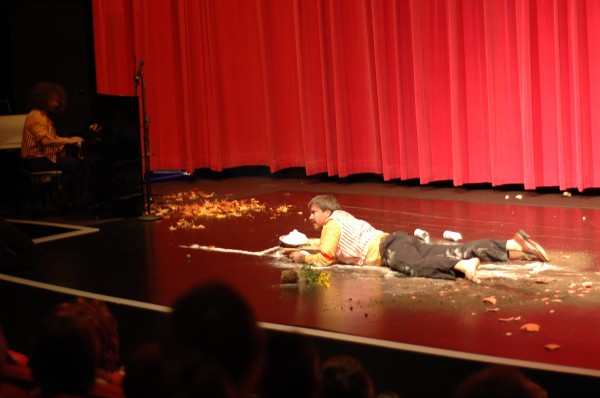
Sola’s soon-to-close exhibition at Happy Lion Gallery in L.A.’s Chinatown, called I found some Bic pens by the railroad tracks, takes gender into a more whimsical but still confrontational arena. It includes a lighthearted collection of self-referential watercolors, a brutally funny video pitting a [male] artists against a [male] collector, and, on January 30th, it also included a performance by Sola and collaborator Michael Webster. The performers—though it was mainly Sola that we watched, while Webster sat behind the piano and provided a perfectly timed soundtrack—wore red and yellow striped vests and black pants that made them look like circus performers. Their slapstick personae were reminiscent of a Charlie Chaplin-Marx Brothers’ hybrid, totally masculine but mocking of masculinity at the same time. Sola had typical junk food, glitter, feathers, and some explosives hidden inside a top hat that had been affixed to a table top (there was no attempt to maintain an illusion as Sola reached through the hat to pull out his props). He also had a blow torch, and the night consisted of dancing;  the placing of containers, filled with milk, cheerios, glitter, and the like, on precarious platforms around the gallery; and periodic explosions.

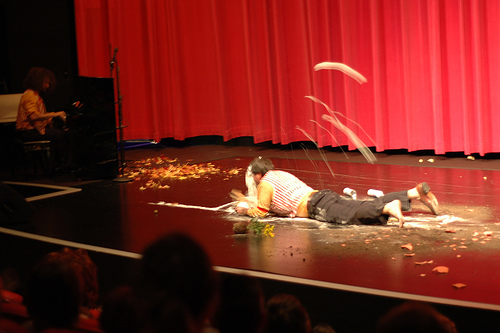
Toward the end of the performance, Sola set us up to expect something big. He’d built a contraption out of carboard, feathers, and glue that looked like a miniature horse. And he’d pulled out the blow torch, wordlessly warning people in the front row to don the protective glasses he’d passed out. In preparing for the big explosion, Sola accidentally slipped onto the floor, and he stayed down, waiting for an eruption that never happened. Then, like an injured and disgraced warrior, he pulled himself along the floor with his arms, stopping under each platform, letting bowls of milk and cheerios that had been placed on precarious platforms around the gallery fall on his head. By the end of the evening, his pants were collages of feathers, glitter and food, glued together with milk. This was as rewarding a game as any Super Bowl I’ve ever watched, because it showed how much the failure to perform could hurt, but it also showed failure to be an inevitable part of performing gender or anything else.

Note: Images from Webster’s and Sola’s Happy Lion Gallery performance are not yet available. The above images depict a 2008 performance at the Hammer Museum, called Bananas at the Hammer.

Share

Russell Tyler: Decomposing in the land of Paradise

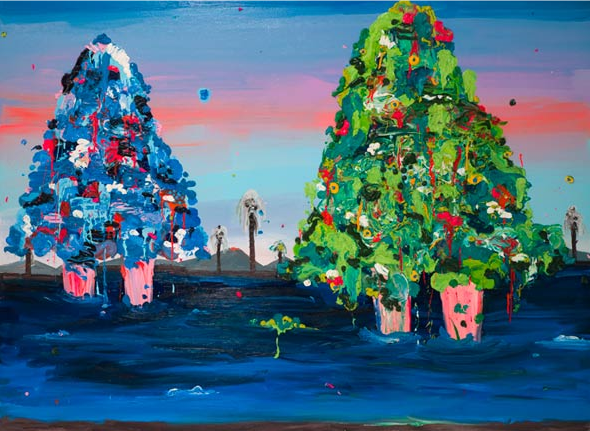
Opening this evening at Freight and Volume in New York City is the exhibition Decomposing in the Land of Paradise, new work by New York based artist Russell Tyler. The exhibition marks the first solo presentation of the artist’s work, as he is currently a graduate student at Pratt Institute of Art and Design. The exhibition promises to be filled with twelve luscious oil paintings that literally dissolve on the surface, rendering each subject in a semi-abstract manor where the paint simultaneous exists as material and image. Figuration is consistently explored through each of Tyler’s paintings, clearly referencing formal qualities utilized art historical giants Phillip Guston and Willian De Kooning.

Decomposing  in the land of Paradise will be on view through March 20th, 2010. Russell Tyler has exhibited in recent group exhibitions including Surreal Landscapes at DNA Gallery in Provincetown, MA and Giver at Union Gallery in NYC.

Share

The Power of Selection: Part I

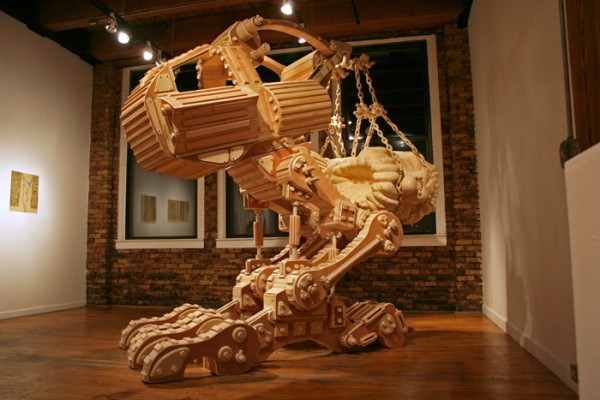
Western Exhibitions in Chicago is currently presenting The Power of Selection (Part I), the first in a series of three exhibitions organized by Chicago-based artist and independent curator Ryan Travis Christian. The exhibition, which features works by Alika Cooper, Mike Rea, Allison Schulnik, Marissa Textor, and Eric Yahnker, loosely explores the idea of contemporary figuration. Works in the exhibition range from a massive anthropomorphic wooden sculpture by Mike Rea, who also exhibited in DailyServing.com’s 1000 DAYS exhibition in Los Angeles last May, to new video work by recent DailyServing.com interviewee, Allison Schulnik.

The exhibition series is designed to bring new creative talent to the Chicago area by artist who rarely exhibit in that region. Curator Ryan Travis Christian works diligently, as he has noted, “to increase the circulation of contemporary artwork”, not only in Chicago, but also as a correspondent for Fecalface.com and through his daily artist selection through Facebook and Beautiful/Decay.com. The young artist and curator has organized recent exhibition including West, Wester, Westest at FFDG, San Francisco, SPORTS at Synchronicity, Los Angeles, and Control C, Control V at EbersMoore Gallery in Chicago.

Share