Anthony Discenza: Everything Will Probably Work Out OK

Anthony Discenza, Teaser #1 (2009)

Opening Thursday, May 13th and running through Saturday the 15th is a flash project at Catherine Clark Gallery‘s New York space, the 14th Street Studio. The show, entitled Everything Will Probably Work Out OK, will feature recent work by Oakland, CA-based Anthony Discenza. Discenza’s text-based work is both literary-minded and low-brow laugh-inducing, and references the artist’s interest in what he calls an “internal viewing experience,” which is born of the freedom offered when one steps back from the constant heckling of image-based culture. His aluminum “street signs” offer the sort of one-liners that the Age of Twitter has become known for, though their enigmatic sentiments require a deeper dive into the murky waters of the wasted adult imagination than most 140 character witticisms.

When I spoke recently with gallery Owner/Director, Catherine Clark, she responded to Discenza’s new work—his so-called “non-visual source material”—by noting that “the new body of text-based projects, while in some ways a media or stylistic departure from his videos, remains consistent with his interests in appropriation and re-contextualizing cultural information.”

Everything Will Probably Work Out OK is the second pop-up exhibition being held at the 14th Street Studio—which is not so much a gallery in the classic sense (there is no “Catherine Clark Gallery, New York”), as an experiment into the way collectors and the public commingle with work. The first show at the space opened in March of this year—during the swarming of Manhattan that is New York art fair week—inspired by the idea that this season the gallery would like to present work in a more personalized setting in lieu of doing a fair.

The Discenza exhibition is a similar, though slightly altered, East Coast incarnation of an eponymously titled show at the Catherine Clark Gallery in San Francisco in January/February 2010. According to Clark, while many of the pieces from the original exhibit will be re-presented in the new space, “there are some significant additions and changes,” including the addition of a large digital photo-based work featuring the Olsen Twins. Additionally, she notes that “some of the text-based signs and works on paper are either newer pieces or feel more appropriate in relationship to the space and the other works selected for the exhibition.” While Everything Will Probably Work Out OK is only on view for three days this weekend, including during several cocktail receptions, the body of work will be up through the beginning of September and can be arranged for viewing by appointment.
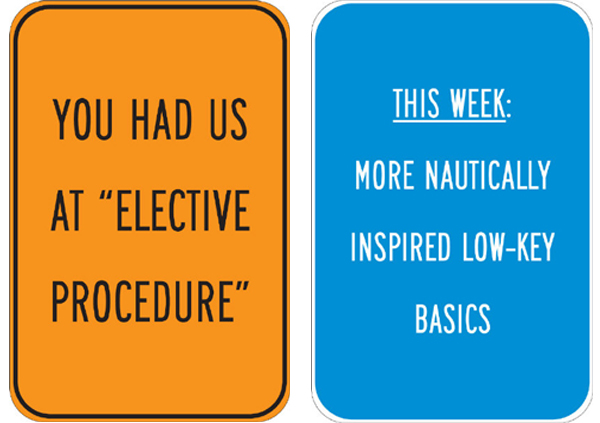
Anthony Discenza, ELECTIVE PROCEDURE (2009) and LOW-KEY BASICS (2009)

Anthony Discenza, ELECTIVE PROCEDURE (2009) and LOW-KEY BASICS (2009)

Anthony Discenza earned his BA from Wesleyan University, Middletown, CT and his MFA in Film and Video from California College of the Arts, San Francisco, CA. His work has been exhibited widely nationally and internationally, including at the San Francisco Museum of Modern Art, the Australian Center for the Moving Image, the Getty Center, the University of California, Berkeley Art Museum & Pacific Film Archive and at the 2000 Whitney Biennial at Whitney Museum of American Art, New York.

Share

Production Site: The Artist’s Studio Inside-Out

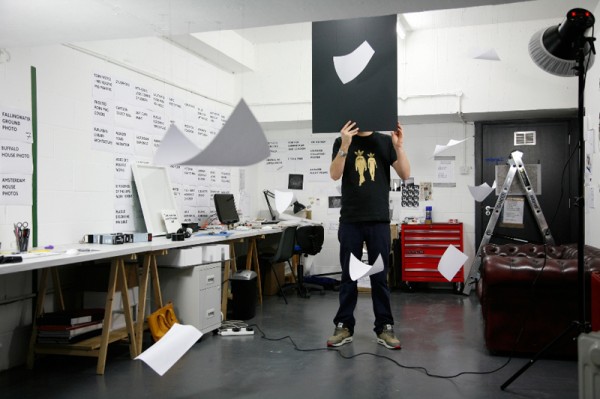
Ryan Gander Felix provides a stage #8-(Eleven sketches for 'A sheet of paper on which I was about to draw, as it slipped from my table and fell to the floor'), 2008

The Museum of Contemporary Art Chicago‘s current exhibition, Production Site: The Artist’s studio Inside-Out takes a look at the studio not only as a location for production but also as a place where experimentation, performance, failure, and meditation can occur. Organized by Domonic Molon, this exhibition is in connection with the yearlong city wide Studio Chicago project which brings forth the studio as a site and subject. The show consists of a diverse group of artists that work both locally and internationally including; Andrea Zittel, Amanda Ross-Ho, Bruce Nauman, Deb Sokolow, Justin Cooper, Kerry James Marshall, Peter Fischli and David Weiss, Nikhil Chopra, Rodney Graham, Ryan Gander, Tactia Dean and William Kentridge.

An overarching playfulness is found throughout many of the works in the gallery; most noticeably in the works of William Kentridge, Justin Cooper, and Amanda Ross-Ho. Kentridge’s video installation 7 Fragments for Georges Méliès (2003) shows the artist working in his studio in seven different projections. Referencing the French filmmaker Kentridge plays with early special effects and stop motion as he paints, destroys, and interacts with his own creations.

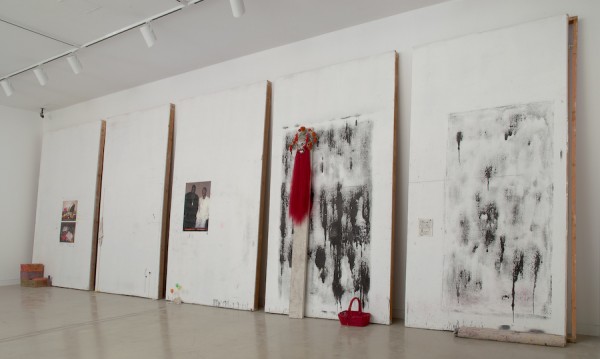
Amanda Ross-Ho, Frauds for an inside job, 2008

Amanda Ross-Ho’s installation, Frauds for an Inside Job (2008) is in fact her former studio. Cut apart and reassembled as leaning “paintings”, a presentation that she often uses, Ross-Ho presents the objects that are often found on her studio walls. A poster of Puff Daddy and Notorious B.I.G., paint splatters, buttons, a basket, and a Beijing Opera Mask are all disclosed as references and inspiration.

Justin Cooper’s Studio Visit (2007),shot while the artist was in residency at Skoheagen, is shown through the perspective of the artist in a state of frenzy. As Cooper attempts to create a still life and fails, miserably might I add, we are shown a vulnerable side of the artist as they create. The studio becomes a site of private failure.

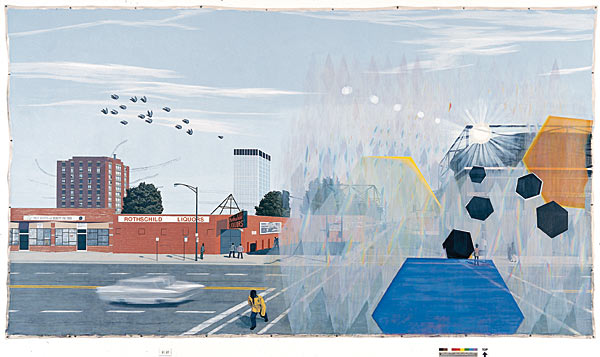
Kerry James Marshall, 7am Sunday Morning, 2003

Production Site: The Artist’s Studio Inside-Out will on view at the Museum of Contemporary Art
Chicago until May 30th.

Share

Tim Bavington: Decade

Long May You Run, 2010 synthetic polymer on canvas 64 x 64 inches

Mark Moore Gallery‘s current exhibition, Decade, signifies Tim Bavington‘s tenth year of representation by the gallery, as well as the fifth solo presentation of his work at the gallery.  Bavington synthesizes aural and visual stimuli, organizing chromatic variations of both worlds onto the picture plane.  The artist pays homage to his favorite musicians, often by selecting one of their songs to interpret. In the work, Long May You Run, two rows of vertical stripes represent separate elements of Neil Young’s musical composition. The lower half of the painting denotes the bass line while the upper portion shows the guitar solo.  Another way the artist references music is by choosing album covers and mirroring their compositions.  Paintings like Blue Monday and Give ‘Em Enough Rope are Bavington’s interpretations of New Order and Clash album covers, respectively.  In addition, Bavington includes art historical references by emulating Kenneth Noland and Mark Rothko, tying the concentric circles of Noland to the New Order cover and Rothko-like horizons to the Clash album.

Bold As Love, 2010 synthetic polymer on canvas 72 x 72 inches

When discussing his conceptual process, Bavington stated “I generally read sheet music and start with that as a sketch.  Then, I go from there.  The color palette is pretty subjective, it’s not scientific or mathematical. You can’t imagine what sounds will come out when you look at a score.  Basically I do the same thing as a musician (when reading music), except I interpret the score with color instead of sound.  I’m not trying to capture sound– the nature of sound waves and light waves are completely different.”

Installation View

Bavington received his M.F.A. from University of Nevada, Las Vegas, in 1999.  His work is represented in prominent collections such as the Museum of Modern Art, the Albright-Knox Art Gallery, and the Portland Art MuseumDecade will be on view through May 29th, 2010.

Share

Nairy Baghramian and Phyllida Barlow

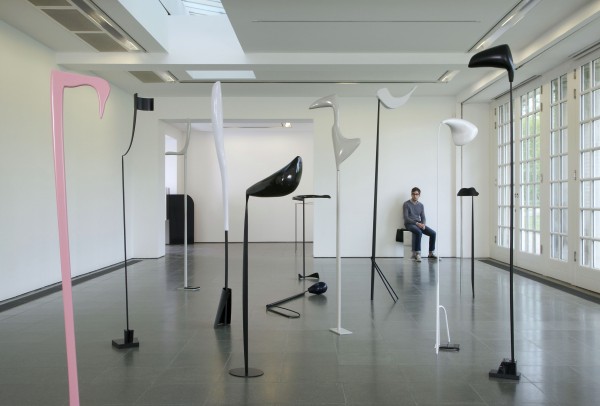
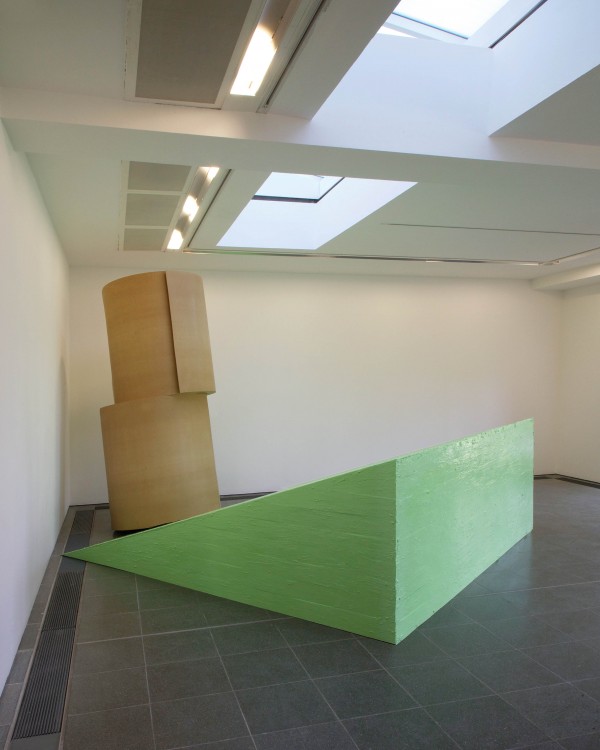
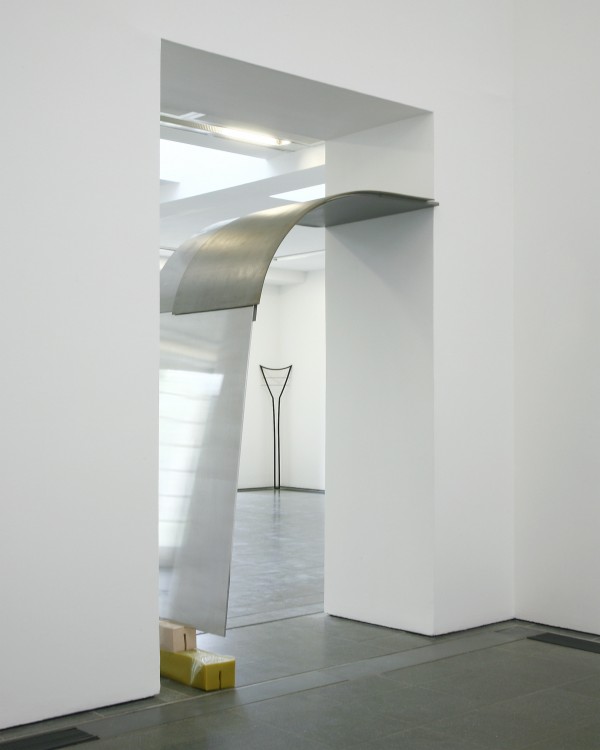
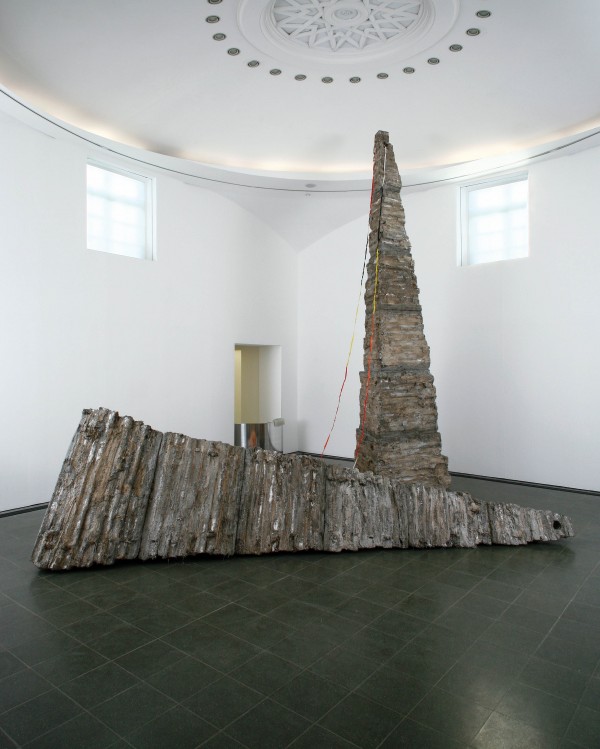
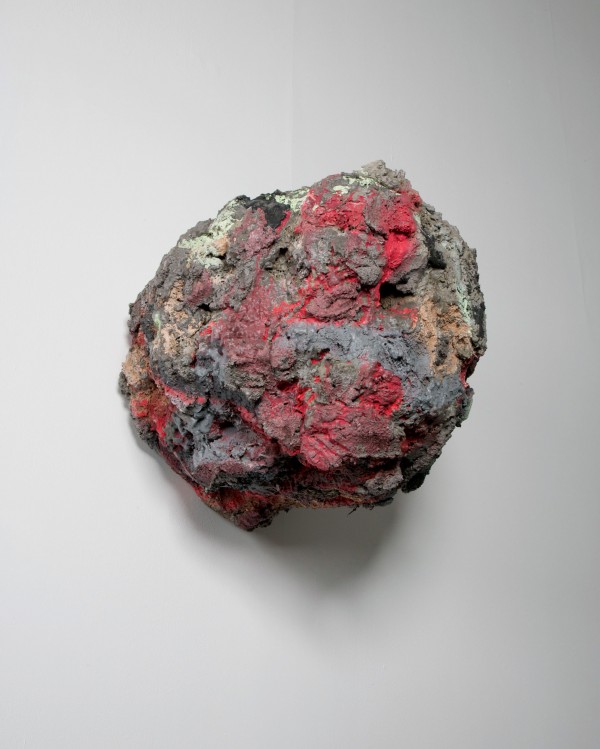
The Serpentine Gallery in London presents Nairy Bagrhamian and Phyllida Barlow.  The exhibition features new and recent work by two contemporary artists exhibited together for the first time.  The Serpentine Gallery suggests Baghramian and Barlow represent ‘two positions on sculpture in the 21st century’.  The pairing of the two artists offers new insight into their respective sculptural practices.

Baghramian and Barlow’s work is displayed separately, in solo rooms, and also in deliberate dialogue.  While offering different approaches, both artists are inspired by the gallery context and capitalize on characteristics of the space.  Their large-scale installations are often in arranged in tension and certainly inhabit the space of the gallery visitor.  For all of these characteristics, the installation demands a physical viewing experience.

Nairy Baghramian was born in Iran.  She now lives and works in Berlin and is represented by Galerie Daniel Buchholz.  She is known for photography in addition to her sculptural and installation work.  Baghramian is inspired by politics and literature as well as the legacies of minimalism, design and modern architecture.  She often engages with context, institutional framing and the production and reception of contemporary art.

Phyllida Barlow lives and works in London.  She graduated from the Slade School of Fine Art where she has served as professor for some time.  Barlow’s work utilizes mass produced materials that she typically combines on-site and later recycles.  Her sculptural work is often realized in the large-scale, installation environment.

Nairy Baghramian and Phyllida Barlow is on view at the Serpentine Gallery from 8 May through 13 June 2010.

Share

FX Harsono: Testimonies

Rantai yang Santai (The Relaxed Chain), 1975, Installation with cushions and chains, 67 x 97 x 56 cm, Artist collection

FX Harsono: Testimonies is on show at the Singapore Art Museum from March 4 to May 9, 2010. The exhibition is a survey of works by the Indonesian-Chinese artist FX Harsono, a key figure of the Gerakan Seni Rupa Baru or New Art Movement in the 1970s which questioned assumptions on art and the attempts to depoliticize art during the authoritarian regime of that era in Indonesia. Alongside contemporaries including sculptor and art critic Jim Supangkat, Harsono is known for his politically-charged works, employing strong performative and conceptual approaches which were a deviation from the conservative aesthetic existing then.

Rantai yang Santi (The Relaxed Chain) was one of his earliest works. Combining the comfort of a mattress and cushions with the grip of metal chains, it acted as a commentary on a society enjoying the outcomes of a strong centralized government which brought about industrialization and increased living standards, while imprisoned by this same comfort and the clampdown on freedom of expression and political participation. His experimentation from the 1970s led to bolder and politically strident works. Voice without Voice / Sign comprises a series of silkscreens, each with a hand gesture spelling out demokrasi, the Indonesian word for democracy, with the sense of futility and powerlessness of the people heightened by the depiction of a bound hand in the last panel.

Voice Without Voice / Sign, 1993 – 4, Silkscreen on canvas (9 panels), wooden stools and stamps, 143.5 x 95.5 cm each panel, Fukuoka Asian Art Museum collection

A turning point in Harsono’s art practice dates back to the late 1990s. The debilitating impact of the Asian Financial Crisis led to riots in Indonesia which reached its peak in 1998, with acts of violence against the ethnic Chinese community in Indonesia, particularly those owning businesses and properties. Prompted to question his place as an ethnic Chinese in Indonesia, Harsono shifted gradually away from works dealing with the concerns of broader Indonesian society. While still maintaining its strong political and social relevance, his works began to evoke a quality learning towards introspective anguish, with a surfacing of personal and collective memories and meanings of being Chinese in Indonesia, and its implications on life.

Preserving Life, Terminating Life #1, 2009, Diptych, acrylic and oil on canvas, thread, 200 x 350 cm, Artist collection

Preserving Life, Terminating Life #2, 2009, Diptych, acrylic and oil on canvas, thread, 200 x 350 cm, Artist collection

Preserving Life, Terminating Life #1 and Preserving Life, Terminating Life #2 draws on the unspoken history of the massacre of Chinese in his hometown of Blitar in East Java from 1946 to 1948 which was a result of a belief that the Chinese acted as spies for the Dutch during the period when Indonesia was fighting for its independence. Two photographs from Harsono’s family album which were taken by his photographer father, depict the effort of an expedition in 1951 to exhume 191 bodies from the secret graves.  Harsono conjoins paintings of these together with portraits from the same family album of a newly married couple and young family, speaking to the continuity from life to death and linkages within communities, reinforced by the red thread across each diptych, a color used in traditional Chinese festivities and funerals to ward off bad luck. While being a survey of the artist’s shifts and contribution to direction of artistic endeavors in Indonesia, the exhibition is a statement of truth to the political shifts and fragmentation within the country.

FX Harsono was born in 1948 and studied at the Indonesian Arts Academy in Yogyakarta, Indonesia and the Jakarta Art Institute. In addition to his art practice, he is also a lecturer at the Faculty of Art and Design at Pelita Harapan University, Tangerang (West Java).

Share

Parties and Pretenders

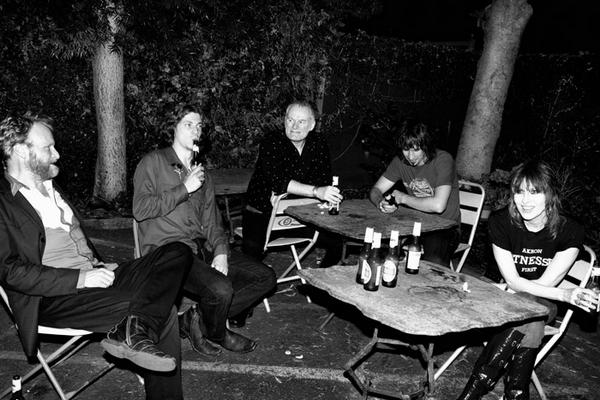
The Pretenders, 2008

The Pretenders, 2008

Chrissie Hynde met her soul mate at a party hosted by Damien Hirst’s wife. Hynde, not a party person, had gone with a girlfriend out of a sense of obligation. When she realized she’d dropped in on a Congolese Art themed festival, replete with a Congolese barbecue, she headed straight to the bar. “Anyone who knows me knows exactly what I would think about that,” Hynde said in a recent interview. She proceeded to get “wrecked” and while getting wrecked met JP Jones, a young Welsh musician who would become her band mate and muse. “It was some sort of wanky arty party,” Jones later said when asked where he first encountered Hynde.

While Hynde’s anti-diva diplomacy has always attracted me, I certainly don’t know her. Nor do I know much about The Pretenders—beyond the opening verses to Private Life and rumors of members’ drug induced downfalls. But I can imagine why someone like Hynde might resent a Congolese Art party, especially one hosted by a few wealthy Brits and frequented by a hand-picked assortment of artists and intellectuals.

Circle of Charles Marville (French, 1816-ca.1879), Women of Algiers, 1858, Salted-paper print, Ken and Jenny Jacobson orientalist photography collection, The Getty Research Institute

I spent yesterday, Thursday, May 6th, at The Getty Museum, attending a different sort of art party, one at which the option of getting wrecked did not present itself. But opportunities to over-indulge in freshly brewed coffee and gaze out at sunny green vistas more than sufficed. Called Zoom Out: The Making and Unmaking of the “Orient” Through Photography, this party had a guest list of people who read Edward Said and write papers with titles like The Prosthetic Eye: Photography as Cure and Poison. This sort of guest has symmetrically styled hair (even the man with Einstein-worthy, sandy-colored tufts made an effort to balance his mop), sports silk scarves and wears tastefully unobtrusive eyeglasses. As my companion, a hip, inquisitive specialist in Vietnam War era photography, assured me, art historians are the best looking academics around—far superior to, say, those working in Early Modern Studies.

“The sight of a Greek head depresses most people, strikes an un-liberated chord, reminds them of books in their grandmother’s parlor and of all they were supposed to learn and never did,” wrote Joan Didion in The White Album, published soon after The Getty opened to the public. “This note of ‘learning’ pervades the entire Getty collection.”  It pervaded yesterday’s panels and talks too. The talks, which continue today, focused on two photographic archives from The Getty Collection: The Ken and Jenny Jacobson Orientalist Photography Collection and the Pierre de Gigord Collection. But if the sight of sightly blurred, romantically composed photos from the 19th Century Middle East and North Africa depressed anyone there, they hid it well.

Pierre de Gigord Collection, The Getty Research Institute

What seems reprehensible about a Congolese Art party is that it uses limited knowledge of another culture as the premise for fun, possibly mindless fun. Academic conferences about how images taken in the Orient changed the course of photography’s history also take limited knowledge of another culture as the premise. But the overarching goal is not fun and what does take place is rarely mindless, even if you genuinely enjoy probing the politics of representation–and, of course, most art historians do.

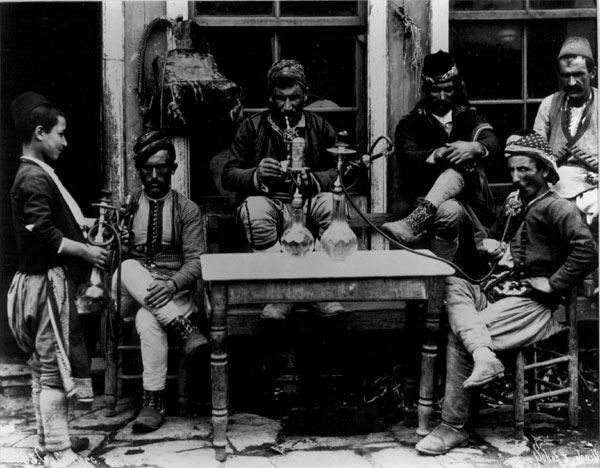
Nancy Micklewright, The Getty Foundation’s Senior Program Officer and yesterday’s closing speaker, showed a series of photographs from the Gigord Collection, probably taken by a box camera. A group of Turkish women and one man act out different stereotypes. In one image, they play Harem; in another, they play aristocratic family; in yet another, they play tea party. In all, they’ve donned genre-specific costumes and masked the identity of their surroundings, though a painting above the fire place gives them away.  They’re having their own art party, maybe even their own mindless fun, while half-knowingly, half-unknowingly probing the strange ways in which the photograph has turned their culture into myth.

Share

We have as much time as it takes: Interview with Red76

Opening Thursday, May 6th, We have as much time as it takes is the final thesis exhibition of the Curatorial Practice program at California College of the Arts in San Francisco. The following interview was conducted for the exhibition catalog between curators Nicole Cromartie and Courtney Dailey and two members of Red76. It is the first in a series of interviews to be published at Daily Serving with artists from the exhibition. The catalog is available as a free downloadable pdf at www.wattis.org/whamtait.

Red76 is a multi-artist collective founded in Portland, Oregon, in 2000. The project they conceived for We have as much time as it takes was executed mainly by two of its members, Sam Gould and Gabriel Saloman. Counter-Culture as Pedagogy: Pop-Up Book Academy is a yearlong series of events that take place in a variety of venues. The latest edition of The Journal of Radical Shimming, available for free in the gallery, includes interviews and a counterculture index created for this exhibition. It will accompany the project’s next iteration at the Walker Art Center this summer. Learn more at www.red76.com.

Read More »

Share