







Los Angeles
Kota Ezawa: Gardner Museum Revisited at Christopher Grimes Gallery
In 2013, Kota Ezawa once gave a presentation at the California College of the Arts about a man in Japan. As he explained it, Ezawa saw a man talking on CNN, with the name of “Kota Ezawa” printed in the bumper graphic at the bottom of the screen. This onscreen Ezawa was a scientist, and as Ezawa watched the interview, he became intrigued. The name Kota Ezawa is so uncommon that after the interview, the artist decided to travel halfway across the world to meet this other Ezawa, living somewhere in Japan, to investigate their intriguingly dissimilar paths of life. Ezawa’s investigation of his namesake mirrors his artistic process: He isolates and studies discreet visual units—in this case, his name—so that the larger significance of each individual element can emerge.
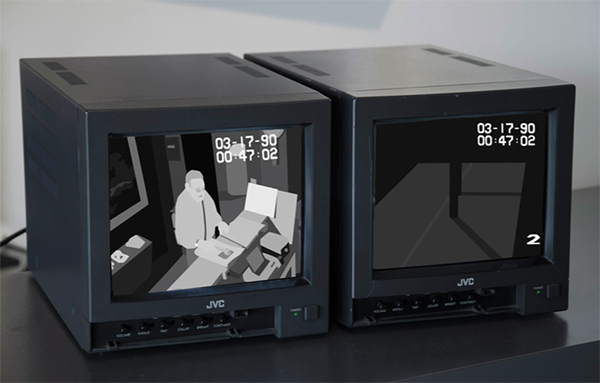
Kota Ezawa. Double Tape, 2015; two-channel black-and-white video, silent; 05:41. Courtesy of the Artist and Christopher Grimes Gallery.
In his new body of work, Gardner Museum Revisited, now on display at Christopher Grimes Gallery, Ezawa focuses on the largest property crime in U.S. history: the theft of thirteen works of art from the Isabella Stewart Gardner Museum in Boston. On March 18, 1990, two men dressed as police officers entered the Gardner Museum. They gagged and tied up the security guards on duty, and stole sculptures, sketches, and paintings by Rembrandt and Degas among others, taking with them one of the only thirty-six Vermeer paintings in existence. The robbers and their half-billion dollars’ worth of loot were never found.
Ezawa uses his characteristic style—digital animation and illustration—in his presentation of the theft. Upon entering the exhibition, two small TV monitors show a digitally animated version of the Gardner Museum’s closed-circuit video on loop. In the piece, titled Double Tape (2015), one animation shows a museum guard peacefully meandering around his desk, thumbing through a newspaper, while the other shows a car pulling up into a dark alleyway.

Kota Ezawa. Gardner Museum Revisited; installation view, 2016. Courtesy of the Artist and Christopher Grimes Gallery.
In the main gallery, thirteen lightboxes hold an illustrated image of each of the thirteen stolen works in their original sizes. Ezawa’s animations and illustrations consist exclusively of a handful of solid, flat colors without contour lines or gradation, as if he were painting by numbers but could only count to ten. The thirteen works are hung salon-style on one wall. A single lightbox, Empty Frame (2015), hangs on the opposite wall, holding a reproduction of a photograph depicting the empty frame from which the Vermeer was taken.
Ezawa veers from the Gardner Museum theft with another digitally animated video, Space Jam (Abramovic and Ulay) (2015), a reproduction of Ulay and Marina Abramovic’s performance in which the two performers repeatedly slap each other’s left cheek. A metronomic tick from the piece fills the galley with nervous energy, as if a clock were counting down the minutes until the pieces would be stolen. But the slapstick content of Space Jam adds an incongruous levity to the ominousness within the rest of the show.

Kota Ezawa. Space Jam (Abramovic and Ulay), 2015 (film stills); single-channel black-and-white video, sound; 00:03 (looped). Courtesy of the Artist and Christopher Grimes Gallery.
The animated videos look as if paper cutouts were expanding and contracting, and yet the detail in the figures’ movements is endearing. In Space Jam, Ulay squints his little animated eye every time Abramovic slaps him. In Double Tape the security guard hunches over and shuffles around the office. It’s remarkable how strong a feeling of empathy arrives out of a few color swaths.
Ezawa’s investigations of dissimilitude align with what Roland Barthes called the “structuralist activity,” distinguishing discreet units so that their interrelationship and significance can be understood. Like the Russian Formalists, Ezawa limits the number of pictorial elements in his visual system, but this limitation immensely accrues their value. His illustrated reproductions follow a rule-based system that abstracts most of the visual elements in the original image. These are the basic conventions of a signifying system, or a language. Like Bernd and Hilla Becher’s study of German industrial architecture, Ezawa’s structuralist activity begins to feel like a methodological study into specific elements of each image strategically isolated from a larger, complicated environment.

Kota Ezawa. Empty Frame, 2015; duratrans transparency and LED light box; 24.5 x 33.5 x 2.75 in. Courtesy of the Artist and Christopher Grimes Gallery.
Ezawa’s approach is not so much an essentialism of these images through color as it is a process of evidentiary discovery. His choice in imagery is dry and focused. For example, he chose an image of the empty frame in the crime scene, rather than an image of a security guard bound and gagged in the basement with duct tape around his head. Ezawa translates his imagery into animation, a form normally associated with fantasy, culling the observable material until the viewer has a baseline of visual facts.
And yet, through this process of isolation, an entire world is conjured. Ezawa’s process feels like a powerful investigative tool rather than a method for filtering or masking. Ezawa checks how our perception of a central figure changes according to the modifications of its surroundings, just as a scientist would do, perhaps similarly to the other Ezawa’s scientific investigations in Japan.
Kota Ezawa: Gardner Museum Revisited is on view at Christopher Grimes Gallery in Los Angeles through March 12, 2016.





