Summer Session

Summer Session – Prescription for a Healthy Art Scene

For this month’s Summer Session were thinking about going Back to School, and whether that means formal training, self-directed learning, or something in between, author and curator Renny Pritikins “Prescription for a Healthy Art Scene” asserts that various kinds of education are necessary for a robust and thriving arts community. His list reminds us that teaching and learning are types of engagement that, rather than codifying knowledge, encourage active participation and the circulation of ideas, and that all forms of education play a role in generating discourse.  

Prescription for a Healthy Art Scene by Renny Pritkin.

Prescription for a Healthy Art Scene by Renny Pritikin, 2009.

Share

Summer Session

Summer Session – Interview with David Levi Strauss

This Summer Session we’re going Back to School, and today we bring you an interview with David Levi Strauss by Amelia Rina. Rina had first been interviewed by Strauss in 2013 for admission to the School of Visual Arts MFA Art Writing and Criticism program, and here returns to speak with Strauss about his perspectives on writing, academia, and his role as an educator. Throughout the conversation, Strauss emphasizes the dynamism of discourse and arts need for something outside of itself. This interview was originally published on September 10, 2015. 

John Berger and David Levi Strauss, 2009. Photo: Yves Berger.

John Berger and David Levi Strauss, 2009. Photo: Yves Berger.

Amelia Rina: Can you talk about your relationship with teaching writing and your own education as a writer?

David Levi Strauss: The Art Writing program at the School of Visual Arts (SVA) in New York is really modeled after the Poetics program at the New College of California, San Francisco, in the 1980s. It was built around the teachings of the poet Robert Duncan and the other poets that gathered around him, including Diane di Prima, David Meltzer, Michael Palmer, and Duncan McNaughton. It was pointedly not a creative-writing program, but a program in poetics, the study of how things are made. The poets who taught there intended to give us an intellectual base that we could build on for the rest of our lives and to give us sources we could continue to draw on as we built our own network of sources. I think that’s probably even more important today. We now live in the Golden Age of Search, where a vast amount of material is accessible, so the need to develop ways to make distinctions among these disparate sources is crucial.

AR: Something that seems integral to the SVA department’s mission is that it isn’t in the business of “discourse production.” Can you elaborate on what you mean by that? And if it’s not in the business of discourse production, what is it in the business of?

DLS: I don’t know when the term discourse production was first used, but I think it was imported from cognitive neuroscience. To me, it always sounded like a needless bureaucratization of writing and thinking. Our approach is very different from this. We look at writing as a way of thinking—and a way to live, actually—and, at the same time, as a craft.

Read the full interview here.

Share

Summer Session

Summer Session – Teach 4 Amerika

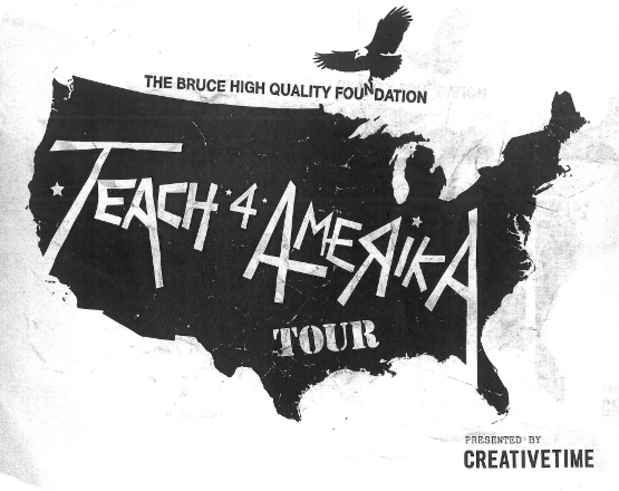
Our new Summer Session topic is Back to School, and today we bring you an article from our sister publication Art Practical. Here, Patricia Maloney reviews the Bruce High Quality Foundation’s tour Teach 4 Amerika, the collaboratives 2011 performative critique of the art academy. Though BHQF foregrounds its significant arguments against the economic art-school model with a healthy dose of irony, Maloney finds that the most ironic aspect of the tour is its dependency on the very academic structures it critiques. This article was originally published on May 4, 2011.

Teach 4 Amerika, 2011; poster. Courtesy of the Bruce High Quality Foundation and Creative Time, New York.

Teach 4 Amerika, 2011; poster. Courtesy of the Bruce High Quality Foundation and Creative Time, New York.

On April 27, the pranksterish collaborative the Bruce High Quality Foundation (BHQF) arrived at my alma mater, the San Francisco Art Institute (SFAI), in a limousine painted to resemble a yellow school bus for their tenth stop on a five-week, eleven-city tour across the United States. At each destination of Teach 4 Amerika, which is sponsored by the New York–based nonprofit public-art program Creative Time, BHQF has challenged art students to reconsider the terms, methods, and purpose of their educations. They posit that the proliferation of BFA and MFA degree programs in this country—over 900 at last count—has led neither to a corresponding increase in contemporary art’s reception in the broader culture nor to an expanded market in which more artists can sustain themselves by sales of their work. Instead, according to BHQF, it supports a self-perpetuating, peripheral industry around art and contributes to the increasing professionalization of the contemporary art world.

All these conditions—the glut of academic programs, artists’ narrowing access to the art market as their numbers rapidly increase, the progressive isolation of contemporary art within a sphere of similarly educated participants—have been pressing topics of conversation for several years and urgent ones since the 2008 economic collapse. They’ve also been the impetus for the rise of alternative pedagogical models by which artists self-direct their research and curricula. So the precept behind Teach 4 Amerika—that aspiring artists should eschew formalized art education in favor of such alternative models in order to reclaim their artistic agency—has much traction and would have resonated more strongly in the rally if it hadn’t been grounded in the outmoded premise of the artist as an autodidactic bohemian.

Read the full article here.

Share

Summer Session

Summer Session – “Little Chance to Advance”: Why Women Artists in Academia Are Left Behind

Welcome to the first installment of our Summer Session topic “Back to School.” For this session we will be talking about art and the academy, exploring the unique opportunities, challenges, and problematics specific to academia. Today we bring you an article by Bean Gilsdorf reporting on the Katarzyna Kozyra Foundation’s study on the lack of women in positions of power within the Polish art academy. The foundation finds that the significant schism between the female-dominated student population and the male-dominated teaching population is, perhaps unsurprisingly, the result of both systemic and individual cultural gender bias. This article was originally published on April 7, 2016.

Karolina Melnica. Celujacy (Excellent), n.d.; performance documentation.

Karolina Melnica. Celujacy (Excellent), n.d.; performance documentation.

If you are currently attending or working in an academic arts institution, look around. What is the ratio of women to men in the student body? What proportion of the faculty is female? How many female faculty members are tenured? How many department chairs or deans are women? At many institutions, there is a visible disproportion between the number of women who are students versus the number who make it to ranked, tenured faculty or senior administration. This conspicuous lack of women in positions of power is the impetus for the groundbreaking 2015 study “Little Chance to Advance? An Inquiry into the Presence of Women at Art Academies in Poland,” published by the Katarzyna Kozyra Foundation.

Though the data portion of the study concentrates on Poland, it would be easy to extrapolate the majority of the philosophical findings to art departments, colleges, and universities around the world. “Little Chance to Advance” illustrates the cultural, psychological, and environmental factors that operate on individual and systemic levels to disenfranchise women, both within and beyond the academy. Currently, across the nine Polish visual art academies, women constitute 77 percent of the student body, but only 34 percent of assistant professors, 25 percent of associate professors, and 17 percent of full professors. In essence, the higher the level in the visual arts academy, the more women disappear. Are they opting out? If not, at which points in their trajectory are they being pushed out of the system?

Read the full article here.

Share

Summer Session

Summer Session – Clint Mario and ME, @me_newyork

It’s the last day of July—and with it, our final look at the theme of celebrity! We examined the complex intersections of fame, money, desire, and artistic practice this past month, and for our final installment we bring you an ongoing project in New York City by pseudonymic street artists Clint Mario and ME, whose self-reflexive ad takeovers speak to the inherent absurdity of celebrity’s constant jockeying for cultural ubiquity. Tomorrow our Summer Session continues with Back to School.

Share

Summer Session

Summer Session – The Artist Who Inspired Kanye West’s “Famous” Visuals Responds to the Video

This Summer Session we’re thinking about celebrity, and today we bring you an excerpt from an article by Erica Gonzales about Kanye Wests re-creation of artist Vincent Desiderios work for his music video “Famous.” Desiderio was neither consulted nor compensated before West made the video, yet he asserts that he was honored by West, exemplifying the social, economic, and artistic realities of what it means to have “star power.” This article was originally posted by Elle Magazine on July 3, 2016. 


When Kanye West’s “Famous” video released last weekend, many pointed out its likeness to Vincent Desiderio’s “Sleep,” which similarly shows naked figures slumbering side by side.

Soon after the premiere, it was revealed that West not only aimed to re-create Desiderio’s famed piece, he personally collaborated with the artist too. Since the weekend, Desiderio has spoken out about getting discovered by Kanye and helping to create “Famous.”

The artist apparently didn’t know the rapper was re-creating his work until the morning of the video’s premiere at the Forum last week, according to the New York Times. He only found out West wanted to meet him the night before, when he received an urgent call at his studio. He was then flown out by the rapper’s team to meet with West in Los Angeles for a confidential project. When West finally showed him the piece he was working on, Desiderio nearly broke down.

“I was almost in tears,” he told NYT. “We just hugged each other.”

Read the full article here.

Share

Summer Session

Summer Session – The Mohn Games

For this Summer Session we’re thinking about celebrity, and one of the key ways in which celebrity status is produced in the art world is through the winning of prestigious awards. While these awards spotlight contemporary art, they often come at the cost of reducing the conversation around works to their marketability, and introduce the artists themselves to a number of ceaseless public media inquiries. Today we bring an excerpt from East of Borneo, in which author Carol Cheh examines the creation and reception of the Mohn Award. This article was originally published on August 9, 2012.

Meg Cranston, Made in L.A. 2012 installation view at the Hammer Museum, Los Angeles. Photo by Brian Forrest.

Meg Cranston, Made in L.A., 2012; installation view at the Hammer Museum, Los Angeles. Photo: Brian Forrest.

In March of this year, the Hammer Museum introduced the Mohn Award—a $100,000 art prize offered in conjunction with their new “Made in LA” biennial—to some fanfare. Blending elements of the Whitney Biennial’s Bucksbaum Award and Britain’s controversial Turner Prize, the Mohn Award will recognize a single biennial artist, selected from among sixty participants, with a hefty cash sum and the publication of a monographic book on the artist’s work. A jury of four professional curators chose five finalists shortly after the exhibition opened on June 2 and now, in a unique and attention-grabbing twist on the classic art prize format, the winner will be selected by public vote.

The Mohn Award is the latest in a series of flag-planting, publicity-generating spectacles that have altered the fabric of LA’s art landscape. If the Getty’s “Pacific Standard Time” initiative offered corrective histories, and Michael Govan’s upgrading of the LACMA campus with monumental, crowd-pleasing installations by Chris Burden and Michael Heizer provided iconic visual references, the Mohn Award could be said to add some serious bling to the mix. Money talks and, as many have noted, this award puts Los Angeles and the Hammer Museum on par with the biggest global players in the art prize market.

Read the full article here.

Share