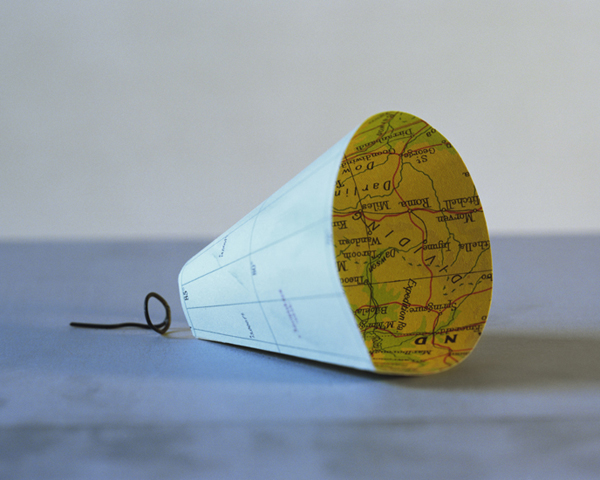
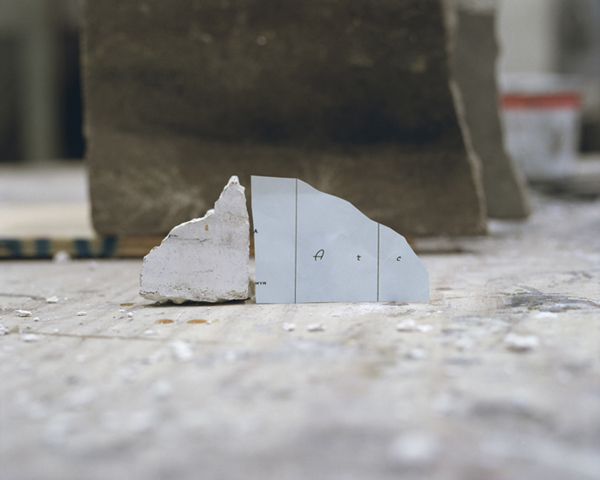
Currently on view at PDX Contemporary Art in Portland, OR is a solo presentation of new work by John Mann. The exhibition, entitled Folded in Place, represents Mann’s recent eponymous series of photographs. The shallow depth of field images present curious constructions of maps made by the artist—maps which now take on different roles than those once dictated by their previous lives as simple geographical guides. These new constructions seem to trade function for form as they morph into miniature architectures. Mann’s work is also currently in the group show Geography at Rayko Gallery in San Francisco.
John Mann lives and works in Tallahassee, FL, where he teaches at Florida State University. He received his MFA in Photography from University of New Mexico. His work has recently been exhibited in Crossroads at Museum of Contemporary Art, Atlanta, GA; Group Photography Exhibit at JK Gallery, Los Angeles, CA; NOW: Art of the 21st Century at Phillips de Pury, London, UK; Haunts at Privateer Gallery, Brooklyn, NY; and Hey Hot Shot at Jen Bekman Gallery, New York, NY.
San Francisco-based artist and curator Brion Nuda Rosch creates subtle, yet powerful collages, paintings, sculptures and conceptual projects, which often pair disparate but poetic associations. This ability to provide insightful connections shines through Rosch’s playful but pensive collaborative and curatorial projects as well. Rosch often partners with other artists on creative exchanges through a one-day residency program in his own home called Hallway Projects, while curating more extensive exhibitions in other venues. Earlier this month, Rosch closed a solo show at Baer Ridgway Exhibitions, simply titled New Work by Brion Nuda Rosch, featuring work which investigates the value of materials and the idea of the non-monumental. The artist recently sat down with DailyServing.com founder Seth Curcio to discuss his recent Artadia Award, the next installment of his curated exhibition series, Paper! Awesome!, and his recent solo exhibition in San Francisco.
Seth Curcio: So Brion, you were notified a few weeks ago that you are one of the recipients of the Artadia award for San Francisco this year. Congratulations on your award. Tell me a little about the works that were included in your application and about the process that led to the selection.
Brion Nuda Rosch: I included a selection of collages and documentation of several assemblages. At the time I was also in the process of selecting work for my first solo exhibition and for an upcoming book project. Ultimately, the works included in my application were the starting points for the work shown at Baer Ridgway Exhibitions in San Francisco, CA from November 18 – January 2, 2010. I was short-listed as a finalist while preparing for this exhibition. The process was rather swift. First, a social with the jurors and other finalists, then a studio visit, then an announcement.
SC: Your creative practice is very diverse and includes curatorial projects as well as impromptu galleries and online projects, such as your blog Something home Something. Do you feel that your decentralized practice made your work more attractive to the panel at Artadia as they reviewed hundreds of artist applications? How do you feel that each of these different modes of working help to inform your greater practice?
BNR: The focus for my application was primarily centered on my art making. My curatorial efforts were only represented in my Curriculum Vitae and were discussed only briefly during my studio visit. In any discussion about my work, conversation will not remain on one topic, such as painting, or collage. I feel I could easily assert different categories for various works, however doing so would prove to be a shortcoming. I balance the roles of both art making and curating — both practices relate to one another, each sharing similar starting points. Somewhere the boundaries fade and a project initiated from a curatorial standpoint becomes a work of art, and vice versa. It is not a priority to identify each action with defined labels. Most of my work simply involves a selection of material and then a relationship to that material within a new situation.
SC: Thinking about your recent show with Baer Ridgway Exhibitions and the statement that ‘most of your work simply involves a selection of material and then a relationship to that material’, I am curious about both your humbly-constructed images and sculptures. Talk a little about the concepts that play out in that exhibition, both through your image and object construction.
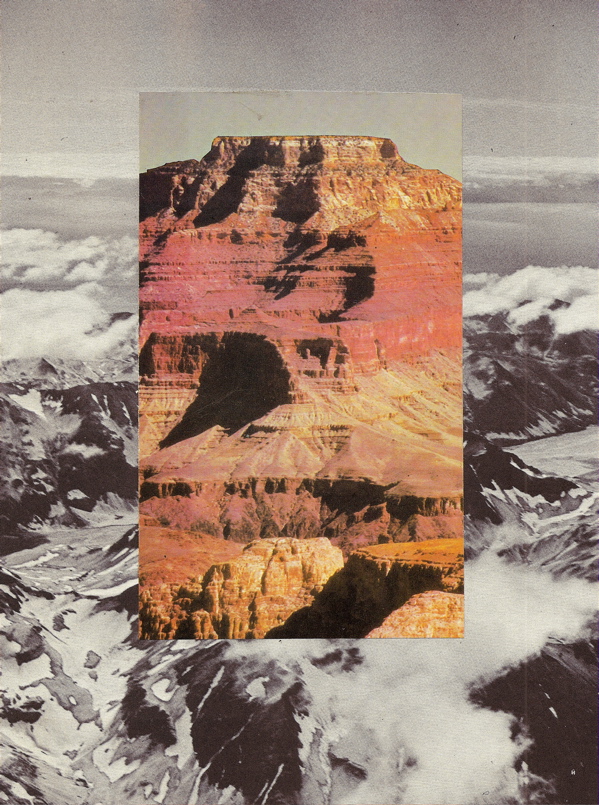
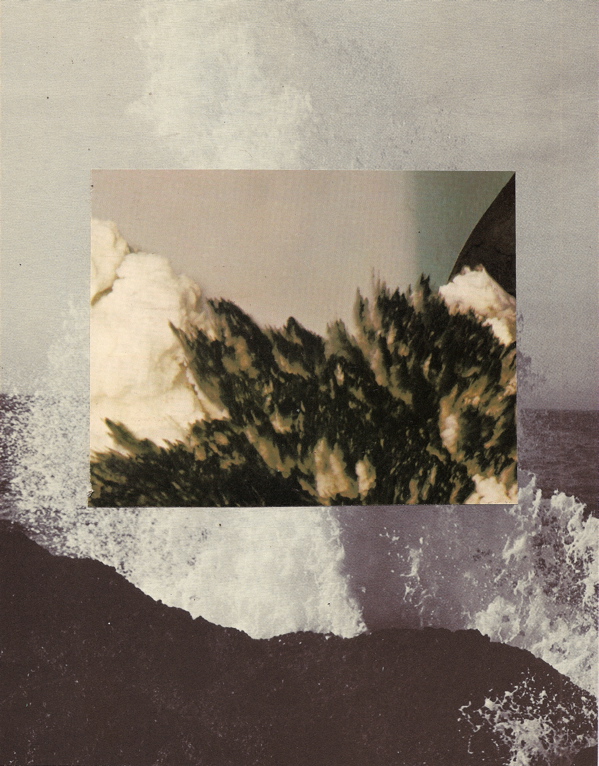
BNR: The images and the collages are both humble and monumental. Minimal adjustments have been made, a waterfall placed over a waterfall, a new ridge placed over a mountain range, a vague monument placed over a field. These ideas are monumental in scale, almost impossible, while also positioning room for our own reflection into the world around us. The monuments I create are non-monuments; they lack distinct meaning. The materials lack value, found book pages, recycled dump stock paint, wood and drywall. The assemblage works are a direct reaction to accumulated materials within my studio. The assemblage titled, Contents of Studio, Gathered, Painted Brown is just that, the contents of my studio gathered, painted brown and placed in a pile. I accumulated a collection of unsuccessful and unfinished works, and painting them all the same neutral color resolved the conflict I was having with them, placing them in a pile offered a solution for their arrangement and physicality.
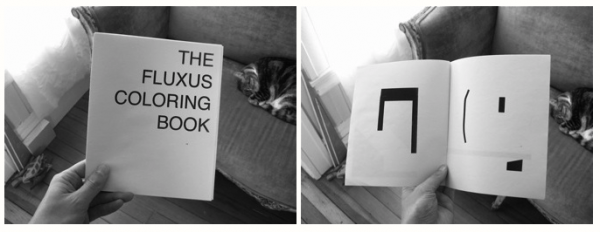
SC: In addition to your studio practice, I am also interested in your other more social and collaborative projects. I know that you have produced the ‘Fluxus Coloring Book’, you are now conducting day-long artist residencies out of your home, and you are in the process of curating the third installment of Paper! Awesome!, a show that features an impressive line-up of artists that work with or on paper.
BNR: The Fluxus Coloring Book was produced while in residence at Southern Exposure. During my residency, I worked with a group of artists to build The Portable Ice Cream Stand, part art object, part functioning ice cream stand, part social happening. Visiting artists and guests initiated the direction of the project. A worktable was built to make handmade fliers, later the table functioned as a place for conversation and art making. A few artists made coloring book pages, and guests colored in them. All of the work created at the table was left behind. As a reaction I wanted to develop something that could be taken away from the project. I have an interest in Fluxus art, and felt there was a relationship between the childlike tendencies of a coloring book and the humor of Fluxus art. The coloring book consisted of blank pages and non-representation lines. There was nothing to color in or around; the coloring book was failure, a document for it’s own joke.
One-Day Artist Residencies will take place within the context of Hallway Projects, which exists in my home. During these residencies, an interaction will take place in private, and then later be shared with the public via on-line documentation and distribution of printed materials. During each residency the contributor is offered both a physical venue and a reasonable timeline to execute direct actions in art making. Within the modest time frame and hospitable environment, I hope to interview each contributor and produce either collaborative works or investigate shared sensibilities in our interests as makers. For example, in a conversation many years ago, Amy Rathbone and I discovered we both dislike the colors yellow and blue. For her residency, we plan to explore the colors, and our reaction to them now. We plan to evaluate various tones of each color and rank our tolerance. In addition, we plan to directly tackle our fears by submersing ourselves in the colors and sharing our experience with the public in efforts to gain a better understanding of why we dislike the color yellow and the color blue.
And, Paper! Awesome! was first produced out of necessity for an exhibit within a short timeline. It took place at the now closed Mimi Barr Gallery in 2003. I put out a call to artists to submit work on a letter size piece of paper. I figured with the upcoming deadline, a letter size piece of paper was the most approachable form for both the artists, and my vision for installing the work in a cohesive manner. The works were hung on two walls in a quilt-like fashion. The second installment took place two years later, and involved an open call and a jury process. The range of artists selected added an important element to the exhibit. Artist who were established within the art world and artists who have not shown their work before were hung alongside one another and the proximity of the works offered a slightly anonymous experience for the viewer. For the third installment at Baer Ridgway this spring, I have invited an interesting range of artists who have shown extensively in the international art world, and I am in the process of working with members of other organizations to provide another element to the exhibit. Again, the timeline here is important, I invited the artists to participate nearly six weeks prior to the deadline of submissions. Like the One-Day Artist Residencies, I am interested in what can be produced within a limited time frame and limited space.
SC: So what can we look forward to from you in 2010? Do you have any exciting new projects that you have been wanting to tackle?
BNR: 2010 is shaping up to be very productive. I will be a curator in residence for a short period of time with Baer Ridgway Exhibitions. Little Paper Planes is publishing a book of my collages and assemblages. The book will be released in February. The Andy Warhol Foundation has funded the catalog for Artadia Awardees. I’m looking forward to returning to the studio, and having a lot of conversations about the potential to do larger projects. A very ambitious year to come!
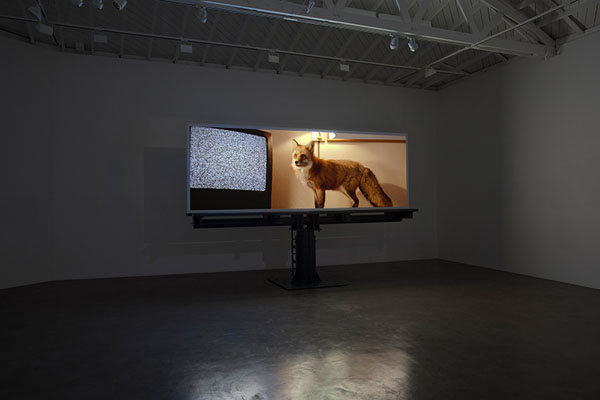
Installation view: Regen Projects, Los Angeles 2009 Photography by Brian Forrest
Sometimes simplicity can be stunningly difficult. Doug Aitken‘s film Migration has an apparent enough premise: migrating animals occupy hotel rooms, bringing together the instinctive and unfamiliar aspects of travel. And Aitken uses pristine, focused images to realize this premise. Yet the effect is something more nuanced and confusing: migration becomes precariously noble, the virtual and the actual slip in and out of each other, and bittersweet anticipation pervades each scene.
Aitken, the SoCal native who is now as much an East Coast as West Coast artist, long ago dismissed the fugitive, homegrown approach of many video artists. He’s an expert audio-visual craftsman. His work reminds me of those feature filmmakers, Jane Campion or Ang Lee for instance, who gravitate toward provocative subject matter yet also toward sublime cinematography, dragging their viewers into a weird, subconscious battle between the need to understand and the desire to bask in beauty.
Aitken filmed Migration on location, in motels across the country. The film made its New York debut a year ago exactly, appearing on three industrial-sized screens at 303 Gallery, and then on the face of a building at the 55th Carnegie International. It took a year to travel – migrate – to Los Angeles. Now it’s projected in two places: on a screen inside Regen Projects‘ Almont Street gallery and, when the sun sets, as a two channel installation on two exterior walls of Regen’s Santa Monica Blvd building.
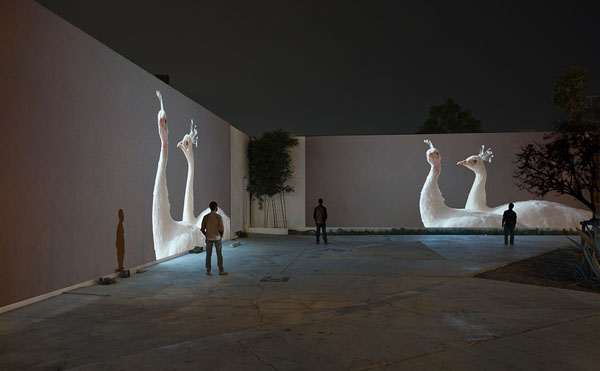
Installation view: Regen Projects II, Los Angeles Photography by Brian Forrest
I watched Migration inside first. Alone in the space, I felt like a solitary witness to everything on screen. When I first walked in, the camera was lingering on a motel bed with a pink spread and an aura of oldness – this motel probably didn’t belong to a national chain. The first creature on screen, a horse, couldn’t be recognized at first because rays of sunlight turned its profile into a shadowy structure. Then, once the shadow turns into a body, the film really began: animals waiting in empty, clean, but rudimentary rooms, sometimes watching themselves on television – a meta-narrative that, given the context, seems more factual than profound (watching one’s own species on TV is intricate to the traveling ritual). Every movement that happens in these rooms is restrained, like the horse hoof that beats against the carpet, or the mountain lion that wrestling a pillow but never puncturing its cotton skin. Running water, a motif in journey narratives, enters Aitken’s film only in spirit. The faucet filling bath, coffee dripping into pots, pool surfaces vacillates slightly – no rushing rivers puncture the stillness.
The creatures in Migration are going somewhere, there’s no doubt, but their destination must be unknown or foreboding because the hotel rooms they occupy seem more like psychological respites than physical resting points.
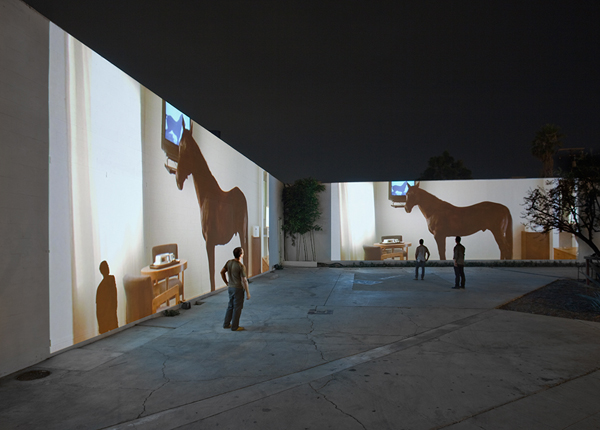
When I came back at night to view the outdoor incarnation of Migration, I was alone again. A steady stream of cars drove by, but only about six people walked in front of the gallery and fewer really looked at the dual projections playing on Regen’s walls. This inattentiveness surprised me at first, but, actually, outside, that line between provocation and beauty that Aitken straddles so nicely, fuzzed in favor of beauty. And pretty things on walls are second nature to the West Hollywood-Beverly Hills neighborhood Regen occupies.
Installation view: Regen Projects, Los Angeles 2009 Photography by Brian Forrest
Seen inside the gallery, the best moments of Migration had to do with the strangeness of being alone, and watching creatures, also alone, use man-made conventions of comfort to satiate some some mysterious anxiety. Outside, the best moments had to do with distortion – like when a close-up of a door latch took over, when striped carpet looked like a candy-colored corn-field, or when a buffalo’s eye filled the walls so abstractly that it wasn’t clear what it was. These moments, I hoped, could interrupt passers-by, showing them that they didn’t intuitively understand what they saw.
Migration focuses on something that is intuitive, but isn’t understood, and that’s what makes it difficult. The urge to journey certainly may be familiar – most of us, if we haven’t felt it, know it exists – and yet, the tendency to view everything through a familiar lens is even stronger than the tendency to venture out. The animals in Aitken’s hotel rooms seem to willingly, maybe even sacrificially, accept a lifestyle that doesn’t belong to them, and the unfamiliar consequences of this makes Migration unsettling but also hopeful.
Weatherbee’s Revenge is the title of a new exhibition featuring works by Mark Mulroney, which opened last night at Chicago’s Ebersmoore Gallery. When the artist was a child, his mother gave him a book titled “What’s Happening To Me?” in hopes of answering all of his questions concerning puberty and sex. For the show, Mulroney continues his irreverent imagery through a new series of works on paper which explore his youthful and naive understanding of sex as an adolescent. The book’s illustrations and texts proved to be completely misleading and altered the artist’s understanding of sex. As a response to the comedy and horror that ensued, the artist has created the work in Weatherbee’s Revenge.
Opening tonight in San Francisco is an exhibition of new works by artist Adam Friedman entitled With a Generous Allowance of Time. The exhibition, which is on view at Eleanor Hardwood Gallery, features several collage works on panel that explore both time and the geological physicality of the world around us. The artist quoted John McPhee from his 1981 book Basin and Range to state “If you free yourself from the conventional reaction to a quantity like a million years, you free yourself a bit from the boundaries of human time.” By understanding the world around us as an epic and ongoing force for which we have the opportunity to experience for a limited time, vain concepts such as our ability to destroy the planet through an apocalypse or doomsday fades, and our understanding of the world broadens. Friedman’s landscapes depict a planet where the environmental damage that humans have caused over the past few millennia has long been healed simply through, as the title suggests, a generous allowance of time.
Friedman is a recent MFA graduate of the San Francisco Art Institute. He is currently a resident artist in the studio program at Root Division in San Francisco, where we will also have work in a group show titled Compelled which opens tomorrow evening.
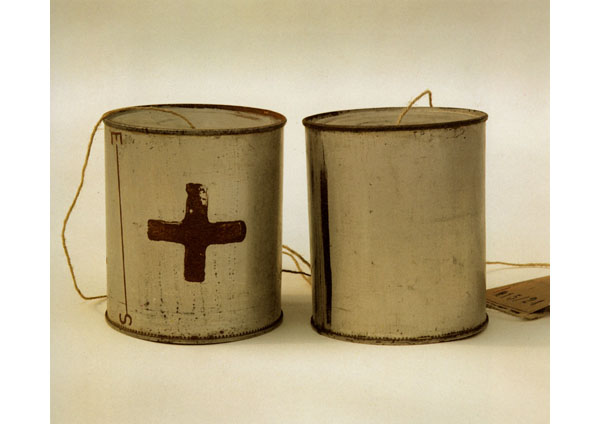
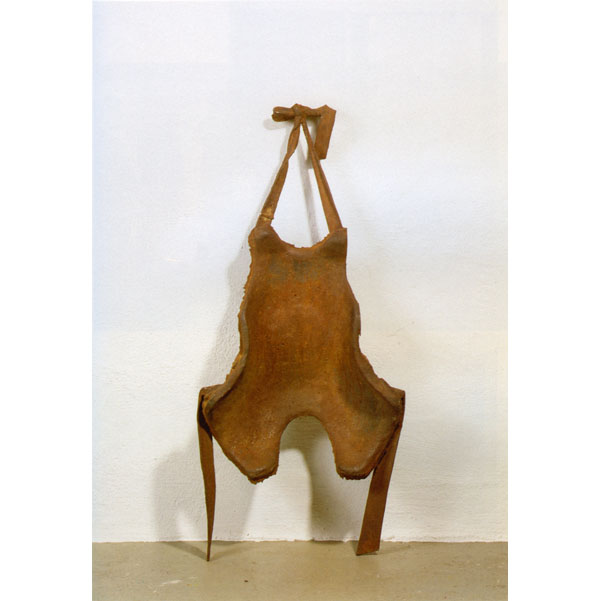
Over one hundred and seventy-five works by the massively influential 20th century German artist Joseph Beuys are currently on display at Mary Boone Gallery in New York City. The exhibition, titled WE ARE THE REVOLUTION, features a comprehensive selection of the artist’s work including early drawings, plastic sculptures of the 1960s, blackboard drawings, and countless multiples. The exhibition, which includes such notable works as Beuy’s Iconic Sled and Felt Suit, provides a survey of the artist’s work and highlights his importance as an artistic leader in the fields of social philosophy and politics.
The exhibition was curated and installed by independent curator and art historian Dr. Pamela Kort, and will be on view through February 6, 2010.
Matthew Day Jackson: The Immeasurable Distance at MIT List Visual Arts Center
Currently on view at the Contemporary Arts Museum, Houston is the solo exhibition, Matthew Day Jackson: The Immeasurable Distance. The exhibition, which features works based on Jackson’s artist residency at MIT List Visual Arts Center in Cambridge, MA, was originally on view at MIT from May through July of 2009. The work on view reflects Jackson’s curiosity with aspects of MIT’s research, as well as his own while in residency at the institution—particularly the Energy Initiative, since the Brooklyn-based sculptor has historically employed the use of recycled and repurposed objects in much of his work. Chariot—a crashed race car frame that the artist’s cousin, Skip Nichols built, raced and then crashed—has a body rebuilt by Jackson and is lit underneath in a ROYGBIV spectrum of lights generated by solar panels on top of the museum. In a video interview with MIT, Jackson says that “bringing it [the piece, Chariot] to MIT and working with the Energy Initiative was a…seamless, perfect fit in the sense that it was an opportunity to sort of explore perhaps…some poetic aspects of what they’re doing.”
Matthew Day Jackson: The Immeasurable Distance at MIT List Visual Arts Center
Born in Panorama City, CA, Matthew Day Jackson lives and works in Brooklyn, NY. He earned his BFA from University of Washington and his MFA from Rutgers University. Jackson’s solo exhibitions includeTerranaut, Peter Blum Gallery, New York, NY; Diptych, Mario Diacono at Ars Libri, Boston, MA; Paradise Now!, Portland Institute of Contemporary Art, Portland, OR; and By No Means Necessary, The Locker Plant, Chinati Foundation, Marfa, TX. His work was included in the 2005 exhibition Greater New York at P.S.1 in New York City. For the 2005 Whitney Biennial of American Art, Jackson contributed Chariot, The Day After the End of Days (2005-2006), a pioneer covered wagon floating above a bed of fluorescent tubes.