No Subtext

L.A. Expanded: Notes from the West Coast
A weekly column by Catherine Wagley

When Marsha Norman began her play ‘Night Mother, she gave her protagonist Jesse one ominous line of dialogue: “We got any old towels?” It sounds utilitarian, but it actually dives right into the core of play’s tragedy.

As playwriting instructor Richard Toscan has pointed out, if Norman let all the implications of that line hang out, Jesse would have said something like:

Do we have any old towels, plastic sheeting or foam
rubber padding? I’m going to commit suicide in the
bedroom tonight with Daddy’s pistol as soon as I get
everything done for you and I need the towels so all the
blood won’t make a mess on your floor.

But Norman never would have written that. She’s a queen of subtext, and ‘Night Mother is about what isn’t said.

Kalup Linzy’s films hardly use subtext at all. The characters say what they feel and want with a frank degree of self-knowledge that would be prescient if their personas had a little more nuance to them. But like the stars of the soap operas Linzy takes inspiration from, his characters have fairly predictable preoccupations–love, rejection, betrayal, themselves–and embrace cliche guilelessly.

Linzy, who gained a swell of fresh attention for appearing in General Hospital with James Franco this Spring, is a Guggenheim Fellow who has been art-making for the past decade.However, Fantasies, Melodramas, and a Dream called Love, his current exhibition at Ltd Los Angeles, is his solo debut in L.A. It includes three short videos and a number of dumb-fisted cut-out collages that look like the quaint results of a Henri Matisse-Romare Bearden collaboration.

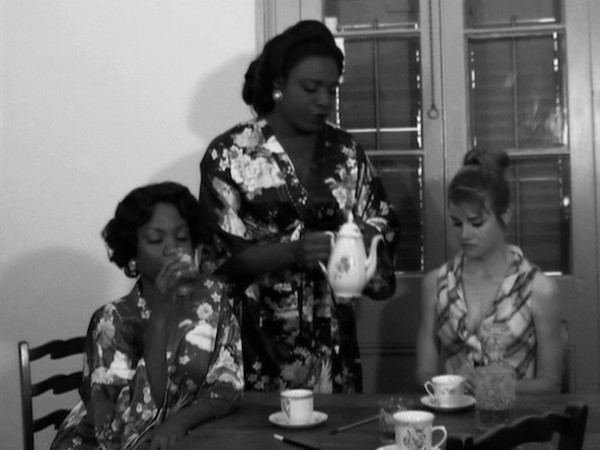
The videos, roughly made and surprisingly spare considering the flamboyance of their casts, are the exhibition’s highlight. Linzy overdubs all the voices, which gives the otherwise blatant dialogue an absurdly robotic quality. In Conversations wit de Churen VII: Lil Myron’s Trade, an animated short in which characters gallop across the frame as if riding invisible horses, two men have a sexual tryst that ends with one dead and one in prison, all because a woman in town chose to “run her mouth off.” Women are always running their mouths off in Linzy’s work. In Keys to Our Heart, two women, one a matronly Linzy in drag and another a wispy blond thing, try to help “John J.” navigate his “bitchy” lover. Linzy, playing “Lily,” says she “wants to do something positive,” then tells John, “If you can’t be an asshole to her, I suggest you leave her and find a good girl.” “I’m looking for a queen of my heart, not a shady spade,” declares John, once his female friends have coaxed him into breaking it off with his girl.

But even if Linzy’s characters purport to have their hearts on their sleeves, the over-the-top intensity of their acting always makes it seem as though their shallowness is a front for something deeper and heavier. In a way, the undercurrents in Linzy’s films are just as quietly ominous as the subtext in Norman’s play–his characters speak with a cockiness that suggests they know what they want and more or less understand their own feelings. Of course, they don’t understand themselves at all and that’s what makes listening to their “running off mouths” so exquisitely, smartly uncomfortable.

Share

Lari Pittman at Regen Projects

Lari Pittman is a gardener. Particularly fond of succulents, he maintains precisely manicured rows of cacti that borrow from a methodical landscape sensibility, a rational formation he claims “pushes back” against the chaos of nature. A composite of Columbian and American Southern heritage, Pittman is fluent in the duality of cultivated life. He understands that mortality is the only fixed variable in our otherwise unique existence, that micromanaging our realities affords us a sense of archive in the face of impermanence. His proficiency in composed ephemerality thus manifests itself in one hell of a cactus garden, not to mention two staggering concurrent exhibitions currently on view at Regen Projects in Los Angeles, CA.

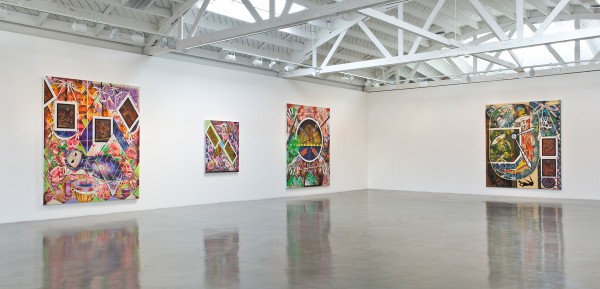
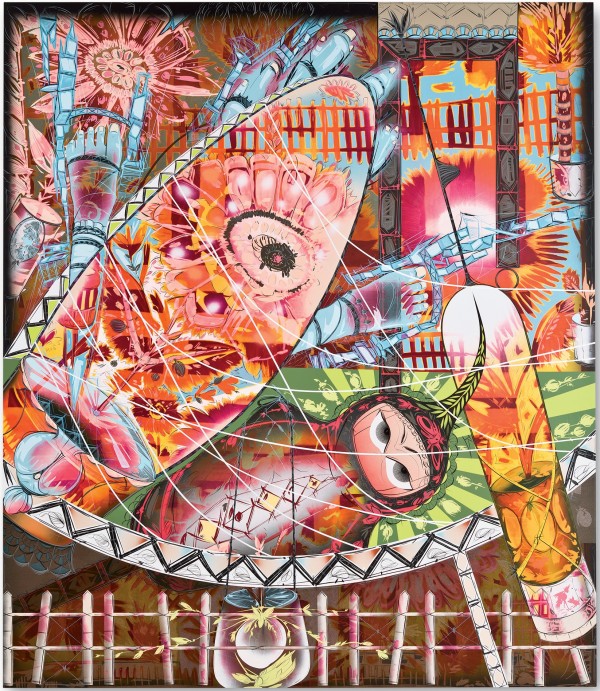
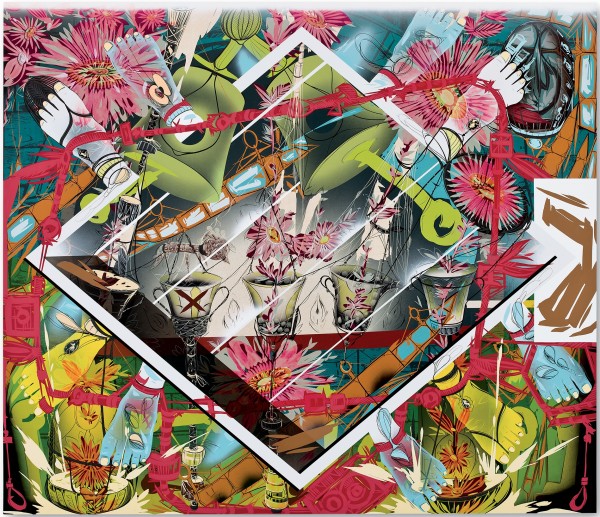
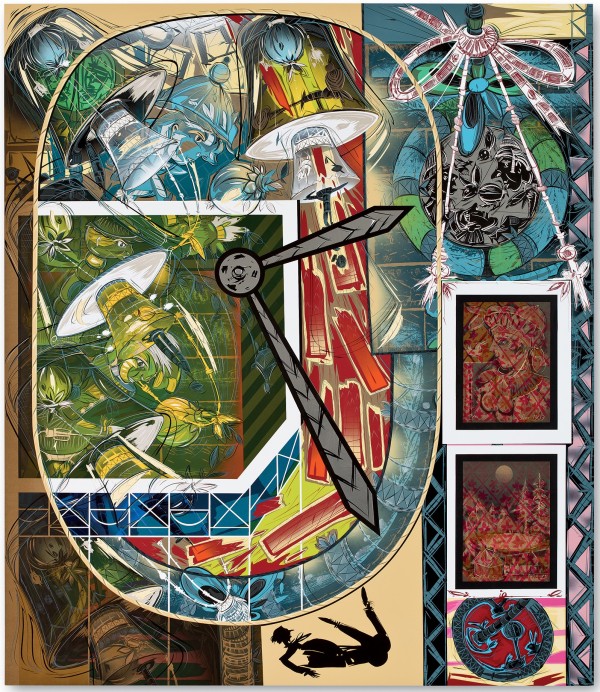
In the ten studio-fresh works that comprise Pittman’s New Paintings at the gallery’s secondary location (Regen Projects II), there is a painstaking compression of the opulent and familiar. A purposefully cluttered fullness that conjures a likeness to Grandma’s armoire, the canvases are rife with nostalgic ornaments and exotic trifles alike. Potted flowers and picket fences indicative of quiet Americana intertwine with flamboyant nesting dolls and henna-stained feet, affording a visual legibility unspecific to any one demographic.

While initially jarring in their vibrant pandemonium, Pittman’s paintings unearth a system of carefully meditated codes – a series of optical cryptograms that ruminate on the magnificence of hybridity and its modern ubiquity. Pittman celebrates plurality, and through his seemingly paradoxical menagerie of figures, abstractions, silhouettes and patterns he achieves an unanticipated harmony between disparate practices and imagery. Meticulous embellishment reminiscent of early 20th-century decorative arts coexists with cartoonishly provocative characters, forging a relationship that is both comical and wistful in its imaginative meandering. Given Pittman’s sensitivity to the trajectory of life – as echoed through the repeated use of clocks and the (literal) hands of time – it seems only natural to acknowledge our habitual reliance on humor and sentimentality in navigating our own humanity.

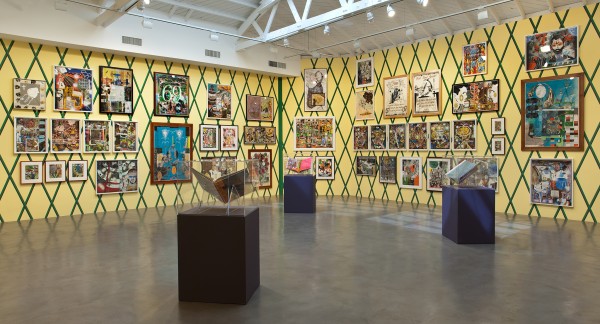
Just a crosswalk away from Pittman’s current paintings, Regen Projects I houses Orangerie, a curated repository of the artist’s renderings dating 1980 – 2010. The gallery features 108 works on paper suspended salon-style on bold yellow and green latticed walls, a cheeky allusion to the exhibition’s namesake. Acting as excerpts from Pittman’s larger topography, these pieces chart the exploration of identity, faith, sexuality and ritual through intricate pop-cultural and autobiographical signifiers.

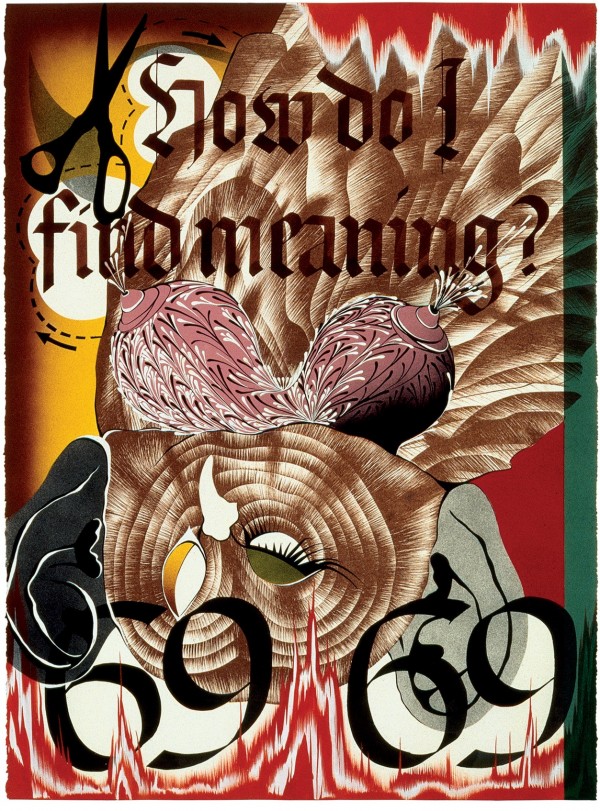
Formative seeds to the artist’s opus, the earlier works probe foundational elements to those in New Paintings. The snappy text of period advertisements is often ensconced in erotically charged sketches proposing weighty inquiries like “How do I find meaning?” or “Why was I born?” in the place of hollow solicitations.

Conversely, some later works operate as narrative flowcharts to a constructed concept of self, as various phrases and labels snake between anthropomorphic contours and diagrams. Acting as a conservatory for Pittman’s most delicate and earnest ventures, this Orangerie is appropriately ripe with the rigorous labor of his oeuvre – its fruit alluringly complex and bittersweet.

Share

Martina Sauter: Shapely Shadows and a New Apartment

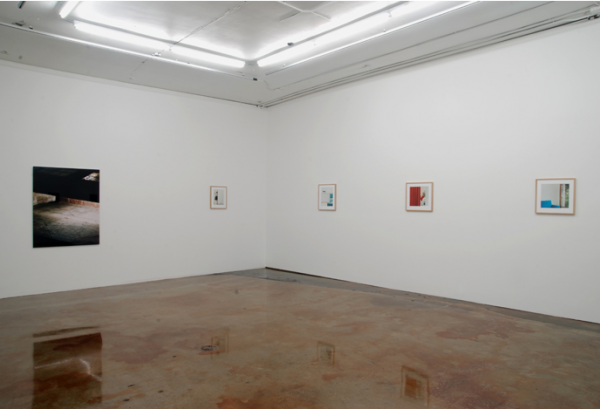
Each work in Martina Sauter‘s Shapely Shadows and a New Apartment, currently on view at Ambach and Rice, is made from two images–a still image from a pixelated video or film and a real space documented with distinct clarity.  The two parts are contrasting but complimentary, differing in texture and distinctness, but made to be one thing, often a fractured space or situation in flux.  By setting the documented image next to the appropriated, a comparison is drawn, but there is also statement of equivalence between the two.  All of Sauter’s images are made with a 35mm camera, which has the capacity to capture nearly life-like detail, coming through mainly in the documented space of her images.  But film is also very good at accentuating darkness and capitalizing on extremes of light to create a nostalgic blurriness that digital photography frequently fails to capture.  Through the mediation of the screen, Sauter pushes the qualities of film further into abstraction, often heavily cropping her images.

Although fragmented, the spaces are regular and the subjects seem known.  Fabrics, carpet, and apolstery cover surfaces and define forms, bringing attention to their shine, plushness, or weave.  Wood, brick, sheetrock and other building materials are used to give impressions of space divided or opened.  Qualities of surface are vital elements in these works and seem to control the landscape.  Doors are repeated throughout the works, along with frames, windows, and roofs–elements of architecture that were made to fit the human form.  But the characters are often pushed to the background or set to the side throughout the exhibition–and many works don’t have any figures present at all.  White walls are brought to the foreground in many of the works, seeming to echo the gallery itself, heightened by their astute framing and printing.  But walls also act to conceal space, to keep some kind of truth hidden from view.

Türundlandschaft, 11.75" x 13" (Courtesy of Ambach & Rice)

In Türundlandschaft, wallpaper from the artist’s apartment becomes the vivid scenery, as seen from an interior space created by a strange heavy-handled door.  The mountains look “real” and until the material’s source was revealed by the artist, I accepted this reality, even though the evergreens lacked a deep blue-green and the ground is too reddish.  This color palette is reflected in the almost-black vertical stripe on the door, also capturing the blue-whites and blue-blacks of the mountains.  The two panels draw us to compare these images–the landscape draws my attention through the work into the fine details, while next to it, the door brings me back to the reality that this is a constructed image.

Kacheln, 11.75" x 13" (Courtesy of Ambach & Rice)

Paired with the landscape is Kacheln, a study of yellowed tiles cropped from distant sources.  The wooden seam makes an edge that should be an interior space, but appears inverted, rendering an illogical space.  Here, the tiles are only differentiated by their sense of “reality”–we clearly see the streaks from hard water, but on the left, any sense of use of this space has been erased by abstraction.  The effect of the color yellow varies between these two approaches—the pixelated image has a warmness to it, while the more detailed tile wall appears dingy or off-white.  Kacheln and Türundlandschaft both seem to explore the psychological implications of yellow.

Garage, 49.25" x 39" (Installation image with audience reflections)

Like many of Sauter’s larger images, Garage is printed on reflective aluminum.  As a viewer, I immediately notice my own reflection, and others too are seen as shadows on the surface of the otherwise empty space.  I become a voyeur in this work, using it like a mirror to gaze at the crowd around me.  It seems like we are looking into this space from from above, as though from an outside window at ground level, so there is a sense that this is a view not often seen, even more so because the space is left undecorated and unused.  Because I am let loose into this open space, there is a tendency toward introspection that crops up.  Having no characters in the work creates a stillness that needs no narrative.  But the surfaces tell a story–the man-made materials cover the environment, eradicating all vegetation except some fall leaves that have entered, and the worn down wall itself shows the passage of time.  This simple perception of the materials displayed is one reading, but there’s an essence of foreboding here in the cement and darkened roofline that’s like something we would stumble into in the films of Hitchcock.

3Stufen, 11.75" x 9.5" and Loch, 11.75" x 12.75" (Courtesy of Ambach & Rice)

Within Loch, a companion to 3Stufen, the woman’s profile is pointed toward the man’s back as he looks downward, but both are looking into a void, enveloped with shiny black hair.  Both characters are isolated, but the woman’s gaze is fixed toward something or someone unseen.  Characters are unaware of any spectators, so there is a sense of seeing into a private moment or possibly a mental state.  But these moments are derived from very public footage and the characters could be identified if you’ve seen some films such as Contempt and Mullholland Drive.

Here is a strange, gorgeous icy woman looking very Hollywood and a man with slick hair and a flannel shirt seeming like he belongs on the streets of Seattle.  Because we aren’t given a story, we draw on the little bit of context that we can forge together from the works and their position in the gallery.  Film is often a passive experience for the viewer, even when there’s something to figure. out  Sauter’s works don’t have to participate in the constraints that films have, but can still draw on its rich history.  These works are imbued with a sense of mystery that drive the viewer’s search for clues to understand the content.

Loch & Hofmauer (Courtesy of Ambach & Rice)

Women appear prominently throughout Sauter’s compositions as glamorous forms, wrapped in towels, flowing fabrics, and styled hair, but Loch is the close-up view.  She appears as if halted by wooden beams, in an unfinished house, looking into a hole, wrapped in darkness.  She draws us into her single, visible eye, mimicked by the knot in the wood on the left.  A hand-like form below the floating head is about to do something–and that’s a story you should tell yourself.

Sauter pursues images that she enjoys seeing, maybe looking for elegance, darkness, humor, or strangeness, in her efforts to evoke an emotion.  The works seem intuitive, not meant to convey a certain meaning, but having relevance as an object of meditation for the viewer and the artist.  Sometimes the works are aimed at creating suspense, but other times they appear more quotidian.  Often, the imagery is drawn from the artist’s daily life, so possibly it’s saturated with the psychological associations that Sauter imagines–or maybe it’s a more simple gesture of formal exploration.  The obsession with rooms or spaces and elements of architecture with little ornamentation becomes a dream-like environment that encompasses characters who have dressed themselves up for the camera.

Martina Sauter currently lives in Düsseldorf, Germany after earning a master’s degree at the Kunstakademie Düsseldorf in 2006.  She was awarded both the Young Artist on the Road Award  by the Ludwig Forum in Aachen and the Thieme Art Award in 2006.  Her work has been featured at Foam Magazine’s Fotografiemuseum Amsterdam and she’s had numerous solo and group shows since 2004, exhibiting throughout Europe and at the Aperture Gallery in New York.  Her recent exhibitions include Räume auf Zeit at annex14 in Bern, Switzerland and Manuel Graf/Martina Sauter at the Kunststiftung Baden Wurttemberg in Stuttgart, Germany.  Shapely Shadows and a New Apartment is on view at Ambach & Rice Gallery in Seattle, WA until October 31, 2010.


Share

Victor Albrow

Image from Street Level Photoworks

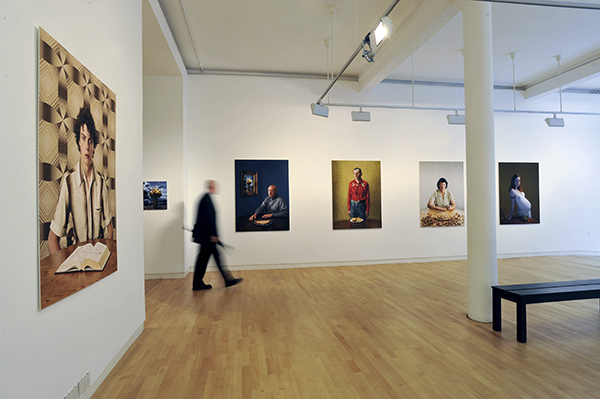
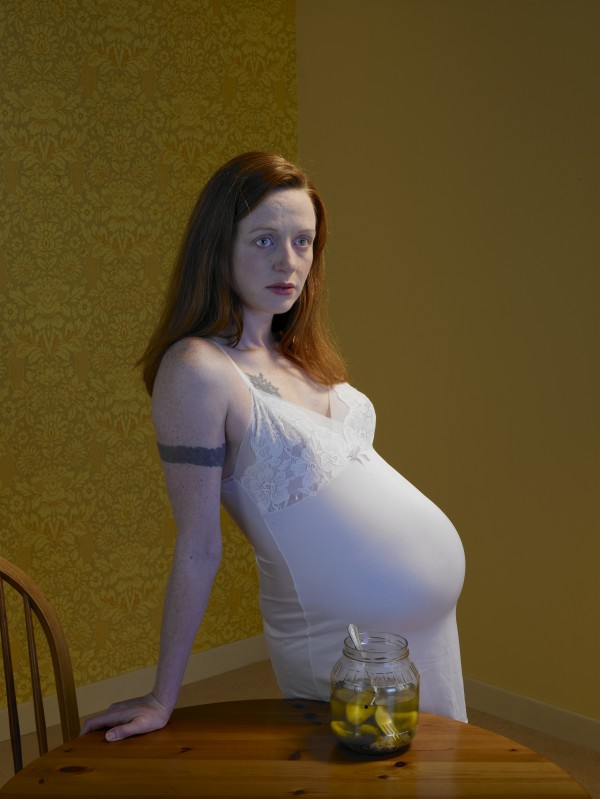
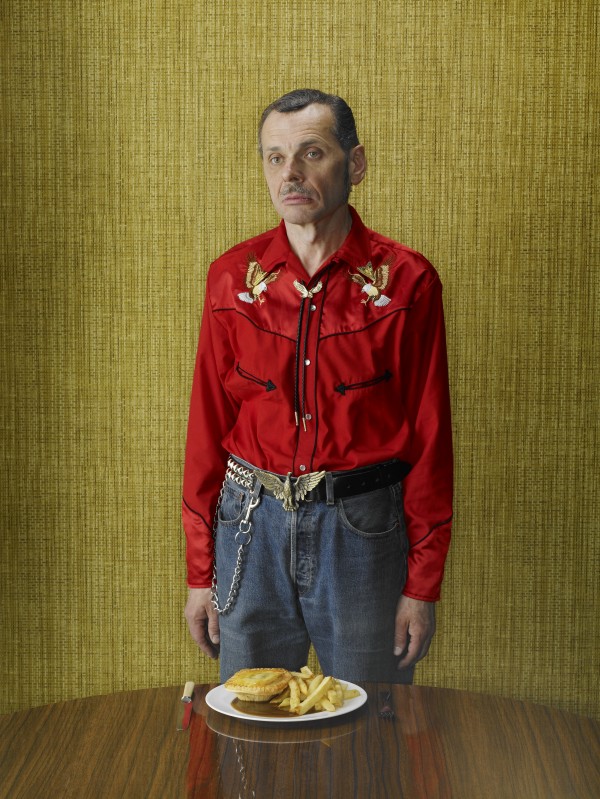
A solo exhibition of Victor Albrow’s photography is currently on view at Street Level Photoworks in Glasgow. On entering the exhibition space, one is immediately drawn to the almost life-size portraits through the odd contrast of figures in a contemporary setting staged so to be reminiscent of Renaissance portrait paintings. While Albrow did not intentionally create parallels with Renaissance portraiture, the similarities and contexts are palpable. Two distinctive qualities of Renaissance portrait paintings were technical innovation that allowed for much greater detail in rendering, and a democratization in choice of subjects, where people from different social classes, not just the privileged, were depicted. These two aspects of introducing new techniques and social demographics mark issues in contemporary art which emanate from Albrow’s works.

Image from Street Level Photoworks and copyright of Victor Albrow

Albrow’s photographic portraits exude an unmistakable sheen of digital production. While the camera was initially used as a window into social life through documentation, the ubiquity of digital technology has moved us along a trajectory where the motif of fact versus fiction is now deeply embedded in photography and art production of various media. Within this context, a viewer recognizes each of the photographs as a tableau, constructed and choreographed.

Image from Street Level Photoworks and copyright of Victor Albrow

Albrow selects each of his subjects, some purposefully, but most by serendipity, and has each carefully and precisely transformed in the studio. Each subject appears styled based on physical and social codes. For instance, the associations of the color white, pickles with pregnancy, the embossed eagle insignias, a plate of chips, gravy and pie, all have evolved to become signifiers of culture and class. The acknowledgment of the construction of the scene makes explicit a provocation to question if these codes are demonstrative of the person “behind” the image and the validity of appearances and images in relation to our lived experiences. Regardless of the staging, a sense of despondency from the bare and vacant expressions which contributes to a pervasive human quality is felt, and further wrestles uncomfortable with the air of artifice within each work.

Albrow (b. 1952) was placed second in the Schweppes Portrait Prize 2003 at the National Portrait Gallery, London, and participated in Future Face an international touring exhibition which was presented at the Science Museum, London. His work is in various private collections and the permanent collection of the Ivory Press Gallery, Madrid.

Share

Fan Mail: Scott Jarrett

DailyServing.com selects two notable artists each month from the submissions we receive to be featured in our series, Fan Mail. For a chance to have your work appear below, with an article written by one of the DailyServing contributors, please submit a link to your website to info@dailyserving.com, subject: Fan Mail. You could be the next artist in the series! (We will try to contact chosen artists prior to publication, but please be sure to check the site everyday!)

untitled (mattress #11), 2010. Archival Inkjet Print. 30 x 40 inches.

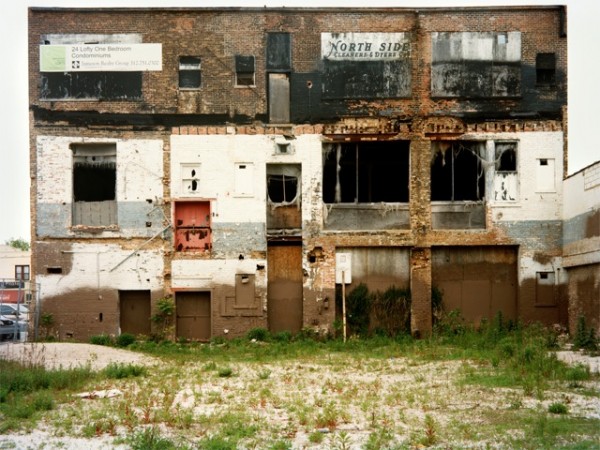
The instability of vanity is perhaps one of visual art’s greatest selling point. And, in an understated way, when derelict man-made objects and places are pushed to the boundaries of their own self contained and easily understood offensiveness, they often transform into something beautiful. Scott Jarrett’s recent work aggregates the refuse of urban life to create reductive montages that are both surreal and magical. While Andy Goldsworthy meticulously curates what nature has provided, Scott Jarrett uses the remnants of city dwellers to provide moments in which the understood reality of place must recalibrate and exist in a secondary—albeit curated— dimension.

The notion of vacancy in Jarrett’s work is perhaps in part what drives the soporific quality of the installations which are ultimately presented as photographs. Jarrett seeks out ghostly locales and uses the emptiness to his advantage—piling white buckets past a boarded building and pushing a used mattress unapologetically against the window of an abandoned repair shop—situations that would lose their power in a world more populated.

untitled (mattress 7), 2010. Archival Inkjet Print. 40 x 30 inches.

The photographs begin to build a loosely qualitative narrative that is resonant with individual urban journeys as well as the notion of home. When understood as a whole the work begins to address a social consciousness rendered around historical absence, memory and loss.

Scott Jarrett received his M.F.A. in studio art from the School of the Art Institute of Chicago and has exhibited internationally, including most recently, the 2010 International Sculpture Exhibition of Outstanding Art Graduates in Beijing, China.

Share

From the DS Archives: Jarod Charzewski

Today on DailyServing, we revisit the work of Jarod Charzewski, following his recent exhibition at 621 Gallery in Tallahassee, Florida.

This article was originally written by Seth Curcio and published on March 27, 2009.

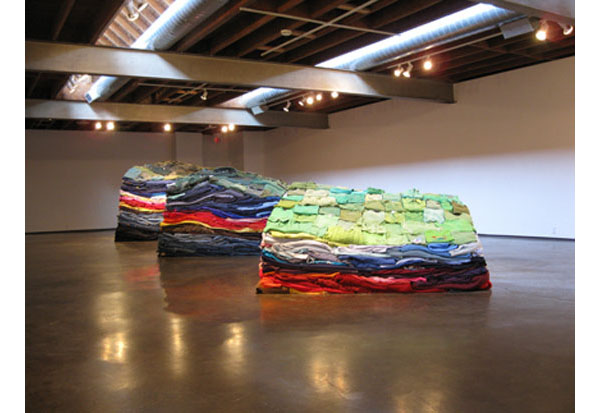
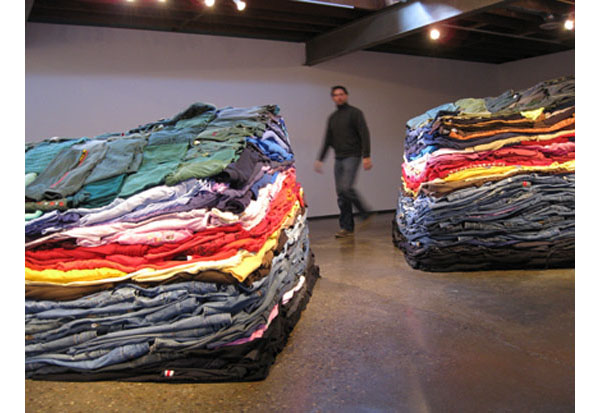
Regeneration Gap is the title of a new installation by Canadian-born artist Jarod Charzewski on view at the Pari Nadimi Gallery in Toronto. The exhibition features three major works, each representing a cross section of a hypothetical landscape, complete with revealed geological layers, created entirely out of used clothes. The artist obtains the used clothes from local Goodwill stores, which are given on loan from the store and returned at the closing of the exhibition. Also on view are several large-format photographs from a previous installation titled Scarp, which was presented this fall at the Halsey Institute of Contemporary Art in Charleston, South Carolina.

The artist’s work illustrates the reality of consumer culture’s effect on the landscape by actually reconstructing a cross section of the landscape made entirely of used clothes. Perhaps the most interesting component of this process is that the work is created using recycled materials which are taken from and reintroduce into the market place, without actually creating any new consumption.

Charzewski is a graduate of the University of Minnesota and has completed recently solo exhibitions Vortices at Trinity Square Video in Toronto and Vanishing Point at Ace Art in Winnipeg, Canada. The artist currently teaches sculpture at the College of Charleston, School of the Arts.

Share

Tammy Rae Carland at Silverman Gallery

Encapsulating topics as grand as performativity and vulnerability in visual art often leaves the viewer unsatisfied. So often, concepts such as these are over-thought and over-articulated, but in Tammy Rae Carland‘s Funny Face, I Love You, this couldn’t be further from the truth. In her latest exhibition at Silverman Gallery in San Francisco, Carland takes on the role of the comedian, one could argue the most vulnerable of all creatives, as a vehicle to explore fragility and personal exposure.

I'm Dying Up Here, #6 (wood suit). Color photograph, 2010. Courtesy of Silverman Gallery.

In her most recent photographic series, I’m Dying Up Here, Carland’s isolated figures live in an unsettled state, seemingly caught mid-act. The figures rest between being obscured and exposed by the heavy dark cloaking of the background. Each background is both visible and invisible, with subtle texture only coming into focus as one approaches the photograph. Even when there is no figure present, the environments in each image lie in waiting for something, giving one the sensation of anticipation, fear and self-doubt that accompany the act of performing.

For an exhibition revolving around comedians, humor takes a surprising, and unexpected, backseat role. In so many ways, humor can be one of the best ways to protect one’s self, but in Tammy Rae Carland’s case, humor only presents itself alongside humiliation and exposure, acting as a tool to show how one is both hidden and revealed, guarded and defenseless.

Punch Line, Ink and paper, 10 × 13 Inches each, 2010. Courtesy of Silverman Gallery.

In some of the most uniquely satisfying work in the gallery, a series of ink and paper text works, entitled Punch Line, mask transcripts of famous comedians’ acts, only leaving the punch line revealed. This disguise leads the viewer to search, to postulate, and to wonder about that which is missing, only providing the feeling of being utterly incomplete, and unfulfilled. What results is a context that is lost or mistranslated, mirroring the vulnerability embedded in the I’m Dying Up Here series.

Funny Face, I love You. Various sizes. Ceramic cast and hand built objects. Courtesy of Silverman Gallery.

And, as a perfect way to complete this well articulated thought, the fragility and subtle habitation of the ceramic sculpture, Funny Face, I Love You, reveals the balance of presence and absence in all of the work in the show. As it sits in the window space of the gallery storefront, the sculpture lives both inside and outside of the space. The ethereal nature of the white ceramic simultaneously exists as the omission of a figure and as the immaterial quality of the prop to the act of performing. All of these elements combined in Carland’s well choreographed narrative leaves a place for the viewer to explore vulnerability and fear in relation to the body and mind united in the performative act.

Funny Face, I Love You will be on view at Silverman Gallery through October 23rd, 2010.

Share