Monument D.I.Y.

Installation Shot, Agathe Snow, All Access World, 2011, Courtesy of Deutsche Guggenheim, Photo: Mathias Schormann

With its chaotic visual imagery, Agathe Snow’s All Access World feels like Berlin. There are a ton of brightly colored images posted on the walls covering the entire room. In the middle, is an array of what could be small parade floats, approximations of internationally recognized monuments, sometimes crudely made out of a mish-mash of materials. The floor is covered partially with a bright pink pseudo-map of the world. The images on the walls of Snow’s installation are mainly collages of individual monuments. Dozens of what look to be tourist snapped images of a site are piled on, along with pieces of rope or small plastic toys. I got the sense that a Google image search of the cities depicted would render similar findings. The multitude of visual stimuli alone forces a slow, archaeological handling of the space.

By recreating human scale models of famous architecture, structures and historical marvels, Snow presents her work as a showroom for products. The structures themselves are reminiscent of example Big Ben, or the Hollywood sign, but their attainable size suggests that you too could have some for your very own. The catalog even offers a how-to guide for constructing one for yourself. The Stonehenge on wheels is particularly humorous, as it negates the mystery of how those big rocks got in a circle in the first place. This focus on recreating genericizes the objects and strips them of their history; monuments without the baggage. But what is the point of having a grand symbolic structure if it has nothing to say?

Installation Shot, Agathe Snow, All Access World, 2011, Courtesy of Deutsche Guggenheim, Photo: Mathias Schormann

The fact of the matter is that we see this all the time. From world’s fairs to Las Vegas, landmarks and cultures have been rebuilt and represented to varying degrees of accuracy. Entire theme parks have been developed on the premise of bringing the world to you, be it Epcot Center, or on a larger scale, China’s Window of the World. A long car ride down to Florida in order to experience Norway and Italy and Germany may seem like a much better option than an entire European vacation, and there’s no pressure to learn the language. The recreations at world expositions served the purpose of enticing further exploration of these areas by a greater audience. Explorers bringing home the exoticism of Ancient Rome and the Orient led to the broadening of horizons and opened cultural passages to worldwide access. Today, however, I wonder about the amount of tourist dollars generated in Egypt by the Luxor Hotel and Casino.

Conversely, one could argue that it is unnecessary to go to the actual sites, as a theme park facsimile or the Internet can provide us with the same vantage points and access to information. I’ve never seen an image of the Lincoln Memorial more meaningful than any other, and seeing it in D.C. at this point doesn’t really excite me. I could only speculate that perhaps because of the breadth of images I’ve been exposed to on the one subject, the monument reads as a banal image to which I am bored and well-accustomed. One could make a case for aura and the ability of the physical world to give us a visceral experience, but I contend that the access to these places is so great that they have infiltrated our lives without us even actively seeking them out, and in the process they have lost their mystique.

On occasion, I have felt like an ignorant tourist blindly consuming a city, taking in the sights but without fully understanding them, as if I were experiencing the fake version at a theme park. When traveling between monuments as if checking off some sort of scavenger hunt, their value with regard to the place’s history is lost. Then, photos aren’t reminiscent of the significant event memorialized, but rather serve as status symbols; a sort of ‘I was here’ marker, to boast one’s cultured and roaming spirit. Really the intention of traveling, for me, is more self-concerned. It is not so much a quest to see what makes a place culturally relevant but instead it’s a search for a place where I feel comfortable, a home. If I’m interested in a place for its historical significance I’ll read about it at my house.

Agathe Snow during 28th Long Night of the Museums at Deutsche Guggenheim, 2011, Courtesy of Deutsche Guggenheim, Photo: Nina Straßgütl

Snow’s home is New York City. While she is visible in several of the tourist images in the various cities, her relationship to New York is apparent in the personal images in the collages; holding her pregnant belly, posing as the subject rather than as a marker of time and place in front of the monumental subject. She was there for 9/11, a point which provides perspective on the entire show.  While before the World Trade Center was integral to any spanning cinematic shot of the city, the lack of the towers now symbolizes something completely different and is an anti-monument to that day, at least for the time being.

Monuments are created to commemorate and remind, bonding a particular site and time, however the only real value in Snow’s monuments comes from her position in the art market. By presenting these images and effigies of buildings and monuments, we are shown what great markers they are of a place, but also their inability to necessarily signify the history which they were built to present. Perhaps because of an over-saturation of access to the world we have reached such a tolerance for The Spectacular, these feats of ancient times or impossible and innovative architecture, that we’re dull to it’s message. If a monument ceased to exist today there would be no real cultural loss. What the Twin Towers stood for in the hearts of Americans has not been abandoned. Furthermore, we have the history, innumerable images, blueprints and scale models by which to remember them, all easily accessible and available. The proposition of the work suggests that the function of a traditional monument has been outgrown in lieu of more self-centered values. We are now free to take these objects and imbue them with individual meaning. The lingering dust of our past has finally settled; a complicated message particularly in Germany, a country where entire cities have been destroyed and rebuilt as monuments to their former glory, obscuring the event of destruction and investing in one national history over another.

Share

Interview with Amilcar Packer

ensaio:circuito #03, 2010

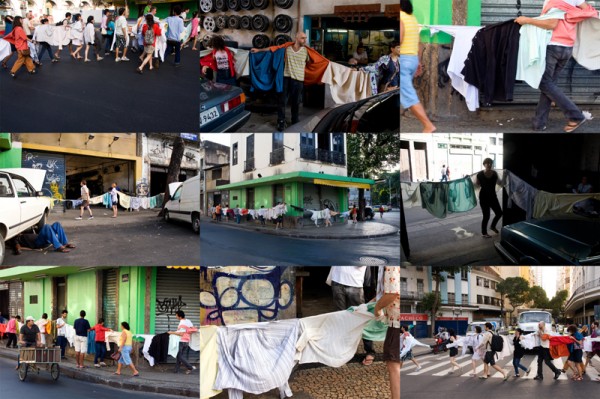
It’s a sunny day in Rio de Janeiro’s neighborhood of Lapa, a linked chain of button up shirts and people weave through the city streets. They enter into a mechanics garage and circle through the space, the mechanics continue their work; the unfolding of everyday life continues. The performative art action and the work of the mechanics rub up against each other, influencing each other without collapsing their particular flows. This is the work of Amilcar Packer, potent, yet resisting brash spectacle. Through actions, images, and videos Packer plays with the structured scaffolding of our systems of knowledge and understanding of the world. With his background in philosophy, art has become a discourse of images, sounds, and actions where the chosen medium becomes a malleable method or route for a way of thinking, a way of building and deconstructing at the same time.

Rebecca Najdowski: Bom dia Amilcar! Thanks for agreeing to have this conversation about your work. I think the first time I encountered you work was at the Centro Cultural São Paulo’s exhibition celebrating its 20 years of programming. Your works that were presented kind-of buttress your practice chronologically, but for you, your practice is less linear and more cyclical, am I right?

still #57, 2006

Amilcar Packer: The fact is that somehow the answer is no, even if the direction you took is correct… putting things in linear/cyclical is keeping the dichotomy, the split in two opposites, and even though the idea of cyclical is more correct, when talking about what we call time, it seems to me that things get a little bit more complicated. For instance, there’s a beautiful text by Walter Benjamin in which he elaborates on the idea of a constellation of historical times to criticize, or to avoid, linear time and all the entailments of cause and consequence that it establishes (of course W.B.’s ideas are much more complex than that and relate to his criticism on historiography…). One of the problems of a linear conception of time is that it often creates this idea of progress/development and when you see things in retrospective they gain this aura of necessity; that things couldn’t have happened in another way. Also, the idea of linear time brings the need of a beginning, what is pretty much connected with the monotheistic ideas of time, more specifically with Christianity. As we were talking the other day, it seems interesting to look at the idea of eternal return at a “ritual” time in which it’s not about repeating what was done in a former time, it’s rather about being there for the first time. The way I conceive it: even though everything that I do is fragmented and has different and separated pieces which appear in time, it’s about only one thing that ideally could be seen as a picture, as a non-pre-existent whole, at once and the same time, but where you can always “come back”, “return”. It gets even hard to describe using words. History is unfolding into what we call present and future, but as well as to what we call past. The past is not frozen it is constantly changing…it is always open.

RN: When you mentioned an aura of necessity, or a particular unfolding of time that is rigid – and that this is perhaps something that you avoid in your work, it makes me think in small “strategies” that you use to keep open possibilities.

AP: Those “strategies” that you’ve mentioned deal with the need to develop a practice which assumes since its “beginnings” that meaning is built and rebuilt, and most of the time, we have little control over that. It’s pretty freeing in some ways since you don’t need to elaborate strict and rigid structures to avoid noise and change, what is not programmed. Even though, of course, I have very specific directions, intentions, and wills on the context I would like my practice to participate, or ideas that I would love to take part in and which fascinate me, the beautiful thing for me is to think about how what I do is and will be seen, read and used, re-appropriated and dismantled.

video #17, 2010

RN: I think this might be a good point to look at an image. Speaking of the “strategies”, in your Video #17 you deliberately left empty jackets. Can you speak to that a little bit?

AP: For Video #17 I had to count on the presence and collaboration of many friends, friends of friends, and some passer-byes. Even though I had an idea of the amount of jackets and individuals that I needed I knew I couldn’t fill everything because some of those places had to be left “empty” for those who couldn’t be there for various reasons. People that I would have loved to have there participating but that died before, people I would have loved to meet, people that I will meet or never will, and people that will meet the “work” after I die. The fact was/is that there must remain some empty place left. Place for possibilities or gaps, commas, intervals, silence… The action took place in downtown São Paulo and consisted of zippering together more than 100 jackets to form a circle, we turned around a building in both directions the same amount of times as if we were adulating the action, reversing it. It was not specifically about those people who were there or not, it dealt much more with ideas connected to the flow and movement of people in urban centers and how this displacement is determined by the split and organization of the “space” – all the hierarchies and world visions which determine social behavior. It is a collective body, a children’s game, but at the same time a powerful way to invoke and create energy – we can’t forget how important it is to get together in a circle with other people, and how many different human societies have used this in rituals and practices.

RN: Wow, ok… this leads me to two different (maybe not so different) wonderings:

This kind of fluid, social activity (and even the use of clothes/textile material) really seems to have some cords connecting to significant Brazilian artists like Hélio Oiticica, Lygia Pape, and Lygia Clark, but I’m curious as to how you see the relationship/s, if any.

I’m also super interested in how you use the urban landscape and all it’s implications in your work. There is so much on offer to work with. In much of your work you’ve used you own body in relation to architecture and space as a way to play with systems knowledge, to prod at them a bit. What’s happening here?
    still #36, 1999

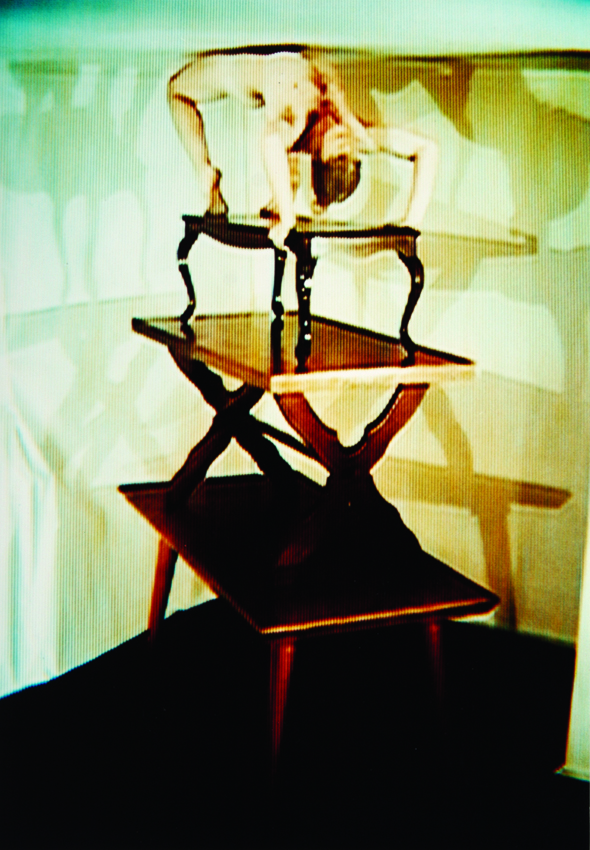
    AP: I believe there are several connections in what I do with the artists you’ve mentioned. First because they certainly shaped the context in which I move and some of my world vision. They worked in a similar context as I do, Brazil and my practice have many connections with theirs: body as site, body as language, psychoanalysis, perception as subversion of the common state, revolution and freedom as for instance against morality and power, oppression and prejudices… But where I think we really do get close is in the sense that we believe that art is not an end in itself, in that maybe even “art” is not enough; or that art is always making art, that it is an action that has to create problems and formulate odd questions and become a strange body.

    RN: So in the making you are sort-of proposing questions, ones that perhaps can’t be answered…I want to get back to how this is happening in the artworks themselves. Can we address that second question, about how you use the urban landscape and your own body?

    AP: Concerning the urban space I guess it was discovery; a consequence that came from the experiences I’ve had in the previous works. The fact is that in the early works, the skin was a main concern as well as the clothes and the wall, but everything was taken more as surfaces – biological, cultural, architectural, social, and so on – layers and skins. I was pretty much interested in how clothes and walls function as a second skin and body and how cultural, social, and historical layers become like a second nature to us and determine social relations and world visions; they shape our behavior and our perception. But then I realized that the “skins” are thick and that it is not only about a mathematical layer… actually do you know that the skin is consider the biggest organ of the human body?!!

    RN: Yes I did!

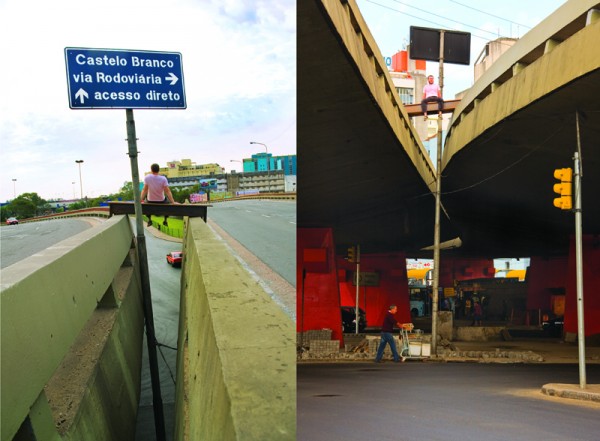
    AP: Anyway, those, and some other discoveries opened up the possibility to me to work with the body in another way, to play with directions and gravity, to think about how physiological, intellectual, and “formal” structures of the human body are projected in the “outside” world and shape it symbolically and materially and solidify as rigid knowledge and power structures.

    RN: So, considering this notion of “skin”, what is essentially a barrier…

    AP: Something, which separates one place from another and creates hierarchies, value, segregation, split, power structures, difference. But I’m more and more interested in thinking of skins as more porous, something which defies the notions of subject, individual, particular. The skin is constantly exchanging and at the end it’s more a question of density since our bodies and minds are constantly being crossed. On another hand, other barriers try to avoid exchange and control it: country borders, jails, walls, and fences are made to avoid others to enter, to communicate. But the fact is that nothing has a unique meaning and that the scenario is further more complex and that’s why it seems much more interesting to think and to address the relations established between things as well as their contexts and not isolated objects, things, or phenomena.

    RN: In some works you use barriers that are maybe less porous than skin, dense ready-mades found in the urban landscape. For instance, I really love the video installation piece where on the left side there is a panning video of glass barriers between what seems to be residential areas and public space, the right side is a video of you, or your arm, dragging a metal rod against metal fencing that seems to be in the same type of area as the other video. There is a flow that seems like this is vast space that can go on forever, this was made in São Paulo, right? Is its location important? How?

    AP: The work you are mentioning is a video installation composed of two works that also function separately. Together they become “Field of dominance”. Both are ongoing videos that I have been working on for the last two years and are meant to be a collage of the same actions recorded in several cities that I visited, in video for the fences and in photographs for the glass walls. So till now you have fences from Berlin, Paris, São Paulo, Buenos Aires and so on. Each city that I’ll visit will be added to the prior video. The idea is to create an endless fence, which doesn’t consider any physical border and which in that sense refers to the idea of fence implanted in our minds. Also, the video records an action where sometimes I am inside and sometimes outside (of what is protected) which means that the landscape behind the bars sometimes is composed by houses, buildings, gardens, and other times by the street; both sides of different fences are alternated. The “glass walls”, Transparency/Opacity, is also an ongoing project which started at the end of 2009 after I realized that the walls and fences of some buildings in São Paulo were being substituted by glass and behind this fashion, that spread as a virus, I couldn’t stop seeing a perverse phenomena of transforming space into image; creating desire, fetish. As a material, the glass is considered more fancy and less aggressive than bricks and cement, or metal fences with spikes. But if one takes time to consider and reflects on the situation, it is really a complex and perverse phenomena of in-materializing the systems of power and control, of split and segregation. Formally, it’s also an endless panorama of glass walls; so far, I’ve only worked in São Paulo, but as you know, I just came back from Rio de Janeiro with a vast material to add. Actually, Rio is facing the same phenomena and as far as I know, several other cities are suffering from the same. In fact, the processes of control and surveillance, segregation and power, are global and the same strategies are being used everywhere, transnational borders…we must know that the main danger is not what we see, rather, it’s what we don’t but which is always there, a forcefield.

    RN: How did you come to make the choice of placing the separate videos together?

    AP: Well both seem to be part of a same urban phenomena connected with the industry of fear and the paranoia with protection and surveillance that most of the cities face nowadays. Both videos are pretty connected and form what I’ve called “field of dominance” which are relations that materialize and settle power structures, segregation, and submission and are strongly connected with ideas of private property and rights over things and space. Each video flows to a different direction – the fences from right to left and the glass walls from left to right – the videos are placed next to each other in a way to point to the space in-between them. They are developed as collages of places and cities and point of views; endless panoramic borders which place us at the center of a panopticon.
    Hifen #2, 2008

    RN: To take a bit of a different direction… I’m super intrigued by elements of you practice that don’t result in an “art object”. Perhaps there is a more obvious connection here to your background in philosophy, but it really seems to be important to what we were talking about before, of art (the art object) not being the end in and of itself. Your preparing for a residency in Turin, what are you going to do there.

    AP: As a matter of fact, I don’t really have a formal background in visual arts, which doesn’t mean that I haven’t and don’t still study art. But as I told you the other day, for me from philosophy to art, it was just a slide. I thought I could think/do the same but in another way, for instance including the body, objects, architecture, images and sound as part of language and discourse. In recent years I’ve been asked to participate in conferences and seminars or to “present” my practice and I have been taking those opportunities to elaborate and explore another format that is a blend of talk/performance/conversation/walk and so on. A development of what I do but in a more direct way in the sense that I establish a concrete dialogue with specific persons in front of me. This has interested me for many reasons. For instance the possibility to establish a determined time/space; a situation in which the conversation and exchange is the means and the end. It is really something pretty new for me, but very exciting – a whole new field to experiment with me, for me, with other people and for other people… It doesn’t create physical objects, which I like as a principle, and it is based in conversation, which brings me back to many structures of knowledge and ways of sharing. It matters that it is art in the sense that it might help to open this kind of practice – even if there is nothing new in what I am doing and I am not looking to do something new as an avant-garde way of thinking – I intend and expect to collaborate with narration. I was recently granted to go to PAV (Parco Arte Vivente) in Turin, Italy, as part of the ResO’ residency program. The main project that I will develop there is a walking talk based in the peripatetic practice of open air lectures, with ideas connected with how historically in the western world there was/is a split between body and mind and how this shaped not only architecture, but more specifically, the formal structure of the theater spaces in stage and public, and how it came to the cinema and the art institutions, galleries, and museums. How this became the architectural and institutional frame in which the actors/artist are supposed to do something meanwhile the public observes and judges; this also connects with ideas of private property and use of the space since it seems that one of the reasons which made Aristotle walk while teaching/talking was the fact that he was not a citizen from Athens so he couldn’t posses land.

    360º, 2006

    RN: I think what you said about “intending to collaborate with narration” is really beautiful. If feels very in line with what I think about you work, which is making space for possibilities. Although a lot of what we have discussed is pretty heavy, I can’t just graze over the fact that a lot of your work has humor in it and knowing you as a person, you’re pretty light-hearted. Are you satisfied with the balance between sometimes-heavy subject matter and playfulness in what you output?

    AP: I guess so and I think its necessary. When you talk about possibilities you open fields but nothing really assures which will become reality and I believe humor might help to deal with the unexpected. I am a big fan of irony I see it as one of the faces of intelligence (but have my doubts with cynicism and also sarcasm). For me irony makes you part of the situation, it puts you in a kind of drama or “pathos”, it creates sympathy, and makes us laugh about our own misery. For me it’s obviously a way of seeing life, a way to approach very “heavy” matters and also not to take things too personal or too serious…

    RN: Yes, we all have to sometimes remind ourselves not to take things so seriously; it can often feel like a bit of a paradox….

    AP: and it is… that’s exactly the point; we are the place where paradox and contradiction can co-exist.

    Amilcar Packer, born in Chile, lives and works in São Paulo. His work has been extensively exhibited internationally at S.M.A.K., Ghent, Belgium, Museu de Arte Moderna de São Paulo, Bienal de las Américas, Museum of Art, Denver, Colorado, “2nd Thessaloniki Biennale of Contemporary Art” Thessaloniki, Greece, 2aTrienal Poligráfica de San Juan, San Juan, Porto Rico, “Third Guangzhou Triennial: Farewell to Post-Colonialism” Time Museum/Guangdong Museum of Art, Guangzhou, China, “On reason and emotion” – Biennale of Sydney 2004, Museum of Contemporary Art, Sydney, Australia, National Museum of Contemporary Art, Bucharest, Romania, Ivan – Instituto Valenciano de Arte Moderna, Valencia, Spain, Cisneros Fontanals Art Foundation, Miami, Itaú Cultural, São Paulo, Secs Pinheiros, São Paulo,  Instituto Tomie Ohtake, São Paulo, Pinacoteca do Estado de São Paulo, Museu de Arte Moderna do Rio de Janeiro, among others with solo shows at Oi Futuro, Rio de Janeiro, Centro Cultural Banco do Brazil, São Paulo, Galeria Vermelho, São Paulo, Museu de Arte de Brasília, Brasília, and Centro Cultural São Paulo.


    Share

    From the DS Archives: Brian Ulrich

    Remember your semi-recent political past through the DS Archives this Sunday as we reintroduce Brian Ulrich. Ulrich is participating in the group show American Psyche at the Religare Arts Initiative Gallery in New Dehli, India through April 3rd.  In addition, Copia, Ulrich’s traveling show, will be arriving at the Cleveland Museum of Art in August of this year and will remain up through January of 2012.

    This article was originally written by Ian Curcio on June 29th 2007.


    The large-scale photographs of Brian Ulrich embody a distanced awareness to usually familiar environments. Encouraged by the response to the Bush Administration’s call to citizens to strengthen the economy through shopping in 2001, Ulrich created the ongoing “Copia” series that offers an acute look at life in commercial settings. “Copia” not only explores the everyday activities of shopping, but also the economic, cultural, social and political implications of commercialism and the roles played in self-destruction and over-consumption, as well as those played by marketing and advertising. His imagery is made of personal moments in public spaces that are essentially enclosed virtual worlds, such as big-box retailers and thrift stores. The artist received a photography degree from the University of Akron and a photography Master’s from Columbia College in Chicago. He teaches photography, Web design and visual literacy at the School of the Art Institute of Chicago and Columbia College. Ulrich is also a frequent contributor toAdbusters Magazine. The artist is represented by Rhona Hoffman Gallery in Chicago, Robert Koch Gallery in San Francisco and Julie Saul Gallery in New York.

    Share

    Say My Name Say My Name: Josh Smith at Luhring Augustine

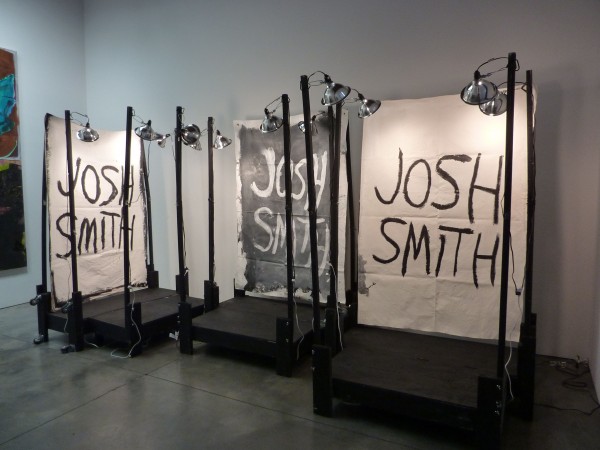
    Josh Smith, Installation View.

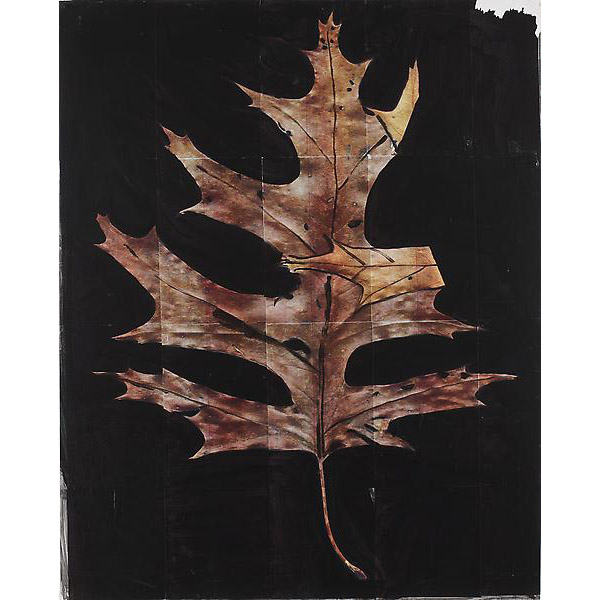
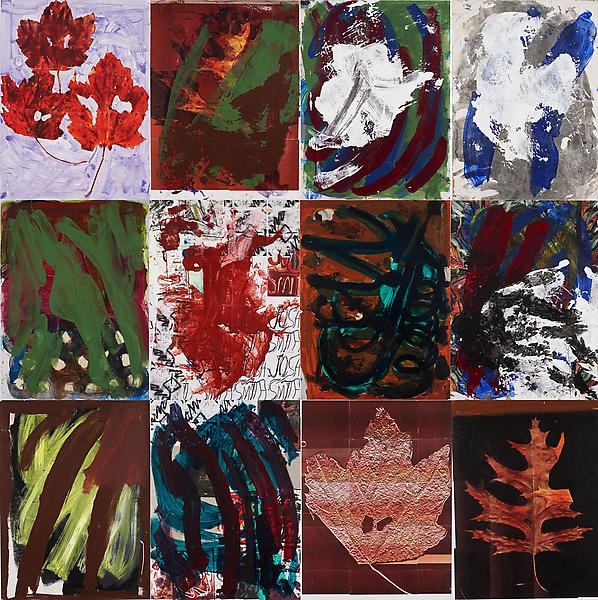
    If, on some level, art really is about what you can get away with, then Josh Smith, known mainly for painting his name over and over, has been robbing us blind for years.  Perhaps he senses that the gig is up on the name paintings because his current show introduces leaves, fish, bugs and butterflies, as well as an impressive foray into sculpture.  It seems as if his transformation from boy-obsessing-over-his-name to kid-turning-over-rocks-in-search-of-lizards is nearly complete. Watch out, folks! Next thing you know, he’ll be asking to borrow the car.

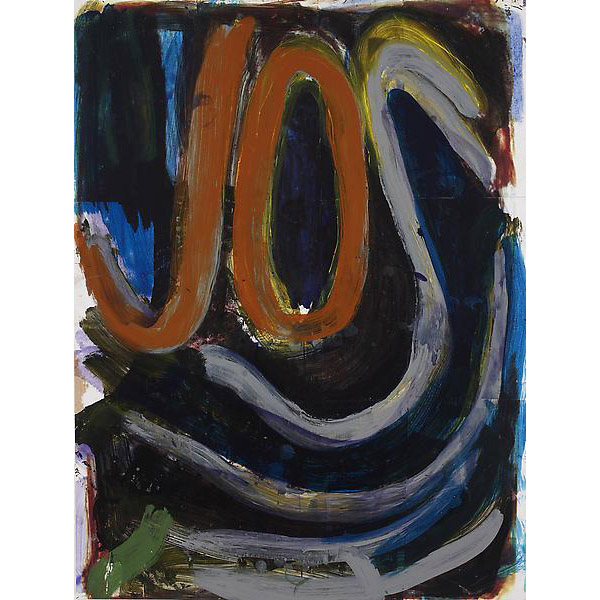
    Josh Smith, Untitled, 2010.

    There’s so much natural history museum style art out there—taxadermic specimens, hyper-realistic fake plants, and 19th-century illustration look-a-likes—yet Smith manages to stay in the realm of, for lack of a better term, art. This is mostly due to his messy mash-up of production techniques like silk screening, ink-jet printing, and direct painting.  None of this is especially new, however, and many of the paintings at Luhring Augustine either juxtapose retro advertising with accidental brushwork à la Albert Oehlen or evoke the swashbuckling bravado of George Baselitz.  But with all of the autumnal decay on view, there’s a somewhat solemn tone to the show. It feels like new territory for Smith and goes well with his trademark sense of experimental play.

    Josh Smith, Untitled, 2010.

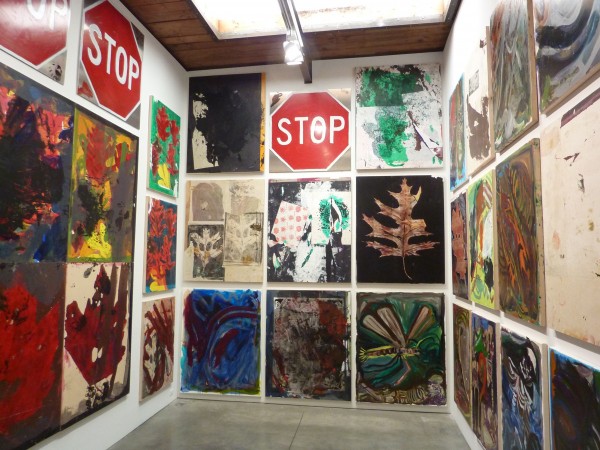
    Ever since his installation/assemblage at the New Museum’s Unmonumental in 2007, it’s been clear that Smith can hold down a large expanse of wall.  And his current show has a fat dose of theatricality to it, which I like. Hung floor-to-ceiling with standard-sized paintings, the back room is awesome. Previous shows of Smith’s were linearly installed, each painting equidistant from the others, making it tough not to focus on weak links in the chain. There’s strength in numbers in the current show, as individual works work together to form a coherent whole. The Stop Sign paintings, for example, probably wouldn’t knock your socks off by themselves (actually, they’d suck), but as resting spots in a vast conglomeration, they do the trick.

    Josh Smith, Installation View.

    But it’s Smith’s sculptures that really take the cake here. Basically, they’re stages lit with clamp lights and adorned with blunt but effective name paintings as backdrops.  There’s nothing super fancy about them, and like the rest of Smith’s best work, they contain an attractive dose of nonchalance. You feel the urge to clamber aboard, yet I don’t think Smith is going for the performative or relational thing. He knows that’s played out. Their precedents include John Bock’s plywood platforms and basically everything by Rirkrit Tiravanija, but the mindframe of Smith’s sculptures is more photographic than physical. You can’t help but imagine your foto-booth experience with his name as the backdrop. But the intimation of use is much more alluring than actually touching these things. Calling them Stage Paintings, Smith might be toying with the idea of theatrical backdrop or just exploring a painting off the stretcher. Either way, he’s deviating from his norm, which is good.

    Josh Smith, Untitled, 2010.

    As a matter of fact, this show marks a turning point for Smith, where subject matter might actually have, um… weight. Regardless, what it all comes down to is whether or not you like his style. Obsessiveness is often an excuse for artistic legitimacy, and Smith certainly benefits from this. But it’s good to see that he can dig beneath the surface a bit without losing himself in the process, a.k.a. you can alter, erase, or obliterate it, but as long as you scrawl your name really big on it, it’s still yours.

    Share

    Perversity

    L.A. Expanded: Notes from the West Coast
    A weekly column by Catherine Wagley

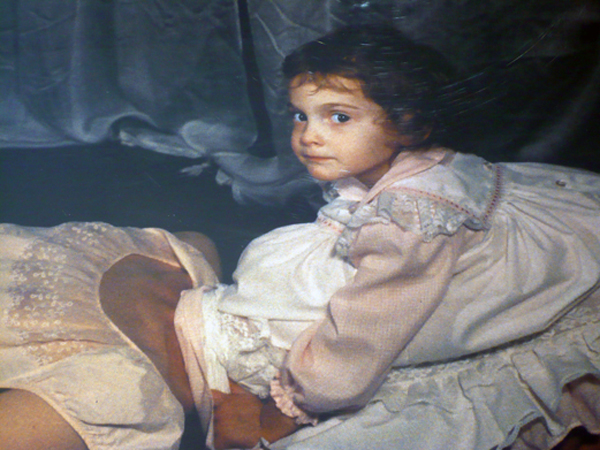
    Dorit Cypis, "The Nervous System: Mother and Child," 1987. Courtesy Jancar Gallery.

    When Workspace, a Lincoln Heights storefront with a gallery the size of a living room, hosted a reading last Sunday, only one of the four featured artists actually read, and he read the work of someone else. It was Tyler Coburn, who sat at the front of the room in bow-tie and jacket, looking very readerly and comfortable in the way a teacher does when sharing something he believes in with students who believe in him.

    The someone else he chose to read, Sam D’Allesandro (who changed his name from run-of-the-mill Richard Anderson in order to pose as son to fringe superstar Joe D’Allesandro), had a neutrally inquisitive voice, somehow self-involved without being solipsistic; in a review, Joanna Petrone called it “calm and heatless.” In reading D’Allesandro’s Electrical Type of Thing and Jimmy, Colburn had some of that heatless calm. The first, a story about wanting what doesn’t want you—at least not in the same way—and being wanted by what you don’t necessarily want, wonders whether people could really want wrongly. The story’s explicit sexiness, while tangled up in what the protagonist does and doesn’t desire, seems so subsumed by that question of the rightness or wrongness of wanting that the it loosens itself from its own perversity.

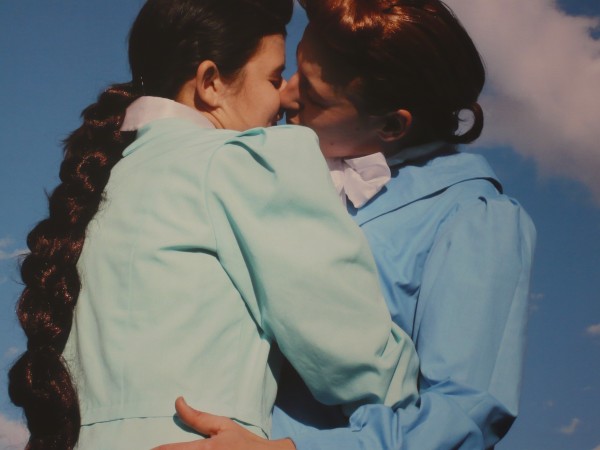
    Angela Ellsworth, "Untitled," 2011.

    It’s difficult for perversity to hold its own when the parameters that define what’s expected or proscribed are undercut (could “proscribed” and “perverse” be antonyms?)—“Perversions are often phantasms spun by jurisprudence,” wrote Wayne Koestenbaum, in the same essay in which he posited perversities as “a continuum of harmless grays.” There are a good number of grays in D’Allesandro’s stories and even more in Jancar Gallery’s current exhibition, Narratives of the Perverse – II (I occurred in 2008), a show that’s intergenerational and amorphous. Despite its title, Narratives functions more as a list than as a story, an enumeration of perversions, some political, pornographic, decorative, exploitative, explicit, and all somehow tied to how you assert or lose yourself while trying to connect with others. With thirty-eight artists and work hung upstairs, downstairs, in the alcove between desk and wall and in the stairwell, it’s a promiscuous exhibition. But it doesn’t feel overfull.

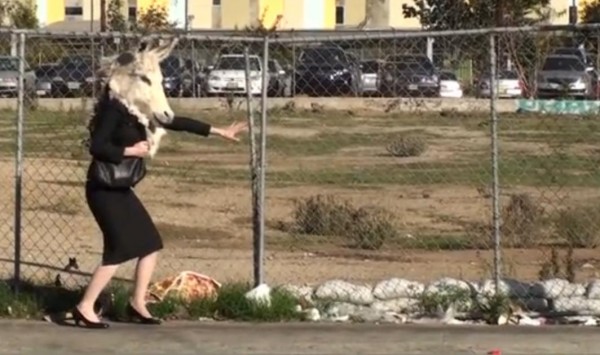
    In Dorit Cypis’ 1987 photograph The Nervous System: Mother and Child, a pink, frilly, sinister image, a toddler holds her dress over her mother’s face in a way that connotes either precocious murder, or a forced pedophilia. In Angela Ellsworth’s Untitled, two girls with heavy braids, who could’ve come from Yearning for Zion Ranch, are about to gently kiss, putting the conservative, repressed wholesomeness of their appearance into intimate contact with the liberation tied up in girl-on-girl loving. There’s no shame in Ellsworth’s image, but there is in Elana Mann’s 2009 video Ass on the Street, where the artist wears an ass’s head and feels her way down a South L.A. street. Her body’s timidity and the simplicity of her black outfit makes the expression of perversity (she’s openly being an ass) seem wrong, like a Scarlett letter, and, as moving through the world with an ass head makes it difficult to see where you’re going but easy for everyone else to tell, Mann places herself at the mercy of others even though she can’t really engage them at all.

    Elana Mann, "Ass on the Street," video still, 2009.

    Annie Sprinkle and Elizabeth Stephens can and do engage one another in their collaborative Ecosexual, a kitschy, defiant image of Sprinkle with legs spread and Stephens standing above. The couple has now been married six times and hosted six different weddings in the past six years, ever since their planned legal one was denied. This print corresponds with the most recent. It’s a performance of promiscuous commitment–wanting the right kind of togetherness but wanting it wrongly.

    “I did not want comfort,” wrote Sam D’Allesandro, not in the story Coburn read but in another, titled Nothing Ever Just Disappears. “I did not want to be comfortable with not seeking comfort or predictability . . . I wanted to be challenged, but not in pain.” The most heartening trait of Narratives of the Perverse II‘s is its ability, as an unweildy collective, to be comfortable with the discomfort of wanting and not wanting in ways that aren’t sanctioned, destabilizing perversity as taboo while still allowing for the confusion of a series of “harmless grays.”

    Share

    The Rape of the Sabine Women: Eve Sussman and Rufus Corporation at Impronte Art

    Eve Sussman | Rufus Corporation, Marilisa Reflected, 2005. Photo by Ricoh Gerbl. Courtesy Impronte contemporary art.

    The abridged version of the story goes something like this: Shortly after the founding of Rome, the local men noticed a decided lack of ladies with which to start families. They attempted to negotiate a deal for some of the women of neighboring tribes, known as Sabine; however, the patriarchs of those tribes refused. Plan B was to arrange a great feast, invite all the neighbors, and then kidnap the females, which is exactly what happened. Some histories are adamant here that no sexual assault actually took place, that the ‘rape’ was in fact an abduction. The Sabine women were then offered marriage with Romans, along with civic and property rights and the privilege of mothering free men. Later, as the Sabine tribes confronted Rome in an attempt to reclaim their daughters, the Sabine-Roman wives intervened, begging their fathers and husbands to cease combat, in fear of being orphaned or widowed. And the war was ended, thus sealing the destiny of Western civilization.

    Eve Sussman, in collaboration with the improvisational players known as the Rufus Corporation, stages her revision of The Rape of the Sabine Women in an idyllic 1960’s setting, filmed on location in Greece and Germany. Having been shown, since its release in 2007, at major international exhibitions in New York, London, San Francisco, and Berlin, among other venues, The Rape… is now premiering in Italy, screening at Impronte Contemporary Art in Milan through March 19. This 80-minute ensemble-musical without dialogue, in 5 acts, is filled to overflowing, cinematically. Its slow, sumptuous shots, voluminous and heavily pitched sound, dramatic staging, and densely packed art-historical references lend themselves to a deeply self-conscious and masterful, if overwrought, work of filmmaking. This piece never loses sight of itself.

    Eve Sussman | Rufus Corporation, Annette with Rabbits, 2005. Photo by Benedikt Partenheimer. Courtesy of Impronte contemporary art.

    The Romans here are costumed in dark business suits and ties, hovering somewhere between the glamour of double-oh-seven spy-culture and the comforting anonymity of the everyday corporate employee. The Sabine women recall Holly Golightly in mod shift dresses and big dark sunglasses, all against an opulent backdrop of sleek mid-century (and at times, ancient) architecture and design. The characteristic representation of Roman-Sabine married life is a drawn-out summer party scene at a lavish mid-century vacation home, in which affections are openly shared, alcohol flows freely, and cigarette smoke obscures our vision. Sussman provides viewers with a re-imagined fantasy of indulgence, affluence, and Roman excess.

    But (spoiler alert!) the modern paradise collapses in on itself at the culmination of the film, as a slow, fraught battle ensues between the men and, though the women attempt to intercede, the struggle continues to utter destruction. And in the end, I’m compelled to consider the value of the feminine role in this version. Whereas, in the original legend, the Sabine women were venerated for their heroic halt of the conflict, here they are unwary co-conspirators in bringing forth the decline of a deceptively prosperous dreamworld. This myth of love in the face of adversity, buoying the frenetic rise of a civilization, is recast instead as the final fall, no thanks to the ladies, of an overly idealized utopia.

    Share

    Iain Forsyth & Jane Pollard: PUBLICSFEAR

    Or ‘The manipulation of mind and memory…’

    Iain Forsyth & Jane Pollard, File Under Sacred Music, 2003. Production still. Image courtesy of the Artist and Kate MacGarry, London.

    British duo Iain Forsyth & Jane Pollard are masterminds of re-enactment as an art form. Their current exhibition at the South London Gallery opens onto one of the best examples of this with the seminal work, File Under Sacred Music. This painstakingly detailed and dead-on remake of the infamous bootleg video of The Cramps’ live performance at the Napa State Mental Institution in California in 1978, was meticulously re-staged by Forsyth & Pollard at the ICA in 2003. With grainy, damaged images, delays, jumps, gaps and feedback, there is nothing about this footage that would distinguish it from an original, straight from the 70s, carelessly-shot home video.

    Iain Forsyth & Jane Pollard, File under Sacred Music, 2003. Production still. Image courtesy of the Artists and Kate MacGarry, London.

    Music has always permeated the work of Forsyth & Pollard, and it extends through explicitly here not only in subject matter but choice of collaborators as well. Their nod to Bruce Nauman’s Art Make-Up (1967-68) features the world’s longest running Kiss tribute band, Dressed To Kill.

    Iain Forsyth & Jane Pollard, Kiss My Nauman, 2007. Production still. Image courtesy of the Artists and Kate MacGarry, London.

    The work, cheekily titled Kiss My Nauman, is a forty-seven minute video installation that follows the members of the band as the carefully apply their stage make-up, allowing us to witness their transformation into their alter-egos. Nauman’s singular performance where he successively paints his face white, pink, green and finally black, is fractured into four screens, four bodies and four identities that are culturally specific and locatable. It is a re-enactment of Nauman’s work by a band whose have made a livelihood of nightly re-performance. Everything here has a reference in the past.

    Forsyth & Pollard’s work continually re-performs history, and by doing so, attempts to transfer the past into the present, collapsing the linearity of time. The past is relocated into the present and the present indistinguishable from the past, creating a sense of displacement that runs through the work.

    Iain Forsyth & Jane Pollard, Silent Sound, 2006. Installation shot. Image courtesy of the Artists and Kate MacGarry, London.

    Silent Sound is the only work in the exhibition that does not use video as a medium to perform re-enactment. Instead it is primarily an audio installation (although there is always a visual accompaniment of some sorts…) based on a 2006 work originally performed live in Liverpool.

    As we are warned upon entry:

    ‘You are about to enter Silent Sound, an ambisonic installation with a subliminal message.’

    The work was inspired by a public seance presented by Victorian entertainers Ira and William Davenport in 1865 and the ongoing interest of the artists in methods of silent, non-verbal communication. During the original live performance Forsyth & Pollard repeated a secret phrase into a microphone which was embedded within the ambient music that filled a concert hall and now fills a black box in the South London gallery.

    In an attempt to get inside your mind, Forsyth & Pollard worked closely with a former employee of the American Ministry of Defence’s ‘non-lethal weapons’ programme which allegedly exploited the power of subconscious messaging as a military strategy. Immersion is the key here, not only in the subliminal sense, but also in a time past. While based on parapsychology, these voices are not speaking to you from beyond the grave, but they are speaking to you from the past, a inaudible message replayed here in the present. A presence that cannot be heard, or seen, but as the artists argue, will affect you and be taken forth into the future.

    What is the message the artists are trying to spread? We don’t know – all we are told is the following:

    ‘The signal needs to be carried. The truth doesn’t matter.’

    What does music meant to manipulate your mind sound like? A soothing, yet emotionally charged classical composition – calm, beautiful, haunting, electrifying….

    Share