Scott Treleaven at Silverman Gallery

In the 1990s, Scott Treleaven was best known as a film and zine-maker. Toronto-bred and living in Paris, Treleaven had made a name for himself through his zine, Salivation Army, which he filled with collage, drawings, 35mm photographs and sprawling notes. It was a meeting place of Queer, occult, and punk interests, if you can imagine such a wild thing.

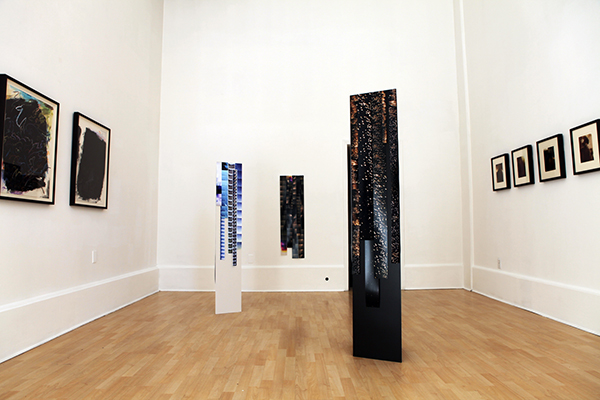
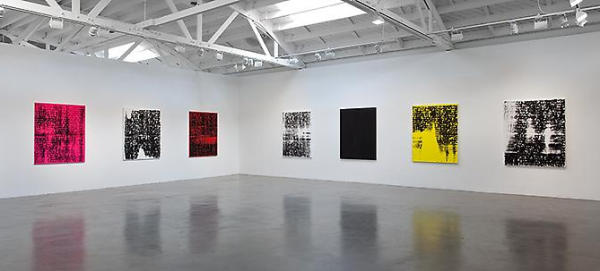
Installation view, Scott Treleaven, 2011, Image courtesy of the Silverman Gallery

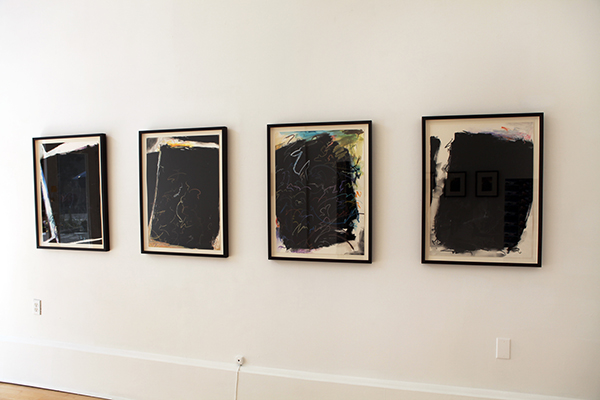
Treleaven’s new show at Silverman Gallery in San Francisco is an evolution of his genre-crossing method. It employs drawing, photography and sculpture, though delineating between them feels counterproductive, as all his mediums consciously overlap. Upon first glance, the work almost appears to have been made by several artists. On the rightmost wall hang multiple small and near-monotone 35mm images of objects photographed through aging second-hand mirrors, titled Portal Photographs, while the leftmost wall features large, abstract collages obscuring painted images, titled Cell Drawings, with a gestural effect that recalls Cy Twombly’s expressionistic mark-making. Separately, each set of works refuses narrative, but together, they engage in dialogue.

Cell Drawings (2011), Scott Treleaven, Image courtesy of the Silverman Gallery

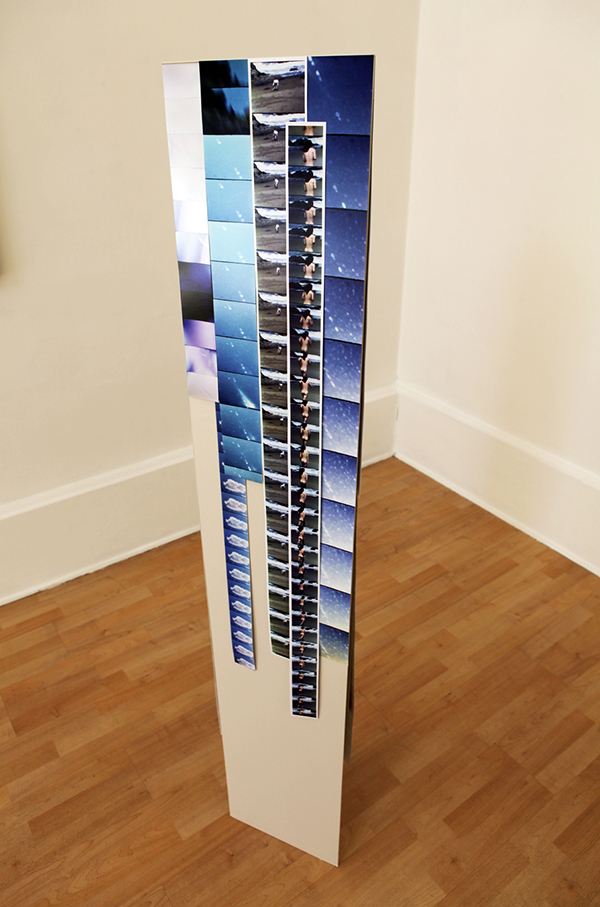
The substance of the show, however, is the pillars in the center of the floor (Totems, 2011). Standing between four and six feet high, the triangular-shaped Totems are draped with scanned and printed C-prints from Treleaven’s own super-8 films: film strips made positive. Secured only at the top of each pillar, they hang loosely and overlap to form an object equal parts collage, photograph, and sculpture. Two out of the three are totally abstract, featuring moments of color and lens flare from the films. The third pillar intermixes frames of light, sky, and a nude young man running away from the camera with a white dog seemingly in tow. These stills, drawn from a visit to Marshall’s Beach in the Presidio, provide the one moment in the entire show in which a narrative becomes fleetingly imaginable. In relation to the mediated abstractions that encircle it, the encounter with a recognizable sense of scale and time is disquieting.

Untitled (Totem II, 2011), Scott Treleaven, Image courtesy of the Silverman Gallery

Still, much like a zine refuses the sequential structure of a book, the result here is a story that goes nowhere, a memory that’s slipping away before our eyes. Using film and photography to deny, rather than affirm, narrative is a strange thing indeed, and the effect here is at once haunting and sentimental.

Share

The Nature of Change: Hybridity and Mutation

Before we go any further there is a confession I should make – I have a slight obsession with art that is visceral, uncomfortable and generally disturbing. Something my friend David – a mutual adorer – once designated ‘the creep factor.’ So when I first laid eyes on images from HRL Contemporary’s upcoming show The Nature of Change: Hybridity and Mutation I was hoping to find something to satisfy my grotesque sensibilities.

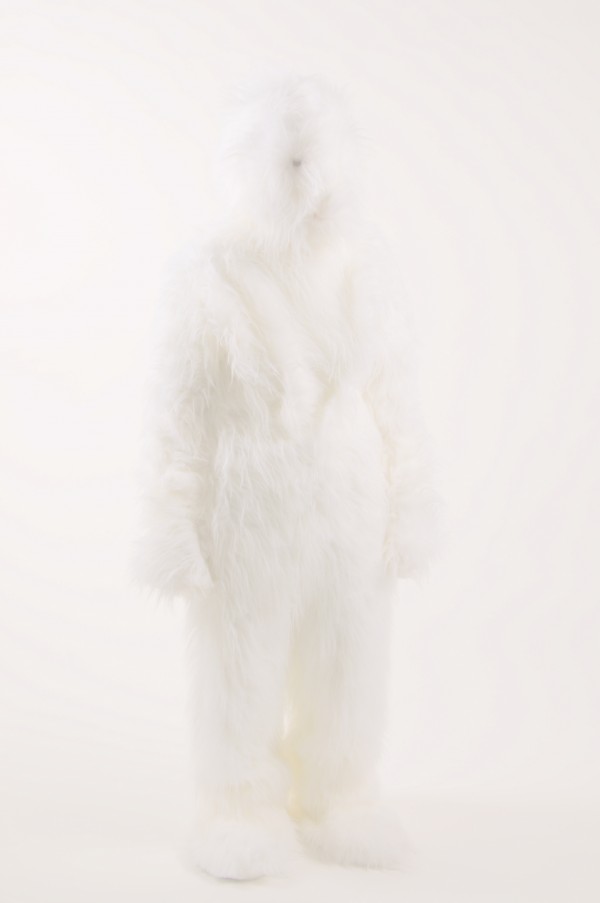
Kayde Anobile, Portrait of a Creature, 2011. Image courtesy of the Artist and HRL Contemporary.

Hybridity and mutation are taken as a starting point here and spun out through materials, processes and subject matter. Applaudingly, this is not a shock value show of cyborgs and monsters, but is rather polished and leans more towards the unexpected and the uncanny. The ‘creeperies’ found here have a poetic and sensitively commentative approach.

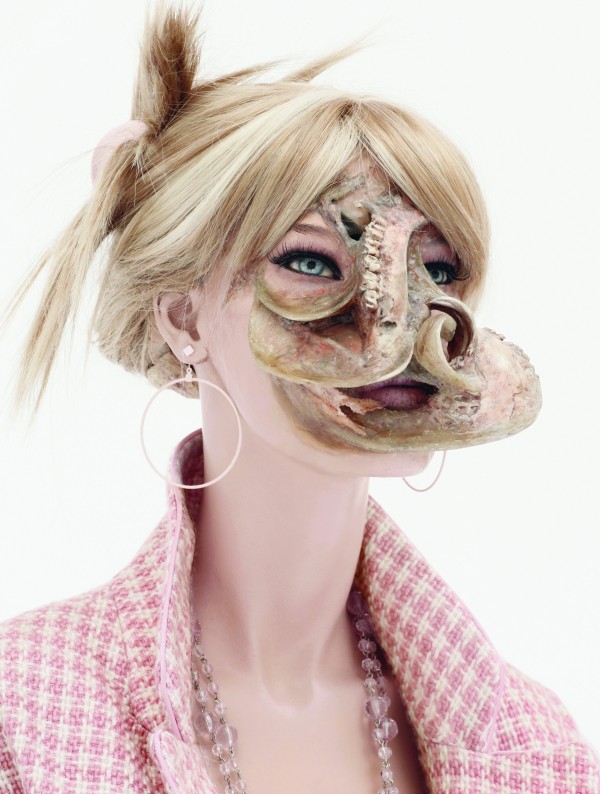
In Kayde Anobile’s installation, Portrait of a Creature, two life sizes yetis face a mirror affixed to the wall, and as you take your place in between them, three faces stare back. These creatures are not monstrous, but rather quite human-like. They stare into the mirror in a state of existential contemplation, their images reflected back to us just the same as ours are.

David A Smith, Banshee, 2011. Image courtesy of the Artist and HRL Contemporary.

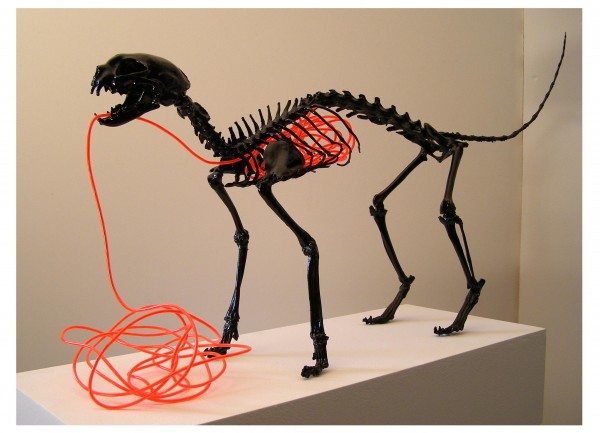
London-based sculptor David A Smith creates organic hybrid sculptures made of glaringly inorganic materials. Fusing skeletal forms with seductive materials, Smith’s enticingly slick animals vomit up their phosphorescent insides, as in ‘Banshee’ – an excavated prehistoric form constructed of conspicuous synthetic products.

Jan Manski, Onania - The Onaniser Strain, 2010. Image courtesy of the Artist and HRL Contemporary.

Throughout the exhibition hybridity is found in both form and subject matter, however the most striking work is that which tears into the blatant consumerism of contemporary society.

Jan Manski’s work in its wholly complex and all-encompassing narrative approaches that of Matthew Barney, without the self-mythologising and machoism. Manski’s work takes on the guise of a slick advertising campaign for the ultimate self-gratifying consumer item – the Onania.

Jan Manski, Onania - Aetiology Unknown 27, 2010. Image courtesy of the Artist and HRL Contemporary.

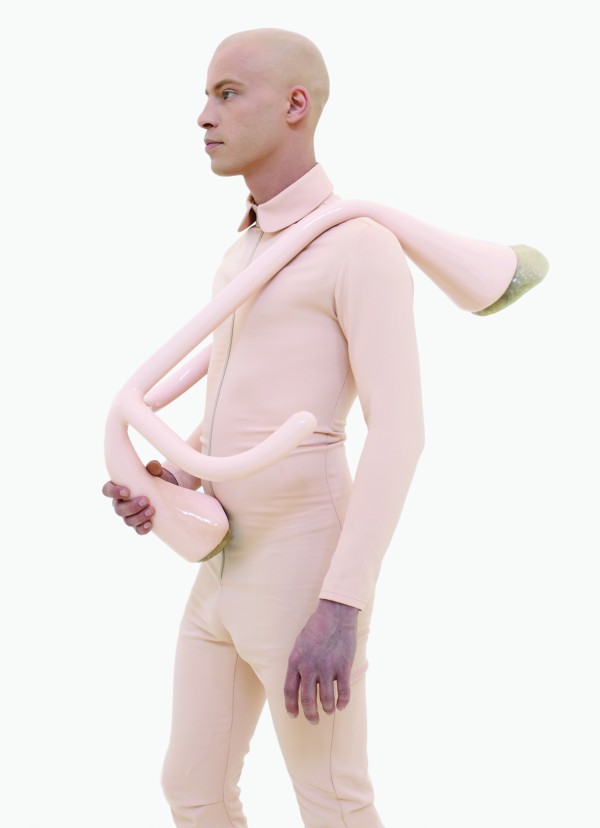
A hybrid masturbatory device combining organic and inorganic substrates, the Onania is billed as ‘the ultimate modern plaything.’ As the video advertisement shows, this sickly pink device promises to tap into neural networks, creating a cyclical escalation of ultimate pleasure.

Forcing the user into an isolated and narcissistic existence is not the only concern – as the photographs show, the Onania has horribly disfiguring side-effects, as insides force themselves out, creating bony bulbous growths on the sites of attachment. A self-inflicted mutation brought on by the desire for self-sufficient satisfaction.

As Manski shows us, for the ultimate in pleasure there is a price to be paid – and it is quite horrific.

Share

From the DS Archives: Glenn Ligon

This Sunday, From the DS Archives takes a second look at New York-based artist Glenn Ligon. Ligon is currently the subject of a mid-career retrospective at the Whitney Museum of American Art, an exhibition that will travel on to the Los Angeles County Museum of Art in fall 2011 and the Modern Art Museum of Fort Worth in early 2012. Ligon’s most iconic works, namely his celebrated text-based paintings, will be presently alongside previously unexhibited early paintings and drawings, offering the opportunity to reexamine his origins as an artist.

This article was originally written by Seth Curcio on December 24, 2009.

Picture 1

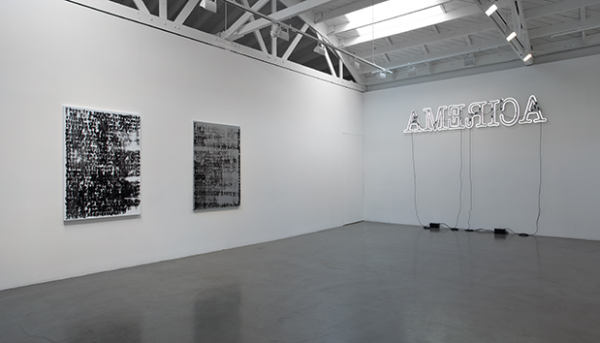
Off Book is the title of a current exhibition by acclaimed New York based conceptual artist Glenn Ligon. The exhibition, which is on view through January 23rd at Los Angeles’ Regen Projects, continues the artist’s investigation of cultural identity, social and historical constructs, language, race, and gender. Similar to previous exhibitions by the artist, Off Book explores these ideas through text-based work, installation, and video. This new series of works investigate many themes discussed in James Baldwin‘s essay entitled Figure, originally published in 1953. For this series, the artist has silk screened versions of existing text-based paintings onto colored backgrounds, and then dusted the surface with coal particles. The result is a semi-abstracted surface where the test is obscured through the application of the screen print.  Also on view is a 16 mm black and white film titled, The Death of Tom, and a neon piece, which features the word AMERICA backwards, titled Rügenfigur.

Picture 2

Ligon’s work has been the focus of several major international exhibitions. The artist’s work was selected by the Obama’s to be on loan at the White House. This inclusion made Ligon the youngest artist ever to receive this honor. Recent solo exhibitions for the artist include, ‘Nobody’ and Other Songs at Thomas Dane Gallery in London and Figure/Paysage/Marine at Yvon Lambert in Paris and Love and Theft at Power House in Memphis. The artist is a graduate of Wesleyan University and Rhode Island School of Art and Design. Ligon lives and works in New York City.

Share

Marilyn Minter’s Paintings from the ’80s [NSFW]

Today’s article is brought to us from our friends at Flavorwire, where Rozalia Jovanovic discusses Marilyn Minter’s works from the 1980’s. Two distinct bodies of work from this period are on view at Team Gallery in New York City.

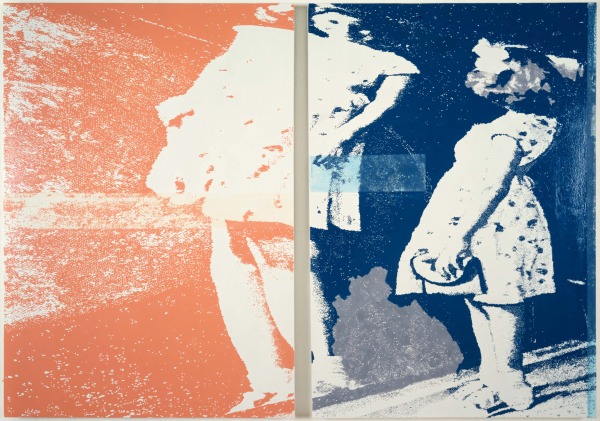
Marilyn Minter, Little Girls #3, 1987. Enamel on canvas. Two panels. © Marilyn Minter Courtesy Team Gallery

Appropriation, commodification, and the body are some themes from the ’80s art-world discourse that artist Marilyn Minter embraced in her paintings from that time period, a selection of which comprise a new exhibit at New York’s Team Gallery. The pieces on display are taken from two bodies of work, Minter’s Big Girls/Little Girls series and her Porn Grids, a representation of “money shots” from porn flicks. Minter’s ben-day dot images on enamel and metal surfaces of glamorous women, prim girls, and erect penises are suffused with an undercurrent of dark optimism. While her images were controversial when first shown in the mid-to-late ’80s, her intent was to explore the pro-sex feminism that was just beginning to take shape earlier in the decade. Click through for a slideshow of some of her best raunchy, glam, and always rigorous output.

Click here to view more images.

Share

Fandom

L.A. Expanded: Notes from the West Coast
A weekly column by Catherine Wagley

Elizabeth Taylor and Noel Coward, still from "Boom!," 1968, dir. Joseph Losey, screenplay by Tennessee Williams.

It makes a weird kind of sense that Elizabeth Taylor, who managed to move from sweetheart to sexpot to scandal then back to sweetheart more gracefully than any actress on record, would die the week of Tennessee Williams’ centennial. The playwright, not unlike the actress, had a remarkable knack for being glamorous and tawdry, Pulitzer-worthy and tabloid-ready at the same time. The two even followed one another’s trajectories—or, more likely, helped shape one another’s trajectories.

Williams would complete Cat on a Hot Tin Roof in 1954, debut it on Broadway in 1955 and win his second Pulitzer for it just as Taylor was preparing for Giant, her first truly memorable film as a grown-up. Then, in 1957, Taylor would sign on to star in the film version of Cat and, in ’58, snag an Academy Award nomination for her beautifully bitchy turn as Maggie. A year later, she’d receive another nomination for another Williams’ role: as the more tender Catherine who’s trying her darndest not to be lobotomized in Suddenly, Last Summer, the screen adaptation of which (Gore Vidal helped write it) cloaked all reference to homosexuality in an eerie haze.

If they flourished together, Williams and Taylor floundered together too. A decade after Suddenly, Taylor, addicted to pain killers and prone to illness, had lost five husbands and was four years into her first of two taboo-soaked marriages to Richard Burton; Williams was five years into a dark depression. The two teamed up again, but this time for a project critics savaged. In Boom!, Taylor plays an ailing husband killer who lives on her very own island, while Burton acts a stranded mystery man and Noel Coward appears as the psychic “Witch of Capri.” The footage feels like something out of a dystopian romance novel and John Waters called it “one of the most gloriously failed art films ever.” In 1989, five years after Williams’ too-early death and the same year Taylor checked out of the Betty Ford Clinic for the second time, the actress played a sinking screen siren in a made-for-TV rendition of Williams’ Sweet Bird of Youth.

“She’s the opposite of her public image,” Williams said of Taylor two years before his death. “She’s not a bitch, even though her life has been a very hell. . . . Pain and pain. She’s so delicate, fragile really.”

“I adored Tennessee,” Taylor said of Williams. “He was hopelessly naive, however.”

Justin Lowe, Untitled, 2011, collage, 10 x 8 inches. Courtesy of the artist and Pepin Moore, Los Angeles.

The Tennessee whose bust was on a chocolate cake at Skylight Books in Los Feliz last Sunday did not look naïve. He looked dapper and slyly omniscient. In celebration of what would have been the playwright’s 100th birthday, Skylight staged an afternoon of readings that ended with  playwright Chris Phillips’ tribute, Garden District, set to debut at Celebration Theater in May. Like the best of devoted, obsessive fans, Phillips has trolled through Williams and unpacked the stories behind the stories, fixating on the three gay men whose deaths spur the plots of Williams’ most iconic plays: Cat on a Hot Tin Roof, Suddenly, Last Summer and Streetcar Named Desire. The scene read on Sunday was between Maggie—Taylor’s role, here played by redhead Karah Donovan with an inebriating Southern drawl—and Skipper, the best friend of Maggie’s husband Brick; Maggie eggs Skipper into admitting he’s been in love with Brick.

The play, in its entirety, will likely be charming—Phillips channels Williams-esque verve with a precision that must be difficult to come by. Still, the project feels a bit like teenage love, the sort that makes you believe saying what your object of desire has left unsaid is equivalent to intimacy.

The Williams centennial reminded me of a different kind of precise and obsessive fandom: the kind at play in Justin Lowe’s frayed collages, currently on view in his exhibition Hair of the Dog at Pepin Moore. Small, smartly assembled, and all culled from trade paperbacks of the ’60s and ’70s, the collages recalls Boom! with their surreal aesthetic and borderline vulgar romanticism. Instead of unpacking and exposing, Lowe has allowed the mystery of his already-strange sources to swell. The psychedelic is compounded by the exotic, the criminal tied up with the sacred, the primitive paired with the polemical and the hopeful with the fatal, until trashy paperbacks feel as weighty and terrifying as Lord of the Flies. Reverence for the mystique of what you’ve immersed yourself in: that’s a fandom with cavernous possibilities.

Justin Lowe, Untitled, 2011, collage 5 x 11 inches. Courtesy of the artist and Pepin Moore, Los Angeles.

One of Lowe’s images strikes me as particularly inspired. It starts on the left with a dinosaur gazing at a haggard cross–a confluence of eons of real and imagined time–and ends with on the right with a man furtively disappearing into a dark city. It makes mortality feel like a slippery, sci-fi crime novel. It also reminds me of this, an experience Tennessee Williams described in the Paris Review: “I do think there was a night when I nearly died, or possibly did die. I had a strange, mystical feeling, as if I were seeing a golden light.” He added, “Elizabeth Taylor had the same experience.” It sounds as pulpy as a paperback (he saw a golden light?), but Williams, Taylor and, it seems, Lowe, all prove that pulp has an unmatchable potential for veracity.


Share

Manifest.AR at the ICA, Boston

This spring, the Manifest.AR collective is presenting new and established augmented reality (AR) artworks at the ICA during the 2011 Boston Cyberarts festival. Approximately 16 artists will present their incorporeal digital art in and around the ICA. Some will be site-specific works that respond to the architecture of the museum and some will aim to juxtapose their work against the existing physical exhibitions in the museum. There will be visitors to Manifest.AR @ ICA that won’t know what to think about the artworks confronting them and many will just not see the works. Stepping beyond Oscar Wilde’s request that we intensely admire the uselessness of art, the AR works are indirect, mediated works that are only accessible with smart phones. I’m sure he would have praised these undetectable artworks as the highest form of art.

John Craig Freeman, Tiananmen SquARed, 2011 All images courtesy of the artist.

AR artworks are still in their infancy. Although AR works are not dependent upon smart phones, since the release of the iPhone in 2007, AR works have been inclined to use the phone as an access device. One of the first AR applications in art was presented during the 2001 Cyberarts festival. It took the form of a pair of “glasses” made out of video monitors that reacted to printed graphics in the gallery. From a wider perspective, the presentation ethic, unauthorized superimposition of work within an institution, is an old technique– think Banksy installing his own work into four New York museums in a single day. Manifest.AR, or its members (the collective was founded in January of 2011), have intervened at the MoMA, Statue of Liberty, Venice Biennial, Anslem Keifer‘s exhibition at Gagosian, the White House, and the Pentagon. This intervention is one of the first working with a museum’s blessing and even has an informal educational reception scheduled for April 22.

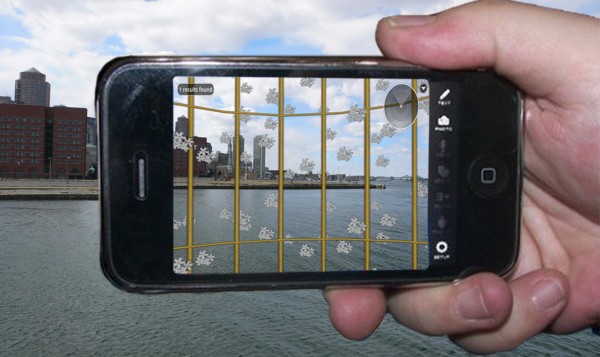
Tamiko Thiel, Jasmine Rain, 2011

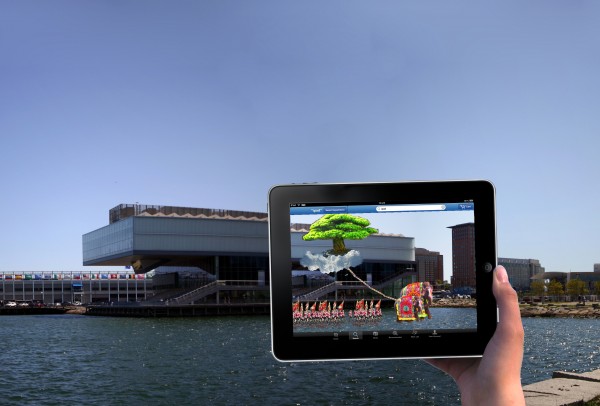
The disembodied art on display include (in collaboration with Damon Loren Baker and Arthur Peters) Mark Skwarek‘s Parade to Hope that will be located in the Boston harbor. John Craig Freeman will be exhibiting Tank Man and Goddess of Democracy as one work, Tiananmen SquARed. Both of these images draw from the 1989 Tiananmen Square protests. Tamiko Thiel will present Jasmine Rain, a soft-curtain of Jasmine flowers falling around a golden cage that surrounds the viewer. Will Pappenheimer will present his signature psychedelic AR toads. Geoffrey Alan Rhodes will be exhibiting a new work titled MaoDoll(ar). His past works are compelling and sensitive to what’s possible within the AR vocabulary. Sander Veenhof, who made the worlds biggest AR work, a carpet of cubes surrounding the entire earth, will be presenting a minimalist take on the AR titled 1px. It’s sure to push the definition of what an AR work can and should be.

Mark Skwarek Parade to Hope, 2011

Manifest.AR @ ICA will be viewable from April 22 – May 8, 2011 and is part of the Boston Cyberarts Festival 2011. To see the works, you will need a device that can run the Layar AR app.

Share

Viewshed: Sean McFarland at Baer Ridgway Exhibitions

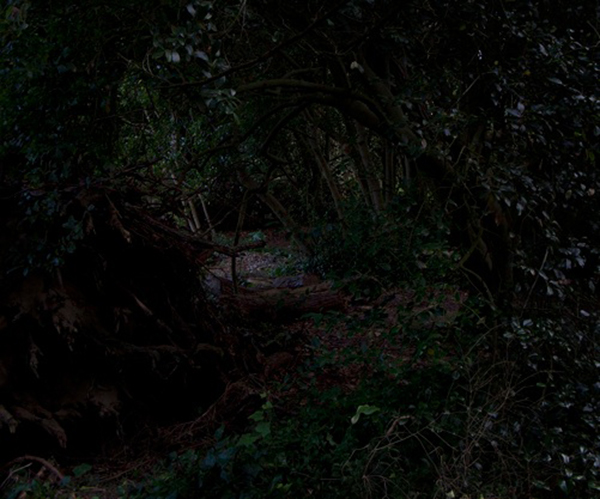
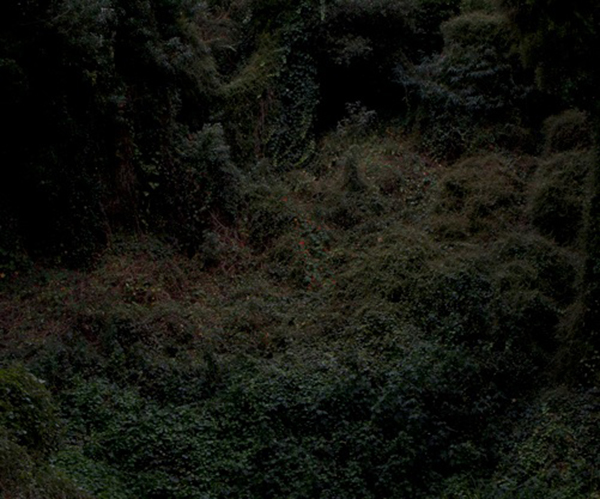
One offshoot of photography is the debate over the authority we give it, a fact that San Francisco artist Sean McFarland plays with in Viewshed, a solo show up this month at Baer Ridgway ExhibitionsViewshed contains two separate but related bodies of work: Dark Pictures, a series of large, extremely dark but detailed photographs taken of what look like wild and wooded landscapes; and Pictures of Earth, small, black-and-white polaroids of mostly aerial landscapes.  In each case, however, nothing is what it seems.  Thankfully, McFarland has such tight control over his sleight of hand that the questions Viewshed poses never become obvious or didactic.

Exit (2010), Sean McFarland, C-Print, Image courtesy of Baer Ridgway Exhibitions

Dark Pictures delivers what its title promises: a series of artfully underexposed, too-closely-cropped wilderness shots.  Seen live, the effect is similar to a daguerreotype, with each image so dark that you find yourself squinting to see better.  As your eyes become used to the darkness, the lushness of the individual details stands out.  In Wall of Plants (2010-2011), thousands of pieces of foliage compete for attention, a battle ultimately won by color alone: a single strand of muted-red ivy weaves its way through the rest of the plants.

Wall of Plants (2010-2011), Sean McFarland, C-Print, Image courtesy of Baer Ridgway Exhibitions

Eventually, the tight cropping of the images in Dark Pictures and the lack of any traditional “vistas” become cues of their own, leaving us wonder what may have been left out.  It’s not a giveaway, however.  The fact that these are actually images of urban “wildernesses” shot within a few miles of McFarland’s house (often during daylight) remains available but not noticeable.

Wave (2009), Sean McFarland, Polaroid, 3.25 x 4.25 inches, Image courtesy of Baer Ridgway Exhibitions

Pictures of Earth functions similarly.  In this case, McFarland gives viewers a group of lilting black-and-white polaroids showcasing mountaintops, billowing clouds caught in forested valleys, and rolling hills bathed in sunlight.  What is almost impossible to see are the alterations that McFarland has made in his studio, or even in the taking of the photos themselves.  What looks like the top of a rolling hill set against a starry night sky is actually an image of the ocean (Wave, 2009); a divided landscape was divided after the fact by McFarland’s own marker-wielding hand (Divided Land, 2010).

Divided Land (2010), Sean McFarland, Polaroid, 3.25 x 4.25 inches, Image courtesy of Baer Ridgway Exhibitions

The modern human is a funny beast.  Despite the fact that we acknowledge how each person views the world as an individual, we also continue to insist that some view(sheds) are more accurate, or have more authority, than others.  Without forcing the question, Viewshed gives it us space to wonder what happens when the object photographed misrepresents itself?  Or, perhaps, never existed in the first place.

Share