Photographing Art in the Streets

L.A. Expanded: Notes from the West Coast
A weekly column by Catherine Wagley
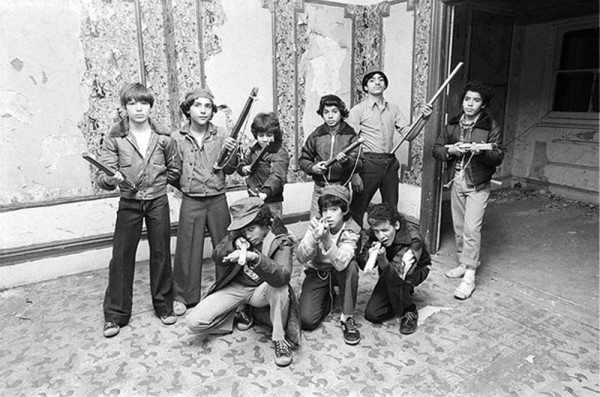
Martha Cooper, "Defiant Youth"

Larry Clark’s mother was an itinerant baby photographer, and she took her son with her on her rounds. This means that Clark, the photographer famous/infamous for his grittily voyeuristic depictions of youth culture, began photographing kids when he still was one. Before he reached 20, he was taking his camera deep into a late 1960s and ‘70s drug culture, documenting the experience in a way that often seemed more persuasively visceral than it probably seemed in real life. Later, he’d shadow skaters and other young creatives, obsessively immersing himself in the worlds of his subjects.

Clark is a lifestyle artist, but not of that holistic, spiritualistic or narcissistically new age “life is art and art is life” vein. He’s the kind who is just interested in doing what he wants to do and doesn’t over-fixate on boundary-crossing—or maybe fixates about boundary-crossing to the exclusion of all else.

This sensibility is what connects Clark with a good number of the street artists who share space with him in MOCA LA’s current controversial street art blockbuster, Art in the Streets. But it’s not what makes his work so well-suited to the exhibition. It’s that Clark, like most of the other photographers who appear, is really good at capturing the vibe of a given community—it’s exclusivity, its urgency, it’s quirks and attitudes.
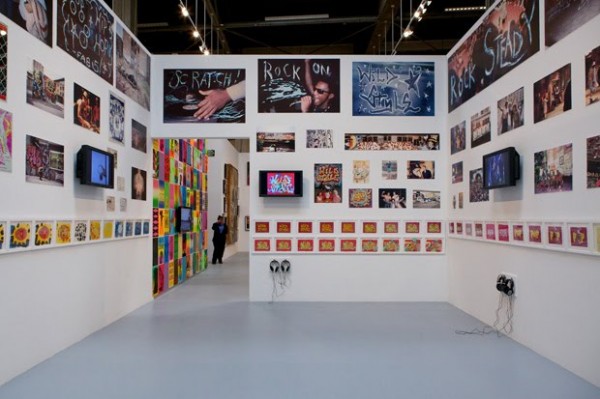
Installation View of Art in the Streets at MOCA

I’m not the first to thrill over the inclusion of such a strong posse of art and journalistic photographers in Art in the Streets. It more or less pulls the exhibition out of the realm of showmanship and into a softer, smarter realm of reflection. While Banksy’s alleyways and dank walls, as dark and melodramatic as a haunted house, and Barry McGee’s  five life-size sculpted taggers standing above in overturned car make it glaringly obvious that you are not in the street, but instead in a weird performance of “streetiness,” the photography pulls you back into the spaces and lifestyles this work emerged out of. Along with Clark, the show features work by photographers (and filmmakers) Martha Cooper, Henry Chalfant, Cheryl Dunn, Ed Templeton, Terry Richardson, Teen Witch and others. Each captures the sense of community and restlessness, and also the thrill of tagging and train-riding and working your way into a subculture that makes sense to you.

One of Henry Chalfant's photographed subway trains

Henry Chalfant’s rows of tagged subways make street art look like a renegade urban beautification project, while Cooper’s wall of artists–many not included in the exhibition, some no longer living–shows the diversity and sameness of street arts participants; despite different skin color and stature, all are young and defiant and totally seductive as personas. Teen Witch’s fresher, newer images shows a coterie of friends still just as rebellious and self-contained as the groups depicted in the more historical photographs.  The photography makes the show, I think. It brings the art back into the street, not literally, of course, but effectively.

Share

Remembering The Undressed Majesty Of His Paintings

Lucian Freud, Reflection (Self Portrait), 1985

Today’s article is brought to you from our friends at the Huffington Post, written by Edward Goldman.

The death of great cultural figures always prompts us to assess their impact on art and, ultimately, on the way we perceive ourselves. The recent death of the great painter, Lucian Freud (1922 -2011), at the age of 88, is definitely one of these occasions. Through more than six decades of his career, he stubbornly clung to the particular subject that defines his art: the human body, in all its dark glory. The artist was the grandson of Sigmund Freud. His family left Germany for England in 1933, and that’s where Lucian got his education and lived all his life. Not being fond of traveling, he stayed mostly in London.

When the Metropolitan Museum, in 1993, presented an ambitious, in-depth exhibition devoted to the art of this great painter, it was not only Lucian Freud’s first museum exhibition in the United States, but it was the first retrospective the Met gave to a living artist ever. For me, it was the first encounter with the artist’s work, and I remember walking slowly, entranced by the power emanating from his paintings, with their piles of naked, often grotesque bodies. Even the portraits of somber-looking, fully-clothed people looked as if they’d been undressed by the artist’s eye and completely exposed by his brush.

Continue to full article.

Share

Hockney’s Digital Stroke

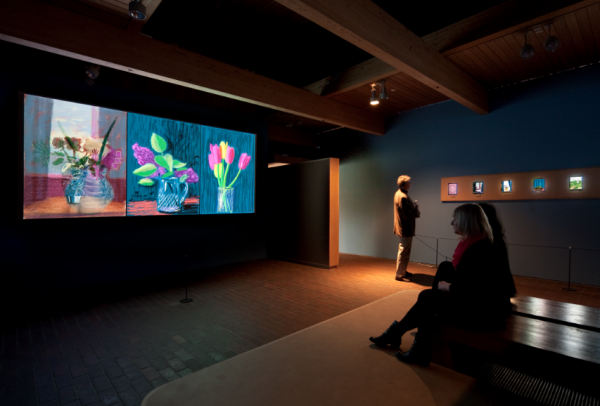
David Hockney, Untitled 26 December 2010, iPad Drawing. Courtesy of Louisiana Museum of Modern Art.

David Hockney included himself among the iPad’s expectant lovers. Since 2008 he’s used the application Brushes to draw on his iPhone—but what he can do with the app on the oversized model, oh. He can draw with multiple fingers and recently a stylus.

His show Me Draw on iPad is exhibiting until August 28th at Louisiana Museum of Modern Art, outside of Copenhagen, Denmark. 20 iPod touches, 20 iPads and a triptych slide loop through several hundred still lifes, landscapes, portraits and self-portraits looking, I think, especially Matisse. On display the bright screens color in the dark galleries like panes of stained glass, what else. They light like the screens we hood our hands over in movie theaters. And, how weird—to come to a museum to stare into a face probably like the one stifled on your person.

Courtesy of Louisiana Museum of Modern Art. Photo credit: Brøndum / Poul Buchard.

One iPad drawing reads,

made for

the screen

totally on

the screen

it’s not an

illusion

I am able to watch these works come into being thanks to an animation playback feature—the ghost in the machine going through the motions again, his intense lines. Someone at my shoulder remarks, “Det godt.” It’s good.

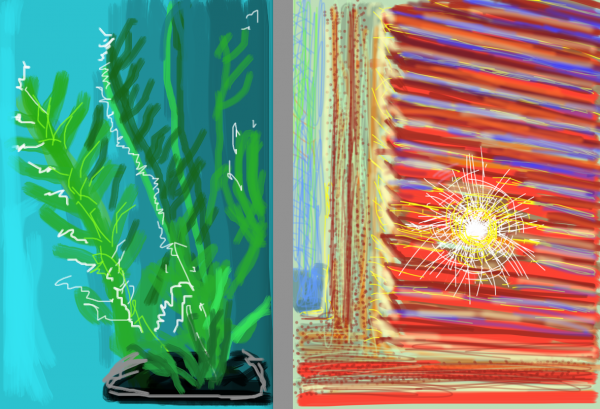
There is no saying what the implications of this new form are for making. The form is easy-to-access and convenient-to-create. Apps aren’t messy, no. Witness this playback of Hockey’s flora, watch how it blooms to life something like child’s play. Then consider the immediacy of the process. How there is no consequence because you can choose not to “Save” and take it out of the world lickety-split.

The thing no one’s saying about this show is that it’s all more or less politeness. When art is an omnipresent file on a portable showcase, do we need to get hung up on museum walls? Obviously this is not “street”; it’s something else. Hockney likes to send his flowers and sunsets to the inboxes of friends. In fact, he has, over the course of this Louisiana show, continuously emailed new drawings to the exhibition. Unless you count yourself as an intimate of Hockney’s the museum seems like your window in. But theoretically, that won’t prove true. Maybe Hockney’s “iPad period” is not a phase.

David Hockney, Untitled 13 June 2009, iPhone drawing. / Untitled 16 June 2010, iPad drawing.

Hockney has always had a big pocket put into his tailor-made suits, ad hoc for sketchbooks—but now that pocket is reserved for his iPad. As technology advances, I wonder if maybe what is next is subscription services. Art with a capital “a,” delivered like RSS feeds or Netflix—like milk in the old days—right to you. Pay-per-view? (Holograms?) I do not know that we can only interrogate in hallowed white spaces. It was said that no one would shop online. That the Video Home System would flop because we want to be swallowed by the cavernous theater. It wasn’t the same. And no, it isn’t the same. And yet. We can get the soul of a book without the spine. And I’m looking at a Hockney drawn on an iPad.

Share

Jake or Dinos Chapman? Jake & Dinos Chapman

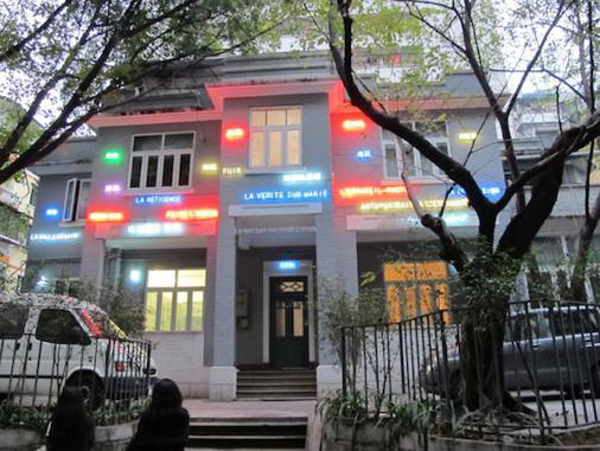
Jake and Dinos Chapman are one of those duos whose artistic identity seems to be forever fused together – much like the disfigured, conjoined zygotic children they famously produced in the 1990s. So what happens when that artistic relationship in severed? As their current exhibition in London shows – really, not that much.

Spread across both of the White Cube spaces in London, Jake & Dinos Chapman: Jake or Dinos Chapman, combines works made by each of the brothers in isolation from one another over the past year. After the self-imposed severance, their work and ideas were brought together to create a show, that despite this separation, is iconically and iconoclastically the work of the Chapman brothers.

Jake or Dinos Chapman, White Cube Mason's Yard and Hoxton Square, London © the artists. Photo: Ben Westoby. Courtesy White Cube.

They have produced individual works in the past – notably the novels of Jake Chapman, however, even the content of these texts reference and draw upon the brothers’ collaborative practice. The consistency of their work is a testament to their umbilical inseparation – two brothers, joined in ideas and execution, even when apart.

Within the exhibition at the Hoxton Square location, it is impossible to discern what has been created by Jake and what has been created by Dinos – and this seems to be the point. Much of what is here are things we have seen before – the ground floor is home to mock-tribal totems and figures – statues housed within dirty and discarded materials of corrugated cardboard, cotton swabs, ping pong balls, wood and exposed nails, complete with spatters of blood and coffee ring stains.

Jake or Dinos Chapman, White Cube Mason's Yard and Hoxton Square, London © the artists. Photo: Ben Westoby. Courtesy White Cube.

On the walls, a series of hazy, colourful, fairly innocuous oil paintings. At the end of the long space a group of swastika-clothed, animal-faced children stare and contemplate the work ‘One Rabbit Contemplating the Moon’. These perverse hybrids are nothing new, but the seamless transition of the orifice-faced children previously produced by the brothers becomes increasingly violent. The beaks, mouths and trunks of the animals protrude through open wounds in the faces, pushing out from the inside and disfiguring the children in a way that is far more disturbing than the smooth genital-faced children.

Jake or Dinos Chapman, White Cube Mason's Yard and Hoxton Square, London © the artists. Photo: Ben Westoby. Courtesy White Cube.

Upstairs sculptures of bleeding religious figures with reptilian tongues and protruding tentacles are juxtaposed with traditional oil painting in which the figures seem to melt as their flesh bubbles away, the details, unfortunately lost in reproduction – Jesus with a swastika carved into his head, Mary’s devil tongue flickers out, Baby Jesus lies in a state of rot and decay. Religion dissolving and disfiguring in a most grotesque way.

Jake or Dinos Chapman, White Cube Mason's Yard and Hoxton Square, London © the artists. Photo: Ben Westoby. Courtesy White Cube.

Always pushing to disturb, shock and disgust, the solitary vision of Jake and Dinos Chapman screams against all that is pure and sanitized. Arguably the show is nothing groundbreaking, but the brothers continue to make work, even when apart, that continues to contribute to their subversion of the world – a wholehearted commitment to their iconoclastic practice.

Share

State of Independence

It’s the end of an era here in Los Angeles: the era of Clara.  August 1, 2011, marks the day that Clara Kim, the outgoing gallery director and curator of Los Angeles’s REDCAT, officially begins her new post as Senior Curator of Visual Arts at the Walker Art Center.  Minneapolis’s gain is Los Angeles’s loss.

Atelier Bow-Wow, "Small Case Study House" (BBQ house), 2009. Installation view, REDCAT, Los Angeles, courtesy the artists and REDCAT. Photo: Steve Gunther.

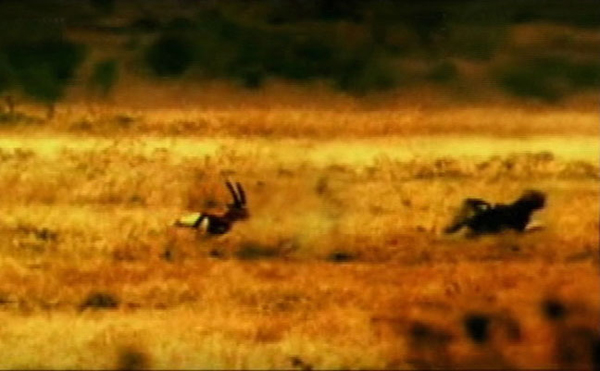
Over the last eight years, Kim has focused on contemporary art from Pacific Rim countries, with exhibitions like Small Case House Study, 2009, a three-month residency and project by the Japanese micro-architecture firm, Atelier Bow Wow, and Animalia, by the Korean artist Kim Beom, which contained—amongst other works—Spectacle, 2010, a twist on the typical predator/prey video.

Kim Beom, "Spectacle," 2010. Video still.

It seems fitting that Kim’s culminating project—a forum on alternative art spaces—was also global in its reach and impact.  State of Independence: A Global Forum on Alternative Practice, took place over the course of two days: July 23 and 24, 2011.  It featured artists, writers, archivists and curators from Mexico, Jakarta, Columbia, China, and Los Angeles, amongst other places.  One of the standouts was Janet Chan of Asia Art Archive, a Hong Kong-based group which has taken on the Sisyphean task of creating an as-comprehensive-as-possible archive of documents relating to the last twenty-five years of contemporary art in Asia, at least a portion of which is available online.

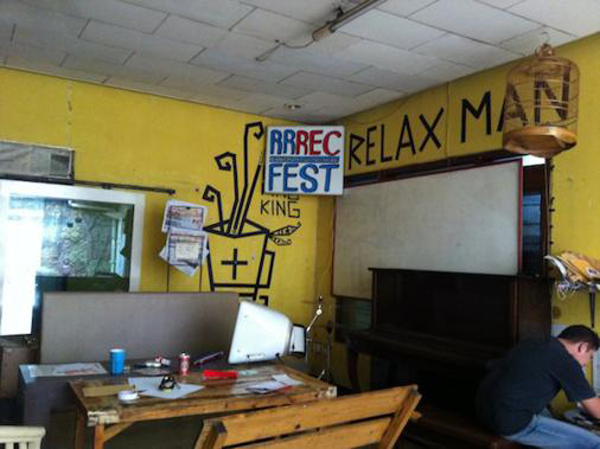
ruangrupa, Jakarta, Indonesia, 2011. Image courtesy of REDCAT.

The forum was the result of six months of field research on alternative art spaces around the world: their effect on their communities, their relationship to the Internet and digital technologies, their financial architecture, and how they function in relation to the larger, often state-sponsored, art institutions in their countries.  As Thomas Lawson of East of Borneo—an online publication based in LA—put it, there’s a shift in how you think about the struggle of an independent art space (or program) when you realize that part of that struggle is against a government that trends toward totalitarianism.

Borges Libreria, Guangzhou, China, 2011. Image courtesy of REDCAT.

The last panel of the weekend asked whether alternative spaces could become new models for future institutions; we here at DailyServing Los Angeles would like to take a moment to recognize Ms. Kim for her work at REDCAT and point out that regardless of whether an institution is “alternative,” it will only ever be as good as the people it is made up of, and we’re sorry to see her go.

Share

From the DS Archives: Turner Prize Sound Off

This Sunday, From the DS Archives features artist Martin Creed and others from the 2010 Turner Prize. Creed is currently exhibiting in a summer group exhibition at the Tate St. Ives. As part of an ongoing series of artist videos produced by the Tate, TateShots brings you a short video on Martin Creed.

The following article was originally published on December 16, 2010 by Michelle Schultz.

As the most notorious art world prize in Britain, the Turner Prize is known to ignite controversy – from Damien Hirst’s dead sheep and Martin Creed’s lights going on and off, to Tracey Emin’s drunken appearance and the expletives Madonna released on live television the year she presented the prize. However, it seems as if the Turner Prize might be growing up – emerging out of its celebrity-fueled enfant terrible stage. This year, the only foul language and flashed undergarments came from the art students protesting outside against proposed education cuts.

Within Tate Britain the works of the shortlisted artists created a quiet, contemplative, dare I say quite traditional, show – a far cry from contentious conceptual installations that dominated past exhibitions.

Dexter Dalwood, Burroughs in Tangiers, 2005. Courtesy of Gagosian Gallery. Photo credit: Prudence Cuming Associates Ltd.

Dexter Dalwood’s paintings reconstructed historical and literary scenes as imagined by the artist. The collage-like painting Burroughs in Tangiers,constructs a space for the Beat Generation writer to work – a manic space, like the literary figure himself.

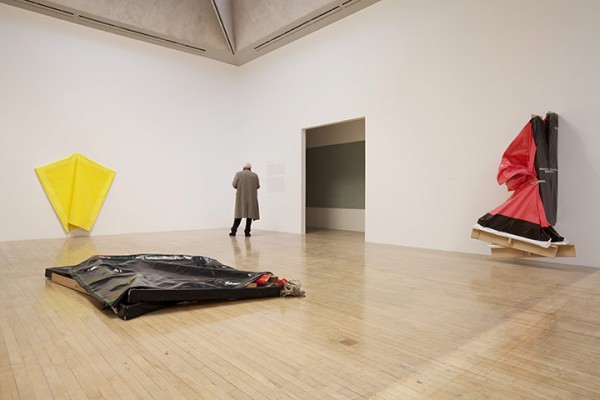
Angela de la Cruz, Turner Prize 2010 Installation. Courtesy of Tate Britain.

Angela de la Cruz’s work is founded in the language of minimalism but she then tears her paintings off their stretchers to create tragic anthropomorphic figures which lie crumpled on the floor and peel away from the walls.

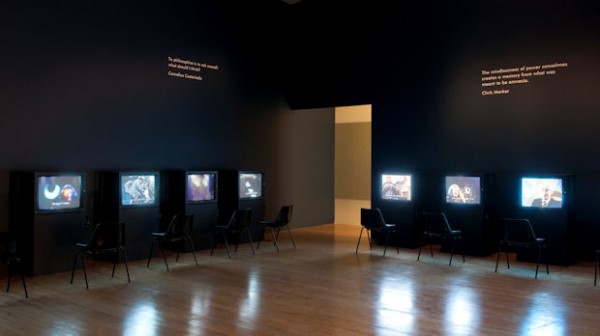
The Otolith Group, Turner Prize 2010 Installation. Courtesy of Tate Britain.

The Otolith Group’s installation Inner Time of Television works with video and text using historical Greece as their subject matter, challenging constructions of history and narrative structures.

Painting. Sculpture. Video. Check. Check. Check.

Arousing excitement, this year, for the very first time, the Turner Prize was awarded to a ‘Sound Artist’ – Susan Phillipsz.

Gasp. Applaud. Sigh. Yes, sound can be art. But we already knew this. Didn’t we?

Susan Phillipsz, Lowlands, 2008/2010, Glasgow. Courtesy Glasgow International Festival of Visual Art. Photo: Eoghan McTigue

Susan Phillipsz’s audio installation Lowlands was originally installed outdoors under a set of bridges at the Glasgow International Festival of Visual Art. Her warbling voice singing a sixteenth-century Scottish song travelled across the water and echoed against the architecture, transforming the space in which it was installed.

Susan Phillipsz, Lowlands, 2008/2010. Turner Prize 2010 Installation. Courtesy of David Levene, The Guardian.

Transplanted here into Tate Britain, Lowlands loses all the poetic nuances of its original environment creating a contained, sanitised experience – one that forces you to construct the environment from the inside. Lowlands, full of sentiment and emotion, runs the risk of being read (or rather heard) here as simply beautiful music. ‘Sound Art’ doesn’t seem so apt a term here – perhaps ‘Audio Installation’ is better suited.

The Turner Prize this year lacked any contentious issues that in the past have led to stimulating and heated debate. While it is fine and dandy, admirable even, to create a subtle space in which to intellectually discuss the work of these four accomplished artists, after becoming accustomed to years of controversy, quite frankly, this year’s Turner Prize Exhibition felt slightly lacklustre.

Yes, perhaps the Turner Prize is growing up, perhaps it is time to put all the crazy antics of youth behind. But it is stories of those crazy antics that we will be telling in years to come. ‘Remember when Roger Hiornes plastinated cow brains and atomised a jet engine?’ Oh, weren’t those the days…

Share

We Operate in the Vacuum, and Other Tales

Ronald Duarte and Abel Duarte, Images courtesy of Pedro Victor Brandão

Once upon a time there was a very high hill. Then, an apartment building appeared on the hilltop, with a giant swimming pool pointing towards the Guanabara Bay. From the apartments’ windows, all of Rio de Janeiro can be seen, including the Corcovado, Sugar Loaf, the bridge to Niterói and beyond. The capital of the country had yet not been transferred from Rio to a distant flatland so a former dictator came in person to celebrate the opening of the new belvedere. Some years later, unplanned neighbors took over the building’s surrounding. People with no place to live started to build their own shacks. What a contrast: the slums and the building. Three bedroom apartments, four units on each level. Eleven stores, the last one is a penthouse with a 360º view. The pool became a target. Bullets shone at the façade while the “community” would walk in with their tires and attitude to have a swim. Close, leave, sell, run, since then the water is gone. This huge emptiness hangs from up above. Since then, the water comes in, from the roof, down the walls, through the pipes, and the wind blows. Last February, that community was “pacified” by the police, meaning they have collected the guns and removed the criminals. There is no funk party anymore at that court. Another void, another vacuum, and the wind blows. Real estate bubbles flying all over.

Travel inside the tram

A friend from São Paulo was so impressed to find an active and interesting art scene in Rio de Janeiro when she came for a curatorial research. She says it seems like nothing happens in town, because she never hears about what goes on here from outside. Even though Rio is the city with the most museums in Brazil, there is a huge institutional void. Lack of consistent programming and other administrative issues make most visits to museums in Rio interesting only regarding the architecture. For a city this big with so much available space, the feeling of emptiness is overwhelming. But there is a lot going on, just not easily visible for the visitor. After all, Rio de Janeiro is the home city of many great artists. And, they are not asleep. The vacuum generated by the absence of institutional support doesn’t completely suffocate alternative models of art production.

Alexandre Vogler, Image courtesy Pedro Victor Brandão

“It is easy to disparage what we cannot have.”

Apartment 1002 has finally opened its doors. They had been closed for 15 years. The new owner talked to Ronald Duarte, artist and good friend of his, about shaking the place up while he remodels and fixes the ruin 1002 has become. Ronald introduced him to Bruna Lobo, another artist who has experience in organizing shows in private apartments. Many phone calls later, and a group of people who are not a group started to spend time at the flat, experiencing the place, the neighborhood and the surroundings.

Bhagavan, Image courtesy Pedro Victor Brandão

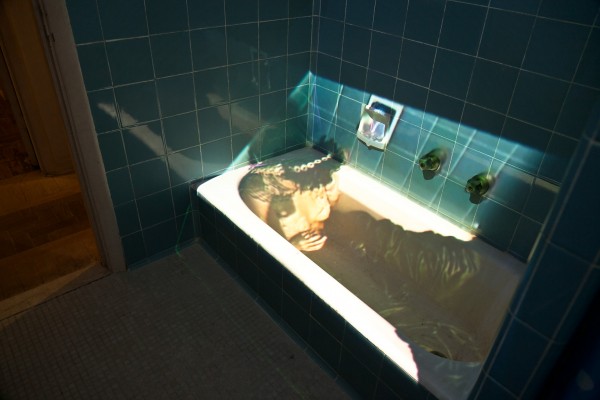
It all started 3 weeks before the opening, short notice and no budget. It was named “O Rapozo e as Uvas” which is a mix of the building’s official name with the Aesop’s “ The Fox and the Grapes” fable. It was never meant to be an exhibition, rather a creative lab where the process would be open to public during a weekend. Some works were developed and shown while others remain unfinished. Such as the apartment, which was being transformed while we artists were there working, what was visible was always changing. The most impressive piece, though, is the view. There is this new perspective people can reach from the top of a mountain. This time of fast changes triggered by all the big international events to come requires reflection and attention. The apartment provides that space and experience.

Babalon, Image courtesy Pedro Victor Brandão

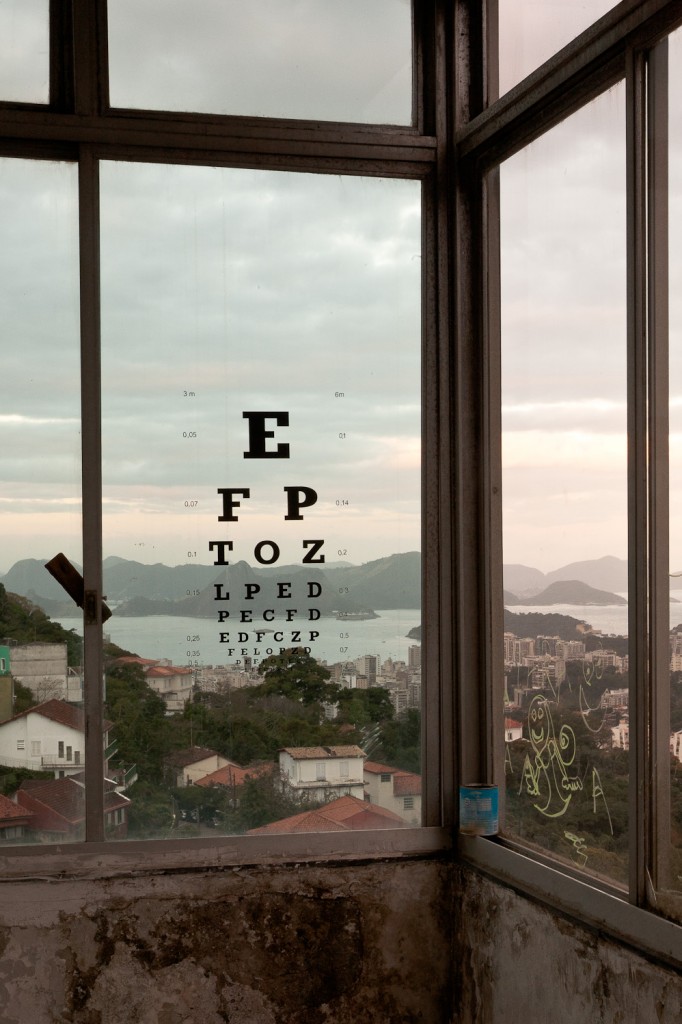
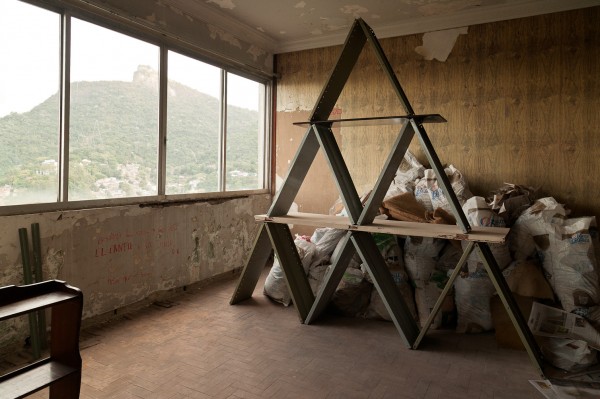
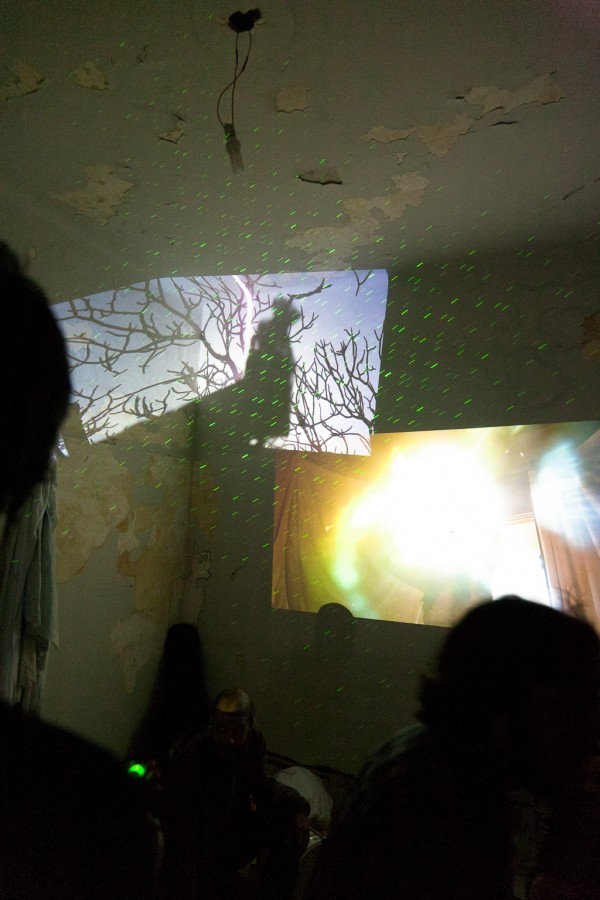
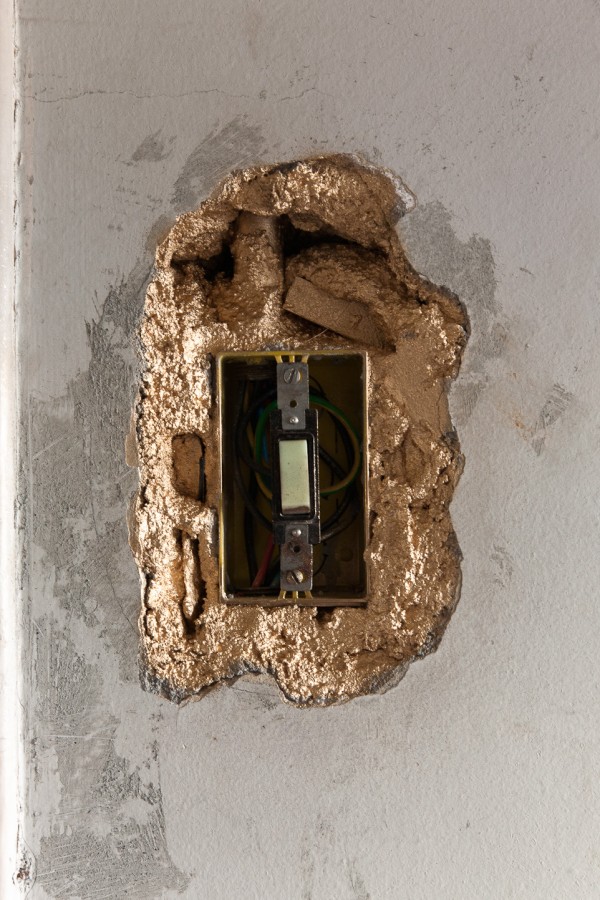
Many works dealt directly with the windows and the view, such as Alexandre Vogler’s sight test and Ronald Duarte’s laser beam reaching Christ while on Abel Duarte’s hand. Other artists worked directly with the apartment’s debris and objects. Guga Ferraz turned the freshly exposed wall insides into gold, and Baghavan transformed furniture pieces in castles of cards. Babalon was opened for everyone who wanted to grab an instrument and play along, even while keeping the bedroom doors closed. It is important not to bother next-door neighbors. They were all officially and unofficially invited, a few showed up and no one called the police. Hurray!

Guga Ferraz, Image courtesy Pedro Victor Brandão

The fairy-godmother

It all started in 2001, when a house for sale was home for the most important art show in Rio that year. Orlândia, Nova Orlandia and Grande Orlândia were organized by Márcia X and Ricardo Ventura. They led to many other shows in the same format.

Bruna Lobo, Liza Machado and Gustavo Sotero, Image courtesy Pedro Victor Brandão

Associados, in 2007, was organized by Ricardo Ventura and the art collective Opavivará at Ventura’s own house. But not only empty houses become temporary art spaces. Artists Bruna Lobo and Jonas Aisengart invited about 20 artists to add works to inhabited apartments without removing any furniture or personal items. Projeto ApArtamento took place in 2008 and 2010 and more editions are yet to come. Last year, curator Bernardo Mosqueira organized a show in his own new house before moving in…this apartment shows list could go on and on. It is important to highlight that alternative models interest both well-established and young artists. There is a common urge impelling us to take over fractions of space and time, to make things, to show, to experience, to exchange. Empty spaces tend to be filled. Vacuum surfers, here we go!

Share