Best of 2011
Constructing the Victim

Serving as an editor for over 30 international contributors, I often read about amazing exhibitions in countries that I rarely visit. However, once in a while I get the opportunity to visit an exhibition in a new place and then read about it from the perspective of someone on our team. This summer, while visiting Berlin with DS Managing Editor Julie Henson, we attended the exhibition Cady Noland / Santiago Sierra at KOW Berlin. The exhibition was sleek, seductive and packed a seriously aggressive punch. When we read the review by our Berlin-based contributor Heather Van Winkle we were excited to find her take on the exhibition as equally compelling.

-Seth Curcio, DailyServing.com Founder

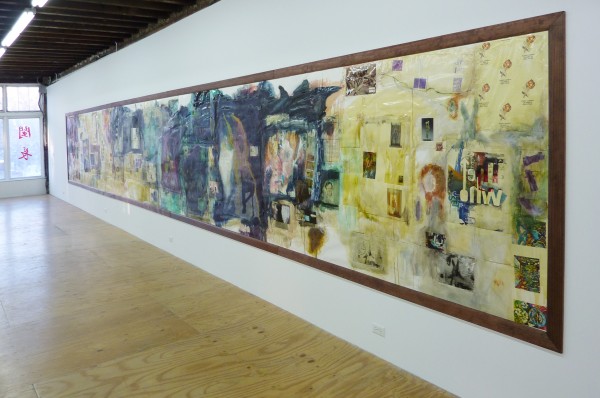
Santiago Sierra, Audience Lit by a Petrol Operated Generator, 2008; Veteran Standing in the Corner, 2011, Courtesy of KOW Berlin

Like a newspaper in its matter of fact presentation of content, Cady Noland / Santiago Sierra at KOW Berlin, curated by Alexander Koch and Nikolaus Oberhuber, appears purposefully removed of emotion. We never make eye contact with other humans, backs are often turned, or we find ourselves averting our eyes for our own protection. We stand on the outside looking in. No one makes a human gesture towards us as viewers; our presence is not acknowledged or regarded with any sort of value. Just as we may be blind to other’s suffering, we are made invisible and unimportant.

Read More »

Share

Best of 2011
Alec Soth’s Broken Manual

During the holidays, its always nice to look back at the accomplishments of the past year. With that in mind, we have asked each of our contributors to dig deep into the articles, interviews, and reviews from 2011 and pick some of their personal favorites. Our contributor from London, Sara Knelman, selected a review of Alec Soth‘s Broken Manual written by our Berlin-based contributor Heather Van Winckle. Alec Soth’s work has also appeared in the DailyServing article, Postcards from American: A New American Road Trip back in May of this year.

Alec Soth, 2008_02zL0189 (leprechaun man), 2008, Edition of 7 + 3 AP, Archival pigment print, 40,6 cm x 50,8 cm / 16 x 20 inches, Courtesy Loock Galerie, Berlin

Many of us, at one point, have felt near our breaking point with the life we live and the sacrifices we have to make in order to even have that life. Escaping our day-to-day, or “the man” at large is at times the sweetest fantasy. Through a collection of portraits of the lives of men who have removed themselves from society, Alec Soth’s Broken Manual asks of the viewer to reconsider the social standards that we take for granted and blindly accept in our lives.

Read More »

Share

Best of 2011
True Grit: Michaela Eichwald at Reena Spaulings

As we continue to look back to the best articles, interviews, and reviews of 2011, today we have Michael Tomeo‘s article True Grit. Selected for Best of 2011 by DailyServing’s New York based writer, Carmen Winant, True Grit features works by Michaela Eichwald at Reena Spaulings Fine Art. In addition to True Grit, in 2011 Michael has wrote other great articles like Oh No You Ditten! Los Angeles invades SoHo and Maybe Techno Doesn’t Suck? Cosima von Bonin and Moritz von Oswald, The Juxtaposition of Nothings at Friedrich Petzel.

Michaela Eichwald, Pofalla, (willst Du mir jetzt komplett den Garaus machen?) 2010.

It’s not that Michaela Eichwald doesn’t give a crap about her paintings; she just beats the shit out of them. It’s part of a lengthy weathering process that imbues them with the perfect balance of attraction and repulsion. Before they get to the gallery, they’ve been stepped on, left out in the rain, randomly stained, and often chemically altered. Eichwald decimates boring oil painting clichés (think “fat over lean”) by glopping oil, acrylic and varnish seemingly at random. Yet, despite their abject quality, her work feels uniquely intimate. She stakes a claim somewhere between the automated work of, say, Wade Guyton and the ubiquitous “special moments” abstraction crowd that seems destined to follow the Nozkowski/Tuttle/De Keyser rules in perpetuity.

Read More »

Share

Best of 2011
Heaven Is A Place Where Nothing Ever Happens

From across the world, our Melbourne based writer, Joleen Loh, picked Michelle Schultz‘s review of the Folkestone Triennial in the UK as her favorite article of 2011. “I really enjoyed her description of AK Dolven’s Out of Tune and how she relates that back to the theme of the Triennial – it was really clear and descriptive which got me really excited about triennial.” – Joleen Loh. Nothing makes us want to travel more than seeing articles from cities across the globe.

In the aftermath of the manic, dizzying opening of the Venice Biennale, it is refreshing to see an alternate possibility for an international exhibition on the coast of England – a project, that much like it’s place, embodies the understated, the poetic and the site-specific – a welcome breathe of fresh air in contrast to the global displays of power battling it out at the site of the Giardini.

Tracey Emin,

Folkestone is one of those seaside towns that is both idyllic and sleepy – the kind of place you run away from London to in order to escape the chaos and urban imprisonment. With the coast of France visible on a clear day, it is becoming a place of refuge for many of the artistic community who eagerly embrace the one hour commute to London for a bit of serene escapism. But this somnolent town is stirring – the Folkestone Triennial is reinvigorating the town with a perceptive, engaging and meaningful project – an ambitious public programme aspiring to reach far beyond geographical boundaries.

Read More »

Share

Best of 2011
Feminist Finish Fetish

For Best of 2011, our West Coast Editor, Danielle Sommer, fell in love with Catherine Wagley‘s article, Feminist Finish Fetish, from her weekly column, L.A. Expanded. “I loved Catherine’s piece on Judy Chicago. Not just because of the snappy name, but because she managed to reframe Chicago’s practice for me.” – Danielle Sommer. We hope you find Feminist Finish Fetish as enlightening as we do.

L.A. Expanded: Notes from the West Coast
A weekly column by Catherine Wagley

ood"

Judy Chicago, "Car Hood," Sprayed acrylic lacquer on Corvair car hood. 42 15/16 x 49 3/16 x 4 5/16 in. Moderna Museet, Stockholm. © Judy Chicago. Photo: Donald Woodman

Pacific Standard Time, a nearly year-long paean to SoCal art history, has barely begun and, already, I’m experiencing PST fatigue. Funded by the Getty Institute and the result of at least a decade’s worth of scholarship by the Getty researchers and others, PST will include 60 or so exhibitions and more artists than you can count, all of whom were working between 1945-1980. Over 60 institutions are “partnering” with the Getty, which means SoCal galleries and museums will be ablaze in the glory of their own history for much of the foreseeable future. Shows have titles like Greetings from L.A.: Artists and Publics 1950–1980 or Best Kept Secret: UC Irvine and the Development of Contemporary Art, 1964-1971, mouthfuls that would be at home on textbook covers. The draw of the PST initiative is, of course, that some of the work on display will have barely been seen since it was made, and uncovering overlooked gems makes a canonized period of L.A. history feel open and alive again. However, even this draw exacerbates the fatigue. Obscure, surprising gems from the 1950, ‘60s or ‘70s will undoubtedly send you reeling back through history; you’ll want to learn more about the work’s making and reconsider its makers. And how will you ever get through 60-plus exhibitions that way?

Read More »

Share

Best of 2011
Go to Hell Moamar: Benghazi’s Aesthetic Insurrection

As we welcome in the new year at DailyServing, we take the time to reflect on some of the 365 articles, interviews, and reviews we have completed over the last 12 months. Our writer, Catlin Moore, loved Matthew Harrison Tedford‘s article from our new series on art and politics, #Hashtags. We are so proud of our regular series, LA Expanded, Fan Mail, and #Hashtags, and we are thrilled to continue our series and have #Hashtags twice a month in 2012!

#Hashtags: Viral Thoughts on Politics, Arts, and Culture

In honor of last weekend’s events in Libya, DailyServing kicks off our newest series, #Hashtags, with an article by writer and editor Matthew Harrison Tedford on street art and politics. #Hashtags provides a platform for longer reconsiderations of artworks and art practices outside of the review format and in new contexts. Please send queries and/or ideas for future to hashtags@dailyserving.com.

Anti-Qaddafi graffiti in Benghazi, February 25, 2011; artists unknown. Courtesy of Al Jazeera English.

In the last ten months there has been a rash of high-profile arts censorship incidents. Late last year, following complaints, David Wojnarowicz’s A Fire in My Belly was pulled from the Hide/Seek exhibition at the National Portrait Gallery in Washington, D.C. That December, a mural at the Museum of Contemporary Art, Los Angeles by street artist Blu was painted over, again, following complaints. In April, the work of Mustapha Benfodil was pulled from the Sharjah Biennial. In June, Aidan Salakhova’s work was removed from the Azerbaijan pavilion at the Venice Biennale. And of course, there was the arrest and detention of Ai Weiwei. I would like to continue listing these incidents, but they would fill this column.

Read More »

Share

Best of 2011
Boulevard: An Interview with Katy Grannan

As we welcome in the new year at DailyServing, we take the time to reflect on some of the 365 articles, interviews, and reviews we have completed over the last 12 months. Today, we have Michelle Schultz‘s pick for her favorite article of 2011 — Seth Curcio‘s interview with Katy Grannan. ‘I love discovering new artists – and found work of Katy Grannan instantly seductive, but like the light in California, also relentless…’ – Michelle Schultz. We hope you enjoy revisiting some of our personal favorites over the next week.

Roaming the streets of a metropolitan area, it is easy to become overwhelmed by the scale of urban architecture and the number of individuals that occupy the space. So often, the individual gets lost in the equation; attention is turned to the sum over the parts. For the past three years, San Francisco-based photographer Katy Grannan has walked the streets of Los Angeles and San Francisco observing what many choose to overlook — subjects for whom life has been hard and despair has been plenty. Working within the grand tradition of portraiture, Grannan has selected a wide range of subjects for her recent body of work, Boulevard, which is currently on view at Fraenkel Gallery in San Francisco. Grannan turns the city into her studio, shooting each subject on a variety of white surfaces found on location. Relying only on the strong California light and a stark white backdrop, the physicality of her chosen subjects open a myriad of narrative possibilities that simultaneously evoke hardship and optimism. I recently spoke with the artist about the series, Boulevard, her upcoming film project, The Believers, and the shared history between the viewer and her subjects.

Katy Grannan. Anonymous, LA, 2009. Courtesy of Fraenkel Gallery

Seth Curcio: The portraits in your new series Boulevard are striking in their simplicity. Yet, given the reductive context, each photograph speaks volumes about the subject. The physical qualities of the individual make evident their distance to the what most call the American dream. With the narrative possibilities being so strong, I wonder what are the guiding principles used to select your subjects?

Read More »

Share