Best of 2011
History in Art at MOCAK

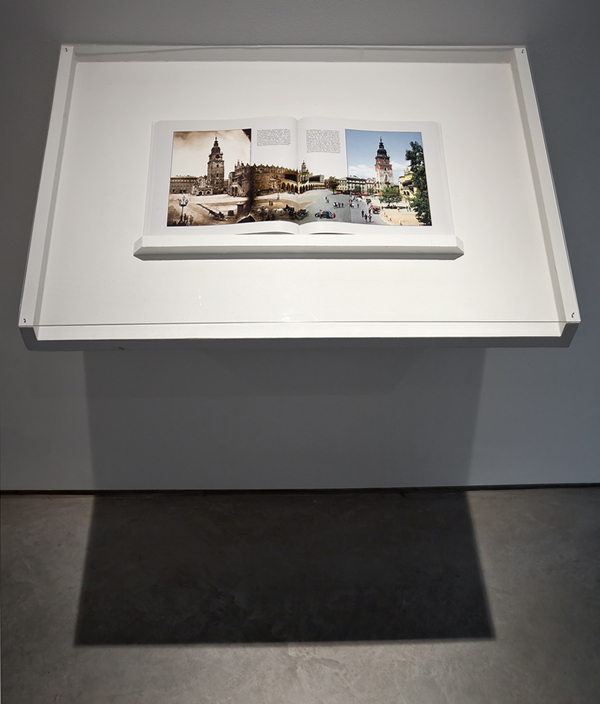
Picked by Allie Haeusslein for our Best of 2011 is History in Art at MOCAK, at Museum of Contemporary Art in Krakow written by Bean Gilsdorf. “I have recently come to terms with the fact that I will not, at least in the near future, be the world traveler I would so like to be. Until that day comes, I will gladly live vicariously though the experiences of others. Bean’s intelligent series of pieces from her travels to Poland provided a beautiful, articulate introduction to the art and culture of a place I have yet to visit.”

Shinji Ogawa, Then and Now, Krakow, 2010, acrylic on book

With the work of over forty artists, History in Art at the Museum of Contemporary Art in Krakow is a sizeable exhibition; but its scale is not only warranted, it is necessary. If the internet age ushered in a global culture of multiplicity, then History in Art demonstrates the contemporary attitude toward the formation of a historical record: individual voices make up a flexible, imaginative whole.

Read More »

Share

Best of 2011
Lisa Tan: Two Birds, Eighty Mountains, and a Portrait of the Artist

Every once and a while, a review comes along that manages to completely shift the way you see an artist’s work. Today on Best of 2011, Magdalen Chua found just this in Noah Simblist‘s review of Lisa Tan’s recent project in Austin. “I was intrigued by Noah’s reading of the “notion of the double” in Lisa Tan’s works. For me, this perspective elevated both the sense of serendipity and solitude in her works.” – Magdalen Chua.

Les Samouraïs , 2010 Single-channel video lightstands, painted wood, projector 3 min 36 sec, sound Courtesy of the artist & Galerie Vidal Cuglietta

One might be tempted to call Lisa Tan’s exhibition at Arthouse in Austin poetic. But what would this mean? It is spare, filled with layered and complex allusions, much like a poem. The imagistic lyricism of two finches in a cage; a lone man smoking as he stares out a window; flashes of barren mountain peaks; and a doctor’s stark appraisal of an aging body might suggest something more than prose as an apt metaphor. But regardless of the correct literary comparison, this exhibition is an aggregate of images – a series of artworks that collect around a few themes. One of the most evocative is the notion of the double.

Read More »

Share

Best of 2011
Art in Limbo

When asked to make a selection for DailyServing’s Best of 2011, contributor Bean Gilsdorf chose Art in Limbo by Danielle Sommer.  “I loved the mix of art-political reporting and personal experience, which are combined here to bring depth and emotional meaning to a bureaucratic tangle involving one of the most significant pieces of land art in the United States.  In describing Spiral Jetty and its particular site, Danielle makes a great case for its continued preservation.” -Bean Gilsforf

Robert Smithson, Spiral Jetty (1970). Image copyright Danielle Sommer.

It’s true. The state of Utah now owns Spiral Jetty. For the last decade, the Dia Foundation has paid Utah’s Department of Natural Resources $250 a year to maintain the 20-year lease on the land surrounding the earthwork. In February, the Dia received and paid its annual invoice, only to have the payment returned in June with a note that the lease had expired—a fact that had somehow escaped everyone’s attention, including the DNR’s. According to an article by Jennifer Dobner of the Associated Press, the oversight may have occurred due to the fact that the DNR’s Sovereign Lands coordinator, Dave Grierson—the man who should have sent Dia a notice about the lease renewal—passed away last year. Conspiracy theories about drilling aside, the Dia maintains that it has a “collegial” working relationship with the DNR and that they are in the process of re-negotiating the lease. But for the moment, the Jetty belongs to Utah, a fact that has the art community unsettled.

I first visited Spiral Jetty in August 2007, thirty-seven years after Robert Smithson installed it and thirty-four years after his death. I’d heard that the water level was low enough that the jetty was visible again, so I made a point to visit it on my way from Portland, Oregon, to Chicago, Illinois. I’d seen photographs, as well as the film of the construction that Smithson had made with his wife, Nancy Holt, but the physical experience caught me unprepared. Visiting Spiral Jetty in the flesh provides an experience of time unlike any other. Everything seems to halt, even as it remains in motion.

Read More »

Share

Best of 2011 – Recovering Site and Mind: Richard Serra’s Sequence Arrives at Stanford

Today on Best of 2011, we revisit Rob Mark’s Recovering Site and Mind. Selected by New York-based contributor, Carmen Winant, Rob Mark’s essay beautifully recontextualizes Serra’s lifelong practice through the recent installation at the Cantor Arts Center at Stanford University.

Over the course of its three-day installation in July 2011, Richard Serra’s “Sequence,” on loan from the Fisher Art Foundation, both reveals itself and conceals the expansive space it inhabits. Photos: Saul Rosenfield, © 2011, with permission of Cantor Arts Center at Stanford University.

The Cantor Arts Center at Stanford University is engaged in a dangerous experiment, and it is not the levitation of a twenty-ton piece of Richard Serra’s steel sculpture, Sequence, 2006, thirty feet into the air. Nor is it the gyration of a 200-foot tall crane lifting the first of twelve panels—each almost thirteen-feet high and between thirty- and forty-feet long—from a flatbed trailer onto a concrete slab three-quarters the size of a baseball diamond. The ironworkers from the Hauppauge, New York, rigging company, Budco Enterprises, have handled all of Serra’s North American installations for the past 20 years. The dangerous experiment is, instead, the transplantation of the sixty-five by forty-foot labyrinthine sculpture into a site that the artist did not specify when he first created the piece.

Two 20-ton plates from Richard Serra’s Sequence, on loan from the Fisher Art Foundation, swing into place. Video: Rob Marks, © 2011, with permission of Cantor Arts Center at Stanford University.

Serra is famous for his site-specific sculptures. Of Tilted Arc, 1981, the 200-foot long grandparent to arced works like Sequence, Serra proclaimed, during a U.S. General Services Administration hearing to determine the disposition of the piece, “To remove the work is to destroy the work.” Commissioned and approved by the Carter administration, and constructed in lower Manhattan’s Federal Plaza, Tilted Arc was eventually decommissioned, forsworn, and bundled into storage by the Reagan administration. We can never know whether the Tilted Arc controversy—the first salvo of the 1980s culture wars—would have subsided had the surrounding political context not pre-empted the community’s process of coming to know the sculpture. Many of Serra’s public works, however, are now valued by the communities that first rejected them.

Other Serra pieces, including Clara-Clara, 1983, and Torqued Spiral (Closed Open Closed Open Closed), 2003, have, with Serra’s participation, found second homes. Sequence, however, may evolve into the most itinerant of Serra’s behemoths. Conceived for a gallery at the New York Museum of Modern Art and installed there in 2007 for Serrra’s 40-year retrospective, the sculpture traveled to the Los Angeles County Museum of Art in 2008. This year, Sequence, now owned by the Fisher Art Foundation, traveled from LACMA to the Cantor Arts Center, where it is currently on loan from the foundation and where it will reside until in 2016. Then it will move, perhaps finally, 35 miles northwest to a new wing of the San Francisco Museum of Modern Art.

Left: Trailer as it prepares to move a plate from storage lot to installation site. Riggers remove the chains holding a plate to its trailer. Photos: Saul Rosenfield, © 2011, with permission of Cantor Arts Center at Stanford University.

Can Sequence, removed from its place of origin, sustain its prodigious capacity to shape space and lead us to the conscious and embodied experience of what we often take for granted? Will it still unmoor space and time from the feet and inches, seconds and minutes that define them in everyday life and provoke the reorientation of thinking and the individual psychological experience that Serra seeks for participants who engage the sculpture? In 2007, Serra told PBS’s Charlie Rose, “I think these pieces really need the definition of architecture,” referring to Sequence and its two gallery siblings. “They need a flat floor. They need a certain contained volume. I think these pieces might be able to be in a courtyard, but if you put these pieces outside, say in a big field, they’re going to get lost.”

Left: Master Rigger Joe Vilardi (center, in black shirt), and riggers John Barbieri, Joe Berlese, and Bill Maroney, survey the concrete slab. Right: Master Rigger Joe Vilardi (right) and rigger John Barbieri (left) plot reference points that will guide the installation of Richard Serra’s “Sequence” (on loan from the Fisher Art Foundation). Photo: Saul Rosenfield, © 2011, with permission of Cantor Arts Center at Stanford University.

The gallery at New York MoMA, an awkward H-shaped space with a low ceiling, seemed barely able to contain the three pieces. For some, this was the exhibit’s flaw: the sculptures had no room to breathe. We are used to viewing sculpture from the outside, framed by an expanse of space. For Serra, who seeks always to confound the viewer’s desire to see the entire sculpture at once, the cramped MoMA quarters may, in fact, have been preferable. Indeed, the frustration some visitors felt may have stemmed from the sculptures’ ability to stymie the creation of a purely visual experience separate from the body’s active engagement with them. In New York, Serra had produced new space in a place where visual inspection suggested there was little to spare. Within each sculpture’s orbit, the participant’s perception of space expands and contracts, independent of the gallery’s concrete dimensions. In this context, Sequence seemed akin to a magician’s hat from which emerges far more matter than could be contained by the dimensions of the magician’s head.

How then can such a piece successfully reconform itself—and the experiences of its participants—to an exterior space 3,000 miles away? How can the activity of getting lost in what Serra describes as “a seemingly endless path between two leaning walls” about which “you cannot recollect or reconstruct a definite memory” be preserved in a courtyard where landmarks—a roof, a terrace, a tree, even a hanging cloud—continually orient the participant?

Left photos: Lost inside Richard Serra’s Sequence (on loan from the Fisher Art Foundation). Right: Parapets of the museum’s old wing peek above the sculpture. Photo: Saul Rosenfield, © 2011, with permission of Cantor Arts Center at Stanford University.

On Monday, July 18, the bare concrete pad seems to provide some reassurance. Two- to three-feet thick and doubly reinforced with rebar, according to Cantor Operations Manager, Steve Green, the pad should satisfy Serra’s desire for a flat floor. More than this, however, nestling the bulk of the sculpture into the cul-de-sac formed by the Cantor’s original building, its octagonal extension, and its new wing, seems to realize the “definition of architecture” Serra had specified for Sequence and its siblings. Further, Museum Director Tom Seligman said that the Cantor Center had been in close contact with Serra, and the artist approved of the site.

Read More »

Share

Best of 2011- #Hashtags: Narco-Violence and Ritual Sacrifice

This year we launched #Hashtags, a series that examines the various intersections of visual art and politics. Selected by Danielle Sommer, today’s Best of 2011 features the article Narco-Violence and Ritual Sacrifice written by Robert Gomez.

#Hashtags: Viral Thoughts on Politics, Arts, and Culture

This month, #Hashtags features an essay by the Mexican-American artist and writer Robert Gomez on the relationship between online images of drug cartel violence and Aztec rituals. Please be aware that this article contains graphic representations of violence. The author and the editors of the site would like to make clear that we are not interested in exploiting the sensational qualities of these images, but rather in their complex social roles. #Hashtags provides a platform for longer reconsiderations of artworks and art practices outside of the review format and in new contexts. Please send queries and/or ideas for future to hashtags@dailyserving.com.

As Mexican-American, I am awed by Mexico’s cartel warfare, and by the seeming American ambivalence towards it. My first experience with Narco-violence started where you are now: at the computer, as I read through online articles about drug trafficking. Eventually, I came to El Blog del Narco. Hosted by an anonymous college student, El Blog del Narco claims to democratically post videos, pictures, and stories from anyone with information on the drug war. The moment remains vivid to me—it was a Tuesday afternoon, and the San Francisco fog was just beginning to roll across the sky. I clicked upon an article. At first, I didn’t quite understand what I was seeing. It looked like two bodies piled on top of each other, except the skulls were the color of pus. I scrolled down, and saw what looked like a flattened mask of a face. I realized the image was of two flayed men, one with his heart removed. I felt sick. This was real. There were no movie crews creating this image—no costume designers, no makeup. It was achingly raw. And yet in the same moment, I realized that I had seen this before, not in life, but in images of sixteenth-century Aztec ritual sacrifice.

Read More »

Share

Best of 2011
Seeing is Believing: An Interview with Trevor Paglen

Each year DailyServing produces dozens of original interviews with artists all over the globe. Today, DailyServing.com contributor, Sara Knelman selected Seeing is Believing: an interview with Trevor Paglen. The interview, which discusses Paglen’s thoughts on photography, art history, aesthetics and the politics of watching, was conducted in February by DailyServing.com founder Seth Curcio.

Trevor Paglen They Watch the Moon, 2010 / Courtesy of Altman Siegel Gallery

Recent advancements in technology such as Google Earth and street-view, has given anyone with a computer and an internet connection the ability to collapse time and space. It is easy to sit in the comfort of your home and within just a few seconds, virtually place yourself anywhere in the world, that Google has imaged. This uniquely 21st century way of seeing may be relatively new to the masses, but there is no doubt that similar advancements were made years ago for military purposes. From the birth of photograhy, man has learned to “see with machines.” This concept is a crucial part of Trevor Paglen‘s research in art and experimental geography. Paglen recently presented a new series of images, and video, in an exhibition titled Unhuman on view now at Altman Siegal Gallery in San Francisco. I recently spoke with Paglen about photography and art history, aesthetics and the politics of watching that which watches us.

Seth Curcio: Trevor, your practice is centered in both experimental geography and art-making. Often the two collapse into one. Did your interest in geography develop concurrent with your interest in art-making? Or, did one come before the other?

Trevor Paglen: I’ve been an artist my whole life – much longer than I’ve been a geographer. In the mid 1990s, I started doing projects that had a strong relationship to landscape and the politics of visibility. While earning a MFA in Chicago, I became frustrated by the limits of traditional art theory, which mostly comes out of literary criticism, and wanted to find a more expansive theoretical language that could account for things like economics, politics, materiality, and so forth, in addition to questions of representation. Geography theory, I found, was incredibly powerful and flexible: it provided me with a way to think about cultural production in a much more powerful way than what I’d found in art and representational theory. So, I ended up moving to Berkeley and doing a PhD in geography.

Read More »

Share

Best of 2011
Mike Kelley at Gagosian Gallery

Today we revisit Catlin Moore‘s review of Mike Kelley’s epic exhibition at Gagosian in Los Angeles as our latest pick for Best of 2011. Selected by DailyServing Managing Editor, Julie Henson, this article tackles Mike Kelley’s intense spacial and psychological explorations with great wit. It is a feat within itself to accurately assess Mike Kelley’s work, and Catlin’s writing takes this project head on.

Kandor 10 / Extracurricular Activity Projective Reconstruction #34 and Kandor 12 / Extracurricular Activity Projective Reconstruction #35, installation view. Photo by Fredrik Nilsen. Courtesy of Gagosian Gallery.

Mike Kelley claims he doesn’t particularly like Superman. The jury is out on whether or not this qualifies him as a communist, but his claim does provide a source of perplexity when evaluating the inspiration for his ongoing Kandor sculpture and installation series – the newest of which being currently displayed at Gagosian Gallery (Beverly Hills) alongside the latest chapters of his filmic project, Extracurricular Activity Projective Reconstruction (EAPR).

In its original graphic incarnation, Kandor is noted as the fictional capital city of Superman’s native planet, Krypton. By the swift and conniving hands of the villainous Brainiac, the city was taken hostage and miniaturized for purposes not entirely sensible or mildly coherent – but not without valorous retrieval by our hero. Despite Superman’s Samaritan ways, the omnipresent plague of a haunting past hinders him from true emotional and psychological liberation – not to mention, visible underpants. For Kelley, the conceptual appeal lies in Kandor’s embodiment of an alienating victim culture for our protagonist: the notion of a burdensome present dictated by a labyrinthine past. Kelley’s unorthodox fusion of fragmented narrative, medium and sensory immersion seem nonsensical and queer at first encounter, yet the further we delve into his sensational rabbit hole, the closer we come to the truly bizarre fidelity of the human condition. Kelley confronts our latent attitudes and popular convictions relating to sexuality, socioeconomics, education and history with jocular finesse and – well – candor.

Read More »

Share