San Francisco

The whispers too, they intimate

As a part of our ongoing partnership with Art Practical, today we bring you a profile from writer Matthew Harrison Tedford on Claudia Joskowicz, a recent visiting artist at the San Francisco Art Institute.

Claudia Joskowicz. Sympathy for the Devil, 2011 (still); two-channel HD video; 9:00. Courtesy of the Artist.

Claudia Joskowicz, who is an artist based in New York and Santa Cruz, Bolivia, creates videos that reawaken violent events and their residue from Bolivian history. Often filmed in very slow motion, these works allow viewers to focus on the intense emotions or complicated scenarios they document. Oscillating between serenity and suspense, Joskowicz’s videos first create points of entry and then confront viewers with the trauma and anguish of the videos’ subjects.

Sympathy for the Devil (2011) is a haunting peek at a commonplace interaction between two unassuming neighbors in a La Paz high-rise. The opening scene shows two elderly men passing each other, as one enters and another leaves an elevator. The man facing the camera holds his head high, averting the gaze of the other, who looks down. The former represents K. Altmann, the alias of Nikolaus “Klaus” Barbie, the German Nazi officer who earned the nickname “Butcher of Lyon” due to his torture of Jews and Resistance leaders in Vichy France. In the video, the second man represents an unnamed Polish Jew who immigrated to Bolivia during World War II and was allegedly Barbie’s neighbor, living on the floor below. The scene progresses like molasses, with almost indiscernible movement—as one might imagine feeling the time passing during such an uncomfortable situation. Did each of these men know the history of the other? Is Barbie’s distant glare evidence of hubris or humiliation?

Read the full article here.

Share

Fan Mail

Fan Mail: Marta Stysiak

For this edition of Fan Mail, Marta Stysiak of Warsaw, Poland has been selected from our worthy reader submissions. Two artists are featured each month—the next one could be you! If you would like to be considered, please submit your website link to info@dailyserving.com with ‘Fan Mail’ in the subject line.

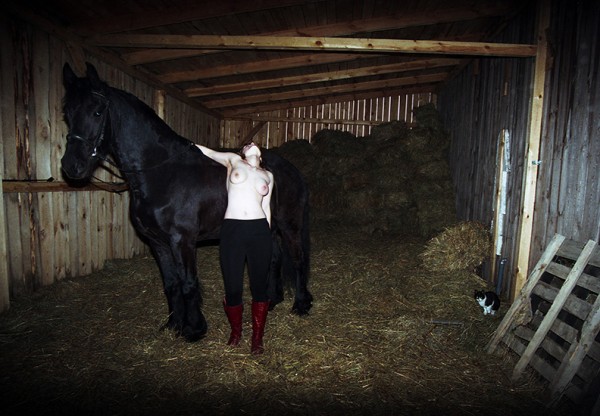
When viewing the body in the series “with” by Marta Systiak, I wonder if I should be aroused or not. Or, if I am aroused and the artist did not intend this, what does that mean? Sexuality is often part of the viewer’s attraction to the nude, even when the work does not overtly sexualize the body. Stysiak further complicates this notion by depicting the nude singularly, alone and autonomous, yet paired with a pet.

When considering Stysiak’s photographs, the 1781 oil on canvas by Henry Fuseli titled The Nightmare comes to mind. It depicts a woman, her body draped by a nightgown, in a pose of ecstasy while dreaming, depicting a demonic creature alongside the head of a horse with piercing eyes. The animals and objects in the room act as symbols in the dream, expressions of the subconscious. Though Stysiak’s works are based in reality, they can be read in a similar, intimate and symbolic, way. How a person organizes their space, how they occupy it, and what animals they choose as their friend, all offer insights into their personality. Stysiak’s photographs observe aspects of the human pysche, rather than ideals of bodily beauty.

Henry Fuseli , The Nightmare, 1781

I think of Peter Greenaway’s film A Zed & Two Noughts (1986), which, in part, speaks to the relationship between man and animal. Two twin zoologists, in shock after the simultaneous death of their wives, examine the process of death and decay in search of understanding their suffering. Venus de Milo, a vampish colleague, tries to seduce the scientist brothers to liven them up a bit. In a bedroom scene, she is naked and talking with one of the brothers as he lay in the bed, holding a glass plate of snails, observing and touching them, talking poetically about their vital role in the processing of decaying material. The scientist is more interested in the snails and his work, and viewing his nude body with the little creatures becomes unerotic and depressing, but beautiful. The snails seem to bring more refuge than the woman.

Since antiquity, the nude has been used  to present the ideals of human form. Examples of non-sexualized or non-idealized nudes are not common in the early history of photography. An early and bold departure from this tradition is found in the photographs of Diane Arbus. Retired man and his wife at home in a nudist camp one morning, N.J. (1963) shows the ideals of nudism–no shame in exhibiting the body in its most natural state.

Read More »

Share

Boston

A Moment with “The Man”: Thoughts on Ragnar Kjartansson’s Recent Work

Through his refreshing lack of self-seriousness or sanctimony, Ragnar Kjartansson has cut a jagged, joyful figure on the contemporary art scene. Indeed, with solo exhibitions in Boston and New York, the artist has recently been favored with the art world’s fickle attentions and is having something of a well-deserved moment.

Ragnar Kjartansson, “The End–Venice,” 2009. Performance view. Venice, June 2009. Courtesy of the artist, Luhring Augustine, New York, and i8 Gallery, Reykjavik.

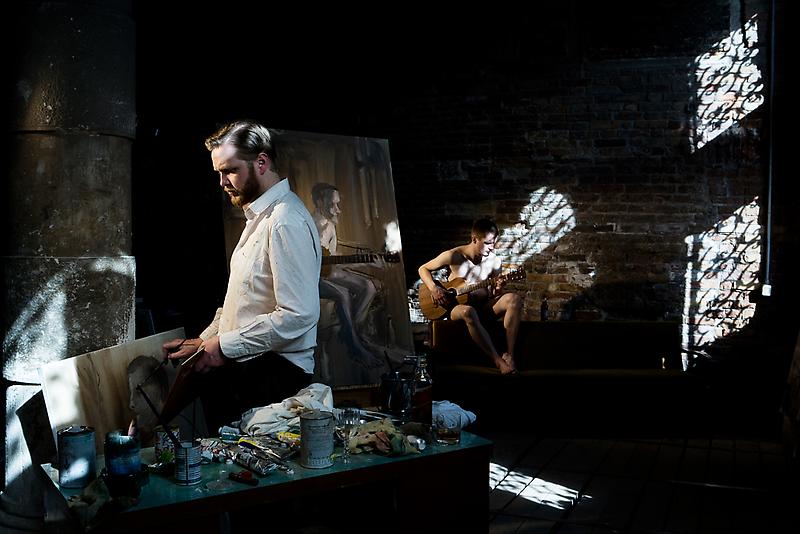
As the youngest artist ever to represent Iceland at the Venice Biennale, Kjartansson penetrated the art world’s collective consciousness with The End–Venice in 2009. This performance piece, like so much of his subsequent work, managed to be at once playful and provocative, sly and guileless. Ensconcing himself with friend and fellow artist Pall Haukur Bjornsson in a Venetian palazzo for the Biennale’s six-month run, he proceeded to churn out one painting per day, each depicting the variously posed yet invariably Speedo-clad Bjornsson.

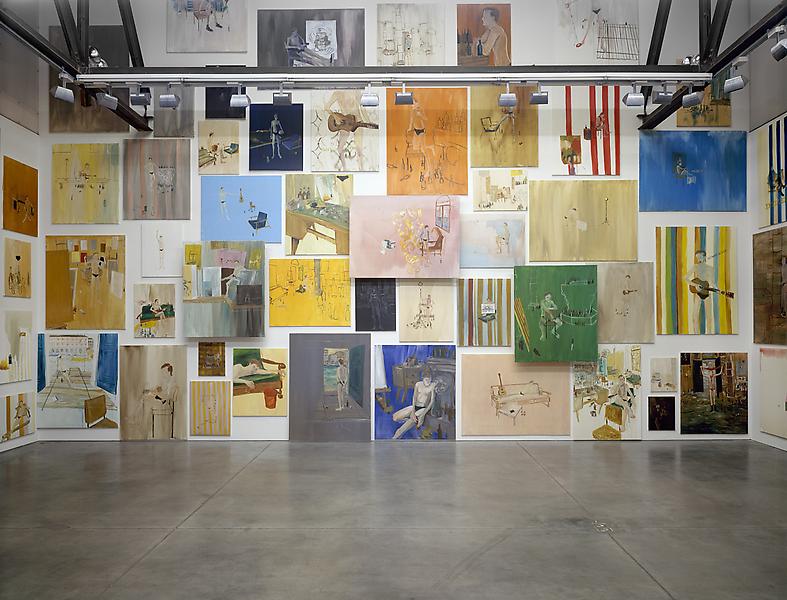
The resulting œuvre—144 canvases in total—alluded to diverse artistic periods and riffed on numerous painterly styles. Overtly bound to the ephemeral, irretrievable conditions of their making, the canvases made explicit the duality of temporal independence and historical specificity implicit in the material work of art. Ultimately, the works inhabited an uncertain state between autonomy and implication, and despite their elemental, antic energy, they evinced a certain lack—the viewer, knowing the paintings’ role within a larger artistic project, could scarcely help but see them as material fragments of an unreproducible whole.

Ragnar Kjartansson, “The End–Venice,” 2009. 144 paintings. Dimensions variable. Installation view. Luhring Augustine, 2010. Courtesy of Luhring Augustine, New York.

The End—Venice refracted the ebb and flow—backward, forward, side-to-side—of contemporary art itself; it effectively “performed” the conditions of uncertainty, ambivalence, and contingency that inform so much art making and viewing today. The End also elucidated a particular approach to the creative act that has distinguished Kjartansson’s practice, an approach that has its roots in Icelandic history and culture. As Kjartansson has explained, “You drive through the [Icelandic] landscape, and every hill, every farm, has a story connected to it. That’s how my performance works are. I don’t believe in the idea that you have to obtain the art piece to have it—or even see the art piece. It exists as a story.”[1]

Read More »

Share

Singapore

Thukral & Tagra: Windows of Opportunity

Dominus Aeris: Escape 3, Jiten Thukral & Sumir Tagra, 2012. Oil on canvas 96 x 72 inches. Image: Courtesy of Art Plural gallery.

Windows of Opportunity (2013), Jiten Thukral’s and Sumir Tagra’s (branded as Thukral & Tagra) latest show at Art Plural gallery, gives expression to the cacophonous spectacle of hybridity that defines contemporary India, a site that they deem to be a hotbed of conflicted histories and global transactions. These issues of societal flux are explored in their oeuvre through an eclectic visual language composed of cartoonish sketches, pop art and marketing media, serving also as a reminder of the days when Thukral & Tagra worked in the commercial realm of communication design at the beginning of their careers.

Weekend-bonanza-2, Jiten Thukral & Sumir Tagra, 2007. Oil and acrylic on canvas 72" x 144". Image courtesy of Nature Morte gallery.

The glyphs of their works are immediately recognisable: stock images of hot-air balloons and architectural postmodern buildings (Dominus Aerius, 2011), the consumerist’s supermarket trolley, popular culture’s action heroes (Science, Mystery & Magic, 2011). Stylistically combined, these images come together like a surreal dreamscape, blurring the line between kitsch and high art to become a product of strategic brand management created from a wide spectrum of media, weaving a narrative of dissimilar elements like a cheeky and humorous literary conceit. As deft as it is, one can’t help but think each work stumbles on its own cleverness when it is mostly reliant on a backdrop of an elaborate system of art-historical- and cultural-allusions that demands a measure of such literacy in their audience.

Read More »

Share

Hashtags

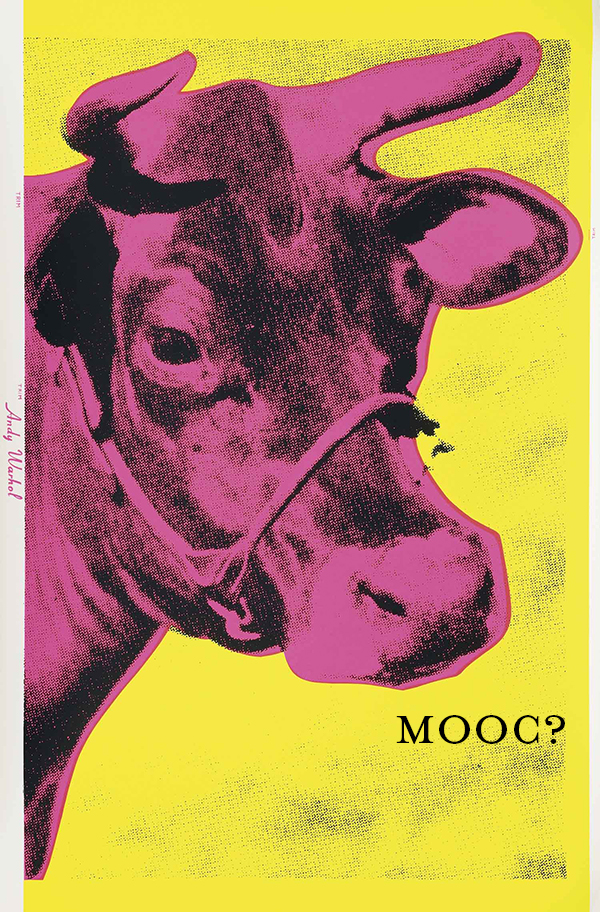
Hashtags: What if an Arts Organization was a MOOC?

Arts organizations in 2013 strive for more than visitors and ticket buyers. Take a look at just about any arts nonprofit’s mission statement and you’re likely to see community building, engagement, and education listed as top priorities. Public lectures and digital content production top the list of methods, but every once and a while an organization tries something more unique; here in Los Angeles, for instance, LA><ART has started holding office hours with local artists. ‘s suggestion yesterday on his Diacritical blog that arts organizations adopt the MOOC model was so unusual, we thought it bore repeating.

What if an arts organization was a MOOC?

That’s “Massive Open Online Course” and they’re everywhere right now. Some of the most prestigious universities are creating courses online and attracting tens of thousands of students. Among them is Curtis, the music school in Philadelphia, which became the first big music conservatory to sign up with Coursera.

We live in a time in which we’re overwhelmed with information, with choices. People lament the shortening of attention spans and we’re bombarded with ever-shorter messages and snippets of information. But an interesting thing has begun to happen. Perhaps because the short message has become so ubiquitous, so disposable, we’re seeing a rebirth in interest in long-form publications and endeavors that take an investment of time.

Now that we can access “everything” and everything is clamoring for our attention, we have become more discerning, and if we choose to invest our attention in something, we want it to pay off, to be able to dive into it. Increasingly, that seems not to be the quick hit; it’s those things that ask something of us, that require us to put something into them to get the payoff.

Read More »

Share

At War With the Obvious

William Eggleston is recognized for taking the ordinary and elevating it to levels of grandior that could have never been conceived for things so seemingly mundane. In celebration of his indelible mark on the history of photography, The Metropolitan Museum of Art presents “Art War With the Obvious,” a survey of well known and lesser known photographs by Eggleston. Today from the DS Archives we take a look back to last year’s exhibit, “William Eggleston: New Dyes” at Rose Galley, which displayed several previously unreleased vintage images.

The following article was originally published on November 1, 2012 by :

William Eggleston, Untitled (from Los Alamos, 1965-68 and 1972-74)

I will never forget the first time I saw a photograph by William Eggleston. It was the Los Alamos exhibition at the SFMoMA; I was sixteen, a time when the only thing I could do to mask the uncertainty I felt about the world was with an all too common teenage bravado. But as I walked through the rooms, every ounce of the know-it-all in me fell away; I had never seen the world look the way it did in those photographs. The curiosity, devotion, and nonchalance all shone through the unworldly vibrancy of each dye-transfer print. It feels trite to say that he taught me how to see, but it also seems like an understatement. Now as a somewhat less uncertain adult, I was able to relive with the same sense of awe I felt as a teenager while viewing William Eggleston: New Dyes, the current exhibition at RoseGallery in Los Angeles. Read More »

Share

San Francisco

Apichatpong Weerasethakul / Matrix 247

As a part of our ongoing partnership with Art Practical, today we bring you a feature from writer Matt Sussman on Apichatpong Weerasethakul’s 2007 video installation Morakot (Emerald), currently on view at the UC Berkeley Art Museum (BAM/PFA) in Berkeley, California.

Apichatpong Weerasethakul. Morakot (Emerald), 2007 (still); single-channel video projection; color, sound, 10:50 min., looped; museum purchase: bequest of Phoebe Apperson Hearst, by exchange. Courtesy of the UC Berkeley Art Museum and Pacific Film Archive.

Named after the abandoned Bangkok hotel in which it was filmed, Apichatpong Weerasethakul’s 2007 video installationMorakot (Emerald) transforms the UC Berkeley Art Museum’s (BAM/PFA) small Matrix gallery into a kind of temporary residence. While the video can be viewed as a documentary sketch of a particular place at a particular time, it becomes, in the context of the installation, part of a modest proposal to visualize a subjective experience of memory that feels very much out of time.

Apichatpong Weerasethakul. Morakot (Emerald), 2007, Installation View

The nearly 11-minute looped video opens with a static shot inside a nondescript bedroom, empty save for some weathered furniture and the dust particles and feathers swirling in the natural light that streams through discolored curtains. The mostly static shots that follow, also of similarly derelict rooms, reveal that the camera is lingering not in someone’s home but in the titular hotel. Each shot is framed to place the viewer in the center of each room. As Weerasethakul’s camera takes in other details of the rooms—the peeling paint and stained mattresses, the barren closets and tacky wallpaper—increasing numbers of digitized motes are superimposed until the air in the hotel appears thick with some shimmering, efflorescent life force.

Read full article here.

Share