San Francisco

Aesthetics of the Spectacle

In societies where modern conditions of production prevail, all of life presents itself as an immense accumulation of spectacles. Everything that was directly lived has moved away into representation.
—Guy Dubord, Society of the Spectacle, 1967

Installation view of Several Species of Small Furry Animals Gathered Together in a Cave and Grooving with a Pict at Et al.

The Bay Area is the social media capital of the world; with headquarters for Google, Facebook, Twitter and Instagram, it is no surprise that everywhere you go, people are on their cell phones. The subsequent inundation of digital and virtual media creates a state in which the real world is increasingly less necessary. We are constantly connected not through corporal interactions but through uploading and downloading of information. The result of is an ever-expanding chain of posts and reposts that increasingly disconnects us from the original idea. Simultaneously appropriating, diffusing and layering, we create a state in which we can live vicariously through the representations of others’ experiences. The current exhibition “Low Subject” at The Popular Workshop and the inaugural exhibition “Several Species of Small Furry Animals Gathered Together in a Cave and Grooving with a Pict” at Et al. bring together a group of artists whose works challenge the notions of what we understand to be authentic, and how we process the current bombardment of visual information. While the two exhibitions are not intentionally connected, the relationships between the works in each show and between the two galleries demonstrate a local investigation of contemporary issues that is proving to be more than the sum of its parts.

Installation view of Several Species of Small Furry Animals Gathered Together in a Cave and Grooving with a Pict at Et al.

“Several Species of Small Furry Animals Gathered Together in a Cave and Grooving with a Pict” could not be a more perfect title for the experience of viewing Et al.’s debut exhibition. Taken from a Pink Floyd song, it sets the stage for the wonderfully strange and pedantic gallery visit. Occupying a basement-level room behind a dry cleaning business, Et al. covers the walls with a surprising number of artists while maintaining enough space for each work to be appreciated. Featuring works by Kate Bonner, Andrew Chapman, Anthony Discenza, Aaron Finnish, Chris Hood, and Cybele Lyle, the overall aesthetic of the installation is chromatically minimal, which helps to keep the room from feeling cluttered. In a continuation of the exhibition title, the works are all deliciously anti-cathartic. What we see is a biopsy from a larger narrative that the artists never full reveal. Instead the works confront the viewer with tension and aura, encouraging the consideration of the exhibition as a whole.

Anthony Discenza, The Woodcut, 2013

CHROMA III (10MB data), Aaron Finnis’s tall wooden rectangle painted with dizzying, thin stripes leans on one wall. With a hole where a knob could go, the object is at first recognizable as an incomplete door. To further demonstrate its absolute uselessness, behind the door is a wall, so even if it were complete with handle and hinges it would lead to a dead end. Any potential “doorness” of the object deteriorates in CHROMA IV (10MB data), the sister piece across the gallery, which lacks even a hole for a doorknob. Facing Finnis’s impassable door and mirroring its graphically buzzing lines, Anthony Discenza’s lightbox, The Woodcut, glows with white serif text on a black background. The combination of the text and what it describes negate all that is typically featured in a light box. Devoid of sensational or commercial pictures, Discenza paints a scene of revulsion and confusion in a deadpan, matter of fact tone.

Read More »

Share

Elsewhere

Organism/Mechanism: Michael Theodore at David B. Smith Gallery

When you enter your local supermarket, the door will most likely slide open automatically, welcoming you as it senses your presence. There’s nothing remarkable about that, you’re accustomed to the simple technology of motion sensors. What is remarkable is that technological fixtures such as motion sensors have become so ubiquitous that we scarcely notice them anymore. They are a part of your daily routine, a simple and unnoticed interaction with technology. It is that subtle relationship between man and machine that new media artist Michael Theodore explores in his solo exhibition organism/mechanism currently showing at David B. Smith Gallery in Denver.

Michael Theodore, endo/exo (2013), installation view, dimensions variable, courtesy of David B. Smith Gallery and the artist.

At the entrance of the gallery stands the monumental sculptural piece, endo/exo (2013). Spanning most of the length of the darkened lobby and rising from ceiling to floor, a flow of ambient LED light reflects off organic clumps of yarn creating a James Turrell-like illuminated atmosphere. However, moving closer to the piece, one is able to see how it departs from traditional light and space work when rows of rods begin rotating in response to the presence of the viewer. endo/exo is similar in design to many of Rafael Lozano-Hemmer’s pieces that also utilize motion sensors to create kinetic sculpture. However, Theodore’s work ventures further into traditional media in addition to the technological formats. This creates an environment that enhances sensual perception through the use of light and sound as well as movement.

Read More »

Share

New York

Tracey Emin at Lehmann Maupin: The Carry

Tracey Emin’s work presents an unfiltered and often embarrassingly personal view of emotional pain. It reflects the kind of desperate or careless narcissism that is the territory of the depressed. Emin is concerned with the primacy of her own experience—and the narrative of her own sadness is the unabashed subject of her work. Emin’s oeuvre has always felt most valuable to me in terms of a documentation of personal response: those small moments in her work in which we can be self-indulgent with her; when her moments develop a mutual understanding of depressed interior life.

Emin’s current solo exhibition at Lehmann Maupin, I Followed You To The Sun, features work in mediums that we’ve come to associate with her: small, square, painted canvases of figures in coitus; an extensive collection of figure drawings in gouache on paper; a gratuitous neon installation of the exhibition’s title in her handwriting. The collection is punctuated by a series of new bronze sculptures developed during her residency at Louise Bourgeois’ Long Island foundry.

Tracey Emin, I Followed You To The Sun, neon, 22.4 x 72 inches. 2013. Image courtesy of Lehmann Maupin and the artist.

Read More »

Share

San Francisco

Time After Time: “The Clock” at SFMOMA

Christian Marclay, video still from The Clock, 2010; single-channel video with stereo sound, 24 hours; courtesy the artist and Paula Cooper Gallery, New York. All photos from Christian Marclay: The Clock; San Francisco Museum of Modern Art

Everyone I know who saw Christian Marclay’s Clock raved about it. The 24-hour sequence of film clips, most with a view of a clock face, is more action-packed than I’d imagined it would be. The focus is as much on the events surrounding the passage of time as on the instruments we use to measure that passage. In this way, The Clock isn’t about clocks at all, and often is only circumstantially related to temporality. What it’s really about is film technology, the nature of story telling, nostalgia, and the absurdity of life.

First things first: you don’t need to watch all 24 hours. I say this with the arrogance of someone who saw only two hours; and I say it even though I am constitutionally drawn to finishing things I begin, even though I believe there is a qualitative difference between doing something for a little time and doing that same thing for a long time. I recognize the irrationality of my confidence in grasping Marclay’s epic after experiencing only 8 percent of it. It is also true that some people insist that one period of Clock watching—10:00 am to noon, for instance—is qualitatively different from another—4:00 to 5:30 pm; or 1:00 to 2:00 am. Such natural enthusiams are proof of Marclay’s achievement, even if they are tinged, perhaps, with nostalgia; that is, influenced by the memories and narratives we fabricate as a fortress against the passage of time. But there is a way in which every period—whether period equals segment formed from connected scenes, hour, or length of time I sat in the theater—is always the same.

Christian Marclay, video still from The Clock, 2010; single-channel video with stereo sound, 24 hours; courtesy the artist and Paula Cooper Gallery, New York

Everyone admires Marclay’s craft. He strings together thousands and thousands of moments from cinematic history, transforming fragments into a whole or, more precisely—since few witness the complete opus—into a series of “scenes” that somehow tell a story none of them originally set out to tell. He invites the sound from one fragment to extend seamlessly into the soundscape of the next. He conjures such segues with images as well, fading not into a double exposure, at least not during my two hours—11:15 am to 1:15 pm—but into a double exposure of associations. (And he goes beyond film editing techniques such as shot-countershot to produce this illusion of continuity from one fragment to the next.) Buttressing the whole composition is the beat, beat, beat of the clock—digital, analog, mechanical (even a sundial!)—whose relentless tick-tock presence comprises not only a visual metronome but also the false sense that we are experiencing the passage of time as linear, as complete, as fully accounted for. What a delightful fictional device! On its face, the clocks prove that time exists; beneath this facade, the seconds don’t add up, revealing the artificiality of the whole overlay of minutes and hours.

But mostly what Marclay achieves is a continuous recollection not of films we remember having seen—although there is plenty of that—but of films that we feel we’ve seen, even though we haven’t, as if the whole history of film comprised our collective (sub)consciousness. You and I are there. It appears to be no accident that the San Francisco Museum of Modern Art gallery in which The Clock plays through June 2 is a darkened theater, evoking something of what I imagine as the hushed, almost religious, original cinema experience. The ritual begins outside the sanctuary. Here, I experience a different sort of time. That’s part of the Clock experience too, the period of waiting. People wait for hours. Many will wait longer than I will have watched (the price of redemption, I guess). Eventually, I am called and guided by one of the two ushers ministering the sanctum to one of the pre-seating, standing-room places at the back of the theater. I hug the wall for 30 minutes with a dozen other initiates. Before us spreads not only the screen but also the heads of visitors silhouetted against grainy film clips. Finally, having withstood these trials of endurance, I am called for a second time. I shiver as I follow the darkened profile of my usher down one of the two aisles, past row after row of three-seat couches, toward the promise of the epiphany.

Read More »

Share

Chicago

A Ballad for Chicago: Theaster Gates at MCA Chicago

Last year, Theaster Gates and a team of collaborators took over a run-down building in Kassel, Germany called Huguenot House, renovating the space for performances and creative interventions as part of 12 Ballads for Huguenot House, the artist’s contribution to dOCUMENTA (13). It was a fitting gesture considering the restorative origins of the first dOCUMENTA in 1955, which reintroduced modern art to Germany after years of banishment under the Nazi regime. Building off his work at Huguenot House, Gates has returned to his native Chicago with an outstanding installation in the atrium of the Museum of Contemporary Art Chicago titled 13th Ballad.

Theaster Gates, Double Cross, 2013. Courtesy of the artist, White Cube, and Kavi Gupta. Installation view, Theaster Gates: 13th Ballad, MCA Chicago, 2013. Photo: Nathan Keay, © MCA Chicago.

Gates’s installation enhances the atrium like no installation I’ve seen in the same space. Normally a sun drenched thoroughfare, the spacious multi-story glass reception area directs patrons to the two galleries on the main floor or to the café overlooking the museum’s sculpture garden. With Gates’s additions, the space is transformed into a kind of secular church, though perhaps ‘transform’ isn’t quite the right word. Augmented with thirteen pews repurposed from the University of Chicago’s Bond Chapel, an altar, and a giant double horizontal axis cross, the installation calls attention to the already cathedral-like quality of architect Josef Paul Kleihues’s entrance, while also referencing the migratory history of religious communities. Gates’s work fits so well within the museum architecture, one might think Kleihues himself commissioned the installation.

According to museum literature, the row of pews was recently removed from Bond Chapel as an inclusive gesture to open floor space for Muslim students to pray. Here, the pews offer a place to rest, reflect, or gather and discuss the work in the adjacent galleries, as a group of students was doing on the afternoon I visited the show. The slightly worn edges of the benches suggest a history of use from their previous life. Similarly, Stage Floor (2012), an assemblage of white rectangles hanging on a nearby wall is still dusty and stained from recent activity. Evidence of time and use places Gates’s objects within a continuum of purpose, serving as a reminder that everything has a past and could have a future when given the opportunity. This connection to accumulated history, purpose, and reactivation is reminiscent of the artist’s past work, particularly, Dorchester Projects (2009), an extensive undertaking in which Gates converted abandoned buildings in his South Side neighborhood into an artist residency, library, soul food kitchen, and community space.

Read More »

Share

Help Desk

Help Desk: Death & Taxes (Mostly Taxes)

Help Desk is an arts-advice column that demystifies practices for artists, writers, curators, collectors, patrons, and the general public. Submit your questions anonymously here. All submissions become the property of Daily Serving.

I have recently been the lucky recipient of an unprecedented amount of small, but not insubstantial, payments. Some are for arts writing and editing, others are one-time grants, art sales, and various art-world related odd jobs. All have been issued through W-9s and will show up come tax time as 1099-MISC income. None have been taxed. I do have a regular 9-5 job that gives me a more stable income and provides for my room and board. This new, supplemental income will mostly go toward studio rent and art supplies. I understand I should set aside a portion of these funds for the state and feds, but where do I start?

First, congratulations! Nice job on your grants and sales, and good hustle on the art-related income. Second, I can’t believe you came to me for advice that involves numbers. All I can recall about Algebra 1 was that my teacher had a glass eye, and there is honestly a question in my mind as to whether I ever once attended Algebra 2. My strongest memory related to arithmetic doesn’t even have to do with numbers: one summer in college I took a remedial math class and the guy who sat next to me wore a Stone Temple Pilots shirt every day.

Now that I’m wiser and more mature, I shove art-related receipts into an envelope and then hand the whole thing off to an accountant while hyperventilating.

If that’s not enough to scare you away, read on, because I’ve unearthed information that will help us both.* To start, I contacted a friend who is an accountant in a museum, and she backed me up about hiring an accountant: “The best advice I can give you is to seek the counsel of a professional tax accountant who specializes in artists and freelancers. He/she will be able to really analyze your situation and give you advice that is current to state and federal tax law.” It may seem like a cop-out to point you to a professional, but the U.S. tax code gets changed every year; so depending on the specifics of your situation, it may be better to hire an expert who can captain your little financial tugboat through the choppy waters of deductions, exemptions, withholdings, etc.

Llyn Foulkes, Who’s on Third?, 1971-73. Oil on canvas, 48 x 39 inches

My friend sends you some more advice: “The quick and dirty is this: reduce your exemptions at your day job and save your receipts on all expenses related to your practice. Review the W-4 you submitted to your employer and resubmit it with fewer exemptions. Many people I know who freelance and have day jobs take zero exemptions on their W-4.  A Certified Public Accountant can help you determine the best exemption rate for your situation so that you neither owe nor get a refund, which is the best possible outcome. You want that money in your pocket, as you earn it.”

She also pointed me to the book Legal Guide for the Visual Artist, by Tad Crawford. Chapter 20 deals with taxes on income and expenses, and though I glazed over somewhat in a tax-vernacular-inspired stupor, I actually learned a few things that we can both bear in mind:

First, “[t]he artist realizes ordinary income from all income-producing activities of the artist’s profession” [italics mine]. Ordinary income (what you’re earning with your many jobs) is taxed at a higher rate than capital gains income (when you sell stocks or real estate), up to 35%. This tidbit is important for two reasons: one, you can estimate your own tax and set that money aside so that you don’t get caught short when April 15, 2014 rolls around (since you file W9s and claim all your income as a good citizen should, the IRS will tax you on all of it). Two, if you lump all your art-related income together, you’re less likely to claim a loss after you subtract your deductions (see below), which means you’re also less likely to have to prove to the IRS that what you do is a profession and not a hobby.**

Read More »

Share

From the Archives

New Histories and Epic Tales: Better a Live Ass than a Dead Lion at Eli Ridgway Gallery

Continued from last week’s From the DS Archives, today we feature an article written by Daily Serving’s founding mother, Julie Henson. Both Henson and her husband Seth Curcio have been the directors of Daily Serving from its beginning, while working and maintaining their own artistic careers. Henson just finished her part of a new exhibition at San Francisco’s Southern Exposure titled Reverse Rehearsals in which she and twelve other San Francisco-based artists and writers work in conversation with one another over the course of a month to reconstruct the concept of story-telling. The show is on view through June 1st. In this week’s featured article, Henson reviews a group show at Eli Ridgway Gallery of San Fransico-based artists whose featured work narrates in a different manner: through physical exploration and fascination with nature.

This article was originally published on October 24, 2011 by Julie Henson.

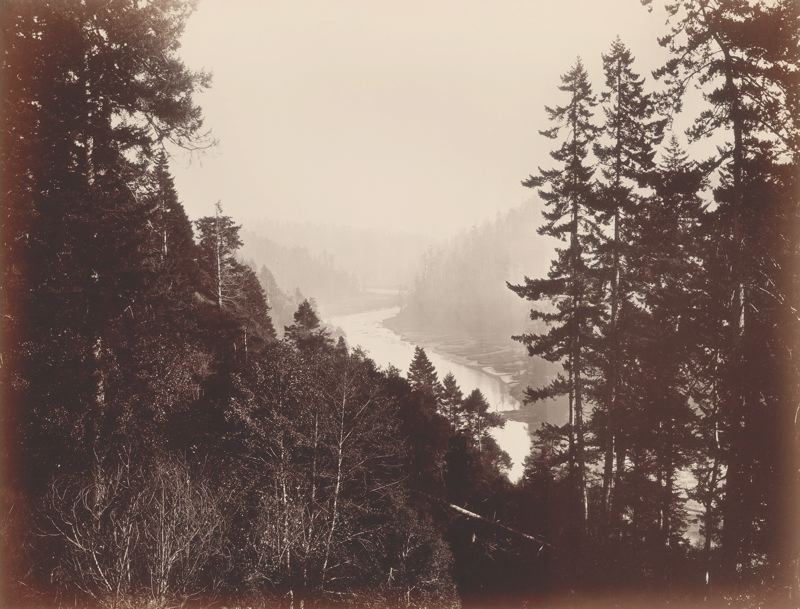
Carleton E. Watkins. Mendocino River, From the Rancherie, Mendocino County, California, c. 1863/68. Albumen silver print from wet-collodion glass negative.

Standing on a hillside gazing into the Pacific Ocean, one can’t help but to be overwhelmed by the beauty and ruggedness of the landscape. Rolling hills, steep cliffs, and thick forests bring to mind epic stories of western expansion and the conquering spirit of those who have traveled here, a spirit currently under investigation at Eli Ridgway Gallery. Better a Live Ass than a Dead Lion brings together a group of San Francisco artists that restlessly explore our romance with both narrative and landscape alike, weaving together stories and dreams of uncharted lands and undiscovered peoples. The love for exploration needs no real truth here; each work presents a small part of a tale bound together by the love of the land.

Elisheva Biernoff. Inheritance, 2010. 80 slides of endangered wilderness areas projected onto mist from a humidifier housed in a plywood and fabric enclosure.

When entering the room that houses Elisheva Biernoff’s Inheritance, 2010, one’s eyes instantly begin to play tricks. Picturesque waterfalls and mountains go in and out of focus. Images dissolve and reconstruct themselves against a backdrop of fog, flashing in and out rhythmically with the subtle sound of a the slide projector. Just as 19th-century photographer Carlton Watkin’s images create mythic space, Inheritance reinterprets fabricated lands at the edge of our perception. Encased in fog, the images rest on the verge of becoming clear, allowing memory to fill in where our vision can’t.

Read More »

Share