Los Angeles

Mike Kelley: Single Channel Videos at REDCAT

Nearing the fourth anniversary of Mike Kelley’s death, REDCAT presented a theatrical screening of six of his video works, curated by Steve Anker and Bérénice Reynaud as part of the Jack H. Skirball Series. The selection of works in Mike Kelley: Single Channel Videos included a one-act melodrama based on a black-and-white yearbook photograph, a hammy and melancholic Superman reciting Sylvia Plath, an invocation of power through juvenile imagination, and collaborations with Paul McCarthy and BDSM dyad Sheree Rose and Bob Flanagan.

Mike Kelley. Superman Recites Selections from 'The Bell Jar' and Other Works by Sylvia Plath, 1999 (film still); 7:19 min. Art © Mike Kelley Foundation for the Arts. All Rights Reserved/Licensed by VAGA, New York, NY.

Mike Kelley. Superman Recites Selections from ‘The Bell Jar’ and Other Works by Sylvia Plath, 1999 (film still); 7:19. Art © Mike Kelley Foundation for the Arts. All Rights Reserved/Licensed by VAGA, New York, NY.

A little over a year ago, MOCA curator Bennett Simpson arranged the Los Angeles iteration of Kelley’s posthumous retrospective, Mike Kelley, at the Geffen Contemporary. First organized by the Stedelijk Museum Amsterdam and curated by Ann Goldstein, the exhibition included a number of Kelley’s major installations. There, his video works were part and parcel of a larger whole, submerged into hilarious, exploded altars to the American ritual. In its entirety, the exhibition was loud, stimulating, and messy—and rightly so. Like Frankenstein’s monster, Mike Kelley was a chaotic assemblage whose sensitive eloquence gained psychic strength from the dissolution of the singular, rather than a distillation toward the sublime. There is no way to neatly separate and isolate light and sound within the box of a building that is the Geffen, and there is no reason to pursue that kind of purity with Kelley’s artworks, which are so much about the uncanny—how near-familiar images and objects can push their fingers into our psyche, beyond the clean boundaries of conscious control.

Nonetheless, at REDCAT’s presentation on December 14, 2015, curator Bérénice Reynaud framed the screening as arising out of Kelley’s MOCA retrospective, her idea being that the video works necessitated a theatrical screening so that they could be experienced in a facility specifically built for viewing films. As promised, REDCAT provided a space that enhanced the innate qualities of the medium, which in effect changed the experience of the six presented video works in varying ways. In the organized darkness of the theater, I could see the moving image projected in front of me, but I couldn’t see my hands. The sweet boozy scent of my neighbors became all the more palpable. The theatrical seating and its positioning of bodies created a sort of nonconfrontational, gentle sense of community—one unified by a common focus and consolidated by sharing a point of reception and reaction in space and time.

Read More »

Share

Mexico City

An Other Art World in Mexico

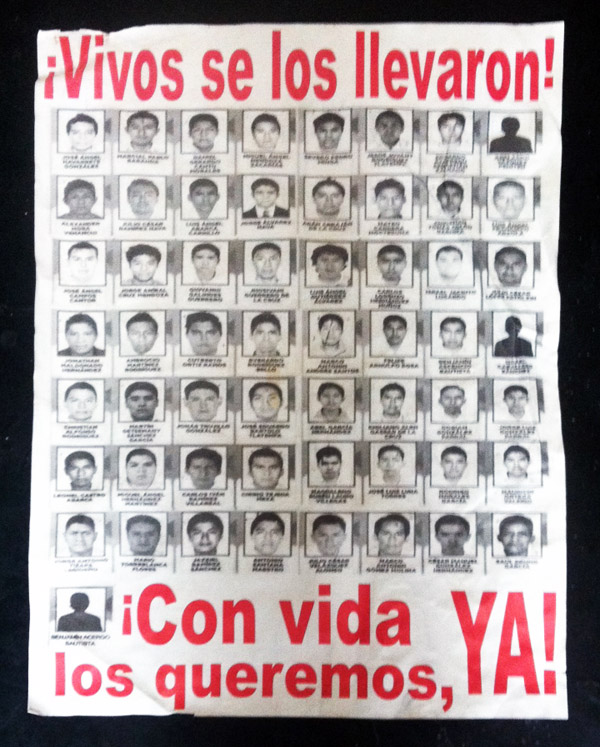
Contemporary art in Mexico operates within a very specific social and economic climate. Since 2006, Mexico has experienced ever-escalating levels of criminal and state violence. Suspicion of collusion between organized crime and the government is common. The case of the presumed torture and murder of the forty-three normalistas directly shows the extent of cooperation between criminal groups and local, regional, and federal authorities. Police officers, soldiers, and civic leaders have all been charged in connection with the disappearances. In addition, waves of political repression have swept through most of the country’s towns and cities. In and around Mexico City, where I live, community activists, artists, journalists, and students have faced beating, abduction, torture, rape, and murder.

Poster calling for the return of the disappeared normalistas. Photo: Jorge Gomez del Campo

Poster calling for the return of the disappeared normalistas. Photo: Jorge Gomez del Campo.

According to some critics, neoliberal reforms account for much of this violence. The chapter on Ciudad Juarez in Ed Vulliamy’s book Amexica is a particularly good example; it situates the epidemic of femicides in that city in the context of the structural changes brought about by the North American Free Trade Agreement. Furthermore, Vulliamy asserts that the particularly brutal character of narco/state violence in Mexico results from the drug war’s neoliberal form.

The question of how art responds to, or ignores, this climate is of utmost importance. Recently, the College of Art and Design of the National Autonomous University of Mexico organized a conference, XI Simposio Internacional del Posgrado en Artes y Diseño, on management and professionalism in design, documentary film, and the visual arts. Peppered throughout the talks given by important and august museum directors, curators, art-investment bankers, copyright lawyers, and gallerists were many dissident voices calling for and describing another, more socially conscious art world. The presentation by curator and artist Carlos-Blas Galindo Mendoza, in conjunction with the roundtable he moderated, revealed the contradiction implicit in staging a conference about professionalism and management in the context of the social, political, and humanitarian crises facing contemporary Mexico.

Read More »

Share

Providence

Laurie Anderson: Heart of a Dog

Artist Laurie Anderson opens Heart of a Dog by recounting a rather bizarre dream. Illustrated on the screen through sketchy black-and-white drawings and narrated in Anderson’s calm, comely voice, the artist gives birth to her dog, Lolabelle, the spectral rat terrier who becomes in some ways (though in others not) the star of the film. After being presented with her bundle, Anderson’s dream self feels very happy, though she admits to a glimmer of guilt for hatching the whole grotesque plan: to have a struggling Lolabelle sewn into her stomach so that she could give birth to her beloved pet.

Laurie Anderson, Heart of a Dog, 2015 (still). Courtesy the artist and Abramorama Entertainment.

Laurie Anderson. Heart of a Dog, 2015 (still). Courtesy of the Artist and Abramorama Entertainment.

The 75-minute film moves ethereally through the artist’s dreams, memories, and, perhaps most poignantly, her failures. The soundtrack is lean but emotive, comprising sparse string instrumentation, layers of synthetic beats and scratches, intermittent sound effects, and Anderson’s ever-present narration. Those familiar with Anderson’s work will recognize her distinctive voice: one full of air, released with great intention, one syllable at a time, her esses melting into a sibilant hiss. The accompanying footage maintains a similar airiness, many of the frames blurred by a heavy peripheral vignetting, or filtered through rain or haze. The images appearing onscreen are pulled from a variety of places. Anderson’s drawings, her own footage capturing her New York neighborhood along with West Side Highway, and the modest adventures of Lolabelle provide visual material for some of the film, while other scenes are borrowed from 8mm family movies from the artist’s youth and footage borrowed from Anderson’s other video works. The images remain indeterminate, abstracted—in the very way that memories and dreams are visually recalled.

Read More »

Share

Shotgun Reviews

Yo-Yos & Half Squares: Contemporary California Quilts at the Oakland Museum of California

Shotgun Reviews are an open forum where we invite the international art community to contribute timely, short-format responses to an exhibition or event. If you are interested in submitting a Shotgun Review, please click this link for more information. In this Shotgun Review, Elena Harvey Collins reviews Yo-Yos & Half Squares: Contemporary California Quilts at the Oakland Museum of California in Oakland.

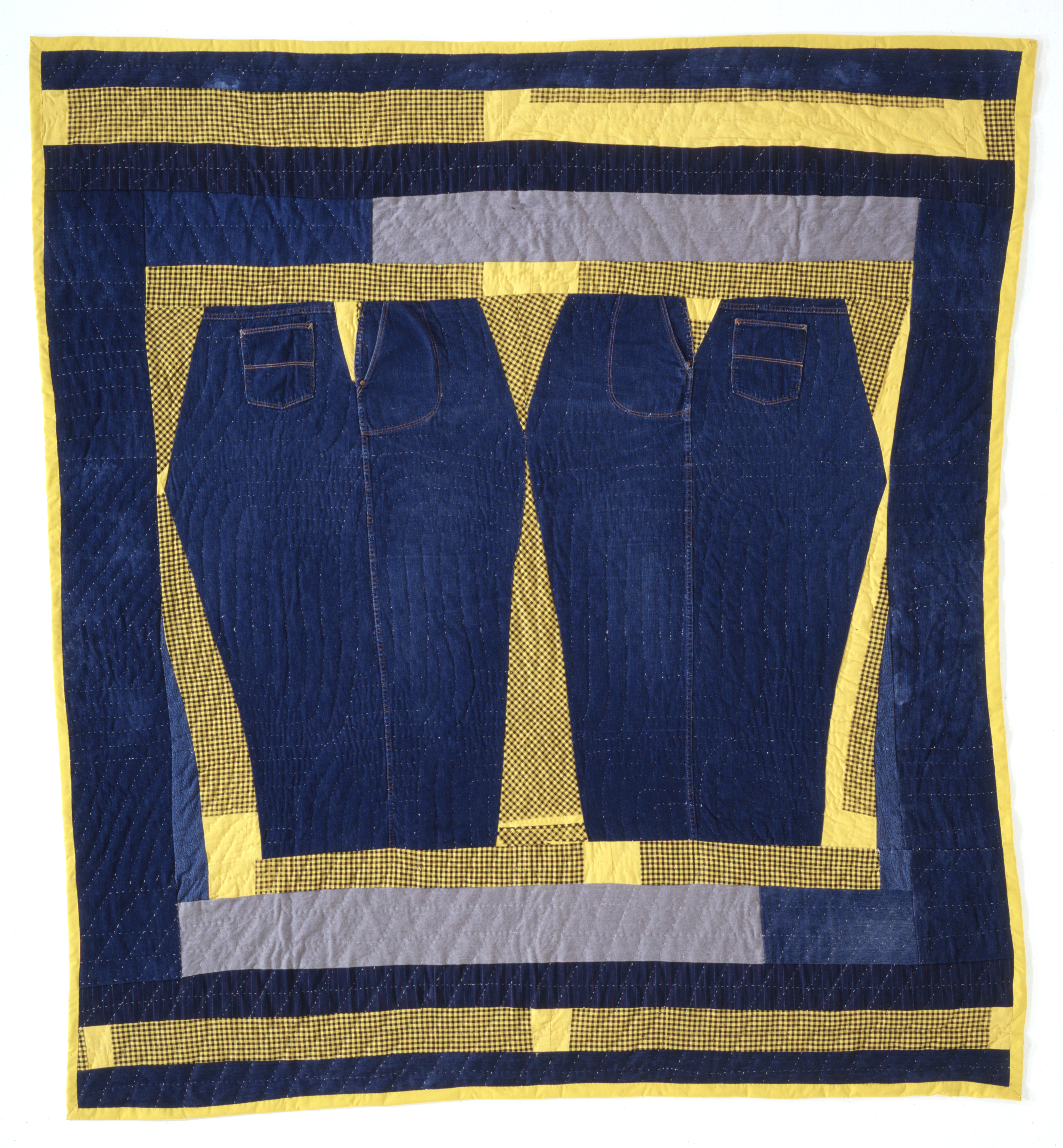
Willia Ette Graham, Johnnie Alberta Wade, and Arbie Williams. Mamaloo, 1992; denim, cotton flannel; 76 x 68 in. Courtesy of the Eli Leon Collection and the Oakland Museum of California. Photo: Terry Lorant.

Willia Ette Graham, Johnnie Alberta Wade, and Arbie Williams. Mamaloo, 1992; denim, cotton flannel; 76 x 68 in. Courtesy of the Eli Leon Collection and the Oakland Museum of California. Photo: Terry Lorant.

On view at the Oakland Museum of California, Yo-Yos & Half Squares: Contemporary California Quilts presents a focused selection of quilts from the extensive collection of Bay Area quilter and collector Eli Leon. This exhibition emphasizes the playful and conceptual aspects of the form, centering on the improvisational aesthetics of the African American quilting tradition, and engages the vocabulary of the craft. Understated titles such as Four Patch Half Square Strip (1994), pieced by Rosie Lee Tompkins and quilted by Irene Bankhead, and Double Strip (n.d.), pieced by Mattie Pickett and quilted by Willia Ette Graham, draw on the quilting pattern used, yet the loose geometry and freewheeling combination of techniques listed sits in irreverent contrast to the precision and consistency often valued in conventional quilts. Unusual material choices abound, too. Pittsburgh Steelers jerseys, men’s ties, and lacy doilies are just some of the bits and pieces tethered into rhythmic schemas of pattern, texture, and color.

Read More »

Share

Interviews

Otobong Nkanga in Conversation with Clare Molloy at Kadist Paris

From our friends at Kadist Art Foundation in Paris, today we bring you a video of Clare Molloy in conversation with Nigerian artist Otobong Nkanga. They discuss Nkanga’s exhibition Comot Your Eyes Make I Borrow You Mine, which was on view from September 27 through December 20, 2015. Nkanga says, explaining the title, “In a way, traveling and going through all these places, I had only the eyes of others.” 

Share

Happy New Year!

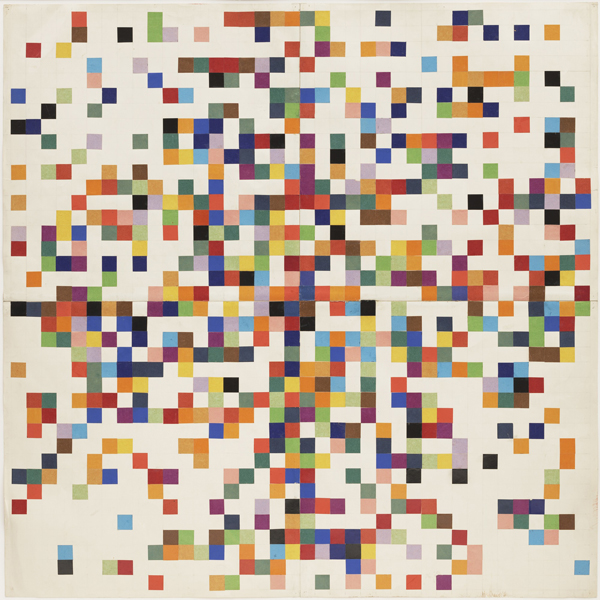
Ellsworth Kelly. Spectrum Colors Arranged by Chance II, 1951; Cut-and-pasted color-coated paper and pencil on four sheets of paper; 38 1/4 x 38 1/4 in.

Ellsworth Kelly. Spectrum Colors Arranged by Chance II, 1951; cut-and-pasted color-coated paper and pencil on four sheets of paper; 38 1/4 x 38 1/4 in.

We’re very proud to say that 2015 was an exceptional year for Daily Serving! The California College of the Arts became our publisher and we partnered with Kadist Art Foundation to create a funded arts-writing fellowship in Mexico City. We published our 100th Help Desk art-advice column, covered major art-world stories like the 56th Venice Biennale and the opening of the new Whitney and Broad Museums, and also turned an assessing eye to exhibitions in cities like Portland, Birmingham, St. Louis, and Krakow. And your support made it happen!

We’re looking forward to another year of the best in arts criticism from around the world, and we wish you a bright and successful New Year!


Share

Best of 2015

Best of 2015 – Ann Hirsch: Playground at JOAN

As we come to the end of our Best of 2015 series, our final selection comes from editor in chief Bean Gilsdorf, who writes: “I love our Shotgun Reviews program: Anyone anywhere in the world can submit a review for publication. We keep the format short so that it’s accessible, and authors have ranged from a thirteen-year-old newcomer to a lifelong writer with many prior arts publications to her credit. And no matter who they are, the authors receive the same editorial attention as our regular contributors. All the reviews this year have been commendable, but Anastasia Tuazon’s review of Ann Hirsch’s Playground stands as an example of clear writing that tackles a complicated subject.” This article was originally published on April 19, 2015.

Ann Hirsch. Playground, 2015 (performance still); 65 minutes. Courtesy of JOAN, Los Angeles, . Featuring AnneMarie Wolf and Gene Gallerano. Runtime . Photo: Ruben Diaz.

Ann Hirsch. Playground, 2015 (performance still); live performance; 65:00. Courtesy of JOAN, Los Angeles. Photo: Ruben Diaz.

Ann Hirsch’s Playground, a 65-minute play originally commissioned by Rhizome and performed at the New Museum in 2013, had its second showing at JOAN in Los Angeles on March 28, 2015. Hirsch’s performative and object-based works often explore female subjectivity and sexual power, and Playground draws directly on her experience as a preteen using AOL chat forums in the late ’90s , an online space that enabled her to explore her sexuality at an age when parental monitoring limited her agency.

The play centers on the communication between two characters: “Anni,” a 12-year-old girl (played by AnneMarie Wolf), and “Jobe,” a 27-year-old man (played by Gene Gallerano). With both seated at desks facing the audience, they communicate at first by typing silently onto keyboards, their messages projected onto the wall behind them. They then transition into verbally narrating these messages, and ultimately into interacting with each other physically; this is purely to express what is being communicated online—the two never meet face to face. Hirsch does an admirable job tackling the problem of how to stage a play about instant messaging that doesn’t feel boring, and she does this by drawing viewers into Anni’s imagination.

Read More »

Share