New York
From Minimalism into Algorithm at the Kitchen
In a 1966 review, Rosalind Krauss described how one of Donald Judd’s “progression” wall reliefs pulled the rug from under her. Its intervallic sequence of supporting members suggested a Renaissance colonnade, but its variable spacing negated the compositional and spatial logic that this model prepared her to expect. “The work itself exploits and at the same time confounds previous knowledge to project its own meaning,” she wrote.[1]
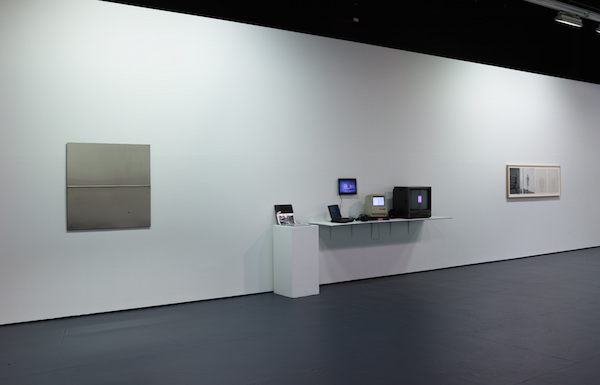
From Minimalism into Algorithm, Phase 1, 2016; installation view, the Kitchen. Featuring works by Donald Judd, Laurie Spiegel, and Charles Gaines. Courtesy of the Kitchen. Photo: Jason Mandella.
The Kitchen’s current exhibition, From Minimalism into Algorithm, pulls a similar maneuver. Its title suggests a cogent historical arc, but in fact it presents nothing of the kind. While the show has been divided into three parts, shown over the course of a few months (phase three is currently on view), these have not corresponded to distinct phases of a historical narrative—such as minimalism, transition, and algorithm—or indeed any other obvious organizational scheme apart from the exigencies of spatial limitations and loan requirements. Each installation has featured a medley of works ranging from the 1960s to the present, with a good deal of overlap among the three parts. Moreover, the older works consistently skirt conventional understandings of Minimalism, while the newer ones reflect upon or utilize algorithms—sets of rules described by formulas, nowadays typically followed by computer software for problem-solving purposes—in such different ways as to render the term disposable. The result is that the show looks like something of a mess, which is its greatest virtue. Rather than presenting one line of thought, it allows for the proliferation of many, giving the included works ample room to project their own meanings.