Summer Session

Summer Session – When Rock Star Fantasies Go Too Far

For this Summer Session’s topic of celebrity, we bring you an article by former Daily Serving columnist Catherine Wagley, who explores artistic practices that take specific personages, both real and imagined, as their subject matter. Wagleys piece begins the complex work of mapping out the intersections of fantasy and reality in the face of celebrity, and whats at stake when they overlap. This article was originally written for Art21.org and published on October 25, 2012.
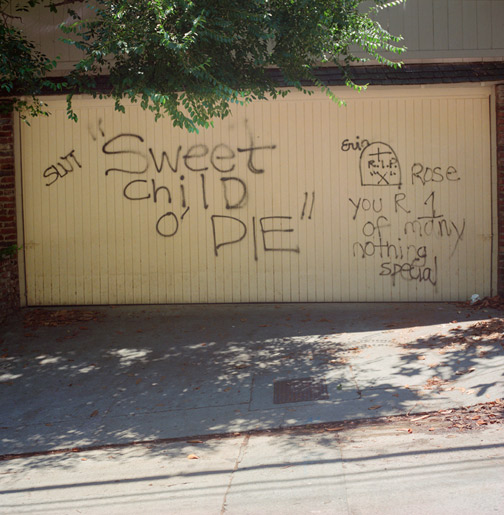
Laura London. "Once Upon A Time... Garage Text," 2012. Color photograph on vinyl stretched on aluminum strainers. Copyright Laura London.

Laura London. Once Upon A Time… Garage Text, 2012; color photograph on vinyl stretched on aluminum strainers. © Laura London.

When photographer Laura London’s show opened at Coagula Curatorial in Chinatown last month, it was called Once Upon a Time…Axl Rose Was My Neighbor. By the time it closed on October 20, its title had been cut down to just Once Upon a Time… and all direct reference to Axl Rose, famous for Guns N’ Roses but more so for being his complicated self, excised from the press release. The release nowapologize[d] for the confusion” the first title may have caused.

From the get-go, the show was supposed to occupy that slippery space between truth and fantasy. But Axl Rose’s lawyer didn’t catch the nuance.

Read the rest of the article here.


Share

Summer Session

Summer Session – Glenn Ligon on “The Idea of a Black Man”

For this Summer Session we’re thinking about celebrity, and therefore also its opposite: anonymity. Today we bring you a video clip from our friends at SFMOMA of Glenn Ligon on his 1997 exhibition Glenn Ligon: Day of Absence. Here, Ligon presents his subjects as generic figures, their faces turned away from the camera or out of frame, in order to play with the idea of the individual standing in for the whole of a social mass, his work exploring the linkages between personal identity and group identity.

Share

Summer Session

Summer Session – Jeff Koons: A Retrospective at the Whitney Museum of American Art

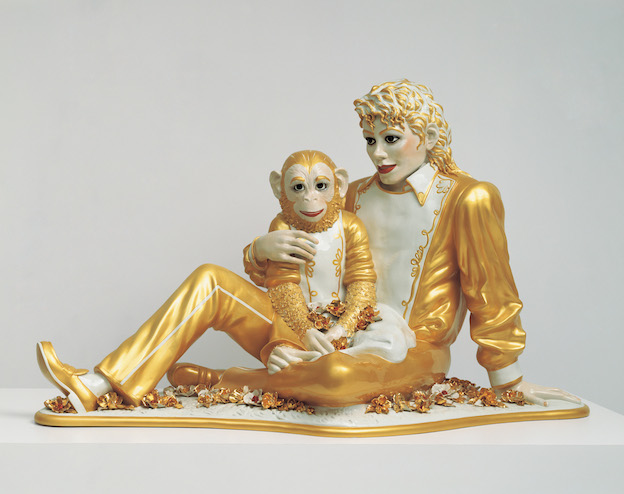
For this month’s Summer Session were thinking about celebrity, and what better contemporary artist to embody this topic than Jeff Koons, for whom celebrity and consumerism are the hallmarks of his most famous pieces? Today we bring you Alex Bigmans review of the Jeff Koons retrospective at the Whitney Museum, which ran June 27–October 19, 2014. Despite Koons infamous reputation for banality, Bigman reminds us that much of his work involves sophisticated critiques of the very bourgeois culture it purportedly celebrates. This article was originally published July 16, 2014.

Jeff Koons, Michael Jackson and Bubbles, 1988. Porcelain; 42 x 70 1⁄2 x 32 1⁄2 in. (106.7 x 179.1 x 82.6 cm). Private collection. © Jeff Koons

Jeff Koons, Michael Jackson and Bubbles, 1988; porcelain; 42 x 70 1⁄2 x 32 1⁄2 in. (106.7 x 179.1 x 82.6 cm). Private collection. © Jeff Koons.

At the press preview for Jeff Koons: A Retrospective, more than one member of the Whitney Museum’s curatorial staff urged visitors to dispense with “preconceived notions” about Koons and embrace the exhibition as an opportunity to view the artist’s perhaps too-well-known oeuvre with fresh eyes. One of the largest retrospectives the Whitney has ever mounted, Jeff Koons sprawls across three floors in ascending chronological order, lucidly mapping the artist’s career as he progressed from wunderkind art-school grad, to cultural provocateur, to the Mylar man we have known and either loved or hated for past twenty-odd years.

Those who revile Koons often do so on the basis of his later works, like Balloon Dog (or, more recently, Balloon Venus of Willendorf), the production and sale values of which have soared while their meaning has seemingly become ever more surface-deep. Admirers, meanwhile, employ a modernist-inflected rhetoric of materiality and monumentality to elevate this work on much of the same bases. Wall text at the Whitney describes how Cat in a Cradle required Koons to push the limits of a worldwide network of specialist plastic fabricators, suggesting that the work owes the “sense of wonder” it supposedly inspires to this insistence on medium and scale. On similar grounds, New York Times reviewer Roberta Smith hails Play-Doh (1994–2014), a towering mound of brightly colored globs that uncannily resemble the matte tackiness of the titular children’s putty, as an “almost certain masterpiece.” Those who agree with such a statement will be delighted by the playground of huge, shiny, pneumatic-looking things that is the Whitney’s top floor. Those inclined to see Play-Doh as little more than a colossal waste of time and money may find a surprising protagonist two floors down: Koons circa 1985. Believe it or not, Koons’ artistic practice was once pointedly critical and anything but insular. Jeff Koons: A Retrospective is most interesting (and encouraging) when it reminds us of this.

Read the rest of the article here.

Share

Summer Session

Summer Session – Artist Orlan Tries Again to Sue Lady Gaga for Plagiarism

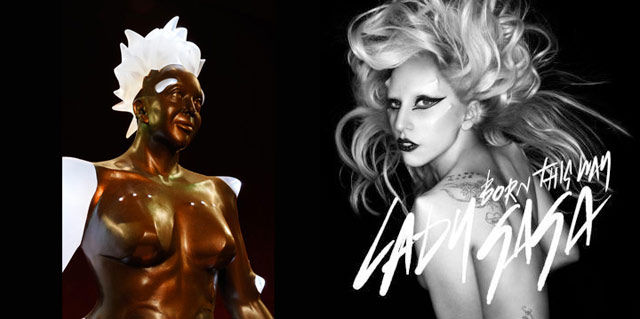
This month our Summer Session is about celebrity, and today we bring you an article by Claire Voon from our friends at Hyperallergic. Voon updates us on artist Orlan’s ongoing lawsuit with Lady Gaga, whom she claims has plagiarized her “theme and aesthetics,” in addition to several of her specific works, in order to generate publicity for her pop career. This article was first published on January 8, 2016.

Left: Orlan, “Bump Load” (2009), mixed media, 170 x 100 x 200 cm (via orlan.eu); right: cover image for Lady Gaga’s ‘Born This Way’

Left: Orlan. Bump Load, 2009; mixed media; 170 x 100 x 200 cm. via orlan.eu. Right: Cover image for Lady Gaga’s album Born This Way.

Two years ago, French artist Orlan sued pop star Lady Gaga in French court for plagiarism over the singer’s cover art for her 2011 album Born this Way and the eponymous, award-winning music video. Now, Orlan is taking the case to New York City, seeking testimony from members of Lady Gaga’s creative team, over whom French courts do not have jurisdiction.

On Wednesday, lawyers representing Orlan filed documents—all publicly available—seeking subpoenas for fashion director Nicola Formichetti and makeup artist Billy Brasfield. The documents order the pair, both responsible for the visuals associated with the album, to appear at a district court on February 12. Known for undergoing multiple sessions of plastic surgery in the name of art, Orlan is claiming that Gaga ripped off two specific pieces, echoing the same alien-like aesthetic the French artist supposedly controls.

“In order to promote her album, Lady Gaga did not hesitate to plagiarize the entire ORLAN universe,” one document reads. “Indeed, the singer ‘Lady Gaga’ not only did not hesitate to copy ORLAN’s theme and aesthetics, but she also infringed upon several of the artist’s famous works without permission to do so.”

Read the entire article here.

Share

Summer Session

Summer Session – Freestyle: Interview with Rashaad Newsome

Today for our Summer Session theme of celebrity we bring you an interview between curator Laura Blereau and artist Rashaad Newsome from our friends at GuernicaNewsome’s cooptation of heraldic symbolism blends the opulent vernacular of aristocracy with feminist and pop-cultural forms, forming a critique of the art world, hip-hop, and global capitalism that is both pointed and complicit. This article was originally published on March 17, 2014.

Rashaad Newsome. King of Arms, 2013 (performance still); live procession in City Park, New Orleans. Courtesy of the Artist. Photo: Jena Cumbo.

Rashaad Newsome. King of Arms, 2013 (performance still); live procession in City Park, New Orleans. Courtesy of the Artist. Photo: Jena Cumbo.

Guernica: The kind of art that you create has found a wide international audience, yet its themes are emblematic of the Gulf Coast. How did being raised in New Orleans influence your perspective on art and culture at large?

Rashaad Newsome: When I think about New Orleans as a point of inspiration, I think about growing up in a place where street theater is so readily available all the time. Brass bands are vibrant. Drumming, improvisation. In my work I often use improvisation as a device to compose. For example, it’s a very important component of my performances FIVE and Shade Compositions. In that sense, I think part of my process is connected to the musical traditions of the New Orleans landscape. I’m also influenced by the region’s sense of color, ornament, its interest in pageantry, obviously, and Baroque architecture.

The experience of art can be had strolling from Camp Street to the Bywater, and on that walk one can encounter so much. Maybe someone is playing a trumpet, and then you go a little further and see a mime; then up the block somebody is singing, and another person is painting canvases on the street. Whether it is “good” or not is debatable, but there are a lot of artistic gestures constantly happening around you there. It’s a very accessible art community that way.

Read the rest of the article here.
Share

Summer Session

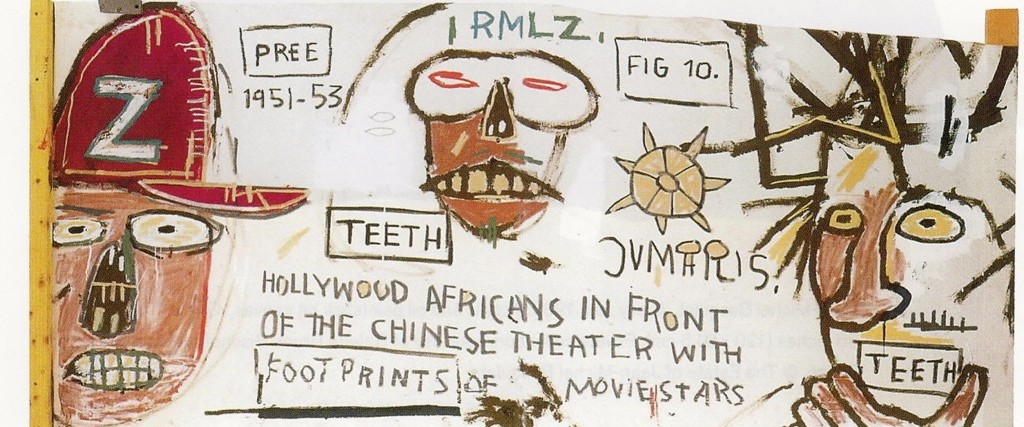
Summer Session – Reading Basquiat: Exploring Ambivalence in American Art

The focus of July’s Summer Session is celebrity, and for our first installment we bring you an article from our sister publication Art Practical. Here, Anton Stuebner reviews the first single-author, book-length monograph of Jean-Michel Basquiat, written by Jordana Moore Saggese. While acknowledging the “celebrity politics” at play in Basquiat’s career, Saggeses critical look at his oeuvre and iconography asserts the artistic merit of his work over his fame. This article was first published on October 7, 2014.

Jean-Michel Basquiat. Hollywood Africans in Front of the Chinese Theater with Footprints of Movie Stars, 1983; acrylic and oil paintstick on canvas mounted on wood supports; 35½ x 81½ in. Courtesy of the Estate of Jean-Michel Basquiat, New York © The Estate of Jean-Michel Basquiat.

Jean-Michel Basquiat. Hollywood Africans in Front of the Chinese Theater with Footprints of Movie Stars, 1983; acrylic and oil paintstick on canvas mounted on wood supports; 35½ x 81½ in. Courtesy of the Estate of Jean-Michel Basquiat, New York © The Estate of Jean-Michel Basquiat.

The mythology around Jean-Michel Basquiat continues to proliferate in the twenty-six years since his death. The standard-issue biography of his life reads like a cautionary tale on the perils of success: the early years in the graffiti movement; the street art produced with classmate Al Diaz under the tag SAMO; the sudden media attention on the East Village art scene; the transition into formal painting and the overnight success of shows with Annina Nosei and Mary Boone; the highly publicized friendship with Andy Warhol; the meteoric rise of auction and gallery sales; the heroin addiction; the self-destruction at a preternaturally young age. It’s a story that owes much to clichés of the artist as tragic hero, reduced in equal parts through simplification and fabrication. It is also a story that sells art, and at record prices.

Read the full article here.

Share

Summer Session

Summer Session – Open Letter by Frances Richard

On the final day of our month considering labor in the arts, we bring you an open letter and call to action from Senior Adjunct Frances Richard on labor, value, and unionization. This letter was originally published in an email to the administration at California College of the Arts on June 2, 2016.

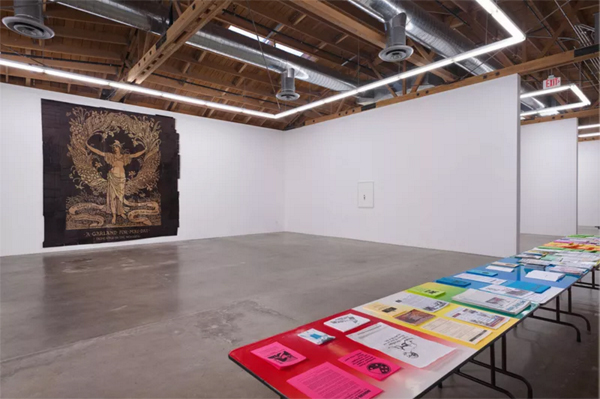
Andrea Bowers. Help the Work Along, 2012, Installation view at Susanne Vielmetter Los Angeles Projects; Photo: Robert Wedemeyer

Andrea Bowers. Help the Work Along, 2012; installation view, Susanne Vielmetter Los Angeles Projects. Photo: Robert Wedemeyer.

Dear President Beal, Provost Carland, and members of the Administration Negotiating Team,

I have been an adjunct for all my teaching life. For years, this was a professional choice, as it allowed me time and flexibility to pursue the other, equally important aspects of my practice–writing and publishing poetry and criticism, and editing magazines. I’ve written three books and co-authored, contributed to, and edited many more; I’ve written for the Guggenheim Museum, the Whitney Museum, Independent Curators International, Creative Time, The New Yorker, BOMB, Aperture, and many others. I’ve won prizes, grants, and fellowships–I write from a residency right now–and I’ve been part of the editorial team at two artist-run publications, Fence and Cabinet. I have a piece in a national magazine (The Nation) going out this week. And I’ve taught across the spectrum of institutions, from the Ivy League to art schools (RISD and Parsons in addition to CCA) to the Bard Prison Initiative.

I know perfectly well that my adjunct colleagues at CCA and at each of the other schools I’ve named could write similar lists. Every long-term adjunct I’ve ever met has a wildly impressive, expansive, and rigorous record of engagement in her field. Often she–my generalized adjunct colleague–excels in several fields at once.

It’s only in the last few years that I have felt the sharp edge of the adjuncting system cutting into my livelihood, and into my sense of the integrity of university education in the US. I used to take pleasure in assuring students that they could become artists, work as freelancers, and thrive: I’d done it, and so had most of my friends. You are artists yourselves, so doubtless you can understand how important it has been to be able to tell students, with absolute honesty, that the path of the creative intellectual and imaginative craftsperson remains open to them in contemporary culture, regardless of their economic and family backgrounds, despite the pressures of a capitalist-realist system whose internal logic reduces every public effort to market value.

Read More »

Share