In A Pure Land

Alyson-Shotz-10-5-08.jpg

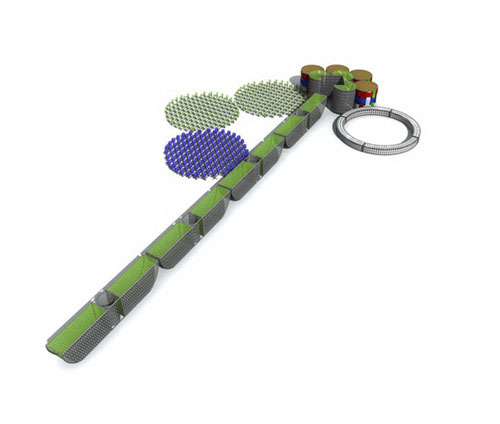
In A Pure Land is the title of a new exhibition on view through the 8th of November at Isis Gallery in London. The exhibition which features new sculptures by artists Nayland Blake, Martin Griffiths and Alyson Shotz, whose work is pictured above, attempts to reinsert purity and deliver viewers from the “communal unease, bad news, moral panic and government-induced fear” that is often characteristic of our time. The results are clean and sleek creations that emphasize a purity of form and material. The works are minimal in structure and contemplative by nature.

The group of artists includes Nayland Blake, who has exhibited works at the Tate, the Whitney Museum and the Contemporary Art Museum, Houston. Martin Griffiths, who is in the permanent collections of the Museum of Modern Art, Wales and the Cass Sculpture Foundation in England, and Alyson Shotz who has exhibited with Guggenheim, New York and the Hirshorn, Washington D.C.

Share

Masakatsu Sashie

Sashie-10-4-08.jpg

On view now at Giant Robot’s GR2 gallery in Los Angeles is the exhibition Under Fluorescent Light, featuring new works by artist Masakatsu Sashie. The artist, who is from Kanazawa, Japan creates intricate paintings of hovering orbs, which contain details of his youth, densely packed in an auto-biographical manner. The work references, video games, fast food signs and vending machines, among other highly recognizable imagery.

The artist is currently a professor of art at Kanazawa College of Art, the same school from which the artist graduated. Sashie began his carreer as an artist by exhibiting in Takashi Murakami‘s GEISAI exhibitions in Japan. Under Fluorescent Light, will be the artist’s first solo exhibition in the United States. The work will be on view at GR2 until October 15th.

Share

Yoshitomo Nara + graf, A-Z Project

Nara and Graf.jpg

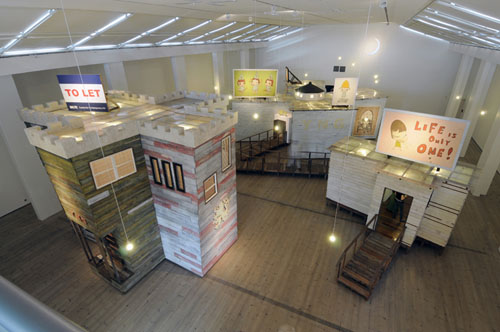
The Baltic Centre for Contemporary Art in Newcastle presents Yoshitomo Nara and graf‘s A to Z Project. Nara, who was born in Hirosaki, Japan in 1959 and presently lives and works in Tokyo, is mostly known for his deceptive, innocent and childlike images. Since 2003 he has teamed up with graf, the Japanese creative design team, to work on the A to Z project, building small ‘huts’, as they call them, to fit within gallery and museum spaces in Japan and abroad.

Nara and graf are interested in exploring the relationship between the lived in space and the individual. They recreate work spaces and the objects that may inspire and help their creative sensitivity. This installation includes three houses, with ramps connecting two of them, one with a dog house. Nara’s paintings are strategically distributed within the spaces with a few billboards outside the houses. The third house, Castle of Baltic, was inspired by the Newcastle area and was created specifically for the Baltic exhibition. These small villages are built with recycled materials. In one of the rooms from the Big Seagull House, he has recreated his studio with a half finished painting, beer cans, the Baltic CD playlist he listened to during his time there with the CD playing in the background, among other paintings, furniture, garbage, etc.
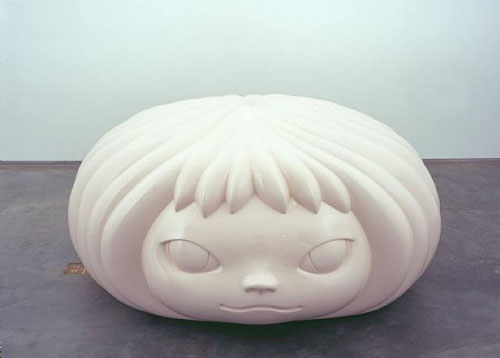
Nara.jpg

In addition there is special surprise! You are lead by a ramp to a separate room. You imagine this will be another little house but instead you are confronted by the huge sculpture, Puff Marshie, one of Nara’s characters, who represents an innocence but it is also intimidating because of its size.

It is a place to explore, where you continuously find something new. The experience of stepping into this sort of naughty children’s village allows for a privileged and secret glimpse into a world that adults have forgotten, but at the same time makes it a wonderland for all, including children. The exhibition is running until the 26 October 2008.


Share

Dennis Oppenheim

Dennis_Oppenheim.jpg

Dennis Oppeheim, known for his experimentation in land art and body art, is now exhibiting new work at Ace Gallery in Los Angeles. Cactus Grove features colorful, exuberant, architectural sculptures of cacti – a lighthearted but characteristic venture for an artist who has spent the last forty years adventurously challenging the way people interact with space and nature. Oppenheim has used a span of materials, including fiber glass, side walk grating, galvanized steel, doors and windows, to evoke these organic cactus forms, engaging a conversation between architecture and natural bodies.

Oppenheim, who has lived and worked in New York since the 1960s, studied art at California College of Arts and Crafts in Oakland and Stanford University. At the 2007 Vancouver Sculpture Biennale, he was recognized for his life’s work in sculpture, photography and performance. Recently, Oppenheim was commissioned to display public sculptures during the 2008 Beijing Olympics. Two of his works, Engagement and Raining Halos, appeared during the games, one in Hong Kong, the other in Beijing. Oppenheim’s exhibition at Ace Gallery continues through December 2008.

Share

Matthias Hoch

Matthias Hoch-10-1-08.jpg

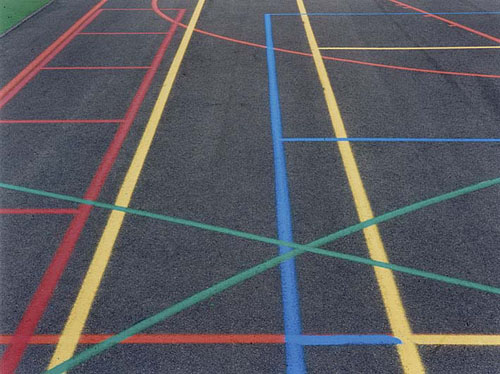
Exhibiting at Rena Bransten Gallery in San Francisco is German photographer, Matthias Hoch. Using architecture as his focus, Hoch creates a blurred division between the natural and the man-made. His large-scale, vibrantly colored photographs reveal contemporary city elements and cutting-edge architectural structures. Through learned manipulation, Hoch has created an organic atmosphere among these structures. The artist’s choice in photographing public space questions the architectural notion of public arena – what are city planners, architects and urban designers creating for contemporary outdoor spaces?

Hoch has exhibited widely throughout Europe. He currently lives and works in Leipzig, Germany. Born in post war Germany, Hoch has been invited to show in the upcoming traveling exhibition, Art of Two Germanys/Cold War Cultures, which commences at Los Angeles’ Broad Contemporary Art Museum and will continue to tour throughout Germany in 2009.

Share

Olafur Eliasson

waterfall.jpg

Olafur Eliasson‘s work provides a sensory and dispersive experience for the viewer; elements such as light, air, fog, water, and even sound are employed in his installations and public art projects. The artist is influenced by both the built environment and natural elements, and his artistic practice moves between the public and private sectors. Eliasson has previously completed commercial works for Louis Vuitton and BMW.

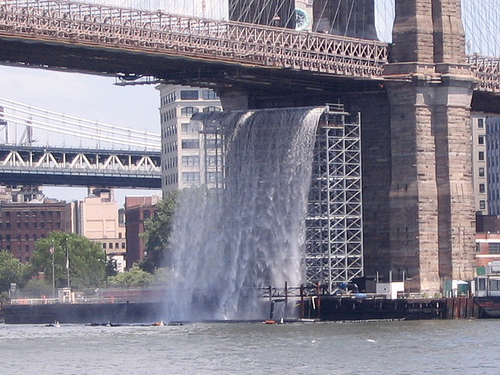
The New York City Waterfalls was commissioned by the Public Art Fund and includes four monumental waterfalls located beneath the Brooklyn Bridge, between Brooklyn’s Piers 4 and 5, at Lower Manhattan’s Pier 35, and one on the north shore of Governors Island. The water plunges 90-120 feet, and can be seen from land and water (ferry tours are available). The falls are constructed of scaffolding, a ubiquitous New York City material, and were built by a team of engineers, architects, and ecologists. Filters protect wildlife and the falls run on green energy provided by ConEd. When viewed from the harbor, the water gently mists over the viewer and the loud roar of cascading water is heard. New York harbor has been a gateway to immigrants for centuries, and the artist has stated, “I hope to evoke experiences that are both individual and enhance a sense of collectivity.”

Eliasson’s previous projects include The Weather Project at the Tate Modern‘s Turbine Hall in 2003. The installation, which included a giant sun made of 200 yellow lamps, mirrors and mist attracted over 2 million visitors during its five month run.

The New York City Waterfalls will be de-installed on October 13th and 90% of all materials will be re-used in construction projects. A map of vantage points, boat schedules, and suggested bike routes are available at www.nyc.gov.

Share

Zheng Gougu

Unknown.jpeg

Zheng Guogu’s sculptural work often pairs confounding idioms, layering ephemeral qualities with imposing materials, in order to poetically arrange forms that operate on both a tactile and symbolic level. In his sculpture, Waterfall, Gougu pours white melted wax over a rigid metal armature, embedding calligraphic scripts into this serene fountain. Gougu both reinforces and freezes the progression of time, in an allegorical fashion not unlike the symbolism of burning candles, skulls, or rotting fruit prevalent in Dutch Renaissance still lives.

Evocative of natural forms on multiple levels, from snow-capped trees, mountainous landscapes, to icicle-like forms, Gougu creates an enigmatic presence, both familiar and foreign. The piece’s somber, haunting aura is reinforced by the fact that white is traditionally a symbol of mourning in China. Lyrically composed, the piece acts as an abstract Memento Mori of sorts – reminding the viewer of his or her own mortality and the impermanence of life.

Zheng Gougu was born in Yangjiang, Guangdong province, China and lives and works in Yangjiang, Guangdong province. He has shown at the Venice Biennale, and was one of the few Chinese artists to participate in Documenta 12 in Kassel, Germany. Last year, he was exhibited in The Real Thing: contemporary art from China (2007) at the Tate Modern in Liverpool. He has also shown at the Mori Museum in Tokyo and Guangdong Museum in Guangzhou, China.

Share