Meeson Pae Yang

12

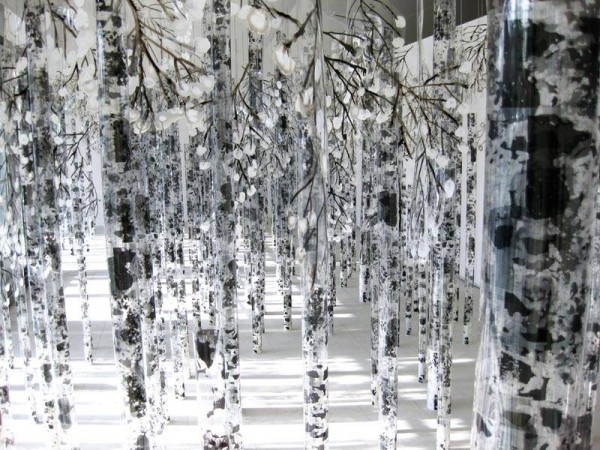
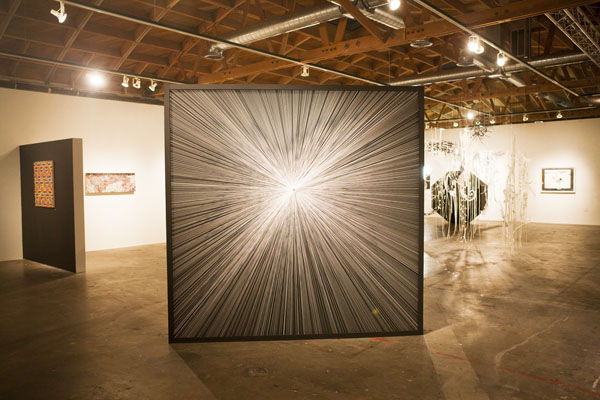
Los Angeles-based artist Meeson Pae Yang creates intricate sculptures and installations that explore technology through the context of the body and the natural world. Developing systems that mimic both micro and macro environments, the artist often builds an entire ecosystem within a singular installation. Meeson Pae Yang’s most recent work, Traverse, takes place in a vacant storefront in California. The artist has built a replica forest-like landscape that is composed of translucent trees which spring from the hard concrete floor. The exhibition combines organic and synthetic material to create the illusion of a deep seated wintry forest.

The artist received her undergraduate degree from the University of California Los Angeles (UCLA) and has completed recent projects with Lawerce Asher Gallery and JK Gallery, both in Los Angeles. Her most recent project, Traverse, can be seen 5661 Atlantic Ave in Long Beach, California.

Share

Eric Deis

Art-Photography-Toronto-Dundas-Street

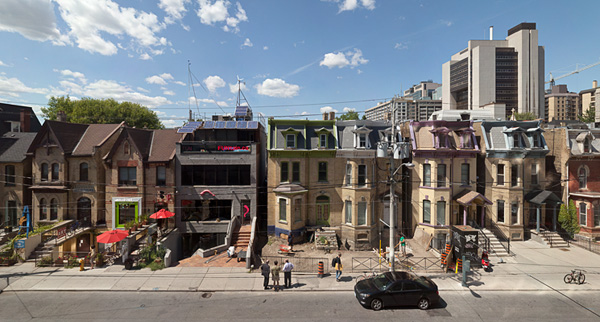
Canadian artist Eric Deis is currently exhibiting a new series of photographs titled Shadows Cast on Imagination’s Past, on view now at Elissa Cristall Gallery in Vancouver, BC. The exhibited images include scenes from Vancouver, Tokyo and Toronto. Deis’ images usually depict urban settings with striking clarity, as the artist uses a virtual view camera that features a hybrid digital-analog system which offers a gigapixel of resolution. The images embody a psychology that is introspective and isolated, even if there are other people present in the image. About the new series, the artist has stated “My photographs of landscapes and urban spaces critically examine the intertwined dynamics of nature, history, and economics. Captured in-situ, my images are not staged nor manipulated. I strive to capture the idiosyncrasies of our society through the collision of artifacts of urban living and astute visual story telling.”

Deis is a graduate of Emily Carr Institute of Art and Design and received his MFA from the University of California at San Diego.

Share

Scion: Infinity

Scion-1

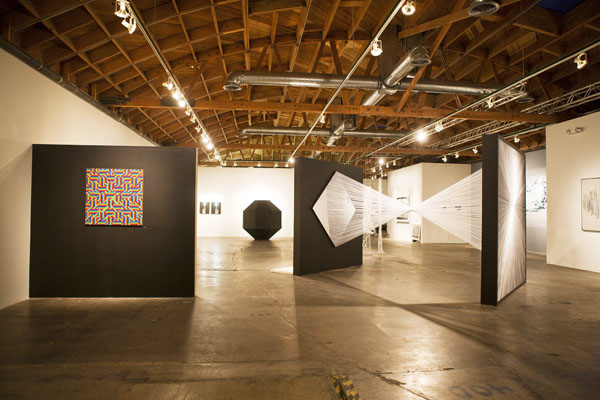
Infinity, curated by Andrew Schoultz is a collection of 15 contemporary artists’ interpretations of a boundless theme. Scion Space in Los Angeles hosts the exhibit, which opened Saturday, October 10th, and will continue through November 7th, 2009. Prior to the opening, I chatted with some of the artists as well as the curator, who revealed how relative concepts are strategically woven into the pieces, whether through mathematics, metaphor, science, or technique.

Schoultz chose artists who frequently question life’s immeasurability, like Ryan Wallace. During the process of completing oil paintings such as Fulcrum, Wallace explained that he saves pieces of tape used to mask off sharp-edges. Wallace then uses the tape and other appropriate odds and ends in his studio to make pieces like Quest. Throughout his process, Wallace experiments with how variables involved in the chemistry of oils, alkyds, acrylics, mylar, paper, and tape affect the surface of his painting. He enjoys “letting each material have its own voice based on chemical properties.” Further, his imagery questions aspects of physics that might be in play. For example, Fulcrum features two intersecting walls; yet, one cannot determine which wall is acting as the support for the other. Therefore, the walls take on an endless “push-pull” scenario. Similarly, Quest features a central orb created by light tones in the center of the panel surrounded by darker vertical strips. The sphere-like shape hovers and can be seen as an ascending or descending point simultaneously.

Scion-3

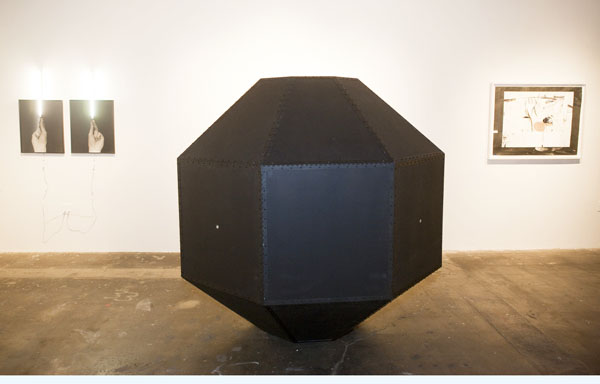
Chris Natrop scrutinizes the concept of infinity on a more microscopic level in that he thinks of his cut out shapes as “molecular bombardments.” Infinity features one of Natrop’s first, stand-alone sculptures, different from the room-sized installation pieces he is used to creating. In all of Natrop’s work, he deals with shapes that he has captured from his memory–spindling, interweaving forms he spontaneously cuts with a knife and hangs with transparent string. Also new to his work is the inclusion of two-way, acrylic mirrors that he had fabricated specifically for the piece displayed at Scion.

Contemporary collage artist, Hilary Pecis, is represented in the show by two of her collages. One of her works were created specifically for Infinity, as well as some of her new video installations. Pecis’s collages stay true to her fundamental aesthetics. She continues to entrance viewers with meticulous depictions of angular patterns, whether they are the varying facets of cut gemstones or the repetitive planes of her trademark ink drawings. Pecis pointed out the underlying theme of “limitless combinations” in her work. For example, she sought out multiple sources to represent white in her new collage. In the past, she may have used a single source, like fabric from a wedding dress, to fill the white spaces. Now, however, she has substituted many different magazine images in addition to other white fabrics. As usual, Pecis depicts cosmic landscapes brimming with glimpses of society’s prized commodities. She reiterated that the landscapes are basically the same place, but the seasons are different. Seasons change in her work due to the fact that the countless magazines she uses change intervals from spring, summer, fall or winter. Pecis admitted that her reliance on print media will likely shift as digital media becomes more relevant. Her video installations feature segments of her multi-faceted ink drawings interspersed with translucent, floating, shapes, some of them different types of diamonds. In one of the videos, crows horde a pile of diamonds, CD’s, and other “bling”–metaphorically showing that the “continuum of desire is never fulfilled.”

Scion-2

In addition to curating the show, Schoultz contributed an intricate ink drawing that speaks to “the infinite unraveling of history.” The drawing, which is reminiscent of both Indian miniature painting and 14th century German map-making, is chock full of military symbolism. The upper half of the composition is dominated by a labyrinthine mixture of vertical flags, all emblazoned with the masonic eye, and a variety of unraveling ribbons, culminating into the shape of a horizontal 8–the undeniable symbol of infinity. The lower half of the composition shows a military horse carrying a turban-clad man with his eyes closed and hands raised as if in meditation. To Schoultz, it is important to portray the duality involved, so there are references to peace as well as war, just as the infinite must also contain the finite.

Other artists who participate in the show are Ryan Travis Christian, Richard Colman, N. Dash, Noah Davis, Chris Duncan, Andres Guerrero, Joseph Hart, Andy Diaz Hope, Xylor Jane, Butt Johnson, and Aaron Noble.

Share

Jacob Holdt

Jacob Holdt 1

Jacob Holdt is showing a selection of some 200 photographs, handpicked from four decades of work documenting the injustices of the American human condition. Faith, Hope, and Love, is ongoing until February 7th at Lousiana Museum for Moderne Kunst, in Humlebæk, Denmark, near Copenhagen.
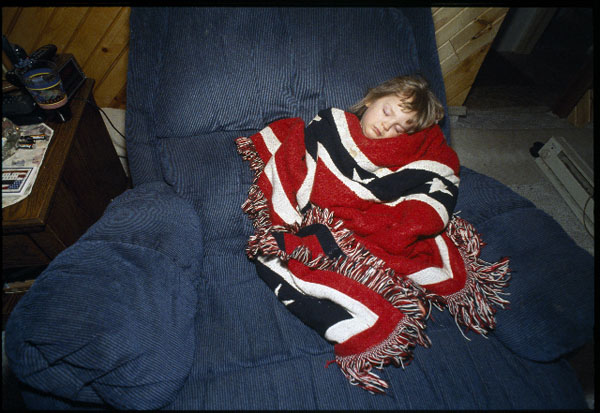
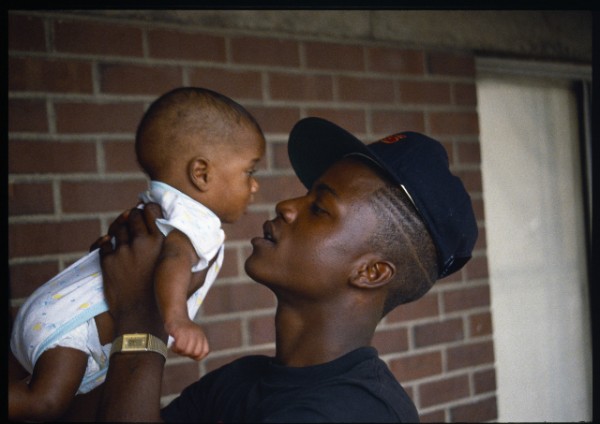
Jacob Holdt captures the insider scene, intimate frames telltale of the gross disparity between the have’s and the have-not’s in the United States. Taken together, the collection outdoes the normal ability of the viewer to bear witness to an event; it is a salient report on the contingency of life chances, and a competent reply to the-world-is-your-oyster mythology. Viewers are necessarily taken aback and empathized by this poignant, in-your-face presentation. The photographs are further authorized by the option to use your mobile phone to listen to Holdt narrate the footage.

Jacob Holdt 2
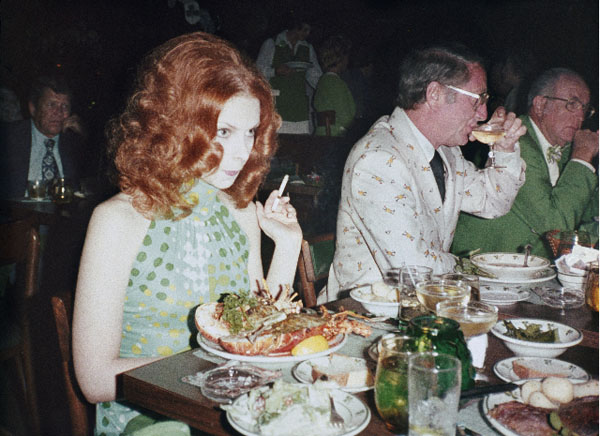
Jacob Holdt was born in Copenhagen, Denmark in 1947, the son of a Danish minister. In 1970, with about a mere forty dollars to his name, Holdt intended only to pass through the US and into South America from Canada. Instead, he stayed on more than five years chronicling American society with a cheap camera–hitchhiking his way across country and staying with hundreds of families who invited him into their homes (and who ran the gamut from pauperized farm workers to the silk-stocking Rockefeller’s). He published a compilation of his work upon returning to Denmark, American Pictures (1977). Now he is a lecturer and writer besides photographer, and has presented slideshows of his work in hundreds of American institutions of higher education and abroad.

Jacob Holdt 3

Share

Melanie Schiff : Mirror & Mastodon

Melanie Schiff: Mirror

Melanie Schiff: Mirror

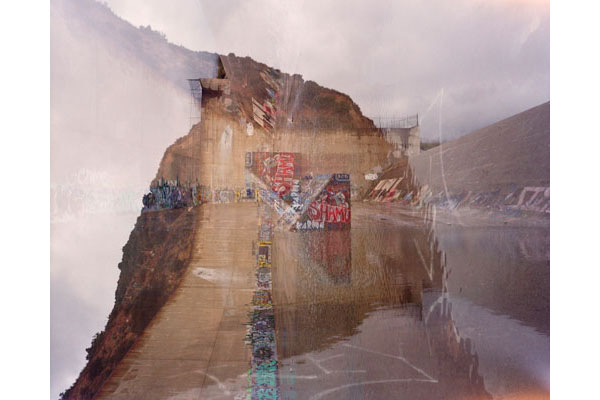
Los Angeles-based photographer Melanie Schiff opened her New York solo debut with Horton & Liu gallery last week. The exhibition, titled Mirror and Mastodon, features 8 mid-sized photographs that investigate ideas of spirituality and collective experience through the intersection of man and nature. While the images don’t contain any figures, the influence of man on the landscape is evident. The photograph titled Mastodon features an open field with a mysterious tree and root system that has fallen — twisted, blackened and reclaimed by the land. The photograph Mirror depicts two images simultaneously,  containing both a raw hill or cliff with the image of a graffiti covered concrete embankment.

Melanie Schiff: Mastadon

Melanie Schiff: Mastadon

Schiff was born in Chicago and is a graduate of the University of Illinois-Chicago. Mirror and Mastodon marks the artist’s first solo exhibition since her inclusion in the 2008 Whitney Biennial. The artist has exhibited internationally with recent exhibitions at Kavi Gupta Gallery in Chicago and Uschi Kolb in Karlsruhe in Germany. The artist has forthcoming exhibitions in 2010 at the Seattle Art Museum and P.S.1 MoMA in New York.

Share

Matthew Brannon

Matthew Brannon

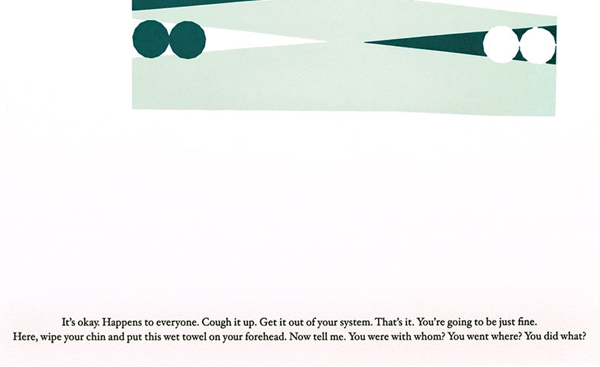
Viewing the work of Matthew Brannon is like watching a foreign film with no subtitles–you can understand and appreciate the imagery to the extent that you might even form your own idea of what the storyline might be, but there will always be a disconnect between your imagination and the true intention of the film, as told through its dialog. Similarly, Matthew Brannon’s letterpress prints offer charming and straightforward imagery via a highly accessible medium, but they tease your understanding with lines of text that do not expressly correspond with the image, as I learned upon first viewing Brannon’s work in the 2008 Whitney Biennial. While the intention of the artist might not be to confound, that may sometimes be the result; but in most cases the pieces invite the eager viewer into a cheeky game of wordplay.

Matthew Brannon-2

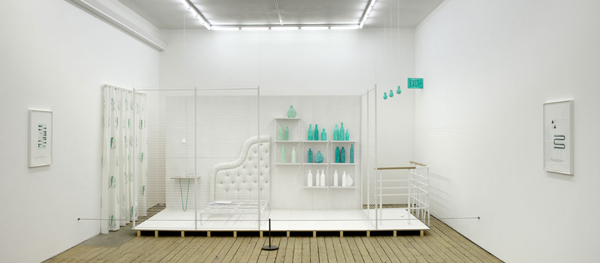
Currently, Brannon’s new work is on display in a show entitled Nevertheless at The Approach in London, marking the New York-based artist’s first solo show in the city. Nevertheless marks a departure from the print-dominated exhibitions of his past, showing sculpture installation alongside only four letterpress pieces. The show explores “both the idea and the image of a transatlantic sea voyage. The outdated–once preferred–way to travel to London, now but a literary backdrop or an obnoxious tourist getaway,” according to The Approach, and runs through November 1st.

Matthew Brannon was born in 1971 and lives and works in New York. Recent solo exhibitions include: The Question is a Compliment, Friedrich Petzel Gallery, New York (2008); Grandmothers, Galleria Gió Marconi, Milan (2008); Where Were We, Whitney Museum of Art at Altria, New York (2007); Meat Eating Plants, David Kordansky Gallery, Los Angeles (2005).

Share

The Third Chapter of Blum & Poe

gallery2-1

Installation view, 15th Anniversary Inaugural Exhibition, Blum & Poe, Los Angeles photo credit: Renée Martin


In 1994, the year Kara Walker graduated from RISD, Jeff Koons made his first balloon dog, and OJ’s white Bronco became a celebrity, Timothy Blum and Jeff Poe opened a gallery in Santa Monica. In 2003, the year Charles Saatchi called white walled galleries “antiseptic” and Arnold Schwarzenegger became California’s governor, Blum & Poe relocated to Culver City. Now, in 2009, the year Holland Cotter proclaimed that ‘The Boom Is Over’, Eli Broad bailed out MoCA, and Obama won the Nobel Prize (not to mention the presidency), Blum & Poe has crossed the street, moving into a renovated 1968 manufacturing building.

Blum & Poe Gallery, which played a central role in making Culver City a “scene’, is celebrating its 15th anniversary in its new space with an exhibition that features its whole roster of artists. The inaugural celebration took place last weekend and caused a bit of a stir in the world of society blogs.

I visited Blum & Poe a week after its debut, having just browsed the New York Social Diary’s Gossip Girl worthy photos of the opening and feeling a little suspicious of bigness in general. I tend to romanticize the margins, to prefer grainy video art to pristine footage or to assume that something like the Watts Towers, built in obscurity on a laborer’s budget, deserves its place on the historic registry more costly venture like the Bradbury Building. But Blum & Poe’s new space wins me over without even threatening my proclivity for underdogs.

gallery1-1-1

Installation view, 15th Anniversary Inaugural Exhibition, Blum & Poe, Los Angeles photo credit: Renée Martin

Renovated by Escher GuneWardena Architecture, the same firm that transformed Blum & Poe’s previous headquarters from a warehouse into an art space, the building is stunningly spacious: 5 galleries, 21,000 square feet, a door onto La Cienega, a second private door that opens onto a parking lot out back, office space galore. But it’s also refreshingly awkward. The first floor walls are tall in proportion to the rooms’ width; the broad foyer, furnished with only a raw wood desk, could be an exhibition space itself; and the upper level room unexpectedly resembles a Brooklyn loft. More important than the space’s specs, however, is the fact that it’s full.

At first, I worry that Blum & Poe have caught the overhanging bug that seems to prey on big venues — Ace notoriously overhangs, and MoCA will never accept that it’s not MoMA. But this show isn’t meant to be coolly composed; it’s a jamboree, a compilation of everything the gallery is proudest of.

In the first gallery, Friederich Kunath’s whimsical, minimally expressive watercolors hang behind Matt Johnson’s A shape in time, freestanding tires that I’m tempted to topple with my breathing even after I learn they’re bronze and not rubber. Country Produce by Nigel Cook, an artist whose grungy panoramas I am still learning how to like, has a gonzo color scheme and leniency that offsets the meticulousness of Keith Tyson’s and Florian Maier-Aichen’s work on the adjacent wall. The two Mark Grotjahn drawings in the show – from the series Untitled (Full Colored Butterfly) – have radial colored pencil stripes that look weathered and wrought. The surface has been cuffed up and this “damage” acknowledges the dated legacy of Grotjahn’s compulsive lines and systems.

Installation view, 15th Anniversary Inaugural Exhibition, Blum & Poe, Los Angeles photo credit: Renée Martin

Installation view, 15th Anniversary Inaugural Exhibition, Blum & Poe, Los Angeles photo credit: Renée Martin

Murakami’s youthful porno-kitsch side and his sleek, grown-up side coexist in this exhibition, and Yoshimoto Nara’s signature wide-eyed prepubescent figure is present in the form of fired clay. But LA’s Dave Muller has the most work in this exhibition – upstairs, downstairs, above doorways, on support beams – though his nostalgically loose paintings of record albums and disco balls hardly steal the show.

Each artist has contributed new work, staking a claim in the gallery’s future, and together they represent a range of sensibilities: from contemplative to pristine, to severe, to humorous and nostalgic. Blum & Poe’s artists veer away from gut-spilling viscosity, the sort of art Libby Lumpkin would call “adolescent”, and I always associate a certain breed of elegance with the gallery. But beyond that, its artist roster doesn’t quite make sense to me – why is Murakami next door to Sam Durant? What could Sharon Lockhart and Chiho Aoshima have in common? While I suppose not making sense could be a strategy akin to “staying ahead of the curve” or “keeping people guessing”, I prefer to think of it more optimistically, as the project of two dealers who know what they like. Luckily, when it comes to the art world, promoting what you like and strategizing have everything in common.

The last time Blum & Poe moved, they essentially transformed Culver City from a landscape warehouses into an art district. We’ll have to wait to see if this new move proves equally influential, but, for now, the gallery is full of infectious good-will.


Share