Cy Twombly: Eight Sculptures

Cy Twombly

Artist Cy Twombly has created a new series of sculptures, under the humble title Eight Sculptures. These new objects are currently being presented at Gagosian Gallery‘s 980 Madison Ave location in New York City. The exhibition is a companion to a new series of paintings, titled Leaving Paphos Ringed with Waves, on view at Gagoisian’s Athens gallery. In addition to the shows at Gagosian, the acclaimed artist also had two major museum exhibitions on view this fall, Cy Twombly: The Natural World, Selected Works 2000-2007‘ that inaugurated the new wing of The Art Institute of Chicago, and Cy Twombly: Sensations of the Moment at Museum Moderner Kunst, Vienna.

Eight Sculptures is a continuation of Twombly’s acclaimed formally driven, pedestal-based objects. While the earlier forms were created from accessible materials and objects, generally coated in gesso to create hauntingly white forms, the new sculptures are cast bronze with a white patina creating a very similar effect. Each sculpture references the unearthed fragility of an object of antiquity, while remaining distinctly modern in its formal presentation.

Share

MOMA: New Photography 2009

Walead Beshty

Walead Beshty

The Museum of Modern Art in New York is currently presenting New Photography 2009, this year’s installment of a series that began in 1985 with the aim of exhibiting the most compelling recent work in the field of contemporary photography.  Organized by Eva Respini, Associate Curator in the Department of Photography at MoMA, the exhibition brings together six young artists, Walead Beshty, Daniel Gordon, Leslie Hewitt, Carter Mull, Sterling Ruby, and Sara VanDerBeek, in a visually diverse body of work.  Most of these artists actively produce work in other media, such as drawing, video, and installation, and each one has an innovative and distinct method of constructing a photograph.  Collectively, these artists investigate the making of a photographic image in the twenty-first century, often utilizing processes of collecting, assembling, or manipulating other images or items.

With the advent of contemporary aesthetics and technologies, photography, long characterized by its ability to capture and represent reality, is again the subject of critical debate. The historical definition of the medium is challenged by the rise of digital capabilities and software programs, which allow photographers to combine their own images with others that are digitally uploaded or scanned.  The abundance of imagery now available at the click of a mouse has led artists towards a deeper analysis of the role of an image within society.  The six artists included in the exhibition create their pictures in a studio or darkroom, investigating the expanded vocabulary of digital processes and its technical and theoretical implications for photography.   The exhibition highlights an epochal moment of transformation for the medium, showcasing the work of artists who critically confront our media saturated world, and open a new era of possibility for photography.  Some works reference traditional techniques of the medium while others are constructed from online images; the works included range from abstract to representational. Read More »

Share

Another End to Irony: DS Archives

Originally published on September 3rd, 2009

Second Nature, currently on view at the UCLA Hammer Museum, provides a freshly intelligent glimpse into Los Angeles’ past decade, depicting a world in which art can insouciantly assert itself without resorting to contrivance.

1. “‘There’s going to be a seismic change,” said Vanity Fair editor Graydon Carter after 9/11. “I think it’s the end of the age of irony. Things that were considered fringe and frivolous are going to disappear.” But, of course, Carter kept right on publishing his sleek, ad-filled nucleus of frivolity and irony kept thriving.

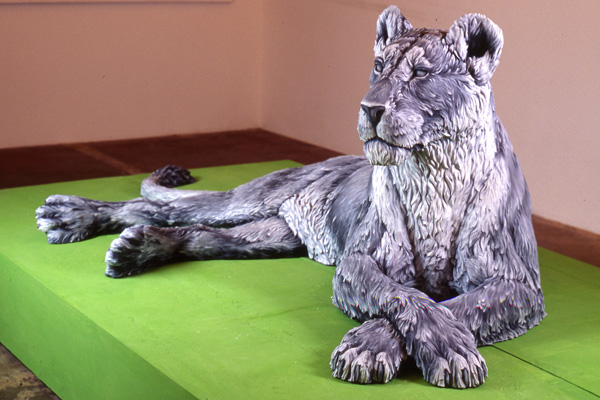
Rubi Neri The Lioness.jpg
Ruby Neri. Untitled (Lioness), 1998-1999. 102 x 63 x 44 1/2 inches. Hammer Museum, Los Angeles. Gift of Dean Valentine and Amy Adelson. Image courtesy of the artist, and David Kordansky Gallery, Los Angeles.

The Age of Irony seemingly began at the same time Seinfeld did, slipping into living rooms and intoxicating Americans with its self-consciously cynical pose just as the 1980s edged toward their close. Irony then wound through the ’90s and into the 21st Century with relative ease, making ‘post’–postmodern, post-postmodern, post-feminist, post-colonial–and ‘meta’ catch phrases for anyone who wanted to sound coolly intellectual (though, to be fair, the desire to flaunt jaded braininess has haunted humans for centuries).

Comically, the age rotates around an endlessly misused word. Irony, which technically refers to the gap between what people say and what they mean, has come to reference a giddy inability to take one’s self seriously. It makes sincerity passe and fawns over contrivance. Read More »

Share

Timothy Karpinski

TimothyKarpinski

Folksy, but refined, Timothy Karpinski‘s work is most aptly defined as lovely. Currently on view in the solo exhibition, My Heart Never Sleeps, at Thinkspace Gallery in Los Angeles, the Portland-based artist’s work draws upon a romantic and almost childlike fixation with the quiet and beautiful moments of life and love. Hand cut paper, acrylic paint and graphite make up collages of such harmonious scenes  as: a scarfed sleeper in a moment of solitude, sitting beneath a tree, his limbs entwined with curling steam from a hot mug of coffee, autumn leaves touching down around him; or pastel lovers in a tug-of-war, legs and arms stitched into one another as they push and pull on a half-sphere grassy knoll. The most dynamic piece in the show is the installation called Fear Fort, which, according to the gallery, housed the artist for months leading up to the show as well as in the gallery during installation of the exhibition. Derived from Karpinski’s lingering childhood fascination with fort-building, Fear Fort seems at once claustrophobic and cluttered (owl-shaped chotchkies and hand drawn doodles abound) and wondrously safe, like so many spaces or objects continue to make us feel over the years.

Timothy Karpinski lives and works in Portland, OR and earned his BFA in Graphic Design and Painting from Castleton State College in Vermont. His work has been exhibited at White Walls, San Francisco; Suite 100 Gallery, Seattle; Together Gallery, Portland, OR, and elsewhere.

Share

Joe Johnson: Mega Churches

Joe Johnson

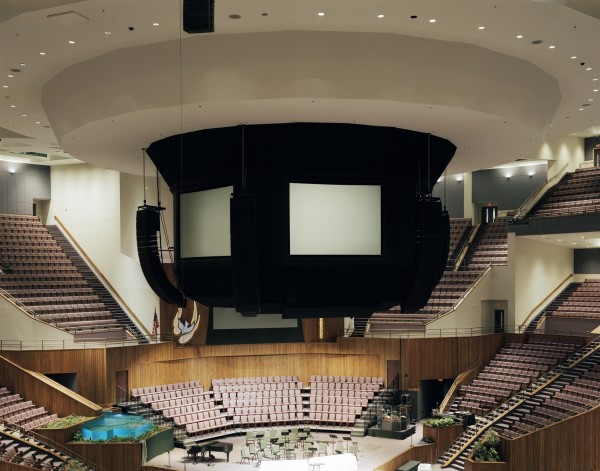
Joe Johnson‘s photographic project Mega Churches is currently on view at Redux Contemporary Art Center in Charleston SC.  The mega church, which can be found throughout the United States, hosts a large congregation of 2,000+ evangelical worshipers and a production of often-televised religious spectacle.  It is a highly relevant subject for the contemporary visual artist to explore as the literal Biblical interpretations such mega churches typically preach influence the US socially and politically.

Joe Johnson2

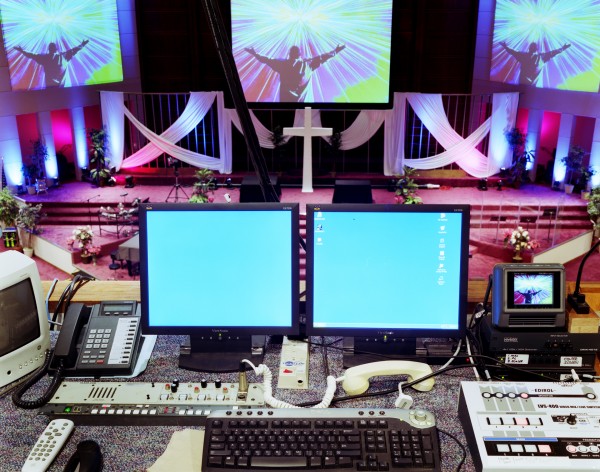
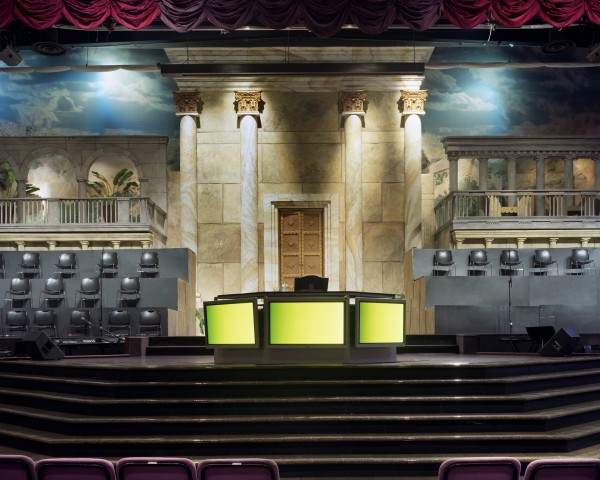
Johnson maintains a formal distance in his photographic series, Mega Churches, through choosing to capture these vast interior spaces in a state of absence and quiet; in doing so, he avoids human representation that could potentially veer into caricature.  In Johnson’s words, the ‘mechanics of faith’ are his focus in these photographs.  The artist hones in on the rows of seats, acrid neon and fluorescent lighting, corporate decor, theatrical stage sets, large-scale screens and behind-the-scenes computers and wires that define and facilitate the business of worship in the mega church’s arena-like space.

Today’s fundamentalist Christian mega churches appropriate entertainment technology and theatrical production to capture their audiences’ attention – and more sardonically, their pocketbooks.  Through Johnson’s visual emphasis upon the creation of artifice, the artist is perhaps commenting on the insincerity and fallacy of the message these mega spaces serve to convey.

Joe Johnson3

Joe Johnson earned his BFA from the San Francisco Art Institute and his MFA from the Massachusetts College of Art and Design, both in photography.  Johnson’s photographic work has been shown throughout the United States in both solo and group exhibitions.  Johnson is an assistant professor of photography at the University of Missouri and a member of the Midwest Photographers Project at the Museum of Contemporary Photography in Chicago.

Johnson’s Mega Churches series has been well received in the US – earning the artist runner up recognition for the 2008 Aperture Portfolio Prize.  The series was previously shown at the Gallery Kayafas in Boston MA from April through May 2009.

Mega Churches remains at Redux Contemporary Art Center through 18 December 2009.

Share

Javier Vallhonrat

javier1

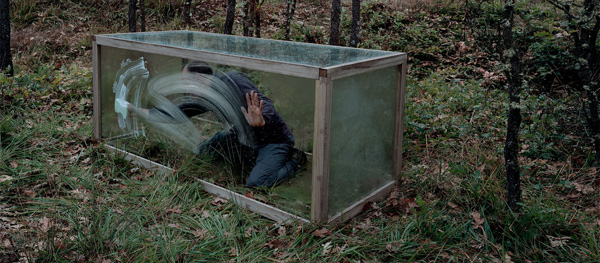
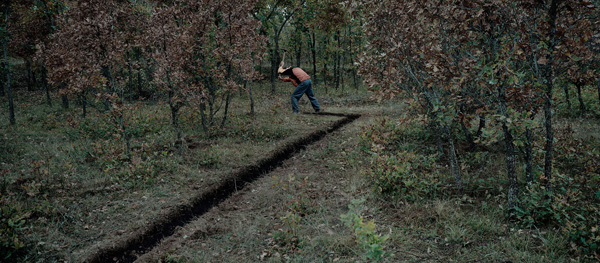
Acaso features a series of photographs which are the result of a four-year project by fashion photographer Javier Vallhonrat. The images largely differ from the hip and glossy fashion-related work he often realized for publications such as Vogue and the New York Times.

The works exhibited at the Galleria Carla Sozzani -located at 10 Corso Como in Milan- explore the ways in which we tend to interact with, and transform, space in order to give shape to something, such as a house or a building, which we can occupy as inhabitants. The images prove to question the meaning of the concepts of ‘place’ and ‘home’ as sites around which we construct our experience, our individual memory and our identity, while at the same time trying to make sense of an unfamiliar condition such as the absence of what might be a ‘safe’ place we recognize as ours and which we can refer to. Vallhonrat seems to invite the viewer to come to terms with a re-definition of a perception of space that moves from being abstract to becoming real and concrete, a process which highlights the interplay between nature and man. Privileging shades of grey, green and blue, the images by the Spanish photographer depict a variety of tasks performed by male characters within a landscape setting, and although the photographs suggest that some kind of action is taking place, the overall impression they deliver is one of extreme stillness and solitude.

javier2

Born in Madrid, Spain, in 1953, fashion photographer Javier Vallhonrat studied Painting at the Fine Arts Faculty of the University of Madrid in the early 1970’s. He achieved international recognition soon after receiving his Fine Arts degree, while shooting for the Condé Nast Publications. In 1992 he started working on advertising films, while teaching photography at the same time. He has also worked for various international fashion designers, such as Comme des Garçons, Christian Lacroix, Jil Sander, Martine Sitbon, Yves Saint-Laurent, Chloé, and John Galliano.

Acaso will be on view at Galleria Carla Sozzani in Milan from 18th October to 22nd November 2009.

Share

For the blind man in the dark room looking for the black cat that isn’t there

blindman1

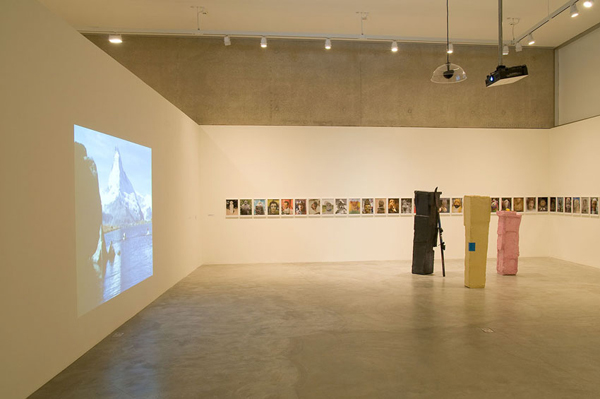
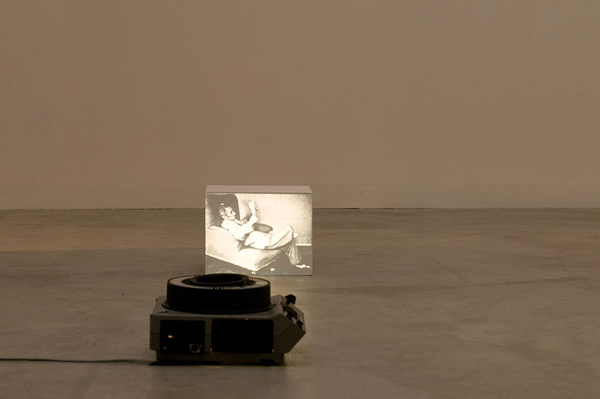
On view until January 3, 2010 the Contemporary Art Museum St. Louis presents its most ambitious group show since its grand opening six years ago. Curated by Anthony Huberman, For the blind man in the dark room looking for the black cat that isn’t there starts with the premise that art is not a code that needs cracking. Celebrating the experience of not-knowing and unlearning, the artists in this exhibition understand the world in speculative terms, eager to keep art separate from explanation. Embracing a spirit of curiosity, this show is dedicated to the playfulness of being in the dark.

Among the works included are Sarah Crowner’s re-insertion into circulation of the two issues of the 1917 journal The Blind Man (edited by Marcel Duchamp, Henri-Pierre Roché, and Beatrice Wood), offering copies on sale at the museum’s front desk at the publication’s original cover price of 10 and 15 cents. Additionally, In search of an explanation of a painting, Marcel Broodthaers interviews his cat in a recording from 1970 in his Musée d’Art Moderne, Département des Aigles. Nashashibi/Skaer (Rosalind Nashashibi and Lucy Skaer) contribute their 16mm film Flash in the Metropolitan (2006),  whereby the artists wander through the Metropolitan Museum of Art with the lights off, using a strobe light to briefly illuminate portions of small sculptural statues and vessels, as if the long story of the Metropolitan was reduced to a series of short poetic haikus.

blindman2

Share