Rob Fischer

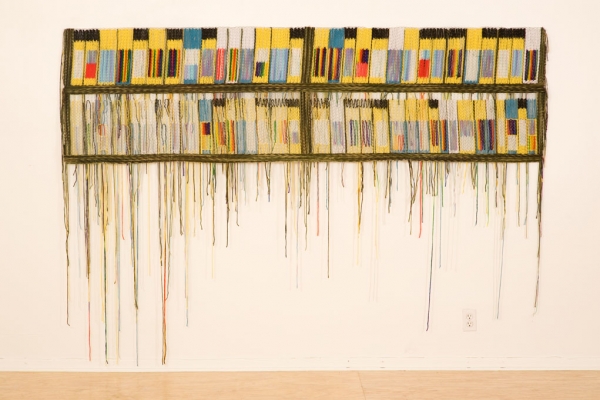
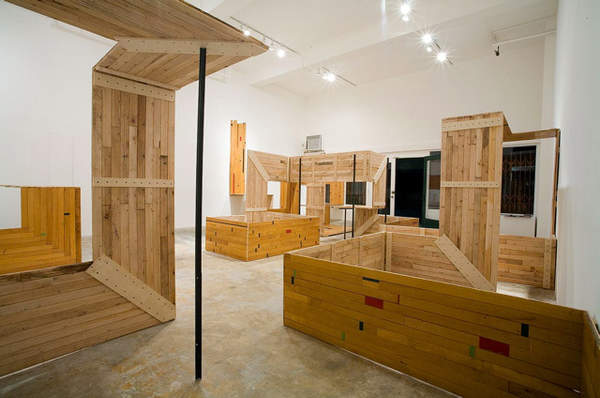
The Hammer Museum in Los Angeles is known for presenting exciting new works from emerging and mid-career artists through the Hammer Projects program. Currently on view at the museum are new works by Brooklyn-based artist Rob Fischer. Utilizing materials that are deeply embedded with a sense of social history through their once utilitarian function, Fischer recontextualizes the materials to create new meaning and form. For the museum, the artist removed a wooden floorboard from a gymnasium that belonged to a neglected school in Minnesota. The artist reformed the floor to create a large labyrinth-like sculpture that stretches around the walls and floor of the Hammer’s lobby. As the Hammer has stated, the artist is “inspired by the American mythology of the road trip, rooted in notions of freedom and self-discovery, as well as the thousands of miles of interstate highways that connect our cities and small towns,the overlapping and intersecting floorboards are like a map of a fantastical roadway.”
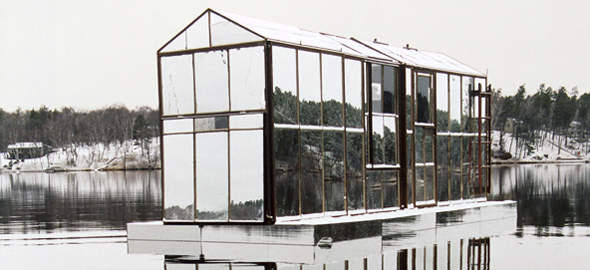

Fischer was born in Minneapolis and is a graduate of Minneapolis College of Art and Design (1993). The artist has completed a number of international museum and gallery exhibitions including solo exhbitions at the Whitney Museum of American Art, Cohan and Leslie in New York City and Mary Goldman Gallery in Los Angeles.

Share

Interview with Storm Tharp

Inspired by movies, pop culture, fashion, and Bernini, Storm Tharp has been exhibiting his ink and gouache paintings in Portland, Oregon and Geneva, Switzerland for years. His work will be included in the 2010 biennial at the Whitney Museum of American Art in New York City. DailyServing’s Bean Gilsdorf recently spoke with the artist about his inclusion in the Whitney Biennial, the idea of identity as performance, and the role of realism and abstraction in his current portraits.

Storm Tharp, Cream Puff (2008)

Bean Gilsdorf: You just finished the work that’s going into the 2010 Whitney Biennial. How many pieces?

Storm Tharp: Five pieces, all large-scale portraits.

BG: And how did the Whitney process start?

ST: Well, there’s the condensed version, which is about this biennial and my relationship to it. But when Larry Rinder curated the biennial—that would have been about eight years ago—it was the first time that I had ever been exposed to somebody coming to town on behalf of the Whitney. So when you ask how it started, I want to take it all the way back there. I feel like there was some momentum that started then.

BG: And you’re in the collection of the Whitney.

ST: That’s true, but they [2010 Whitney Biennial curators Francesco Bonami and Gary Carrion-Murayari] weren’t aware of that. I assumed they knew. I brought it to their attention and we thought it was really funny.

BG: And did you meet with Larry back then?

ST: Yeah. Little did he know, or did I know, that the work that was so unbelievably half-baked at that time would turn into the nugget of where I am now.

BG: What did you show him then?

ST: It’s funny, I was really embarrassed as soon as he walked out the door. I was just scratching the surface about Japanese theater, where the details in the masks denote the kind of character being played. This is also mirrored in Chinese opera: messy facial makeup helps the audience understand that the character is unstable. I had just scratched the surface of this kind of representation, the physiognomy of the face. And I brought up Noh, and Larry was immediately like, “Oh, you’re interested in the theater”, and I realized that I had no idea what I was talking about. And the work was totally juvenile and half-baked. But that work led to where I am now.

The Ex-King (2009)

Storm Tharp The Ex-King (2006)

Read More »

Share

From the DS Archives: Albert Oehlen

Each Sunday through 2010, we will be revisiting some of our favorite archived features from previous years. Today we have selected Albert Oehlen, a German artist featured during our second year of operation….

Albert Oehlen
Originally Published on December 24, 2007

Albert-Oehlen-12-19-07.jpg
Albert Oehlen, a German artist who currently lives and works in Bizkaia, Spain has been on the international radar for decades as a provocative painter. The artist studied with Sigmar Polke in the mid-seventies at Hochschule fur Bildende Kunst, Hamburg and emerged in the 1980’s along side artist Martin Kippenberger. Oehlen challenges painting today by rigorously investigating and referencing historical painting from many periods, simultaneously. The scope of his painting references allows the artist to point out some of art’s failures, something that Oehlen is very interested in revealing. The artist recently exhibited “Spiegelbilder” with Max Hetzler in Berlin, and “The Good Life” at the Nolan / Eckman Gallery in New York. Oehlen has appeared in countless publications, and in April of 2003 Artforum conducted an interview between Oehlen and Eric Banks.

Share

Katie Herzog

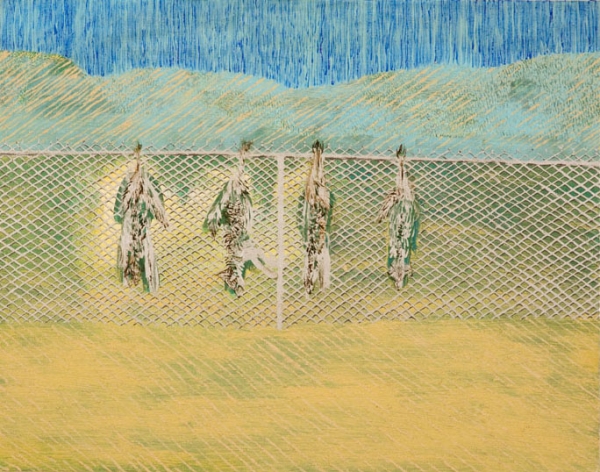
A peculiarly calm brand of humor is found in Katie Herzog‘s work. With an aesthetic that seems to reference both craft and contemporary painting, wit is infused into the cheerfully colored paintings and mixed media pieces that the Los Angeles-based artist and assistant reference librarian creates. Her painting entitled Freedom (Richard Stallman Folk Dancing) (2008) renders the poker-faced father of the GNU Project prancing on a rainbow, in an apparent celebration of freedom of speech. In the explicitly titled, Dead Coyotes on a Fence (2008), Herzog depicts a neat row of four dead coyotes hung by their feet along a chain link fence, while a vast landscape of color blocks sprawls beyond. Both pieces were on view in her 2008 solo show, Librariana, at Circus Gallery in Los Angeles. In 2010 Herzog’s work will be on view in the solo exhibition, Ecstasy of Municipality at Whittier City Hall, Whittier, CA.

Katie Herzog lives and works in Los Angeles. She received her BFA from the Rhode Island School of Design, her MFA from UC San Diego, and attended Library School at San Jose State University. She has been an artist in residence at Program Initiative for Art and Architecture Collaborations in Berlin, Germany; the Skowhegan School of Painting and Sculpture in Maine; and the Banff Centre in Alberta, Canada. Solo exhibitions include: Art As Experience at the Whittier Public Library, Whittier, CA; Librariana at Circus Gallery, Los Angeles, CA; Katie Herzog: New Paintings at Bucket Rider Gallery (now called Andrew Rafacz Gallery), Chicago, IL; Soft Philosophy at Pawn Shop Gallery, Los Angeles, CA; and group shows include: You Gave Me Brave at S1F Gallery, Los Angeles, CA and Literature As Exploration at The Other Gallery atThe Banff Centre, Alberta, Canada, among others.

Share

Best of 2009

Happy New Year from everyone at DailyServing.com!!

We are continuing our Best of 2009 coverage for one more day. Don’t miss our exclusive interview with Allison Schulnik to be published later this month in conjunction with her upcoming solo exhibition, Home for Hobo, at Mark Moore Gallery in Los Angeles.

Best of 2009

Allison Schulnik: Hobo Clown
Originally published on July 15, 2009

STILL_07.jpg

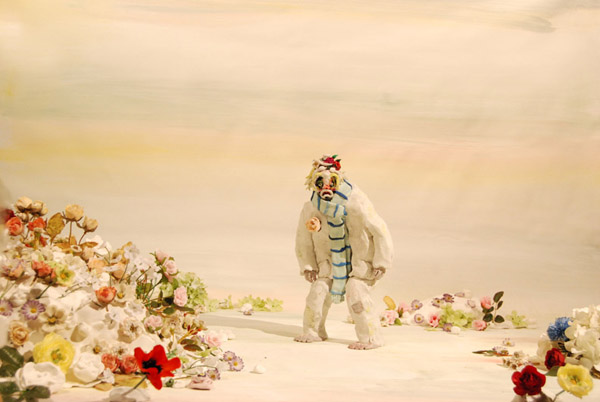
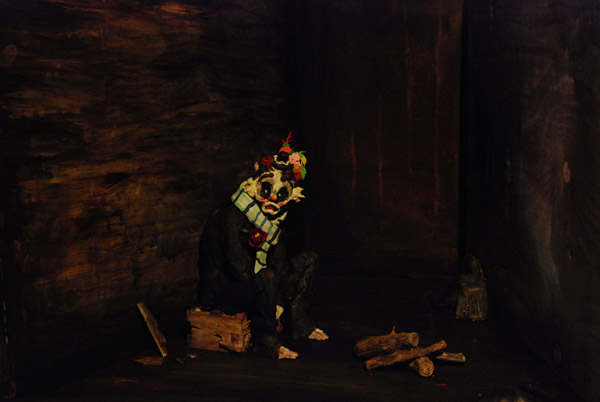
It’s unfortunate but rare that art, particularly video work, moves me to the point where I’m exaggeratedly weaving words like “love” and “obsessed” into conversations about it–confessions that some might say belong more within the confines of teenagers’ online message boards about “Twilight” than within the discussion of serious contemporary art. But such is the case with Allison Schulnik‘s claymation video Hobo Clown (2008). The few minutes that it runs are some of the most heartbreaking, kaleidoscopic, breathtaking and gracefully tragic that you might ever spend on viewing art. Schulnik has created a messily pinched and sumptuously colored world of upside-down-smile wearing clowns, dragging along a vast lonesomeness of delicate floral arrangements and faded landscape, to the mesmerizing music of Grizzly Bear. You just want to climb inside the video and wrap the folds of clay around yourself, maybe fall asleep to the heartbreaking guitar strums. Around the point when the song’s first lyrics hum “Why don’t you do any dishes?”–which surprisingly isn’t at all distracting, as is the case with much of the music played over video work–things turn psychedelic, but in an honest and fresh way. Hobo Clown is currently on view at Marty Walker Gallery in Dallas, Texas.

STILL_01.jpg

Allison Schulnik lives and works in Los Angeles. She received a BFA in Experimental Animation at the California Institute of Arts in 2000. Her paintings have been exhibited internationally at venues including Basel; The Armory Show, New York; Rokeby Gallery, London; the Museum of Contemporary Art, Chicago; Mark Moore Gallery, Santa Monica; and Bellwether Gallery, New York.

Share

Best of 2009

Best of 2009

DailyServing.com presents 1000 DAYS
Originally published on May 13, 2009

Caleb-Weintraub.jpg
Caleb Weintraub

Opening Saturday, May 23rd will be the exhibition 1000 DAYS, presented by DailyServing.com and Scion. The exhibition will take place at the Scion Installation L.A. Gallery in Culver City, California. 1000 DAYS celebrates a milestone for DailyServing.com as the online contemporary art publication approaches 1000 daily features. Since the fall of 2006, DailyServing.com has highlighted a cross section of contemporary visual art from around the world. Honoring this commitment, 1000 DAYS delivers an exciting mix of emerging talent, focusing for this exhibition on artists in the United States.

Christina-Seely.jpg
Christina Seely

1000 DAYS also marks the first curated exhibition for DailyServing.com, bringing together eight emerging artists. The exhibition will feature recent works by Caleb Weintraub, Chris Scarborough, Christina Seely, Julie Henson, Michael Rea, Mark Mulroney, Matt Phillips and Tivon Rice. These artists, all of whom have been previously featured on the site, work in a variety of media including painting, drawing, sculpture, photography and new media. The diversity of the artwork in 1000 DAYS celebrates the myriad of influences utilized by visual artists today. Collectively, these artists address many of the major issues found in contemporary art, combining a range of conceptual and aesthetic elements while highlighting topics such as pop culture, technology, and current social issues, often through the lens of art history.

Tivon-Rice.jpg
Tivon Rice
Share

Best of 2009

Best of 2009

Yayoi Kusama
Originally published on April 27, 2009

yayoi kusama.jpg

Gagosian Gallery is presenting two major exhibitions in New York and Beverly Hills to celebrate Yayoi Kusama‘s eightieth year. The artist, born in Japan in 1929, started painting with polka dots and nets as motifs around the age of ten. She moved to the United States in 1957, where she showed large scale paintings, soft sculptures, and environmental installations using electric lights and mirrors. From 1998-1999, a major retrospective opened at the Los Angeles County Museum of Art and traveled to the Museum of Modern Art in New York, the Walker Art Center in Minneapolis, and the Museum of Contemporary Art in Tokyo.

The exhibition in New York, which opened on April 16th, features a large yellow pumpkin sculpture with black spots in a specifically designed space at the front of the gallery. This piece is based on a similar work Kusama showed at the Japanese pavilion at the Venice Biennale in 1993 – a mirrored room filled with pumpkin sculptures in which the artist resided in color-coordinated attire. The pumpkin, made of fiberglass and reinforced plastic, represents a type of self portrait or alter ego for the artist, whose compulsive covering of surfaces and infinite repetition of dots, patterns, and forms is characteristic of her entire body of work.

kusama installation.jpg

Share