Joan Linder

In an attempt to reconcile sources of daily anxiety while simultaneously recording seemingly mundane facets of life, artist Joan Linder painstakingly illustrates the objects that fill her days. Objects such as junk mail, weeds, resumes, and domestic items are all rendered with the greatest of detail through the most economic of means, paper and pen.

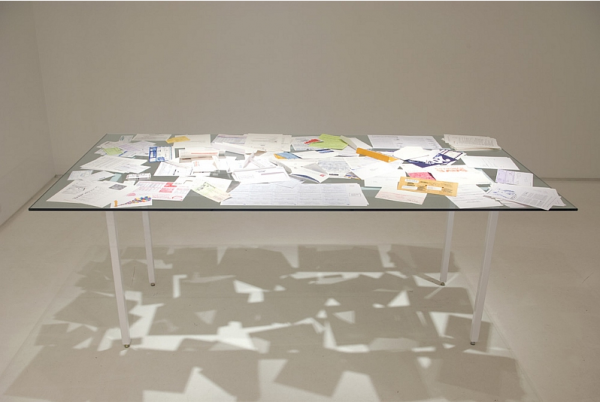
Cost of Living is the title of the artist’s most recent exhibition, on view now at Mixed Greens in New York City. The exhibition contains several new drawings from multiple series including Documents, a series of to scale drawings of the artist’s bills, advertisements, schedules, coupons, instructions and directions. The ink and watercolor drawings, which are all strewn across a glass table top in the gallery, are a near exact replica of their source material and offer an intimate look into the artists personal life.


Other works included in Cost of Living are from the artist’s resume series. These works, which are hand drawn reproductions of artist resumes, include an out dated copy of artist Louise Bourgeois’ resume. The famed artist’s resume outlines just what it means to have a successful and enduring career as an artist.

Cost of Living marks the fourth solo exhibition for the artist at Mixed Greens.  Other recent exhibitions include, More Fun in the New World at Judi Rotenberg Gallery in Boston and the pink at Hallwalls Contemporary Art Center in Buffalo. The artist currently lives and works in Buffalo, New York and received her MFA from Columbia University (1996).

Share

Roy McMakin: In and On

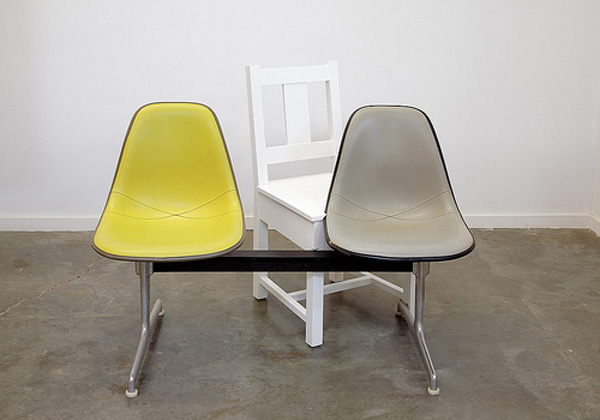
Roy McMakin, My Slatback Chair with a Pair of Attached Chairs (2010)

Maybe it’s a case of seeing something a lot because I am hyper-interested—like when you suddenly notice that every other car on the freeway is a VW Jetta after you begin to drive one yourself—but I have been seeing a lot of design making its way into the fine art world of late. I’m talking about capital “D” Design, which for the purposes of this piece refers to furniture and other functional objects that also assume a glossy aesthetic that reach beyond pure functionality into the realm of art. Design is actually a process, but as a noun these days it is used to describe what we see when flipping through an issue of Dwell or the pages of the Design Within Reach catalog. Because even the great academic of our time, Wikipedia, can’t pin down a true definition, I can’t either in so many words. But I recognize that so-called fine art and design maintain separate identities (and followings) in large part.

I would be doing my Art History degree an injustice if I didn’t acknowledge that, yes, design has been an important player in the fine art world for a long time. What I’m seeing these days is in fact a resurgence of the Bauhaus-like interest in the coexistence of all arts, and a Meret Oppenheim-like playfulness in approaching the definitions of each genre. Still though, design hasn’t penetrated the white cube of the contemporary art gallery as much as painting or non-functional sculpture has over the years, until recently. As design makes its way into the exhibition scene, definition derives from context more than anything. Who among us hasn’t feared taking a seat at The Museum of Contemporary Art because we had doubts as to whether the bench was for resting upon or a part of the exhibition?

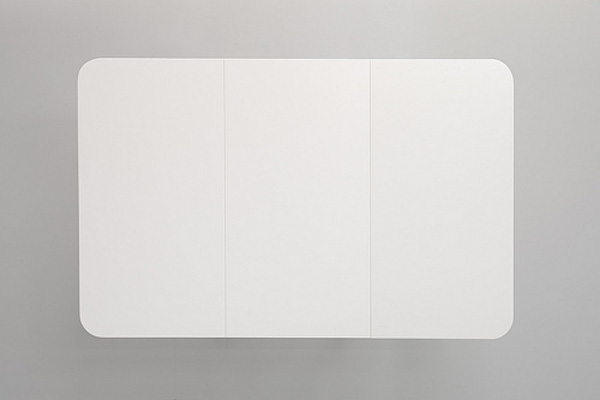
Roy McMakin A Wall Sculpture of a Drop Leaf Table (2010)

In his recent solo exhibition, In and On, at Lora Reynolds Gallery in Austin, TX, artist Roy McMakin presented a body of work that dives head-on into the ever-murkening waters of design and fine art. McMakin, who is also a furniture designer (again, the artist’s bio requires a distinction between his trades), combines found objects of the minimalist and much celebrated Mid-Century Modern design traditions with his own sculpture work, essentially reassigning all components new roles, or stripping them entirely of their original intentions. A minimalist drop leaf table hangs on the wall as a purely visual object; a duo of Mid-Century chairs gets tacked to McMakin’s slatback chair to form a disjointed piece wherein the latter loses its functionality and all parts become simply “art.” Click here to listen to the artist discuss his work from a March 24th gallery talk.

Roy McMakin lives and works in Seattle, WA where he owns and operates Domestic Furniture. He earned his BA and MFA at the University of California, San Diego. His work has been exhibited widely, including at Matthew Marks Gallery, New York and Portland Art Museum, Portland, OR. He has been commissioned by The Henry Art Gallery, Seattle and The J. Paul Getty Museum, Los Angeles, among other institutions.

Share

Andrew Dadson at Lawrimore Project

Installation View (Detail of Plank Lean Painting #2) Lawrimore Projects

When one encounters an abstract painting with goopy paint and an expressionist hand, it is still hard not to be seduced by the sheer beauty of it. But in a day when even painting has to be smart, it is always a relief to find someone making objects that make you rethink your relationship to the world, not to mention your relationship to paint itself. On view at Lawrimore Project in Seattle, Washington is new work by Vancouver-based artist, Andrew Dadson. Although an artist whose work often explores performative actions, Dadson’s new paintings seamlessly merge the beauty and seduction of painting with the defiance of painting itself. The aggressivity and expressionistic qualities of the thick colorful paint obscured by the smoothness of the warm black layer over top references the depth and emotion of Rothko’s beautiful colorfield paintings. Yet much of his work allows black to become the aggressor – obscuring or acting against the layers underneath.

To Be Titled (2010) Lawrimore Projects

What is surprising about Dadson’s work is that the obscuring  in his painting adds to the layers of meaning within his other actions. The layering in the paint actually informs his other work – giving a visual and emotive parallel to his actions – like one of his “outdoor paintings,” Black Painted Lawn with White Fence (2006), where he illegally paints someone’s lawn black. This results in the layering and obscuring in painting reaching to the obfuscation of rights and property in our culture. What is seemingly beautiful becomes something aggressive.

Black Painted Lawn with White Fence (2006)

Andrew Dadson’s work will be on view in Seattle through June 26th. He has exhibited with The Apartment and Or Gallery in Vancouver, Slaughterhousespace, in Healdsburg, California and Galleria Franco Noero, Torino, Italy. He received his BFA in Integrated Media from Emily Carr Institute of Art and Design in Vancouver in 2003.

Share

Chris Beas: Tamburello

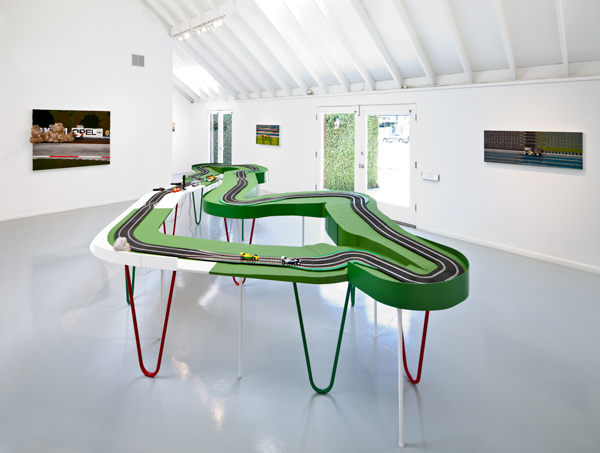
Los Angeles based artist Chris Beas is currently presenting a new exhibition titled Tamburello at Martha Otero Gallery in L.A. Similar to previous exhibitions by the Beas, Tamburello consists of several flat works which are bridged by a larger freestanding sculptural installation in the center of the gallery. The exhibition focuses acutely on the events of May 1st 1994 when Formula One driver Ayrton Senna crashed his vehicle and died taking a sharp turn during the San Marino Grand Prix. Driving at nearly 200 miles per hour at the time of the crash, the Tamburello corner marked the last site of the driver’s spectacular career.

For the exhibition, Beas has created ten new paintings that feature die cast metal replicas of race cars driven during Senna’s first ten years of F1 driving. The paintings simulate the affect of driving a vehicle at such high speeds. In the center of the gallery, a 1/32 scale model replica of the F1 circuit rack at Imola serves as the site of the San Marino Slot Car Grand Prix for which the driver had his last race.

Chris Beas was born in Sierra Modre, California and received his MFA from the University of California, San Diego. The artist has previously exhibited at the Prague Biennale 3, Parc Saint Leger Centre D’Art Contemporain in Pougues-les-Eaux, France, and Casey Kaplan, New York, NY.

Share

From the DS Archives: Epistemology of Polka Dots
Evan Holloway responds to James Turrell

Originally published on May 4, 2008


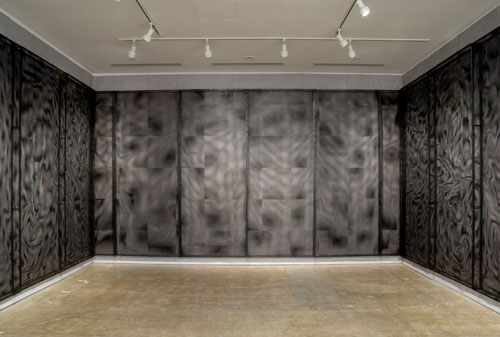
All images Evan Holloway Project Series 35, 2008, Photo credit: Robert Wedemeyer

Polka dots aren’t typically transcendental. They aren’t autonomous and they aren’t monumental. Yet in Evan Holloway’s current exhibition, Project Series 35 at the Pomona College Museum of Art, polka dots take on some serious questions.

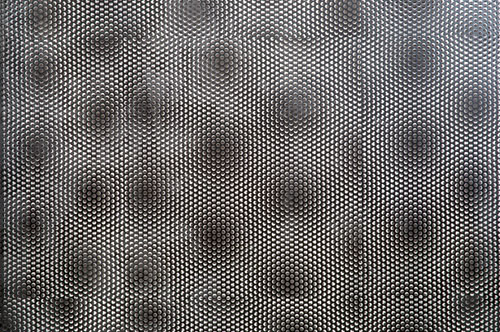
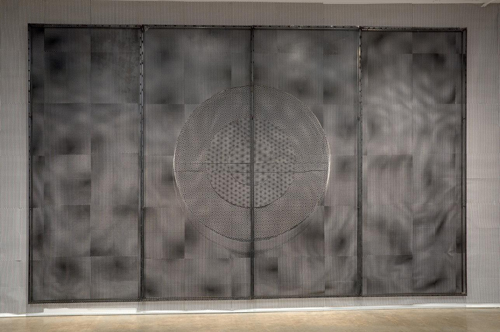
Holloway’s installation seems like the perfect place to listen to Zeppelin’s “Stairway to Heaven” or Lou Reed’s “Heroin” – it’s portentous and lulling, just like 70s rock at its best. But Holloway’s work also has the calculated restraint associated with minimalism. Pages of black dots cover nearly every inch of the gallery walls and a lightly gridded metal screen, installed to hang a few inches from the wall, adds a layer of empty holes. The holes and dots move in and out of each other, turning the exhibition into a brain tease that reconfigures itself every time you turn your head. The room only stops moving if you stand still and pick a spot of wall to stare at. At first, the installation seems like a lighthearted foray into the haphazard vernaculars of classic rock and youth culture. But an undercurrent of indecision and mistrust tampers with the fun.

Pomona College’s Museum of Art devoted its 2007-2008 season to James Turrell, an artist who took the Light and Space movement to an extreme by constructing craters and natural light observatories. Turrell openly traffics in the language of spirituality and sensory experience. His sculptural spaces exist to illicit a sensory experience that transcends our typical perceptions of light. He does this expertly, with well-crafted, big-budget projects. On one hand, Turrell’s work has a compelling serenity that can fascinate any audience with five senses. On the other hand, Turrell’s transcendental aesthetic can be alienating and insincere, too much about the illusion of spirituality and not enough about the world and the way people live. This is where Holloway enters the picture.

Holloway’s installation currently lives across the hall from Turrell’s End Around, a work that relies on neon lights and pristinely painted surfaces to create the illusion of endless space. To enter “End Around,” viewers must wear little blue slippers over their shoes and be accompanied by a gallery attendant. Still, the transition from Turrell’s work to Holloway’s is agreeable enough. Project Series 35 engages our sensory perception, even if the installation has more to do with the here and now than celestial light.

In a pseudo-catalogue that accompanies Holloway’s installation – it’s a newspaper-like pamphlet with sixteen pages of dots and two pages of text – Holloway and writer Bruce Hainly engage in an email dialogue about Turrell, baby boomers, contemporary poetry and gay porn. The emails have a biting earnestness, perhaps because Holloway and Hainly are as opinionated as they are uncertain. They have plenty to say about Gertrude Stein and pop music, but neither knows exactly how to respond to the monumental, poignant quality of Turrell’s work or to the contrived “poignancy” of art in general.

Near the end of the dialogue, Holloway explains his own use of perceptual phenomena, saying that he finds the mistrust of perception and illusion more interesting than revelation. He comments, “It was quite irritating to me that Turrell is often framed within a soft-core, new-age belief system. I always present my work in a context of skepticism.” Holloway prefers to pose question: why should art aim for poignancy and transcendence when perception is already rife with inconsistencies?

Holloway’s response to Turrell does something uncanny. The room of dots achieves the scale and experiential potency of monumental art without seeming epic. Like Turrell, Holloway holds viewer’s attention by engaging them in a large-scale sensory experience. But while Holloway does not require his viewers to put in time, Turrell’s work requires a commitment. It seems to say, “I can offer you a new perception of the physical world if you sacrifice your time to my work.” Viewers who spend an hour or two in Turrell’s skyspaces experience an ever-transitioning vision of light that they couldn’t have seen with their naked eyes.

Holloway’s installation is more immediate. He engulfs his audience in an experience but he doesn’t require anything of us, nor does his work offer us anything that we don’t already have. He essentially says, “Here, look at how this familiar vocabulary of dots and holes can conjure up an experience.” Just one look around the gallery leads to a trippy sensation. The installation begs for free-association – it’s pixels gone gaga, a psychedelic trip in monochrome, or your favorite polka dot t-shirt stretched across the length of a room.

By the end of their email correspondence, Hainly and Holloway haven’t really reached any definitive conclusion. Sure, Turrell makes mesmerizing, epic work that relies on illusions of authenticity and revelation. But does this mean that his work needs to be challenged? What Holloway ends up doing is proposing an alternative. His installation gives us a foray into what perception-bending work can look like when it takes a straightforward, immediate route: a head-spinning but somehow uplifting sea of polka dots that broaches what’s going on in our heads and leaves the celestial realm to its own devices.

Share

Catherine Opie at Regen Projects

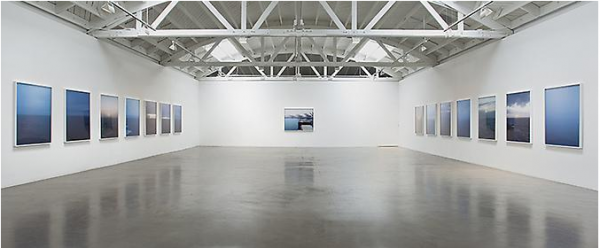
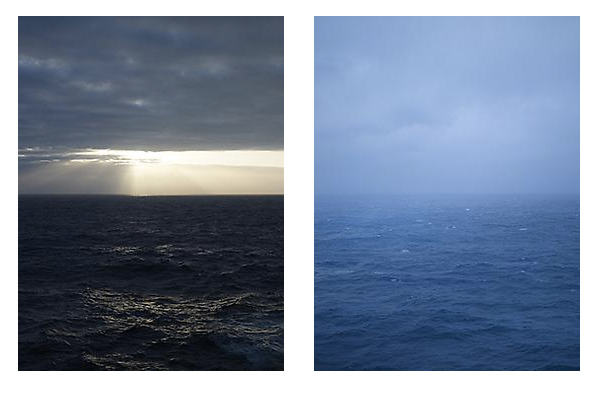
Closing next weekend at Regen Projects II in Los Angeles is new work by Catherine Opie. These photographs titled Twelve Miles to the Horizon document Opie’s trip on a container ship from Korea to Long Beach, capturing the sunrise and sunset across the ten days of the trip. Each image is composed with equal amount of water and sky, deliberately placing the viewer in the time and place documented in the image, allowing for both consistency in relation to the experience and variation in color and texture within the image. What remains is a sensation of solitude within this documented time and place, allowing the viewer to sense the duration of the work through these highly seductive and reductive photographs.

Although compositionally this body of work reflects her Icehouses (2001) and Surfer (2003) series, conceptually, these horizon photographs move in a different direction.  Although the series maintains both aesthetic consistency and variation as these earlier series did, what strikes more is the repetition of the action — a sensation of documenting time rather than just the beauty and stillness present in the earlier series. What remains in the viewer’s mind is the constraint embedded in the image, reaching more to the limitations present in her self portraits than to her more aesthetic and experiential photographs. These photographs allow the viewer to witness her self-imposed restrictions, revealing the decisions that created the series of images rather than just a documented experience. What remains are sensations of time and place, bound in a beautifully seductive series of photographs.
Catherine Opie received her BFA from the San Francisco Art Institute in 1985 and her MFA from CalArts in 1988. She is currently a tenured professor at UCLA, and her work has been exhibited internationally. In 2008, she had a mid-career survey at the Solomon R. Guggenheim Museum in New York — and the New York Times has a feature corresponding to the show. She has had solo exhibitions at the Walker Art Center, Minneapolis; The Saint Louis Art Museum, St. Louis; Photographers’ Gallery, London; Museum of Contemporary Art, Chicago; and the Museum of Contemporary Art, Los Angeles. An exhibition of Opie’s football, surfer, and landscape photographs will open at the Los Angeles County Museum of Art in July 2010.

Share

Can’t Afford the Freeway

L.A. Expanded: Notes from the West Coast
A weekly column by Catherine Wagley
Elana Mann, "Can't Afford the Freeway."

In the only photograph I have ever seen of her, Kajon Cermak  looks omniscient. She is sitting in a white sedan and glancing sideways at something worthy of a half-smile. But only a half-smile. The main traffic reporter for the public radio station KCRW, Cermak has a been-there-done-that cool to her voice which softens her otherwise feisty mien. She is very good with words: “if you’re northbound on the 405 right now, forget it,” “it’s bummer to bummer out there,” “pack-a-snack folks,” and  it’s “one long, non-stop, never ending rush to stop or so it seems.” Sometimes, what she says will make me drop whatever I am doing—hopefully, I am not driving—and wonder if I’ve heard quite right. “There’s a metal bar in lanes,” she said last Tuesday afternoon, “and people are pulling up and ordering cocktails.” This made the freeway sound expensive.

It’s no small thing to be a traffic reporter in a city where a person could feasibly spend a sixth of a day on freeways (“First there was rush hour, then there were rush hours,” Cermak has said) and freeway driving  has moral undertones too–a friend of mine sees glares every-time her Mercedes 240D lets out black smoke, and even if the glares aren’t actually there, the fact that she sees them says enough. L.A. artists fixate on cars, what you drive, whether you drive, and whether you should. I don’t know of another city in which art world folklore involves Robert Irwin leaving a critic on the side of the road after said critic denied the aesthetic acumen of a boy rebuilding a hot rod: “Here was a kid who wouldn’t know art from schmart, but you couldn’t talk about a more real aesthetic activity.”

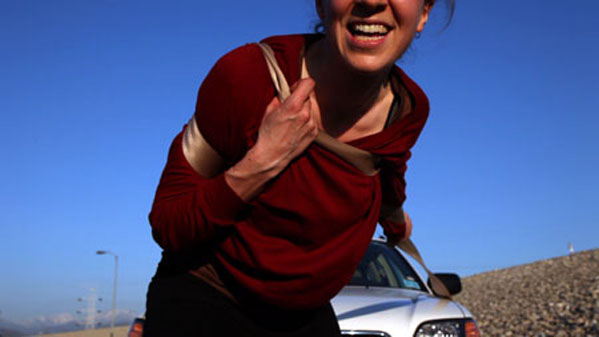
The day after Cermak turned stuck-in-smog-time into cocktail-time, I took the Red Line to RedCat in downtown L.A. and sat in one of two Subaru seats set up in front of Elana Mann’s video installation. Called Can’t Afford the Freeway, after the chorus of an Aimee Mann song, Mann’s video includes abundant car time but no drive time. Mann bends across and over car seats, sometimes merging with her car’s body, and other times fighting the car’s body. The freshly washed white Subaru Legacy Outback, sits in residential streets, shopping districts and barren lots as Mann tangles herself in the seatbelts–at one point, it’s like she’s in a seatbelt straight jacket–, caresses the headrests with her cheeks or lets herself roll head-first out the window, like a pool of lotion sliding over the  edge of the counter-top.

Lisa Anne Auerbach, 2009.

As Mann maneuvers, the soundtrack of her voice questioning Captain Dylan Alexander Mack, an Iraq war veteran who goes by Alex, plays out. Mann’s voice sounds polite, maybe even guarded, and Alex sounds more matter-of-fact and barefaced than he should, given what he says. At first, the interview seems like a distraction from the intensely physical dialogue Mann is having with her Outback. But then the overlaps between what Mann does and what Alex says become stronger: “Everyone was snaking and weaving” (Mann snakes and weaves around the gray upholstery), “you have resentment towards them because they’re the one’s closest to you” (Mann attacks her car sometimes, like when she throws herself on the hood), “I felt alone in the emotional attachment” (Mann is alone in every shot), “your car becomes a metaphor for your life” (for Mann, it seems to be a cocoon-like forum for acting out your feelings), “finally, I can steer my life” (Mann never steers the car), “I didn’t feel like I did anything for American culture” (Subaru may be owned by Fuji Heavy Industries, but the Outback is an American car; it doesn’t do anything in Mann’s video, though).

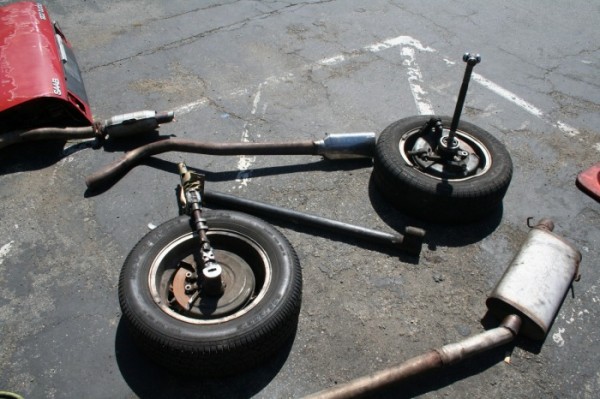
Car art has been more skin-deep than guttural lately. Artist Lisa Anne Auerbach, an adamant bicyclist,  recently bought herself a car to drive to her new job in Pomona. In response to her own digression, she knitted a green sweater. On the front, above  bicycles and happy hand-holding accordion people, it says, “I used to be part of the solution”; and on the back, which is bogged down by knitted cars, it says “Now I’m part of the problem.”  This Spring, artists Folke Koebberling and Martin Kaltwasser began rehabilitated sedans by turning them into bikes at Bergamont Station. On designated days, visitors could come watch a process that resembled a mini demolition derby. Jedediah Caesar turned a red pick-up truck  into an overgrown, inorganic ecosystem for the California Biennial last year. The pick-up felt apocalyptic.
Cars into Bicycles, 2010, Bergamont Station, Santa Monica.

Mann’s installation is too melancholic and probing to be apocalyptic. It susses out of the need for comfort and control, using the car as a proxy for trauma, war, anxiety, desire and affection. Given the emotional baggage her white Subaru carries, it’s no wonder Mann can’t afford the freeway.


Share