Alex Lukas: These Are The Days of Miracle and Wonder

Alex Lukas, Untitled (010), 20inx14.75in, 2010, Ink, Acrylic, Watercolor and Gouache on Paper

Due to the ubiquity of image and video today, we have become accustomed to witnessing disasters, both man made and natural, unfold in front of our very eyes. Because of the easy access of imagery and news media, it seems as if these disasters are growing at an exponential rate and are perhaps starting to spiral out of control. The recent onslaught of crisis’, be it economical, environmental or social,  has created a permeating feeling that we are now living in a highly uncertain time and the normals of stability are starting to slip away. This feeling has prompted many artists to create narratives that explore what happens when all of these disasters come together and finally threaten human life as we know it. However, it is too often that work in this vein focuses on the actual apocalyptic event, the spectacle, without much attention being placed on what happens to the world when there is only the scare of past human presence remaining.

The paintings and collages of Alex Lukas are centered on the days that take place after the “event”. The works offer a window to the future, a time that is oddly quiet, but that would look dismal to any human. In a new exhibition titled, These Are the Days of Miracle and Wonder, currently on view at the up and coming Guerrero Gallery in San Francisco, Lukas continues to explore the notion of looking to the future for information about the present, as well as documenting what it would be like to view a post-human world. The artist recently met Seth Curcio, founder and editor for DailyServing, at the gallery to discuss what events led to the moments depicted in his recent works, the time and place of these catastrophes, and what it feels like to view actual disaster images, which are currently taking place in the world.

Alex Lukas, Untitled (015), 18.875inx11in, 2010, Ink, Acrylic and Silk Screen on Book Page

Seth Curcio: The paintings that you have been creating in recent years depict a type of forgotten land that is in the process of being reclaimed by nature. Since it isn’t always clear, I’d like to get your thoughts on the possible events that led up to the quieter moments featured in your recent works?

Alex Lukas: The lack of a clear depiction of what came before is obviously very intentional. I know that the natural question raised by any depiction of “after” – which is how I think of these pieces- is “what happened?” And, that is a question that isn’t answered in the paintings. I’m interested in the idea of the confusion that will inevitably come “after” whatever has happened, be it war or disease or flooding, and how that confusion might grow with time. I imagine that the witnesses (if there are any) to the scenes depicted in these paintings might not have a clear idea of what has happened either. I think, given the breakdown of modern communications, rumors and false information will circulate and change over time – or there might be no information at all, no record of “the event” – yet it hangs over everything. I think of this sensation a little like an echo – there was a violent event, a loud clap of thunder, a tremendous bag, and in the silence afterward your ears are left ringing – even if you forget the sound, you can still hear it in the silence afterward.

Alex Lukas, Untitled (029), 2010, 42in x 90in, Ink, Acrylic, Gouache, Watercolor and Silk Screen on Paper

SC: The concepts of time and place are also interesting elements in your work. It is often difficult to discern if your scenes depict the aftermath of one catastrophic event, which is affecting several locations at once, or if we are seeing several different disasters that take place over a much longer period of time. Since time and place are so ambiguous in your work, how do you feel that you relate to these concepts and how do you feel they affect the viewer’s perception?

AL: I think of these paintings as scenes in a future – but they are depictions that reveal the past, they are focused on an after. In the paintings, this unknown “event” that I was talking about is something that has already happened, yet for us this event is still ahead – which makes for a very ambiguous time line. The locations for the drawings are created, composited or altered and generally generic, so they don’t reflect a precise place – they exist without firm landmarks that might give a clue as to where or when these places are (the tense is confusing – trying to determine where a location is from the perspective of the future looking back, but in our real time line, back is still forward). This ambiguity continues with some of the flooded cityscapes. Because I am using dated source materials, there are buildings that have now been altered or demolished or renovated, but here they stand as they were in the past, but again, they are in a future. All of this I hope leaves the viewer a little confused as to when the events happened, and it is with that sense of confusion that I hope people react to the scene.

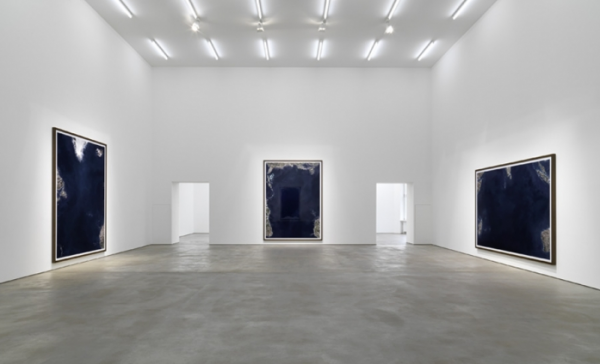
Exhibition Installation

SC: It seems that there has been exponential growth with both man made and natural disasters happening in the world recently. The ubiquity of disaster related images and videos certainly make this growth seem more apparent. How do you feel when you see actual images of disasters that threaten life as we know it, such the events of Katrina or the recent oil crisis in the Gulf? It must seem strange after working on these images in your studio all day to view images of actual events, which are strikingly similar to your paintings.

AL: I have been making these drawings since just before Katrina, and it was a very odd sensation to see images similar to what I’ve been drawing on television. Obviously it is a little unsettling, and it feels somehow wrong to draw inspiration from the suffering of others, (I’m always worried it will seem exploitative) but the political implications of these events I think are important and worth of investigation. The fact that we are seeing the second destruction of the Louisiana coast in the past five years, it speaks to the fragility of our government and the system of safety nets that we have set up for ourselves as a society. I think we have witnessed how events can easily spin out of our control – and what happens if we cannot be brought back from the brink? One of the interesting ideas that was mentioned right after Katrina, I don’t remember who said it, but you couldn’t call 911, and that is such a staple of our society, being able to get help when needed. So what happens when the police leave or are unavailable? What happens when hospitals no longer accept patients or are no longer able to treat those already in their care? (There was an amazing, heartbreaking story in the New York Times Sunday Magazine a while back by Sheri Fink about this situation during the aftermath of Katrina). This sense of isolation really interests me, the idea that there might be a day when help will not come, and then what? It all falls apart. I’m interested in exploring what specifics will bring us to this point.

These Are The Days of Miracle and Wonder will be on view at Gurerro Gallery in San Francisco until June 3rd, 2010.

Share

The Great Contemporary Art Bubble

In the first installment of an ongoing series, we’re teaming up with our pals at Art Practical, a San Francisco Bay Area based website that is the nexus of four important chroniclers of art and visual culture: Bad At Sports, Happenstand, Shotgun Review, and Talking Cure quarterly. DailyServing will be partnering with Art Practical from time to time to bring you the latest in whats happening in the Bay Area. Our excerpt of their recent article The Great Contemporary Art Bubble, written by Lani Asher, is featured below.

Damien Hirst with For the Love of God, 2007; platinum and 8,601 diamonds. Courtesy of White Cube, London.

Damien Hirst is a brand, because the art form of the 21st century is marketing. To develop so strong a brand on so conspicuously threadbare a rationale is hugely creative—revolutionary even.   —Germaine Greer.

In 2007, London-based art critic Ben Lewis wrote an article for the Evening Standard newspaper entitled “Who put the ‘Con’ in Contemporary Art?” The article discussed the overinflated art-market bubble that Lewis thought was ready to burst. Doubting the compelling idea that capitalism nurtures art and creates a free-trade zone for ideas and feelings, he suggested that the current art market might actually not be good for either making meaningful art or for democracy and freedom of expression. Lewis notes that the art market is notorious for its lack of regulations and transparency. He also points out that, between 2003 and 2008, billionaire hedge-fund managers, as well as the new business classes from Asia, Latin America, and Russia, pushed the already inflated prices of contemporary art into overdrive. Additionally, according to Lewis, the world’s biggest galleries, dealers, and artists were buying work by their most prominent artists, propping up their ever-rising prices. He concluded that the art market’s recent roller-coaster ride was fueled by “cynicism, absurdity, and greed,” accurately predicting the art-market crash at the end of 2008.

Lewis is best known for Art Safari, his BBC series on contemporary art. Additionally, he has made films for European television—ranging from the history of French nuclear testing in the Pacific to the fall of Romanian dictator Nicolae Ceauşescu—and has written regular art columns for several London-based publications. In his most recent film, The Great Contemporary Art Bubble (2009), Lewis investigates the cynical romance between capitalism and the art world through an economic lens. The well-made and entertaining documentary was filmed over a two-year period, between 2006 and 2008, and it favors the reflexive style of documentarian Nick Broomfield. It is, in many ways, a movie about the making of a movie. After viewing the film at the Roxie Theater in San Francisco in January of this year, I interviewed Lewis, curious about his motivation for making the film and what he discovered in the process.

The film clearly shows the consolidation of money and power in an unregulated art market, in which the collusion of collectors, galleries, and artists is firmly enmeshed in the web of finance capital. Lewis introduces the reality principle into this game of smoke and mirrors. While Larry Gagosian and Jay Jopling refused to be interviewed, many art insiders spoke on the record, including art advisor Abigail Asher; hedge-fund manager Jim Chanos; Josh Baer, creator of the Baer Faxt Art Industry Newsletter; and collectors Alberto and Jose Mugrabi and Aby Rosen. It is notable that Lewis does not focus on art-historical perspectives for any of the work he discusses in the film. As he notes, My film had hardly any art criticism. It was an economic analysis of the art market. In a way that was my art-critical point―that most of the art in my film did not merit being assessed within the framework of art criticism, and should only be considered as products in a market.

Visit Art Practical to continue reading The Great Contemporary Art Bubble.

Basically, we want you to take more license to connect the work that is being featured to the greater system of art or culture. You already do this, but just feel more freedom to write more creatively in terms of daily features, and don’t feel like you need to stick to the DS “format.”
Share

Brent Green: Gravity Was Everywhere Back Then

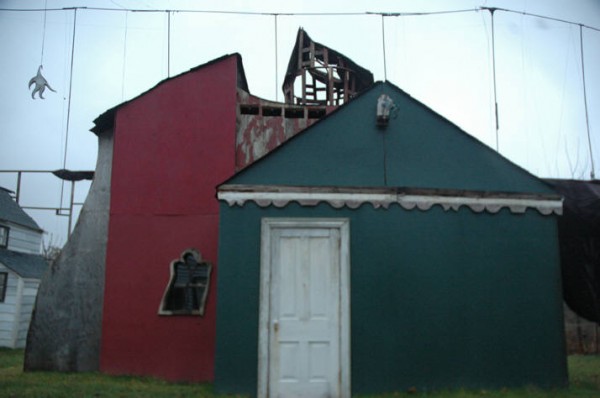
Brent Green, Leonard's House From Front, Gravity Was Everywhere Back Then. Mixed media, 2010.

Is it true belief’s unyielding determination that redeems and protects? This question lies at the heart of Brent Green‘s solo exhibition Gravity Was Everywhere Back Then at Andrew Edlin Gallery. The issue of belief occupies both Green and the man whose work provided the inspiration for the project.

The story goes like this: a man named Leonard Wood once built a house entirely by hand in Kentucky—a chaotic house of multiple rooms with strange dimensions—believing it would save his wife Mary from dying of cancer. Green visited the house before it was torn down and acquired the hand-drawn plans. In examining the house and its meaning, Green was inspired to rebuild it on his own property in Pennsylvania, resurrecting a lost monument to love, devotion, hope, and delusion.

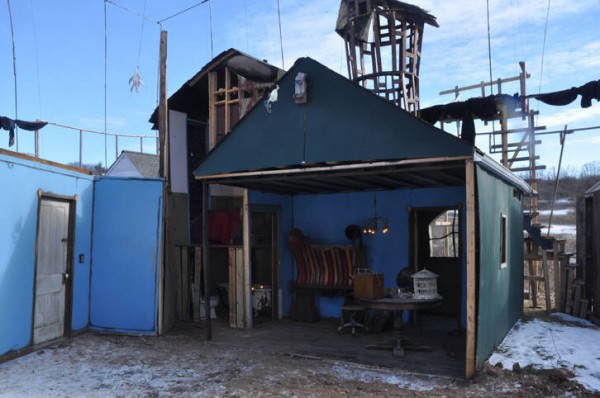
Brent Green, House Opened Up, Gravity Was Everywhere Back Then. Mixed media, 2009.

But Gravity is more than just a house. It is a multilayered project that is comprised of the house, its contents, sculptures, projections, and a feature-length stop-motion film. And the project is more than the story of a crazy man who thought he could heal his wife’s cancer with planks and nails: beyond the biography of Wood, it’s also the story of Green himself, as he explores his conviction and responsibility as an artist.

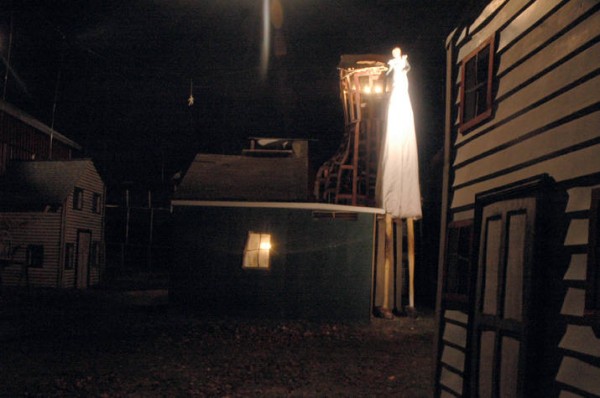
In the back room of the gallery, Green has installed the house in situ: bedroom, bathroom, sitting room with piano, kitchen; each element recreated with a palpable zeal. Avoiding the common pitfalls of outsider art created by an insider, there is nothing ironic, or cynical, or tongue-in-cheek here. The components are charming without being cloying or twee. Instead, one comes away with the feeling that Green is as much a true believer as Wood, though each in his own way. In the first iteration, the work of building the house was a testament to faith; in the second, it is a guileless exploration of belief itself, a willful belief in belief. The result reads as an authentic ode to desperate hope and an all-in commitment to hopeless causes.

Brent Green, Mary's First Memory, Gravity Was Everywhere Back Then. Video still, 2010.

A looped projection plays in the front of the gallery, showing Gravity Preview, the trailer for the film. Dark and dreamily restless in the way of all stop-motion, the fitful shots show Leonard and Mary in various scenes as Green’s voiceover narrates. The main characters build, plant flowers, and sleep in scenes of magical reality, stuttering and jerking in the frame while metal flowers grow and bloom, and galvanized nails roll into the gutters.

Toward the end of Gravity Preview, Green’s voiceover explains “…and so I decided to make this film about Leonard, and I rebuilt his house behind my barn in Pennsylvania, full-scale. And, you know, I’m making this film about him and just running everything down to zero to leave something wonderful behind, which is exactly what Leonard did.” In retracing Wood’s steps, Green presents a full-scale documentation of Wood’s doomed project, but what we also see is Green’s struggle to overcome his own skepticism and faithlessness.

Share

Andreas Gursky

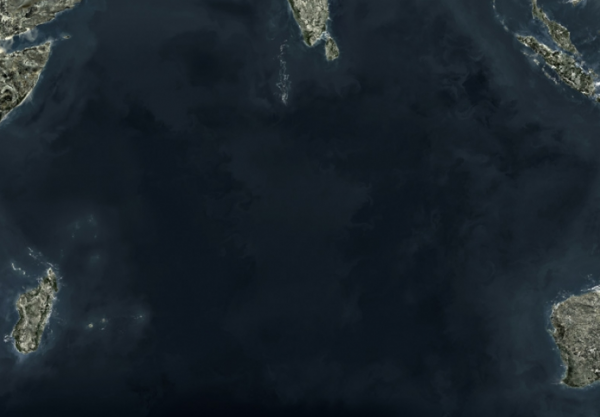
Attempting to map the unknown in order to better understand the world around us has long been a product of human curiosity. The oceans have always existed as the ultimate site of uncertainty on our planet for humans, and a consistent point of interest by artists and scientists alike. However, historically the oceans have been mapped and charted only in regards to the land mass that they boarder, no doubt a product of economic needs. Capturing only the peripheries of landmass and focusing on the void that results in their absence, internationally acclaimed German born photographer Andreas Gursky recently embarked on a new photographic series that is currently on view at Sprueth Magers in Berlin. The exhibition features a new six-part series of images titled Ocean I-VI, which was conceived by the artist during a flight from Dubai to Melbourne. The images capture the oceanic space that lies between Africa and the tip of Australia near Antarctica. To create the series, the artist used high-definition satellite images that were augmented from varies photographs sourced from the internet. The sourced images provided the artist with an accurate view of the land mass and coastal lines, but caused for Gursky to fully generate the oceans through digital means. The resulting fabricated waters, which link the landmass, take on the aesthetics of a formal painting with textures and shifting tonalities directed by compositional principles.


With the exception of a single work, all of the exhibited images depict the void in between the land mass, drawing attention to an often forgotten space. The manufactured illustration of the oceans also acts to underscore the development of cartography, which rarely focused on the oceans, mainly due to a lack of knowledge followed by little economic motivation. But in this series, the artist is able to give form to the shapeless seas based on the contours of the surrounding land mass, while also illuminating a part of the world that often escapes any trace of human presence.

Share

From the DS Archives: Tara Donovan @ the ICA Boston

Each Sunday we reach deep into the DailyServing Archives to unearth an old feature that we think needs to see the light of day. This week we found a feature of Tara Donovan’s works at the ICA in Boston (2008/09). If you have a favorite feature that you think should be published again, simply email us at info@dailyserving.com with you selection and include DS Archive in the subject line.

Just two weeks before the opening of her first museum survey at the Institute of Contemporary Art (ICA) in Boston, Tara Donovan is named a 2008 recipient of the MacArthur FoundationGenius” Grant. Selected for her creativity, originality, and potential to make important contributions in the future, the new Fellows work across a broad spectrum of endeavors. The Foundation cited Donovan’s “dazzling body of work that will enrich the fields of contemporary sculpture and installation art for years to come.” Tara Donovan was born 1969 in New York City.

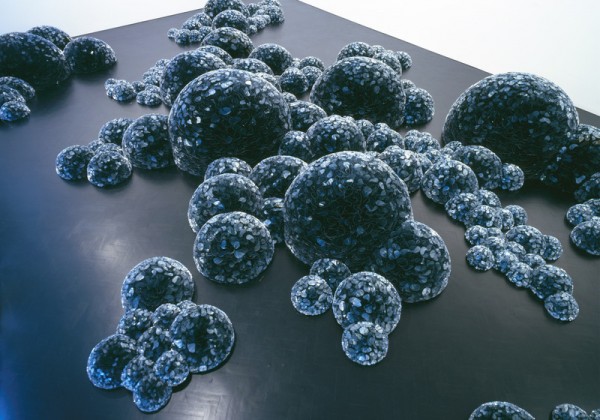
The ICA presents the first major museum survey of the American sculptor. Tara Donovan gathers 16 works from the past decade and displays a new installation commissioned by the ICA. The exhibition examines her distinctive sculptural process, exploring how a single action applied to a single material countless times can transcend our expectations. Donovan transforms large quantities of mass-produced items, drinking straws, toothpicks, and buttons, into stunning works of phenomenal impact. Layered, piled, or clustered with an almost viral repetition, these products assume forms that both evoke natural systems and seem to defy the laws of nature.

Spilling across half a dozen rooms at the ICA, her works are so straightforwardly beautiful. It includes rolls of adding machine paper piled on the floor, styrofoam cups suspended from the ceiling, and enough plastic drinking straws to cover a wall. This exhibition changes our perception of things seemingly familiar. Donovan revels the unrealized sculptural potential of pins, cups and plates. She understands how to use simple consumer products to generate complex results that speak to form, light, space and perception. The installations illustrate her sensitivity to materials, their innate properties, and potential to create evocative visual experiences.

Donovan’s work is about creating a system, using a structure and then repeating in incremental units that can expand from the finite to the seemingly infinite. From a distance, her work’s rhythm reminds one of the cohesion of cells and particles or even the geographic patterns of landscapes or clouds. She responds to their given form, texture and surface allowing them to accumulate in a set of given boundaries.

Her works invite you to approach the familiar with a new curiosity.

Share

Gary Lee Boas

Bianca Jagger and Andy Warhol, 1978, New York City, 2009

In a day and age where photographing celebrities is a multi-million dollar business, seeing the photographs of Gary Lee Boas only complicates this already murky water. On view at Country Club Projects in Cincinnati, Boas’ exhibition Sentimental Journey shows a series of beautifully nostalgic celebrity images referencing a very familiar place and time, while questioning the roll of the celebrity image, the fan and the photographer. Showing personal fan photographs that were taken in the 60’s and 70’s of highly publicized celebrities before the age of paparazzi, Boas’ images instantly give you vision into our current world of hyper celebrity combined with capitalist gain. Through the lens of memory and nostalgia, these photographs give you a glimpse into the life of a fan and our culture’s obsession with fame, fortune, and celebrity, yet somehow also provide the viewer with the odd relationship between artist and audience. Boas constructs a system in which one can observe celebrity without inherent criticism, where obsession is beautiful and where our culture is worth questioning and celebrating.

Elizabeth Taylor with Halston, April 24th, 1979 Party for Edith Head, 2009

Gary Lee Boas lives and works in Lancaster, Pennsylvania. His recent exhibitions have included the Scottsdale Museum of Contemporary Art in Scottsdale, Arizona, Reflex Modern Art Gallery in Amsterdam, Yerba Buena Center for the Arts in San Francisco and Deitch Projects, in New York.

Share

Not-Quite-Beauty

L.A. Expanded: Notes from the West Coast
A weekly column by Catherine Wagley

"Searching for my Prince," 2006 Hand-stitched embroidery, applique and paint on vintage print table linen , 70 x 60 inch. Courtesy Charlie James Gallery.

Orly Cogan is searching for the feminist beauty queen. Her strategy involves backtracking, returning to the same matronly craftiness embraced by members of Womanhouse a quarter of a century ago. That’s only sensible. Beauty queens and “the cutting-edge” do not go hand-in-hand. Case in point: this year’s freshly crowned Miss USA may have been the first Arab-American to take the title and the first to unwittingly promote birth control for all, but she still won viewers’ affection with a by-the-bootstraps story—she sold her car to pay for her dream—and still looked like a small-town prom queen in her strapless, wedding-white evening gown. Cogan’s work, in which figures rarely wear gowns if they wear anything at all, does not have the Horatio-Alger-style gumption of Miss USA but it has a homegrown wholesomeness that even its narrative deviance can’t suppress. Its crafty, colorful stitching seems better suited to a 4-H booth at the county fair than a white-walled art space.

At Charlie James Gallery, Cogan’s tapestries and hand-stitched pillows flank a potluck-style table loaded with crocheted cakes and doily cupcakes. A white shelving unit to the table’s left holds pillows that sport messages like “It’s not me, it’s you” and “You’re not really what we’re looking for” stitched in a childlike hand. While endearing in the same way Miranda July’s idiosyncratically confessional titles are endearing, the pillows’ self-consciousness contradicts the rest of the exhibition’s guilelessness.

"East of Eden," 2008, Hand-stitched embroidery and paint on vintage linen, 24 x 80 inches. Courtesy Charlie James Gallery.

Searching for My Prince, a symmetrical scene embroidered on vintage table linen (Cogan often reworks old materials), would still pass for a table cloth if not for the naked and near-naked pair of figures leaning into the blue oval at the image’s center. The blond women, who, like many of the figures in Cogan’s work are Doppelgangers for Cogan herself, pucker up to kiss a small green frog, while a spattering of additional frogs strain to watch. It’s fairyland meets Hicksville, since the slightly used, wrinkled surface of the linen and the womanly bodies, one clad in a loose-fitted pink bikini, make the frog-kissing seem tawdry. (Magic never seems as magical when it hasn’t been air-brushed.)

In East of Eden, fairy characters reappear, this time accompanied by figures with Biblical portentousness and about as much inhibition as the locals of a nudist colony. There are abandoned tires, pregnant women and a disproportionate number of frogs, though Steinbeck did mention toads early on in his version of East of Eden. Steinbeck also said that “it would be reasonable to suppose that a routine time or an eventless time would seem interminable,” but that actually, routine time flies, as it does in Cogan’s yellowed, panoramic tapestry. Figures lounge in yards, touch themselves, cuddle, bicker and just exist. Whole generations seem to grow up inside their languor. Figures begin to overlap one another, and houses grow in on each other. Picket fences impinge on log cabins.

"The Affair," 2004, Hand-stitched embroidery and paint on vintage print table linen, 68 x 51 inch. Courtesy Charlie James Gallery.

More Henry Darger than Tracy Emin, and more Miriam Schapiro than Ghada Amer, Cogan’s work is less concerned with bucking the art world than sidestepping technology. Her linens and embroidery suggest that material progress doesn’t necessarily equal human progress. That same logic informed the Pattern and Decoration movement that emerged in the 1970s. Minimalism had been materially sophisticated, employing Anodised aluminium, painted steel or zinc plates. But it had omitted a whole range of textural, sentimental experiences that artists like Schapiro and Joyce Kozloff re-embraced. Holland Cotter noted, reviewing Hudson River Museum’s Pattern and Decoration: An Ideal Vision in American Art in 2008, “most P&D art isn’t beautiful and never was, not in any classical way. . . . And not-quite-beauty is exactly what saved it, what gave it weight.”

Not-quite-beauty, at least the way it manifests in Cogan’s work, still has some edge to it. It’s awkward, dated, homely and possibly oblivious to a few generations of institutional critique and art-about-art that preceded it. But the beauty queen Cogan is looking for isn’t ambitious or sleekly intellectual; she’s more of a potpourri, pulling from everything hearty, domestic, raunchy and defiant.

Share