All Signs Point to Yes: An Interview with Kadar Brock

When I first heard that Kadar Brock was using Dungeons and Dragons dice as engines of chance to determine the elements in his new paintings, I was as suspicious of it as I am of mullets on the L Train. I’d seen his work in several recent group shows, but it didn’t really stick with me until I saw Night Fishing at Thierry Goldberg Projects last month.  Kadar’s painting was a mysterious moment in the never-ending parade of lukewarm group shows on the Lower East Side. The surface, a repeat pattern of linear diamonds, somehow felt more personal than past work I’d seen of his.  It seemed that he was revealing, through reductive means, something more than an arch sense of nostalgia for a teenage fixation. Intrigued, I approached him to do this interview hoping he would shed some light on his process.

"Spell List (Resist Planar Alignment)," 2009. Marker, spray paint, and house paint on paper. 30 x 22"

Michael Tomeo: I’ve read that you use Dungeons & Dragons dice rolls to inform your compositions…how does this work?

Kadar Brock: It isn’t so much about the composition per se; it’s about determining an amount of marks. Each piece adopts a rule set from a D&D spell. These rules involve rolling a certain type of die a certain number of times, and the resultants determine how many of those zigzag marks the piece will get. That then determines the composition. But really the use of D&D is just a system or a set up. It takes away certain decisions from me and forces more onus on the mark making and paint handling to communicate things. It also sets up an analogy with abstraction – both essentially being belief systems and participatory experiences.

MT: This reminds me of how 60s artists like John Cage or Robert Rauchenberg would use the I Ching to create music or dance. I feel like the spiritual and Zen-influenced side of their work kind of got trampled by the onward march of minimalist sculpture. At the risk of sounding corny, does any spirituality from the spells influence your work? Are you into any thing like Jospeh Campell or the idea of the monomyth?

KB: Not corny at all – in fact incredibly spot on…this is what I’m getting at, while trying to co-opt/include self-criticism. It’s post-cynical romantic, i.e. incorporating and coming out on the other side of my doubts, while still maintaining and believing in this stuff I choose to call “other content” like the sublime, spiritual, romantic (essentially the lineage I find myself to be a part of). It’s about finding meaning and creating meaning. The I Ching is a set of rules too, and something that is given belief, given meaning, by the person playing by those rules or using those rules. That participation is a creative act. For me I’ve always felt that, and this really ties into Campbell, it’s my job/endeavor/whatever as an artist and human being to come up with my own sense of meaning for this life, to come up with what would be my own mode of myth. It’s the only way not to succumb to some other person’s story and the power that exerts over you, it’s also, at least for me, the only way to be sure that life is “fresh” or new to me.

I’m also very much into the spiritual connotations of spells and magic. My parents were hippies, I was raised all new age, and the reason I got into abstraction was because of its spiritual, metaphysical, and Gnostic underpinnings, and the relationship between that and my upbringing. I like the idea of abstract paintings being spells and being magical. I think using this set up, calling them spells etc. co-opts any cynicism I have about it and incorporates it, takes in my doubts and beliefs. It comes out on the other side with something.
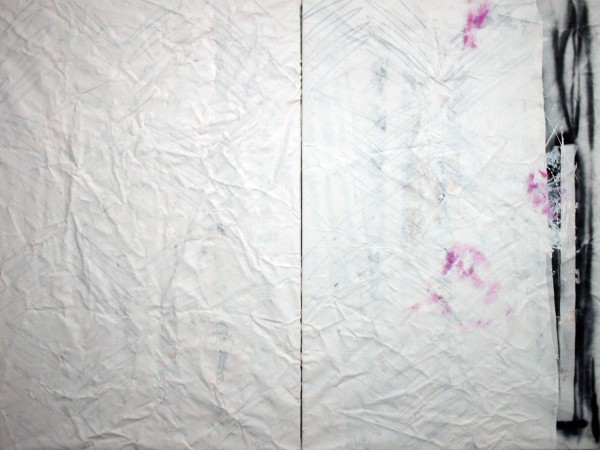
"Combust," 2010. Marker, spray paint, and house paint on canvas (diptych). 72 x 96"

MT: About being a post cynical romantic, correct me if I’m wrong but it seems like you are taking up where Gen X left off or maybe it’s that you don’t have to follow their well-worn paths. To generalize, Gen X seemed to know more what it didn’t want to do rather than what it did. I’m thinking of John Cusak’s famous “I don’t want to buy anything, etc…” rant from Say Anything. You don’t have Gen X’s weighty sense of nostalgia/regret and you seem to combine some ideas from the literary sense of romance, like a belief in the supernatural, but your work is also firmly placed in the unsentimental present.  In other words, your work has feeling and you believe in things but you’re not like Lloyd Dobler standing with a boom box over his head in the rain, right?

KB: Yeah, I think I do believe in things. And that pretty much sums it up, I think I do… or better yet, I think about what I do believe in and challenge that, but as a means of clarifying all of it, not trying to get that nihilistic “I don’t want to do anything.” I have these moments of intensity. I have these things I relate to and feel moved by. And I see people in the past that talk about these same things, these same moments. So maybe it’s something other people relate to also. That said, maybe not everybody does, maybe some paintings ain’t gonna do shit for someone and they’ll be meaningless to them.

I think abstract painting really exists on a precipice of being meaningful and meaningless, and I really embrace that. For me the paintings are meaningful, but for someone else – nothing. Same like D&D – for someone invested in that system, someone putting into it and participating – wow! I read a study about how role-playing was able to cure someone’s social anxiety, and another one about how it cured someone’s depression. I also watched a documentary about a live action role playing community outside of Baltimore, and man, that game, that world, the characters these people played, gave their life a more pointed sense of purpose and meaning and worth. I mean, couldn’t you say by being this art maker I’m doing the same thing? I get to think and feel all these things that are incredibly important and crucial, and make all this stuff.

But yeah, for me, I am concerned with this romantic stuff. I had been taught to be cynical about it in school, to make fun of it, or use it winkingly. I’m over that though, but I also feel a responsibility to not just weep and bleed out a painting (in fact I think that’d be boring). It’s like how do I experience that moment of intensity, how do I talk about that moment with some self-awareness, that precipice of believing and feeling, while still giving into the feeling and the belief. And that in itself is another precipice between letting go (which I do in the act/action of painting), and staying self-conscious.

But to get back to your analogy, I think if I were going to be Cusak in the rain though, I’d be him in High Fidelity, figuring out relationships and feeling some shit.

"Disintegrate," 2009-10. Spray paint, house paint, and pigment dispersion on canvas (diptych). 96 x 144" (courtesy private collection)

MT: What I like is that even though you’ve poured a lot of energy into a painting, you acknowledge that someone looking at it just might not get it, and that’s ok. I don’t think you’d ever be offended by a reading of your work that might not match your intentions…

KB: Not exactly, but I’m definitely not offended if people don’t respond to it. Everyone is different, and that’s ok. Some people will get into it and others won’t and that’s fine. I do want the people into it though to get into what I’m into, and to experience that in someway. And if their interpretation is a little different, all the better, because then they’re participating more and making it more their own, which in the end, I think is more meaningful and will be more significant to them.

MT: When did you start to fully engage with myth? Did that have anything to do with a tendency toward reduction and the monochrome I’ve noticed in recent works?

KB: You know, I’m not totally sure when it started. I’ve really always been interested in that mode of thinking and relating. I mean, I’ve always thought, since like high school, that it was my job to come up with my own belief system or synthesis of belief systems in order to relate to the world in a more direct and meaningful way. I mean if you want to look at it one way, I would always draw comic book characters and fantasy characters when I was a kid – those subjects are rife with mythological content.  I was reading myths in college too and making some drawings related to them – the subjects ranged from Siegfried in the Nieblungenlied to Jonathan Livingston Seagull. And I’ve always been fascinated by the myths I related to about being an artist – ideas of heroes and shamans, the magic of the painting practice and inherent communication that happens in the act of painting. The possibility to talk about things words can’t really touch on. The ability to get all this complexity of thought and feeling into on object/moment, that then can unfold and change before someone.

The shift towards monochromatic work came from wanting to challenge my belief in the myth of painting’s inherent communicative qualities and wanting to put as much pressure on my gesture/mark making as the touchstone of communicating subjective content. So yeah, it definitely relates to a myth I believe in and want to investigate, challenge, and potentially validate.

MT: Although my experience is limited, what I always liked about D&D is that despite its endless volumes of rules, the nuance of the game lies in the dungeon master’s discretionary or even improvisational application of them. Does improvisation play a role in your current work?

KB: It’s really funny, Michael, I’ve actually never played either! I wish I had, and actually would still like to now (if there’s anyone out there who’d be into it, email me). But yeah, there’s a lot of freedom in the framework – and again, it really comes down to a belief system and participating, and internalizing and making it one’s own.

In regards to the painting though, I think improvisation is everything in the work. I mean that’s where all the feeling is going to come from, all the wet “other” content. How a piece gets folded, what sort of spray/marker/house paint/other paint combination is used, how many drips, footprints, scratches, whatever, are all in the moment.  The whole system thing is just that, a system, a box, a set up, so I can have as much freedom in the act of painting as possible. If I know what I’m painting, have all these limitations, the only place for the stuff I want to come through is in improvisation in the action of making it.

Kadar Brock’s work can currently be seen in Substance Abuse, curated by Colin Heurter, at Leo Koenig Projekte, up through July 3rd, and in In.flec.tion at the Hudson Valley Center for Contemporary Art through July 26th. Conjuring and Dispelling, a solo show at Motus Fort, Tokyo, Japan, opens on June 18th.

Share

Maurizio Cattelan: Is There Life Before Death?

Installation at Tate Modern for the exhibition “Pop Life,” 2009

Courtesy: Marian Goodman Gallery, New York, Photo credit: Zeno Zotti

A myth is a foundational narrative that may be based in truth or fiction but either way it tells a story of who we are. Thus self-consciousness is constructed by a shared narrative and helps us to give shape and even name our identity. If we think of identity in the usual terms of religion or nationalism, some examples of these mythological narratives include the King James Bible or the story of George Washington cutting down a cherry tree. But in the art world, there are strains of mythology that are built on identity formations like artist, curator, or critic.

Photo: Zeno Zotti

Maurizio Cattelan is notorious for using unabashedly bad-boy black humor to resist easy classifications of identity. He does so through imagery and institutions that are deeply tied to religion, nationalism and the art world. In his exhibition at the Menil Collection in Houston, Is There Life Before Death, Cattelan has worked with the curator Franklin Sirmans to explode the distinctions between a number of categories. The exhibition includes art objects that are situated as “interventions” in the galleries of Byzantine, African and Surrealist art, culminating in a haunting set of works in dialogue with Arte Povera works from his native Italy. As a result the work is both art object and its context within the museum. In this sense Cattelan plays both artist and curator.

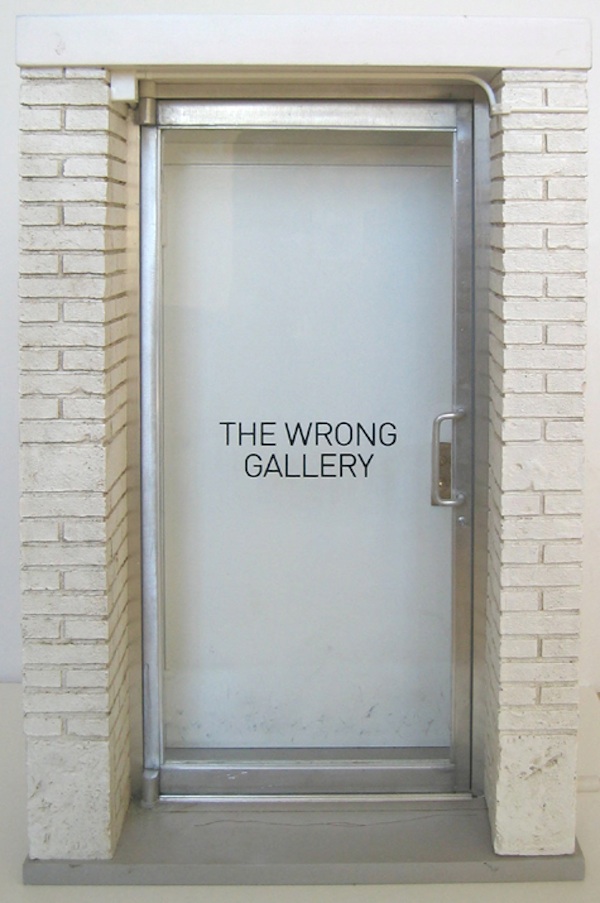
This blurring of boundaries is one of many attacks against authority that Cattelan perpetrates. But as Sirmans notes in the accompanying catalog, Cattelan has a long tradition of work in and out of normative roles. In addition to making sculpture and installations, Cattelan also worked on the publication Permanent Food and acted as curator for the Wrong Gallery and the 2006 Berlin Biennial along with curators Massimiliano Gioni and Ali Subotnick. This kind of interdisciplinary activity cuts against the grain of traditional divisions of labor in the art world. The myth of these divisions is based on the notion that artists are dumb mute expressionists who use innate talent to make objects that are interpreted by critics, bought by collectors and arranged by curators. By resisting this mythology, Cattelan capitalizes on the expansion of artistic practice by many artists of the twentieth century such as Duchamp and Warhol found in the Menil Collection.

Installation view Kunsthaus Bregenz, 2nd floor

Courtesy Kunsthaus Bregenz, Photo: Markus Tretter

But Cattelan also challenges more traditional mythologies such as Christianity. His Untitled, 2009, a taxidermied horse on its side with a wooden sign reading INRI staked in its flank, was placed in a dark gallery of dreamy Magritte paintings. This obviously references the Latin acronym inscribed on Jesus’ cross declaring him to be king of the Jews. But placed on a dead horse, a symbol of foolishness, what does this mean? In the Menil’s comment book there were some Christian visitors that were very much offended by this work, assuming that is was heretical along with Untitled, 2007, a sculpture of a woman face down and crucified in a shipping crate.

Photo: Hester + Hardaway, Houston

These gestures cause controversy because they rupture the fragile fabric of our expectations. When these Christian visitors walked into the Byzantine section of the Menil Collection they were looking for something old and true. They were expecting artifacts that would deliver on the promises of their identity’s myths. Instead they were confronted by a Trojan horse, an object that trafficked in similar iconography but proposed something less clear and concrete. This was the true heresy, for mythology cannot tolerate ambiguity and skepticism. Myths are made to describe truths and their reproductions and meant to reaffirm them. But artists like Cattelan use mythology along with the strategies of artistic, critical and curatorial practice to reveal that a story is only as good as its teller.

Share

Mike Kelley: Arenas

Flip through any Mike Kelley catalog and you’re likely to find a plethora of images that show the artist to be a maker of videos, installations, and objects that betray what critic Jerry Saltz once described as “clusterfuck aesthetics“.  So it may be a surprise to view the relatively straightforward Arenas at Skarstedt Gallery, comprised of seven out of the eleven works from the original series exhibited at Metro Pictures Gallery twenty years ago.

Arena #10 (Dogs) (1990) Stuffed animals on afghan, 11.5 x 123 x 32 inches.

These seven works, all created in 1990, puncture the mythic preciousness for which stuffed animals and handmade baby blankets are renown.  Generally, cloth is used by artists for its connection to the body and domesticity, and Kelley manages to bring these associations along while still creating a colder, more antagonistic ambiance.  In addition, Kelley also manages, despite the suave white cube setting, to deflate the illusion that art need be urbane or polished.

Arena #10 (Dogs) is one of the most playful and visually-pleasing compositions in the show.  On a bright red, orange, and brown striped afghan sit eight stuffed animals that seem to be engaged in a tug of war to divide the centermost animal, a two-headed dog.  Most of the other animals are also dogs, but some are silly, ambiguous hybrids like the snake/dachshund/duck concoction or the cheerfully anthropomorphic tomato.  Arena #10 is just fun-n-games; yet look at the display for perhaps too long, and you’ll see that some of the dogs’ expressions are not quite right.

Arena #7 (Bears) (1990) Stuffed animals on blanket, 11.5 x 53 x 49 inches.

In Arena #7 (Bears) five stuffed animals are poised at the perimeter of a satin-edged receiving blanket on the floor: two monkeys, one taupe bear, and twinned golden bears that could be the uglier younger brothers of Pooh. The colors of the animals harmonize with the cream-colored blanket.  The animals sit at the edge of the square as though playing Monopoly, or waiting for a referee’s whistle to blow and a game to begin.  It is one of the sweeter, more innocuous pieces in the show, but even so, the second-hand blanket is on the floor and the bears and monkeys are bedraggled, adulterating the potential innocence of the scene.

Arena #9 (Blue Bunny) (1990) Stuffed animal on blanket, 7 x 60 x 74 inches.

In contrast to #10 and #7, Arena #9 (Blue Bunny) feels stark.  A lone light-blue knitted rabbit sits in the center of a grubby light-blue blanket, smiling somewhat sheepishly with arms raised.  The ambiguity of the gesture—is this an expression of the victor alone at last on the playing field, or a sign of mommy-pick-me-up dependence?—gives the piece a heightened emotional force.

Arena #5 (E.T's) (1990) Stuffed animals on blanket, 7 x 97 x 87 inches.

Arena 5 (E.T’s) is, no pun intended, the most alien.  Here, the field is a large goldenrod-colored blanket.  At one corner sits a lone alien, facing toward the other actors but solemnly looking down.  In the diagonally opposite corner, two cloth E.T. dolls inspect a prone pink humanoid dispassionately.  The attitude and position of the dolls and the emptiness of the territory turns a pilled old throw and some fabric toys into a diorama with all the warmth of an operating theater.

It’s a mild case of what anthropologist Mary Douglas called “pollution behavior”: activities likely to cross closely-held boundaries or repudiate cherished designations, like putting boots on the kitchen table or eating spaghetti in bed.  In this case, and especially in the context of an urbane Upper East Side gallery, it’s the contact with the floor that evokes pollution.  Not just by using obviously worn and recycled objects, but by literally reducing art objects to the level of the floor, Kelley manages to interrogate assumptions about art and also the viewer’s feeling for handmade and beloved objects.  Kelley melds the personal, cherished nature of stuffed animals and security blankets and the costly, refined nature of blue-chip art to show us how flimsy the narrative of sacred objects can be.

Share

7 Days of Myth

Over the next 7 days, DailyServing will be bringing you the first installment of a new series that considers a selection of new international artists through one central topic. This week, our writers tackle the concept of Myth through the work of a variety of artists by way of features, articles, reviews and interviews. Check back every day this week to see how our artists and writers alike see Myth in the world around us.

Christodoulos Panayiotou, Wonder Land. 80 color slides, 2008.

Searching for the perfect way to introduce a concept as illusive as Myth lead me down the rabbit hole of trying to capture the essence of the word. Yet, what I found was that such an ethereal notion that seems to be a major focus in the work of so many visual artists is rooted in our collective understanding of our own cultural identity. In each of the artists featured this week, the work somehow struggles to puncture or abuse a particular myth in our collective conscious, just as the stories from Greek mythology reached to enlighten the Greek public.

But as I reflected on this concept, what interested me most is how we as individuals adopt these roles given to us through our own contemporary mythology. Whether it is through the idea that Disney brings joy, as shown in the work of Christodoulos Panayiotou, or the concept that an artist should desire something big and mad and bad, as in the work of Maurizio Cattelan or the legend that is Dennis Hopper, our cultural identity is rooted in generations of stories, auras, heroes and events with no determinable basis of fact or natural explanation. I doubt that anyone could deny that much of our cultural and personal identity is built on this concept, but what many of the artists working today provide is an access point to these stories – where we might all take a step back and recognize, appreciate or question the world around us.

Installation view Kunsthaus Bregenz, 2nd floor

Maurizio Cattelan, All, Marble, 2007. Courtesy Kunsthaus Bregenz, Photo: Markus Tretter

Throughout this week, we hope you take a chance to question your own relationship to Myth through the work of these artists. Each of them take on a very direct conversation with our culture’s identity, adopting an anthropological investigation into various facets of our lives, and we hope that you will be willing to take on the same kind of questioning about our concepts of Myth or your own personal or cultural identity through their work.

Share

From the DS Archives: Taylor McKimens

Each Sunday we reach deep into the DailyServing Archives to unearth an old feature that we think needs to see the light of day. This week we found a post featuring playful paintings and sculptures by artist Taylor McKimens. If you have a favorite feature that you think should be published again, simply email us at info@dailyserving.com with you selection and include DS Archive in the subject line.

Originally published: September 3rd, 2007


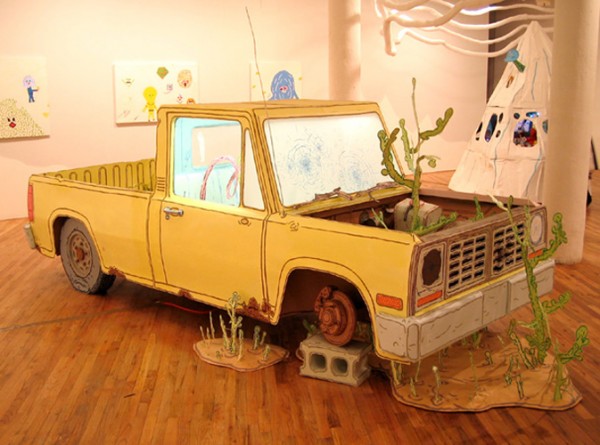
The work of Taylor McKimens is included in the new exhibition “Mail Order Monsters,” on view this month at Deitch Projects in New York City. McKimens creates an array of comics, zines, paintings, and site specific cut-out installations. The artist has stated being interested in “everyday things that are loaded somehow,” portraying the tragic and the humorous with equal strength. Many of the artist’s sculptures look as if they are three dimensional cartoons taken from another context and placed before the viewer.

McKimens is currently represented by Galerie Zurcher in Paris, Perugi Arte Contemporanea in Padova, Italy and Galleri Loyal in Stockholm, Sweden. The artist has appeared in Art Krush, Tokyo Art Beat, and idPure Magazine, Issue No.9.

Share

Nick Cave and Phyllis Galembo

Installation View, Halsey Institute, photographs by Rick Rhodes

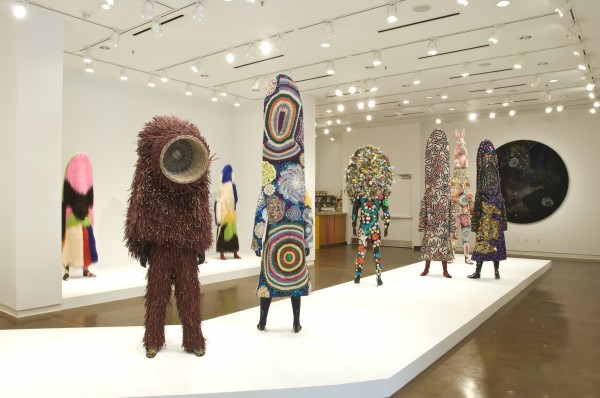
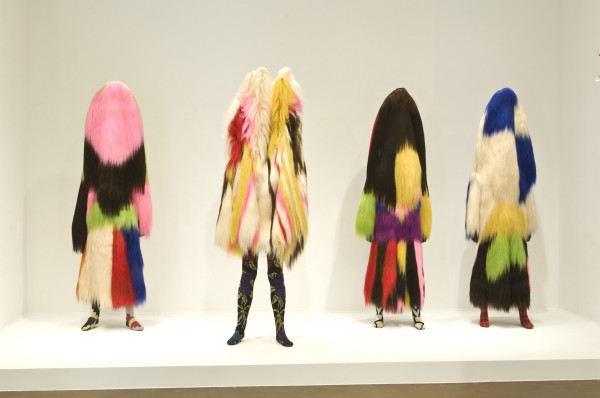
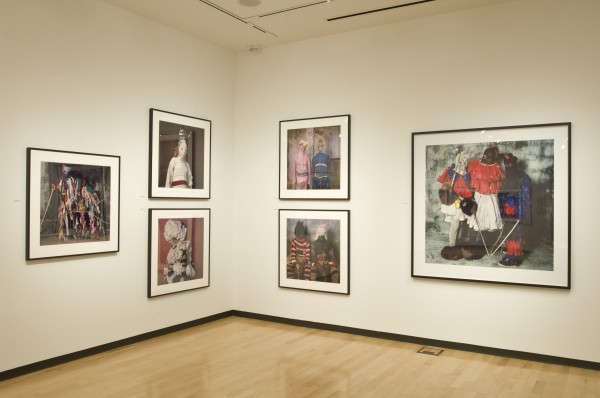
Call and Response: Africa to America / The Art of Nick Cave and Phyllis Galembo recently opened at the Halsey Institute of Contemporary Art in Charleston, South Carolina. The exhibition brings together the work of two American artists intrigued by the formation of cultural identity and individual experience within a society. Drawing inspiration from the rich ceremonial traditions and elaborate guises of African nations, Nick Cave and Phyllis Galembo create objects that are visually captivating and conceptually charged. Cave’s imaginative Soundsuits and Galembo’s photographic portraits of West African masqueraders prompt the viewer to regard the world in terms of connection and community.

Installation View, Halsey Institute, photographs by Rick Rhodes

Upon entering the Halsey, one is struck by the mystical presence of Cave’s Soundsuits. Cave, a former dancer and current Chair of the Fashion Design Department at the School of the Art institute of Chicago, combines his experience in modern dance with his expertise in fiber textiles to create his Soundsuits. The first soundsuit was constructed entirely of gathered twigs, resulting in a subtle rustling sound when worn; thus, the name. The kaleidoscopic costumes reference the ritualistic garments worn by Galembo’s subjects, the people of Africa whom she has spent decades photographing. Cave’s sculptures, anthropomorphic assemblages of materials such as dyed human hair, plastic buttons, beads, sisal, sequins, fabrics, feathers, and other natural ephemera, are layered with personal and cultural associations. The disparate materials are masterfully woven together by the artist, ornamental embellishments create undeniable tactile and visual appeal for the viewer; the soundsuits incite a collective sense of awe.

In the adjacent gallery, Phyllis Galembo’s photographic portraits chronicle masqueraders from various West African countries, including Benin, Nigeria, and Burkina Faso. The masquerade is a meaningful mode of cultural expression for several African groups, and Galembo presents a straightforward observation of individuals within particular cultures. Galembo’s work is a field study on these regions, a modern documentation of their ancient ceremonial traditions. Disguised as animals, spirits, or ancestors, her subjects enact ancient legends and stories, but the artist captures them in stasis. Galembo, described as a “photographic hunter-gatherer” by writer Emma Reeves, incorporates her subjects’ natural surroundings in detailed compositions that highlight the garments, the accoutrements (i.e. a staff to connote authority), and the occasional glimpse of a bare, or sneakered, foot of a masquerader. Galembo elegantly achieves a personal encounter with a masked individual, and successfully conveys this engagement to the remote viewer.

Courtesy of Phyllis Galembo and Steven Kasher Gallery, New York

Call and Response: Africa to America will remain on view at the Halsey Institute of Contemporary Art until June 26th. The exhibition is taking place during Spoleto Festival USA, an annual performing arts event held in Charleston, SC every spring. The Halsey’s sincere presentation of Cave’s soundsuits and Galembo’s photographs offer an exciting visual arts alternative to the citywide performing arts festival.

Share

Andrew Lord’s Bodies

L.A. Expanded: Notes from the West Coast
A weekly column by Catherine Wagley

Andrew Lord: between my hands to water falling, selected works from 1990 to 2010 Installation, 2010. Courtesy Santa Monica Museum of Art. Photo: Douglas M. Parker Studio.

The poet Frederick Seidel once received a death threat. It came via answering machine, in the form of a message left by a young woman. In a breathy voice, the woman said, “Frederick Seidel . . . Frederick Seidel . . . you think you’re going to live. You think you’re going to live. But you’re not. You’re not going to live. You’re not going to live . . . .” It was repetitive and frightening, but it also seemed like the wrong kind of threat to give a poet like Siedel. Even if he didn’t want to die, he knew he would. Much of his poetry fixates on that very fact, though the way he writes about death and the life that leads up to it often unnerves readers. “Give me Everest or give me death,” he writes  in Climbing Everest. “A naked woman my age is a total nightmare /but right now one is coming through the door/. . . She kisses the train wreck in the tent and combs his white hair.”  Verses like these that marry unexpected privilege with bodily dilapidation and a flash of meanness are hard to forget.

If Siedel’s poems were made of clay, each would more or less resemble an Andrew Lord sculpture: the crevices, fluids and disruptions of the human body would be unapologetic, ungainly and honest. Yet they would maintain a strange veneer of sophistication. Lord knows how to turn a clay vessel into a receptacle for everything corporal.

"Andrew Lord: between my hands to water falling, selected works from 1990 to 2010," Installation, 2010. Courtesy Santa Monica Museum of Art. Photo: Douglas M. Parker Studio.

between my hands to water falling, the current exhibition at Santa Monica Museum of Art, catalogues the past 20 years of Lord’s career and highlights four distinct bodies of work. Despite his irreverence, Lord, a British artist who began making art in the 1970s, plays into the revered tradition of ceramic vessels. In fact, his work, which has the air of something old and privileged, recalls Cellini’s Saltcellar at the same time that it recalls the childish ceramic mounds made by Michael Reafsnyder. For breathing, biting, swallowing, tasting, smelling, listening, watching, a series that began in 1994, Lord used impressions from his own body to shape the clay—a crude way of translating physical sensation into art objects. He literally bit, pressed into and clawed at his forms. The results are craggy gray vessels displayed on white pedestals. Siedel might say they look as though they’re “wrinkles of the ocean on a ball of tar.”

In smelling, the vessels are thin and elongated. In breathing, they have unevenly swelling bases, like balloons inflated by someone who has to regroup between each blow.  In swallowing, the most visceral of the series, the vessels are lumpy as if full of food and other objects, choking hazards that got lodged in the throat and never slid down. Though flesh-like and vulnerable, the sculptures in breathing, biting, swallowing, tasting, smelling, listening, watching are also glazed and embellished with streaks of gold coloring. Corporeality doesn’t have to be all grit.

"Andrew Lord: between my hands to water falling, selected works from 1990 to 2010," Installation, 2010. Courtesy Santa Monica Museum of Art. Photo: Douglas M. Parker Studio.

The untitled series, begun in 2004, reimagines ceramic work by Post-Impressionist Paul Gaugin. Lord emphasizes Gaugin’s weirdness over his voyeuristic self-importance and Lord’s blackish vessels double as caricatures and exotic creatures. Grouped together, they become an army of knotty bodies, an unromantic interpretation of Gaugin’s dabbling in the prehistoric. (Siedel wrote about Gaugin too, talking about a nose that, “looks like Guagin’s/ His silent huge hooked hawk prow”–and while noses in Lord’s work aren’t too imposing, there are some “hooked hawk” elbows).

Lord’s exhibition also includes two Fontana-like wall works with fleshy bumps protruding from them and a seven minute video of water gushing down a stream, the stream  that inspired Lord’s recent river Spodden series. The inadvertent effect of these inclusions is to emphasize how much more evocative Lord is when he works in ceramics.

Ceramics are possibly the most bipolar of the art mediums. When polished and over-crafted, they silence, even deny, life’s rawer aspects. But when handled with the virtuosic impertinence of a sculptor like Lord, they become a fleshed-out battlefield that pits refinement against ruin. between my hands to water falling, a collaboration with the Milton Keynes Gallery, continues at the Santa Monica Museum of Art through August 21st. A sister exhibition will open in the UK in September.

Share