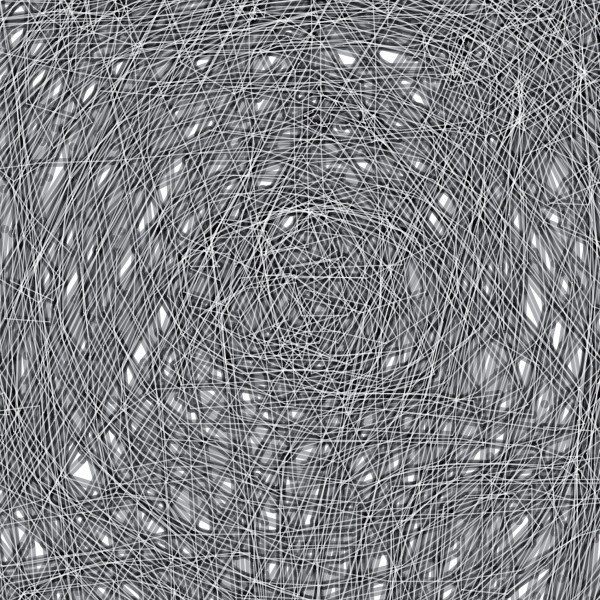
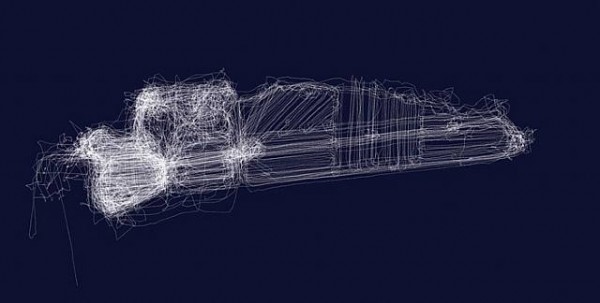
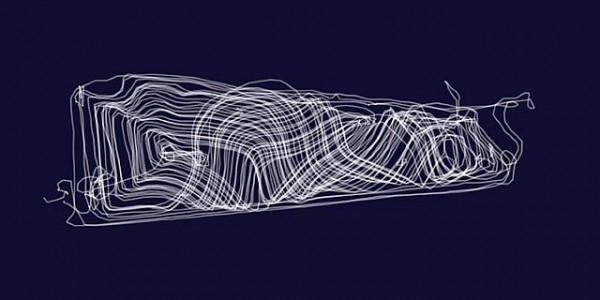
Mowing the lawn is synonymous with suburban existence. It is a task so habitual and perfunctory that it seems unlikely as artistic subject matter. However, it is precisely this everyday quality of lawn maintenance that enables Jeremy Wood to imbue it with significance by newly exploring it with GPS (Global Positioning Systems) technology. For Mowing the Lawn, currently at Tenderpixel in London, Jeremy Wood continues his technique of GPS drawing – this time in his own backyard. Using GPS to record his riding lawnmower’s path over several seasons, data of his movement and location (including latitude, longitude, altitude and time) are essentialized into a linear pattern.
Wood’s use of GPS diverges from the traditional use of the technology, which was invented by the United States military for navigation and combat purposes. Instead of underscoring the current power structure, Wood creates personal cartographies that reflect the everyday nature of contemporary mobility. Wood likens the GPS record of his movement to a ‘visual journal’. He maps his journey through space and time, recording and understanding an otherwise transient experience in a new way. Unlike some past work, Mowing the Lawn does not cross borders, but instead ignores traditional lines of power all together.
Jeremy Wood currently lives and works in Oxford, England and Athens, Greece. Wood has worked with GPS technology since 2000 – when military quality GPS first became available to civilians globally. He holds a fine arts degree from the University of Derby and an MFA from Central St. Martin’s College of Art and Design. His work was recently included in Map Marking at the Pace Digital Gallery in New York.
Jeremy Wood’s Mowing the Lawn will be on view at Tenderpixel through 22 June 2010.
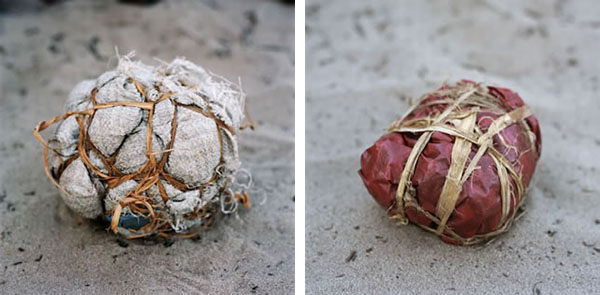
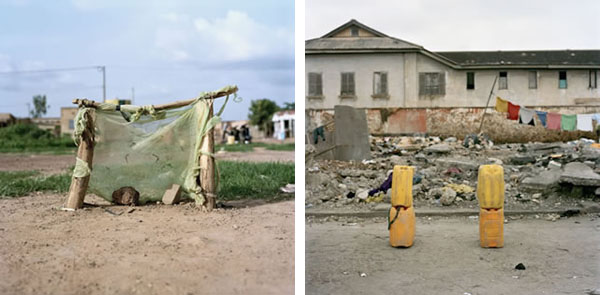
Jessica Hilltout; Domingos Ball, Mozambique; Chicome, Mozambique; from Amen series
Contemporary art, with it’s postmodern penchant for theory-riddled subtext and quirky aesthetics, doesn’t often fall under the category of “feel good” entertainment. That’s not a degradation, it’s a generalization by someone who looks at a lot of contemporary art. And nobody ever said that the role of art is solely to make the viewer feel good. However, when one comes across a series of work that is both visually and intellectually compelling, as well as inspiring, one takes notice. Perhaps one (that would be me) is even seeking it out on a subconscious level. Humans and their pesky yearning to be inspired. We seek this kind of joy and inspiration in other forms of art and entertainment as well, including: film, literature and sports. And in the case of sporting events, I can think of no better example of people coming together from around the world to be inspired and compelled than the FIFA (Soccer) World Cup. Sure, the Olympics draws upon that enthusiasm and serves up its share of inspiration every four years as well, but not like the World Cup. These fans are dedicated; they know the game, they follow the teams and players 365 days a year, every year. They play the game themselves.
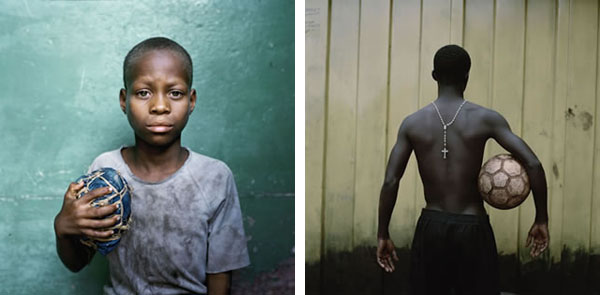
Jessica Hilltout; petit-poto, Burkina Faso; James Town, Accra; from Amen series
As the 2010 World Cup kicks off its first full week in South Africa, the culmination of joy and inspiration seems even more heightened in comparison to previous years. Its host country is a historical nerve center for racial strife, social tension and high crime, with a rapidly increasing rate of disease, including HIV/AIDS. It is also a “model of racial reconciliation following decades of apartheid, with a burgeoning black middle class” (source). And, as often happens when a country finds itself climbing out of the trenches of tragedy, an event such as the World Cup—or even a simple pickup game of soccer—acts as a natural binding agent, suffusing hope far beyond the reach of sports enthusiasm. I should note that, certainly, not everyone takes such an optimistic view of the World Cup in South Africa, and of course my view is that of an outsider in any case; an observation more than an opinion. But by in large, the World Cup and the game of soccer (er, football) are inspiring a nation and a world at the moment.
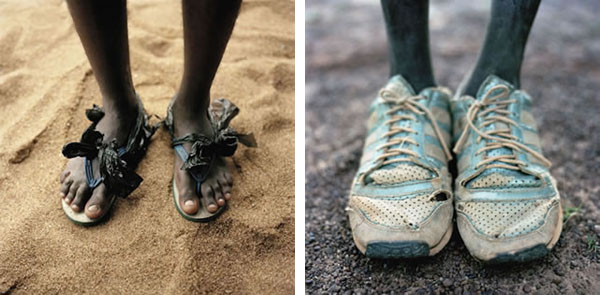
Jessica Hilltout; Orlando, Chicome; Michael Sarkodie, Ghana; from Amen series
But what if the grandiose spectacle of the World Cup is removed from the sport? Will a nation—a continent—still be inspired by the game? In a new solo exhibition at Joao Ferreira Gallery in Cape Town, South Africa, Belgian photographer Jessica Hilltout presents a series of work entitled Amen, capturing images of rural football players from all over Africa. Equally inspiring to the aforementioned global match, the matches played by the rural footballers offer none of the World Cup’s fanfare. Their equipment is makeshift, their pitches (fields) are crude. There are no Nike logos or Gatorade sponsorships. But the essence of joy—of hard work, inspiration and coming together around a game—translates the same. As the artist says, “Amen, above all else, captures the strength of the human spirit.”
Jessica Hilltout; Demble, Ivory Coast; Unknown, Bukina Faso; from Amen series
Born in Belgium, Jessica Hilltout has had a nomadic that has taken her across Europe, Asia and Africa. She earned her BA in Photography at Blackpool College of Art, UK. Her work has been exhibited internationally, including at The National Portrait Gallery, London and Aliceday Gallery, Brussels.
Nostalgia is a word that means “a wistful desire to return” or “a sentimental yearning,” but from these cloying definitions one would never guess that the word originally meant “homesickness”. At its heart, Haunted: Contemporary Photography/Video/Performance at the Guggenheim Museum in New York is nostalgic, but it is also complex and engaging without a hint of the saccharine. Nostalgia as homesickness is the distant light that guides this excellent melancholic exhibition.
Sarah Charlesworth, "Herald Tribune, 1977" (1977). Twenty-six chromogenic prints, 59.7 x 41.9 cm each, edition 2/3.
Despite its subtitle, Haunted includes work in a wide variety of media, including painting and sculpture. Helpfully, the works are organized into thematic sections that guide the viewer through the winding gallery: Appropriation and the Archive; Documentation and Reiteration; Landscape, Architecture, and the Passage of Time; and Trauma and the Uncanny. These divisions assist the viewer in comprehending the modes in which current artists have reckoned with history and their art-historical antecedents. Insightful wall text accompanies the beginning of each new section.
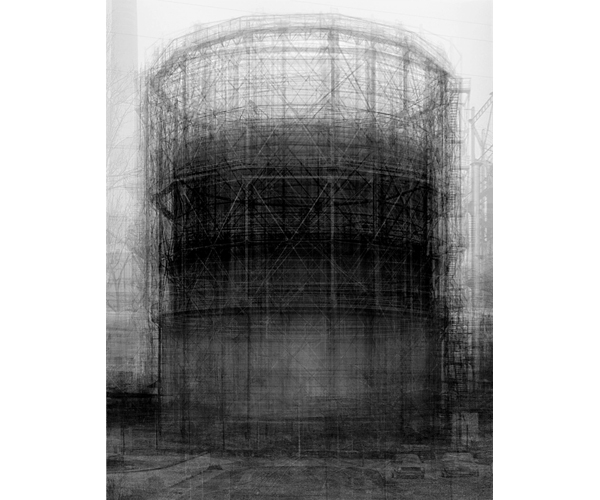
Idris Khan, "Homage to Bernd Becher" (2007). Bromide print, 49.8 x 39.7 cm, edition 1/6.
Walking up the curving ramp, the viewer encounters Appropriation and the Archive first. This is the perfect introduction to the show for both uninitiated and seasoned viewers, featuring imagery “borrowed” from print media, movies, and other images taken from the public domain. The textbook-classics are here: Andy Warhol, Sherry Levine, Richard Prince, Sarah Charlesworth. For the experienced, it’s like greeting old friends; for the newcomer, it’s a well-rounded primer. Though it may be familiar, Charlesworth’s Herald Tribune, November 1977 (1977) is particularly gratifying to see in person. Idris Khan’s Homage to Bernd Becher (2007) is a diminutive powerhouse of layered emotive lines that conjure up the industrial structures documented by photographers Bernd and Hilla Becher. The work in this section stands as a persuasive critique of the myth of artistic originality.
Spencer Finch, "42 Minutes (after Kawabata) (2005). Seven chromogenic prints, 15.2 x 15.2 cm each.
Continuing up and around, the Documentation and Reiteration portion displays the photographic evidence of performance work, citing notables such as Marina Abramovic, Tacita Dean, and Ana Mendieta. Though most of the works in this section stand on their own, they function primarily as reminiscent testimonials to events in the past. The performances that provide the basis for this section provoked conversations among fellow viewers: one well-dressed woman recounted her experience of seeing an Abramovic performance to her companion; an elderly couple argued about the processes likely used to make Markus Hansen’s Curtain (2004). Landscape, Architecture, and the Passage of Time is modest, with many of the works being smaller than their counterparts in other sections of the exhibition; but it also contained some of the most evocative work. Spencer Finch’s 42 Minutes (after Kawabata) (2005) is a series of seven photographs that transform a snowy landscape into a picture of an interior door via a reflection on glass. The subtle shift from landscape to door, inside to outside, means that one image manifests itself in another, and no image in the series truly exists without its counterparts. This is a literal haunting, and it is eloquent.
Nate Lowman, "Loser" (2009). Alkyd on canvas, 101.6 x 76.2 cm.
Organized around a theory that originated with psychologist Sigmund Freud, Trauma and the Uncanny contains intriguing and provocative work, some by lesser-known artists. Nate Lowman breathes new life into the raster-dot image first promoted by pop artists like Sigmar Polke, Andy Warhol, and Roy Lichtenstein. The Last Supper (2009) and Loser (2009) are compositions that manage to be smart, funny, and heart-rending all at once. Gillian Wearing’s Self-Portrait at Three Years Old (2004) provides a double-take experience: the artist took a sweet childhood portrait and cut out/replaced her three-year-old eyes with her own adult eyes. The new portrait could function as a mask, hiding the adult self behind a guise of innocence; or show the outward form of a child who understands more than she lets on. The effect is disturbing.
Gillian Wearing, "Self-Portrait at Three Years Old", (2004). Chromogenic print, 182 x 122 cm.
There is no doubt that the work in the exhibition is superlative, and the thematic arrangement makes it easy for the casual art viewer to understand the context—without seeming too obvious for the more sophisticated habitué. This is museum curation at its best: stimulating but accessible, informative without condescension. The nostalgia in evidence brings to mind a quote from the late cultural theorist Jean Baudrillard: “Simulation is master, and nostalgia, the phantasmal parodic rehabilitation of all lost referentials, alone remains.” The nostalgia demonstrated by the artists is wistful but not sentimental; and the history they mine tells us as much about the present as it does about our past.
In a world consumed by technology, there is no doubt that countless artists have adopted many forms of new media into their work. In today’s art world, what is harder to find is an artist whose work seamlessly uses technology and image-making to show us something new about the way we understand the world around us. Jim Campbell‘s work does just that. His work effortlessly combines light and darkness, flatness and space, movement and stillness, to subtly expose how we perceive imagery. I recently met with him at Hosfelt Gallery in San Francisco to talk about the way he makes images, how he uses technology and some of the new projects he has in the works.
Julie Henson: To start with, I would love for you to talk about your practice. One of the things that I noticed when I first entered the gallery is that your work appears to be rooted in both technology and the creation of an image, which seem to be very important parts of your practice. If you could start by telling me a little bit about how you work and about creating images?
Jim Campbell: My background before I made electronic art was filmmaking, which is completely about making images, unlike a lot of people in new media who come from painting or from sculpture. So the image has been the most important thing to me. In fact, even sometimes a little too much so, in that I do get complaints from friends who, for example, will say that since it has to plug I should show that it plugs in. I tend to really hide everything as much as I can and just leave the image. Obviously that changed with Exploded View (Birds).
So you aren’t asking about my background but my daily practice, right?
JH: Well, I am really interested in your process of creation more than anything else, because the work is so complex and, like you are saying, the way they are made is somewhat hidden. They become very wonderful and mysterious things to look at, and I find that really fascinating.
JC: Well there are two works here that come at it from a different perspective, one would be Exploded View (Birds) and the other would be Taxi Ride to Sarah’s Studio. Sometimes what I do, and Exploded View (Birds) is a good example, is that I will start with an idea for a technology, like taking my relatively 2D images, and really trying to come off the wall and just pull the image off or stretch it out. And so the idea for the technology was there before the image that was going to go on the display. That probably happens about half the time, where I will have a new technology and I will try a bunch of different things in it until I get something that makes sense. Sometimes it even takes a couple of years to come up with imagery that really matches the display. Up until that point they might be real works, I might sell them, I might display them, but they aren’t necessarily the perfect match with the technology. One of the things that I say to myself is that if I can do this with video, I should do it with video. There has to be a reason that I use this low-resolution technology to do each of these works.
I have been working with what I refer to as “the curtain works” for three years maybe, and I think Taxi Ride to Sarah’s Studio is a good example of a pathway to this work. If you look at the work a little more than just glance at it, you’ll see that it changes resolution as it goes across. And all of the works up until this one were like the others – they reflected off the wall but they were still grids of consistent resolution. One of the things that this technology allows for, given how modular it is, is to change where the pixels are and allow for something other than the perfect X/Y grid. And that came together with another idea that I have had for many years, which is to do a work that somehow represents peripheral vision. And that is this work. It marries one idea that is more of a concept or structural idea with the technology that I have been playing with for three years.
JH: It is interesting that you say that, because one of the things that I kept coming back to is that the image rests somewhere in between the object and illusion. There is something about your creation of an image that becomes a play between the image and your physical space, and your physical limits of being able to perceive it. One thing that caught my attention in Taxi Ride to Sarah’s Studio and Market Street Pause was that they almost live as abstraction until they start moving, which I find really fascinating. How do you work with the play between movement and still image or image in space, which is something that I see in all the work?
JC: One of the very first works like this that I made I tried to photograph, and about 98 of 100 pictures didn’t come out, because they were stills. And what I quickly realized was that the way in which you perceive these images is through their movement. That is actually what that work is about. By freezing, the image goes to abstraction. It makes you aware of your relationship between perception and movement. Hopefully it freezes and goes into abstraction, but it is never really abstract because one can comprehend the image before it freezes. I have done a number of works, probably ten, that really deal with that relationship between perception, abstraction and movement. One of the ones that I think was successful was one of the first ones, around 2004, where I took an image of ocean waves moving and then gradually slowed it down until it stops completely over a 10 minute period. It starts out completely representational and ends up purely abstract. So it slowly goes from one to the other, and Market Street Pause is a more abrupt version of that. I am fascinated by how if you press pause in a video image that it stays an image, yet it in the low-resolution works, it actually becomes abstract when it pauses. This is really unique to low-resolution work.
JH: Yeah, it is a really affective way of recognizing the connection between what your brain realizes as image and what it understands as abstraction. That is the first thing that I noticed when I walked in the door, and you can really see this in Exploded View (Birds) and Taxi Ride to Sarah’s Studio. You started talking about it a little, but one thing I noticed was that a lot of the work has very different spaces, but they seem to be environments that the viewer relates to from a very observational or removed place. Can you talk about how you pick our imagery?
Market Street Pause (still), 2010. Courtesy of Hosfelt Gallery
JC: Yeah, I don’t think it is profound, but hopefully some of them become profound in terms of what I do with them. And I say that because I am very limited (because what we were talking about in terms of the movement) in what I can shoot. The images have to be very simple in some ways and the backgrounds generally can’t be very complex because you just can’t tell what you are looking at otherwise. So I need to find these very simple images, and I use the figure a lot because the figure is an image that relates to what I call primal perception. And going back to what we were talking about in terms of movement, I believe that we perceive movement almost separately from detail and edges. I think movement is less analyzed as it’s interpreted, so these works get rid of the details, leaving open the more primitive pathways to one’s brain, and allow one to perceive things like isolated movement.
But, I think I drifted from your question.
JH: That’s ok, because this was something that I was really interested in to start with. In Exploded View (Birds) and Taxi Ride to Sarah’s Studio, the technology seems to be more apparent than it is in a lot of the other work. How do you feel about exposing the system?
JC: Like I was saying earlier, I tend to hide it as much as possible because it is really the image that I am interested in. But, I have done a couple of works that connect to Heisenberg, and for me, Taxi Ride to Sarah’s Studio does this because the display device is actually obscuring the image. The only way to look at the image is through the display device.
JH: I think that the same thing happens with Exploded View (Birds). Your ability to perceive the image is through this field or mask of lights. I find it really interesting that even as you walk around it, that the form maintains it shape. How did you find that technology to create an image in a special field?
JC: Most images that I would put in that display can’t be seen from the sides – they mostly go completely abstract. Because the birds are so small and the movement is so simple, you can see them from the side. So it is really about seeing it from the front. The image is exploded towards you by taking the LEDs and pulling them towards you. So when you look at it from far away, it looks flat – just like one of my “normal” images. But, when you look at it from the side it becomes meaningless, which I like. It’s the same as we were talking about with movement. When you slow it down, it becomes abstract. In this case, as you walk around it, it becomes abstract.
And honestly, it was just an experiment. If I explode this image in this way, will anything be recognizable? Will we be able to tell what we are looking out, or will it just be a waste of my time? Honestly, that is what drives me to do a lot of these works. I am just really curious to know how it will turn out.
JH: With Taxi Ride to Sarah’s Studio, you were talking about the focus changing from the left to the right side, and I noticed that the piece actually curves off the wall. Does the change in focus come from the distance from the wall or in the image itself?
JC: It is actually in both. It is in the resolution of the image. So, it is very high resolution on the left side. It uses 50 pixels to define that side and on the right it is only 6 pixels. It is almost a 10:1 resolution change going across. It is not actually getting blurrier, it only changes resolution.
JH: That’s amazing, because it this goes right back to this relationship to your perception, and shows how little changes like that can actually make things come into view or show distance.
JC: The reason it moves away from the wall, and it is kind of a technical reason, is that the LEDs have a cone of light that come out of them. So when the LEDs are close together, they need have to be close to the wall to have their reflected light overlap. But on the far right end, where the cone hits the wall, it is much bigger, so the LEDs need to be further from the wall.
JH: It is interesting that it is a somewhat technical reason, because the shape actually mimics the sensation in the image – moving in the car. It is nice to hear that it is not only a visual tool to create an experience.
JC: Right. Well, they all go together. But in the experience of driving, as things get closer they come into your peripheral vision, which is blurry. So the technology actually reminded me of the sensation of riding in a car, and that’s why I chose this image.
JH: So since the work is so technically complex, how much of this work is made by you, or do you outsource it? How do you come across the technology?
JC: I am an engineer, so I still get trade magazines to to keep up with technology. A few media artists have told me that I cheat, because I know what I am doing in terms of the electrons moving around on the back of the board. I have three assistants plus contractors and vendors in Silicon Valley that build my circuit boards for the works. For example, for Fundamental Interval (Waves), it has nine circuit boards fabricated from my design. We take the nine and put them together in my studio to make it. But the fun part is when it is not a cookie cutter of something I have already done, like Taxi Ride to Sarah’s Studio. The ones I have made like this in the past, had all the strands made with the same distance between the lights, and for this one they are all different. There was no way to send it out to a fabricator to have it built. So the quirky ones and the prototypes, I definitely do in my studio.
I am working on a large-scale public art project for the San Diego Airport and so we are having all kinds of materials cut and tested for the studio, and then once we have them done, we will find a place to have this 1000-foot long sculpture fabricated.
JH: Well, what other projects do you have coming up?
JC: Beyond the project for the San Diego Airport, the most fun thing in the near future is that I am doing a large-scale version of Exploded View (Birds) in Madison Square Park in New York as part of their rotating public art program. Instead of LEDs, they will be light bulbs, and instead of one inch a part they will be eight inches apart, and instead of six feet wide it will be 50 feet wide, 20 feet high and 20 feet deep. I am really interested to see what it is going to look like because the equivalent of being ten feet away here will be 50 feet away there. There is a little nervousness that it will be too abstract and that you will really need to see it from three blocks away. I am also doing a an intermediate sized one in the lobby of the SFMOMA in 2011.
As we conclude our week of exploring the role of myth in contemporary society, we have taken a close look at the myth of art and art materials as seen by Mike Kelly, the myth of artistic boundaries as undermined by Maurizio Cattelan, the Mad Man Myth as displayed by the late Dennis Hopper, and the global spread of myth that is perpetuated by Disney as demonstrated by the work of Christodoulos Panayiotou. As we combed through the DS Archives to look into the role of myth as explored by some of our previously featured artists, a recent review of Isa Gensken’s exhibition, simply titled Wind, quickly surfaced.
Wind explored the death of Michael Jackson, one of America’s most important and mythical pop figures. For the exhibition, Genzken created a series of large sculptural monuments and wall works that level both the hierarchy of sculptural materials as well as that of contemporary and historically saturated figures. In this series, images of Michael Jackson sit in close proximity to that of Michelangelo’s David with the same unfamiliarity as that evoked from seeing pristine copper plates, fabric and cheap xerox prints all on the same artistic surface. Through the peculiar coupling of both the materials and images exhibited, Genzken is able to explore our ongoing cultural consumption of both material and myth. The following review was written by DailyServing’s Bean Gilsdorf and was published on January 10th, 2010.
In William Gibson‘s 1986 novel Count Zero, an abandoned but sentient AI robot composes art objects from detritus found in space. Despite being built by a computer from discards and rubbish, these objects have a deeply human gravity—both a grace and a yearning for grace—and are highly prized. It is precisely this evocative use of materials and imagery that Isa Genzken gives us in Wind, her response to the death of Michael Jackson. This recent work, at Neugerriemschneider Gallery in Berlin, expertly conjures the agitation between glory and coarseness in celebrity culture.
Five monumental mixed-media works, all from 2009, are hung from the walls of the gallery. The outlier of the group in materials and scale, Wind (Rom), is composed of pages torn from a floral wall calendar, plastic, satin ribbon, spray paint, and tape. The other four works are larger and a more intriguing mix of temporary and durable materials: the weight and chill of large copper and aluminum plates clashes with flimsy photocopies provisionally clamped to their edges, and the glitz and promise of mirrored disco tiles is defeated by the crassness of cheap blue painter’s tape. To say that the work is abject would be somewhat misleading; the scale and materials often point to permanence and beauty, even though it falls short of being fully realized. In Wind, Genzken tells us that true beauty is not possible under current historical and cultural conditions.
And yet, there is a scavenged poetry, too. Wind (Michael) uses repetition to evoke a sense of loss. Against a background of alternating copper and aluminum panels, the piece depicts Jackson in concert, leaping into the air in a dance routine. The photos (more cheap photocopies) are attached to the first two of the three copper panels, establishing a visual rhythm that points to the blankness of the last panel. Despite the heroic scale of the piece, the apparent permanence of the metal, and the brightly colored papers, the piece is cold and despairing.
The various compositions of the pieces are anarchic but not disorganized. Materials, too, are severely contrasting but not completely unharmonious. If the work is, as stated in the press release, “concerned with the depiction of this immaterial force of nature,” it seems that Genzken shows us a wind that can simultaneously elevate and sully. In the end, the work feels less specifically about the adoration and dejection of Michael Jackson than about the society that produced him.
For nearly a century, Disney’s eclectic assembly of animated characters have persisted the hopeful notion of Happily Ever After. (And the certitude that a duck without pants is always quick to anger.) Like modern-day mythology, Disney stories take seemingly ordinary characters and place them into extraordinary circumstances, through which they eventually persevere and often learn a lesson along the way. Boy meets genie and earns the heart of a princess after he discovers that true value lies not in material riches but in love. Girl meets a gang of small men and learns that a prince’s kiss will revive her after she has been poisoned by a witch. (This one’s less about perseverance and more about Happily Ever After.) Mouse, Duck and Dog take an unpredictable drive through the countryside in a house-turned-precariously hitched trailer, during which time their bond of friendship strengthens. In any of these cases, the ultimate lesson or happy ending is revealed via the entertaining exploits of characters whom we grow to love. Disney characters are iconic and far-reaching. They are recognized the world over for bringing joy to children and adults, alike.
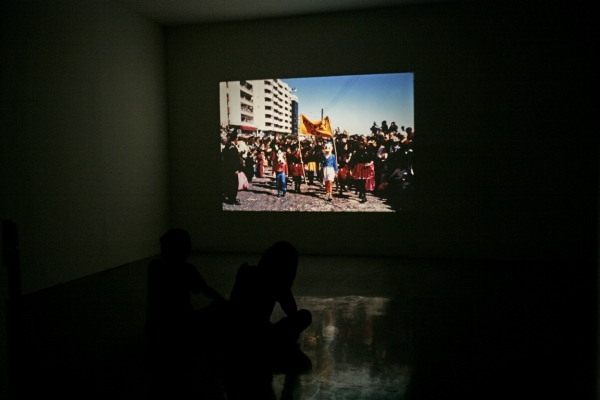
One community of particularly exuberant Disney fans has caught the eye and intellect of Cyprus-born artist, Christodoulos Panayiotou. In researching the city of Limassol’s Municipal Archives, Panayiotou has discovered that Limassolians have a decades-long tradition of dressing up as Disney characters during the town’s annual carnival parade. Since the 1970s the people of Panayiotou’s native town have adopted some of Disney’s most beloved personae. In his 2008 piece, Wonder Land, Panayiotou depicts this curious tradition through 80 color slides. While the phenomenon might appear as nothing more than eccentric to some of us, the artist—who refers to it as an “obsession”—has a much deeper interpretation. In a conversation with Nicos Charalambidis, published in Art Papers, Christodoulos Panayiotou says, “The parade is a kind of revelation of everything we would like to be, of everything we know we cannot be, and of everything we cannot afford to accept that we are.” In explaining how Wonder Land came to be, he says, “When I began my research at the carnival parade’s archives, the unusually large number of Disney-themed floats, costumes, and masks struck me…I interpreted it as an indication of a kind of popular, subversive reformatting of the official aims of the parade, which presents itself as a continuation of the Hellenic tradition, in both historical and mythological terms. I then tried to isolate the many Disney themed photographs, as I realized that their inner logic reflects my concept of the complexity of the island’s identity.”
L.A. Expanded: Notes from the West Coast
A weekly column by Catherine Wagley
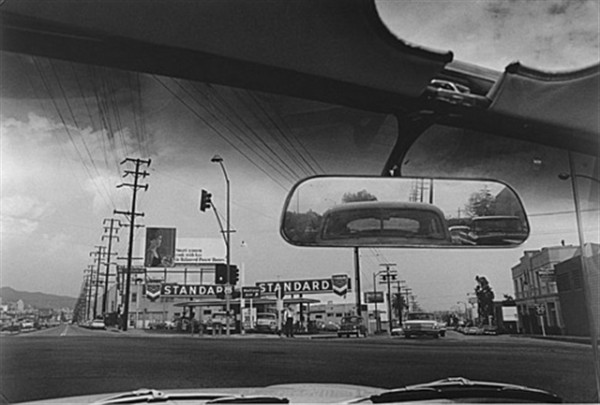
Dennis Hopper, "Double Standard," 1961
When they were newlyweds living in Switzerland, my grandparents met Terry Southern, the beatnik bad boy who would eventually co-write Easy Rider. My grandmother worked with Southern’s wife, Carol, at the United Nations nursery school in Geneva. Carol charmed her. “What a sport she was,” my grandmother remembers, “and a super gorgeous woman who would do anything to keep her husband.” Southern, on the other hand, struck my grandmother as “shy, moody, and insecure,” albeit talented. The one time my grandparents went to the Southerns’ home—they’d been invited for all-American apple pie—Southern sat brooding in a corner rocking chair. He abandoned his silence only to comment on his wife’s baking: “Well, Carol, this pie sure isn’t up to snuff.”
Not long afterward, the Southerns left Geneva for Spain. “How can I possibly write when day after day I look out the window and see gray?” Southern purportedly asked his wife. In Geneva, the mountains often block the sunshine.
In the decade that followed, Southern divorced Carol and settled in Los Angeles. There he met actor and artist Dennis Hopper, whom he profiled for Vogue in 1965. Hopper, like Southern, saw a keen connection between the way he lived and the art he made. “Bred despite the wild sterility of Dodge City, [Hopper] is now morassed in a creativeness that is almost as hopelessly complete as that which spread and drowned the great Cocteau,” Southern wrote, connecting Hopper’s success not only the century’s premiere polymath but also to Hopper’s ability to transcend mid-western roots. Both the writer and the actor-artist seemed to be searching for the same thing: big, mad, momentous experiences that would make them feel intensely alive. That kind of experience would undoubtedly awaken creative genius.
At the time Southern met him, Hopper, his Nikon practically glued to his face, was religiously photographing both the burgeoning art scene and political upheaval. He found a thrill in being close to the action. Southern found a thrill in worrying about Hopper’s thrills:
‘Hopper, take care!’ I charged him when last we met, on the eve of his madcap jaunt to photograph the Selma march. He threw a quick masculine look for support to Brooke Beauty [Hopper’s wife, Brooke Hayward]—who responded only by shyly lowering her great doe eyes, sensual lips pursed into the sort of Mona Lisa smile which seemed to say: ‘Don’t you know you are both mad as hatters?’
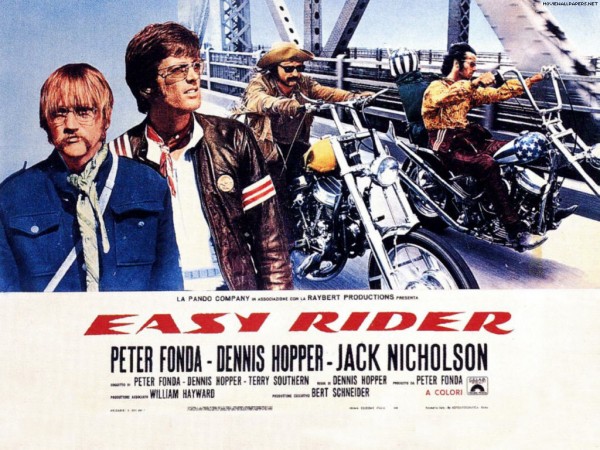
In 1968, the mad hatters, who had by then both separated from their supportively gorgeous wives, joined forces with Peter Fonda to make Easy Rider, a film in which everyone more or less plays himself (and the film is full of him-selves). Hopper once said of Easy Rider, “Nobody had ever seen themselves portrayed in a movie before.” He meant that no film to date had portrayed the ‘60s as an acid-drenched blur that felt real.
Even if it was scripted, Easy Rider blurred fiction and non-fiction so effortlessly that it could, at times, pass for cinéma-vérité. The film’s acid trip scene, set in a New Orleans cemetery, remains one of the most poignant pieces of video art I’ve seen. It’s crisp then blurred, honest and then flamboyant. On the merit of that scene alone, Easy Rider belongs not alongside Blow Up, Breathless, or Zabriskie Point, but alongside Bruce Conner’s and Bruce Nauman’s gritty experiments.
The scene begins when Billy (Hopper) and Wyatt (Fonda) venture into the cemetery, accompanied by two prostitutes, Karen and Mary. They drop acid –“what’d you do with it?” asks Karen; “just shut up and take it,” says Billy–and then descend into a kaleidoscopic group confessional. The Lord’s prayer echoes in the background. Karen says she wants to be pretty. Mary strips. Billy laughs a lot. Fonda as Wyatt climbs up into the lap of a classical goddess and caresses her, mourning the suicidal death of his actual mother, Frances Seymour: “You’re such a cruel mother and I hate you so much.” Hopper rolls around on the grass and forces Karen to roll with him. “I can feel the inside, but I can’t feel the outside, okay?” says Karen.
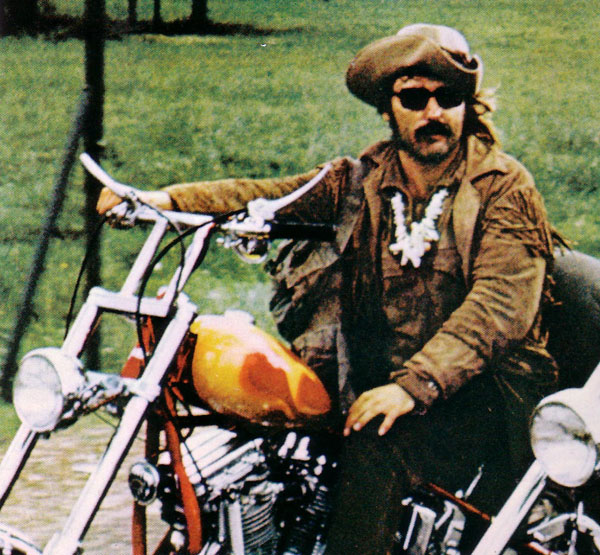
Denni s Hopper in "Easy Rider," film still.
Dennis Hopper passed on May 29th, and a much-talked-about exhibition featuring his oeuvre will soon open at MoCA L.A. The show will likely include a range of “in-the-moment” creations, images and objects Hopper made because they reflected the creative morass he had worked so hard to live in–and reflected what everyone else was doing at the time. It doesn’t bother me that his style is hackneyed. His ability to be a chameleon exposes him as a fan: he had a Cartier-Bresson phase, a Robert Longo phase, a Keith Haring phase. But his art did remain bogged down by the myth of the artist as someone who always catapults head-first into experience. It’s not living hard that makes art good.
In his anti-fiction manifesto, Reality Hunger, David Shields quotes an unnamed source:
The body gets used to a drug and needs a stronger and stronger dose just to experience the thrill. An illusion of reality—the idea that something really happened—is providing us with that thrill right now.
All throughout his career, Hopper seemed to be looking for that drug. And the best part about the scene from Easy Rider is that it cuts through in-the-moment madness and exposes the drug as a drug.