





Odd Jobs

Odd Jobs: Jibz Cameron/Dynasty Handbag

Welcome to the first issue of “Odd Jobs,” in which we explore artists’ day jobs. Many artists have held very odd jobs in order to support their art practice, and more often than not these jobs go unspoken and yet end up informing their work. Today we chat with Jibz Cameron, a Los Angeles-based performance and video artist who performs as her alter ego, Dynasty Handbag. Apart from her short video productions, she has performed at the New Museum, Performa Biennial, The Kitchen NYC, Brooklyn Academy of Music, Portland Institute of Contemporary Art, and the REDCAT presented by The Broad in Los Angeles, California. She performed I, an moron at The Hammer Museum on October 2, 2016.
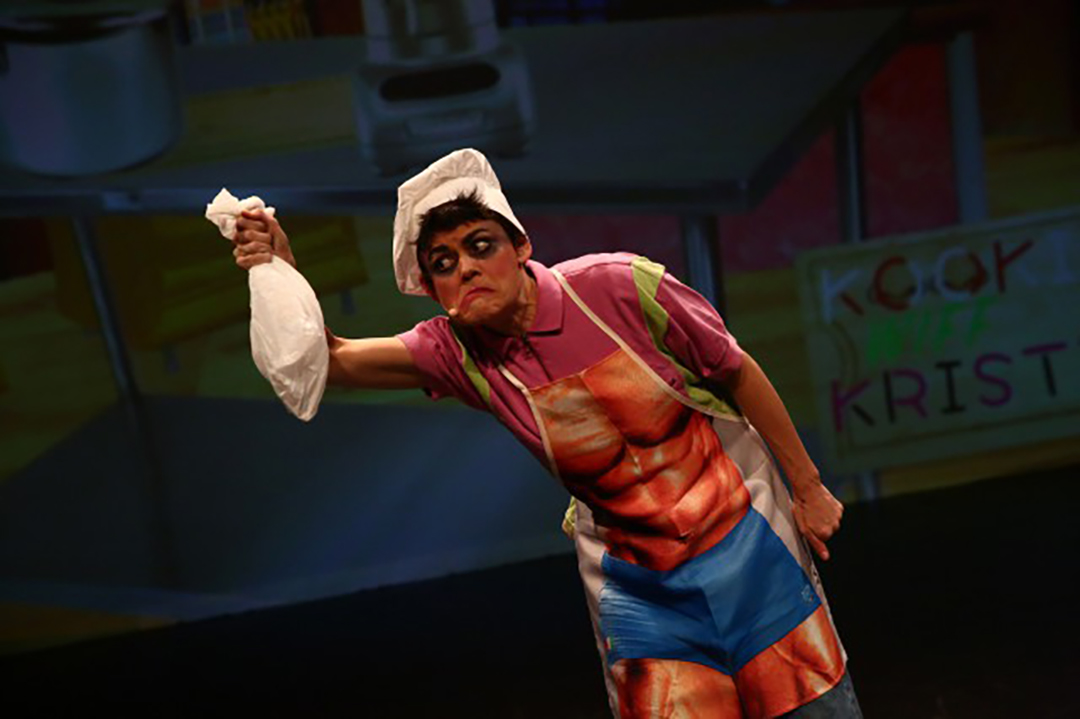
Dynasty Handbag. Good Morning Evening Feelings, 2015; performance at The Kitchen, NYC. Courtesy of the artist. Photo: Paula Court.

Dynasty Handbag. Good Morning Evening Feelings, 2015; performance at the Kitchen, NYC. Courtesy of the Artist. Photo: Paula Court.

Calder Yates: You grew up on a hippie commune, is that right? Did that experience inform your perspective around work?

Jibz Cameron: You mean having zero responsibility and absolutely no willingness to earn money? Yup! My mom never really held a job. Mostly she cleaned hotel rooms and babysat. Sometimes she worked for preschools. Mostly we were on welfare and food stamps with my mom.

My dad broke his back when I was young and was in a body cast for a year. He went through law school while in the cast at home and taught himself how to be a lawyer. He was really smart. He became an attorney, but we lived up in the woods and nobody had money, so he ended up trading law work for an old car, stuff like that.

CY: What odd jobs have you held?

JC: Most of my work life, before I started to have respectable job titles, I was in the service industry. I worked the day shift at the Lexington Club, a lesbian bar [in San Francisco, since closed]. It was, I don’t know, pretty bleak, I have to say. There’s nothing like a lonely, alcoholic lesbian to, you know, dampen your thoughts of the future. But I bar-backed on the weekends when all the cool people were there and I got to make out with girls in the stairwell.

The weirdest place I’ve ever worked at, by far, was this chain restaurant, Buca di Beppo, in 1999. They had five-liter magnums of wine that were really cheap. One time there was a stripper. Another time there was a fraternity reunion party, which was a total horror show … people were throwing food. The waitstaff was just like wasted and doing blow in the service station. I had a friend, who was a server, who overdosed on heroin, in the restaurant, on the job.

Read More »

Share

Jen Bervin and Dianna Frid

From our friends at BOMB Magazine, today we bring you a conversation between artists Jen Bervin and Dianna Frid. They discuss color as a system of classification, Art Povera, and language. Diana Frid says “In classifying, I’m also alluding to the absurdity of classification, because no one is reducible to just one thing. All systems start out idiosyncratically.” This piece was originally published in BOMB 137, Fall 2016.

Dianna Frid. NYT. APRIL 24, 2014, RICHARD H. HOGGART, 2014; embroidery floss and graphite mounted on canvas, 15 × 20 inches. Photo: Tom Van Eynde.

Dianna Frid. NYT. APRIL 24, 2014, RICHARD H. HOGGART, 2014; embroidery floss and graphite mounted on canvas; 15 × 20 in. Photo: Tom Van Eynde.

Restoring, overwriting, removing, and color-coding are just some of the actions that come to mind looking at the interdisciplinary works of Jen Bervin and Dianna Frid. Each in her own way explores the intersection of text and textile, where writing is a physical, intimate gesture. Both artists employ embroidery, sewing, and weaving to craft works that test the boundary between the visible and the legible.

To immerse oneself in the projects of Bervin and Frid is to be reminded that poetry lies in wait—in dusty Latin tomes, in ornate capitulares, in New York Times obituaries—to be revealed through radical acts of transformation. Their practice is one of palimpsest, in which existing text is repurposed through a combination of buildup and erasure to uncover what is essential.

Frid creates sculptures, installations, and artist’s books, often involving found text and archival material. Her recent book, Apuntes, thread-annotates photographs of classical Greek and Roman sculpture with suggestive pattern diagrams from weaving manuals.

Bervin’s work includes performances, drawings, and conceptual projects. She has published nine books, including Emily Dickinson: The Gorgeous Nothings (Christine Burgin/New Directions, 2013), the first full-color facsimile edition of Dickinson’s manuscripts.

Read the full article here.

Share

Shotgun Reviews

Fiamma Montezemolo: The Secret at Kadist, San Francisco

Shotgun Reviews are an open forum where we invite the international art community to contribute timely, short-format responses to an exhibition or event. If you are interested in submitting a Shotgun Review, please click this link for more information. In this Shotgun Review, Leila Easa reviews Fiamma Montezemolo: The Secret at Kadist in San Francisco.

Fiamma Montezemolo. Neon Afterwords (The Secret installation view), 2016; LED lights and text. Courtesy of the Artist and Kadist, San Francisco. Photo: Jeff Warrin.

Fiamma Montezemolo. Neon Afterwords, 2016; LED lights and text; installation view, The Secret. Courtesy of the Artist and Kadist, San Francisco. Photo: Jeff Warrin.

Like many other fascinating thought exercises, artist and anthropologist Fiamma Montezemolo’s The Secret at Kadist in San Francisco begins with Jorge Luis Borges. The title refers to the climax of Borges’ 1969 story “The Anthropologist,”[1] which chronicles American academic Fred Murdock’s attempts to document a Native American tribe’s “secret.” Murdock eventually assimilates into the culture of his “other” enough to dream in a new language, both literal and symbolic, and thus receives the secret. Returning to academia, Murdoch refuses to divulge this very information; once he has lived outside of his culture, he no longer values its priorities. Knowing the secret is predicated on becoming it.

Montezemolo replicates Murdock’s displacement visually, conceptually, and spatially. Neon Afterwords (2016) represents this disrupted world with its starkly gorgeous display of three hanging copies of Borges books, casting shadows as serious and architectural as church windows. Displaying the text of the story, the books are displaced onto walls and interrupted by tape blocking key phrases: “it has one character,” “he came to dream in a language,” and “the teacher taught him the secret” have been obfuscated.

Read More »

Share

Fan Mail

Fan Mail: Matt Lee

There is a certain playful unknowability to Matt Lee’s work. As preoccupied with structure as its inverse, Lee’s pieces suggest an interaction with the intangible that is at once wholly serious and strangely lighthearted. Confronted by subjects like death, absence, and emptiness, a viewer might expect an oeuvre weighted down by existential dread, but in Lee’s work, these subjects become lively participants in conversation with their environs. Though they offer little in the way of consolation about oblivion, Lee’s pieces propose a wry characterization of the unknown that is rather cheeky; death may be coming, but it feels oddly familiar.

Matt Lee. Untitled, from Presence of Absence, 2011; archival inkjet print, 14.2 x 21.3 cm. Courtesy of the Artist.

Matt Lee. Untitled, from Presence of Absence, 2011; archival inkjet print; 14.2 x 21.3 cm. Courtesy of the Artist.

In the aptly named series Presence of Absence (2011), emptiness is a figurative entity intruding upon the mundane. Lee created this series in response to his move to Bangalore, as he tried to make sense of his new home. A viewer might imagine the artist being surrounded by signs full of meaning but rendered meaningless by unfamiliarity. In the series, absence is made into an insistent material presence. As this looming void becomes more tangible and undeniable, its character becomes almost approachable. In some works, there is an endearing shyness to the black masses peering over rooftops or peeking around buildings. Lee does not so much demystify oblivion as render it surprisingly friendly.

Read More »

Share

Atlanta

Paul Stephen Benjamin: God Bless America at Poem 88

Paul Stephen Benjamin’s current video installation at Poem 88 in Atlanta, Georgia, God Bless America (2016), is a monument to the ambiguous relations between cultural achievement and state patriotism within the contemporary African American political experience.[1] Read against the traumatic history—and current iterations—of racial terror, state violence, and surveillance leveled systematically at Black Americans throughout our nation’s history, God Bless America’s synthesis of flickering and fragmented sound, song, and image gives form to the restless, beautiful, subversive vibrations and tensions that underpin Black dissent in the era of Black Lives Matter.

Paul Stephen Benjamin. God Bless America, 2016; 3-channel video installation, 69 video monitors, DVDs, cables, and cords; installation shot. Courtesy of Poem 88, Atlanta, GA. Photo: Robin Bernat.

Paul Stephen Benjamin. God Bless America, 2016; three-channel video installation, sixty-five video monitors, DVDs, cables, and cords; installation view. Courtesy of Poem 88, Atlanta, GA. Photo: Robin Bernat.

Read More »

Share

San Francisco

Studio Session: Jerome Reyes

Jerome Reyes has a multifaceted art practice. We shoot hoops at the Gene Friend Rec Center, located on 6th and Folsom Street in San Francisco’s South of Market (SoMa) neighborhood, where many of the local youth, including the ones Reyes works with, hang out after school. Both Reyes and I are clearly out of practice. We pass the ball between misses and talk about the different aspects of his work: Reyes is an educator, an archivist, and an artist. He teaches at Stanford’s Institute for Diversity in the Arts, and for the last few years has traveled between the Bay Area and Korea, where he works as a researcher at the Asia Culture Center in Gwangju and as an artist in residence at the Seoul Museum of Art. As distinct as each role is, Reyes merges his work seamlessly, maintaining a studio practice that encompasses drawing, text, video, installation, and live performance, while working across institutions and countries.

Jerome Reyes. Pharos (still a nice neighborhood), 2016; ellipisodial stage lights, lightstands, projected text, outdoor building (3 language versions); 20 x 15 x 15 feet in various locations South of Market area, San Francisco. Courtesy of the Artist. Photo: Jeremy Keith Villaluz.

Jerome Reyes. Pharos (Still a Nice Neighborhood), 2016; ellipsoidal stage lights, light stands, projected text, outdoor building (3 language versions); 20 x 15 x 15 ft. in various locations South of Market area, San Francisco. Courtesy of the Artist. Photo: Jeremy Keith Villaluz.

Born in Daly City, Reyes is a true San Francisco native. When he asks me where I grew up, I tell him, “Milpitas,” to which he responds, “That’s hella Bay Area,” recognizing our common upbringing in the multiethnic immigrant enclave that is the Bay Area. Likewise, SoMa is truly Bay Area in its own right, with a sociohistorical legacy of Filipino-American residents—activists, artists, poets, laborers, small-business owners, and families—who have fought hard to stay in the neighborhood, which has long faced threats from developers.

A block away from the Rec Center is the nonprofit South of Market Community Action Network (SOMCAN). SOMCAN has been operating since 2000, when it was first created to mobilize SoMa residents to fight against displacement set off by the economic changes during the late ’90s dot-com boom. Under director Angelica Cabande, the organization has since prompted many campaigns ranging from housing and workers’ rights to new schools and parks, while providing services such as employment assistance and tenants-rights education to low-income families and immigrants.

Read More »

Share

Help Desk

Help Desk: Studio Trouble

Help Desk is where I answer your queries about making, exhibiting, finding, marketing, buying, selling–or any other activity related to contemporary art. Submit your questions anonymously here. All submissions become the property of Daily Serving.

A few months ago I moved into my first professional studio, which I share with two other artists. They have been friends for a long time, but I don’t see much of them because my work hours are different from theirs. One of the artists is not very respectful, she keeps leaving her things in my part of the studio (we don’t have dividing walls between us) and possibly even borrowing my tools (often things are not where I left them). She doesn’t seem to do this to the other artist. I’ve moved her things back into her space and left a couple of notes but the situation continues. I also mentioned the issue to the other artist, but she didn’t seem to want to get involved. Help! What should I do?

Tracey Emin in her studio, circa 1996.

Tracey Emin in her studio, circa 1996.

Let’s start by assuming that a crisis is not looming; some people just don’t have the same need for rigid boundaries of space. Generally they don’t intend any disrespect, they just have different ideas of what’s appropriate. Maybe Artist A grew up in on a commune, or is from a culture that regards shared space differently than you do. Perhaps she is simply thoughtless, which is certainly not the worst crime ever to be perpetrated by a studio mate (ask me about the jackass who drunkenly urinated on a shared wall, where it soaked into a colleague’s work on the other side). In any case, clear, forthright communication will be your deliverance. Without knowing many of the finer details—like exactly what she is leaving in your space, and where, and why—it’s not easy to determine what you should convey to her, but here are some general strategies that might help.

First, it’s a good idea to figure out precisely what the offenses are and why they offend. Is your work easily damaged, and the potential for disaster is stressing you out? Are you irritated by the thought that your tools might be lost or broken and not replaced? Do you just need to have a space that feels 100 percent your own to be secure? You are entitled to set boundaries, and knowing specifically what you need and why can help you craft some language that might convince your studio partners to respect them. Just remember, they have needs too, and you might have to negotiate or come up with helpful solutions. If having a visible, inviolable physical perimeter is important to your peace of mind, you could mark areas of the studio with tape or paint on the floor, or hang a curtain (these options should be discussed with your compatriots before being enacted, or else your gesture might be read as furtive and petulant). You could also discuss mutually beneficial options: If Artist A moves her canvases into your space because there’s not enough room to work (and then forgets to put them back), then building a shared rack or rearranging the studio to make a storage space might be the answer. As for your tools, you can always buy a locking cabinet (this measure has the added benefit of helping to prevent theft in a more general sense, in the case that the studio is broken into).

Read More »

Share




