Mella Jaarsma

Dirty Hands; Mella Jaarsma; 2010; Chains, lamps; Installation size variable; Photo: Esplanade – Theatres on the Bay

Recalling the stateliness and beauty of warriors, the delicate chainmail in Mella Jaarsma‘s latest work, Dirty Hands, is only interrupted through the visitor’s intervention in the form of light projections of 17th century Dutch prints picturing early colonial confrontations in Indonesia. While on one hand, the interactivity provides a recreation of these historical tensions, the intervention subtly implicates the viewer in their role as teller of incidents which fade into the shadows of history. Of Dutch origin, Jaarsma travelled to Jakarta, Indonesia in the early 1980s to study art, and has since been based in Yogyakarta. The use of shadows has been a fascination throughout her artistic practice, inspired by wayang (shadow puppet theatre) performances and reflections of visitors’ shadows by traditional wall lamps on roadside stalls. In Jaarsma’s body of work, one will find that her shadows have been employed as a representative of the human body and its position in relation to these cultural, social and religious surroundings.
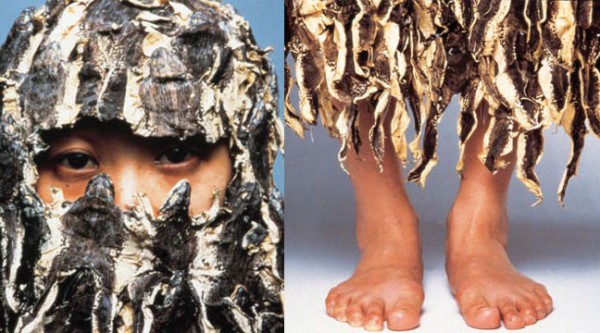
Hi Inlander; 1998/99; frog legs; Image from artist

Jaarsma’s garments also indicate our membership to specific groups by posing as a second skin.  Hi Inlander is Jaarsma’s first in a series of works invoking cloaks and shelters, as symbols of human habitats in physical and cultural forms. Each garment employs a sensation of taboo, through sensitive or contentious materials to provoke dialogue and diverse interpretations of these materials across cultures. The first cloak of Hi Inlander exhibited comprised frog leg skins processed into leather and has been worn by a man at exhibitions in Indonesia, referencing the racial riots against the ethnic Chinese in Indonesia in 1998 which made apparent the fractious relations in the multi-ethnic society. The deliberate choice of frogs was used to carry across the different perceptions of animals and their roles in human culture and in this specific case, how Chinese consider frog legs a delicacy which Muslims consider unclean, yet when presented in Australia, it took on another cultural context.  Jaarsma included cloaks from chicken feet, kangaroo skins and fish skins, and the wearing of the animal cloaks coincided with an event offering the meat of these four animals with a variety of spices to an international group of visitors, bringing about communal eating to open up communication and cultural insight into viewing animals and food. Chinese and French members began preparing frog legs which were eaten by other visitors for the first time and likewise, Australians did the same with kangaroo meat.
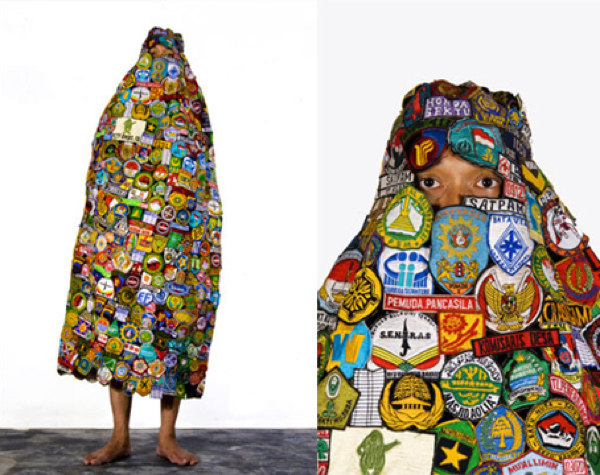
The Follower; 2002; embroidered emblems; photo by Mie Cornoedus; image from artist

Another work based on a tumultuous historical milestone is The Follower, which was conceived of immediately after the  Bali bombing in 2002 and the ensuing representation of Indonesia as a country fueling terrorism by the international media. Jaarsma carefully selected embroidered badges from a range of social organizations in Indonesia, from sports clubs, social clubs and political parties to religious communities, and sewed these emblems together – some adjacent to each other, and some on top of the other – to create a cloak which illustrates the moderate, hybrid and diverse cultural landscape of Indonesia.

Jaarsma’s work, Dirty Hands, is currently on view at The Esplanade in Singapore is a group show entitled  Making History: How Southeast Asian Art Reconquers the Past to Conjure the Future. Jaarsma was born in the Netherlands in 1960, and studied visual art at Minerva Academy, Groningen, the Art Institute of Jakarta and the Indonesia Institute of the Arts. In 1988, together with her partner Nindityo Adipurnomo she founded the Cemeti Gallery in Yogyakarta (now known as Cemeti Art House) organizing exhibitions, projects and residencies. Both Jaarsma and Adipurnomo were awarded the John D. Rockefeller 3rd Prize for their significant contribution to art in Asia.

Share

Johan Grimonprez

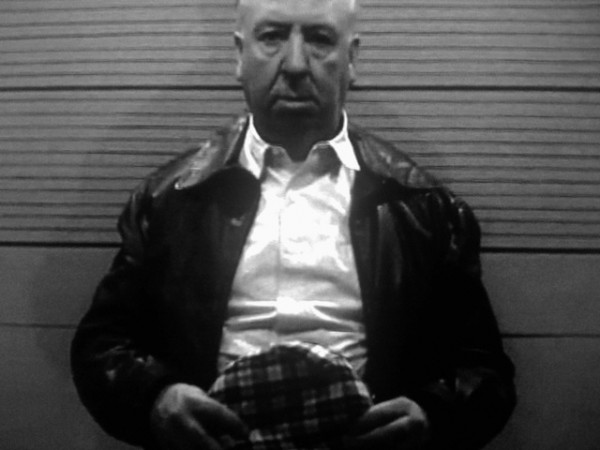
Still from DOUBLE TAKE by Johan Grimonprez, 2009, 80 minutes, Courtesy: Zapomatik

Despite the plethora of images and information that inundates contemporary life, we can rarely be certain of the reliability or the persuasive spin defining what we encounter.  Artist Johan Grimonprez questions the reality presented by news media and popular culture and sees that fear has become a global commodity. In an effort to make sense of the chaos and to offer his own critical analysis, artist Johan Grimonprez positions his film work within the intersections of popular culture and art, of fiction and documentary.

The Fruitmarket Gallery in Edinburgh currently presents Johan Grimonprez - offering a sample of Grimonprez’s work in film that allows the gallery visitor to experience the progression of his career.  This exhibition includes Dial H-I-S-T-O-R-Y (1997), DOUBLE TAKE (2008), Where is Your Helicopter (1992) and It Will Be Alright If You Come Again, Only Next Time Don’t Bring Any Gear, Except A Tea Kettle (1994).  These examples reveal that Grimonprez has been an early leader in the ascendancy of the moving image and documentary in contemporary art practice.

Still from DOUBLE TAKE by Johan Grimonprez, 2009, 80 minutes, Courtesy: Universal and Zapomatik

Dial H-I-S-T-O-R-Y and DOUBLE TAKE – both film essays – address compelling contemporary issues.   Each was created using found footage from news broadcasts, Hollywood movies, animated films and commercials layered together to address contemporary complexities.  Dial H-I-S-T-O-R-Y focuses on the history of airplane high-jacking since the 1970s and how this changed the nature of journalism. In DOUBLE TAKE, Grimonprez uses highly recognizable visual Hitchcock metaphors to segue into important pedagogic content.  Hitchcock’s many cameo appearances hint at repeated doubling of identity and meaning while the birds become a metaphor for fear and paranoia.

Grimonprez’ work reminds us to take nothing at face value – that multiple and hidden meanings lie beyond the images we encounter.  This idea is something that we are reminded of everyday – most recently with the violent Israeli crackdown on aid ships seeking to break the Gaza blockade.

Still from Dial H-I-S-T-O-R-Y, 1997–2004, by Johan Grimonprez. Photography by Rony Vissers, Courtesy: Zapomatik

Johan Grimonprez lives and works in Brussels and New York and is represented by the Sean Kelly Gallery.  He studied at the School of the Visual Arts in New York where he now serves as a faculty member.  Grimonprez has shown internationally and his work can be found in important collections such as Artist Rooms.

Johan Grimonprez will be on view at the Fruitmarket Gallery through 22 July 2010.

Share

Seasonal Depression Syndrome Lives at Team Gallery

If the come hither of May’s New York Gallery Week annoyed the crap out of you, then maybe KRATOS — ABOUT (IL)LEGITIMATE(D) POWER at Team Gallery has just the gravitas you’ve been seeking. Monochrome in execution and serious in tone, this Debbie Downer of a show stands in stark contrast to the group hugs that typically fill galleries’ summer schedules.

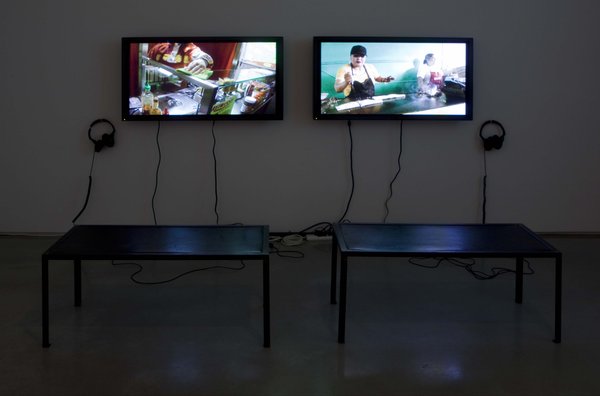
The show is dominated by the stultifying audio in Maja Bajević’s video which repeats the phrase, “How do you want to be governed” in deadpan monotone while a woman is mildly accosted by an unseen interrogator. The audio drove me crazy, but this show is about power and control so I suppose at some level annoyance is the point.  That being said, the works in KRATOS treat this subject matter rather flatly. For instance, I’d be much more interested in an extrapolation of what it is to identify with one’s captor rather than the less complex ideas of resistance and endurance that are on display in Bajević’s piece. Likewise, Gianni Motti’s I’m not on Facebook would be more interesting if perhaps he were. He might in fact want to socialize a bit.

Artur Żmijewski, Patricia, Yolanda, 2006 single channel video 16:50 color sound

Artur Żmijewski’s companion videos, Yolanda and Patricia, attempt to break down class structures by presenting the lives of two women on opposite ends of the social scale in a pared-down documentary style — a.k.a. it’s a snoozefest. Teresa Margolles’ work takes an even more blunt look at the intersection of class and fate. While working at a Mexico City morgue, she pulled shards of glass from the bodies of anonymous murder victims and inlayed them into pseudo-fancy jewelry. Her CSI approach to art making extended to last year’s Venice Biennale, where she hung blood stained tarps on the facade of the U.S Pavilion.  There, it might have been a poignant statement on the effect of U.S imperialist policies on developing nations, but here at Team, represented merely in photograph, the work lacks resonance. Furthermore, it hangs for sale in the same capitalist system it portends to critique.

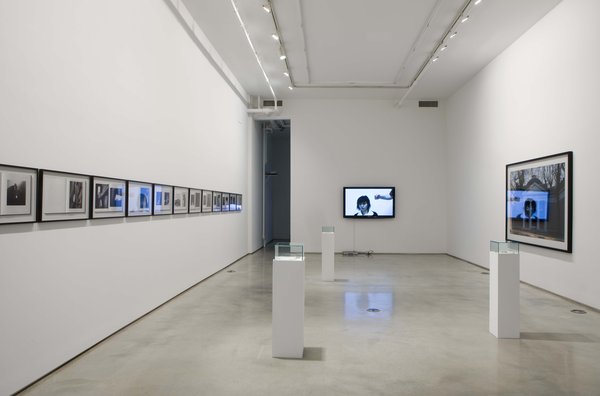
Maria Eichhorn, Prohibited Imports, 2003/2008, black and white photography, 14 parts, 20 x 27.5 inches

A more effective conceptual hook is employed in Maria Eichhorn’s Prohibited Imports, in which she re-photographed pages from a Robert Mapplethorpe catalogue seized from her luggage by Japanese customs officials. Rather than confiscating the entire book, the officials inexplicably scratched out all the depictions of male genitalia, of which there were many. They were careful to stay within the outlines of the form and the effect is bewilderingly perverse. Maybe they should have just used fig leaves, because the ghost dicks they created are just as penile, if not more so, than the original images. The visual experience of Eichhorn’s work is at least as engaging as the idea behind it, which can’t be said for the rest of the work in this show. No matter how shocking or subversive an artist’s idea may be, it’s tough to move beyond a boring video or annoying sound byte.

If summer fun is what you’re looking for, stay away from KRATOS. But, If you’ve spent the past month bitching online about the superficiality of Bravo’s “Work of Art: The Next Great Artist”, this show might be your soul mate.

Share

Mileece at the See Line Gallery

See Line Gallery‘s main showroom currently hosts Room Mobile, a display of star-themed mobiles curated by the gallery’s director, Janet Levy. In addition to the eighteen artists who created mobiles, Levy also invited Mileece, a sonic artist, to transform the gallery’s project room into Soniferous Eden.  Mileece’s installation encompasses both terrestrial and astral elements, highlighting the inherent interconnectedness using what she describes as “Aesthetic Sonification.”

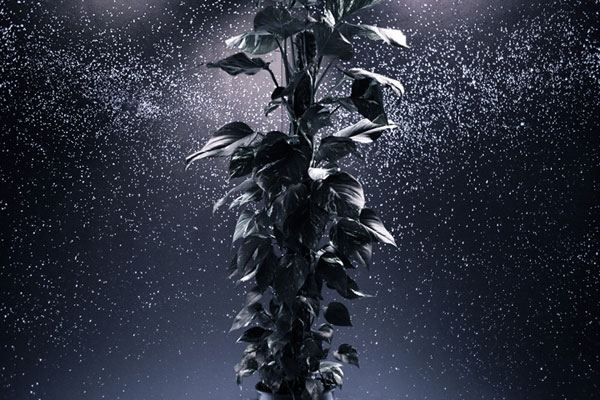
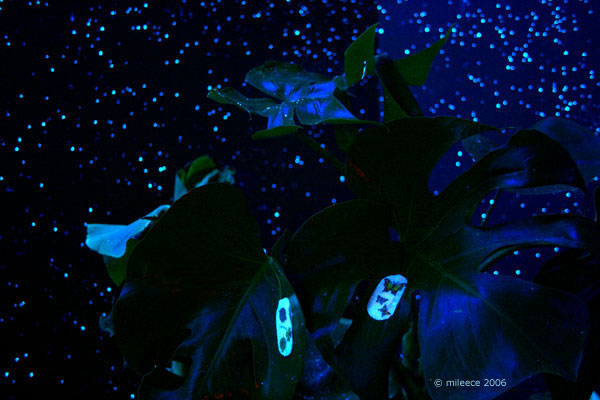
Soniferous Eden invites audiences to fully employ their senses, requiring one to be attuned to the aural, the tactile and the visual. A central orb of leafy plants are encircled by a dampened soil path that is best explored with bare feet.  As the eyes become adjusted to the dim light, one can more comfortably move around and observe the plants, which are barely lit by the reflective black-light paint speckled onto the installation’s surrounding walls.  The paint flecks give the ambiance of a star-studded galaxy, referencing the celestial theme of the mobiles in the main gallery.

The sounds that land on the participants’ eardrums are a result of the artist’s engagement with the electro-magnetic emissions of plants.  Mileece has gently adhered electrodes to plant leaves in order to capture their GSR and EEG signals.  The signals are then channeled through an interactive plant software, written by Mileece with Super Collider, an audio programming language.  The software allows the plant bio-emissions to generate quirky noises, such as ethereal bells, low hums, and other harmonic synthesized sounds.  The sounds ebb and flow throughout the exhibit, indicating both plant/plant and plant/man interaction.  As the participants spend time with the plants, brushing by them and touching their leaves, more noises are generated.  The overall experience is a total immersion in the slice of Eden that Mileece has created.

Mileece is originally from England and studied Sonic Art at Middlesex University and Sound Engineering at the School of Audio Engineering in London.  Her work is on permanent display at the Centre for Innovation at the London School of Economics.  She has also exhibited at such venues as the Migros Museum in Zurich, the Hayward Gallery, the Whitechapel Gallery, and the Thames Festival in London, and the Aldeburgh Festival in Suffolk.  Soniferous Eden will be on display at See Line Gallery at the Pacific Design Center in Los Angeles until June 29th, 2010.

Share

From the DS Archives: Doug Aitken, Migration

Each Sunday we reach deep into the DailyServing Archives to unearth an old feature that we think needs to see the light of day. This week we found a post featuring a review of SoCal native Doug Aitken and his recent video Migration, writen by DailyServing’s Catherine Wagley. If you have a favorite feature that you think should be published again, simply email us at info@dailyserving.com with you selection and include DS Archive in the subject line.

Aitken-1.jpg
Installation view: Regen Projects, Los Angeles 2009 Photography by Brian Forrest

Sometimes simplicity can be stunningly difficult. Doug Aitken‘s film Migration has an apparent enough premise: migrating animals occupy hotel rooms, bringing together the instinctive and unfamiliar aspects of travel. And Aitken uses pristine, focused images to realize this premise. Yet the effect is something more nuanced and confusing: migration becomes precariously noble, the virtual and the actual slip in and out of each other, and bittersweet anticipation pervades each scene.

Aitken, the SoCal native who is now as much an East Coast as West Coast artist, long ago dismissed the fugitive, homegrown approach of many video artists. He’s an expert audio-visual craftsman. His work reminds me of those feature filmmakers, Jane Campion or Ang Lee for instance, who gravitate toward provocative subject matter yet also toward sublime cinematography, dragging their viewers into a weird, subconscious battle between the need to understand and the desire to bask in beauty.

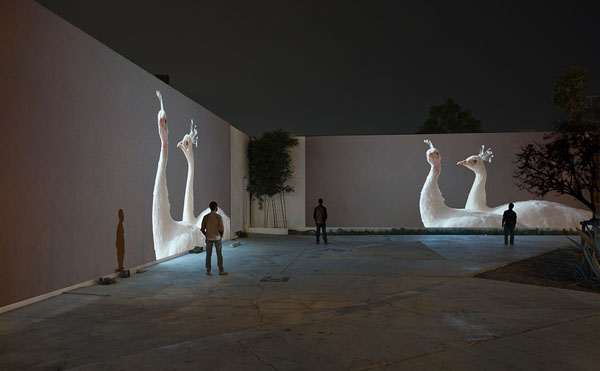
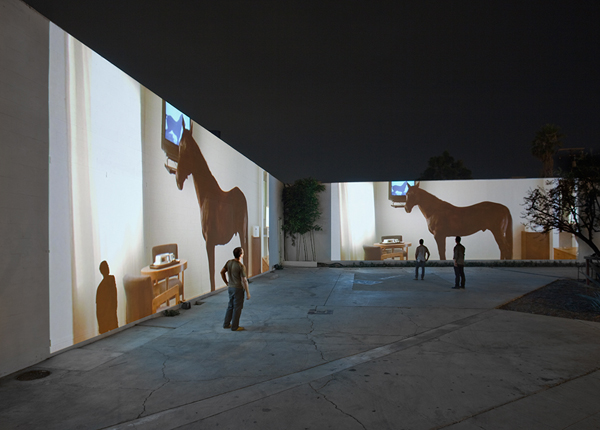
Aitken filmed Migration on location, in motels across the country. The film made its New York debut a year ago exactly, appearing on three industrial-sized screens at 303 Gallery, and then on the face of a building at the 55th Carnegie International. It took a year to travel – migrate – to Los Angeles. Now it’s projected in two places: on a screen inside Regen Projects‘ Almont Street gallery and, when the sun sets, as a two channel installation on two exterior walls of Regen’s Santa Monica Blvd building.

Aitken-02.jpg
Installation view: Regen Projects II, Los Angeles Photography by Brian Forrest

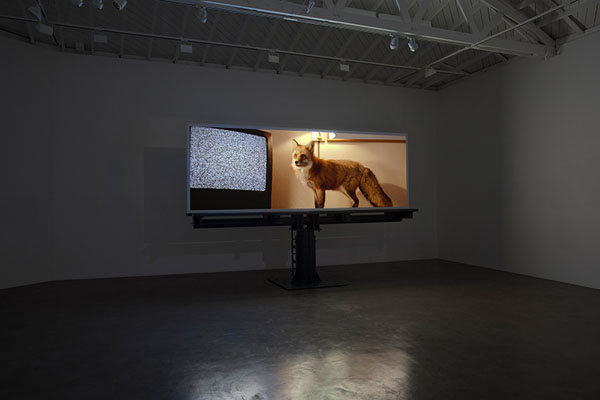
I watched Migration inside first. Alone in the space, I felt like a solitary witness to everything on screen. When I first walked in, the camera was lingering on a motel bed with a pink spread and an aura of oldness – this motel probably didn’t belong to a national chain. The first creature on screen, a horse, couldn’t be recognized at first because rays of sunlight turned its profile into a shadowy structure. Then, once the shadow turns into a body, the film really began: animals waiting in empty, clean, but rudimentary rooms, sometimes watching themselves on television – a meta-narrative that, given the context, seems more factual than profound (watching one’s own species on TV is intricate to the traveling ritual). Every movement that happens in these rooms is restrained, like the horse hoof that beats against the carpet, or the mountain lion that wrestling a pillow but never puncturing its cotton skin. Running water, a motif in journey narratives, enters Aitken’s film only in spirit. The faucet filling bath, coffee dripping into pots, pool surfaces vacillates slightly – no rushing rivers puncture the stillness.

The creatures in Migration are going somewhere, there’s no doubt, but their destination must be unknown or foreboding because the hotel rooms they occupy seem more like psychological respites than physical resting points.

When I came back at night to view the outdoor incarnation of Migration, I was alone again. A steady stream of cars drove by, but only about six people walked in front of the gallery and fewer really looked at the dual projections playing on Regen’s walls. This inattentiveness surprised me at first, but, actually, outside, that line between provocation and beauty that Aitken straddles so nicely, fuzzed in favor of beauty. And pretty things on walls are second nature to the West Hollywood-Beverly Hills neighborhood Regen occupies.

Aitken 03.jpg
Installation view: Regen Projects, Los Angeles 2009 Photography by Brian Forrest

Seen inside the gallery, the best moments of Migration had to do with the strangeness of being alone, and watching creatures, also alone, use man-made conventions of comfort to satiate some some mysterious anxiety. Outside, the best moments had to do with distortion – like when a close-up of a door latch took over, when striped carpet looked like a candy-colored corn-field, or when a buffalo‚Äôs eye filled the walls so abstractly that it wasn’t clear what it was. These moments, I hoped, could interrupt passers-by, showing them that they didn’t intuitively understand what they saw.

Migration focuses on something that is intuitive, but isn’t understood, and that’s what makes it difficult. The urge to journey certainly may be familiar – most of us, if we haven’t felt it, know it exists – and yet, the tendency to view everything through a familiar lens is even stronger than the tendency to venture out. The animals in Aitken’s hotel rooms seem to willingly, maybe even sacrificially, accept a lifestyle that doesn’t belong to them, and the unfamiliar consequences of this makes Migration unsettling but also hopeful.

Share

Ghada Amer: Color Misbehavior

Ghada Amer is known for appropriating images of women taken from pornography, so it’s not unusual to encounter the stylistic conventions of x-rated material in her work.  At her recent solo exhibition at Cheim & Read, big-breasted women display spread legs and vulvas; two women clutch each other passionately as one penetrates the other with a dildo; a single woman is seen from behind in the typical gesture of submission: butt out, back arched, looking coyly over one shoulder.  Amer embroiders these images (which look like line drawings) onto canvas that has been stretched as if for a traditional painting.  She leaves the ends of the threads untrimmed so that loops and tangles are left on the surface to interfere with the image and create a colored mess.  This is often reported to merely be Amer’s connection to abstraction and expressionism, but the colorful turmoil serves to obscure the imagery and requires the viewer to exert effort to see the content of the image itself.  This act of focused looking creates a heightened sense of voyeurism.

Ghada Amer, The Fortune Teller (2008). Acrylic, embroidery and gel medium on canvas, 50 x 60 inches.

In “Color Misbehavior” three large canvases dominate the front room and the entire exhibition.  The Fortune Teller (2008) is sewn with overlapping images of naked women in various poses.  The tangled web of red, orange, blue, and purple threads partially conceal the representational forms; since all the lines of stitched thread are the same thickness, the layered images appear and then vanish as the eye passes over the canvas.  But one image comes into focus and stays: in orange, Disney’s Little Mermaid, a clothed and serene counterpoint to the naked women around her, but no less compliant.

Ghada Amer, The Egyptian Lover (2008). Acrylic, embroidery and gel medium on canvas, 62 x 78 inches.

The Egyptian Lover (2008) is similar in its layered images and consistent line weights, but in this case the embroidery is done over primed canvas painted with beige, lilac, yellow, and blue.  The drips of thin acrylic paint mingle with the “drips” formed by the long tangles of threads, blending the materials nicely.  As with The Fortune Teller, a Disney character joins the orgy of naked limbs, this time in the form of Snow White.  Her kittenish glance is directed over her shoulder. These two canvases portray transparent layers of fantasy women, conflating the myth of the vulnerable, forever-sexually-available woman with the delusion of the innocent and submissive girl.  Combined, they create a madonna-whore tension.  An obvious move?  Maybe—but it is effective.

The title of Who Killed “Les Demoiselles D’Avignon?” (2010) points to Picasso’s well-known painting of distinctly unrefined prostitutes standing in unsubmissive, even aggressive poses.  But in Amer’s work the woman depicted is hyper-groomed with perfect eyebrows, Chola-style eye makeup, and ironed hair.  Drips of paint behind the stitching run like tears from her eyes.   Amer answers the question posed in the title of who killed the sexually adept, self-possessed women and replaced them with the vulnerable and passive displays with which we are now familiar.  Picasso’s women were nude, but Amer’s are naked.

The other work in the exhibition continues this theme.  The next room contains canvases stitched with repeats of a single image, often almost completely concealed by masses of threads, and smaller embroidered-paper works that each show a single women in a pose that is sexual but not erotic.  Amer uses these images to form a critique of woman-as-idealized-object, and tension resides in this shifting cultural no man’s land between acceptable fare and profanity.   The work is dynamic and the content and materials present opposing notions of femininity.  Combined, they create a mix of allure and repulsion.

Share

Waiting Room

L.A. Expanded: Notes from the West Coast
A weekly column by Catherine Wagley

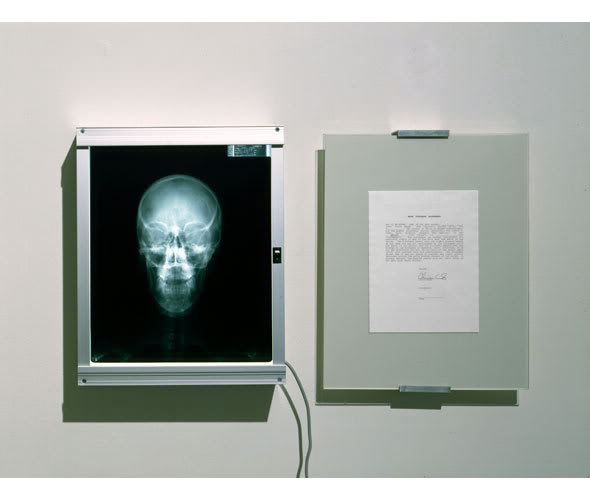
China Adams, "Contract of Sale: Skull," 1994. X-Ray, Light Box, Ink on Paper.

When she gives artist’s lectures, sculptor China Adams often describes her work as a race against her own death. Her smooth plaster “chunks” of ensconced trash, her vampiric experiments with blood consumption and her glass Vitrines filled with mummified possessions all attempt to preserve what’s bound to decay. But, while her work has the same mortality obsession as Vanitas paintings by the likes of Pieter Claesz or Jacques de Gheyn, Adams steers away from iconic symbols—when skulls appear, it’s in the form of a clinical x-ray; when blood appears, it’s already been drained, drunk or cleaned up. Instead of representing it, Adams’ work acts out against death and this has always struck me as the smartest, most proactive strategy.

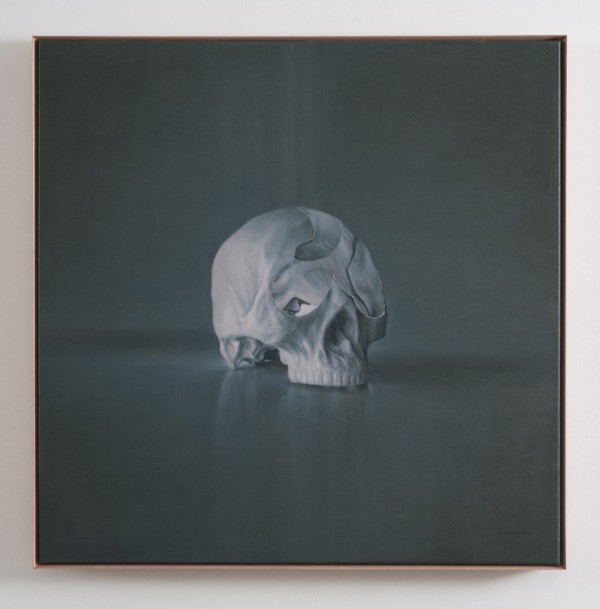
Cris Brodahl, "The Waiting Room," 2009. Oil on glued canvas, framed.

But Cris Brodahl’s current exhibition at Marc Foxx Gallery does not shy away from representing the race with death. In fact, it does so in a way that is both cliched and stunningly insidious. Called Waiting Room, the exhibition includes oil paintings, ceramic wall pieces, and mirrors, all of which depict or reflect fleshy skulls–though Brodahl’s approach to fleshiness has more in common with Ryan McGinley’s than Jenny Saville’s.

Waiting Room feels quietly controlled at first glance, though an Elizabeth Bishop poem of the same title speaks of “the sensation of falling off/the round, turning world.”  The color scheme is understated: sepias, grays, soft pinks. The canvases are framed with wood strips. The mirrors are perfectly clean and slightly tinted. The composition of each painting is sensible and unsurprising. The skull in Waiting Room, for instance, sits right at the center of the the sea of gray. The woman in The Clock, who wears a skull cloaked skirt, has the graceful, front-and-center gravitas of a Degas dancer.

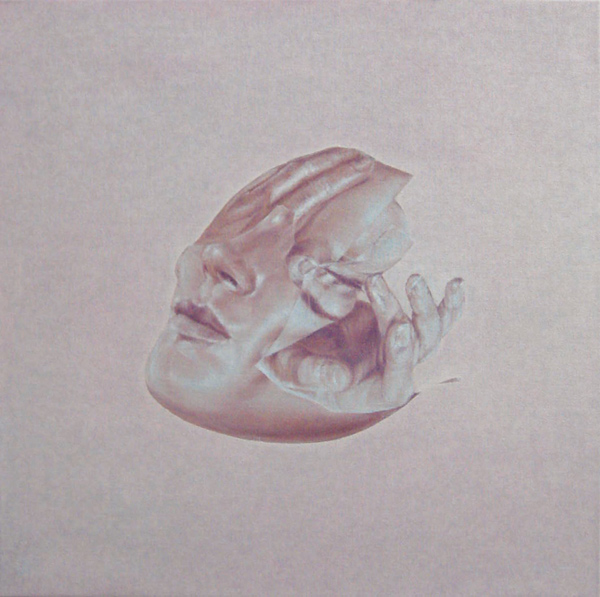
"Wait," 2009. Oil on glued canvas, framed.

The predictability of  Brodahl’s images contradicts their eerie instability. Face, skin and skull have been pieced together in a way that makes bones seem like flesh and flesh seem like a pastiche of paper-smooth planes and curves. In Wait, a rosy image that features a hollow floating head, the skin of a peaceful face covers an empty cavity, not unlike the cavity inside an empty skull. In Next, a skull grows on the outside of an elegant woman’s face, obscuring her features with barnacle-like jaws and foreheads. Brodahl out-waits death by confusing flesh with bone and piecing together bodies that don’t quite make sense (the face in Wait has fingers for a forehead). If death doesn’t know what it looks like, than can it ever really appear?

Share