Whose Map is it? new mapping by artists

Milena Bonilla, Variations on a homogenous landscape (detail), 2006. Photograph courtesy the artist.

While the act of mapping conveys authority – giving credence to that which it records – mapping cannot remain entirely static and must be revised to represent changes in power structures.  In efforts to better understand or better represent the world, many contemporary artists eschew two-dimensional map-making in favor of addressing the ways in which traditional maps are transgressed by global complexities.

Whose Map is it? new mapping by artists currently on view at the Institute of International Visual Arts in London (Iniva) offers creative alternatives to a stale representation of global organization.  Capitalizing on the potentially transformative nature of mapping, nine contemporary artists deconstruct conventions in favor of introducing previously ‘off the map’ concepts.  Whose Map is it? is inextricably engaged with the larger theme of globalization for the way that this present condition problematizes the traditional two-dimensional nation-state map structure.  Presenting new and recent work in diverse media, the exhibition offers freshly layered, content-wise approaches that creatively reposition map-making to more fully represent today’s mobile world.

Bouchra Khalili, Mapping Journey #1 (film still), 2008. Courtesy of galerieofmarseille. Produced with the support of Artschool Palestine. Copyright the artist.

The deconstruction of existing map structures is central to the exhibition.  In Milena Bonilla‘s Variations on a homeogeneous landscape (2006), traditional scientific cartographic means are questioned by presenting repositioned and disoriented fragments of familiar maps.  In a different vein, Bouchra Khalili‘s Mapping Journey films the marking through and across of a two-dimensional map in order to illustrate a path of actual, experienced migration.  As the moving image overrides the flat, two dimensional map, the viewer sees that mobility has become the new global landscape as it crosses political boundaries.  Also mapping in an innovative way, Gayle Chong Kwan‘s new commission Save the Last Dance for Me charts the movement and migration of Rumba.  The resulting large-scale, global cultural map is accompanied by a sound piece offering Rumba dance instruction.

Oraib Toukan, The New(er) Middle East, Installation view at Rivington Place 2007. Copyright the artist, Photo: Thierry Bal.

Map structures take on Post-colonial concepts in Emma Wolukau-Wanambwa‘s new commission A continuing survey of syntatic parsing.  In this work, Wolukau-Wanambwa charts British colonial conquest narratives in juxtaposition with bourgeois British civilian life of the same period.  Also of Post-colonial theme, Alexandra Handal‘s Labyrinth of Remains and Migration (2000-01 & 2010) draws visually spare ‘mental maps’ that represent Palestinian dispossession.

The gallery audience is charged with mapping their own Middle East in Oraib Toukan‘s interactive magnetic puzzle piece entitled The New(er) Middle East.  This work references the region’s divisive geo-political history that has been marked by Western intervention.  More specifically, Toukan’s work playfully alludes to the catch phrase introduced by the Bush administration’s Condoleezza Rice in 2006 conceptualizing a more stable Middle Eastern political map through further Western interference and map restructuring.

Esther Polak, NomadicMILK, installation view at Rivington Place 2007 2010. Copyright the artist, Photo: Thierry Bal.

Globalization’s free-trade economics define the ever-more global face of the world and are therefore addressed by multiple artists in this exhibition.  Artist Susan Stockwell‘s site-specific commission, River of Blood, focuses on the world’s growing urban populations by highlighting economic disparity in London along a commonly recognized North-South divide.  River of Blood is on one hand a map of the Thames River and its tributaries.  On the other hand, its red vinyl cut-outs resemble human arteries, thereby emphasizing the visceral socio-economic, geographic divide between the haves (of North London) and have-nots (of South London).

Esther Polak‘s NomadicMILK (2009) is engaged with mapping the movements of a particular contemporary economic system.  This work tracks the movements of nomadic Fulani herdsmen and dairy transporters throughout Nigeria using GPS technology to illustrate the constant movement required to execute the work of a single industry.  Focusing on a site of dramatic economic transformation, Otobong Nkanga‘s Delta Stories (05/06) illustrates the ecological ramifications of harvesting oil repositories in a Nigerian delta region.
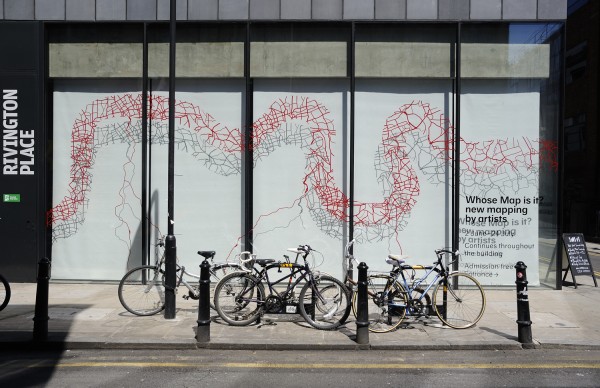
Susan Stockwell, River of Blood, 2010. Copyright the artist, Photo: Thierry Bal.

Whose Map is it? new mapping by artists was initiated by Iniva curators Christine Takengny and Teresa Cisneros in conjunction with a full schedule of educational events including the Crossing Boundaries Symposium that took place 2 June.   Upcoming events include a July 8th talk entitled The Content and the Meaning of the Spaces We Encounter with Paul Goodwin and Alex Vasudeum.  On 15 July a screening will be held of visual essayist Ursula Biemann‘s film Sahara Chronicle, followed by a discussion with visual culture scholar Irit Rogoff.

Whose Map is it? new mapping by artists is on view at Iniva‘s Rivington Place in London through 24 July.

Share

They Knew What They Wanted

This year, there has been a laundry list of artist curated group shows, from David Salle’s exhibition, Your History is not our History, at Haunch of Venison, to Jeff Koon’s Skin Fruit at the New Museum and the upcoming Walead Beshty curated show, Picture Industry (Goodbye to All That), at Regen Projects. Each exhibition has its hits and misses in terms of content, style and arrangement, but what is more interesting out of this trend is how each of these exhibitions question of the role of the artist versus that of the curator. The art world has consistently defined and broken the roles held within it, yet each time one of these artists assumes the role of curator, one can’t help but to take the opportunity to compare their decisions as an artist to their decisions as a curator.

Riding on the heels of this trend, four San Francisco galleries — John Berggruen Gallery, Fraenkel Gallery, Ratio 3 and Altman Siegel Gallery — turn over their spaces to four of their represented artists to mine their backrooms to create a collaborative exhibition.  Titled They Knew What They Wanted, this exhibition is comprised of four separate group exhibitions out of the same collection. In a similar spirit, DailyServing has invited four of our San Francisco writers to use their perspectives to discuss each of the exhibitions.

_________________________________________________________________________________________

Shannon Ebner at Altman Siegel Gallery written by Julie Henson

Lee Friedlander, Egypt (1983), Courtesy of Altman Siegel Gallery

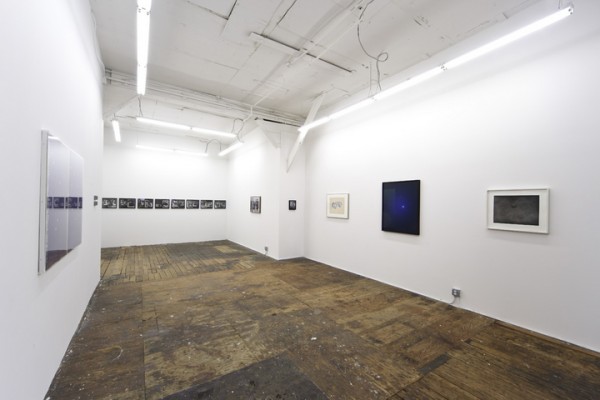
Among the exhibitions included in this collaboration, Shannon Ebner‘s curated project at Altman Siegel Gallery offers a nice mix of investigation and understanding. Basing her choices on work that “express their existence outside the locality of time and place,” the end result is a collection of work full of mystery and object-hood. Each work is disembodied from its individual history and is reduced to abstract physicality and strange, disconnected environments.

Installation View, Altman Siegel Gallery

Many of the works in this exhibition, like Lee Friedlander’s Egypt, quickly lose their context and dissolve into an exploration of time and timelessness. Friedlander’s photo becomes cold and detached in the context of the gallery. Hidden distantly behind Lutz Bacher’s strangely displaced, object living in the middle of the space, Sol Lewitt’s Untitled (2004) and Ed Ruscha’s Unit, give small, intimate spaces for an investigation into questions of objects and textures, flatness and environment.  The exhibition successfully reflects the elements within each piece, allowing the viewer to engage each unit separately rather than depending on a collection or historical context to inform the work. On first introduction, the space seems distant and emptied, but on further investigation, the parts really do become greater than the whole.

_________________________________________________________________________________________

Robert Bechtle at John Bergguren Gallery written by Seth Curcio

Richard Misrach, Golden Gate Bridge, 3.18.00, 4:00 pm, 2000 / Chromogenic print 20 x 24"

Predominantly a photo-realist artist, Robert Bechtle took the role of curator to participate in the exhibition They Knew What They Wanted at John Berggruen Gallery. Clearly approaching the role of curator as an artist, Bechtle selected a collection of works that operate as an extension of his own artistic practice. The most obvious unifying concept within the exhibition is form in space, manifest mostly as object in landscape. However, Bechtle has stated that the main instinct driving his selections are an exploration of the mundane in everyday life, or what the press release states as the “formality of the ordinary.”

Straight photographic works by artists Robert Adams, Lee Friedlander and Richard Misrach sit in proximity to the constructed images of artist Gregory Crewdson and Miriam Bohm. Prints of non-descriptive figures sitting by a suburban pool by artist Isca Greenfield-Sanders fall into a rather easy dialogue with Paul Wonner‘s acrylic paintings of figures in a park.

Mitzi Pederson, Untitled, 2009 Wood, silver leaf, string, and bells 127 x 11 1/2 x 2 1/2"

The exhibition exists without many surprises or profound connections, but is interestingly interrupted through the work of sculptor Mitzi Perterson and the painter Garth Weiser. The inclusion of Peterson and Weiser complicates the exhibition through abstraction. These two artists’ work are reductive and formal, but continue to engage the greater exhibition in terms of both landscape and the mundane, adding new dimension to the exhibition and requiring the viewer to actually work to extract content through context.

_________________________________________________________________________________________

Katy Grannan at Fraenkel Gallery written by Bean Gilsdorf

Installation view of Fraenkel Gallery, curated by Katy Grannan.

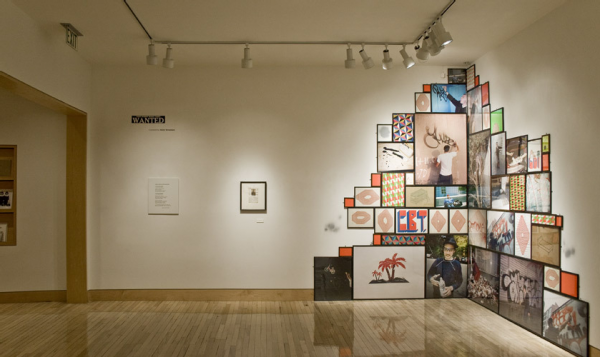
Katy Grannan curates a fairly straightforward exhibition of portraiture at Fraenkel Gallery, and the work in each of the three rooms implies a connection to be made or a correspondence to be understood.  In the first room, the viewer encounters Barry McGee’s Mixed Media in Fifty-Two Elements (2010), a large aggregation of framed patterns and portraits of young men tagging walls.  Frantic and almost imposing, it’s a good start to the show but is misleading as far as what’s to come, as the rest of the exhibition is much more subdued.  Across the room, Grannan has installed a collection of small, black and white “photographer unknown” portraits.  Echoing the shape of Elements, these are arranged in an oval on the wall and invite the viewer to compare the anonymity of their makers to the young men compelled to brand, tag, mark, or initial public surfaces with their monikers.

Installation view of Fraenkel Gallery, curated by Katy Grannan.

The second room contains, among other works, N.Y.C. (2006), twelve photographs of backstage scenes of fashion models by photographer Lee Friedlander.  In the opposite corner is a life-sized sculpted human figure with no head, Manuel Neri’s Untitled Standing Figure (1957).  It’s as if Grannan wants the viewer to consider the form that is all face (the model) and the faceless form (the sculpture).  The two works make for a kind of mirror gesture, conceptually reversing what makes them meaningful.  Although these two pieces might have been moved closer, the distance allows for a connection that is less facile.

In spite of the interesting juxtapositions of the first two rooms, the exhibition flattens out in the final room of the gallery.  Among more portraits is a tight grouping of animal-themed images by Charlie Harper, Peter Hujar, Garry Winogrand, Will Rogan and William Wiley.  On the adjacent wall is a portrait done by Ms. Grannan herself (Anonymous, Los Angeles (2008)).  Here, it’s difficult to discern what correlation the curator wants us to find.

_________________________________________________________________________________________

Jordan Kantor at Ratio 3 written by Aimée Reed

“They Knew What They Wanted,” Installation View 2010, Ratio 3 Gallery, San Francisco

By far the most interesting of these four is Jordan Kantor’s installation at Ratio 3 Gallery in the Mission. Kantor’s approach, unlike the other three, was to keep the drive simple: to “hang a show from what [he] found.” In his grouping, you will find an impressive diptych of ballpoint pen on paper by Alighiero Boetti; a Chromogenic color print of broken glass from Sara VanDerBeek; and a sculptural piece from Rachel Whiteread made up of four separate pieces of stainless steel. Even more noteworthy is Kantor’s selection of photographs, the dates ranging from 1887 to 2009. There seems to be no real rhyme or reason as to why Kantor selected each photograph beyond the fact that they create a cohesive aesthetic experience.

Alighiero Boetti, "Centri di Pensiero", 1978, Ballpoint pen on paper; diptych, 40.75 x 28.75" each, Image courtesy of Ratio 3 Gallery, San Francisco

This seems to be the point of Kantor’s entire directive. His professional background consists of time spent in the curatorial department at the Museum of Modern Art in New York and one can’t help but notice that it must have been time well spent. Curators today seem prone to overtly themed exhibitions in a bid to justify their existence, yet, with Kantor’s contribution to They Knew What They Wanted, he reminds the viewing audience that simply loving the works can, more often than not, work. In this sense, Kantor seems to be the only participating curator able to have the confidence to know what he wanted. And for this particular viewer, I find myself wanting more of Jordan Kantor’s POV.

_________________________________________________________________________________________

What exists between these four exhibitions is more of a premise than a revelation – leaving the viewer searching for comparisons and contrasting the work of both the artist/curators and the galleries themselves. Although we are still questioning the gallery’s delineated roles, like artist, curator, exhibition, or collection, each gallery and artist alike put together an exhibition that is a quirky example of the artist’s point of view.  Yet in this case of artist curated exhibitions, we are left with a seemingly internalized and self-reflexive group.

They Knew What They Wanted will be on view through August 13th.

Share

John Millei: Woman In a Chair

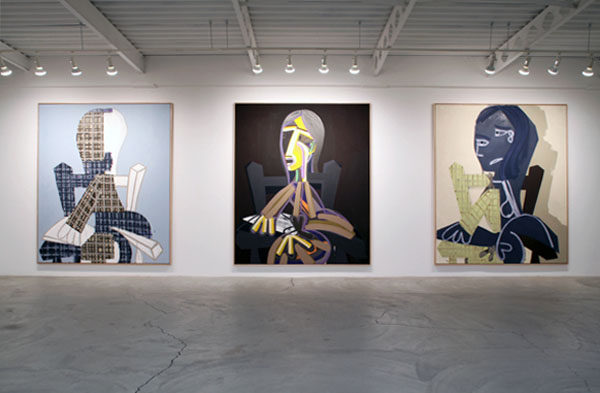
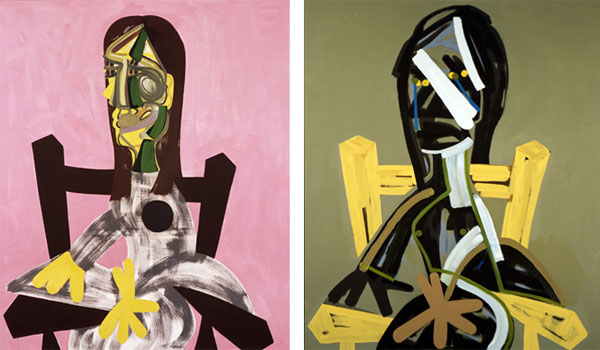
Using Pablo Picasso’s famed 1938 painting titled Portrait de femme (Dora Maar), 1938, as a framework for a new series for formal paintings, both large and small, Los Angeles-based abstract painter John Millei embarked on a series of paintings titled Woman In A Chair. The exhibition, which is on view through July 2010 at Ace Gallery in Beverly Hills, featured a room full of towering paintings, each reaching over eight feet tall, tightly packed along the gallery walls. While the paintings borrow the form of Picasso’s famed painting, they are not specifically concerned with either the subject of Dora Maar, nor Picasso himself. Instead, the image of the woman in a chair serves as a simple armature for the artist to revisit certain stylistic periods of his own career.  As the paintings align the wall in close proximity, the viewer can easily compare the seemingly endless variations of a single subject. Lush and voluminous bands of paint sit next to flat graphic spans of color on certain paintings, while others contain tightly woven bands that are placed beside areas of raw canvas. The handling of the paint seems effortless and almost instantaneous, however it is evident that every mark and color combination is careful considered. While the paintings obviously explore Millei’s art historical predecessor in repetition, the work remains playful while carrying the weight of this lineage.

On view concurrent with Woman In A Chair at Ace Gallery’s Wilshire gallery is another major exhibition of paintings by the artist titled, Maritime. Millei has an extensive resume of international exhibitions dating back to 1981, and has produced eight solo exhibitions with Ace Gallery over the past 10 years. Reviews and overviews Woman In A Chair have appeared in the LA Weekly, Beautiful/Decay, and countless online publications such as ArtDaily.

Share

Roman Ondák

Resistance, 2006; Courtesy the artist; Courtesy gb agency, Paris; Galerie Martin Janda, Vienna; Johnen Galerie, Berlin

The work of Slovakian artist Roman Ondák has been referred to as “intervention,” a label which makes reference to the way a piece confronts the viewer with an unexpected experience. Ondák, who is currently participating in the Berlin Biennale through August 8, 2010, creates work that is at once mischievous, hilarious and stone serious. He deals with social issues of both the grand and trivial scales and swaddles participants—whether knowingly or not—inside the folds of each performance. In the manner of a social scientist, he is wont to stage “temporary situations and imaginative sitespecific constructions that predict various communication patterns in behavior and in the perception of things.” (source) In his 2009 presentation of Measuring the Universe (2007) at Museum of Modern Art in New York, Ondák urged museum visitors to mark their height and first name on a white wall—the same way a child might over the years in a hallway at home—until the thousands of black ink markings became as visually dense as they were socially significant.

In Loop, his installation for the Slovakian Pavilion at the 2009 Venice Biennale, he brought the lush grounds of the Giardini Publici into the interior pavilion, causing guests to take pause before realizing that the artist’s installation was in fact the well-ordered plant-life which surrounded them. His 2006 video Resistance, originally staged during an opening at Viennese Museum of Modern Art, plays with ideas of social status by following the feet of a group of guests with untied shoelaces. As reported by Kontakt, the Art Collection of Erste Group (whose artists were being presented in the exhibition during which Resistance was staged), “Fellow visitors were puzzled by this intervention, since there was no direct clue as to why certain people were posing this way. Thus Ondák queries the bondage, not necessarily visible, of certain peer groups, in this case through the need of people working in the field of art to proclaim otherness as a means counterbalancing social standardization.” (source)

Loop, 2009; Courtesy the artist; Courtesy gb agency, Paris; Galerie Martin Janda, Vienna; Johnen Galerie, Berlin

Roman Ondák was born in 1966 in Zilina, Slovakia and now lives in Bratislava. He was recently included in I’m Not Here. An Exhibition Without Francis Alÿs at De Appel, Amsterdam—a “solo exhibition that takes the form of a group exhibition in which works by the contributing artists evoke the atmosphere of the work of an absent Francis Alÿs.” He has been included in numerous solo presentations internationally, including at MoMA, New York; Tate Modern, London; 2009 Venice Biennale; and 2008 Shanghai Biennale.

Share

From the DS Archives: Brian Jungen, Strange Comfort

For this Sunday’s edition of From the DS Archives we hope to offer a little edification to accompany our readers’ 4th of July festivities.  While we should certainly celebrate, it is also important to think about what it is to be American.  Taking another look at this previously published feature on Brian Jungen’s Strange Comfort, allows us to do just that.  For Strange Comfort, Jungen playfully combines Native American imagery with pop culture consumerism – offering up an aesthetic engagement with American cultural history.

Happy 4th of July to our DS readers!

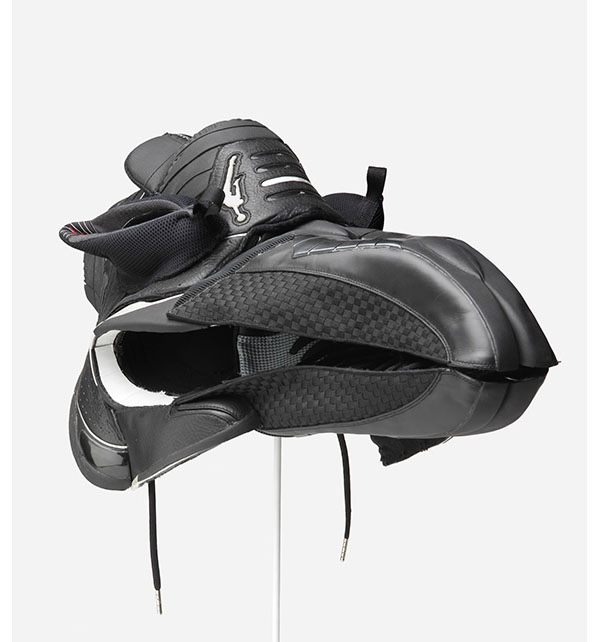
Strange Comfort, Brian Jungen’s exhibition at the National Museum of the American Indian (NMAI), is as delightful as it is disquieting.  Jungen, who is part Northwest American Indian, transforms objects of American consumption into relics of tribal culture.  The result is transcendent hybrids that raise questions about the relationship between art, culture and commodity.

Six pieces from the Prototype for New Understanding series greet viewers entering the exhibit.  While these pieces appear to be authentic tribal headdresses displayed under glass vitrines, it is soon revealed that they are in fact made of Nike Air Jordans.  Because of this material transformation, the sculptures are in a state of constant becoming—at once creatures, masks, animals, shoes, and fantastical hybrids.  There is a confusion of body parts as plushy shoe openings become eyes, rubber-tipped toes become mouths, and thick fabric tongues become beaks.  The reassigning of parts designed for the anatomy of a foot to fit the anatomy of a face is as grotesque as it is wonderful.

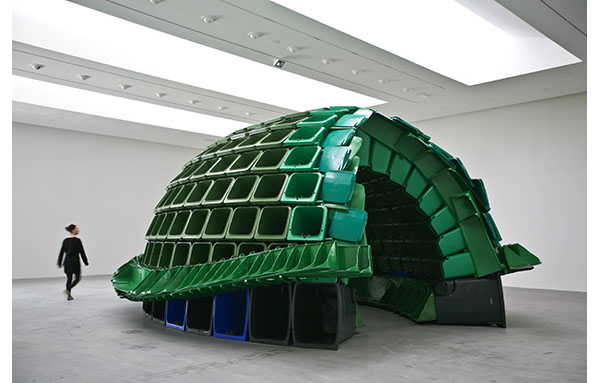
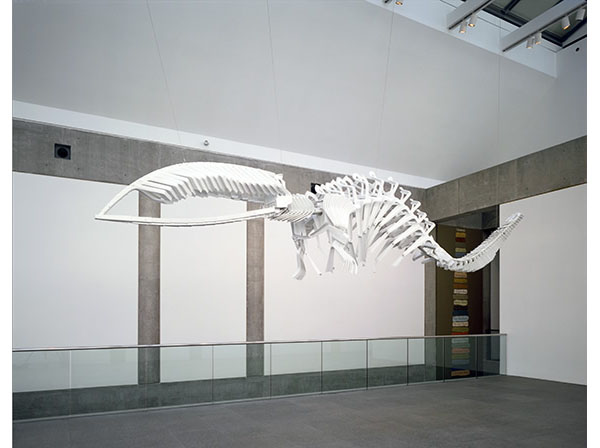
Jungen ironically critiques the way marginalized cultures have been pillaged for their goods by Western colonialists.  He attacks commodity by making a triple-commodity—tribal relic, Nike shoes, and marketable art object. Jungen brings us further into his natural history museum of commodities with Shapeshifter, a huge whale skeleton made of white plastic chairs.

Side by side, the chairs become the sleek vertebrae and ribs of this immense animal.  Suspended several feet above its platform, the whale’s shadows are haunting and give it the believability of an extinct, magnificent sea creature.  Its empty body and ghostly shadows play foil to the recognizable lawn chairs that are its bones, for as much as we believe that this creature was once living in a faraway time, we know that it is part of our vernacular existence. 

Questioning our own knowledge, we wonder if this whale could have really existed, or is it a made up version of Western history?

The context of the NMAI lends another layer to Jungen’s work.  We are invited to view his sculptures as more than art.  In this context, they become American Indian artifacts.  By marrying seeming opposites, consumer and tribal cultures, Jungen proves that the treasures that fill the NMAI are not merely relics of a faraway past—they are the thoughtful products of a people that are part of contemporary society.  This assimilation into mainstream commodity culture, for better or worse, perhaps provides a “strange comfort,” for both seekers of these treasures, and also the people to whom they belong.

Brian Jungen’s Strange Comfort is on view through August 8, 2010 at the NMAI on the National Mall, Washington, DC.

Share

Karen Ann Myers at Luis de Jesus

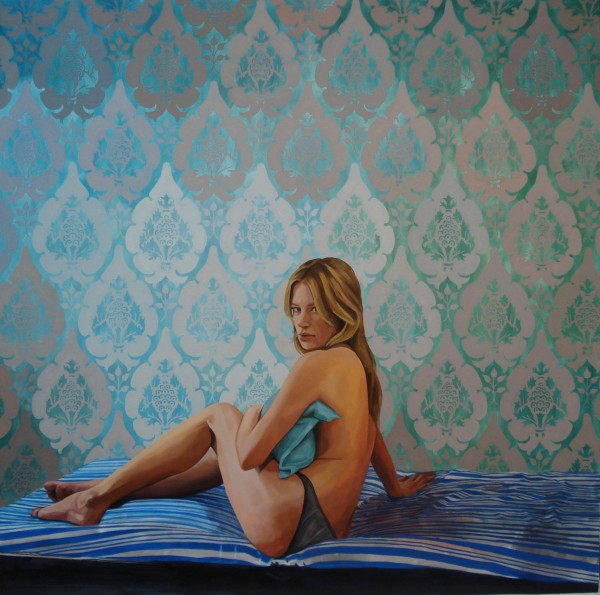
Opening tonight in Santa Monica’s Bergamot Station, Luis de Jesus Gallery is presenting new paintings by Karen Ann Myers in an exhibition titled Thinking Of You. In a series of mid-sized fleshy paintings of hyper sexualized young women, the work seamlessly combines heavy flat patterns with figuration. Patterns slide in and out of abstraction, only grounded by the figures in the image. Based in self portraiture and personal narrative, Myers work both questions and confirms the objectification and idolization of youth and sexuality in American culture. The fleshy flatness of pattern and color reflect the soft, subtle handling of the figures, and when the figures are absent, the color and line mimic the curves of the forms.

Along with the paintings, Myers is presenting several new screen-printed patterns that integrate decorative form with image. Hidden within the maze of pattern, one will find reductive Kama Sutra poses embedded in the sea of color and line.

Myers’ paintings and prints have been exhibited at the Robert Steele Gallery in New York, the Commonwealth Gallery in Boston, the Katzen Arts Center in Washington, DC and Scoop Contemporary in Charleston, SC. Her exhibition at Luis de Jesus will be on view until August 7th, 2010. In 2009, DailyServing did a visit with the artist in her studio to discuss the work in relation to her experiences in love and eroticism, her childhood memories, and herself as a young woman in a contemporary culture that places high value on glamor and sex appeal.

Thinking Of You will be on view through August 7th, 2010.

Share

I Love You Jet Li

L.A. Expanded: Notes from the West Coast
A weekly column by Catherine Wagley

Jaco Bouwer, "I Love You Jet Li," Film Still.

On Jekyll Island, the beaches are nearly rock-free and, at this time of year, ocean swimming feels like bathing in a warm tub during an understated earthquake; the waves roll gently but unpredictably. I spent the third week of June on Jekyll, a resort destination located on the North Atlantic, halfway between Savannah and Jackson. I was vacationing with my aunt and grandmother—the same grandmother who called Terry Southern a brooder and often says she could have married Jasper Johns if only he’d preferred women. The second night of our trip, a small storm broke out. We had seen white chairs and reception tents set up on the beach in anticipation of two weekend weddings and, as the three of us sat on our balcony watching the rain pass and drinking the heavy-handed martinis my grandmother prepared, we wondered if either bride had cried when she saw the clouds move in.

Brides and tears naturally led to the topic of heartbreak, and we took tallies. My aunt’s heart has broken three times. To date, mine has broken only once and my grandmother admits to only one break as well, though my aunt and I suspect her of fibbing (she argues that, if both parties agree that a relationship is doomed from the start, the hurt it causes doesn’t count; we find that logic dubious).

Jaco Bouwer, "I Love You Jet Li," Film Still.

My grandmother’s single countable heartbreak involved a married captain named Brooks. He was stationed at the army base at which she worked as an activities coordinator. He practically ordered her to date him, charmed her into loving him and then sent for his family. When my grandmother found out that his wife and children were on their way, she stopped taking his calls, and so Brooks tried to seduce her friendly Methodist roommate instead. “You must never compare the other men you meet to me,” he once told her. This sounded narcissistic and patronizing to me. “But it turned out to be good advice,” my grandmother said.

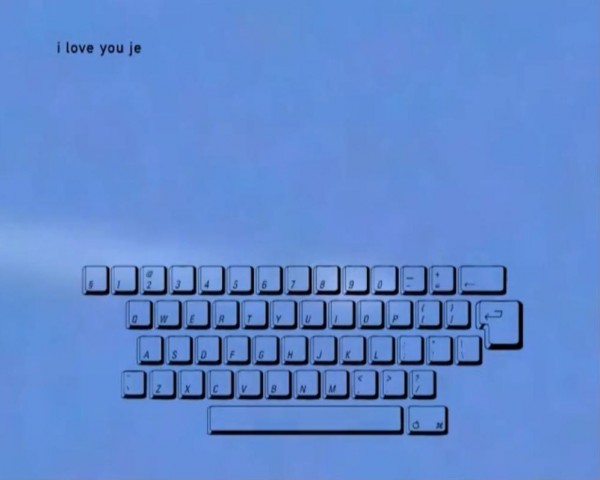
On June 26th, Freewaves, L.A.’s longstanding new media organization, celebrated its 20th anniversary with a video extravaganza at the Los Angeles County Museum of Art. Monitors were arranged in the shape of an oval and heartbreak, or the precariousness of being breakable, recurred as a theme. Jaco Bouwer’s I Love You Jet Li, the only video I watched three times, begins with this monologue: “I’m born with a septal defect. A hole in the heart. . . . Because of the hole, I’m defective when it comes to love.”

In I Love You Jet Li, the female narrator has a melancholic lilt to her voice. As she speaks, murky, slow-moving footage of figures waiting in an airport plays out on the screen. She first discovers the extent of her heart defect in high school, when her crush on a rebel vanishes as soon as he tells her she’s beautiful. She can love, but she can’t receive love. Later, her flirtation with a college English tutor ends after a graduation day hug: “He holds me a moment longer than appropriate. That’s the end of my crush.”

As the narrator speaks of falling for a married man, a young brunette woman wearing a tie-dye t-shirt with a heart in its center rubs her right arm and stares into space. Then, as the narrator speaks of the man who split her lip open and wore Def Leopard t-shirts  that she routinely ironed, a middle-aged woman in a pastel sweat-suit wanders through the airport, sometimes barefoot. At one point, this woman quietly cries.

Jaco Bouwer, "I Love You Jet Li," Film Still.

The narrator visits a therapist who tells her she’s confusing love with fear. She falls for this therapist who then dismisses her feelings. Her final crush, however, is the least attainable. She becomes enamored with martial arts film star Jet Li, learning about his hobbies and eating habits and masturbating to his fight sequences. She plans to visit to China to see him and emails asking him to meet her at the airport. “I don’t know martial arts,” she writes, “but my love is pure and true.”

Years after my grandmother ended her romance with Brooks, she randomly encountered him on a beach in the Philippines. It was a Sunday and she was heading to mass. He accompanied her and spent the rest of day trying to rekindle their flame, an effort she deflected, though doing so was hard. She knew he would hurt her, but part of her wanted that hurt.

Share