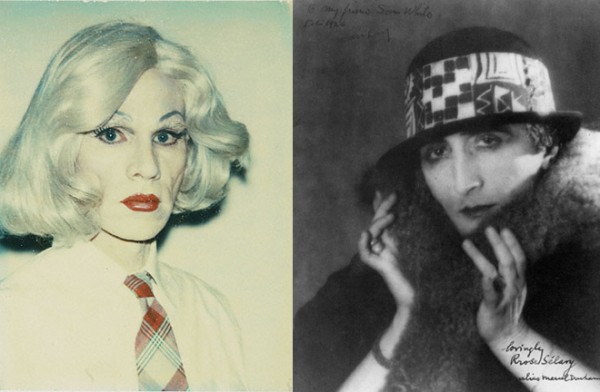
Warhol and Duchamp: Just like Bradshaw and Swann.

If the Andy Warhol Museum in Pittsburgh keeps putting on shows like Twisted Pair: Marcel Duchamp/Andy Warhol then maybe the ol’ Burgh deserves a place on the official Dia art pilgrimage map, along with James Turrell’s Roden Crater in Arizona and Walter De Maria’s New Mexican Lightning Field.  Curated by longtime Warhol archivist Matt Wrbican, Twisted Pair is smart, funny and long overdue. Where many curators employ obscure art theory in attempts to somehow prove that what they are doing is true, Wrbican actually uses the archive. This makes for a much more grounded take on these artists, which is exactly what they need after decades of art world deification.

This show reminds us that before all of the flashbulbs, fame and auction numbers, Andy Warhol was just another young New York artist, albeit a very promising one. It also accurately depicts Duchamp as being fairly aware of what young artists were up to, despite his status as art world legend. He was more accessible as a chess playing jokester than a solitary genius.

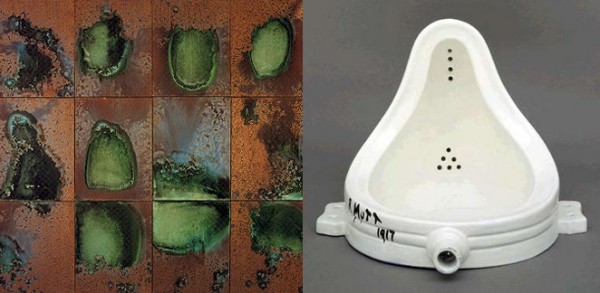
Andy Warhol, Oxidation, 1978. Marcel Duchamp, Fountain, 1917/1964.

There are some terrific pairings in this show, like Warhol’s Oxidation paintings next to Duchamp’s Urinal. There are also a few rare finds like Warhol’s The Lord Gave Me My Face But I Can Pick My Own Nose, 1948 and Duchamp’s Door at 11 Rue Larrey Photographic Enlargement, 1964. But some of the best stuff on view are the letters and archival material that might truly feel sacred to fans of either artist. Usually ephemera bores me to tears but here I was fascinated to see a butcher-paper test print for one of Warhol’s Shadows hanging above a case full of Duchamp’s optical illusion machines.

Among the qualities that Warhol and Duchamp share are a desire to shock, a taste for celebrity, a belief in the everyday object, a penchant for drag, and a strong voyeuristic impulse.  Duchamp’s groundbreaking idea of the readymade looms larger than any other in the 20th century and no one did more with it than Warhol.  Warhol understood that advertisements, consumer objects, newspaper photos, the Empire State Building, and people themselves were all up for grabs as objects d’art. If Duchamp’s Bottle Rack looks rather pedestrian next to Warhol’s Brillo Boxes, it’s because Warhol never fully committed to the anti-retinal to the same degree that Duchamp did.

Andy Warhol, The Lord Gave Me My Face But I Can Pick My Own Nose, 1948, Collection Paul Warhola Family.

This show is so effective in pointing out connections between these two artists that it is tempting to see them as the same creative force formed by two separate eras. However, their differences are just as striking as their similarities. Duchamp embodied an authentic lackadaisical attitude that Warhol could only feign. With a work ethic that would make his Pittsburghian forebears proud, Warhol called his studio the Factory and constantly cranked out product.  Duchamp let large amounts of time, not to mention dust, seep into his works before finishing them. Warhol was a worldwide sensation while Duchamp only appealed to art-nerds. These days it is impossible to imagine any appropriation art, assemblage, or hip art collective like the Paris-based Claire Fontaine without these two artists – they are so influential that we are almost tired of them.

My friends in Pittsburgh roll their eyes when I over-praise their city’s magnificent bridges, or go on about how the PPG Building is like the best Banks Violette sculpture ever. And yes, I’ve been caught on Greenpoint Avenue in Brooklyn wearing a Pittsburgh Pirates baseball hat.  But hometown bias aside, this show is worth traveling for.

On the other hand, Twisted Pair is so essentially New York that its next destination really should be the Whitney, but I doubt this will happen.  If a real sense of what these artists were like intrigues you, and the thought of seeing relics pertaining to their lives and work gets you all fluttery, then a trip to Pittsburgh is a must. After the show, indulge yourself with a little urban exploration. Vacant, post-industrial downtown Pittsburgh might be the closest thing to 60s SoHo to be found.

Share

Interview with Dan Attoe

This week, DailyServing is publishing content from a few of our friends and partnering websites in order share some amazing new artwork with you . Today, we have a fantastic interview with Dan Attoe from our friends at Beautiful/Decay. B/D features really great contemporary art, illustration and cultural content. Make sure to check them out if you haven’t already.

Dan Attoe, The Scrape, Oil on Canvas

When I met Dan Attoe we were both starting the MFA program at the University of Iowa.  I’ve known him for eight years now, and even though Dan lives in Washington State and I live in New York we have maintained our friendship through collaborations, especially with the art group Paintallica.

While at school we became friends – I’ve noticed Dan sort of collects weirdos like me.  Before coming to grad school Dan had created a studio practice that involved making a painting a day, and was already working on paintings that have a relationship to his current work.  While in school Dan wasn’t stuck on some notion of an ideal practice, he just worked while everyone else was talking about how to work, he wasn’t terribly concerned with theories; he has a background in psychology and knew to trust his own creative faculties.

While everyone else was screwing around with their identities, Dan had already settled into a kind of self-knowledge.  I don’t know if his gnosis came from growing up in the deep woods with a forest ranger for a father, or from one of the experiences he had growing up that caused him to study psychology and art.

Being alive you meet a lot of bull shitters and have to play a lot of stupid games, but rarely do you meet someone as genuine and considerate as Dan.

Dan, can you point to any one experience that pointed you towards becoming an artist?  There aren’t any other artists in your family are there?

No, there are no other artists in my family, but my mom has always been into crafts, and gave my brothers and I interesting projects, and lots of materials to work with.  I was one of those kids who always drew on his clothes, and before I had regular paints I used spray paint on my clothing, my skateboard and various ramps that I built.  When I was fourteen, my parents got me a set of acrylics with the intention of redirecting my impulses.  The result was that I started making more meticulous paintings on paper and canvas as well as clothing, but still maintained a fondness for spray paint.

I suppose that growing up in rural and remote places had something to do with my interests too.  There weren’t many activities for kids in the towns and ranger stations that I lived on, unless you were into sports, which I wasn’t.  There was a lot of trails and things to explore, which was pretty formative for me, but there was a lot of time spend indoors too, because winters in Minnesota and Idaho could be long and cold.  In addition, about half the time my family didn’t have television, so that wasn’t an option for entertainment.  I couldn’t always read, because I liked to listen to fast and loud music.  It’s hard to concentrate on a book at the same time as Metallica or Ministry lyrics, so I used to make things.

I got whacked in the head a few times too as a kid, so that might have had something to do with it.

Read More »

Share

Chad Person: Surviving the End of Your World

In an age of twenty-four hour a day news networks that constantly reflect  that we are in the midst of a major environmental disaster, multiple ongoing wars, and the worst economic crisis of our time, it is hard not to become a little paranoid or to begin thinking that the end of the world near. With this in mind it is no wonder that artists have begun to address these issues in increasingly direct ways.

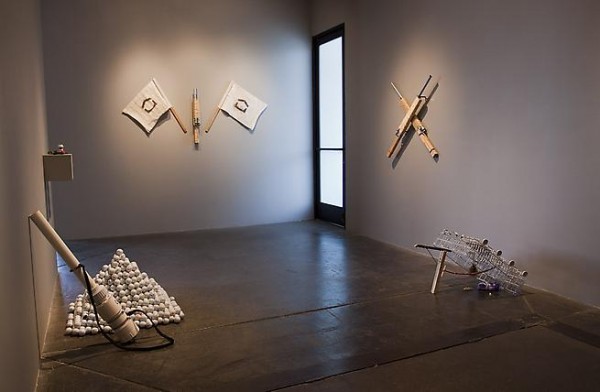
Artist Chad Person is presenting an exhibition titled, Surviving the End of Your World, currently on view at Mark Moore Gallery in Santa Monica’s Bergamot Station. For the exhibition, the artist is presenting works from his RECESS series (Resource.Exhaustion.Crisis.Evacuation.Safety.Shelter), which is essentially the remodeling of the artist’s home into conceptually sound environment that revolves entirely around survival.  Items in RECESS include a converted pool that now acts an operating bunker, a makeshift Double Barrel Shotgun, Modular Rain Barrels, Recycled Solar Oven, Golf Ball Cannon, and Signal Flags among several other objects. Within the context of the gallery these items become art objects loaded with cultural meaning.

The artist has also completed a series of collages which feature war related objects used by the US military, such as planes, helicopters, tanks and ships. These flat works are created through the meticulous deconstruction of US currency. Person actually deducts the money used to create the works from his taxes, potentially refusing to contribute to the war efforts through paying additional taxes. This is a logic that is essentially flawed, but which does make a potent statement.

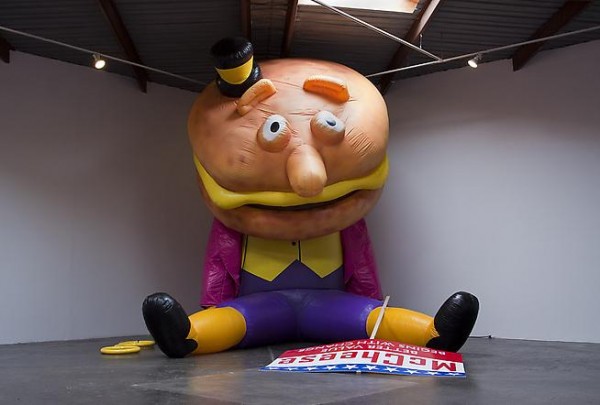
In the main section of the gallery, the artist presents two large inflatables, which dominate the space. Upon entering the gallery, the viewer comes across a large inflatable of the Mobil Oil Pegasus, lying on its side in a shallow pool of oil. This creature is followed by another large inflatable sculpture, this time of the McDonald’s character Mayor McCheese, who has lost his political stature and is now slumped into a corner. The figure dissolves into a metaphor for all political leaders who have failed in their vain attempt to better the world.

Chad Person lives and works in Albuquerque, New Mexico. The artist is a graduate of the University of New Mexico and has exhibited extensively in Southwest. Surviving the End of Your World marks his first solo exhibition with Mark Moore Gallery, and will be on view through August 14th, 2010.

Share

On Kawara: Pure Consciousness at 19 Kindergartens

Today’s article is from our dear friends at Art Practical, where Jessica Brier discusses the new work by On Kawara at the San Francisco Art Institute’s Walter and McBean Galleries.

It’s pretty safe to say that Conceptual Art’s moment has come and gone. Now that we are living in a period in which virtually all art is expected to be “conceptual” in some way or another, it’s refreshing to look back at the origins of Conceptual practice. On Kawara is one of the leading figures of this movement; he is particularly known for his ongoing Today series―iconic canvases painted black, each bearing the date of its own particular creation in bold white block letters. In 1997, Kawara recontextualized seven of these austere works by placing them in kindergarten classrooms across the globe, a social project he titled Pure Consciousness. Since this project existed strictly as a social experiment, the current exhibition in the small overlook gallery of San Francisco Art Institute’s Walter and McBean Galleries modestly showcases the project’s associated ephemera, including a collection of booklets created to document it and the seven paintings themselves.

Pure Consciousness booklet image of kindergarteners in Bethlehem, Palestine, with seven Kawara date paintings from the Today series in background, laid over other booklets. Image courtesy of Walter and McBean Galleries, San Francisco Art Institute.

Kawara is largely known for his sweeping but understated gestures that mark the passage of time. Sometimes these marks are diaristic, other times matter-of-fact. The Today paintings strike me as both―they are personal, in the sense that each is reminiscent of the artist’s hand and reflective of the way he spent a particular day of his life (following his own self-imposed requirement that each one be finished on that given day). But they are also universal, in the sense that anyone can imbue them with his or her own personal associations with that particular date. Aesthetically, they are stark and exact, appearing more like prints than paintings. In this way, Kawara flirts with Minimialism, as well as with the basic principles of graphic design.

Pure Consciousness borrows its title from a quote by Leo Tolstoy; it refers to the stillness of one’s sense of self in relation to the constant passage of time. It’s a Zen-like idea that advocates for paying attention to something as basic as time passing. The title also refers to the notion that children possess a “pure consciousness,” and are more open to absorbing the ideas and images they learn, hear, and observe. This, of course, is the beauty of the kindergarten classroom, the setting for this conceptual project.

Read More »

Share

From the DS Archives: Venice Biennale, Krzysztof Wodiczko

This past week, the United States government sued Arizona to block strict new immigration laws that will criminalize illegal transnational immigration in that state.  In light of this, we chose to pull Krzysztof Wodiczko’s Guests From the DS Archives to be reconsidered in the context of our country’s continuing debate over immigration reform.  Guests takes on new meaning when repositioned close to home.

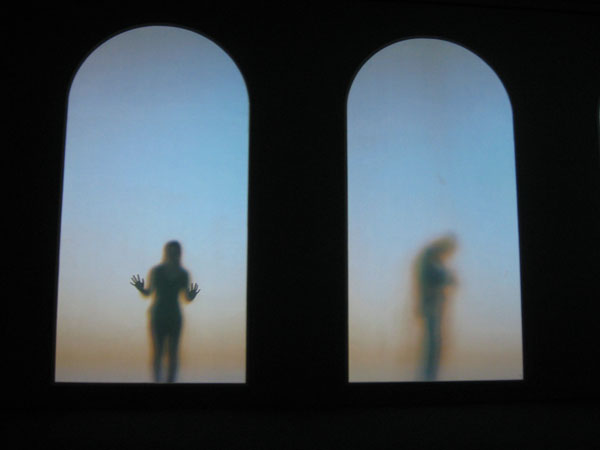
Krzysztof Wodiczko’s Guests represents Poland at this year’s 53rd Venice Biennale. Wodiczko’s video projection installation is at once an aesthetic and a political work. While much contemporary art addresses social and political issues, it is an exceptional achievement for an artist to convey such commentary through powerful aesthetic means as Wodiczko manages to do in this work.

Guests is realized by the projection of large-scale windows physically surrounding the viewer on the walls and ceiling of the darkened Polish Pavilion.  The windows create an invisible but obvious barrier that cannot be crossed by the shadowy, silhouetted figures behind them.  It is clear that these figures are immigrants and refugees through the installation’s accompanying sound element featuring voices discussing their struggle for work visas, opportunity, and national identity.  These stories are pulled from Wodiczko’s own research into the experiences of immigrants from around the world residing in Poland and Italy. Throughout the length of the looping installation (approximately 17 minutes) various vignettes of people come in and out of focus as they are alternately burdened with luggage, washing windows, blowing leaves, sweeping, and selling umbrellas.  In a few poignant instances the shadowy figures look inside, touching the window panes, underscoring their exclusion.

Wodiczko brings the highly relevant predicament of restrictive immigrant policies into the gallery space to educate and to confront the typically elite Biennale audience.  Wodiczko’s Guests certainly presents an idealized account of the immigrant figure, but in doing so creates an effective argument that perceived ‘outsiders’ and ‘others’ are vital members of society.  Wodiczko’s own intent can be summarized by the quote he includes at the pavilion’s entrance: “Refugees driven from country to country represent the vanguard of their peoples.” (Hannah Arendt, 1943)

Krzysztof Wodiczko earned his MFA from the Academy of Fine Arts in Warsaw in 1968.  As a prominent contemporary artist, Wodiczko has been awarded many prizes including the Hiroshima Art Prize (1998) and the Katarzyna Kobro Prize (2006).  He is also a prolific writer and theorist.  Wodiczko is currently Director of the Center for Advanced Visual Studies at MIT and professor at the Warsaw School of Social Sciences and Humanities.  He lives and works in New York, Cambridge, Massachusetts, and Warsaw.

Kryzstzof Wodiczko’s Guests was curated by Bozena Czubak.  It was commissioned by Agnieszka Morawinska and the Zacheta National Gallery of Art along with other supporting institutions for the Venice Biennale.  Guests remains at the Polish Pavilion through 22 November 2009.

Share

All I Really Need To Know I Learned From Baldessari

Today on DailyServing, we have gone to our wonderful friends at the Huffington Post for a brilliant article on the Baldessari retrospective, Pure Beauty, at LACMA. LA-based arts writer, Rebecca Taylor, eloquently lists some of the lessons learned from the work on view.

John Baldessari, Pure Beauty 1966-68, acrylic on canvas. Courtesy of Baldessari Studio and Glenstone

1. It’s all relative, especially Beauty

I can’t imagine a more fitting title for Baldessari’s current retrospective (on view at LACMA through 12 September 2010) than Pure Beauty. The exhibition title references an early Baldessari work of the same name from 1966-68, an off-white canvas with the phrase literally painted in black, capital letters, and was explicitly selected by the artist himself. From the dawning of Greek Classicism to well beyond the Italian Renaissance, artists learned to faithfully master contrapposto, linear perspective, and the like in order to achieve the great, mythic aspiration of beauty. Room after room in the exhibition reminds the viewer of the ubiquitous, albeit trite, truth that beauty is in the eye of the beholder. For example, in Choosing (A Game for Two Players): Carrots (1972), Baldessari asks two participants to impose their own aesthetic criteria upon a grouping of carrots (or green beans in the case of Choosing: Green Beans, 1971). As participants select the carrot that appeals most to them, said carrot is advanced to the next round and compared against two new carrots, and so on, and so forth. Ultimately this “faux exercise of taste,” as David Salle calls it, communicates the message that if there isn’t even consistency in scrutinizing a vegetable, how could we possibly impose a universal definition of beauty? Long-coveted, it continues to elude us.

2. The Rightness of Wrong

In 1996 art historian Abigail Solomon-Godeau penned the essay “The Rightness of Wrong” (1996) which praised Baldessari’s now infamous hybrid painting/photograph Wrong (1966-68) showing the artist purposefully disregarding the “rules” of photography and positioning himself in the shadow of a giant palm tree, that seems to emanate from his head, as he stands directly facing the camera in front of an ordinary tract home. Embracing “the wrong” extends well beyond this singular work and infiltrates Baldessari’s entire oeuvre, whether it’s circumventing the essence of a portrait by obliterating the face of the sitter (Portrait: Artist’s Identity Hidden with Various Hats, 1974) or using subliminal seduction – a la the panned low-art of advertising – to sell himself in his works (Embed Series: Ice Cubes: U-BUY BAL DES SSARI, 1974). Baldessari proves time and again that it’s right to be wrong.

3. Clement Greenberg doesn’t know it all

Baldessari’s Clement Greenberg (1966-68) quotes the critic’s canonical text: “ESTHETIC JUDGMENTS ARE GIVEN AND CONTAINED IN THE IMMEDIATE EXPERIENCE OF ART. THEY COINCIDE WITH IT; THEY ARE NOT ARRIVED AT AFTERWARDS THROUGH REFLECTION OR THOUGHT.” I couldn’t disagree more. What sets a work apart for me is not necessarily my initial reaction or experience – though I’m not discounting works who do pack an immediate punch, as they say – but that which infiltrates the subconscious and, in the words of Baldessari, “lingers in one’s mind.” One might liken it to the fleeting passion of puppy love, often brought on in an instant, versus the staying power of a genuine friendship, earned through time and manifestation.

John Baldessari, Heel (1986). Courtesy of Museum Associates/ LACMA

4. Banal ≠ boring

Whether arranging mundane objects in his studio according to their actual height (Alignment Series: Things in My Studio (by Height), 1975), throwing a ball in the air repeatedly to try and photograph the object in the center of the frame (Aligning: balls, 1972), methodically scribbling on a sheet of paper (I will not make any more boring art, 1971), or juxtaposing a vase of flowers with the apocalyptical text “There isn’t time” (Goya Series: There isn’t Time (1997), the ordinary becomes extraordinary when manipulated by the hands (or more accurately, the mind) of Baldessari. According to John, Sol Lewitt once told him that boredom is interesting when you work through it, and Baldessari has consistently proven this to be the case during his forty-plus year career.

5. Question what is not there with as much tenacity as you question what is there

Nam June Paik once explicated to Baldessari one of the most profound, and idiosyncratic, aspects of his work, saying that what he liked best about John’s work was what he left out. For example, in his Extended Corner series, Baldessari reproduces the exact measurements of famous canvases by Parmigianino, Bruegel, and other masters, but literally whites out the entire image, save a small rectangle in the corner. All that’s left of an epic battle scene or archetypal allegory is a small foot or corner of a building or table. Why does he negate all but the most, seemingly, trivial piece of visual information? In providing his viewer with only small, carefully selected pieces of information, Baldessari creates a conundrum for which there is no solution and allows the viewer the freedom to connect the dots and draw their own conclusions.

6. Always Rise from the Ashes

Baldessari’s work is infused with the notion that art comes out of failure and destroying things. He even describes his practice as reductive – “removing things until the work is nearly dead.” There’s no greater example than his landmark performative piece Cremation Project (1970), in which he formally ended his career as a painter. First, he gathered all the paintings he’d created prior to his photo-and-text compositions (meaning everything done before 1966) – save four he’d forgotten were in his sister’s garage -and had them cremated. In an affidavit published in the San Diego Union, Baldessari formally and publicly renounced painting in favor of a hands-off, post-studio approach. The ashes of the paintings were permanently immortalized in a book-shaped urn and a memorial plaque was commissioned declaring:

JOHN ANTHONY BALDESSARI
MAY 1953 MARCH 1966

John Baldessari (centre) overseeing Cremation Project 1970, from "Somebody to Talk To," by Jessica Morgan and John Baldessari, Tate Etc., Issue 17 / Autumn 2009.

7. Reject the stranglehold of the L.A. aesthetic, and all prevailing aesthetic authorities for that matter

The only thing consistent about Baldessari’s style is his inconsistency. He perpetually oscillates between color and black-and-white, large and small scale, text and image, etc. Beyond that, he defies simplistic categorizations. Is he a photographer or a painter? A performance or video artist? An installation or land artist? Yes, yes, and yes. Baldessari systematically rejected the pervasive L.A. style, oft called “the cool school,” and likewise rejected the philosophies of New York conceptualists Joseph Kosuth and Sol Lewitt, opting instead for his own unique visual language that defies categorization, but is irrefutably John Baldessari.

8. Viewership is active, not passive

Baldessari reminds the viewer of their importance in so many subtle ways throughout the exhibition, but most notably in A Painting That Is Its Own Documentation (1966-68), whereby the canvas is transformed into a work of art simply because it has been displayed and seen. For Baldessari, a viewer has a responsibility, not to consume images passively, but really look. In one of his iconic photo-and-text pieces, he reproduces the revered artforum (an issue with a painting by Frank Stella on the cover) and juxtaposes the magazine with a confusing edict that This is not to be looked at (1968). Baldessari, ever the contrarian, spins a tangled web with this diktat. Whether it’s a play on the meaning of image vs. object (a la Magritte), a call to “read” rather than simply look, or an autobiographical reference to his own isolation from the New York art world, the diversity of meanings and narratives derived from this “simple” juxtaposition have kept critics opining for years.

9. Irreverence is always in good order, even in regards to high art

“In the beginning, I asked myself ‘What would happen if I did this?’ and the work proceeded from there,” (Baldessari in conversation with Matthew Higgs at Frieze, 2009). This statement underscores the artist’s belief that the reason kids often make the best art is because it is made without the pretension that they’re doing “art.” Perhaps that is Baldessari’s greatest talent, humility in the face of fame and success, always making art that stems from a question rather than art for art’s sake. Indeed, Baldessari’s irreverence for the sanctity of art permeates his oeuvre, whether it be negating all but a corner of a Parmigianino masterpiece, mocking the great art critic Clement Greenberg with his own words, parodying the color-field painters by “floating” large rectangular blocks of color outside the second-story window of his home (Floating: Color, 1972), or pairing Goya’s catastrophic texts from his Disasters of War series with everyday objects like a paper clip.

10. The best way to teach art is to live art

Baldessari’s roster of former students reads like a who’s who of important artists from the past 40 years: Barbara Bloom, Liz Craft, Meg Cranston, Jack Goldstein, Karl Haendel, Skylar Haskard, Elliott Hundley, Mike Kelley, Tony Oursler, Liz Larner, Matt Mullican, Analia Saban, David Salle, and James Welling, to name a few. Stories of Baldessari’s post-studio classes, a term he first heard from Carl Andre and employed thereafter, are the stuff of legends in Los Angeles. The most often repeated description of John’s teaching style was that he treated them with respects, always thinking of them as artists, not students, and allowing them to find their own voice. Baldessari himself has said, “You can’t teach art but it might help to have really good artists around.”


Share

Argue with Pictures

L.A. Expanded: Notes from the West Coast
A weekly column by Catherine Wagley

Robert Heinecken, "Time (1st Group)," 1969. Courtesy Cherry and Martin.

Hugh W. Diamond, a 19th century English psychiatrist, began using photography as a therapeutic strategy nearly as soon as photography existed. Diamond would photograph the mentally ill patients he worked with and then confront them with the resulting likenesses, confident that the radical power of reality would jar them into recognizing their own delusions. He once wrote of a patient he called A.D., who believed herself to be royalty:

Her subsequent amusement in seeing the portraits [of herself in various stages of her illness] and her frequent conversation about them was the first decided step  in her gradual improvement.

Diamond believed his strategy worked—no one can argue with a picture.

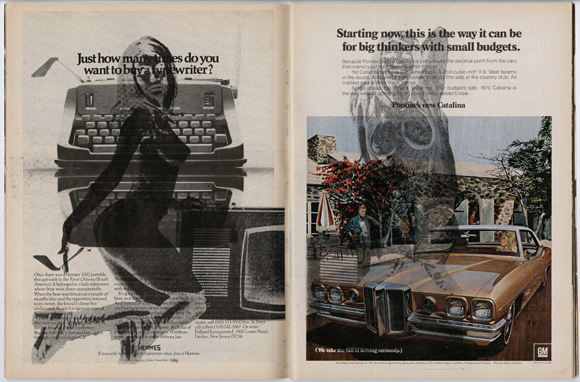
But argue with pictures is practically all artists have done over the past 60 years, ever since pop cut into the ego of abstract expressionism and advertisements became as visually adventurous as art. They Have Not the Art to Argue with Pictures, the current exhibition at Cherry and Martin Gallery, takes as its premise the immense distrust that 20th and 21st century artists have for the photographic image. It also probes the indulgent fascination that always seems to accompany that distrust.  They Have Not the Art primarily mines the work of Robert Heinecken, the late California artist whose gritty, un-apologetically risque reinterpretations of magazine imagery exposed but also seemed in awe of pop culture’s sexiness.

Robert Heinecken, "Revised Magazine: Jungle Prints / Cuts / Porno," 1993. Courtesy Cherry and Martin.

In Revised Magazine: Jungle Prints / Cuts / Porno (1993), Heinecken juxtaposes images from mainstream ads–a black and white one that says “Be what you want, but always be you” and another of a model in a tiger print top–with blatantly erotic images of women painted with tiger stripes or clad in jungle print jump suits. The resulting tangle of bodies is crass and even cheap; there’s nothing lyrical about the way Heinecken cuts into and overlays images. In another collage, Hite/Hustler Fashion Beaver Hunt #1 (1981), a stately woman holds a blue fan and stands between two plush arm chairs. She would have been wearing a white sheath if Heinecken hadn’t replaced it with the cut out of a tan, nude female torso haphazardly wrapped in black and white rope. Instead, she wears a naked body.

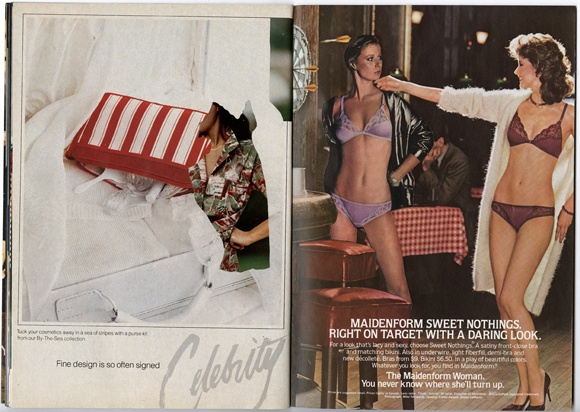
Heinecken’s images feel dirty, not because they’re in poor taste or needlessly provocative, but because they literally do “dirty up” the sleek surface of ads in a way that doesn’t invalidate the sensuality of glossy imagery but rather follows that sensuality through to its natural conclusions. If Heinecken aimed to combat the packaged, deceptively complete aura of 20th century advertisements, he did so by exposing and then re-complicating their subtext.

Robert Heinecken, "Revised Magazine: Maidenform," 1993. Courtesy Cherry and Martin.

Subtext literacy is what the exhibition’s ungainly title,  They Have Not the Art to Argue with Pictures, refers to. It’s a phrase from Marshall McLuhan’s 1964 book, Understanding Media, written after Heinecken had already begun his long career as an art-maker. McLuhan suggests that pictures can’t be understood in the sequential way most have been taught to read text and that those who have the tools to argue with contemporary imagery are those who understand that media collapses sequences into each other and presents a thrust of emotional energy meant to manipulate.

Heinecken had the tools he needed to argue, but not to conquer. The exciting and frightening aspect of his work is that it’s endlessly caught in the web of its source material. Even though Heinecken breaks into imagery, superimposing pin-up girls over domesticated car ads and cutting body parts out of magazine spreads, he never breaks out of it. But breaking out isn’t the point; needing to argue is.

They Have Not the Art to Argue with Pictures, which closes on July 17th, also traces Heinecken’s legacy through the work of a number of younger artists, including Erik Frydenborg, Nicolás Guagnini, Wade Guyton, Leigh Ledare, Amanda Ross-Ho and Collier Schorr.

Share