Summer of Utopia: Michael Rakowitz

On Day 5 of our latest week-long series, Summer of Utopia, we dive into the work of Michael Rakowitz, whose work has consistently interacted with the leveling of inequality or the recasting of a troubled history. As we take this week to consider how the art world uses or abuses the idea of utopia, one might be able to see how small steps to understanding our current social climate takes us just a little closer to an ideal world.

Joe Heywood's paraSITE shelter, 2000. Courtesy of Lombard-Freid Projects.

Despite our culture’s claim to equality, one cannot deny the social injustices that surround us. I doubt that anyone could see our society as utopian in any way, but somehow equalizing injustice and correcting histories seems to be one step closer to a perfect world. I will admit, I always find it interesting when artists directly interact with their own culture, and the history of Michael Rakowitz’s work does just that. For years, Rakowitz worked with the homeless to design structures that would use the wasted heat from ventilation systems to keep them warm. As his project paraSITE grew, each structure became more and more customized to the individual’s needs and desires. Each structure allowed for what the individual wanted – mobility, freedom and outdoor living – by using the discarded materials from the surrounding environment.

Davisons & Co. as a storefront on Atlantic Avenue in Brooklyn, 2006. Courtesy of Michael Rakowitz.

In 2004, Rakowitz began his project Return, where he reopened his grandfather’s import and export store, Davidson & Co. Following his grandfather’s history of moving to New York in exile from Iraq as many Iraqi Jews have experienced, Rakowitz’s storefront allowed for people in the US to send items to their loved ones in Iraq – a simple gesture of facilitating connection across a great cultural divide. As the project developed, Rakowitz tested importing Iraqi goods to the US, despite the failing wartime infrastructure. Through a long and tedious exercise in patience and diplomacy, Rakowitz finally began selling Iraqi dates to his customers, connecting the displaced Iraqi citizens in New York with their memory and nostalgia for their home.

May the Arrogant not Prevail, 2010. Courtesy of Lombard-Freid Projects.

Rakowitz’s most recent project, May the Arrogant not Prevail, at the Haus der Kulturen der Welt in Berlin, recreates the Ishtar Gate which has become a tourist attraction for American soldiers in Iraq. The original Ishtar Gate was taken to Berlin in 1930 and now lives in the Pergamon Museum, leaving only a replica standing in Iraq today. Built out of Middle Eastern newspaper and packaging, Rakowitz’s replica rewrites the history of the gate with the detailed inclusion of the cultures’ sorted histories. Revisiting a structure with centuries of historical strife, May the Arrogant not Prevail seems to bring to mind the evidence of Iraq’s war-stricken past reminding us all that history is made by those who are in power. And, this new work just goes to show that our world will never reach utopia without paying attention to how we treat each other now.

Michael Rakowitz received a Masters in Visual Studies from MIT in 1998 and teaches at Northwestern University, and his recent projects have included a solo show at Tate Modern and Lombard-Freid Projects in New York.

Share

Summer of Utopia: Antony Gormley

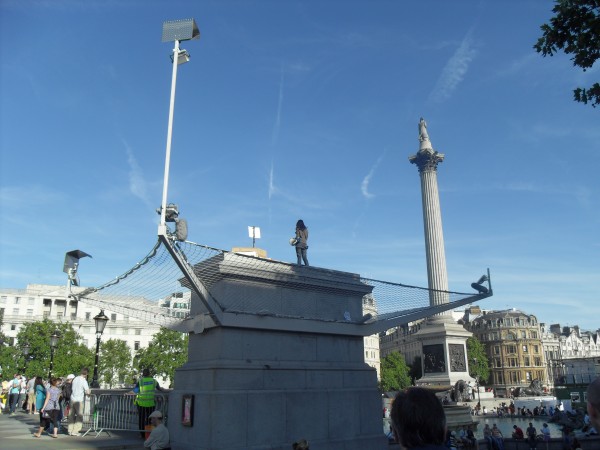
On the north-west corner of Trafalger Square in London lies a structure simply coined the Fourth Plinth. Originally designed in 1841 by Sir Charles Barry, the massive pedestal was intended to display an equestrian statue, but the sculpture was never finished due to a lack of funds. Since the late nineties, the Royal Society for the encouragement of Arts has commissioned several sculptural works for the Fourth Plinth including works from Marc Quinn to Rachel Whiteread.

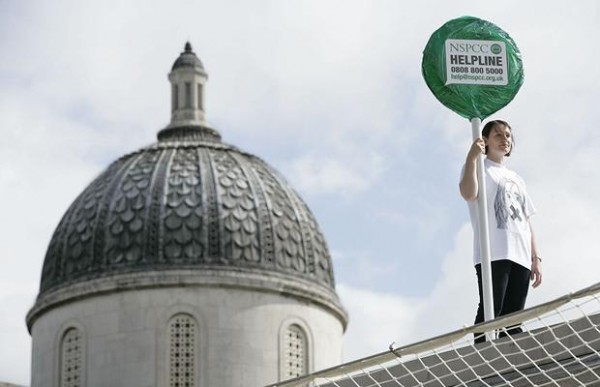
Last summer, British artist Antony Gormley was also invited to complete a project utilizing the Fourth Plinth. Instead of creating a static sculptural form to sit elevated on a pedestal before the city, the artist took a risky move to randomly invite 2,400 people to occupy the structure for a period of one hour, twenty four hours a day for a total of 100 days. Titled One & Other, the pieced allowed each person that inhabited the plinth to become the work of art,  leveling any hierarchy that defines who should be represented in a work of art. Each attendee occupied the structure alone, but was allowed to do anything they like for the hour, providing that it is legal in the UK.


For a brief period, participants could address the world at large and speak to any issue that is of concern to them.  Certainly a momentary equality of voice doesn’t exactly elicit the illusions of grandeur that are usually associated with political or societal utopias, but the ability to speak openly to an audience about an idea or issue that you are invested in without consequence is certainly the first step to identifying a common ideal. To further extend the impact and reach of each participants voice, every minute of the 100 day project was streamed live over the internet and then archived for indefinite public access.

However, Gormley’s work isn’t just interested in the idea of or struggle for utopia in relation to society, politics or even a specific place. Most often the work quietly references the notion of balance and harmony as a state of being. Gormley’s training in archaeology, anthropology and art history at Cambridge University, mixed with years of practice with Buddhist meditation in India and Sri Lanka has positioned him in a unique place to express the experience of inner balance to a greater audience though the language of visual art. When describing the material usage for the majority of his figurative sculptures, the artist will state air as a fundamental material. This is because Gormley is as interested in the inner ‘space’ of his forms as he is the ‘outer space’ that the form itself occupies.


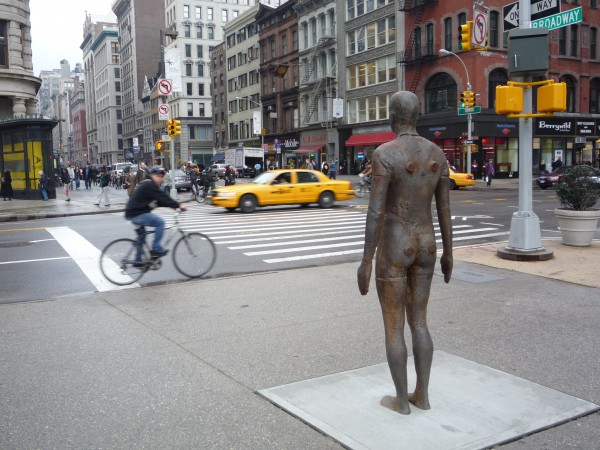
For his first US public art project, the artist is presenting Event Horizon, a current project that includes 31 life-sized figures cast in iron and bronze modeled form the artist’s own body and now populate Madison Square Park and rooftops throughout New York’s Flatiron District. In an area that is vibrant, hectic and anything but still and quiet, these forms serve as a reminder of the balance and utopia that can be obtained inwardly even in the most chaotic of locations. However, this reminder often happens in an abrupt and oddly irritating way. In a recent interview with the New York Times, the artist addressed this notion stating, “You could almost say the insertion of the sculpture is like the insertion of acupuncture needles within a collective body. And seeing how the body as a whole reacts to the presence of this irritation is very much the point.”

Share

Summer of Utopia: Rosa Casado and Mike Brookes

Today we continue our week-long series, Summer of Utopia, through the work of artists Rosa Casado and Mike Brookes. Spanish performance artist, Rosa Casado and British visual artist, Mike Brookes initiated a long-term collaboration in 2000 focusing on performative engagements in social spaces,  informed by seminal works addressing utopian ideals of social equality,  self-organization and ecological sustainability.

Paradise 2 - the incessant sound of a falling tree; Photo by Rafael Gavalle; Courtesy of Rosa Casado

In Paradise 2 – the incessant sound of a falling tree, Casado recites a text based on Jorge Furtado’s Ilha das Flores, a film examining humanity within capitalism. Reflecting on her ability to holiday in Mali having “profited” from work, Casado deftly draws diagrams of her voyage on the ground. Her gestures are interspersed with deliberate consuming of chocolate trees from a chocolate island, each eaten tree activating a sound that creates a loop. She narrates and draws out the voyage taken by Ibrahima Boyé, from Senegal where he was unable to make “sufficient profit” and travels to Spain for work. Though alike in intellect and core physical characteristics, Casado’s journey is one of a tourist, while Boyé’s is that of an immigrant. In an era where consumption and profits form progress, a sense heightened by the rhythmical percussion sound increasing in beats as the trees are eaten by the end of the 40-minute performance, how do we consider our desires and value of human dignity?

Some Things Happen All At Once; Photo by Mike Brookes; Courtesy of Rosa Casado

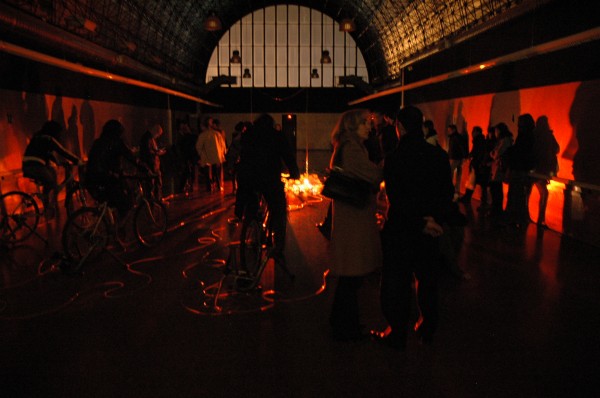
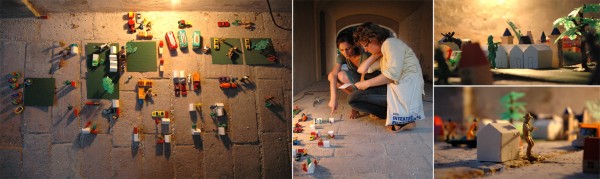
Similarly, Some things happen all at once comprises an installation typifying a community within a 45 minute durational set, represented through 150 ice trees, 60 ice houses and an ice church on the ground. A reading drawing on writings of architect, Buckminster Fuller and scientist, Philip Ball, muses on the extraordinary ways earth maintains the balance of energy exchange and humankind’s capacities to develop survival strategies. As the audience’s heat hastens the ice melting, attempts are made to sustain the village through a bicycle powering a cooling system. The balance between hot and cold senses, and solid and liquid visual properties display the inter-dependence of humans and nature. Against the possible fate of the earth as a heat reservoir, the interventions to foster sustainability provoke thought on the realities of human presence, action, and negligence.

One thing leads to another; Photo by Mike Brookes; Courtesy of Rosa Casado

Human interventions as a critical part of systems takes precedence in One thing leads to another, a durational piece involving the movement of 50 small toys forwards. Visitors become agents of change, articulating the game’s rules and deciding how the game progresses. This action varied across contexts. In June 2008 in Polverigi, it was developed through the streets of the town. In October 2009 in Singapore, participants developed a game which expounded personal meanings of progress in workshops, culminating in a public presentation where visitors played the games, opening discourse and making visible assumptions of social rules and progress.

Casado and Brookes do not pronounce an all-encompassing utopian vision and acknowledge decay and destruction as inevitable scientific processes. Yet, a palpable utopian quality at the core of their works rests in the belief in the human conscience which, when activated, enables meaningful action.

Casado trained in ballet, studied physics at the University of Madrid and theatre at Istituto d’Arte Scenica. Brookes is a Creative Wales Award Recipient 2007 and a Creative Research Fellow at the University of Wales, AberystwythParadise 2 will be presented on 26 September 2010 at Teatre Municipal de l’Escorxador, Lleida, Spain. A new work, Just a little bit of history repeating exploring how a place acquires meaning through time will feature at the b-side multimedia arts festival, Weymouth and Portland, Dorset, UK which runs from 17 to 26 September 2010 and at Festival BAD in Bilbao, Spain in October 2010.

Share

Summer of Utopia: Interview with Ted Purves

Today, Daily Serving continues our seven-day summer series, Summer of Utopia, where we investigate the work of seven different artists who either employ or interrupt ideas of utopia. Full disclosure: Ted Purves was the first person I met at the California College of the Arts and—despite the fact that I don’t work in relational aesthetics—one of the reasons I decided to apply to their graduate program. He is the editor of the seminal book What We Want Is Free and founder of the country’s first MFA in Social Practice. Last week he took some time to discuss utopia, democracy, morality, and the success of the projects he creates with his partner Susanne Cockrell.

Ted Purves and Susanne Cockrell. Temescal Amity Works, July 2004-January 2007.

Bean Gilsdorf: I listened to your interview at Bad At Sports and you said, “I’m not a utopian in any way” and that intrigued me. Tell me how you’re not a utopian, working in social practice.

Ted Purves: Let’s think about what the utopian project is: generally, to design a coherent social system that satisfies all basic needs. Thomas More created this very intense class structure, and utopia saw to the needs of the upper and middle classes. It’s really horrifying, utopia, because it’s the idea of agreement about what a perfect society is. We don’t live in times of agreement or tribal identity or singular religious identity. We live in a situation of disagreement and negotiation. I’m much more interested in the notion of democracy rather than the notion of utopia, because it allows for the possibility of negotiation and change and alteration. Democracy is about the peaceful negotiation of disagreement.

BG: Has that come up in your work, like the Temescal Amity Works, that feeling of negotiating disagreement?  Where has that come in for you guys?

TP: I wouldn’t say that we’ve actively looked at disagreement in our projects. We’ve been working from another starting point: the position of economies in people’s lives and how exchange functions. Even though we tend to think of ourselves as living in this highly capitalist market economy, we actually live within several different economic systems all at the same time. Getting paid and going shopping is participating in a larger capital economy, but giving a friend a lift to the store is a different, casual kind of economy. Not all of our relationships are of cliency and payment. We are interested in the way people are negotiating between competing or overlapping economies within their own lives, and creating a way to see that there are different ways to view your own personal economy. For instance, the projects about sharing fruit were about getting people to think about latent caloric energy that’s growing in the neighborhood, free of charge, at the same time that people are going out to stores to maintain their bodily lives. It’s getting people to see that we’re living in one system where we’re working to get money to buy calories when, yet, there’s another production of calories that’s going on…

BG: …aside from that, parallel with that…

Ted Purves and Susanne Cockrell. Temescal Amity Works, July 2004-January 2007.

TP: …yeah, right under our noses, that’s not being used. And how do you create a project that illuminates this other kind of economy? One project I admire is The Blue House project. It’s a really interesting counter-utopian project because it’s about creating a space for unplanning, a space for ongoing negotiation and debate in a highly planned suburb—even though the idea of that suburb wasn’t necessarily to be a utopia. I think there is a utopian interest in most kinds of civic planning because they are based on the idea that there is a perfect fix or a mostly-perfect decision to make about how you apportion resources, how you set up where people are going to live, what people need, and what’s going to make them happy.

BG: There seems to be a kind of benevolence that underlies a lot of these projects, and I wonder if you guys think about that explicitly in your work. Does morality enter into this at all?

TP: I don’t know if morality does because from our “negotiation-and-disagreement” mindset, morality is another sort of thing that is always going to be disparate among people, so it’s always going to be a negotiated space. We’re interested in working with the public and in public spaces to learn what people think and how people perceive public space around them. We start a lot of these because we don’t know everything about a situation and we’re curious about it, and we are interested in creating opportunities for research and dialogue with people.

BG: So you start with a question?

TP: Exactly. Temescal Amity Works started with questions: What is the history of the neighborhood that so many fruit trees were planted here? How do we negotiate the idea of the developed economy of the neighborhood? And that’s given way to a larger set of questions that we’re thinking about: how does the social imagination continue to drive people’s decisions, beliefs, lifestyle choices?  What kinds of social imaginaries regarding the rural inhabit the minds of people in cities?

Ted Purves and Susanne Cockrell. Lemon Everlasting Backyard Battery, 2008; installation view at San Jose Institute for Contemporary Art.

BG: When do you feel a project is successful?  What makes you go home and high-five each other at the end of the day?

TP: I feel like a project is successful if we have had substantive encounters with people, if we have created spaces where a kind of exchange—whether it’s family history, or talking about why something should or shouldn’t be in an art museum, or sometimes it’s just swapping recipes—some form of animated or engaged dialogue comes out, or some sort of story emerges. It means we learn something, a story can be brought forward from that, that’s when things are successful. Another high-five moment comes when there is something compelling to look at. A lot of times when you see a social practice show, it’s either a room full of crap to read, or it looks like a place where they had a party and you didn’t get to go. I’ve been to a lot of those, and they’re not satisfying! You either wish they had just printed a book you could take home and read in your own chair—because it’s not very comfortable to sit in a museum—or you wish that you’d been at the party. When we did Lemon Everlasting Backyard Battery we had hundreds of jars of lemons on this table, and it was beautiful.

BG: It sounds like bringing aesthetics back into it is important.

TP: Yes, certainly when there’s a material expectation for it to be art. [Lemon Everlasting] was great for us, because it got to be beautiful-looking, but it also got to do something; two things were happening in the same space. It occupied the institution and it challenged the institution in ways that were playful, functional and aesthetically critical. Aesthetics are important. Obviously some artists don’t think this way. They can just go in and do straight up exercises, and by the rules of the game that’s art too, but for us there’s got to be something else, a twist, a different way of seeing. We’re working in public space, so we need to challenge public expectations, a kind of weirdness, wrongness, whatever that might be.

BG: Do you think of projects as iterative? Would you want to restage that project, or do something similar someplace else? Or have the questions been answered and now you can move on to other questions that have been formed by the outcome?

TP: That’s a great question. I think it depends from project to project. I would definitely say that you never answer all the questions. The new thing we’ve been working on is this ongoing newspaper project, The Meadow Network. We structured it in a specific way because a thing like Temescal Amity Works was such a Herculean effort that you don’t want to do it again! We created TMN so that there was an option to have a repeatable form that could grow on itself, so that we wouldn’t have to reinvent an entire project every single time… That only half answers the question: I think it is good to have some projects or programs that are sort of open-ended but able to be temporarily concluded, because some questions don’t go away.


Share

Summer of Utopia from the DS Archives: Meeson Pae Yang

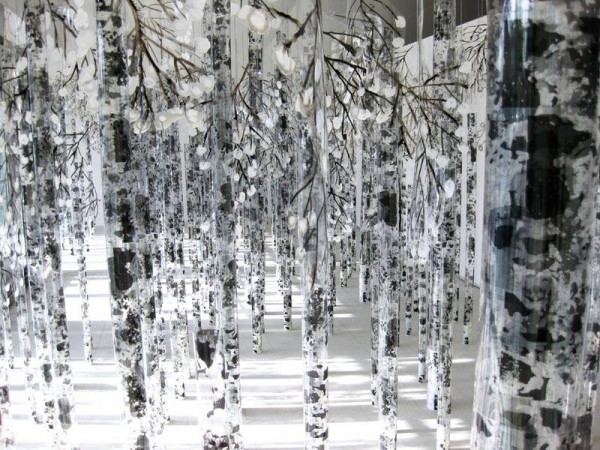
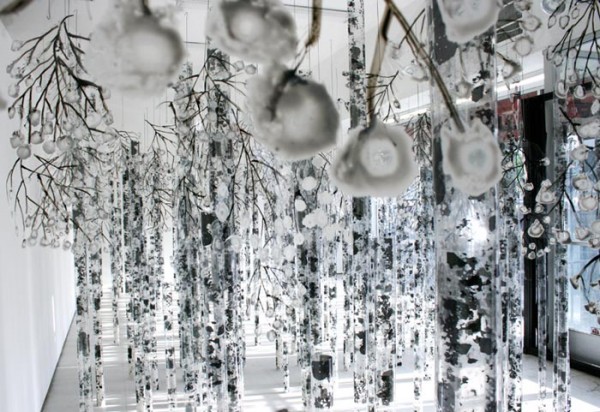
From the DS Archives introduces this week’s series, Summer of Utopia, in which we investigate seven different artists who either employ or interrupt ideas of utopia. Today we are exploring utopia by returning to a past feature on artist Meeson Pae Yang.  Utopia – a broad conceptual imagining of a progressive and perfected society – has engaged many thinkers over the centuries since Sir Thomas More.  Situated in our own time, within the context of global warming and continued deforestation, Yang’s work can be viewed as an inspired aesthetic vision of an ecological utopia.  Recreating a seemingly natural environment within a sterile, urban setting, Yang’s idyllic snow-covered forest takes on the guise of a utopian vision.

Los Angeles-based artist Meeson Pae Yang creates intricate sculptures and installations that explore technology through the context of the body and the natural world. Developing systems that mimic both micro and macro environments, the artist often builds an entire ecosystem within a singular installation. Meeson Pae Yang’s most recent work, Traverse, takes place in a vacant storefront in California. The artist has built a replica forest-like landscape that is composed of translucent trees which spring from the hard concrete floor. The exhibition combines organic and synthetic material to create the illusion of a deep seated wintry forest.

The artist received her undergraduate degree from the University of California Los Angeles (UCLA) and has completed recent projects with Lawerce Asher Gallery and JK Gallery, both in Los Angeles.  Traverse, from 2009, was commissioned by the Arts Council for Long Beach for a vacant storefront at 5661 Atlantic Ave in Long Beach, California.

Share

Jan Mancuska: Everything that really is, but has been forgotten

From time to time we will bring you content from our partnering websites. This week we decided to ramp up some of that cross coverage and bring your interviews and articles from the Huffington Post, Beautiful / Decay and Art Practical. Today we are bringing you a recent article from our friends over at DaWire.com. This coverage of Jan Mancuska‘s current exhibition Everything that really is, but has been forgotten at Meyer Riegger in Berlin was written by Christina Irrang and translated by Zoe Miller.

Jan Mancuska’s films, installations and stage performances are based on the reception and conception of space. The artist uses linguistic and figurative means to implement a reconfiguration of space, often connected to a fragmentary, dramaturgical, sometimes surreal or existentialistic narrative. A predominant theme in his choreographic concepts is movement; in visual, semantic, architectural and corporeal forms of expression it is articulated – and then dissolved. For his present show in Meyer Riegger gallery the artist created three new pieces, which shift between graphic art, text piece, sculpture, installation and film. Reconstruction, association and disassociation are perceptive techniques that connect and correlate the individual pieces.

In his installation Notion in Progress, Jan Mancuska outlines a description of space. The focal points of the work are the three words Cine, Mato and Graphy which the artist positioned in the room in various media and materials – a free-standing wooden sculpture, a wall projection and a floor graphic. Similar to a mind map, individual associative words branch out from this primary word structure, developing like a chain of terms – in this case physically along wires that span the room diagonally. The installation oscillates between the visibility and the immateriality of thoughts, which condense into fictive, cinematic sequences within the process of contemplating and reading.

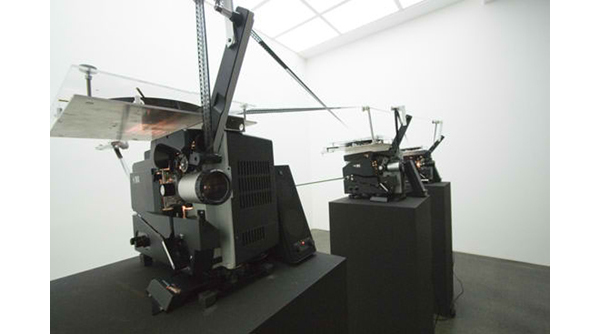
The 16 mm film Postcatastrophic Story is presented on three projectors and causes the disassociation of a chronological order to become a constitutive part of the film image as well as the film narrative: The plot revolves around a news report shown from the viewpoint and basically from the memory of five protagonists. The subject is an insignificant catastrophe that occurred in an unspecified town, which one of the protagonists noticed in a newspaper. In the course of the film, which shows each scene looped in delay, the characters as well as the plot threads belonging to the individuals engage in a dialogue with one another.

To continue reading this piece, please click here….

Share

Stranger Friends

L.A. Expanded: Notes from the West Coast
A weekly column by Catherine Wagley

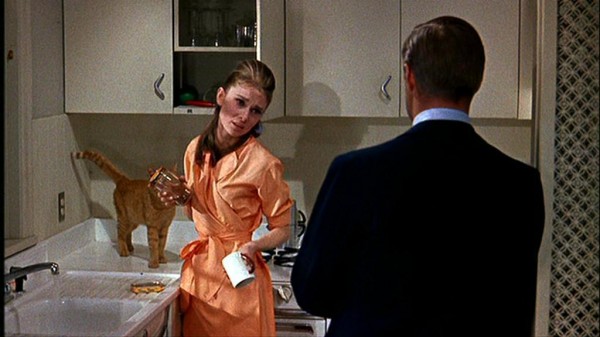
"Breakfast at Tiffany's," film still, 1961.

At the start of Breakfast at Tiffany’s, Truman Capote’s charming novella about a troubled socialite looking for “what’s hers” and attracted to everything that’s not, the unnamed narrator receives a message from a bartender named Joe Bell. He meets Bell, an old friend, and the two clandestinely talk about Holly, the socialite who has long since disappeared (as the novella progresses, we find out why). Both men are still quietly preoccupied with her.

“If she was in the city, I’d have seen her,” says Bell. “You take a man that likes to walk. . . and all the years he’s got his eye out for one person and nobody’s ever her, don’t it stand to reason she’s not there? I see pieces of her all the time, a flat little bottom, any skinny girl that walks fast and straight–” Then Bell becomes uncomfortable. “You think I’m round the bend?”

“It’s just that I didn’t know you’d been in love with her,” the narrator replies. “Not like that.”

“You can love someone without it being like that,” Bell says. “You can keep them a stranger, a stranger who’s a friend.”

Francesco Vezzoli, "A Love Trilogy: Self-Portrait with Marisa Berenson as Edith Piaf", film still, 1999.

Strangers are friends in Francesco Vezzoli‘s A Love Trilogy: Self-Portrait with Marisa Berenson as Edith Piaf, a short, wistful film that had been on view at MoCA’s Geffen Contemporary until July 12.  In it, the actual Marisa Berenson wears Valentino gowns, lip-syncs to the absent Edith Piaf and floats across the screen like a well-manicured ghost. “The result is a bit like catching a whiff of perfume lingering in an empty elevator,” wrote Richard Flood in a 2000 issue of ArtForum

At one point, Berenson whisks down a red-carpeted aisle in a chapel filled with rows of empty white chairs. Vezzoli patiently waits for her at the altar, wearing a tuxedo that, while certainly not cheap, appears unpretentious next to Berenson’s couture gown. Berenson closes in on him, though doesn’t get close enough to touch him, before spinning around and whisking out. And the whole time, Vezzoli looks boyishly content–when he made the film, he was only 28 years old, practically still a boy; Berenson was 52. Later, Berenson throws herself against a black casket. “When Marisa Berenson entered a room, people would clap: she was so beautiful it was unbearable,” Vezzoli told Massimilliano Gioni in 2001.

In A Love Trilogy, everyone dabbles with what doesn’t belong to them. Berenson, a diva, inhabits the life of Piaf, an earlier diva whom Berenson never met but admires enough to embody. Vezzoli, a diva devotee, shares screen space with Berenson, an idol of his but someone whose life he likely never would have entered if not under the guise of this film about Piaf. These triangulating circumstances keep the characters–and Piaf counts as a character–in Trilogy at arm’s length; their mutual admiration is the film’s narrative glue, but they have to remain strangers because of the gaps between their situations.

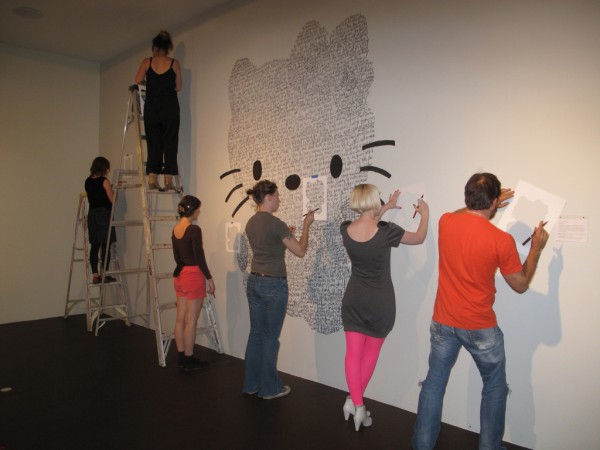
Divya Victor, "Hellocasts", FERAL-CAT ATTACK performance still, 2010. Courtesy Les Figues Press.

I saw Vezzoli’s film on a Sunday afternoon, before boarding the Red Line and riding to Hollywood for Not Content 2, one of a series of performances at Los Angeles Contemporary Exhibitions (LACE). LACE’s back gallery was set up as a haphazard auditorium and vodka-spiked lemonade sat on a table next to a boxed blue cake and a carton of water. Most importantly, a big Hello Kitty icon had been inscribed into the far wall and filled with text. During the second third of the performance, I found out why. Poet Divya Victor’s Hellocasts uses the multi-part poem Holocaust by Charles Reznikoff–which talks about S.S. officers throwing stones at groups of Jews, shooting bodies twice to be sure of death, and forcing orchestras of Jewish musicians to play as others died–as a starting point. The word Holocaust sounds like Hellocasts, which sounds like Hello Cats, which, of course, recalls Hello Kitty, a symbol Victor associates with silence (“Hello Kitty, the cat, has no mouth. Hello Kitty, the brand, always speaks for itself; is always spoken for by its consumer; is a felicific felicitation of affirmed desires,” she writes).

Victor’s voice read Holocaust by Reznikoff as seven performers transcribed what she said into Hello Kitty outlines on the wall, often on top of the big, already present kitty. These performers occasionally pulled audience members up and gave them their own Hello Kitty to write in, which resulted in a crowded and quickly filling wall. Victor kept reminding everyone present that the words she read were not Reznikoff’s when they became hers, and that they were not hers when they became the transcriber’s, and that they were not the transcriber’s when they became the audience’s. In other words, the Holocaust/Hellocasts belonged to none of us and all of us. No one seemed to want full ownership, either. Those of us who wrote seemed more than willing to be friendly, silently participating, jotting what we heard into the body of a kitschy kitty cat but keeping the distance of strangers between ourselves and our situation.

Share