FAN MAIL: Jeanne Jo

DailyServing.com selects two notable artists each month from the submissions we receive to be featured in our series, Fan Mail. For a chance to have your work appear below, with an article written by one of the DailyServing contributors, please submit a link to your website to info@dailyserving.com, subject: Fan Mail. You could be the next artist in the series! (We will try to contact chosen artists prior to publication, but please be sure to check the site everyday.)

Jeanne Jo‘s diverse body of work, which includes video art, performance, sculpture, and collaborations with other artists, successfully evades categorization, reflecting the interdisciplinary nature of contemporary culture. Often impermanent, her projects are theoretically sophisticated, aesthetically uncomplicated, and profoundly personal. After receiving her B.F.A. from the University of Nevada, Reno, Jo completed her M.F.A. in Digital Media at Rhode Island School of Design in 2008. She lives and works in Los Angeles, where she is currently pursuing her Ph.D. in Digital Media at the University of Southern California, with an expected graduation date of 2014.

In her video series Ephemeral Interventions (2007), Jo performs simple activities in front of surveillance cameras situated around her Providence, RI. In the video seen above, Jo writes on a city street, at night, with powdered sugar. The ephemeral white text reads “When I look up from my mind, I see what you are:”, a fragment of poetry by Michael Collier. In this series, Jo inverts the function of surveillance by actively, as opposed to passively, providing content for the camera. The growing presence of surveillance in urban space, and the awareness of constant observation, has triggered a creative response from artists, most cleverly utilizing the mechanics of surveillance technology itself.
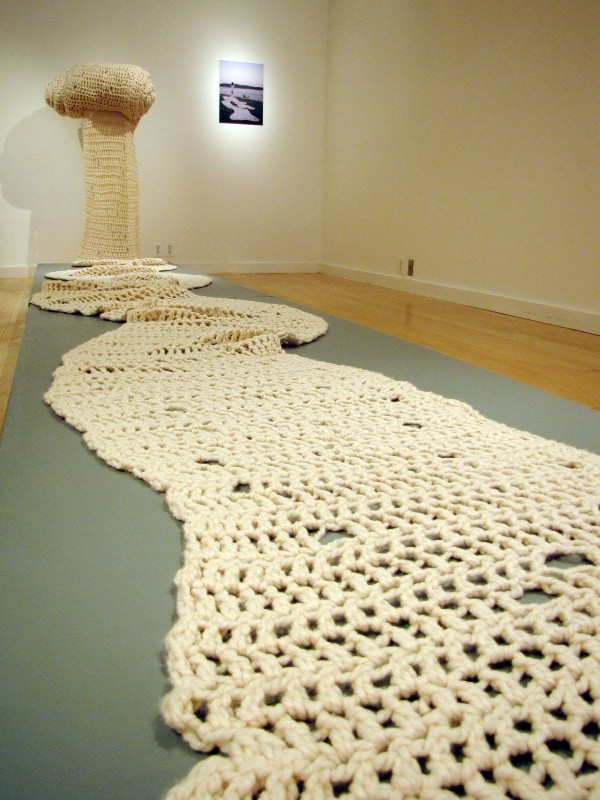
This simple but profound manipulation of chosen medium is seen in Jo’s more tangible works as well. Intrigued by the intersections of craft (specifically female  handicraft, i.e. crochet) and technology, Jo produces woven sculptures that reference the historical connections between the fields of weaving and modern computing. The Jacquard Loom, a mechanical loom invented in 1801, simplified the process of manufacturing textiles with complex patterns and was an important precedent to the development of computer programming, with punch cards controlling a sequence of actions. Jo’s knit sculpture, If a Mouth were to Whisper.. (2010), which resembles a giant cream-colored scarf, is a crocheted love letter, woven in alphanumeric code, with words spelled out in crochet knots. According to Studio Fuse art blog, the artist plans to engineer a computer program that would encrypt any text into a knitting or crochet pattern.

Jeanne Jo will be participating in The Business of Aura, an upcoming group show at Broadway Gallery in New York, opening on August 19th. The exhibition addresses the multiple interpretations of “aura” and seeks to reclaim a broader understanding of the term in contemporary practices. The Business of Aura will remain on view until September 10th.

Share

Mika Rottenberg at SFMOMA

During an admittingly rushed Friday evening in 2008, I attended the Whitney Museum during a pay-what-you-wish night. It was during the Biennial and every floor of the museum was packed with an abundance of people and art. As I made it through each floor, digesting as much art as possible in 3 hours, one artist and artwork stayed on my mind: Mika Rottenberg’s video installation, Cheese. Since that evening, I have followed her beautifully complex projects, faithfully reading about her recent exhibitions at Nicole Klagsbrun Gallery and Mary Boone Gallery. So it was no surprise that when I first heard that her new video, Squeeze, was to debut at the San Francisco Museum of Modern Art, I made it a point to stop by immediately and see what the artist has been up to over the past two years.

Mika Rottenberg, Squeeze (still), 2010; Courtesy Mary Boone Gallery/Nicole Klagsbrun Gallery; photo: Henry Prince

In this new video, Rottenberg continues her investigation into social and labor-based inequalities through a fragmented narrative. The grotesquely seductive video equally binds and separates the concept of labor with gender, class, and race, seamlessly merging the real with the hyper-fictional. Interlocking environments slide in and out of place. Exaggerated sounds of cutting, slicing and crunching divide and define the separate worlds, and rich, fleshy color pull them all back together. Similar to her past work, Squeeze maintains an all woman cast of characters played by non-actors, where the physical characteristics of Rottenberg’s women parallel their occupation within the awkwardly constructed environment. Women working in a rubber plant in India, mining the trees for raw substance, interact with an all female work force at a lettuce farm in Arizona. These two real worlds collide with the fictional factory constructed in the artist’s studio, serving as the main link between all of the spaces in constant flux. Walls move, floors drop, and characters blindly connect to the factory to create a new hybrid consumer product turned art-object, which is composed of blush that is squeezed from the skin of a woman in the factory, rubber, and decomposing lettuce.

Through a beautifully non-linear story, Rottenberg’s use of the absurd confronts the seriousness of her content, mesmerizing the viewer by slowly releasing a delicate flow of information through color, sound and rhythm. Each element quietly underscores the disconnect between the consumer and the production process innate to mass commerce. What results is a world which mirrors her role as a woman creating an art object, and our daily lives of utilizing a variety of products, many of which are produced through the work of people who are socially, politically, and racially removed from the consumer. Yet, while the work is far from generous, the artist subtly reminds us that we can never really separate ourselves from the lives of others no matter how distant or disconnected we would like for them to be.

Share

This Time with Feeling: Young Curators, New Ideas III at P-P-O-W.

Bryan Graf, Lake Accumulation 2010, c-print, 13 x 19 inches- Curator, Kate Greenberg & Hilary Schaffner

I love how far the term “curate” has fallen. Once particular to egg-headed museum types who cared for collections of rarities, now curating, at least in marketing terms, means nothing more than making a kind of fancy or personalized choice. Instead of plain old dinner and a movie, you can now curate the best locavorian burger and artisanal fries while selecting a companion film from your finely tuned Netflix queue.

In the art world, strains of this populist streak were found in Roberta Smith’s recent assail against New York museums’ predilection toward chilly post-minimalism. Coining the term “curator’s art,” Smith called into question the blitz of retrospectives of artists like Roni Horn, Robert Smithson, and Gabriel Orozco that as she put it, “share a visual austerity and coolness of temperature that are dispiritingly one-note.” She added that while she liked these shows, she also wants to see shows by artists whose work belies an intense personal necessity. I took this to mean that she wants to see the same level of passion on museum walls that some employ in everyday decisions such as where to eat.

With this criteria in mind, I judged Young Curators, New Ideas III to mostly be heading in the right direction. Each curator or curatorial team was given their own section of the gallery that they treated like an individual show.  The overall result looks like your average M.F.A. Thesis exhibition, but there were a couple of standouts.

Bryan Graf, An Encyclopedia of Gardening, 1969 2010, two panels of hardcover book covers, 24 x 32 inches each - Curator, Kate Greenberg & Hilary Schaffner

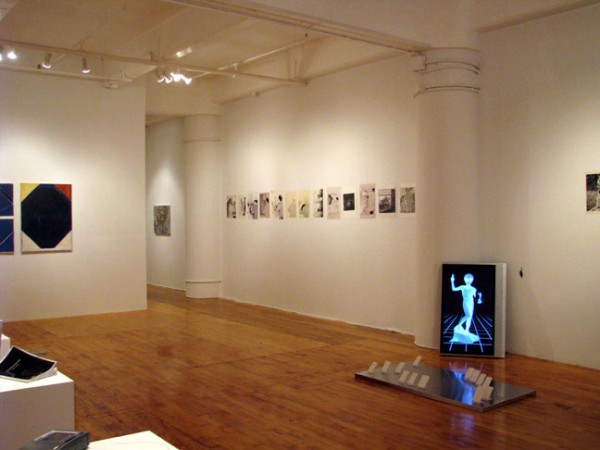
Broken Lattice, featuring the work of Bryan Graf, curated by Kate Greenberg and Hilary Schaffner, feels both cohesive and well varied. Graf uses a multitude of photographic techniques to convey a distant sense of place and memory.  He borrows heavily from the James Welling playbook, but it’s OK, as his intention feels pure and the curators seem humble. The works are given just enough space to breathe easily and the relaxed pace of the installation is completely in sync with the laid-back vibe of Graf’s photography. You can get lost in a floor piece, peer into a smaller work, and lean over a table of seemingly found snapshots—in total, a satisfying experience.

Jan Tichy, Installation No. 5 (Threshold) 2008, three-channel digital video projection, one hundred 250g white paper objects, variable dimensions- Curator, Gabriella Hiatt

Another respite from the competing voices in this show was Jan Tichy’s Installation No. 5 (Threshold), curated by Gabriella Hiatt. Here, four walls of a darkened gallery are adorned with common cardboard tubes and cylindrical lids. After languishing in the dark for a while, the walls are blasted with rectangles of projected white light that transforms the tubes into what looks like the austere post-minimal abstraction of, say, Gabriel Orozco.  Then a layer of black lines snake onto these objects and transforms them once again. Although it’s a bit theatrical, I like how the references in this work slip between DIY craft, high abstraction, mapping, and biological systems.

The rest of Young Curators/ New Ideas III feels a bit scattered. Some of the work that I liked, such as Victor Vaughn’s digital prints, suffered from bad placement and odd context.  Too much of the other work on view bears the heavy influence of grad school obsessions like Marcel Broodthaers, Felix Gonzáles-Torres and Christian Marclay. While it is difficult to know whom to blame for the less successful parts of the show, the artist or the curator, in the best installations it feels as if the curator simply placed the work into a complimentary context and then got out of the way.

Maybe all of the hardworking museum curators out there are over-thinking it. For instance, we shouldn’t need to read a laborious wall label to experience great art. Although Young Curators, New Ideas III misses in parts, it spares us from heady essays and shows how selection, placement, and juxtaposition can go a long way.

Share

Athanasios Argianas: The Length Of A Strand Of Your Hair, Of The Width Of Your Arms, Unfolded

Having just returned from a whirlwind two-week trip in which I covered seven cities within six countries within two continents and two time zones, I am the last person you want to ask what time it is. Or even what day. What’s so exciting about these sort of adventures is precisely that lack of attention to time—save for making sure to catch a train or plane. In our day-to-day lives, time—really schedule—seems to control every single action we take, and we lose the sense of impulse that makes vacation so fun.

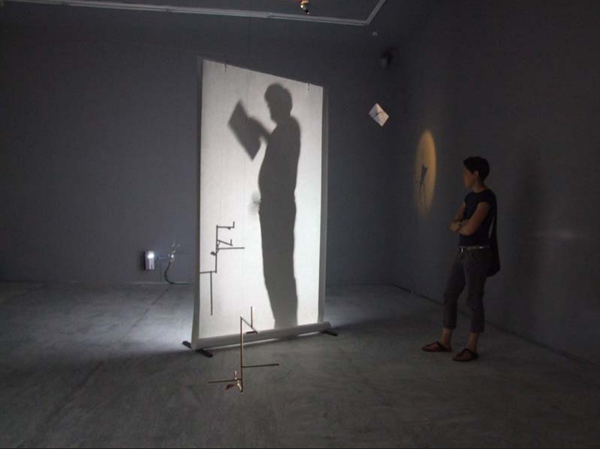
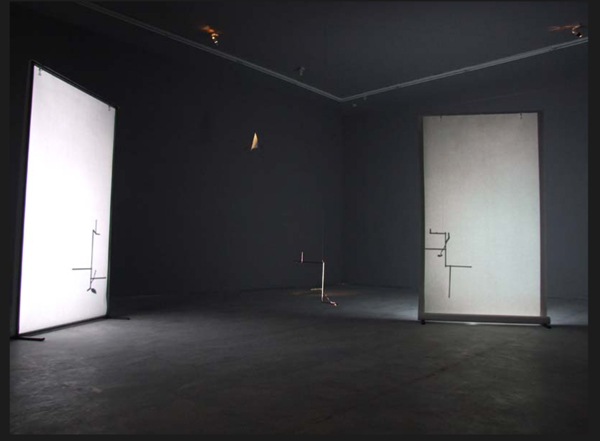
This idea of non-linear time has been investigated by artists, writers and musicians (or at least maybe that’s what jazz is about) for years and is currently the source of inspiration for Greek artist Athanasios Argianas. For his current project at National Museum of Contemporary Art (EMST) in Athens, Greece, entitled The Length Of A Strand Of Your Hair, Of The Width Of Your Arms, Unfolded, Argianas has created new work dealing with “memory and the way we process and translate information.” The title piece of the show is an eerie installation consisting of a metal mobile, which hangs in the way of two projection screens, casting a silhouette of itself onto the projections. It is described by the museum as “interrupting” the projection, which recalls the way one’s memories interrupt the present every so often, layering themselves upon your consciousness like shadows on a screen. Sometimes memories—particularly the really good and the really bad—have a way of interrupting life this way, causing us to momentarily lose sense of time and place. Additionally, Argianas’ piece involves the intermittent presence of a silhouetted man walking across the projection screen, reading aloud from a text, which is “key for understanding the work.” The Length Of A Strand Of Your Hair, Of The Width Of Your Arms, Unfolded runs through September 5, 2010.

Athanasios Argianas was born in Athens, Greece and currently lives and works in London. He earned his MA at Goldsmiths College, London. He has been included in numerous solo and group exhibitions internationally, including at: The Breeder (Athens), La Chambre, Xippas, (Paris), Faye Fleming & Partner (Geneva), The Serpentine Gallery Pavilion (London). He was selected to participate in Heaven the 2nd Athens Biennial (Athens), and was shortlisted for the 2009 Deste Prize.

Share

From the DS Archives: Come Hither Noise

This Sunday, From the DS Archives presents Come Hither Noise.  We have chosen to reintroduce this previously published article for the way it gives singular attention to sound – an often overlooked element of contemporary visual art practice.  Come Hither Noise reminds us that sound can also stand alone as a compelling medium of exploration that is appropriately situated in the gallery space.

Come Hither Noise at Fremantle Art Centre in Perth, Australia is an exhibition of sound-based works, which aims to highlight connections between aural, spatial and visual perception. Curator Jasmin Stephens argues that media and even sensory distinctions are growing increasingly arbitrary in contemporary art. In this exhibition she presents a selection of works which are both noisy and resolutely visual, designed to heighten the audience’s experience of both senses. Come Hither Noise features visual artists working alongside composers, producing aural environments which encroach on the musical, but this is not easy listening.

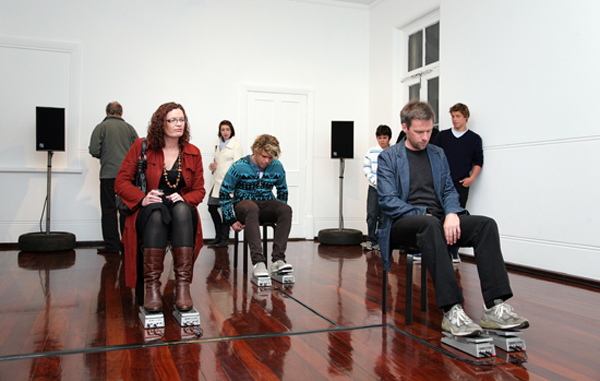
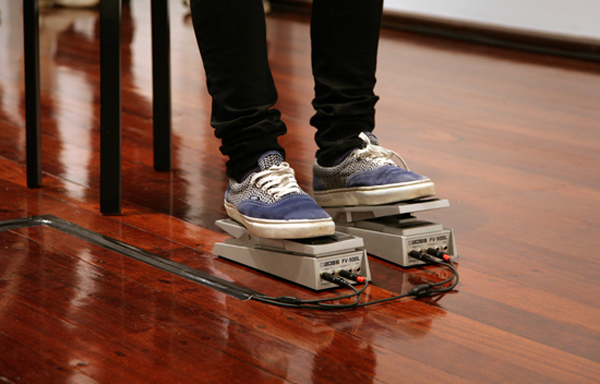
Composer Thomas Meadowcroft’s Monaro Eden references two icons of Australian culture: the Holden Monaro, an engine-heavy muscle car that subjugated the roadways from 1969 to 1982, and twentieth century artist Rosalie Gascoigne, specifically her 1989 work Monaro. Meadowcroft’s installation alludes to Gascoigne’s process of assemblage by sampling the revving engine of a Monaro and layering it with Sine tones, producing a humming aural landscape which the audience can navigate, when seated, by pressing foot pedals which alter the volume of the tones. The artist likens this process to “a Sunday drive” there is no great logic to it: some key musical destinations are dictated by the arrangement of the engine sounds but otherwise listeners are free to hear their own ways through the installation.

Richard Crow’s Imaginary Hospital Radio plays upon the ostensibly therapeutic role of the hospital radio station by injecting bloodless muzak with a form of medical waste the incidental soundscape of the body subjected to surgical technology. The accompanying image is from the archives of the Moorfields Eye Hospital where Crow was treated as a child. Imaginary Hospital Radio was broadcast on ABC Classic FM’s New Music Up Late on Saturday 29 August.

The exhibition also includes Mark Brown (Aus), John Conomos (Aus), Ross Manning (Aus), (Aus/GER), Elvis Richardson (Aus), Sam Smith (Aus), Sriwhana Spong (NZ).

Come Hither Noise is presented as part of the 9th Totally Huge New Music Festival in association with Tura New Music, 10-20 September 2009.

Share

Ai Weiwei: Dropping the Urn

Dropping a Han Dynasty Urn (1995). Middle view of a triptych of gelatin silver prints, each print 49 5/8” x 39 1/4”. Courtesy private collection, USA.

Ai Weiwei is without a doubt one of the most intelligent makers negotiating the art/craft divide.  Ai Weiwei: Dropping the Urn at the Museum of Contemporary Craft in Portland, Oregon is his first museum exhibition on the west coast, and a fitting venue for an international contemporary artist engaged in a deep dialog with Chinese culture, art history, ceramics and craft.  The exhibition addresses ceramic tradition but is satisfying on visceral and theoretical levels as contemporary art.

(Making of) Colored Vases (2006). Single channel video, 13 minutes, 09 seconds. Courtesy Ai Weiwei, Beijing.

Colored Vases (2006) Vases from the Neolithic age (5000 - 3000 BCE) and industrial paint; between 10” x diameter 9” and 14 1/2” x diameter 9 1/2”. Courtesy AW Asia collection, New York.

The best works in the exhibition are those in which Ai takes archaic Chinese vessels and treats them as readymades.  These include paint-dipped pots, pulverized urns in a jar, a pot with a superimposed Coca Cola logo, and a photograph of the artist casually letting a Han dynasty urn smash on the ground.  Of these works the cheerily-painted Colored Vases (2006) immediately catch the eye.  Ai treats the ancient pots irreverently, dipping them into buckets of industrial paint so as to leave some evidence of the original surface decoration and, thus, their age.  The off-the-shelf colors pop brightly against the original dull brownish tones of the vessels, a gesture of cultural washing that nearly obliterates the past in favor of a brighter new plastic-colored future.  Dust to Dust (2009) follows a similar conceptual path: Ai crushed Neolithic-age pottery to powder and stored the gritty remains in a clear glass jar. Here, the funereal act of memorializing an old urn in a modern urn coupled with the implied violence of the grinding gives the work cerebral and visceral force.

Coca Cola Vase (1997).  Vase from Neolithic Age (5000 – 3000 BCE) and paint, 11 7/8″ x diameter 13″. Courtesy Tsai Collection, New York.

Urns of this vintage are usually cherished for their anthropological importance.  By employing them as readymades, Ai strips them of their aura of preciousness only to reapply it according to a different system of valuation.  However, this is not the well-worn strategy of the readymade famously applied by Duchamp to his urinal Fountain, wherein the object lacked cultural gravitas until placed in an art context.  Instead, Ai’s chosen readymades already have significance.  Working in this manner, Ai transforms precious artifacts—treating them as base and valueless by painting, dropping, grinding, or slapping with a logo—into contemporary fine art.  The substitution of one kind of value for another occurs when he displays the transformed urns in a museum vitrine, reinstilling value but replacing historical significance with a newer cultural one.

Share

Mad World: Trecartin’s Any Ever

L.A. Expanded: Notes from the West Coast
A weekly column by Catherine Wagley

Kalup Linzy, Conversations wit de Churen III: Da Young and Da Mess, 2005. Performance documentation. Courtesy the artist and Taxter and Spengemann, New York.

Because I don’t believe that big and bright equals beautiful, I am not a fan of West Hollywood’s Pacific Design Center. A mammoth, reflective blue box that towers over the otherwise low-to-the-ground Melrose Avenue architecture, the PDC has more than its share of empty retail space. Inside, it often feels like a manicured ghost town. I voted for its simulated destruction last fall when artist Gustavo Artigas staged his Vote for Demolition project, which asked Angelinos to select the city’s least attractive building. Artigas virtually razed the winner, which turned out to be the Kodak Theater because, apparently, not everyone sees the world the way I do.

Despite my PDC resentment, I am fond of MoCA‘s mini Pacific Design Center, a quiet beige cube that stands in the shadow of its big blue neighbor. It seems like an almost-joke—a Mecca of materialism’s carefully sized nod to the arts. Usually, design-related exhibitions that run in this MoCA satellite, like Las Vegas Studio and Folly–The View from Nowhere, cater to the curious without undermining the over-fabricated sterility of the whole PDC complex. But this past month, the MoCA mini-me has suddenly become a theater for outlandish projects that turn “over-fabricated” into a race toward synthetic delirium.

On June 24, during the invitation-only event Soap at MoCA, General Hospital filmed an episode starring James Franco. Franco played a demented artist, MoCA played the site of his opening, and artist Kalup Linzy performed in drag. Wearing a wig with bangs and a red and black floral print dress, Linzy recited the lyrics to Mad World while Franco yelled, “Don’t kill me! I know where the baby is!”, and then fell from a balcony to his fictional death. Linzy, accustomed to the drama of soap, wasn’t phased.

Ryan Trecartin, "Sibling Topics (Section A)," Video Still, 2009.

Ryan Trecartin, "Sibling Topics (Section A)," Video Still, 2009.

In his own soap, All My Churun (2003), a distraught, big-haired, striped-skirted woman (most women in Linzy’s films aren’t actually women) talks about the memorial service she’s planning for a murdered love named “Jo-Jo.” “Girl, you need to stop,” says her sister over the phone. “She needs to stop,” says her brother over the phone. Her mother and grandmother, also talking over the phone, act as if a memorial service for a dead man is the most flamboyantly frivolous thing a person could have.

Video artist Ryan Trecartin uses phones as liberally as Linzy, though his rarely have cords and sometimes they’re just pinkies and thumbs extended in the “call me” gesture. Phones turn life into a series of affected soliloquies and now that Trecartin has commandeered MoCA for Any Ever, a show that opened two weeks after the museum performed for General Hospital, soliloquies have become lurid and omnipresent. “You won’t recognize the PDC once you enter,” Trecartin’s New York gallerist Elizabeth Dee told the LA Times.

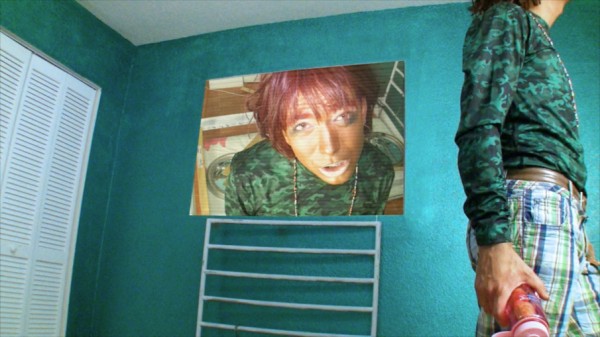
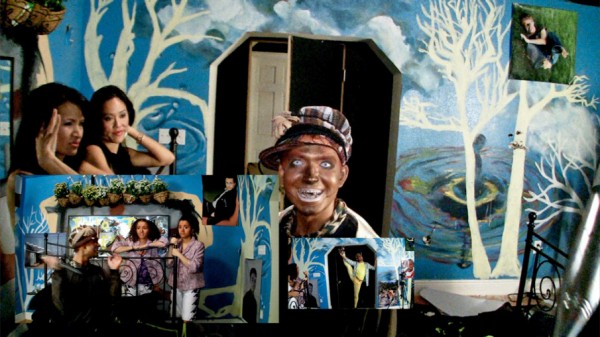
The downstairs bookstore has become a dark gallery. Cluttered with brand new benches, space heaters and superfluous metal chains, it looks like a graveyard for un-bought patio furniture. Trecartin’s Trill-ogy Comp (2009)—note the “trill”—screens on the wall opposite the entrance.  Comp consists of three videos, all of them loosely related. K-CorealInc.K (section a) follows a group of all-blond white collar workers called the “Koreas”; Sibling Topics (section a) follows four quadruplet sisters, all played by Trecartin. P.opular Sky (section ish) is a bit of everything. Upstairs, in a bedroom, office space, faux-stadium and family room–each with nick-free Ikea-style furniture–four videos from the R’Search Wait’S series play out. But following storylines is precarious. As Trecartin pointed out in a recent lecture, “Consequence can just pop out of nowhere and cause can have no effect.”

Ryan Trecartin, "P.opular S.ky (section ish)," 2009.

Everyone wears some form of garish make-up, women play men acting like women, or men play women posing as men dressed as women. The physical gets slippery. With rare exception, characters use winy, effeminate teenage voices and speak confrontationally. No one is melancholic, though plenty are restless. All wear brightly colored clothes that match their bronzed, painted faces and, since Trecartin is an obsessive editor, the brash, sashaying footage has no non-orchestrated lulls. Soliloquies–there’s never really dialogue, even when characters purport to address each other–use language in a way that feels almost-but-not-quite familiar:

“She hates diversity and women. She’d probably shoot me if she saw my very extreme breast reduction that I love.” “Put your breasts back on.” “I never had any.”

“How will I make drive to find you when I’m in automation?”

“Cut my hair shorter. I like that kind of person.”

“Put on your comfort pants and say things in nice voice because.”

“I can go on and on but I won’t. I can go on and on but I won’t. I can go on and on but I won’t.”

About thirty minutes in, Any Ever begins to feel like a dream that’s apolotical, political, apathetic, aggressive and increasingly fluorescent. It becomes exhausting and disorienting, enough so to make me want to hate it. And this means it’s perfect.

Note: Critic Jennifer Doyle recently wrote more extensively about James Franco and Kalup Linzy for Frieze Magazine. Read her essay here.

Share