Summer Show 2010 at Fourteen30 Contemporary

One of the worst things about summer is also one of the best: it’s transitory.  Like an awkward first love affair, that fact that it’s all over so fast is exactly what makes summer such a mythologized season.  In the art world, summer is the spiritual home to the group show, a time to test out new ideas or bring together artists still in an experimental phase of their own.  Summer Show 2010 at Fourteen30 Contemporary takes the ubiquitous August group exhibition and gives it a raison d’etre by actually being about summer, proving once again that the simplest premise is often the best.

John Sisley, Ice and Polaroid 1 (2010). Archival inkjet print, 11 x 15 inches. Edition of 3, AP I/II.

John Sisley, Ice and Polaroid 12 (2010). Archival inkjet print, 11 x 15 inches. Edition of 5, AP I/II.

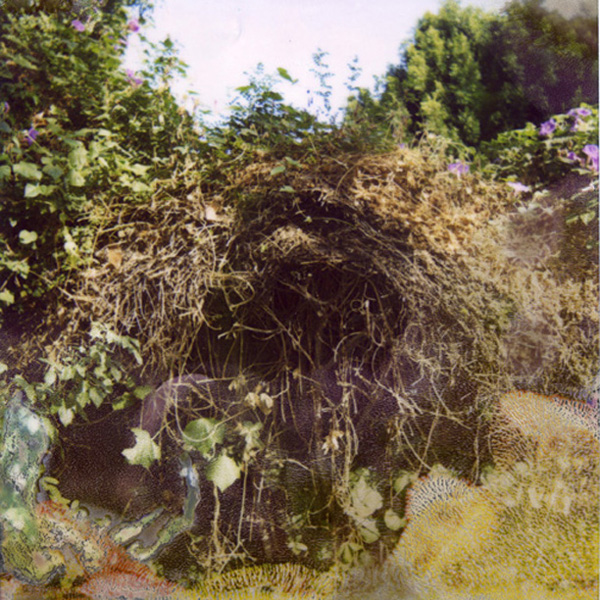
The front and back rooms of the gallery are hung mostly with paintings and photography.  In the front, John Sisley’s two pieces Ice and Polaroid 1 and Ice and Polaroid 12 (both 2010) are small black-and-white inkjet prints.  1 shows a set of ice cubes sitting beside an undeveloped Polaroid photograph; 12 shows the now-developed Polaroid (a shot of the original set of ice cubes) next to a puddle of water.  The clean, evidence-based approach to depicting a process—here is the start, here is the finish—gives the pieces a quiet gravity and the photograph-in-a-photograph plays with ideas of representation, duplication, and the passage of time.  On an adjacent wall, Devon Oder’s Bleed (Tree Cave) (2009) provides a counterpoint to Sisley’s stark vision.  The enlarged vintage photograph depicts a sunbleached view of a cave of overgrown brambles and twigs hunkered at the edge of a forest, and it’s unclear whether it’s a natural formation or man-made and abandoned.  No matter, it’s an eleven-year-old’s summer reverie, the mysterious thing that she hopes to stumble on during long unsupervised hours.  Fingerprints and age spots mar the edge of the photo, attesting to its beloved status: this photograph has been looked at many times, and the smudges make for a wistful feel, conjuring that back-to-school pang of impending bus rides, structured days, and having to wear clean clothes.

Devon Oder, Bleed (Tree Cave) (2009). Lightjet print, 35 x 35 inches.

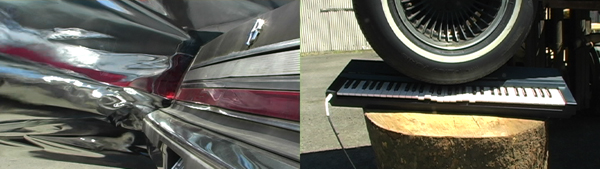
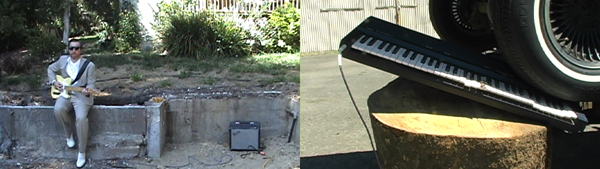
In the next room is Jesse Sugarmann’s I’m on Fire (2010), a deliciously masculine two-channel paean to frustrated love.  The left screen depicts, in succession, a Lincoln Town Car parked in a field, then backing forcefully into reflective mylar; or a man in a grey suit, sunglasses, and white shoes (presumably the artist) playing an amateurish version of Bruce Springsteen’s “I’m on Fire” on an electric guitar.  On the right screen, the same car does hydraulic tricks and falls off cinderblocks; or has the front end propped crazily on (and then falls off) a tall four-by-four; or churns out clouds of smoke that billow over bright green grass and into the hot sky.  In the middle of all this, the arms of a forklift bang an old electric keyboard clumsily; later, the forklift lowers the entire car so that one tire mashes the keyboard, honking out a cacophonic accompaniment to the guitar solo on the adjacent screen.  Somewhere in all of this is a yearning that manifests itself as a pyrrhic desire to destroy things just to get a little fire going in the middle of a dry month.  Whether inspired by real or fictional unrequited love, Sugarmann’s video is pitch-perfect, a charming mix of boyish cool, summer heat, longing, frustration, and semi-dangerous stunts.  I left the gallery with Springsteen’s lyrics in my head-

Jesse Sugarmann, I'm on Fire (2010). Dual channel video, sound: 8:53 minutes. Edition of 5, AP I/II.

Sometimes it’s like someone took a knife, baby, edgy and dull
and cut a six-inch valley through the middle of my soul

At night I wake up with the sheets soaking wet
And a freight train running through the middle of my head
Only you can cool my desire
oh, oh, oh, I’m on fire

Share

It’s My World at Baer Ridgway Exhibitions

"It's My World", installation view of downstairs gallery at Baer Ridgway Exhibitions; image courtesy of BRX Exhibitions

It’s My World, a current group show at Baer Ridgeway Exhibitions in San Francisco, is compelling in its approach to a somewhat dated subject matter: the landscape. The show successfully combines the apparent solid thesis of the exhibition: “a strong emphasis on the use of unexpected materials, abstracted forms and the examination of time” in a bid to approach issues raised by humans’ complicated relationship with the ever changing environment. The group exhibition is comprised of ten artists working in a variety of mediums: painting, video, drawing, photography and sculpture and the cohesiveness that permeates from each artist’s contribution is fantastic.

Claude Zervas, "Skagit," 2005, Green CCFL lamps, wire, inverters, steel, Wall: 70 x 50 x 1 inches; Floor: 37 x 65 x 60 inches; image courtesy of BRX Exhibitions

Claude ZervasSkagit, 2005, a vibrant installation of Green CCFL lamps, wire, and inverters that is modeled after the Northwest’s Skagit River, and protrudes out of the wall alive and active. Zervas’ arranges the inverter cords to simulate the river’s many tributaries, allowing the installation to course through the gallery space.  Christopher Taggart’s But Now You Know You’ve Seen the Worst, 2010, changes the term “process” to an entirely new level. The image is of a car’s driver side mirror that has been recreated, and pixilated, by small cut outs of UV laminated photographs glued to a board. To call this work a collage doesn’t seem to do it justice. The precision in which Taggart is able to assemble these small, seemingly picayune pieces while at the same time inferring the motion of a driver’s view of the landscape passing him by, is impressive.

Christopher Taggart, "But Now You Know You've Seen the Worst," 2010, UV laminated photographs glued to board with pigmented archival adhesive, 32 x 40 inches; image courtesy of BRX Exhibitions

If these eye- catching works draw you in, it is the more subtle pieces that will make you stay. David Wilson’s charcoal on paper drawings of public spaces serve as illustrations to his larger performance works of reinvigorating public spaces. Wilson arranges public events, or “gatherings”, within these depicted landscapes, as a way to serve as a conduit for others who have yet to figure out how to get back to nature. Sean McFarland’s series of Polaroid photographs, though small in size, are breathtaking. McFarland collages together a variety of mixed media – paint, image cutouts, etc., and then re-photographs these elements to create an entirely new image of an otherworldly landscape. These images are ethereal, elusive and affecting. Even if the image doesn’t stay with you for very long afterward, the mystical feeling it invokes within you of a lost world will.

Sean McFarland, "Plane and Land," 2008, Polaroid, 3 1/4 x 4 1/4 inches, edition of 3; image courtesy of BRX Exhibitions

In my opinion, to be an artist in these contemporary times is no small feat. At this point, it would seem that there is no topic that hasn’t been broached, no genre that hasn’t been explored, and no medium that hasn’t had its limits pushed. This is the second reason why It’s My World succeeds—the ability of the selected artists to take a theme that is almost as old as art history itself and to continue to innovate upon it.  Here’s hoping that other artists heed their call.

Share

Cai Guo-Qiang

Vortex 2006, Gunpowder on paper, 400 x 900 cm, Collection of Deutsche Bank Collection, commissioned by Deutsche Bank AG, Mathias Schormann © Cai Guo-Qiang

Cai Guo-Qiang began experimenting with the properties of gunpowder in his drawings in the 1980s. He used gunpowder of various grades and forms and exploded it on paper, leaving burnt and smoky charcoal-stained residue marks behind.  Born out of his desire to subject his practice to the dynamic elements, Cai’s work expresses how beauty and violence are often intertwined. Much of this experimentation has lead to a practice which encompasses the use of explosives on a massive scale, and Vortex, a drawing depicting hundreds and thousands of wolves chasing one another in a circular motion, as if sucked into a vortex, is emblematic of Cai’s work.

Head On, 99 life-sized replicas of wolves and glass wall. Wolves: gauze, resin, and painted hide, Dimensions variable, 2006 Deutsche Bank Collection, commissioned by Deutsche Bank AG. Photography by John Yuen, Fotograffiti

Cai’s work are also recognized by a strong sense of movement, weaving together the extremes of emotions and states within nature. Head On was created in the wake of the 10th anniversary of the fall of the Berlin Wall, and reflects on the remaining fissures in spite of the political reunification of East and West Germany. Ninety-nine life-sized replicas of wolves are seen to be leaping in a pack towards a glass wall. While those leading the pack strike the glass wall and collapse in a heap, the wolves at the rear continue surging forward. Seen from afar, the leaping wolves form an arc of force and power, a reminder of the power of collective ideas and actions, and also, its consequence of blind pursuit.

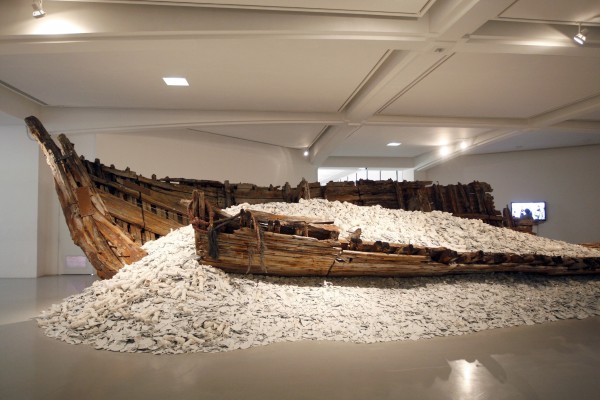
Reflection - A Gift from Iwaki installed at MAMAC in Nice. Copyright: Crédits Ville de Nice

While Cai’s work often relies on context, it also draws on symbols and materials from Chinese culture. His works are marked by a certain theatricality and require a sizable production crew, perhaps a vestige of his background in stage design at the Shanghai Theatre Academy. His aggressive, set-like design brings together historical context and theatricality in Reflection – A Gift from Iwaki, comprised of a 15-meter long boat, excavated by ship makers of the Iwaki village in Japan where the work was created. The beauty of destruction is evident from the decaying shipwreck lying against a mountain of broken ceramic deities. The placement of broken deities in a museum was a deliberate gesture to question the point at which a religious statue relinquishes its spiritual significance, towards its function as mere artistic representations and commercial goods. First presented in 2004, Reflection – A Gift from Iwaki is reconstituted for each exhibition by seven fishermen from Iwaki.

Head on and Vortex are currently on view at Cai Guo-Qiang: Head On which runs till 31 August 2010 at the National Museum of Singapore. Reflection – A Gift from Iwaki is presented in Cai Guo-Qiang: Travels in the Mediterranean at Musée d’Art moderne et d’Art contemporain, Nice, France till 9 January 2011. Cai was born in 1957 in the city of Quanzhou, Fujian Province, China. He was awarded the Golden Lion at the 48th Venice Biennale in 1999, the 7th Hiroshima Art Prize in 2007, and the 20th Fukuoka Asian Culture Prize in 2009. He also held the title of Director of Visual and Special Effects for the opening and closing ceremonies of the 2008 Summer Olympics in Beijing. In 2008, he was the subject of a large mid-career retrospective at the Solomon R. Guggenheim Museum, New York. He has lived in New York since 1995.

Share

Suki Chan: Sleep Walk, Sleep Talk

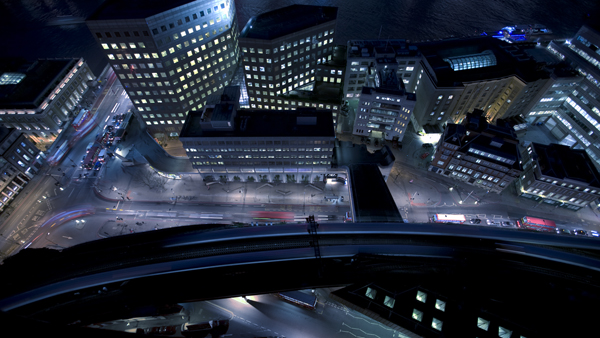
Suki Chan, still from Sleep Walk, Sleep Talk

One person’s bustling metropolis is another person’s claustrophobic nightmare. One person’s tedious, solitary working condition is another’s personal escape and respite. A city as large and as densely populated as London is sure to be brimming with such varied experiences. There are the stories of those who have been there for generations, and of those who are newly arrived—having left stories behind elsewhere in search of a revised life tale. They all come together to make up the fast cars and slow people, the bankers and the bodyguards, the posh and the pained of the city. This urban dichotomy is what interests Hong Kong-born, London-based artist, Suki Chan in her video project Sleep Walk, Sleep Talk, on view through September 4th at New Art Exchange in Nottingham.

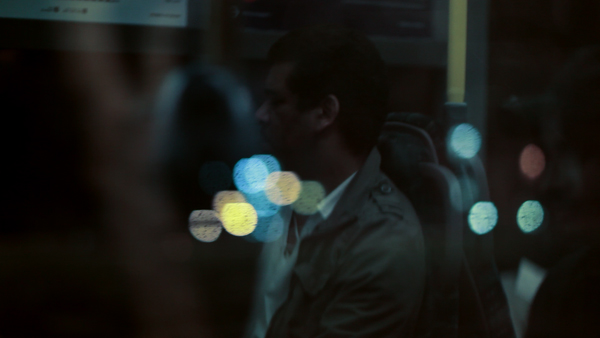
The 2-channel high-definition time-lapse video opens on an aerial view of light-trails of commuter cars and trains at twilight, with a science-fiction sounding background of industrial noises and quiet, disjointed narrative. Then it cuts to the dim, unflattering lighting of an empty office building, and the narrative of a Nigerian security guard talking with great pride about his duties on night-watch. He finds freedom in his perch above the city, behind the high rise’s glass shield. The video goes on to explore others’ experiences, capturing “the nuances at play in a city between the solid mass of its architecture and the fleeting movements of its urban inhabitants and the transportation system that revolves around them.” (source) Sleep Walk, Sleep Talk was commissioned by the Film and Video Umbrella. You can view a preview of the video here.

Suki Chan, still from Sleep Walk, Sleep Talk

Suki Chan was born in Hong Kong and lives and works in London. She graduated from Goldsmiths in 1999 and completed an MA in Fine Art at Chelsea School of Art in 2008. She has been included in several group shows in the UK, including at David Roberts Art Foundation, London and Shanghai Museum of Contemporary Art. In 2009, Chan was selected as one of six young British artists by Charles Saatchi to take part in the BBC’s School of Saatchi.

Share

From the DS Archives: Pablo Zuleta Zahr, Event Horizon

This week’s edition of From the DS Archives reintroduces a feature on artist Pablo Zuleta Zahr written by Allison Gibson.  Zahr’s ‘patterned panoramas’ offer an innovative study of contemporary mobility – finding beauty in the shared urgency of the urban commute.  Zahr’s observance of the everyday suggests that we should pause to appreciate the moment as we navigate our busy lives.

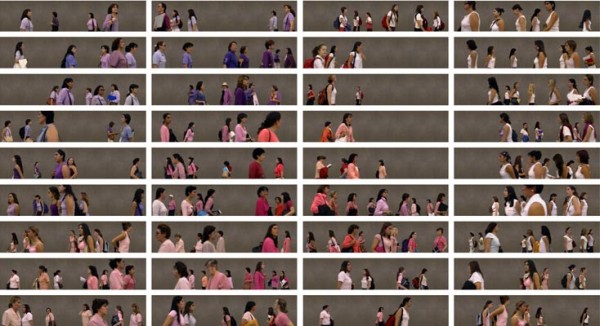
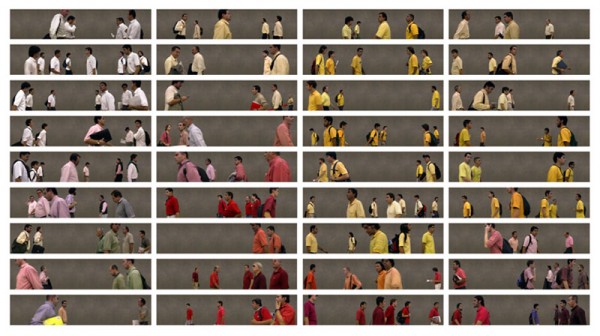
The subway in any major city is a conduit, where thousands of lives flow like water through pipes in the journey from past to future. The subway station, however, is like a purgatory—a present-tense place where the journey temporarily hangs in the balance as one waits on the platform, maybe reading a book or reading the looks on the faces of passersby. Some people are hardened by years of public transportation; they pay no mind to who or what is happening around them. Others can’t help but assume the posture of human curiosity in such spaces and find fascinating the fleeting masses of strangers. Chilean-born, Berlin-based artist, Pablo Zuleta Zahr, belongs to a third category altogether. He surpasses the instinct to merely “people watch” and goes beyond to create elaborately curated photo documentaries of people moving through a particular station. The footage that he captures is true—real people passing through a real subway station—but the art that he makes from the video footage turns into a sociological exercise wherein people are organized by gender, style, and color of clothing and then regrouped into “patterned panoramas,” as the gallery refers to them.

For his first show in the United States, entitled Event Horizon at Richard Levy Gallery in Albuquerque, NM, Zuleta Zahr presents work from his series’ Baquadano and Madrid, as well as the four panel video installation, BUTTERFLYJACKPOT. Baquadano consists of large format photographic grids comprised of stills from ten hours of video footage of Chilean metro passengers. The results of the artist’s meticulous reorganization of people are almost abstract; the visuals of color and pattern become as strange and alluring as the orchestrated grouping of originally disconnected individuals.

Pablo Zuleta Zahr lives and works in Berlin and holds an MFA from Düsseldorf Art Academy. His work has been exhibited widely outside of the U.S., including at MITTAGEISEN, Berlin, Germany; Museo de Artes Visuales, Santiago de Chile; Circulo de Bellas Artes, Madrid, Spain; Studio la Città, Verona, Italy; Gallery Bendana-Pinel, Paris, France; and Michael Hoppen Gallery, London, UK, among elsewhere.

Share

The Political Landscape, a conversation with Andrea Bowers

"No Olvidado - Not Forgotten", 2010. 23 graphite on paper drawings. Courtesy of Susanne Vielmetter Los Angeles Projects. Photo credit Robert Wedemeyer.

There are very few artists today who willingly take a direct political position in their work. Often artists neglect how powerful artwork can be as an instigator for social and political change. In many ways art and politics, or art and activism, have gone hand in hand throughout history, helping to over come social injustice. But, just as often, artwork has acted as a tool to help further social and economic inequalities by declaring ownership and possession.

As an artist that has committed her work to implementing social activism through art making, Andrea Bowers’ drawings and video eloquently document the lives of those who directly interact with the political system, through such issues as illegal immigration and land ownership. Her methods of representation help to humanize and quantify abstract concepts, such as the number of deaths caused by border crossing, through subtle interactions and involvement with her documented subjects. When modern media often explores these issues in a removed and politicized manner, Bower’s work reminds us of the individual. The simple act of documentation gives a face to those who are otherwise overshadowed by the dominating political sphere.

After viewing her recent exhibition at Susanne Veilmetter Los Angeles Projects, which closed last week, I had the privilege of meeting with the artist to discuss the roles of artists and activists, the function of memorials, and personal commitment to public issues.

"No Olvidado - Not Forgotten", 2010. 23 graphite on paper drawings. Courtesy of Susanne Vielmetter Los Angeles Projects. Photo credit Robert Wedemeyer.

Julie Henson: To start with, could you tell me a little bit about your show, The Political Landscape, at Susanne Vielmetter Los Angeles Projects?

Andrea Bowers: The Political Landscape continues my recent exploration of contemporary issues associated with the genre of landscape.  It focuses on contentious locations where countries and corporations are willing to cause environmental degradation or human rights violations for the purpose of attaining or maintaining power.  One of the earliest functions of the landscape picture has been to provide evidence of ownership; in this project I aim to reveal the abuse of ownership. For the exhibition, I have made two different projects that focus on two different sites in the American West: public land in the state of Utah and the Mexican/American border.

JH: I find it interesting that you choose to use drawing as a method to interact with those that are on the forefront of the current immigration debate. It seems to me that the act of creating a photorealistic drawing becomes documentation of the individual’s personal narrative. How do you relate to the individuals that you portray? How does visually capturing the individual relate to the dialogue around the social issue that affects them?

AB: First of all I should explain that one strategy that I use in my work is photorealist drawing. In the current exhibition at Vielmetter, I made a series of black and white pencil drawings of protesters at the recent Mayday March here in Los Angeles. Each drawing contains a protester holding a sign or wearing a slogan somewhere on their clothing. I am focusing on their political position at that particular moment. I’m choosing to honor these individuals in my drawings because I agree with the political ideologies they’re promoting and I think that these political subjects should be apart of historical discourse as well as art discourse.

"Study from May Day March, Los Angeles 2010 (We voted for a change We are waiting for it)", 2010. Graphite on paper. Courtesy of Susanne Vielmetter Los Angeles Projects. Photo credit Robert Wedemeyer.

JH: It seems to me that one consistent element of the show at Susanne Vielmetter Los Angeles Projects is this idea of honoring those who are otherwise forgotten in the mainstream media and current political sphere. The large drawings clearly have a strong relationship to many large public memorials, like Maya Lin’s Vietnam Veterans Memorial. How does the memorial function for you and in what ways does it change once presented in the gallery versus the public realm?

AB: No Olvidado (Not Forgotten) is the largest drawing project I have yet made.  It is comprised of 23 graphite drawings, 50” x 120” each. The piece acts as a memorial honoring those who have died crossing the Mexican/American border.  Unlike most memorials, this is an incomplete list and will always remain that way no matter how many names are added or collected.  So many people that have died migrating to the U.S. from Mexico over the years will never be identified.  The list of immigrant deaths comes from the organization Border Angels, whose mission is to stop unnecessary deaths of individuals traveling through the Imperial Valley desert region and the mountains surrounding San Diego County, as well as the area located around the Mexican/American border. A high percentage of these unnecessary deaths have been the result of extreme weather conditions, while some have, sadly, been the results of racial discrimination crimes. The Vietnam Memorial is government sanctioned and paid for—I wanted to make this memorial because I don’t believe the government would ever sanction and pay for a memorial like this.

JH: I also find it very intriguing that the drawings are more delicate and fragile than the traditional memorial and the list of names visually represents something seemingly abstract. There is something very precious about how seemingly impermanent the drawings are. What are your thoughts on the repetitious act of drawing and listing a record of an almost indefinite number of lives?

AB: I think the impermanence of graphite and paper versus a more traditional material for monuments, like stone or bronze relates to not only the fragility of the situation at the border but also, again, the lack of  U.S. government sanctioned support for people migrating to this county. The issues have only been abstracted by the American corporate media and most of our government officials. I don’t think there is anything abstract about thousands of people dying in the desert who are simply trying to make a better life for themselves and their families. The act of drawing or mark making reveals my personal involvement with the subject matter.

JH: I completely agree that the nature of the border situation is a product of our political system. One thing that I really love about No Olvidado (Not Forgotten) is that it initially comes across as a finite recording of lives lost, and the more time you look at the drawing, the more you realize the innumerable nature of it. And the shear time invested in the act of drawing so many names gives you a place to recognize and humanize the political questions around the border. It seems to me that you assume a different position in The United States v. Tim DeChristopher than you do in No Olvidado (Not Forgotten). Somehow, you smoothly transition from what seems to me as a recording of a story to physically intersecting and numbering the seemingly boundless environment that Tim DeChristopher saved. What happens when you inject yourself into the video?

"The United States v. Tim DeChristopher", 2010. Single Channel HD video (color with sound). Courtesy of Susanne Vielmetter Los Angeles Projects. Photo credit Robert Wedemeyer.

AB: I don’t see them as all that different. The action of drawing is somehow in line or is similar to walking through the landscape. I have spent a great deal of time studying and teaching the history of gestural mark making in both painting and performance.  Paul Schimmel’s exhibition, “Out of Actions” had big impact on me when I was a young artist.  Some of the mark making in No Olividado was made by using a really big brush coated in powdered graphite.  Walking through the landscapes and brushing the negative space of the drawings are both forms of gesture for me.  Both reveal my personal commitment to the issues. This is where my subjectivity enters the work. As an artist, attempting to be neutral or appearing to not have a position only serves the powers that be.

JH: Well, there are definite similarities in your approach. The difference to me is that there is a visual representation of your presence in The United States v. Tim DeChristopher that I read as more involved, or at least more active, than in the drawings. To place yourself within the landscape rather than just documenting through drawing makes me more aware of your presence and your position within the work. It enforces the idea that you are standing in solidarity with the issues at hand, as opposed to simply documenting someone else’s point of view. It allows the work to be more subjective in nature and instills it with a sense of personal passion and investment that is evident to the viewer. This leads me to one thing I find really interesting, which is how your work relates to role of the artist and the role of the activist. Can you talk a little about these two roles and how you think they work together?

AB: Art and activism have always been intricately tied throughout history. It’s just the market of commodification that encourages us to believe they are at odds. I’m always looking for the commonalities between art and activism, as well as thinking through how each might serve the other.  My work is always very opinionated in its political stance.

The exhibition, The Political Landscape, corresponded with multiple events at the gallery, including a fundraiser and information session with Tim DeChristopher, an afternoon of talks, music and conversation toward humane migration reform and a performance by artist Cindy Short in response to the exhibition. Andrea Bowers upcoming projects include “Collection: MOCA’s First Thirty Years (1980 – Now),” The Geffen Contemporary at the Museum of Contemporary Art (MOCA), Los Angeles, and  “Stowaways”, The Centro Cultural Montehermoso, Vitoria-Gasteiz, Araba, Spain, among others.

Share

Summer Social

L.A. Expanded: Notes from the West Coast
A weekly column by Catherine Wagley

Jack Pierson, "Tupelo," 2008. In the group show Country Music, at Blum & Poe, through Aug. 21. Courtesy Cheim & Reid, via Blum & Poe.


“I remember thinking when I first saw a show of Jack Pierson’s that it looked like a group show–Jack’s photos, big letters, a desk. I was excited by this possibility,” wrote Eileen Myles, “that anyone might start to look like a group.” That the peripatetic Pierson–who’s like a travel photographer fixated on minutiae but doggedly committed to the obligatory sunset shot (Myles has called him a hobo with an “Ivy League crook look”)–isn’t interesting as an individual is the most interesting thing about him. It’s like his nostalgic signage, paired with undifferentiated photographs of horizon lines, open books, young-ish nude men or Visconti-worthy table settings are together accidentally. Even his technical finesse, evidence that none of his projects are as flip as they seem, doesn’t keep Pierson from looking like a  library of other people’s wants, wallets and persuasions.

Summer is art’s season of group efforts, and Pierson’s Tupelo sign currently hangs in Blum & Poe’s seven-artist Country Music, a quaint  homage to sappy love and Nashville twang.  But what’s weirder and more exciting is the way in which the Jack-Pierson-effect, an unpretentious artist-as-meme mien, has somehow infected L.A.’s summer scene. The city’s best group shows aren’t really group shows at all.

Ryan Trecartin, "K-Corea Inc.. K (Section A)," video still, 2009.

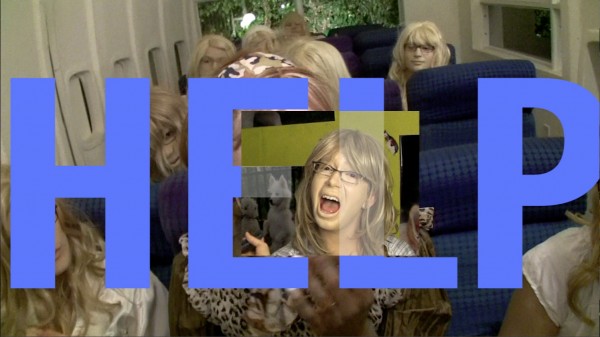
At MoCA’s Pacific Design Center, there’s Ryan Trecartin’s Any Ever, the topic of this column last week. It works intertextually (and that heady term fits Trecartin perfectly, though his version includes a text message shorthand that Kristeva and de Saussure couldn’t have imagined) as a labyrinth of prissy voices, over-the-top flamboyancy and brash epitaphs. Slippery ownership of person-hood is a coursing theme:

“Cut my hair shorter. I like that kind of person,” says one character. “I define myself as a situation hacker,” says another. “Help me define myself.” “The economy of my body is booming and everyone takes part.”

But collaboration, not slipperiness, gives Any Ever its group cred. Perfecting each of the show’s details  involved a posse of helper-friends; Trecartin, though part control freak, manages to give his characters uncanny autonomy; and the videos fluidly feed actors, lines and moods to each other until it’s impossible to tell them apart.

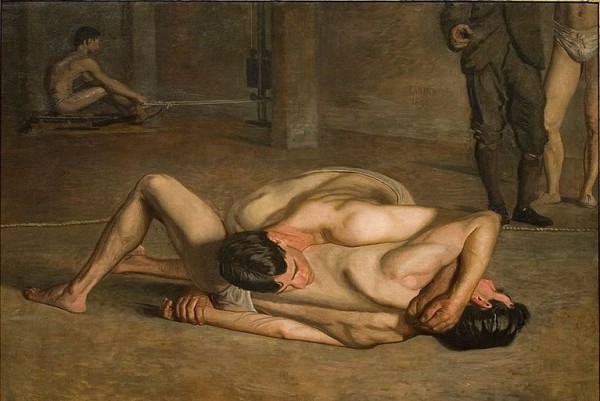
Thomas Eakins, "The Wrestlers," 1899.

LACMA’s Manly Pursuits: The Sporting Images of Thomas Eakins includes photographs and paintings from the wide-ranging sport-focused repertoire of Eakins, the royal of American Realism. Some are platonic and tame–like The Champion Single Sculls (Max Schmitt in a Single Scull) (1871), in which Max sits mid-water,  lost in thought. Others get physically aggressive, like Wrestlers (1899), which shows bodies in a tangle. The exhibition also includes a swath of photographic studies featuring Eakins’ male students in the nude.  It’s a show of many Eakins: the anatomist, the observer, the transgressor, the seducer, the sentimentalist. And it’s best when the different Eakins fit together awkwardly, as they do in a series of equestrian and hunting paintings that make conventional manliness look uncomfortable with itself and studies like this  tug-of-war photograph in which sincerity becomes erotic and erotic becomes comic.

Brian Kennon, Installation view, July 2010. Courtesy Steve Turner Contemporary.

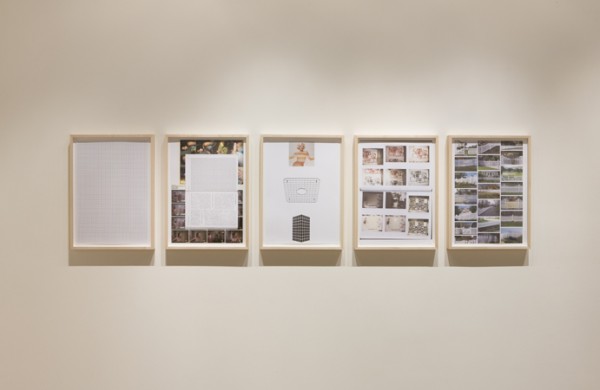
Brian Kennon, "Group Shows," Installation view, 2010. Courtesy Steve Turner Contemporary.

If Pierson begins to look like a group, Brian Kennon arrives as an already-assembled collective. His current exhibition at Steve Turner Contemporary (which closes tomorrow and is worth the last-minute dash) is called Group Shows and the plural–“shows” and not “show”–matters. Even Kennon’s groups are grouped. The exhibition includes two series and, for the first, Kennon composed mid-sized prints that put work of other artists, including John Baldessari, Franz West, Sherrie Levine and Wolfgang Tillmans, into curated conversations with each other. Though, in Dinner with Matthew, art talks to food. A bite-size image of Matthew Brannon’s Last to Know, which shows pink band-aids scattered across an invisible grid,  anchors images of an entree and Bostini Cream pie.  For the second series, Kennon merged gridded patterns with found photographs. One sleek print shows Bert Stern’s iconic striped-scarf photograph of Marilyn Monroe sitting above a gridded panel with an oval orifice which, in turn, sits above a vertical geometric column. It’s called Untitled (Monroe/Bochner Sex Joke).

Artist-linguist-prankster Mel Bochner plays a recurring role in Group Shows and, in the pithy Richard-Prince-quality narrative that serves as the press release’s epigraph, Bochner stands-in for Kennon:

Marilyn (through stripes) to Mel (measured): “If you were given the opportunity to initiate an orgy, one that would include anyone of your choosing, who would be in it?” Mel, in response: “Can you ask me the same question, but in regards to a dinner party? At a dinner party the host retains far more control over who can sit where.”

Kennon controls every interaction that occurs in Shows–which artist sits next to which, who appears in which grouping–but not in a stifling way. While Pierson’s work suggests “anyone might start to look like a group,” Kennon’s suggests a group might start to look like anyone and this sort of mutability makes summer seem really social, not just an excuse for another art-fair worthy melange.

Share