Interview with Babak Golkar

Babak Golkar is a multi-disciplinary artist whose practice, at its fundamental roots, takes aim to deconstruct, recontextualize and rearrange our perceptions of the world around us. Like Zen koans, Golkar’s work seems to arrive at new understandings by setting up impossible questions. At it’s core is a spirit of unbridled philosophical investigation; one that exhibits a Duchampian twist on the visual pun mixed with a Gestalt sense of multistability and reification. Golkar’s work understands both the destructive and regenerative aspects of perspective and shifting visions; and fundamentally contests the fixity of subject and object and space. And, like his work, Golkar’s visual language maneuvers between seemingly oppositional realms–East and West, politics and revolution, Modernity and antiquity, Minimalism and ornament—ultimately exposing not the dialectical relationship between polarities, but rather the poeticism in the world around us.

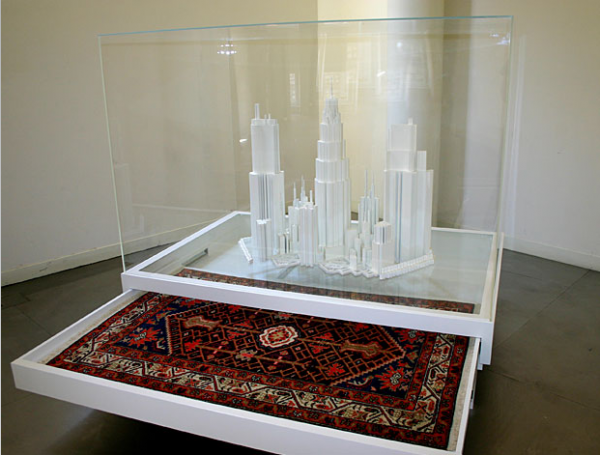
Sasha M. Lee: I wanted to begin with your series “Negotiating Space,” in which you use Nomadic Persian Carpets as a kind of architectural support, transforming its geometric twists and turns into rough blueprints for gleaming, white, three-dimensional models, rising from the woven geometric patterns. I thought the title and the conceptual framework of the work, for me, was actually a poetic way to summarize many of the themes that run through your work. Can you talk about how these forms interact, and why you chose to juxtapose these particular forms in this manner?
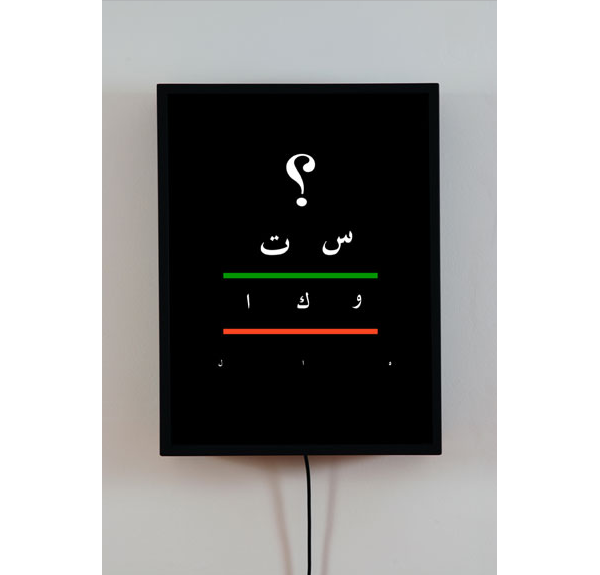
Babak Golkar: I’m interested in the alchemy of the art practice…arriving at gold, metaphorically of course, some sort of proposal for new understandings, the creation of new meaning. I like the idea of a particular piece transforming from two dimensions to three dimensions; something non-existent becoming a possible structure, and the subsequent interaction between the two. I like to talk about my work in terms of “becoming,” of interdependency between these two forms. In the case of the series “Negotiating Space” I don’t like to look at the nomadic Persian carpet as the origin of the whole thing per say…but rather one visual form constantly becoming the other and vise versa.

Hence the title—I like to use titles as materials in and of themselves– it is carefully chosen to hint at a state of uncertainty, a fluid or malleable state of existence. Really, I call the works “proposals,” rather than installations or sculptures.

Even though the carpet is technically the blueprint for the architectural scale-models, the structure adds a vertical dimension, which, as you move above the piece it collapses back to carpet once again. I like to talk about this idea of 2D to 3D, and its reversal; in particular the Duchampian aspect of playing with space. I’m inspired by Duchamp’s alchemical approaches to art making. In some ways I make a reference to Duchamp, in particular his piece, 3 Standard Stoppages. Do you know that piece?

Read More »

Share

Colin Quashie: Service

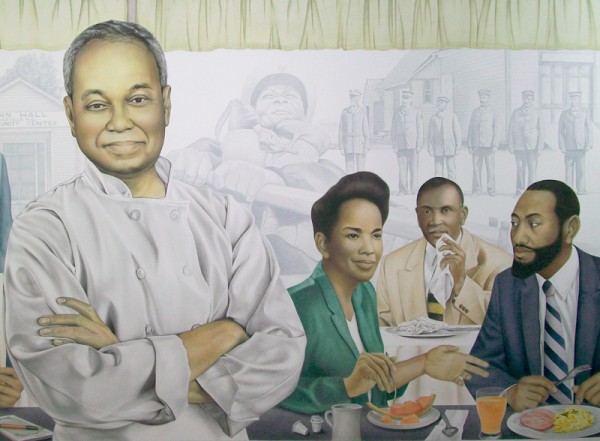
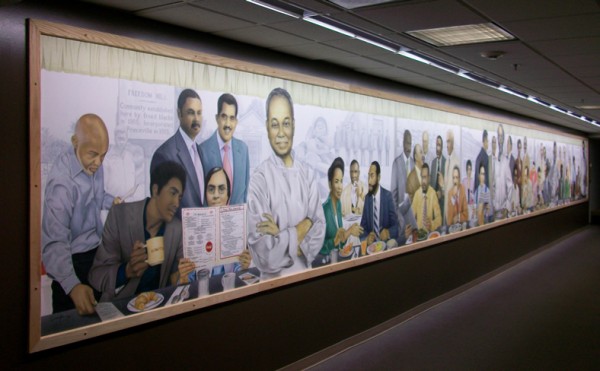
Colin Quashie’s recently completed mural, entitled Service, focuses on the intricacy of interactions between art and politics in a complex, expressive artwork commissioned by the University of North Carolina’s School of Government. Noted as a controversial artist, Quashie, based in Charleston, South Carolina, undertook the completion of this project sustained by the patronage of the Local Government Federal Credit Union. The painting commemorates the contributions of African Americans to North Carolina’s local history, and addresses omissions from popular cultural memory. The circumstances of this image, and its commission offer a rich opportunity for social commentary and a dialogue on culture, race, reasoning, community, and the aesthetics of public memorials in America.

Although Service is presented as a traditional mural painting, its placement, combined with the artist’s contrived design motifs and the mural’s contextual cultural inferences, morphs the work’s significance away from being a “history painting” into a nexus of relevant political issues. Approximately 5’ high and 50’ long, the figures represented are rendered in thin, translucent oil glazes. Despite its concessions to the conventions of naturalistic figurative art, this work’s conceptual richness and informative, amusing, complexity make it more than a simple mural; it is a “conversation piece” in the very best sense of that term.

The ideas suggested in this work obliquely confront visitors to the ground floor dining room of the Knapp-Sanders Building on the Chapel Hill campus. Operating more like a satirically conceived installation rather than the simple mural, it coyly seeks to pacify us with a history painting, yet its complex ideas correspond with the socially critical and ironic implications associated with other works by Quashie, whose rambunctious contentions with our American culture often simultaneously entertain while interrogating the presumed motivations and assumptions of his audiences. Quashie seduces us into believing that this image is “safe” and the mural seems initially to offer few surprises: that is to say, it does the work that it was expected to do by representing a series of figures of historic significance. Service, however deals with more than simple appearances.

Read More »

Share

Kitty Huffman: Self Portrait

According to an article this year, Amercians’ top fears include: terrorism, flying and heights. All of these, we can assume, stem from an ultimate fear of physical pain or death. However, there are those whose life experiences include certain hardships or burdens that would cause them to fear something such as abandonment above even the most horrific physical harm. Wisconsin-based artist Kitty Huffman has explored such ides through her video piece, Self Portrait, which is currently on view in the Wisconsin Triennial at Madison Museum of Contemporary Art.

Huffman, who was born and raised in Communist Romania to Hungarian parents, is interested in experiencing and documenting risks of abandonment, as well as humans’ interactions with the natural world. In her performance piece/video, Self Portrait, Kitty has presented herself in a most vulnerable state—naked in the snow amongst a herd of wild deer. The slow-moving video looks almost like a landscape painting, and rightly so—it was inspired by a Hungarian folk tale that takes place in such a setting. After an anxious few moments of eying Huffman horizontal on the cold earth, we see deer begin to wander into the frame. Eventually, an entire herd makes its way into the scene, vaguely aware of the artist’s presence. It is a tense yet distanced interaction in which you get the feeling that Huffman both longs for and fears that the wild animals will approach her. And then something scares the deer off—maybe a sound, or the presence of a person or vehicle out of frame. They spring off and leave Huffman alone once again, left to deal with both the joy of safety and the sadness of abandonment.

Kitty Huffman is a current MFA candidate at School of the Art Institute, Chicago. She earned her BA at University of Wisconsin-Madison and previously studied drama at Babes Bolyai University, Romania before moving to the U.S. Her work has been included in the 4th International Short Film Festival in Germany.

Share

Piece of Work / Work of Art

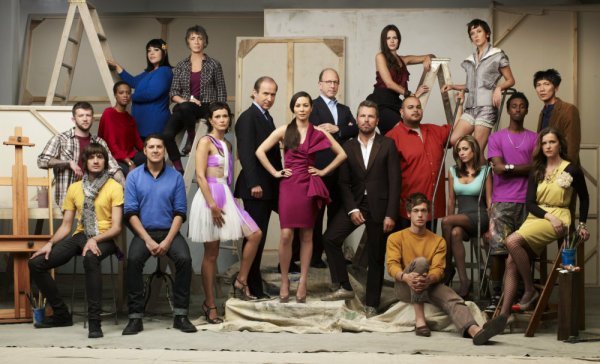
All things considered Work of Art: The Next Great Artist was not nearly as bad as it could have been. In fact, the descriptor benign springs to my mind. I’m not going to lie, though – it was touch and go at the beginning. The first time I heard that a reality television show along the lines of “America’s Next Top Artist” was in the works, my stomach clenched a little. Of course the art world is predominantly a fickle, market-driven star system – but a reality television show? Will we so easily surrender all semblance of substance? Should we not maintain at least the veneer of scruples? I quickly dismissed the whole thing but several months later, I received an email from a curator friend announcing the premier of the show. In the subject heading she had typed simply, “It’s here.”

After watching all the episodes, however, I can honestly say I cringed not once. Not unlike Sarah Jessica Parker’s other little project you may have heard of, the most interesting aspect of the whole situation has been the fervor of criticism surrounding it. Regarding the critical hysteria surrounding Sex and the City 2, Peter Bradshaw of The Guardian noted, “a new army of bloggers has challenged and reinvigorated movie writing.” Similarly, the weekly examinations of Work of Art featured on various Web sites, including those of the participants themselves, and the ensuing conversations that have played out in the comment sections have been far more interesting that the actual show.

Read More »

Share

From the DS Archives: Kathy Grayson

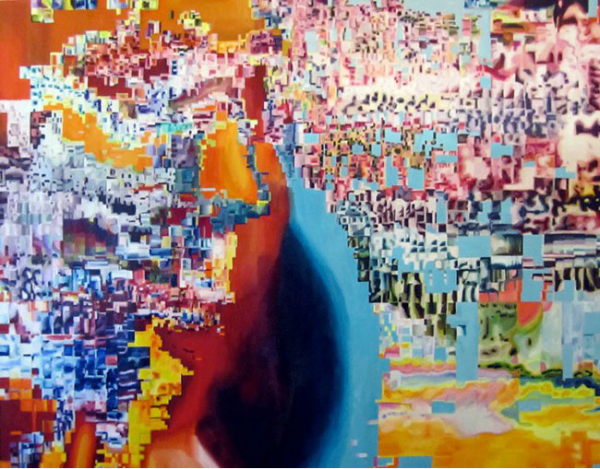
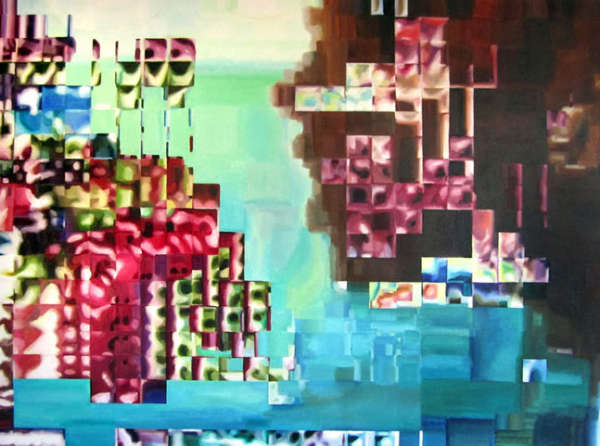
This Sunday’s From the DS Archives unearths a feature on artist Kathy Grayson that presents a compelling example of contemporary painting.  While Grayson’s work is realized in paint, her process capitalizes on the technologies of globalization.  She appropriates You Tube footage and then uses computer programs to capture and abstract the transference of data, which facilitates digital broadcasting.  Grayson’s Bangalore series visualizes an otherwise invisible everyday process.

The translation of information from an original event to a digital screen takes many forms. While the process of transferring data from the camera to satellite to analogue broadcast to a digital screen device occurs countless times each day, we usually absorb this information with little to no awareness of the process. Fueled by this topic, painter Kathy Grayson is currently presenting a new body of work titled Bangalore on view at Kim Light Gallery in Los Angeles. The artist has taken televised sports footage of professional tennis matches for the subject of her new paintings. Utilizing YouTube footage of the matches, the artist examines the abstraction that occurs from the digital compression of data. Grayson runs footage through computer applications to distort and abstract the images, reconfiguring the digital remains to create what she calls a “stirring up of the video data to make interesting ruptures in figurative painting.”

Grayson is a graduate of Dartmouth College and currently lives and works in New York City. The artist serves as the director of Deitch Projects in NYC and works as an independent curator, essayist and book editor. Recent exhibitions include works at Park Life in San Francisco and D’Amelio Terras in NYC.

Share

Francis Alÿs: A Story of Deception

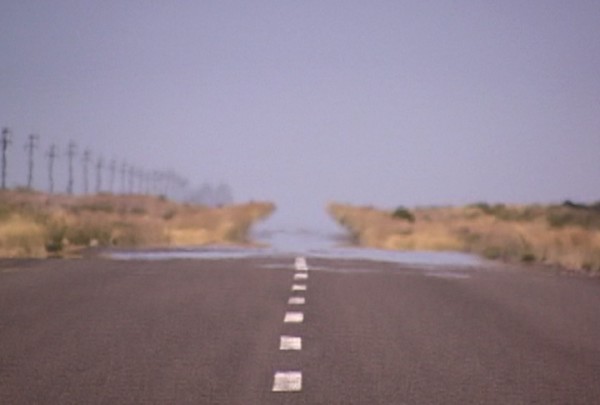
Francis Alÿs in collaboration with Olivier Debroise and Rafael Ortega. A Story of Deception, Patagonia, 2006 still from 16mm film (4:20). Courtesy of Francis Alÿs and Galerie Peter Kilchmann, Zurich © Francis Alÿs.

A Story of Deception is the title of Francis Alÿs‘ current retrospective on view at the Tate Modern. The title of the exhibition, which spans the artist’s two-decade long career is borrowed from a work of the same name, and appropriately provides the exhibition’s subtitle and introduces the gallery visitor to Alÿs’ work. The 16 mm film, A Story of Deception, captures a mesmerizing and unobtainable mirage on the horizon. The camera centers itself on a road, halved by a dotted white line and follows it across an arid Patagonian landscape. The film’s imagery and intent are oblique and deceptively simple – allowing a variety of creative, metaphorical interpretations. The road can be read as representative of a border and the unobtainable mirage as the often out-of-reach goal of border crossing.

Francis Alÿs, Ambulantes (Pushing and Pulling), Mexico City, 1992-present Slide projection. Courtesy of Francis Alÿs and David Zwirner, New York. Image by Francis Alÿs © Francis Alÿs.

While Alÿs is most readily associated with the film or video documentation of his actions, this retrospective takes care to illustrate the multi-media nature of the artist’s practice and is curated thematically. Film and video work is presented with related photographs, paintings, drawings or other ephemera. In one particularly successful example, Paradox of Praxis I or Sometimes Making Something Leads to Nothing (1997) is shown near photographs taken in Mexico City dating as early as 1992. These projected photographic images from the series Ambulantes (Pushing and Pulling) feature street vendors and workers bearing loads in the streets. The connection is evident between these photographs and Paradox of Praxis, in which Alÿs pushes a block of melting ice through the city’s streets. Both point to the often comical futility of contemporary labor.

The artist typically begins his work with an action, allowing other media to play a supporting or planning role, but that is not always the case. The artist works in a variety of media, including photography, sculpture, animation, drawing and painting. Paintings such as Le Temps du Sommeil (2003-present) and Silenco (2003-present) illustrate that Alÿs is influenced by urban advertising. They also reference the precedent – intentionally or not – of past artists like Magritte.

Film or video documentation of Alÿs’ carefully planned actions remain the most compelling and most capable of conveying both subtle and overt political messages. In Re-enactments (2000), Alÿs references the gun violence of his adopted Mexican homeland. When Faith Moves Mountains: A Project for Geological Displacement (2002) is one of Alÿs’ most well known works for its sheer monumentality. In it, the artist directs 500 volunteers to form a line and physically move a sand dune located outside of Lima, Peru. Armed solely with shovels and the spirit of collective effort, these volunteers complete a task whose apparent futility belies its profound metaphorical statement. This great effort of ‘geological displacement’ points to the immense shared burden of geo-political displacement.

The contemporary nation-state border, as a contradictory line that is both increasingly restricted and crossed, is an important theme in Alÿs’ art practice. The artist addresses the hypocrisy of the border in works such as The Green Line or Sometimes Doing Something Poetic Can Become Political and Sometimes Doing Something Political Can Become Poetic (2005) in which the artist walks the 1948 armistice border line between Israel and Palestine. Trailing a leaking can of green paint behind him as he walks a now defunct border, he quietly and profoundly points to the idiocy of human suffering caused by an arbitrary line of division. Loop (2007) chronicles the artist’s purposefully ludicrous route across the US – Mexico border as he travels from Tijuana to Australia, up the Pacific Rim to Alaska, and then finally to California. The epic route of travel taken in lieu of the actual distance between Tijuana and San Diego highlights the difficulty of this border crossing for illegal economic migrants. Also referring to the theme of border crossing, The Rehearsal (1999-2004) features a red Volkswagen Beetle that continually tries and fails to reach the top of a dirt road.

The exhibition makes a strong conclusion with the premiere of Tornado (2000-2010). This newly completed, 55 minute video documentation from hand-held camera footage was ten years in the making. It captures the artist as he places himself in the path of high-altitude tornadoes in Mexico – enduring severe winds and no visibility brown-outs in attempts penetrate the tornado’s central vortex where the air becomes eerily still. Alÿs places himself in peril – throwing himself blindly into chaos in hopes for resolution through the extraction of meaning. Or, as curator Mark Godfrey argues Tornado is again concerned with the border crossing and the immense difficulty of entering and leaving geo-political zones in our increasingly mobile world.

Francis Alÿs Tornado Milpa Alta, 2000-10 Video documentation of an action and related ephemera 55 minutes Courtesy of Francis Alÿs and David Zwirner, New York Image: Video Still © Francis Alÿs

Francis Alÿs: A Story of Deception remains at the Tate Modern until 5 September. The show’s next stop is Alÿs’ home country where it will be presented at Wiels in Brussels (9 October – 30 Janurary). The exhibition comes state-side next year to New York’s MoMA (8 May – 1 August 2011).

Francis Alÿs is represented by David Zwirner in New York and Galerie Peter Kilchmann in Zurich.

Share

Sunday Boys

L.A. Expanded: Notes from the West Coast
A weekly column by Catherine Wagley

Andy Warhol, Dennis Hopper, Screen Tests Reel #4, 1964-65.

I spent Sunday looking at boys. It began at LACMA, where I saw Catherine Opie’s quarterbacks, linebackers and surfers  followed by Thomas Eakins’s rowers, wrestlers and athletic but stationary nudes. It continued at the Egyptian Theater, with ten of Andy Warhol’s four-minute screen tests: Buffy Phelps with delicate, defiant eyes and blondish curls; John Giorno of Sleep, darker and rougher than Buffy; Kip “Bima” Stagg, equally dark but not as rough; Dennis Hopper, twenty-eight but looking younger; Hopper again, still near twenty-eight, but suit-clad and looking older; Gregory Battock with Clark Gable jauntiness; Richard Schmidt and Paul Winterbottom; Kenneth King and Richard Markowitz, who, along with Giorno and Hopper, would appear in the compilation The Thirteen Most Beautiful Boys.

Because Warhol’s tests are meditative and slow, I lost myself in their static silence, and didn’t think about gender until the reel played out. “They were all men, weren’t they?” I said to the friend sitting next to me. He’d noticed before I had.

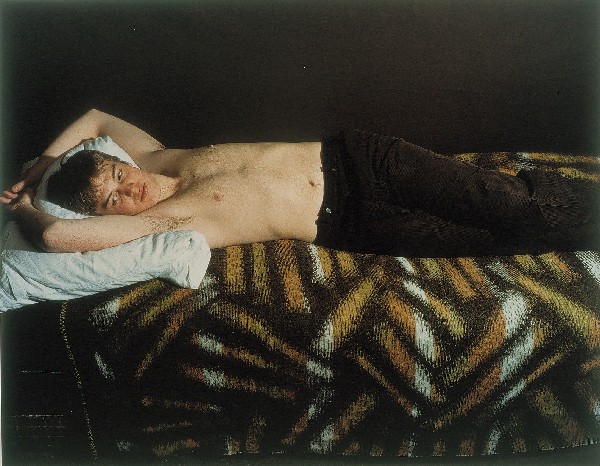
Collier Schorr, "Jens F.," 2005.

Three weeks ago, when Catherine Opie’s unprovocatively titled Figure and Landscape opened, Opie talked about her work in LACMA’s Bing Theater. She mentioned comparisons often made between her sports photographs and the work of Collier Schorr, which depicts, among other things, young male bodies posing and sparring. “Collier wants to be her boys,” said Opie. “I don’t . . . I’m not interested in seeing my butch body through them.” What she’s interested in is bearing witness, and she’s been witnessing a precariously in-between generation, some of which has gone to Iraq, some of which has died.

Being versus bearing is not so simple a distinction, of course–Opie’s boys, as poet-critic Eileen Myles has pointed out, tend to adopt the Opie expression, which resembles a “scary duh.” Even so, it’s possible Schorr wants to be her boys while Opie wants to be aware of her boys; certainly, Eakins wanted to be with his boys while Warhol wanted to collect them.

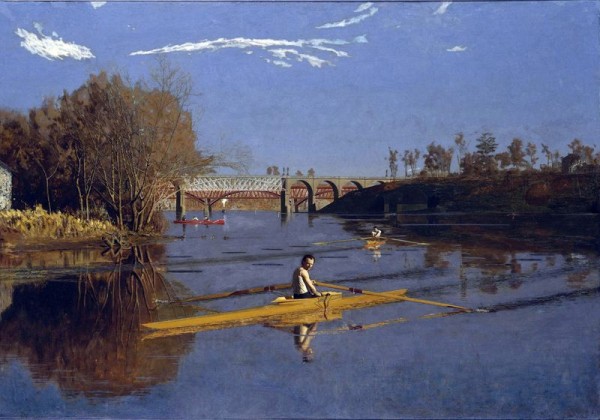
 Thomas Eakins,"The Champion Single Sculls," 1871. Courtesy LACMA.

Thomas Eakins,"The Champion Single Sculls," 1871. Courtesy LACMA.

It’s Warhol and Schorr who most prominently prefer male subjects. Warhol’s Screen Test Reel #5 includes only two women and, like Reel #4, Reel #6 is an exclusive boy’s club. Schorr, when asked why she doesn’t photograph girls, has said she does; she just uses boys to do it. But the strange, sports-focused mannishness of the paired Opie-Eakins exhibitions is even stranger in light of both artists’ genuine interest in women. Opie’s girl-only Girlfriends series showed at Gladstone Gallery in New York last year, and Eakins consistently included women in his work, and even in his controversies. It was his uninhibited disrobing in front of female students and his insistence on the removal of a male model’s “loin cloth” during a drawing session women attended, not his obsession with his “beloved” (as one wall label reads) young men, that forced him to resign from the Pennsylvania Academy of the Fine Arts in 1886.

Catherine Opie, "Untitled #10 (Surfers)," 2003. Courtesy Regen Projects.

In Manly Pursuits and Figure and Landscape, Eakins and Opie, both realists, show themselves to be exquisite technicians with a virtuosic, if predictable, eye for poetic composition. In Eakins’s The Champion Single Sculls, a burnt sienna scull cuts smoothly across royal blue water and its inhabitant looks elegantly, if illogically, casual as he turns to look back. In Opie’s portraits, skin, eyes, pose, gaze, the position of the football helmet, have all been carefully considered; royal blue makes frequent appearances in her work as well. But both artists render the trappings of a conventional masculinity and gender-play to which neither quite belong–to which no one quite belongs–and it’s the work that revels in inaction that seems most gaping and honest.

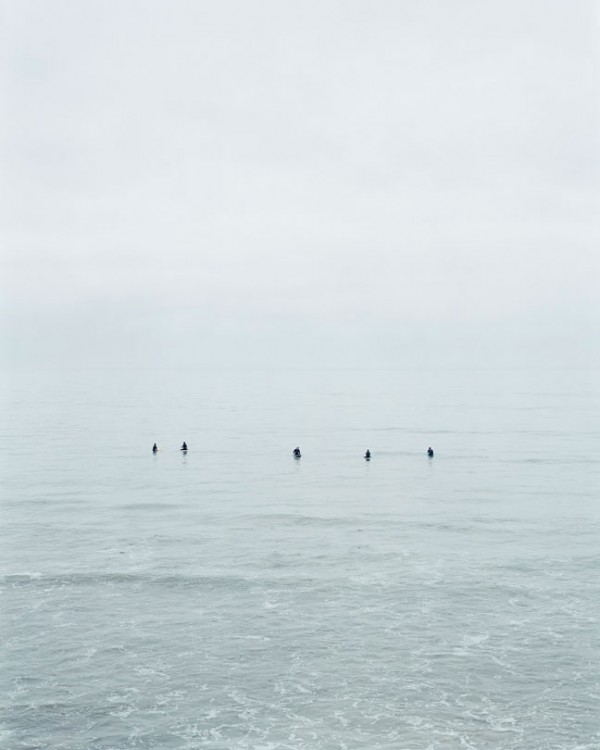
A room at the back of Figure and Landscape features only surfing images, and, though Opie has made striking portraits of surfers she’s shadowed, none of those portraits are included here. Instead, there’s just expansive gray rectangles in which far-off bodies float, largely unmoving, waiting for a chance to resume their sport. They’re certainly skilled surfers; everyone Opie photographs seems to be good at what they do. They’re also like little pawns or bobbing black buoys. They don’t look volitional but they do look comfortable; like the artist who made them, they’re virtuosic and yet awkward precisely because they’re virtuosic.

Share