Courtyards and Shipwrecks

L.A. Expanded: Notes from the West Coast
A weekly column by Catherine Wagley
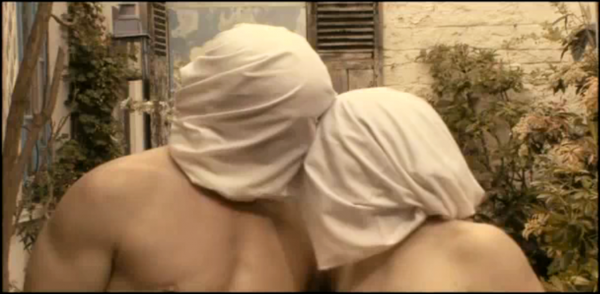
"The Beaches of Agnes," film still of a performance in Agnes Varda's courtyard.

Agnes Varda, the 82-year-old Parisian filmmaker who won the Golden Lion, was married to Jacques Demy, and dressed as a Potato for the 2003 Venice Biennale, has lived on a courtyard off Rue Daguerre for over half a century. The way she speaks of it in her filmed autobiography, The Beaches of Agnes (2009), you’d think she lived in the courtyard itself, with no house attached. That’s not far from the truth. When she first moved in, it was 1951 and the courtyard was really just an alley and a garage, sandwiched between a bakery and framing workshop. It was a knotty, overgrown mess of debris and there was no heat or bath, just a Turkish-style toilet. When her father saw it, he asked, “You want to live in this stable?”  She said, “Yes, wait and see. It’ll be nice later.” Though her father died too soon to see, she did make it nice, and  treated it, quite explicitly, as a set for both life and performance. Jane Birkin and Laura Betti used it for a Charlie Chaplin style routine, and sometimes Alexander Calder (Varda called him “a wonderful man”) rode a bicycle around it in circles.
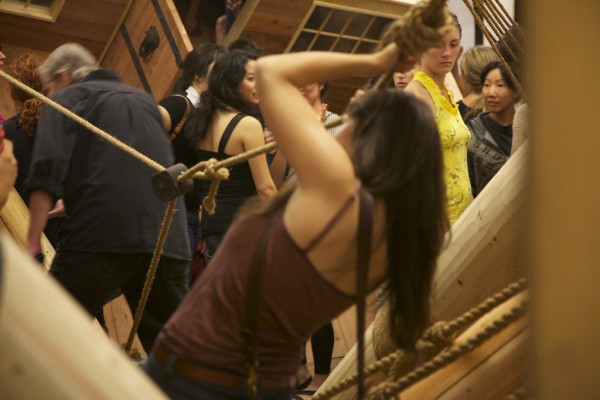
Josh Beckman, "Sea Nymph," Opening Night Installation Shot. Courtesy Machine Project.

Josh Beckman, "Sea Nymph," Opening Night Installation Shot. Courtesy Machine Project.

Machine Project is like Varda’s courtyard, only it’s more beat than bohemian (a slippery distinction that, I realize, mostly means people at Machine wear more plaid).  The storefront art space in Echo Park has existed since 2003. It hosts workshops, events, and the occasional exhibition, catered to the intellectually curious.  Currently, Machine houses a shipwreck. Josh Beckman, who works at the National History Museum and is having his first solo exhibition, has built a severed ship coming out of Machine’s floorboards. The floor stands in as the sea’s surface. Called Sea Nymph, it’s the newest, smoothest, freshest looking wreck I’ve ever seen, but it’s more a set within a set than an attempt at verity.

Sea Nymph’s opening reception on Sunday, September 5th, felt like a launch party, or pre-gaming, rather than a pat-on-the-back celebration (as many openings do). Guests acted like they owned the mast and deck, and felt perfectly comfortable handling ropes, leaning on the poles, and climbing up into the angled cabin. It wasn’t an object to look at, but a place for events that were playing out and have yet to play out: a knot tying workshop, readings, a lecture on the mechanics of disaster. A puppet show scheduled for September 19th will retell Moby Dick “impressionistically.”
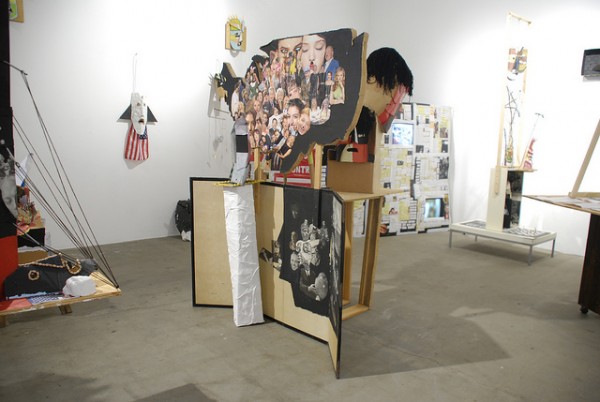
Gustavo Herrera, "The Birth of Satan," Installation View. Courtesy Human Resources LA.

Kenneth Anger interpreted Moby Dick impressionistically, or  murkily, in his 1947 film Fireworks, in which a teenager is attacked by a posse of sailors. Anger’s name makes repeat appearances in another courtyard-like exhibition currently on view: Gustavo Herrera’s The Birth of Satan at Human Resources LA. Herrera has turned the small Chinatown space into a gypsy-like garden of found objects and haphazard sculptures that compulsively reference evil, eccentricity and extreme good (a few scattered well-handled spreadsheets compare Satan, David Karesh, Jesus, Aleister Crowley, and, of course, Anger). The Birth of Satan has changed over its duration, as Herrera has added new objects or moved existing ones. It has also played host to a variety of performances, one in which Michael Decker and Christian Cummings used a Ouija Board to summon ghosts, and another in which Doug Harvey made sculpture-inspired music. The paraphernalia, including a scrawled drawing by the ghost of Sigmar Polke, from these performances now belongs to the installation.

When Jacques Demy was dying of AIDS, an illness he preferred not to discuss, Agnes Varda and a cast of friends restaged and filmed his life in her courtyard (among other places) as a way to accompany him out of the world. Sometimes, they would restage scenes from his movies “naturally,” as if they had been part of his life. In The Beaches of Agnes, Varda points out that it could make for quite the master’s thesis–a home that is also a set hosting the restaging of film events as real events, and life events as film events. It would be a thesis in which Nicholas Bourriaud, who insists on art as a relational experiment in which “time and space weave between themselves,”  could be quoted at length. But what’s most interesting, and much simpler, about what Varda, Machine, and Human Resources suggest, is that, if you build a courtyard and invite people to live in it with you, they might really come.

Share

Carnival: Paintings and Installations by He Jia

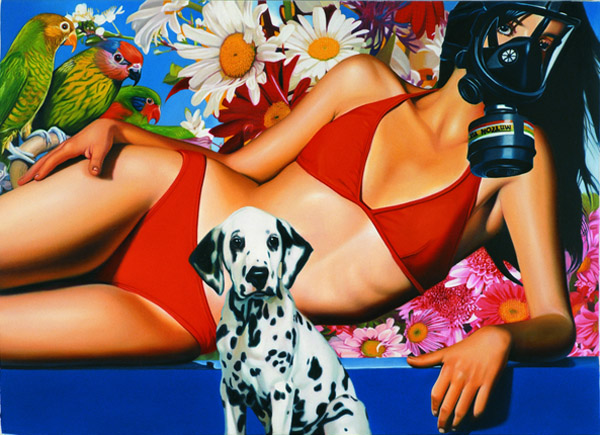
Severe Hypoxia, 2009, Oil on Canvas 180 x 250 cm. Image: Courtesy of Art Seasons Gallery

There is no easy, harmonious blend in the overtly bright and exaggerated portraits in Yunnan-born artist He Jia’s works – headless bikini-clad figures, larger-than-life flora and fauna and traditional Chinese masks just to name a few – but therein lies a complicated and often contradictory statement on contemporary culture. Much has been written about the antagonism between local culture and global culture, the former loosely defined as an entity that clings to tradition, convention and rootedness in any particular time and space. In contrast, global culture broadly encompasses what local culture deigns to reject: cultural universalism, the hyper-real, the celebration of pastiche and the media-driven proliferation of signs and symbols.

Presenting his latest series of monumental works dating from 2007, He Jia creates his art in the era of China’s diluted socialist policies and capitalist economy; it is the rampant consumerism that has transformed China’s economy amid potentially conflicting ideologies and conservative Chinese customs that inspires his paintings. In a first solo exhibition named Carnival at the Art Seasons gallery in Singapore, it becomes apparent that He Jia’s works have less to do with probing the assimilation and the reconciliation of Western cultural icons with Far-Eastern Chinese traditions but is instead almost entirely concerned with the disorientation and indulgence that globalization affords and the accompanying vices that have arisen out of rapid economic reforms and unprecedented social change. He Jia portrays the influx of influences as a visual feast that incorporates disparate and unrelated signs and symbols of both local and global cultures.

At times grotesque and kitsch-loving, Carnival is in many ways, visual anarchy personified: an explosion of garish colors and a surrealistic disarray of inanimate and animate objects collapsing into each other characterize He’s works in this exhibition. They are not reticent works with a brooding presence but rather an over-compensated attempt at compressing all that defines 21st century China. Understatements appear to have no place in Carnival, whose namesake itself suggests the active suspension of belief within a contained but mesmerizing space of enchanting entertainment and dream-like spaces. He Jia’s works impact viewers by their sheer size – the canvases range from 2 – 9 metres long – and amplify the dizzying experience of being caught in a kaleidoscopic world (mostly consisting of primary colors of blue, red, green, and yellow) that has no identifiable beginning and end. Symbols of global and local (traditional Chinese) culture culled from both mainstream media and collective, historical memory appear in He Jia’s array of works.

Fire Eye'd Jingjing, 2010, Oil on Canvas 200 x 245 cm. Image: Courtesy of Art Seasons Gallery

In Fire Eye’d Jing Jing (2007), Chinese (or Beijing) opera is utilized as a trope of an established Chinese theatrical tradition. A masked performer in full theatrical garb is captured mid-pose, his flags (theatrical props) fanning out diagonally in a way that erases any sense of spatiality. Yet half of the composition is dominated by a female Chinese woman whose dramatic eye-makeup is partially completed, possibly in preparation of an upcoming performance, or is simply a female figure who has embraced the global trends of beauty. For the woman as opera performer, He Jia unveils what is typically unseen: the arduous make-up process that goes into each operatic performance, but embeds a current of sensuality in the exposed neck and shoulders of the woman.

Such similar titillating images – found in the form of bikini-clad, headless women amidst the enduring symbols of Chinese opera – return in Wow Yeah Yeah Yeah (2007) and Farewell my Concubine (2010), the latter appearing to be a reference to the Chen Kaige’s 1993 film that propelled post-cultural revolution China into world cinema. Just like Chen’s film, He’s Farewell my Concubine is vividly intense, exploring ideas of sexuality, addiction and the paradoxes of globalization to which there appear to be no solutions.

Farewell My Concubine , 2010, Oil on Canvas 200 x 317 cm. Image: Courtesy of Art Aeasons gallery

While a heightened sense of sexuality is certainly present, the mesh of faceless bodies, tattoos and heavily painted masks add to the intrigue of what lies beneath. He Jia’s paintings in fact, disclose nothing beyond their dazzling colors. A calculated amount of evasion seems present, just as the T-shirt-clad jester in Grimace Koo No. 2 (2010) teases us with his insanely wide-grin and partially-covered face.

Grimace Koo No. 2, 2010, Oil on Canvas 200 x 318 cm. Image: Courtesy of Art Seasons Gallery

Co-sponsored by The Museum of Contemporary Chinese Art (also known as “The Mausoleum”) in Singapore, Carnival is He Jia’s first solo exhibition in Singapore and will run at the Singapore Art Seasons Gallery until 12 September 2010.

He Jia’s paintings are in the collection of Rolex Geneva Foundation in Switzerland, Robert Chaney Foundation in the US, White Rabbit Gallery in Australia, Duolun Museum in Shanghai, and The Museum of Contemporary Chinese Art in Singapore. He currently lives and works in Beijing.

Share

The Intersections Between Photography and Sculpture

Today’s post comes from our friends over at Flavorwire.com, a site dedicated to breaking exciting news in everything contemporary, including visual art. In the spirit of our ongoing content sharing partnership, we bring you an article on The Intersections Between Photography and Sculpture, a new exhibition currently on view at the MoMA in New York City. This article was originally published Tuesday Sep 7, 2010 by Paul Laster.

Herbert Bayer. American, born Austria. 1900–1985 Humanly Impossible. 1932 Gelatin silver print, 15 3/8 x 11 9/16" (39 x 29.3 cm) The Museum of Modern Art, New York. Thomas Walther Collection. Purchase © 2010 Artists Rights Society (ARS), New York/VG Bild-Kunst, Bonn

Although sculpture is a three-dimensional form that needs to be seen to be experienced, it’s normally reproduced through photography. Since the inception of photography, artists and photographers have used the camera to not only capture sculptural forms on film but to stage scenes with objects and document performances that now only exist in print. Likewise, artists have long used photomontage to construct sculptural fantasies purely from the imagination. Examining the intersections between photography and sculpture, The Original Copy: Photography of Sculpture, 1839 to Today, at New York’s Museum of Modern Art offers new ways of understanding what sculpture is, as well as a chance to explore the aesthetic evolution of photography through its rich, 170-year history.

Bruce Nauman. American, born 1941 Self-Portrait as a Fountain from the portfolio Eleven Color Photographs. 1966–67/1970 Inkjet print (originally chromogenic color print), 20 1/16 x 23 3/4" (50.9 x 60.3 cm) Museum of Contemporary Art, Chicago. Gerald S. Elliott Collection © 2010 Bruce Nauman/Artists Rights Society (ARS), New York

Without following a chronological order, the show is organized around ten conceptual compartments that allow its curator, Roxana Marcoci, to expose shared interests between artists of different generations and to isolate moments in time, such as the collaboration between Rodin and various photographers documenting his work and Brancusi’s use of photography to capture his sculptures and studio in another light. The section “Cultural and Political Icons” focuses on images of statues and symbols, both revered and hated, while “Studio Without Walls” investigates documentation of Land Art and artistic urban interventions. Meanwhile, the “Pygmalion Complex” presents surrealist images from the movement’s heyday to its later embrace by contemporary artists as a means to confound the viewer.

Sibylle Bergemann. German, born 1941 Das Denkmal, East Berlin (The monument, East Berlin). 1986 Gelatin silver print, 19 11/16 x 23 5/8" (50 x 60 cm) Sibylle Bergemann/Ostkreuz Agentur der Fotografen, Berlin © 2010 Sibylle Bergemann/Ostkreuz Agentur der Fotografen, Berlin

Displaying over 300 photographs, magazines, and journals by more than 100 artists — ranging from William Fox Talbot and Eugene Atget to Bruce Nauman and Rachel Harrison The Original Copy grants viewers the opportunity to reconsider the development of photography from the perspective of the digital age, while gaining a new awareness of the changing definition of sculpture throughout time.

The Original Copy: Photography of Sculpture, 1839 to Today, which is accompanied by a catalog, is on view at MoMA through November 1.

Share

This is Not a Photo Show

This is Not a Photo Show was organized by the artist Kimberly Aubuchon for Blue Star Contemporary Art and Unit B Gallery in San Antonio. The title makes reference to Rene Magritte’s famous painting cum philosophical conundrum, This is Not a Pipe. Many of the artworks included use photography but following Magritte’s penchant for paradox, this show about photography also includes sculptures, video and paintings.

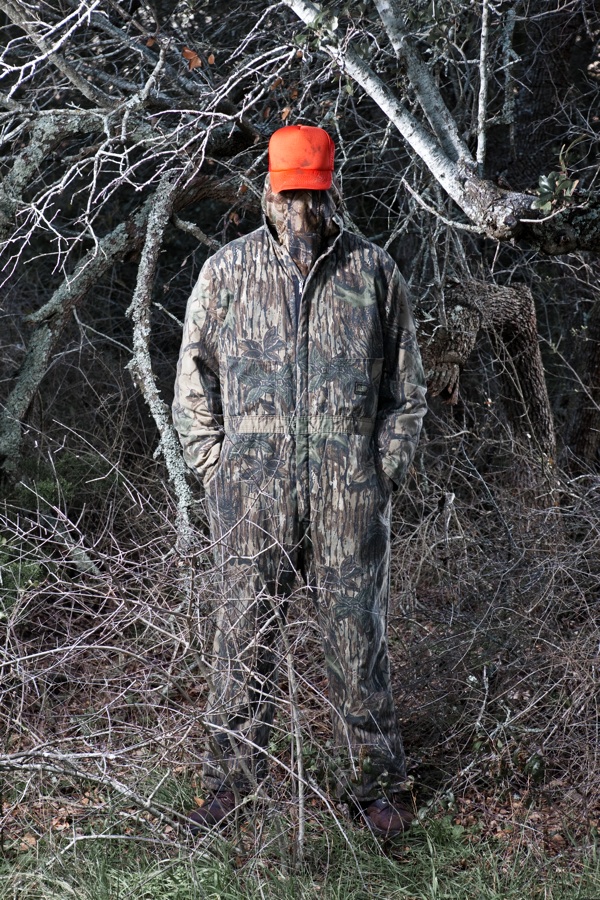
Ben Aqua, Hunter, 2010

Perhaps most surrealistic of the group is the work of Ben Aqua, including a haunting photographic portrait of a man dressed in head-to-toe camouflage in the woods. Without seeing his face and the seamlessness of shifts from the man’s patterned clothing to the branches that surround him, the only human characteristic evident is his bright orange cap, without which we might mistake him for a semi-human woodland character from the X-Files.

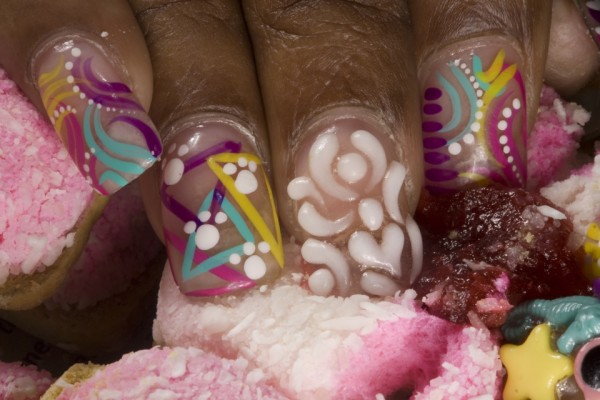
Helen Maurene Cooper, Junknails with Jam and Mexican Cookie, 2009

Helen Maureen Cooper’s photographs of nail art follow in this investigation of pattern and its relationship to the body. In this case, Cooper’s large format color photographs focus on the elaborate decorations that define Chicago nail art styles, revealing the subtle influence of race and class.

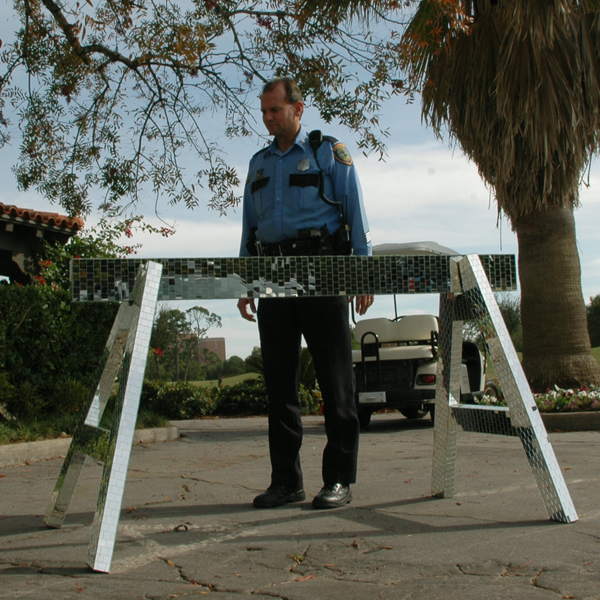
Yumi Janairo Roth, In Situ Houston, 2009

The sculptures by Yumi Janairo Roth combine authoritarian objects that are usually associated with drab unadorned order with bright, shiny and festive decoration. Also included are photographs of these objects in particular sites. For instance, one image of a barricade as disco ball covered in mirrored mosaic is placed on street corner in front of a deadpan policeman.

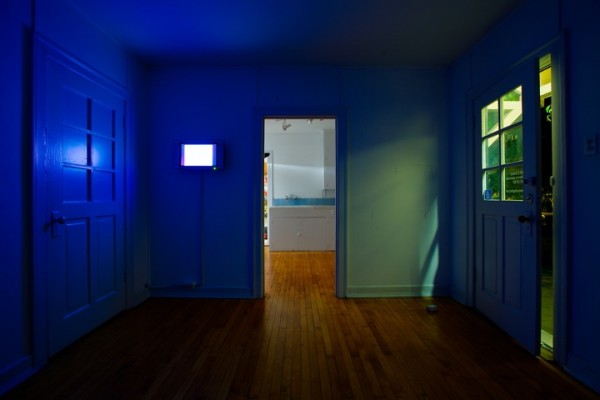
Thomas Cummins, Unit B, 2010

The exhibition also includes works by William Betts with his pixilated paint fields on mirrors suggesting the surveillance of 747 jets as well as works by Thomas Cummins , Michael Eddy and Matthew Noel-Tod. All together, these works evoke strange uncanny combinations that are beautiful and wild.

Share

Happy Labor Day from DailyServing!!

As we embark on a short trip up the California coast with family and friends this weekend, we want to wish you a happy and fun filled Labor Day! To celebrate, we bring you an image of Short Cut, an installation by German-based art duo Elmgreen and Dragset. This piece, created in 2003, was placed at the entrance of Chicago’s Museum of Contemporary Art. Have fun no matter where you travel this holiday weekend!!

Share

From the DS Archives: David Spriggs

This Sunday’s edition of From the DS Archives reintroduces a feature on artist David Spriggs.  Revisiting this article is the perfect opportunity to reacquaint ourselves with Spriggs’ immersive atmospheric installations as a solo exhibition featuring new work by the artist recently opened at Galerie de l’UQAM in Quebec.

This article by Rebekah Drysdale was originally published on June 8, 2009.

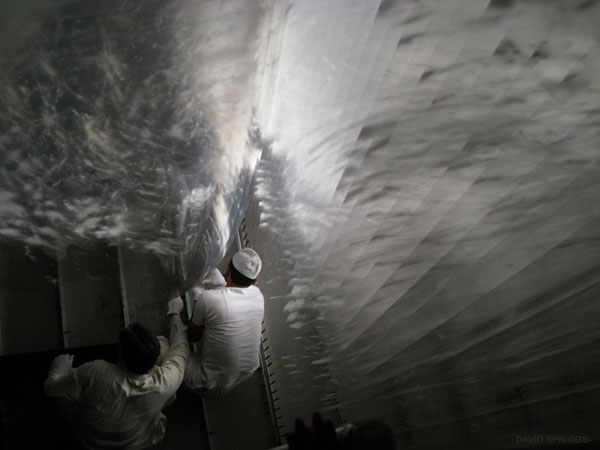
David Spriggs‘ atmospheric installations, such as Axis of Power, above, inhabit both the two-dimensional and the three-dimensional realm, challenging the viewer’s concept of space. The piece, which was commissioned and produced by this year’s Sharjah Biennial, is “like a scientific specimen, the power of nature appears to have been captured, isolated, and objectified within the confines of the room’s architectural space,” as captioned at the installation in Sharjah. Initially, the spiraling forms recall the eye of a hurricane or other meteorological phenomena. As the viewer walks around Axis of Power, the intriguing and methodical manner in which it was constructed is revealed.

Axis of Power consists of several sheets of transparent plastic film that have been marked with white acrylic. These sheets are then installed in precise spatial increments with aluminum tee bars and springs, creating multiple image planes. The logic dictating the placement and hanging of the sheets contrasts with the organic and ethereal nature of the work. The resulting combination is at once chaotic and controlled.

Spriggs is influenced by Futurism and Cubism, as well as digital art and cinema. He received his B.F.A. from the Emily Carr Institute of Art and Design in Vancouver and his M.F.A. from Concordia University in Montreal, where he currently lives and works.

Share

Vincent Leow: Tags & Treats

Vincent Leow, Dumbo, 1991, oil on canvas, 210 x 240 cm, Singapore Art Museum collection. Image courtesy of artist.

In the 2-story installation space comprising about 50 works at the Singapore Art Museum, Tags & Treats is a mid-career retrospective of Singaporean contemporary artist Vincent Leow’s artistic practice that spans almost 3 decades.

Traditional genres of sculpture and painting play no small part in Leow’s early works which at once question and reaffirm institutional pressures, social change and identity. A palette of vivid colours and an aggressive, neo-Surrealist style dominate Leow’s at-times didactic compositions of the late 1980s and early 1990s; the first few works to confront the viewer are Leow’s intensely personal but antagonistic and provocative depictions of cigarette addiction in Lucky Strike (1989) and Cut Throat (1989).

Vincent Leow, White Portrait, 2009, oil on canvas, 100 x 80 cm, artist collection. Image courtesy of artist.

A markedly evolved visual language emerges after Leow’s graduation from the Maryland Institute College of Art in Baltimore as he turned satirist on consumerism and capitalism, injecting a subtle playfulness in his approach to mass production and consumption in Mountian Cow Milk Factory (1998). Deliberately misspelled, Mountian Cow Milk Factory incorporates the techniques of commercial advertising and pop-culture while dabbling in word-play to invoke the impossibility of identical replication.

The second story of the installation space is in part, dedicated to the works commissioned for Tags & Treats, representing as well, an artistic shift and focus in Leow’s practice. Tags & Treats after all, takes its name from a collection of Leow’s later works: where the “tag” – such as the pet identity tag, or the military tag – could serve as an object of remembrance, and can thus co-exist with a “treat” of having lived a life that is befitting of recognition.

Vincent Leow, Andy’s Wonderland, 2006, stainless steel in edition of 8, 200 x 120 x150 cm, Singapore Art Museum collection. Image courtesy of artist.

The later works – greatly informed by the death of his beloved pet dog Andy and his present stint at the University of Shahjah in the United Arab Emirates – appear to be a mellowed re-commitment to the issues of identity, now imbued with an insouciant sense of mortality that commemorates the everyman and the mundane. Straddling the line between seriousness and flippancy, Leow defies the heavy melancholy of death by reconstructing Andy as a wide-eyed, perpetually laughing hybrid man-dog creature in Andy’s Wonderland. Not all of Leow’s installations are effusively humourous; the nobility of the everyman permeates the adjacent floor space where busts and plinths of nameless individuals stand in quiet dignity.

Share