Caught in the Act

L.A. Expanded: Notes from the West Coast
A weekly column by Catherine Wagley
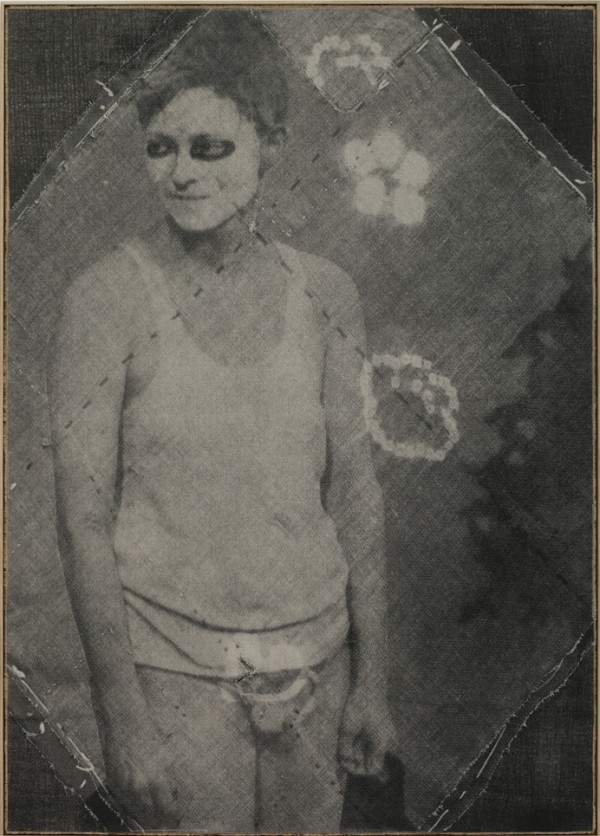
David Noonan, "Untitled," 2010. Courtesy of David Kordansky Gallery, Los Angeles, CA.

David Noonan, "Untitled," 2010. Courtesy of David Kordansky Gallery, Los Angeles, CA.

In 1975, when Bob Dylan was on his Rolling Thunder Revue tour, traveling the country with an entourage of creatives—among them Joni Mitchell, Allen Ginsberg, Ramblin’ Jack Elliott, and Joan Baez—he played Madison Square Gardens. As had become his habit, he wore black-eyeliner over whiteface makeup and a feathered, flat-brimmed hat on top of unruly curls. He didn’t look like Dylan, though he didn’t look like anyone else either.

Mid-set, Joan Baez dashed out onto the stage dressed exactly like him, eyeliner and all. According to playwright Sam Shephard, the two were briefly indistinguishable. “There’s so many mixtures of imagery coming out,” wrote Shephard in retrospect, “like French clowns, like medicine show, like minstrels, like voodoo, that your eyes stay completely hooked and you almost forget the music.” And it wasn’t just that you almost forgot the music. It’s that forgetting became essential to staying “hooked.” Until you heard their familiar voices, they almost were clownish medicine-man-minstrels. But when their mouths opened, Baez became Baez and Dylan became Dylan just playing an elaborate game of dress up.

The best distillations of the Rolling Thunder days tend to be still images. One in particular gets at the strange mix of masking, self-control, and chasmal vulnerability that characterized that tour. In it, Dylan, in makeup and hat, has his hands out in what could be either a “here-I-am” or “stop-right-there” gesture. It’s like he’s cagily reinvented Baptiste Debureau as a pre-punk pantomime who’s petrified of losing his audience but determined to keep them at arm’s length. The image forever freezes him in that vaguely forceful, half-welcoming, half-shunning pose.
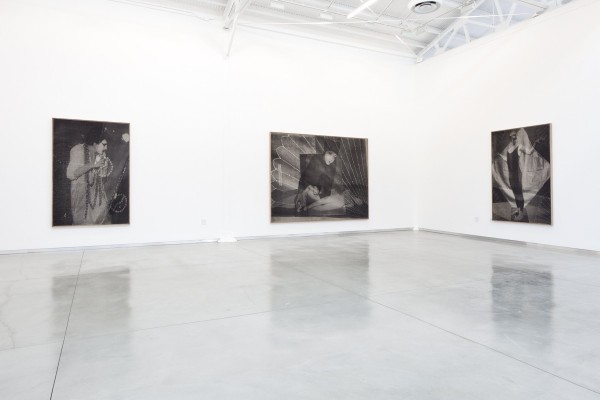
David Noonan, Installation View, 2010. Courtesy of David Kordansky Gallery, Los Angeles, CA.

David Noonan’s silkscreen prints have a similar vague forcefulness. Noonan’s current exhibition at David Kordansky Gallery includes nine large black and white prints on roughly layered linen, all of which document theatrical moments. These are found images, blown up and superimposed on other found images. In most, characters are masked or painted up like mimes; some are caught mid-action, while others seem to be waiting to act or collecting themselves after acting. In one image, a youngish boy stands in an undershirt, jock strap, and full makeup. The guarded smirk on his face, accentuated by heavy eyeliner,  makes him look like he knows more than he understands. Another character, as androgynously full-bodied as Antony Hegarty in Epilepsy is Dancing,wears a long white tunic and hunches over. His  floral necklaces fall forward and he’s sort of lost in himself, but purposefully so—it’s a performer’s job is to get lost like that. A third with Marlene Dietrich eyes leans over two small, doll-like bodies, playing puppet master. Together, the images in the room become a troupe that’s part punk, part Rive Gauche, part gypsy, part Hollywood.

David Noonan, "Untitled (Orlando)," screenprint on linen mounted on plywood, powder coated steel, 2010. Courtesy of David Kordansky Gallery, Los Angeles, CA.

But the most resonant character in the exhibition isn’t necessarily part of the troupe at all. He’s all but alone in a side room adjacent to the gallery’s office, and titled Orlando, which is the name of Virginia Woolf’s notorious man-to-woman protagonist and sounds a lot like “Renaldo,” the name of Dylan’s alter ego during Rolling Thunder days. A three dimensional plywood cut-out covered in silkscreened linen, Orlando sits on a set of black stairs. He’s a body and image at once.  Carefully posed but weirdly absent from himself, Elizabethan but also filmic, he’s caught in a series of mismatched acts. Noonan’s breed of performance art has that effect. It collapses theatrics into one precise moment, making them denser and more layered than they would be if actors could dance, sing, talk or even move. His approach is almost cruel–it puts personality in a permanent state of limbo–but it’s also richly complete in the way it allows “so many mixtures of imagery” to co-exist indefinitely.

Share

Digital Nights

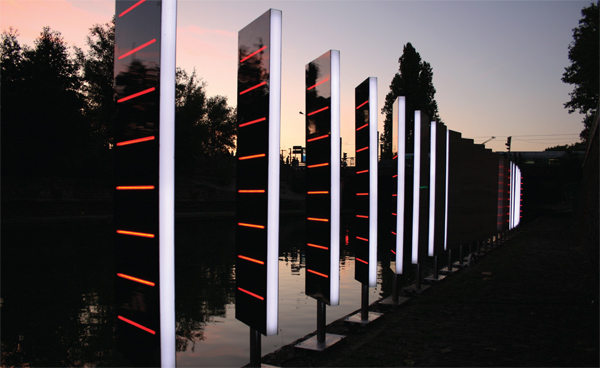
Lab-au, Framework f5x5x5, Nuit Blanche 2009, Paris. Photo credit: Lab-au, Photographer: Natalia Kolesova.

Digital Nights, an adaptation of Nuit Blanche that prioritizes the technological in the multidisciplinary vision of contemporary art, is a 10-day showcase of a varied lot of visualization projects by European artists Miguel Chevalier, Bertrand Planes and Art collectives Visual System and Lab[au], currently on view at the Singapore Art Museum, one of the few venues anchoring this joint project.

It has been several decades since artists such as Roy Ascott envisioned the increasing convergence of computers and communication systems that would greatly impact artistic practices. Essentially, creative practices that assimilate computer technology, as Ascott had also suggested, would produce a collaborative text – a network of relationships – where ideas and images are in a constant flux and whose meanings are dependent on those who enter this collaboration. In a series of uniformly painted objects that seem to reference Piero Manzoni’s white Achromes, Bertrand Planes’s BumpIt! pieces are de-materialized and voided of any sign or meaning, and then re-coloured and re-textured by looped video projections. Applied in a variety of contexts (Planes has previously transformed a church organ into a peak-meter, and redressed the exterior of a Citroën) within the framework of consumerist and material culture, Planes creates the possibility of a space in which the viewer can attribute multiple meanings to entities resembling everyday objects.

Lab-au, Binary Waves at Art Grandeur Nature. Image courtesy of Lab-au.

While the notion of “distributed authorship” and the shift in emphasis to processes and interactivity have been central to technologically-based art has been established for at least 40 years, contemporary digital art has emerged in its own right as an experimental but sophisticated and complex genre calling for an interdisciplinary panel that draws on the diverse expertise of programmers, technicians and architects – just to name a few. Binary Waves exemplifies the manifold techno-architectural efforts of Lab[au], a Belgian collective that aims to examine the role of technology in the forms, methods and content of art in a post-industrial information age. A network of rotating and luminous panels that form a kinetic wall simulate urban flows, are derived from visual wave patterns generated by infrared sensors.

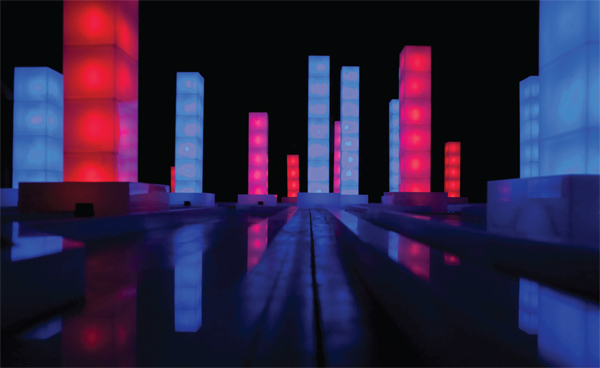
Like Binary Waves, A Digital Experience by Visual System (a collective of French artists whose projects explore the role of digital media in the city of the future) demonstrates the imaginative ways that matter and energy circulate and change form in between projections of light and sound. In a representation of a city of the future inspired by an artistic vision of Shanghai, pulsing LED systems accompanied by a musical composition by Olivier Pasquet take on the metaphor of our networked lives in this digital universe.

Visual System, A Digital Experience. Image courtesy of Visual System and Valere Terrier.

A Monet-inspired, interactive virtual reality installation by Miguel Chevalier, Ultra Nature is an impressionistic visual garden with several varieties of vibrantly-coloured plants that, through motion sensors, mime our every move in space. Yet their artificial life and programmed existence contain a measure of autonomy as they sway right and left in the projected video image, breathed life into them according to the swishing movements of visitors.

Miguel Chevalier, Ultra-Nature 2005, Daejeon Metropolitan Museum of Art, Daejeon, South Korea. Image courtesy of artist.

Digital Nights is held in conjunction with Nuit Blanche Paris, in partnership with ZoMedia Pte Ltd and supported by the Ministry of Information, Communications and the Arts, Tote Board and Singapore Turf Club. It will run through this Sunday, 26 September 2010.

Share

Video at TBA’s The Works

TBA is Portland, Oregon’s Time Based Art festival, a group of performance, dance, music, and visual happenings hosted by the Portland Institute of Contemporary Art.  The visual portion of the festival is held at what the institute refers to as “The Works,” an abandoned circa-1910 redbrick former high school.  It’s an iconic building: if you grew up in the 80s watching after-school specials (or if you’ve ever seen a John Hughes film) this building could serve as the prototype.  This year’s selection of videos installed at The Works varies considerably in style, length, and subject matter.  Given the venue, one could consider it a very liberal arts education.

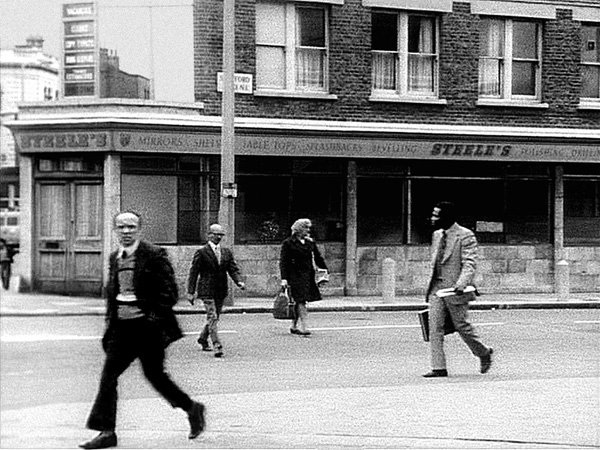
John Smith, The Girl Chewing Gum. Still from film.

John Smith‘s 1976 The Girl Chewing Gum is a black and white film depicting the everyday life of a London street.  At first, the authority of the voiceover narration seems like instructions given by a film director, but over the video’s twelve minutes the narration devolves into mere description and then confusion.  What begins as a commanding presence—masterful instructions given by the voice just as each action is about to unfold—breaks down into a struggle to keep up with the crowded scene.  Finally, the view switches completely to a slow pan over English countryside, even as the traffic noise from the original scene continues.  This is an incredibly simple gesture that creates poignancy and depth.  As understanding dawns that the narrator is not, in fact, directing the actions on screen, the viewer’s recognition shifts.  What starts as the audio of a man who directs his world turns into a man desperate to control his environment (or at least maintain the illusion of doing so), until finally there is a psychic (and literal) break with the scene altogether.

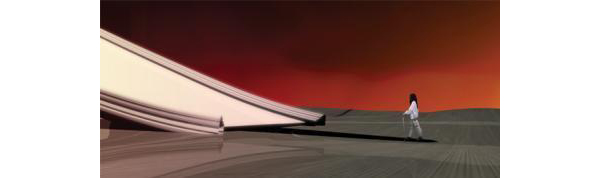
Yemenwed, Episode 3. Still from video.

Smith’s thirty-year-old work still holds up conceptually, but it’s anyone’s guess how the other videos in the exhibition will fare over time.  Charles Atlas‘s Tornado Warning (2008) is a five-channel installation of strong technical proficiency.  It is the only video-based work in the building that addresses its physical space by means of a built environment and moving lights; unfortunately the projections look an awful lot like a cross between Op art and the code-drenched computer screens from The Matrix.  In another room is artist group Yemenwed‘s Episode 3, a combination of animation, painting, sculpture, and live-action video.  The visuals are cleverly done, but if there is a narrative to the meanderings of the main character, who ambles through a constructed and animated space with some kind of hobbles/casts on her legs, it is not apparent.

Christopher Miner, The Safest Place. Still from video.

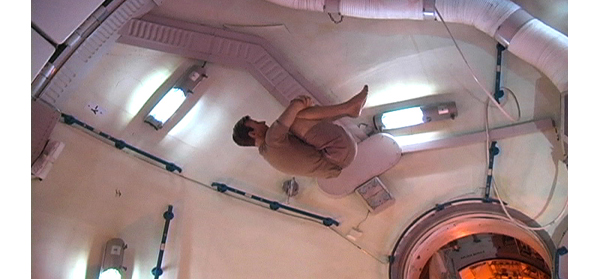
Christopher Miner‘s The Safest Place features a man revolving slowly in the zero-gravity atmosphere of a space capsule.  His knees are drawn up to his chest and his arms are wrapped around his knees.  The soundtrack of a man’s voice singing is unaccompanied, but there is a heavy reverb/echo on the voice and it’s impossible to make out the words.  That’s too bad, as upon reading the exhibition booklet one learns that they comprise the lines of a modest hymn.  Part of the artistry behind The Girl Chewing Gum is that Smith sets up a very simple system and then disrupts it; Miner’s video has the same kind of confident simplicity overall, but in its present state allows no room for a secondary layer of meaning to come into play.  Clearer audio might have provided that.

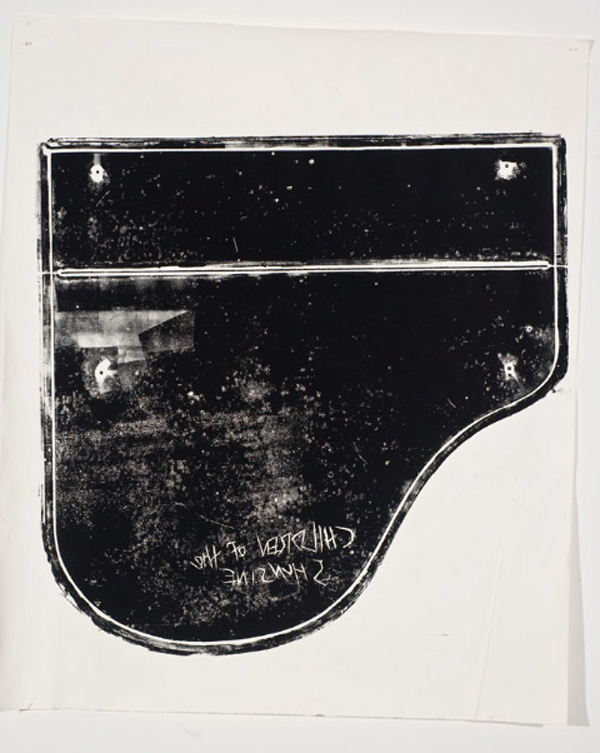
Jessica Jackson Hutchins, Piano Print (2010). Wood cut print, approximately 70 x 60 inches.

Two of the rooms on the second floor contain videos as part of larger installations of more traditional visual art.  Jessica Jackson Hutchins‘s Children of the Sunshine is visually spare and elegant.  Four prints, two of which are taken from her family piano, hang on the walls.  In the center of the room is the actual baby grand: carved, scarred and careworn.  These evocative objects would be enough: the prints are beautiful, with deep black ink providing a backdrop for smeary colors and bulbous papier-mâché protrusions or large burn holes.  The piano—small, dirty, pitted with childish carvings—stands as emblem of home, family, and a middle-class childhood.  Unfortunately, the poetry of the room is completely upset by the cacophonous video on the flatscreen monitor in one corner.  In it, Hutchins’s family of singer-musicians chants a nearly atonal chorus of “we are children of the sunshine, we are children of the sunshine” over and over while banging, blowing, or plonking on various instruments.  I regret that this teeth-gritting and superfluous aural torture not only drove me out of the room, but also continues to haunt me as I write this.

The next room—blissfully quiet, but still prickly—is Storm Tharp‘s High House, an assemblage of objects that toes an uneasy line between studio and gallery. There are hand-labeled jars of paint and plants lining the windowsill; there are color-field canvases hung in a grid, and a fan that blows two silk scarves appliquéd with NOT THE LAST TIME.  A video displays a curtain billowing in the frame of a sliding-glass door.  In the middle of the room, a pristine white staircase rises above head height and leads nowhere.  Tharp has seen many successes in the last few years, including the Whitney Biennial, and this room feels like a web of clues that provide a glimpse into the mental state of an artist on the edge of something really big.  The vibe here is uncertainty; the ambiguity of being poised in a position of near-flight (up the white stairs, out the breezy video doorway), choosing between public glory and private life.

Share

FAN MAIL: Marc Blumthal

DailyServing.com selects two notable artists each month from the submissions we receive to be featured in our series, Fan Mail. For a chance to have your work appear below, with an article written by one of the DailyServing contributors, please submit a link to your website to info@dailyserving.com, subject: Fan Mail. You could be the next artist in the series! (We will try to contact chosen artists prior to publication, but please be sure to check the site everyday.)

Marc Blumthal, Stars Within Stars Within Stars, screenprint on inkjet print, 2010

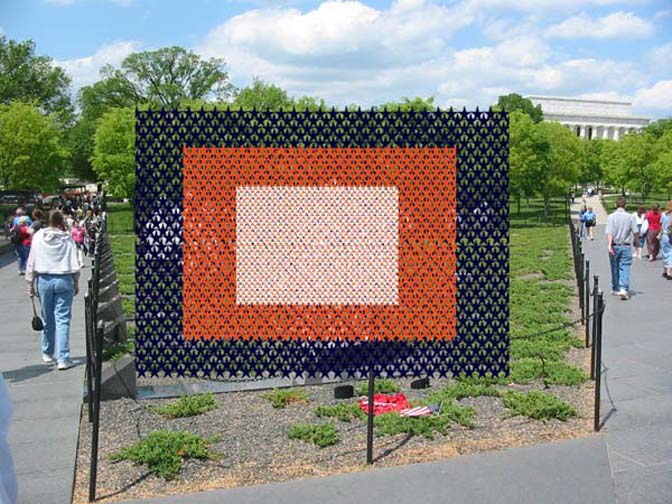
Marc Blumthal‘s work is an investigation of individual and collective identity. His images, which reference the artist’s personal experiences as well as America’s history, address the nature of being human and the pressures of the past. Blumthal’s continuing series, Diary of An American, includes several images of American public monuments and memorials, which the artist has modified with a screen print overlay. Often, the overlay is abstract, and obstructs or obliterates a significant portion of the original photograph, prompting the viewer to question the broader cultural arrangements that shape our lives. On Saatchi’s online gallery, Blumthal bluntly states,  “I’m inspired by shame and guilt. My interests lie in Identity…[my] work addresses my personal identity and my national identity.”

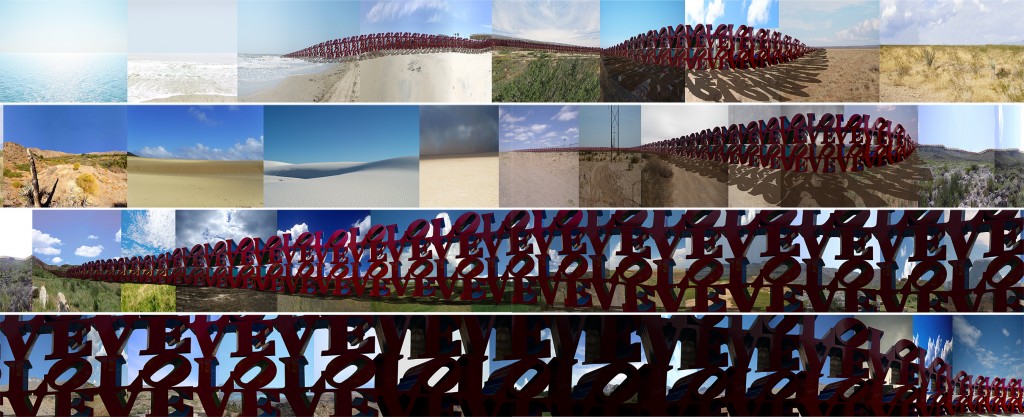
As part of his series My Father Had a Vasectomy, Blumthal combined several photographs in a digital collage to create Neighbours (2009-2010). The background images in Neighbours are found images of the four border states, Texas, New Mexico, Arizona, and California, which are rhythmically juxtaposed to form four photographic rows resembling film strips, each containing multiple images (see below). The strength of the piece lies in its powerful composition and its legion of cultural, political, and art historical references, both past and present. The artist states, “I began questioning my whole belief system and felt terrible to call myself an American, because of our dark history, manifest destiny, and the list goes on; there’s too much to be pissed off about, and when you finally open your eyes, it’s like you caught your partner cheating on you.”

The title of the work itself refers to the 1952 short film by Norman McLaren, Neighbours, which was inspired by the director’s anti-war sentiments towards the Korean War. Across the background images in Blumthal’s Neighbours, which all “point to a boundary and the lines between two people, nations,” the artist powerfully repeats Robert Indiana‘s Love sculpture. One of the most ubiquitous works of twentieth century art, Love was created in 1966 while America was in the midst of the Vietnam War. The proliferation of this iconic work, both with and without the artist’s approval, is due to its lack of copyright. Blumthal selected the Love sculpture because he felt that it “hypocritically reflects everything our nation represents.” Mr. Indiana’s iconic letters fuse to form a wall that weaves in and out of multiple frames, traversing various land and seascapes of America.

The power of this word and work mirrors the erratic nature of the sentiment itself, from the sincere, to the deeply superficial. In an era when various political leaders loudly profess their beliefs, Mr. Blumthal’s work subtely yet effectively sheds light on the shameful hypocrisy that is created when one’s actions are the antithesis of the “love” they preach.

The artist received his M.F.A. in Painting from the University of Pennsylvania in 2010. He has recently exhibited work at the International Print Club of New York and Leonard Pearlstein Gallery in Philadelphia. His M.F.A. Thesis exhibition was held at the Ice Box Project Space in Philadelphia.

Share

Subverting the Male Glaze: Rob Pruitt’s Pattern and Degradation

Rob Pruitt, tbc, 2010 (detail)

Taking up both Gavin Brown’s Enterprise and Maccarone, much of Pattern and Degradation is based on the Amish tradition of Rumspringa, the time when Amish teenagers get to go nuts for a year before deciding whether or not to commit to the whole Amish thing. Admittedly, the Amish are an easy target—they’ll never get through the Holland Tunnel in a horse and buggy to see the show in person, which pretty much leaves things wide open for Pruitt. Hitting closer to home, the show also takes on the tribal nature and herd-like behavior of today’s art world, which at times can seem just as insular as Amish tradition does.

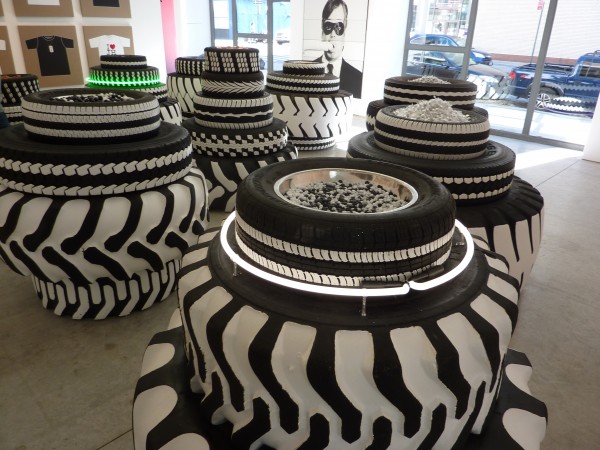
Cementing his reputation as the art world’s premier events planner, Pruitt riffs on three familiar art world occasions: the opening, the auction, and the museum. In one gallery, you can mingle around what he calls “People Feeders,” stacks of tires that serve as lowbrow snack bowls for Oreo’s, (perfectly fresh on both visits I made to the gallery, btw), pretzels, gumballs, and black and white M & M’s. In heavier hands, the tires would have been pain-staking reproductions à la Robert Gober, or machismo car culture symbols à la Richard Prince. Pruitt, however, is much less sentimental than either of those guys. White paint, brushed on the tires Basquiat-style, is refreshingly unfussy. Plus, the snacks made me happy.

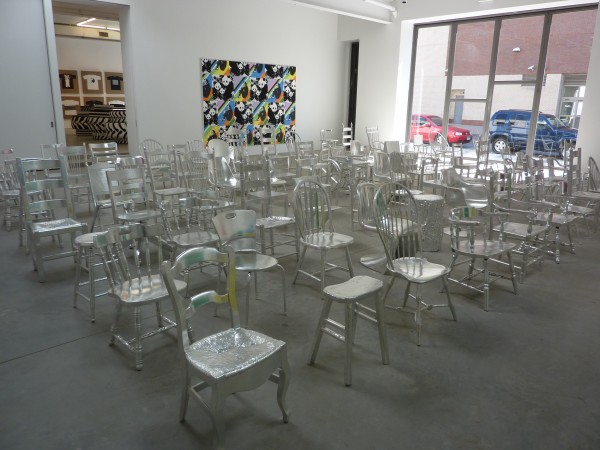
The next room loosely resembles an auction house. Dozens of chairs covered with metallic tape face a series of self-portraits, each showing the artist sensorially hindered in some manner—food in his mouth, googly eyes over his real ones, etc…signaling that the works should be experienced viscerally. The shiny chairs faintly echo Warhol’s silver factory and serve as a reminder that Pop Art’s mantra of “liking things” is at a premium here. Conceptual connections can be made to body art or the subjugation of the artist to the market, but over-thinking it seems beside the point.

In the next gallery, Pruitt has installed metallic tape-covered benches and geometric Amish quilt paintings in a museum-style setting. A comment on the enduring and mysterious perseverance of geometry in art, this is not a sarcastic send-up of institutions. Instead, humdrum art-going experiences are made more visually appealing by way of Pruitt’s lively aesthetic.

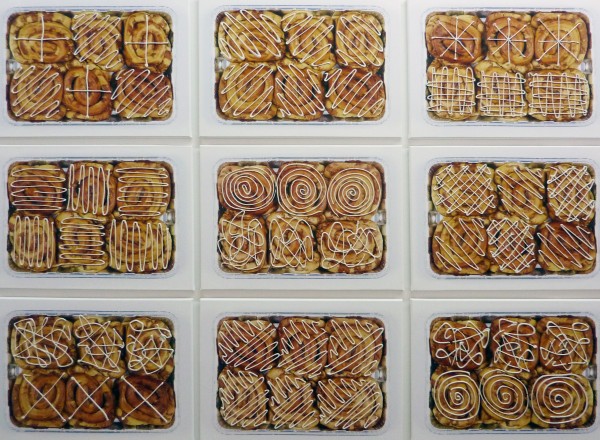
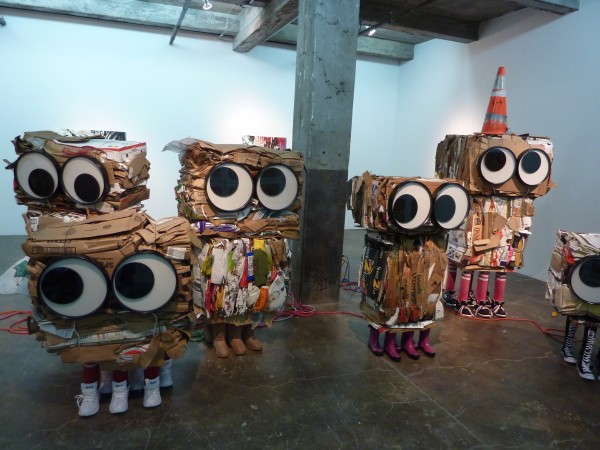
Questions of taste and quality intermix in this show perfectly. A group of six-legged cardboard box sculptures in Maccarone seem to be marching zombie-like into a giant grid of cinnamon bun paintings. The buns are glazed in a way that hilariously evokes Sol Le Witt, except without Conceptualism’s need for mathematical justification.

Although Pruitt has a penchant for self-mythologizing, this is Dude Art of the lightest kind. While seemingly about getting wild, this show doesn’t glamorize party detritus or bad boy behavior. Where many male artists valorize their fetishes through irony, Pruitt is actually funny. Much like the current trend toward restaurant-quality stoner food that celebrates flavor over pretense, the bar room humor of Pruitt’s work is so rooted in visual satisfaction that it passes as the new high brow.

Share

From the DS Archives: Julieta Aranda

From the DS Archives presents a past feature on artist Julieta Aranda, which examines the artist’s exploration of the concept of time.  Most recently, Aranda participated in a group exhibition, Defending Our Values, at the Centro Cultural Andratx in Mallorca that concluded in March of this year.

Julieta Aranda was written by Allision Gibson and originally published on 7 April 2009.

Time is an integral element of life. For me, it seems similar to the phenomenon of breathing, in that it is largely uninvestigated in any great depth by the general public, though it is collectively understood as essential to our existence. Time runs everything, and though most of us plan the entirety of our lives within its confines, we rarely experience the epiphanic moments where the concept of time suddenly hits us like a ton of bricks and for a brief moment we begin to question just how it all works and how extraordinary it is that we all follow it, with our clocks and our calendars, so faithfully.

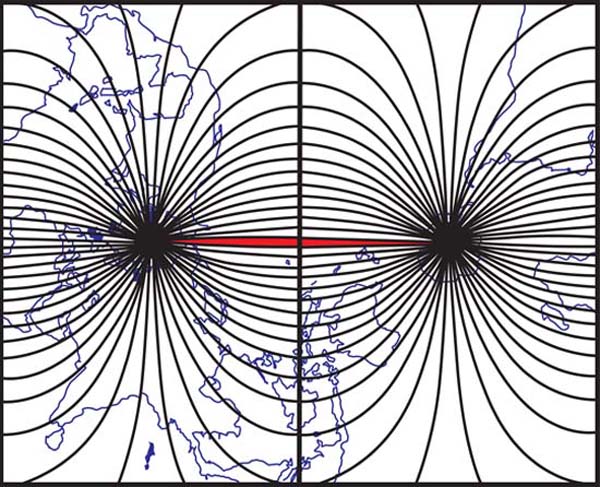
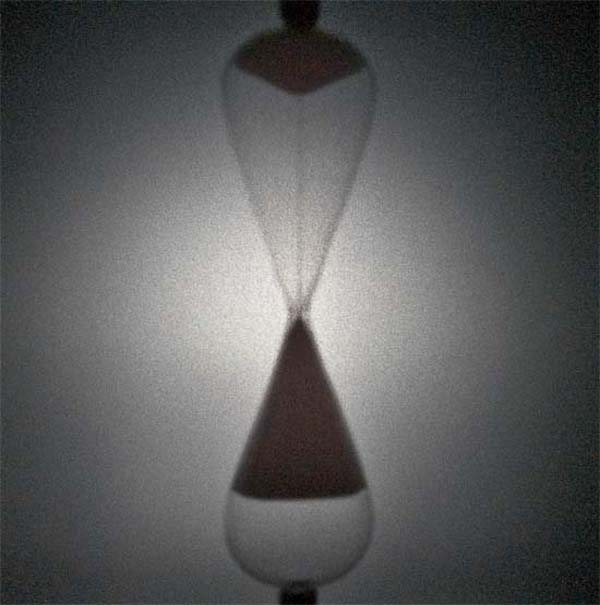
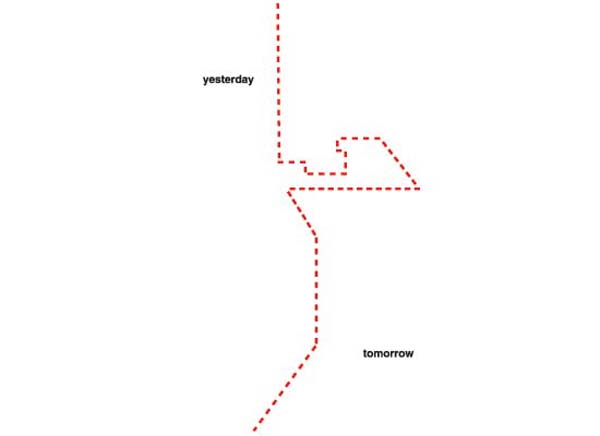
To kick off the new exhibition series entitled Intervals at the Guggenheim Museum in New York, Mexican artist Julieta Aranda will exhibit a multi-part installation that conceptually deals with the notion of time, and plays with the way it is observed as a natural progression. Aranda’s work first became engaged in a discussion about time in 2006 with her body of work You Had No 9th of May!, in which she responded to the idea of defiantly shifting the rule of time, when in 1995 the Republic of Kiribati (an island nation in the center of the Pacific Ocean) decided to reroute a section of the International Date Line that divided its islands between two different days, causing it to no longer be split. Aranda was struck by the way Kiribati challenged the zigzagging line that spans the globe, which we have historically adhered to, though it is not under any international law. Moreover, Aranda explored the idea that Kiribati had blatantly changed time to fit its own agenda, making it as subjective a concept as beauty or comedy. For Intervals Aranda has created new pieces that playfully challenge the concept of time as we know it, including an oversized clock in which the daily cycle is divided into ten elongated hours. According to the Guggenheim, “this system references ‘decimal time’: a short-lived initiative introduced during the rationalizing fervor of the French Revolution that divided the day into 10 hours, each hour containing 100 minutes of 100 seconds each.” Another piece is an image of an hourglass, as seen through a peephole. “Seen through the refracting optical device of a camera obscura, the grains of sand appear to flow upward in a startling reversal of time’s passage.”

Intervals, initiated by Chief Curator Nancy Spector, was “conceived to take place in interstitial locations within the museum’s exhibition spaces or beyond the physical confines of the building.” Julieta Aranda’s work will open the exhibition on Friday, April 10th. The entire series runs through July 19, 2009.

Julieta Aranda was born in Mexico City. She earned her MFA at Columbia University and her BFA at the School of Visual Arts in New York. She has exhibited internationally, including at Galerie Michael Janssen in Berlin, AR Contemporary Gallery in Milan and El Museo Del Barrio in New York.

Share

Build Your Own World: The 2010 01SJ Biennial

This weekend, the largest festival of art, technology and digital culture in the United States opens in San Jose, California. The 2010 01SJ Biennial, Build Your Own World, is a multi-disciplinary, multi-venue event that features dozens of projects by artists, designers, engineers, architects, marketers, corporations and citizens during a four day, city wide event. The biennial, which is open from September 16-19, includes exhibitions, performances, symposiums and artist talks all centered on the concept of rebuilding the world in which we live and the future that is upon us. 01SJ goes to lengths to consider the ways in which technology and community can come together to create real change in our lives and our future. Unlike many typical biennials, Build Your Own World has a very pragmatic agenda. This event brings together the creative community  and general public to foster new partnerships and to disseminate experimental and forward thinking concepts through artworks, performances and workshops.

Our friends at KQED arts in San Francisco visited San Jose earlier this week to speak with Steve Dietz, Artistic Director of 01SJ and to take a sneak peak at the programs in store for this weekend. Gallery Crawl captured several works in the final stages of production, such as Empire Drive-In by Brooklyn-based artists Jeff Stark and Todd Chandler and xAirport, an environmentally-based project by local artist Natalie Jeremijenko who was recently featured on Buzzoid.

Share