When I Say Image, That’s Different Than Me

L.A. Expanded: Notes from the West Coast
A weekly column by Catherine Wagley

Mariah Garnett, "Encounters I May Or May Not Have Had With Peter Berlin," a 16mm installation

“What I advocate is threatening,” said Peter Berlin in 2004, talking to Butt magazine about his fondness for wearing nylons under tight, tight white shorts. The artist/porn star, who emerged in the 70s sporting a blond-ish pageboy haircut, explained he’s always running from police who claim he’s wearing only underwear. What does Berlin advocate? A certain breed of exhibitionism, a self-love frightening because of its frank completeness? Or an edgy artifice that’s some offshoot of camp? He often describes the moment he first really saw himself in the mirror and realized his image turned him on, but he doesn’t confuse self and reflection: “when I say image, that is different than me.” “Really,” he said, “the only compliment that I want is to walk on the street and see at least one other Peter Berlin, but I’ve never seen one.”

Six years later, Mariah Garnett paid Berlin that compliment. The L.A. artist performed him in a video, dressing, posing and turning as he would have, and playing with double exposures and self-photography just as he did. “Doesn’t she look like me?” the now-reclusive Berlin asked when Garnett met him to show him what she’d done.

The original video of Garnett as Berlin, the video of Garnett showing Berlin Garnett as Berlin, and the video of Garnett imagining meeting and making it with Berlin were all on view in Encounters I May Or May Not Have Had With Peter Berlin, an installation at Human Resources L.A. up for only a week. While these reflexive narrative plays were compelling, the installation’s highlight was even more so: a disco ball onto which two 16 mm films of Garnett as Berlin were projected. In the dark gallery, the ball reflected a flickering army of miniature mirror-like images. If you looked up at the reflections closest to the ceiling, you’d see Garnett’s head and chin, as you looked progressively lower, you’d be looking down her jauntily rotating body. She wore a leather jacket, white, well-packed undies, and not much else. When she turned to the front, and you saw her breasts, they didn’t break the façade or necessarily seem that feminine. Even if they had, Berlin-style masculinity was more an exaggerated attitude than a gender, and that blond bowl of hair could never be anything but androgynous.
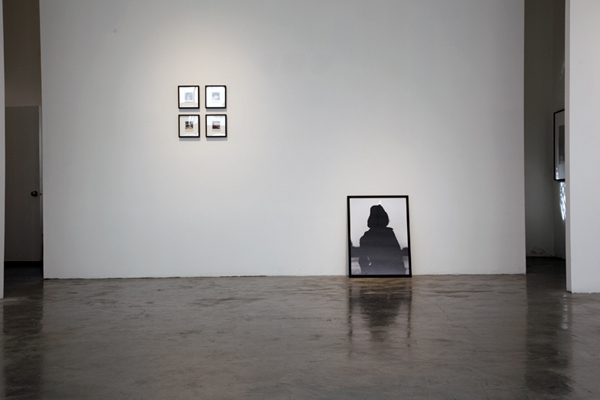
Zoe Crosher, "The Unveiling of Michelle du Bois," Charlie James Installation view, 2010.

While Garnett’s installation closed the second week of October, another experiment in obsessive reenactment opened just down the street: Zoe Crosher’s The Unveiling of Michelle du Bois at Charlie James Gallery and the Dan Graham project space (a third component opens November 6 at Emma Gray Headquarters in Culver City, and even more du Bois is on view at the California Biennial). Crosher has inhabited an imaginary archive of an imaginary woman, who changed identities at will and tried her hand at being everything other than satisfied. Du Bois moonlighted as aspiring flight attendant, sex worker, housewife, socialite, etc. (or so I’m inferring), and so Crosher (or at least Crosher’s image), through du Bois, moonlights as all these things as well. As the story goes, du Bois photographed everything—all the changes in her guise have been documented. Photographing yourself performing yourself: du Bois resembles Berlin. Photographing yourself performing someone preoccupied with performing him/herself: Crosher resembles Garnett.
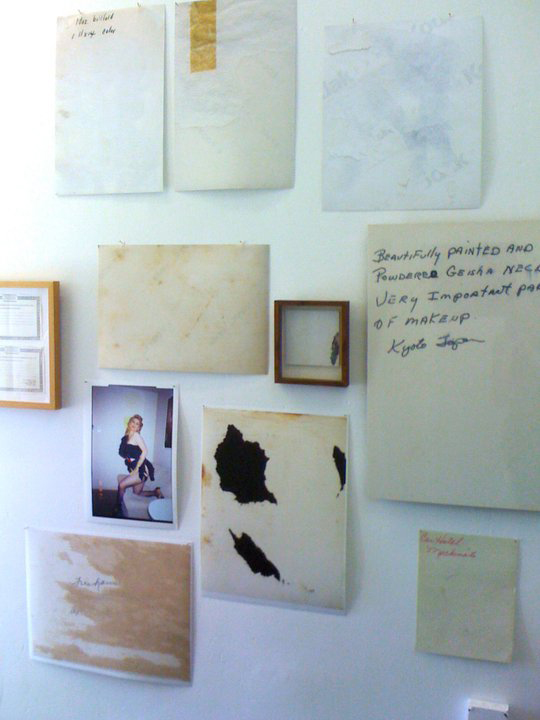
Zoe Crosher, "The Unvieling of Michelle du Bois," Emma Gray Headquarters, Installation view, 2010.

Jenny Holzer, feminist queen of expository, public self-searching in decades past, has become a sage-like twitter presence of late (though the artist isn’t actually behind the tweets). A recent post: KNOWING YOURSELF LETS YOU UNDERSTAND OTHERS BETTER. Crosher and Garnett, women artists of a different generation, might switch it up: UNDERSTANDING OTHERS LETS YOU KNOW YOURSELF. They might even drop the “your” and the “understanding”: OTHERS LET YOU KNOW A SELF. And that’s where their project becomes just as threatening as Peter Berlin’s self-image is when it parades in tight white shorts. If the goal isn’t some sort of gripping self-knowledge, than what is it? Can being others be the same as knowing others, or is inhabiting another’s body and using it to move through the world the definition of loneliness?

Share

Lorretta Lux: Photographs in Milan

On view through this week at Galleria Carla Sozzani in Milan is the solo exhibition Photographs, featuring new works by German artist Loretta Lux.

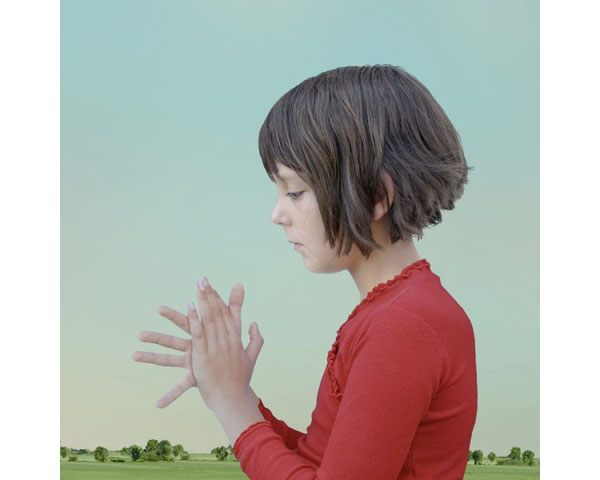
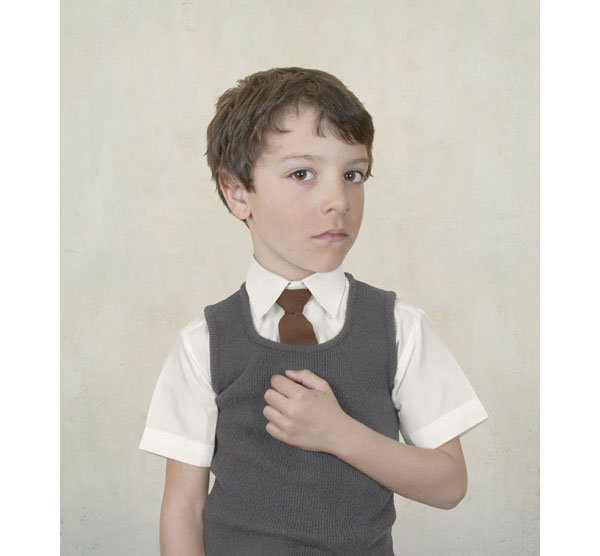
The artist’s portraits of young children highlight the attention to detail, composition and color that characterize much of classical painting. In fact, she is a painter by training -influenced by Old Masters such as Diego Velázquez, Agnolo Bronzino, Philipp Otto Runge, Francisco Goya- and is now employing digital photography to create portraiture. Lux imperceptibly manipulates her photographic images, creating a bewildering space that seduces the viewer to explore every inch of the surface.

In the pastel-colored photographs, her flawless, pale doll-like subjects are dressed in vintage period clothing, and inhabit what seems to be a dreamlike world. Her apparent hyper-perfection is met with a harmony, and demands deeper investigation by causing an uncomfortable state of wonder. In the estranged context of the photographs, her uncanny figures are isolated, as if not capable of establishing a relationship with the viewer.

Born in 1969 in Dresden, Germany, Loretta Lux studied painting in Munich at the Akademie der Bildenden Kunste, from 1990 to 1996. Various solo exhibitions of her work were held in New York at Yossi Milo Gallery, in The Hague at the Hague Museum of Photography, and in Amsterdam at Torch Gallery. She received the Bayerischer Kunst foerderpreis in 2002 and The International Centre of Photography’s Infinity Award for Art in 2005.

Loretta Lux, Photographs, galleria Carla Sozzani, Milan, September 9th-October 31st 2010

Share

Our History in the Present Tense

There are two shows in Minneapolis that share a familiar photographic theme. From W.P.A. era photographers roaming the country to Nan Goldin‘s efforts to record her friends and loved ones, these photographs hope to mirror what and who we are and to write our history in the present tense.

The Minneapolis Institute of Art’s Embarrassment of Riches and The Walker Art Center‘s From Here to There: Alec Soth’s America both provide photographic documents about our current social condition. Riches is a series of photographs exploring what luxury means in the global age and how the localized financial expansions and contractions of the last decade are reflected in photography. Alec Soth’s America is a survey of his images found while traveling the open road, gathered here under the mystery of what it is to be American.

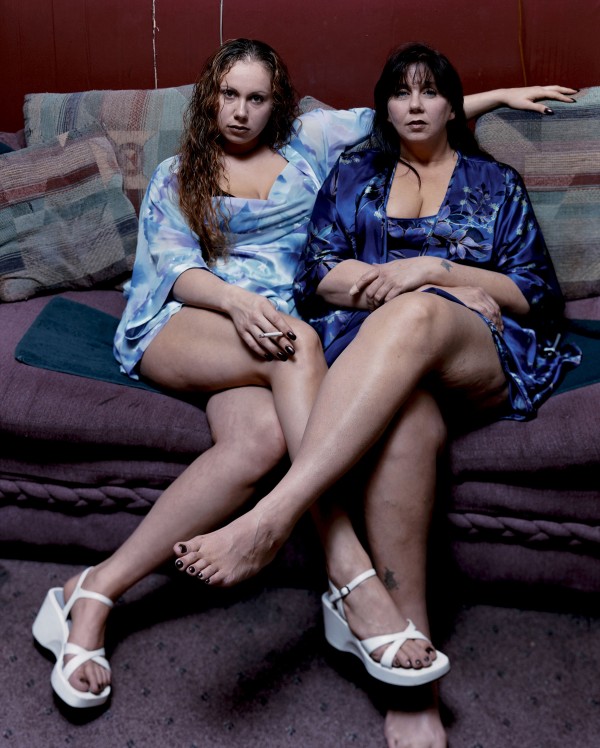
Mother and Daughter, Davenport, Iowa Courtesy Alec Soth

At MIA, curator David E. Little pulled images that reflect his themes of place, currencies, creation of power, luxury, and ritual/fashion while at the Walker, Siri Engberg has selected from Soth’s themed portfolios, Sleeping by the Mississippi, Niagara, and Broken Manual as well as a selection of his videos. At the MIA, the curator holds the center and pulls work together to fit a theme he sees as already existing in contemporary art, whereas at the Walker the artist explores his own self-approved theme and the curators have extracted what they feel are ideal examples. The difference of curator or artist as center forms a long standing argument in curatorial studies, and these shows provide great examples for both sides of the discussion.

Soth’s videos are all-encompassing (most were commissioned by the New York Times). Having more than one frame to explore, the videos allow him to extend his inquiry further into the places and people he meets. Images like Mother and Daughter, Davenport, Iowa rich in innuendo, make the viewer question if Soth is laughing at, documenting, or just enjoying the lush and unusual people he finds while traveling. The video Ash Wednesday, New Orleans gives us some insight into his relationships with his subjects. In the videos, first we witness his nausea when faced with Mardi Gras. Second, his long term commitment is obvious from revisiting Adelyn. And third, we see his dispassionate realization that R. is a man. Soth’s videos provide more insight into him and his process than in any of his still frames.

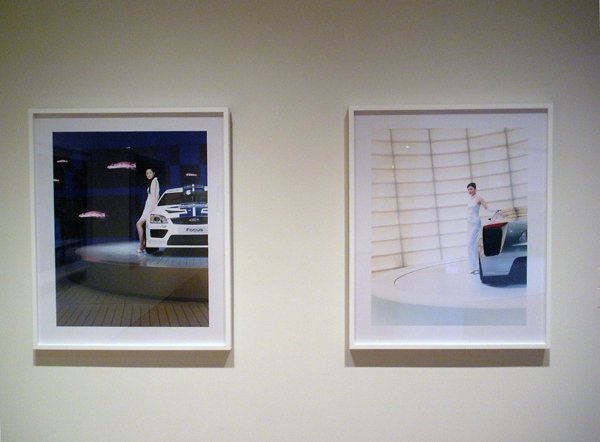
Hassink's Ford Girl, Shanghai and Lexus Girl, Shanghai-- Courtesy John Pyper

The one video included in Embarrassment of Riches, Jankowski’s Strip the Auctioneer, diverges from work in both exhibitions. Christie’s auctioneer Amo Verkade sells his entire wardrobe at auction. It states where value is created a little too literally when compared to the other works in the show. Jacqueline Hassink’s photos of women standing next to cars at international auto shows are more subtle and raises the theatrical moment in marketing through architecture and gender. She further explores these themes in her series Haute Couture Fitting Rooms.

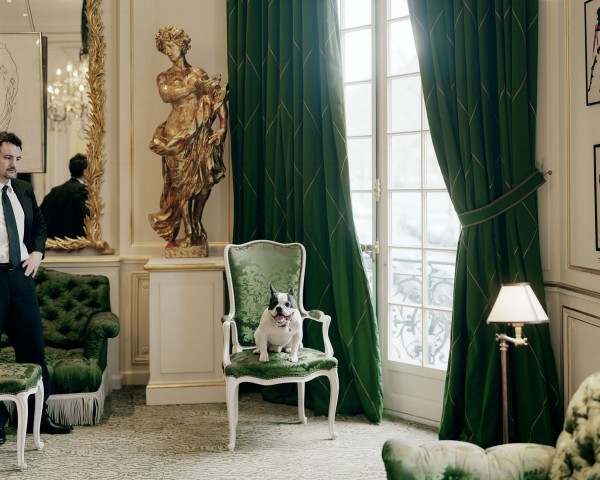
The most compelling works in Riches depict global power centers. Along with Paris, views of Dubai, Frankfurt, and Canada show some of the locations where expansions and contractions have happened in the last decade. The excitement of murmuring white robed sheiks on hiatus from the heat in the Kuwait Exchange is juxtaposed by the silence of an oil line sending resources south through Canada. It is unsurprising that Soth’s work is included in this show too, a photo of Yves Saint Laurent’s dog Moujik sitting quietly on a chair hidden away behind wood panels in the civilized private luxury of Paris’s close-knit streets.

Soth's Fondation Pierre Bergé and Yves Saint Laurent, Moujik courtesy MIA

One of the tasks of contemporary photography is to frame our memory. These two shows create a para-dichotomy pointing at the same question: how did we get to our current position? It would be easy to see an echo from MSNBC and Fox News in this pair, easy to read “the rich get richer” into both shows. But, a political reading– speaking for those with no voices or questioning those with unlimited capabilities– is too simple, isn’t very engaging, and seems rote at this point. Instead of rehearsing these same lines again, we should return to the works and consider how they are actively writing our history.

These works are as compelling for what they say about art as for what they say about us. Art can have its greasy little fingers in every part of our lives. From Yoshitomo Nara’s sketches on hotel stationary and his personal mail to Frances Stark’s fluent translations of the terrified moment of creation, contemporary art is incapable of escaping the moment in which it was created even though it paradoxically freezes time and forces us to live with that moment forever. These moments will seem different to us in the coming years, but today we see things like the financial gulf between rich and poor, the widening and shrinking of the globe, and an unstable political climate. These frozen moments may turn into nostalgia or even seem funny in a few years, but the contact we have with them will allow reflections that their makers could not predict.

Share

The Joy of C-Prints

Today’s article is from our friends at Art Practical, where Mary Anne Kluth discusses a sculptural presentation of C-prints by Mariah Robertson at the NOMA Gallery in San Francisco.

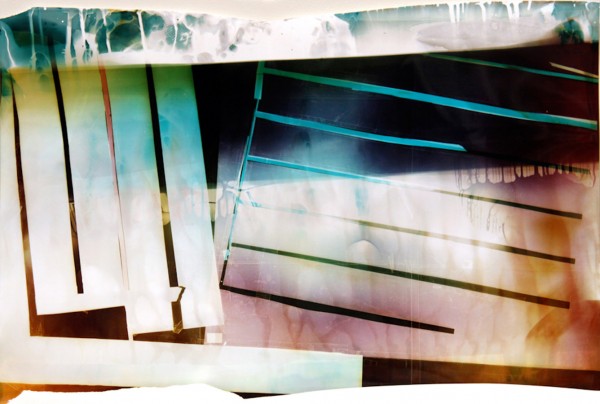
Mariah Robertson’s C-prints at NOMA Gallery are tactile, warped celebrations of the physical process of color photography rooted in the medium’s tradition of experimentation. Manipulating the fundamental interactions of light, paper, and dyes through the exposure and chemical processing of photographic paper and film, the artist revels in the range of possibilities afforded through adjustments in saturation and contrast. The results combine clean geometry, liquid color transitions, subtle fades, and traditional imagery within a remarkably unified collage aesthetic. The pieces are titled numerically, in direct opposition to their decidedly unmechanized production.

130 (2010) is a dark field of alternating purples and cold blues bisected with a light red glow. The surface of the print is filled with photograms, which the artist created by laying translucent slices of rocks and minerals directly onto unexposed photo paper as it was introduced to light. This piece updates the photographic experiments by Richard Parry in the 1930s and by Lázsló Moholy-Nagy in the ’40s with the ecstatic color found in the work of  Robertson’s celebrated Brooklyn contemporary Ryan McGinley.

Read the full article on Art Practical.

Share

Jean-Pascal Flavien

casa para 2, 2010, São Paulo, Brazil

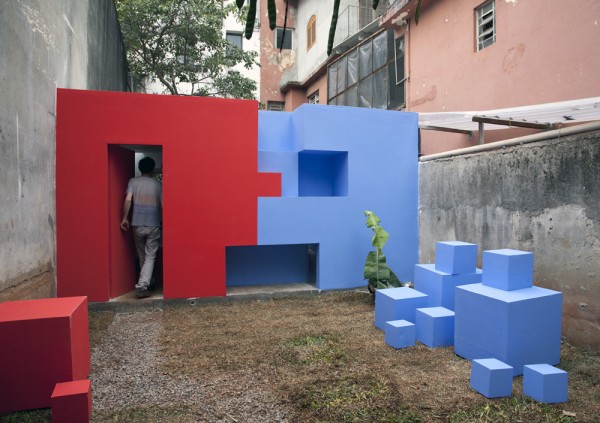
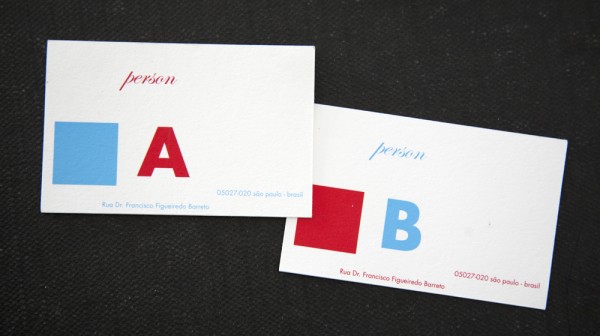
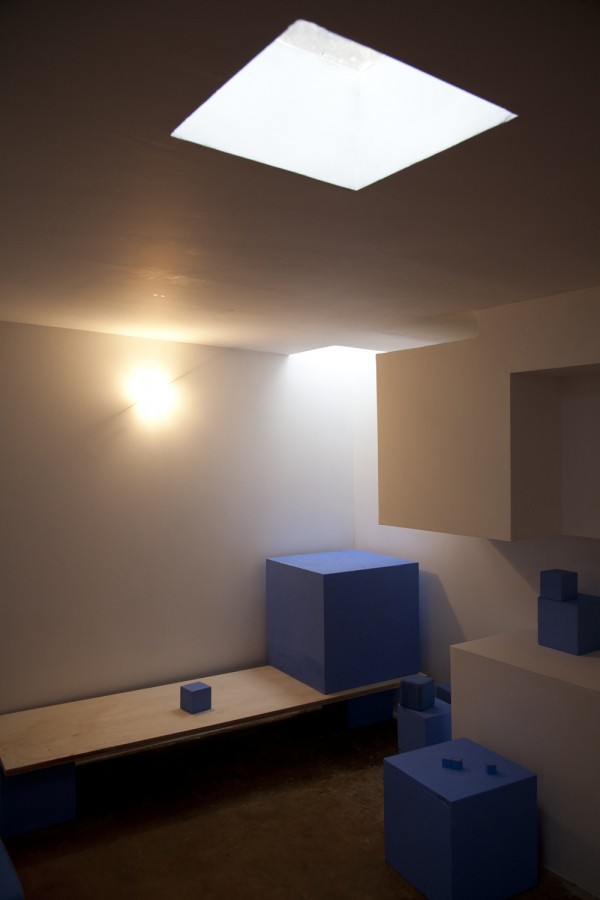
Arguably, the most meaningful aspects of our lives are the relationships and exchanges that come from them. In casa para 2, Berlin-based artist Jean-Pascal Flavien has created an architectural space to induce an experimental dialogue between two people, Person A and Person B. As a means of distinguishing separation, each person participating is designated a color, either red or blue. The interlocking cube structure of the house is reiterated in the interior where various sizes of red and blue cubes exist as potential furniture, props or game pieces to facilitate discourse and play. The cubes can act as architectural elements, to be removed, rearranged, or repurposed from the literal structure. The recently constructed house in the São Paulo neighborhood of Lapa is able to support a co-habitation of two people for several weeks, where the dynamics of a relationship will fold and unfold, intertwine and scatter.

The formal house may be tightly conceived, with each element representing a precise function for the artist, but the beauty of the structure is the uncontrolled and unpredictable dialogue that will take place within it. As with Flavien’s other projects, where a structure is spatially organized with sensory conditions that generate emotive responses, interactions, or experimentations, the methodology and outcome of how one participates with the work is open. The construction is a frame to contain unpredictable forces. Here, an interesting tension becomes evident between the rigidity of the architectural plane and the encouragement of the unknown, between the formal qualities of the physical house and the playfulness of life as art.

casa para 2, 2010, São Paulo, Brazil

Within the structure itself we see an uncertainty of it’s physicality. Casa para 2 will eventually undergo maintenance, a recurring necessity for any house, and these modifications echo the continual adjustment, adaptation, and revision that occurs within a dialogue. A previous project of Flavien’s, Viewer, built just 3 years ago in Maricá, Brazil is rapidly becoming reincorporated into the tropical environment with the aid of termites.  The duration of these artworks increasingly reveals fluctuations in the instability of time and perpetual transmutation. What occurs here, within these walls, is time and space to explore the possibilities of communication, to coax invention, connection, and even folly. The house becomes more than itself as the experimenters and the reverberations of their dialogue are disseminated into the world.

Flavien produces drawings, models, publications, installations and films that support and diverge from his human-scale houses. His architectural works include Cabin in Chicago, built in 1994 to house other artistic works, Viewer, 2007, constructed in Maricá (near Rio de Janeiro), as a means to consider the experience of viewing and an alternative context of time, and No Drama House built in 2009 in Berlin as an experiment in habitation where the participants encounter functional problems for which they must invent solutions.

Casa para 2 was produced in conjunction with Capacete Entretenimentos and the 29th São Paulo Bienal.

Share

From the DS Archives: Fay Ku

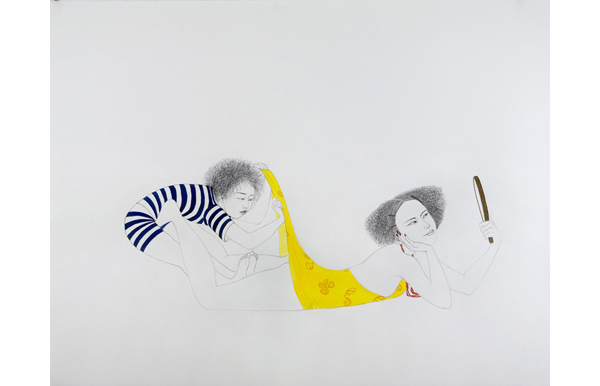
From the DS Archives brings you the stunning work of Fay Ku. Drawing from her own experiences and an aesthetic nod to ukiyo-e or “pictures of the floating world,” Ku renders magnificent pieces that are at once completely modern and historically grounded. If your lucky enough to be in the New York or Wisconsin area you can check out her upcoming shows Tales Gone In Flocks and Herds at the Crossing Art Gallery in Flushing, NY from October 2-November 11 and Animal Instinct: Allegory, Allusion, and Anthropomorphism Group Exhibition in Seboygan, WI at the John Michael Kohler Arts Center from October 17-June 5.

This article was originally written by Arden Sherman on March 17, 2008

The current exhibition at Kips Gallery, Fay Ku: A Survey of Works 2004-2008 curated by Brendon MacInnis, demonstrates Ku’s most significant works to date. Ku’s exhibit coincides with Asian Contemporary Art Week in New York, which runs from March 15-24th. The Brooklyn-based artist is simultaneously showing at Sam Lee Gallery in Los Angeles in a two-part group exhibition, her part titled, Deviance.

Born in Taiwan but raised in suburban America, Fay Ku’s work explores the dichotomy of two worlds. Her sparse graphite, watercolor, and ink drawings on paper display Eastern influences, at times referencing the Japanese woodcutting technique, ukiyo-e or “pictures of the floating world,” though the subject matter is purely her own. Children and women figure predominately in Ku’s work, often presented precariously straddling the divide between myth and reality. Because of the scale of Ku’s chosen canvas and the subject matter therein, the viewer is forced to investigate every minute limb and figure floating among the large stark white paper. In Deviance, there is a metamorphosis of Ku’s subjects where feminism, coquettishness and innocence are faced with uncertainty and the treacherous adult world.

Fay Ku received her MFA from Pratt Institute (2006) in Brooklyn and bachelor’s degrees in visual arts and literature from Bennington College, Vermont (1996).

Share

Visual Arts Center at UT Austin

Ry Rocklen, Cover to Cover, 2010. Photo Credit Robert Boland.

The Visual Arts Center opened last month in an ingeniously subtle renovated Art Building, swiftly filling an enormous gap on the University of Texas campus.  San Antonio architects Lake | Flato are responsible for the staggering streamlined space—think white box white walls, natural light streaming in from punched out windows, and tall vast gallery spaces. Besides all the new opportunity for exhibitions and performances, the VAC’s proximity to habitual student activity is what makes it so essential to the UT Art Department. Throughout the month of September, large windows that look into the gallery spaces allowed students, walking to and from classes, to witness the progress of installation. Often, one would peer in and see artist-in-resident, Ry Rocklen, instructing a band of students on carpet cutting and gluing. Now that the galleries are open, students can stroll the space on most days. This fluid integration between students, faculty, artists, and the public is what makes the Visual Arts Center feel less like a stodgy exhibition space concerned with attendance and more like a playing ground for experience, a laboratory of art made largely by and for the University of Texas community.

Ry Rocklen, ZZZ's installation, 2010. Photo Credit Robert Boland.

LA artist Ry Rocklen’s ZZZ’s is a sculptural installation that makes good use of the 1500 square feet of the Vaulted Gallery–from the tiled carpet flooring to the wind-chimes hanging from the ceiling that when activated by the opening and closing of the gallery doors, fill the space with a soft dreamy twinkling. The exhibition takes sleep and its attendant manifestations as its subject and features woven PVC pipes in a canopy bed frame, a thumb tacked pillow, bronzed bed sheets, and a tumbleweed of thrift-store photographs that all manage to remain humble in their assertive monumentality.

Rocklen spent five weeks in Austin creating the installation with student volunteers enabling a fundamental learning experience in how to conceive of and build a major work of art. Talk to any of the volunteers and their respect and admiration for Rocklen and his work is immediately apparent. I’m excited to see how the student’s process and art works are influenced by their exposure to Rocklen’s seemingly effortless treatment of objects, from abandoned lonely things to gleaming relics of our everyday world.

Magli Lara, Blue Ice, 2010. Photo credit Luis Ordonez.

MacGali Lara: Glaciers is installed in the upstairs gallery and is co-curated by Department of Art and Art History faculty member Dr. Andrea Giunta and former faculty member Dr. Roberto Tejada. The exhibition of drawings and animation examines the solidity and danger of the natural formations through ephemeral notions of line and memory. Mexico-based artist, Lara, creates drawings of fragile looping lines that are accompanied by her animation that details, in abstracted drawn marks, her impressions after a recent trip to the Argentine Glaciers of Patagonia. A brilliant on-line component features the curatorial research that went into the mounting of the show as well as an exhibition essay by Giunta, a poem by Tejada, and an explanation of the work by Lara.

The Kayem Arbor at the Visual Arts Center

The Visual Arts Center also features an additional gallery space currently used for a group exhibition investigating forms of making and unmaking.  Yet another space is allocated specifically for student work and student curatorial collaborations. A rotating schedule of performances and film screenings, from digital music shows to Cassavetes film nights, proves the Visual Arts Center to be ambitious in its programming. Taken as a whole, the VAC is offering itself to the University community, providing a space for rigorous intellectual play and much needed art experimentation.

Share