Stop. Move. And Again.

L.A. Expanded: Notes from the West Coast
A weekly column by Catherine Wagley
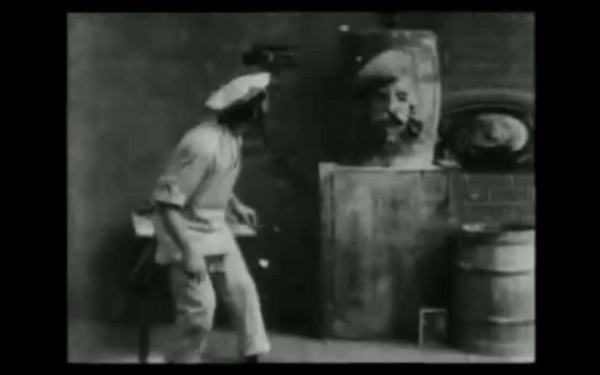

Thomas Edison, "Fun in a Bake Shop," film still, 1902.

Stop motion lends itself to stilted narratives about creativity. Some of the earliest films for which the frame-by-frame technique was used tell stories about eccentric characters making something almost as eccentric as themselves. In Thomas Edison’s 1902 project, Fun in a Bakery, a baker smothers a rat he sees with a glob of dough, then proceeds to sculpt that dough into a robust face; for some reason, his effort gets him thrown headfirst into a barrel of flour by other men in baker’s hats. In J. Stuart Blackton’s 1907 film, The Haunted Hotel, a table is set by invisible hands that go on to create an exquisite, frightening evening for a tired traveler.

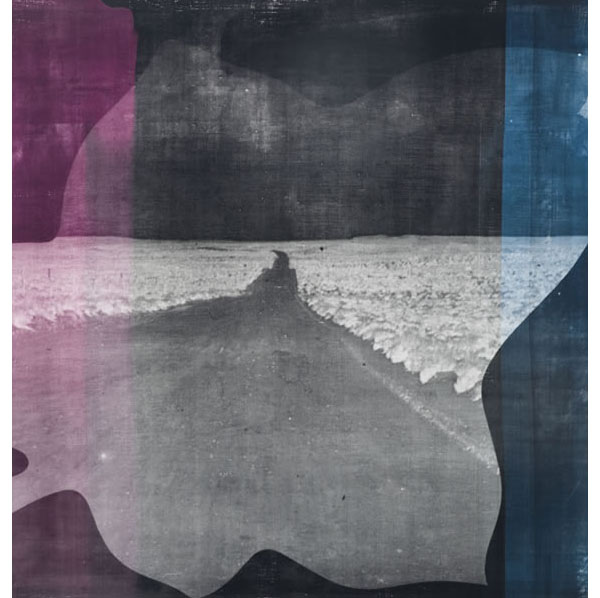
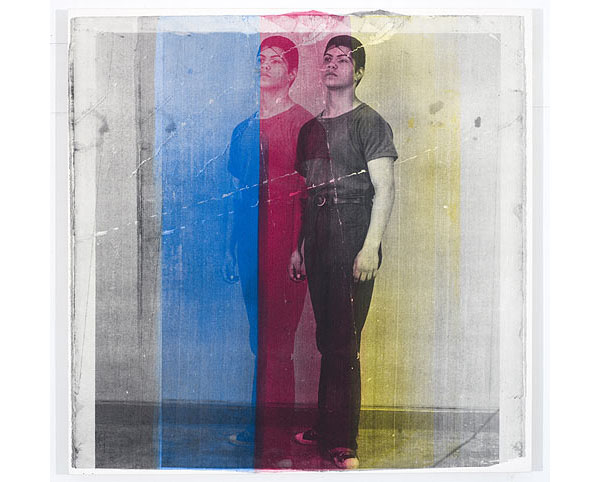
Blum & Poe’s current exhibition, called Stop. Move., attempts to show that this storied, low-tech medium is just as possibility-rich today as it was a century ago, or at least as compelling. It includes four artists, three based in Berlin (at least part of the time) and one based in Los Angeles. Each has been given a single darkened gallery space, and the films by Hirsch Perlman, Robin Rhode, and Nathalie Djurberg are projected onto a single wall, while Matt Saunders’ three-channel installation takes up two additional walls and occupies Blum & Poe’s biggest gallery. Because three of four films have soundtracks, the music that bleed from one gallery to the next become a tainted cohesive, causing the work to mingle and mesh in unexpected ways–the Johnny Cash and Miles Davis tracks paired with Perlman’s film add to the comic effect of Rhode’s work, while Djurberg’s music makes everything else in the show more portentous.

Matt Saunders, "Kuhle Wampe Bikes 108," Edition of 3, 2010. Courtesy of Harris Lieberman Gallery, New York.

Something about the Stop. Move. feels old, and while this has to do with stop motion’s datedness and visual simplicity, it also has to do with the fact that the artists have chosen to present fairly basic, unencumbered narratives. This isn’t a bad thing, and the exhibition’s two most engrossing works narrate stories about creativity that fails. In Robin Rhode’s Canon, a man wearing a sweat suit and red beanie sketches a television on a blank white wall. He then spends the duration of the film trying to “kill” his sketch, by shooting and then exploding it. The problem is that each weapon he draws quickly dissolves into a dirty sea of abstract marks or disappears altogether. Finally, giving up on the canon he’s tried to use, he drags a canon ball across the wall, manhandling it until it collisides with the television. This sort of frustrated effort to make something (or make something work) translates beautifully to the “start, stop and repeat” nature of stop motion.  And even if Rhode’s experiment in failure does veer a bit close to William Kentridge’s charcoal-drenched, foible-filled approach to animation (an acknowledged influence), his nonchalance sets him apart.

Nathalie Djurberg, Still from "We are not two, we are one," clay animation, digital video 5:33, Edition of 4, 2008. Music by Hans Berg. Courtesy of Zach Feuer Gallery, New York and Giò Marconi, Milan.

Nathalie Djurberg, Still from "We are not two, we are one," clay animation, digital video 5:33, Edition of 4, 2008. Music by Hans Berg. Courtesy of Zach Feuer Gallery, New York and Giò Marconi, Milan.

Nathalie Djurberg’s We are not two, we are one steals the show with its lyrically tender weirdness. The Swedish artist’s claymation always feels like the perverse version of Wallace and Grommit; it has a visual wholesomeness that its subject matter totally destabilizes. In this film, a wolf with a slight blond girl growing out of his lower spine navigates a kitchen, making some sort of meal. At first, wolf and girl seem to coexist effectively, though the she tends to pick up after him and finish tasks he starts. Yet the wolf becomes progressively less considerate, and the film ends with both characters naked, battered and in tears. The ever-increasing intensity of Hans Berg’s music, composed specifically for this film, enhances the story line’s formidability, making you feel always on the brink of panic. The characters never finish making their dinner, and the kitchen is left a mess.

It’s not necessarily clear how the four artists in  Stop. Motion. inform each other, but sometimes such  looseness is okay. In the end, the exhibition seems to suggest what we already knew: any medium, wielded by a clever and thoughtful maker can be a success. That stop motion is a strategy artists continue to explore simply means they are keeping their options open.

Share

Isaac Tin Wei Lin @ Print Center Philadelphia

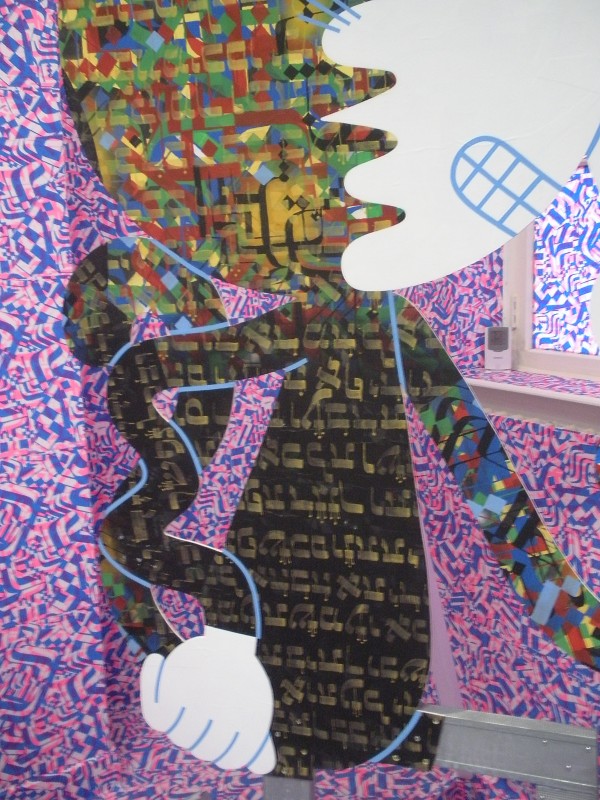
Isaac Tin Wei Lin’s current exhibition at the Print Center is his first solo show in the Makeready series, entitled One of Us. Consisting of a silkscreen installation, 26 gouache paintings, and a freehand mural, the framed gouache drawings greet us and reveal a bit of the extensive processes in the exhibition. More interesting as a group than they are individually, the power of these sketches is fixed to the creativity found in difference. Each seems to be an unsystematic exploration of formal relationships: solid to open, curved to jagged, contrast to complement. The Space 1026 ethos runs through these works, with the emphasis on exploration and investigation and hand-worked art.

One of Us, Installation, 2010. Photo courtesy John Pyper.

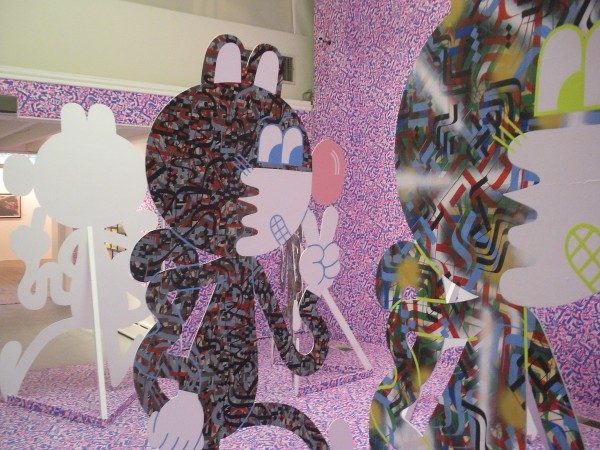
The installation is centered around a pattern inspired by non-latin alphabet calligraphy, printed in edition of 650, and pasted onto the walls and floors of the space. When viewed with 3-d glasses, the high-contrast patterns starts moving and space opens up. The floor you are standing on gets deeper and you are not sure where the floor begins and ends.

One of Us, detail of calligraphy, 2010. Photo courtesy of John Pyper.

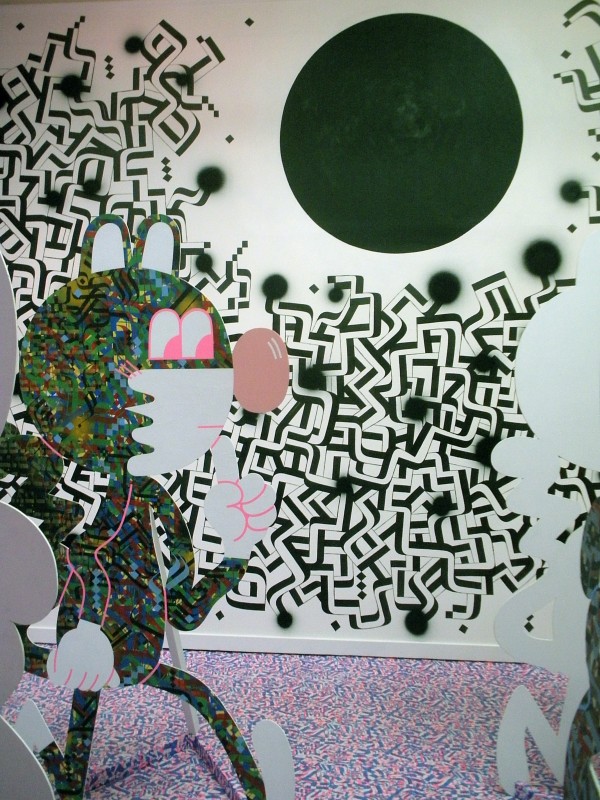
It would not be hard to read psychedelia into this installation. The odd floor layout with six foot cartoon characters interrupting your movement, the intense pattern covering every surface, and the high contrast colors unrelentingly poke at your eyes and brain. I agree with the gallery handout that his work offers a “contrast to the sixties retro work,” but rather than referencing older and culturally loaded psychedelia (Like Justin Lowe’s Matrix 159 at Wadsworth Athenaeum) Wei Lin instead creates an attack on our contemporary senses. The references to arabic and hebrew text shift our paranoid minds to the middle-east. The oversized cartoons bloom into fearful exaggerations, impacting how large we feel. These nervous images command the space, leaving very little to consider beyond it.

One of Us, Detail of mural, 2010. Photo courtesy of John Pyper.

The dense patterns, expert color separations, and skillful overlays matched with the playful depth created by the installation and the 3-d glasses form a riot of information to untangle. If letting the images just wash over your eyes and wander freely is too much, you can always rest your eyes on the relatively peaceful hand-painted mural of calligraphic lines surrounding a circle. But even this mural is surrounded by hand-painted line work, that in a faulty mind (altered somehow) could find their vital motion alarming.

Isaac Tin Wei Lin’s One of Us will be on view at the Print Center through November 20th.

Share

Michael Rea

DailyServing recently had the opportunity to catch up with Chicago-based artist Michael Rea to see what he has been up to since his inclusion in the 2009 DailyServing curated exhibition 1000 DAYS, in Los Angeles. Rea has been busy with all types of new studio projects, many of which have culminated in two concurrent exhibitions on view in Chicago.

Images Courtesy of Ebersmoore Gallery

Seth Curcio: So Mike, its been almost a year and half since you participated in the DailyServing  1000 DAYS exhibition at the Scion Installation gallery space in LA. What have you been up to lately? Tell me a little about the projects that you have been working on?

Michael Rea: After LA, I was out in San Francisco for a solo show at a down town office building 101 California.  After that, I was a group show at Western Exhibitions where I showed the Tasvo Maneaters Part 1 which later went on to show at Next art fair in Chicago.  Last spring, my work was exhibited in a group show at the Contemporary Arts Museum in Houston. The show was curated by Vallerie Cassel-Oliver and was titled Hand+Made The Performative Impluse in Art and Craft. For the show at CAMH, I rebuilt the instruments for my 2004-05 performance piece I Yell Because I Care. The Instruments were displayed along with a video of the performance. After returning for the show in Houston, I began work on a solo show at Ebersmoore Gallery. Around August I took a break and traveled to Darmstadt, Germany to build a site specific sculpture as part of a residency/exhibition called Forest Art. After returning in September I seem to have spent every waking moment in the studio preparing for the show at Ebersmoore Gallery.

Images Courtesy of Ebersmoore Gallery

SC: In addition to your exhibition at Ebersmoore, you are included in the exhibition Inside Out at the Northern Illinois University’s Art Museum. Tell me a little about what is on view at each show.

MR: Well the show at the NIU art museum is a group show curated by Karen Brown, a faculty member in NIU’s art department. All of the  work in the show has a connection in some way to clothing/garments. There is a real nice variety of work in the the show. The two pieces that I am showing are Olympia and a Prosthetic Suit for Stephen Hawking W/ Japanese Steel. While Olympia seems to fit into the show a little more traditionally due to the use fabric and latch-hooking, It was really nice to show the the Stephen Hawking suit in this context.

The exhibition at Ebersmoore Gallery consists of work I made over the last year. In the main gallery space there is a large cannon like structure titled Benita. The cannon begins in the gallery and penetrates through the gallery wall and the living space adjacent to the galley pointing towards an exterior window.  Surrounding the cannon are multiple kegs, a bong, and a collar and chain tethered to the gun. There is also a scope a top the cannon, which has a video loop of a shower scene taken from the film Stripes. Oddly enough the video’s composition is rather similar to that of Les demoiselles D’avion. Viewers are invited to climb up and sit in the cockpit of the cannon. In the living space along with the 20′ barrel I have a few works on paper, which I have worked on throughout the last year.

Images Courtesy of Ebersmoore Gallery

SC: Much of your work is derived from, or abstractly references specific films. Constructing these objects out of wood essentially renders them useless, and they become stand-ins for real and imagined forms. So, I’ve got to ask, if you could activate these sculptures who would you like to see tethered to a death star-like ray gun surrounded by multiple kegs and a bong, and what would he or she being doing?

MR: Well I was considering using a muscular young man at the opening, but did not have time to place and filter the Craig’s List ad.  I wanted my friend’s brother to do it, but he moved away from Chicago.  He would have been perfect. Stylish, bitchy, young, works out all the time, and parties when he is not at work or in the gym. I figure I would have had him wear an outfit he would have normally worn to work at Sidetracks, and just had him drink, flirt and pout.

Images Courtesy of Ebersmoore Gallery

SC: Since you have had such a productive year culminating in the residency in Darnstadt and then these concurrent exhibitions in Chicago, what do you think will be the next object that you will tackle in the studio?

MR: Well I have been talking about making a video. A short remake of the pottery scene from Ghost. The pottery wheel will be replaced with a table saw. I suspect the dust sticking to flesh, respirators, and ear protection may spice things up in an aesthetically pleasing fashion.   I have also been thinking about making a pin ball machine.

Share

New Work: R.H. Quaytman at SFMOMA

Today’s article is from our friends at KQED arts in San Francisco, where Danielle Sommer discusses R. H. Quaytman’s new work at the San Francisco Museum of Modern Art.

In the 1950s, San Francisco poet Jack Spicer wrote that he considered a collection of poems to be a community meant to “echo and re-echo against each other.” A quick look at R.H. Quaytman’s new installation, I Love — The Eyelid Clicks / I See / Cold Poetry, Chapter 18, created just for SFMOMA, assures us that the analogy holds for a collection of paintings, too. Perhaps this is the reason that Quaytman and curator Apsara diQuinzio settled on Spicer as a guidepost for the exhibition.

Quaytman works primarily as a painter, but her installations are site-based and could in many ways be considered sculpture. Images are meant to “echo” — to complement and conflict with each other, and with the architecture of the room. The paintings in Quaytman’s one room show-within-a-show at the Whitney Biennial last spring stunningly incorporated one of the Whitney’s trapezoidal windows as a visual motif, making the actual window look like a trompe l’oeil painting.

With the SFMOMA show, Quaytman is again confined to a single room, a constraint that works well for her. The colors are subdued: a pastel pink just beyond cream and plenty of shades of gray. Using SFMOMA’s photo archive, Quaytman silk-screens images onto beveled, wooden panels of various sizes. The images are somehow relevant to Spicer’s work, although I’m fuzzy on the details: a snake, a creased photograph of a young man, a tripod, and a set of moons. Despite this specificity, the show is not drastically different from other Quaytman shows; while she works in “chapters” and uses specific people — like Spicer — as a way to dive into her work, her formal and conceptual concerns remain constant — and exquisite.

Techniques you’re more-or-less guaranteed to see from Quaytman include parallel lines so closely placed that they shimmer and pain the eyes, paint mixed with crushed glass, and every once and a while a flash of bright, bold color like florescent yellow or magenta. Perspective shifts and jarring juxtapositions between flat, geometric designs and representational images with deep space are par for the course, and most horizon lines lead you to a vanishing point that is off the canvas or in between two works. Shapes repeat, including a realistic representation of the edge of the wooden panels, an effect that serves to remind us that the paintings are objects, not just images.

Stare at any one painting for too long and the danger is retinal burn. The silhouette of a snake surrounded by a sea of sparkling turquoise remains as I blink my way around the room. The clutter in my retinal field builds, disperses, and builds again. Across the room is another painting with the same snake, larger and not in silhouette. Its pebbly skin is visible, and it becomes tangled with the afterimage of its cousin. There are two paintings that contain actual poems by Spicer. Each poem is placed central to its canvas, and yet each is downright painful to look at. Quaytman’s closely-placed lines prevent the text from dominating the image, although when you do manage to lock onto a poem and read it, everything in the periphery melts away.

“The poem begins to mirror itself,” writes Spicer. Poems mirror poems. Paintings mirror paintings. Images appear, accumulate and disperse, only to reappear. Jack Spicer passed away in 1965, but the rhythm and resonance of Quaytman’s installation is a reminder of more than the man. It’s a reminder of the cycling complexity of time in all its invisible and visible moments.

New Work: R.H. Quaytman is on view at through January 16, 2011 at SFMOMA.

Share

The Spectacular Spectacular

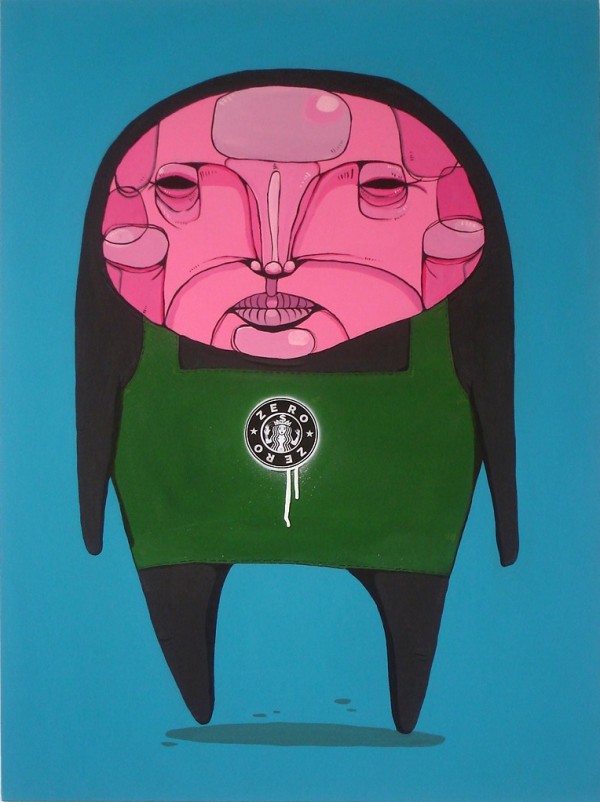
Urban artists in Singapore like ZERO are sought after by advertising companies whose intentions are to speak the lingo of a younger consumer market. The moral dilemma behind what is relatively known to have started on the streets to becoming a recognized trend in the mainstream market leave different impressions. On one hand, the success of what is still considered an illegal act in Singapore is contained and utilized on a larger platform and participating in capitalist markets forms a loose affirmation that graffiti artists can go commercial and actually earn money from their craft. While another group would condemn the decisions made by graffiti artists to take up freelance assignments with corporate brands whose intentions are to monopolize the youth markets and well, make young people spend exorbitantly. These graffiti artists then change their style to become an ‘urban artist’ instead, in order to reflect the works they make that engage multiple stakeholders (corporations, governments etc.). With this, they leave the realm of street art/graffiti whose identity they know of but do not want to insult now that their ideologies have changed.

JOE, Acrylic and Aerosol on canvas, 2007

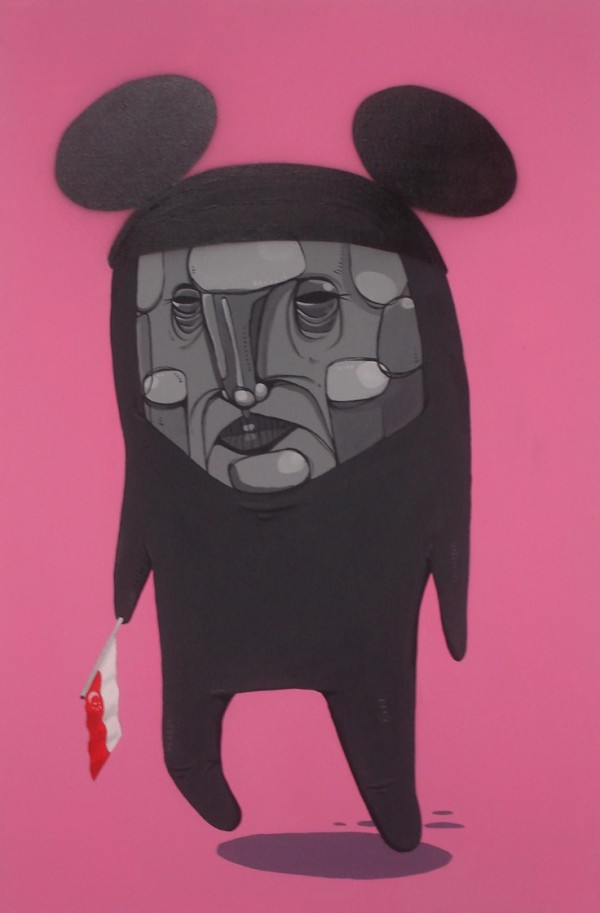
ZERO is a Singaporean whose real name is Zul and he’s been a street artist for a long time. His second solo show, The Spectacular Spectacular, which launched this week at The Substation in Singapore, is displayed complete with a red carpet, blinking lights and famous retail brands like Nike and Nokia. On one side of the space, he sets up a makeshift shop selling limited edition t-shirts silkscreened with the icon he has used in all of his canvas works. Basically, ZERO wants to make use of the idea of branding. When asked about the icon which appears often in his canvas works, ZERO talks about how this icon is deliberately designed in such a way to appear tired and detached from its surroundings. This amorphous icon is an illustrated projection perhaps many can relate to because it is the quintessential person you would meet who is weary and exude a care-less attitude, but naive of the negative impact of his or her choices.

The theme of detachment resonates in ZERO’s practice and with his first solo show. This similar theme has carried over from is previous exhibition. The first solo show he’s held at Wheelock Gallery which was on Scotts Road, a bustling commercial district in Singapore popular for brand shopping, was performative and process based. Here he’s painted five murals in a public open space where members of the public can watch and follow the progress of each mural. From the start, it looks normal, however the artist paints over each mural with white paint as soon as it is completed, leaving many puzzled and almost agitated with the transience of the image on the murals further disturbing the visual display. To the amazement of many, ZERO was asked why he painted over a finished mural with white paint, “I tried to relate to them the ephemeral nature of the kind of art that I did while trying to relate it to the nature of materialism where the process of buying and consuming at such a rapid pace leaves no space for attachment, be it personal or emotional.”

Making a Mickey..., Acrylic and Aerosol on canvas, 2007

Topics of consumerism like ZERO’s latest show is not uncommon in developed countries. Singapore exemplifies a capitalist (and often smugly indifferent to cultural values) modernity through the use of English as a first language while other languages like Tamil, Malay and Mandarin are tagged as the republic’s national languages. A multicultural potpourri of Hollywood movies, Japanese themed shops, F1 race contests and constant drive to attain international attention through the Youth Olympic Games, the prosperous country marks a distinct and cosmopolitan urban experience of consumption. The government’s official rhetoric which one can feel flipping through the pages of state-owner national newspaper, The Straits Times, is anchored in economic rationality which have come to embody and narrate national culture.  As a nation whose globalism is eminent in neighboring Asian states, the nation’s politicians reiterate the 5 Cs – cash, car, condominium, credit card and country club – as the main pursuits for a fulfilling life. It is not totally off-putting for ZERO’s work to talk about branding and material culture condescendingly with a handful of salt.  The critic of consumerism that leads to consumer disempowerment in this show could be fleshed out more. There is only a small few in Singapore’s art scene who examine critical topics unique to Singapore, for example, freedom of speech. In 1987, 22 young professionals were detained under the Internal Security Act by the government and labeled ‘Marxist’. They were condemned to detention without proper trial and subjected to physical as well as verbal abuse. Could artists like ZERO talk about these things that would capture the attention of local Singaporeans and also speak to an international audience who most likely know Singapore just as a cosmopolitan city, possibility of profit-making ventures or the Singapore Sling?

Vandalism Act
In 1966, the Parliament of Singapore introduced the Vandalism Act statute. The Act dictates a fine or jail term for individuals found to have damaged public and private property as well as a mandatory corporal punishment of between three to eight strokes of the cane for persons who are convicted in subsequent times.

Originally passed to curb the spread of communist graffiti conveying anti-government rhetoric, the Act made worldwide news when a young American student, Michael P. Fay was charged and caned for pleading guilty to vandalizing cars in addition to stealing road signs. Similarly, Swiss national Oliver Fricker and British national Llyod Dane Alexander broke into the local subway depot to leave their marks on a train carriage. Unlike Alexander who left Singapore after the midnight heist, Fricker was caught in Singapore and slapped with a five-month jail term as well as three strokes of the cane.

Of course not everything seems doomed and gloom, tourists who visit Haji Lane on Arab Street (popular with Western tourists) would notice the number of street art left behind by graffiti artists. However this only brings about questions of control and demarcation of spaces where street art is ‘allowed’ which makes street art then look acceptable when the craft itself was started as a way of speaking on social injustices.

Share

From the DS Archives: Catherine Opie

Today, From the DS Archives reintroduces you to L.A. based photographer Catherine Opie. Opies latest body of work Catherine Opie:Figure and Landscape showed at the Los Angeles County Museum of Art and explores issues of community and national identity through images of high school football.

This article was originally written by Julie Henson on May 15th, 2010.

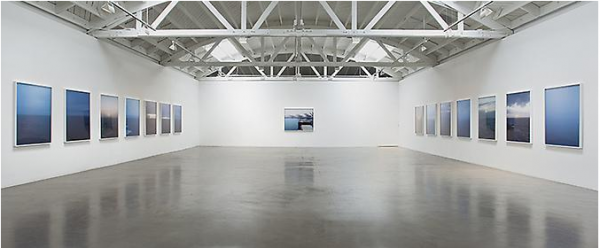
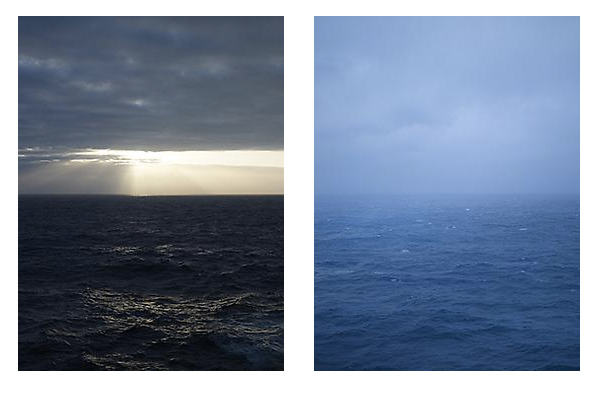
Closing next weekend at Regen Projects II in Los Angeles is new work by Catherine Opie. These photographs titled Twelve Miles to the Horizon document Opie’s trip on a container ship from Korea to Long Beach, capturing the sunrise and sunset across the ten days of the trip. Each image is composed with equal amount of water and sky, deliberately placing the viewer in the time and place documented in the image, allowing for both consistency in relation to the experience and variation in color and texture within the image. What remains is a sensation of solitude within this documented time and place, allowing the viewer to sense the duration of the work through these highly seductive and reductive photographs.

Although compositionally this body of work reflects her Icehouses (2001) and Surfer (2003) series, conceptually, these horizon photographs move in a different direction.  Although the series maintains both aesthetic consistency and variation as these earlier series did, what strikes more is the repetition of the action — a sensation of documenting time rather than just the beauty and stillness present in the earlier series. What remains in the viewer’s mind is the constraint embedded in the image, reaching more to the limitations present in her self portraits than to her more aesthetic and experiential photographs. These photographs allow the viewer to witness her self-imposed restrictions, revealing the decisions that created the series of images rather than just a documented experience. What remains are sensations of time and place, bound in a beautifully seductive series of photographs.
Catherine Opie received her BFA from the San Francisco Art Institute in 1985 and her MFA from CalArtsin 1988. She is currently a tenured professor at UCLA, and her work has been exhibited internationally. In 2008, she had a mid-career survey at the Solomon R. Guggenheim Museum in New York — and theNew York Times has a feature corresponding to the show. She has had solo exhibitions at the Walker Art Center, Minneapolis; The Saint Louis Art Museum, St. Louis; Photographers’ Gallery, London; Museum of Contemporary Art, Chicago; and the Museum of Contemporary Art, Los Angeles. An exhibition of Opie’sfootball, surfer, and landscape photographs will open at the Los Angeles County Museum of Art in July 2010.

Share

Fan Mail: Ela Zubrowska

DailyServing.com selects two notable artists each month from the submissions we receive to be featured in our series, Fan Mail. For a chance to have your work appear below, with an article written by one of the DailyServing contributors, please submit a link to your website to info@dailyserving.com, subject: Fan Mail. You could be the next artist in the series! (We will try to contact chosen artists prior to publication, but please be sure to check the site everyday.)

There is a certain visual rhapsody that comes out of capturing what is typically unseen. Perhaps it’s the closest thing to magic that most of us will experience, or maybe its a trickle down effect from all that scientifically motivated proving. Regardless of the genesis, revealing the unseen in nature is provocative—and more often than not—totally stunning in its completeness.

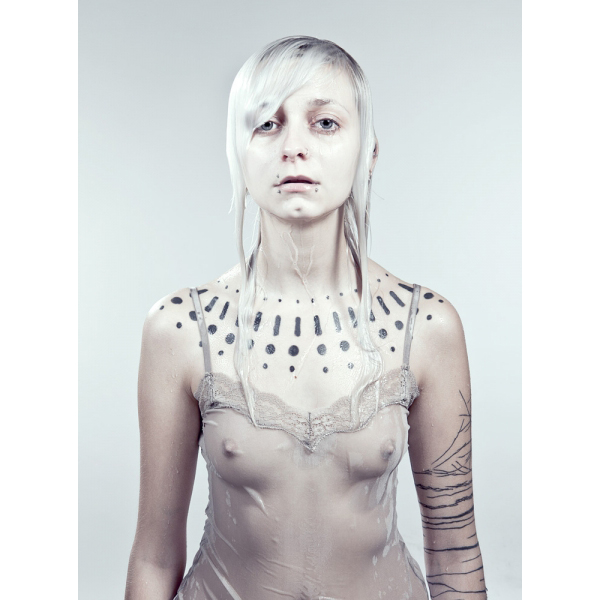
Ela Zubrowska’s latest series Water to Water is an ode to the oft forgotten life essential. Referentially we have this: “the total amount of water in a man of average weight is approximately 40 liters, averaging 57 percent of his total body weight. In a newborn infant, this may be as high as 75 percent of the body weight, but it progressively decreases from birth to old age… the human body is about 60% water in adult males and 55% in adult female.” While these statistics are consistently incredible and certainly relevant to the topic, the more alluring outcome of the work is the stripped away facade of both substance and subject. Zubrowska pairs photographs of revealed liquidity with portraits of individuals who are soaking wet and strangely vulnerable.

Far from meek, the portraits have a primal quality that amplifies each individual personage and seems to reveal a captured moment of genuine existence while the pictures of water seem to mirror some portion of that reality. When seen as a whole, the photographs generate a sensuous yet afflicted dialogue between powerful stability and a shifting vulnerability. Ela Zubrowska has studied psychology and law at Savoy University in France and Photography in AF in Warsaw. She currently works as a freelance photographer, lecturer and graphic designer. Her latest exhibition was in August 2010 at the International Festival of Photography by the young—dream within a dream in Jaroslaw, Poland.

Share