Interview with Nina Beier

In the first moments of our meeting, Nina Beier ambushed me.  “Do you mind if we go over to the tea garden next door?” she asked, “Some friends of mine are there and we can all talk together.”  I was alarmed at the prospect of a one-on-one interview conducted in a group, but I held my nose and jumped in.  It was only through talking with her—and with Chris Fitzpatrick and Post Brothers (both are authors of wall text in the gallery)—that I understood exactly how central this kind of decision is to her working methodology.

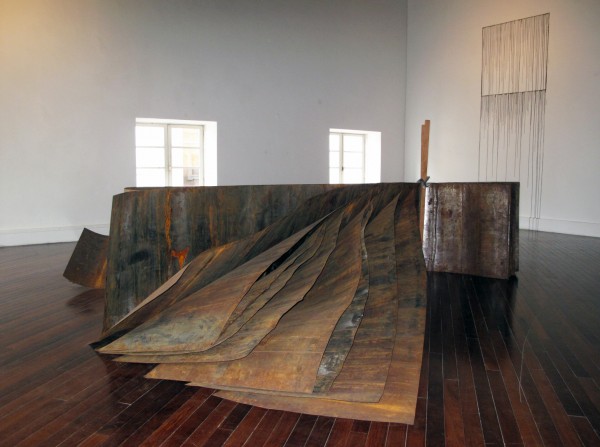
To understand Beier’s oeuvre you have to be willing to investigate, to read, to dig, and to allow other voices to participate.  Her exhibition What Follows Will Follow II at the Yerba Buena Center for the Arts is divergent in media but parallel in its concept.  For example, the core of the exhibition consists of eighteen framed chromogenic prints, views of a previous exhibition.  On the wall outside the main space is On the Uses and Disadvantages of Wet Paint (2010), a rollered patch of paint on the wall, repainted every few days with different colors from YBCA’s existing stock of paint.  The Complete Works (2009-10) has a retired dancer re-stage all the dance moves that she can remember, in chronological order.  Beier’s work is iterative and reiterative, making the work perform itself again and again in order to hold a kind of meaning open, for itself and for the viewer.

Nina Beier, On the Uses and Disadvantages of Wet Paint (2010). Paint, increasing dimensions. A patch of paint on the wall iteratively painted over with a different color from the stock of the Yerba Buena Art Center.

Bean Gilsdorf: Let’s start with the basics—your work is so materially diverse. If someone asks you what you make, how do you answer?

Nina Beier: [laughing] Only in America do I get this question! I usually say that my work is conceptually based and takes any form except painting…but I guess that’s not even true anymore. I am wary of self-mediation though, because conceptually conceived work is already far too self-conscious. The art needs to work as a project: to read, to misinterpret, to reinterpret, that’s how you get closer to the idea of a show.

BG: The Extreme and Mean Ratio sculptures and What Follows Will Follow are projects that have the possibility of being unfinished forever. How do you resolve to stay unresolved?

NB: In the gallery now [at YBCA] there is a wall painting, it gets painted over every few days. It’s never-ending and will continue even long after I have a claim for it, because that wall will be painted now, but also will be painted for subsequent exhibitions. So in a way, it will survive for as long as the exhibition space exists. My process is coming from a direct frustration—as artists we want to explore something that is alive, but normally in the art system the work is supposed to have a final destination, and it freezes. On the issue of staying unresolved, I guess I am not the first artist to struggle with fitting a living and changing practice into a framework that demands final answers.

BG: So what is your process?

NB: All the things that are completely unbearable about the system, that’s what I want to work with. The artwork is autonomous despite the attempt to claim its rights. When I look at my existing work it is not uncommon that something has changed since it was made; it could be its context, itself or even me. I respect the authority of the [extant] work, but I like to believe that mine trumps it. I should have the freedom to change it. For example, I’ll change a title if I don’t think it’s fitting anymore.

Nina Beier, What Follows Will Follow II (2010). Installation view of 18 photographic C-prints, various dimensions. Framed photographs of work extracted from the installation shots of a previous exhibition.

BG: You’ve been quoted as having read the theories of Walter Benjamin and Roger Caillois. Do you think of your work as theory-driven?

NB: I read, but not conscientiously, I have to admit. I use writing for inspiration and I rudely mix and match to make it fit my current thinking. But I would hate to think that my work would be an illustration of any theory.

Chris Fitzpatrick: It’s more like dislocated footnotes, to approach without explaining.

NB: I guess you need to have an ideal viewer in mind when working, someone to assign the ability to read both the conscious and unconscious signs embedded in the work. For me this viewer has recently materialized in the form of Post and Chris [gesturing to the others]. Art relies so heavily on its reader, it is hard to ignore when making an exhibition. And since my work ‘is like concentric crates, which depend on where they are unpacked or who looks inside.’ Okay, that was a bad attempt at quoting Chris and Post’s first wall text, but the point is that they are the people who are stuck with making sense of it all, these days.

Post Brothers: Instead, there are points on a map to locate—and to contradict and compliment.

BG: Do you feel you are playing a game with the audience?

NB: No, a game would imply that I have a master perspective and I don’t want to claim that. This exhibition experience could play out in many directions; for example, the wall text [rewritten repeatedly by Chris Fitzpatrick and Post Brothers and replaced throughout the exhibition] is all in their hands. It is a space that welcomes even misinterpretation and contradiction.

CF: Unlike a game, there’s no objective to achieve, it’s not shutting down meaning. But we are playing our parts, if you will, in the play of the exhibition. There are platforms and frameworks, but it’s not the type of exhibition where works arrive finished. There’s a lot to respond to.

NB: My work tends to be built on some more or less logical premise, but it would be really sad if it ended there. I try to start something and there is nothing better than when it is taken on the route of over-interpretation, an attack of the mind, like the incredible places that these guys’ minds can go. It’s what any work of art would wish for.

Nina Beier, What Follows Will Follow II (2010). One of 18 photographic C-prints, various dimensions. Framed photographs of work extracted from the installation shots of a previous exhibition.

PB: There’s a temporal interaction here. The work resists the historicity of a document fixed in time—instead, there’s a translation from one object to another.

NB: The initial exhibition What Follows Will Follow presents a confusion between the object and the image, between the map and the territory. The story of a one-to-one map is told in the press release and consequently in the exhibition space by the staff of the gallery, raising the question—is the retelling the story, or is it a representation of the story? The sequel What Follows Will Follow II is limited to the perspective of the photographer’s lens, but it opens up to its viewers in many ways that its more heavily loaded predecessor couldn’t. Through their processing, the images have become more or less abstracted, in some cases to the degree where all you can see in the dark framed monochrome print is your own reflection.

Share

Fan Mail: Adam De Neige

DailyServing.com selects two notable artists each month from the submissions we receive to be featured in our series, Fan Mail. For a chance to have your work appear below, with an article written by one of the DailyServing contributors, please submit a link to your website to info@dailyserving.com, subject: Fan Mail. You could be the next artist in the series! (We will try to contact chosen artists prior to publication, but please be sure to check the site everyday!)

I have—unfortunately— encountered photography mostly in the margins of art history books as tiny little thumbnails floating on a forgotten side of the page—barely discernible against the appalling text wraps and lines of grieving widows.  I have also sat through numerous brain dulling conversations about whether or not photography is art, in which a staggering range of opinions are expressed, none of them bearing much weight one way or another.

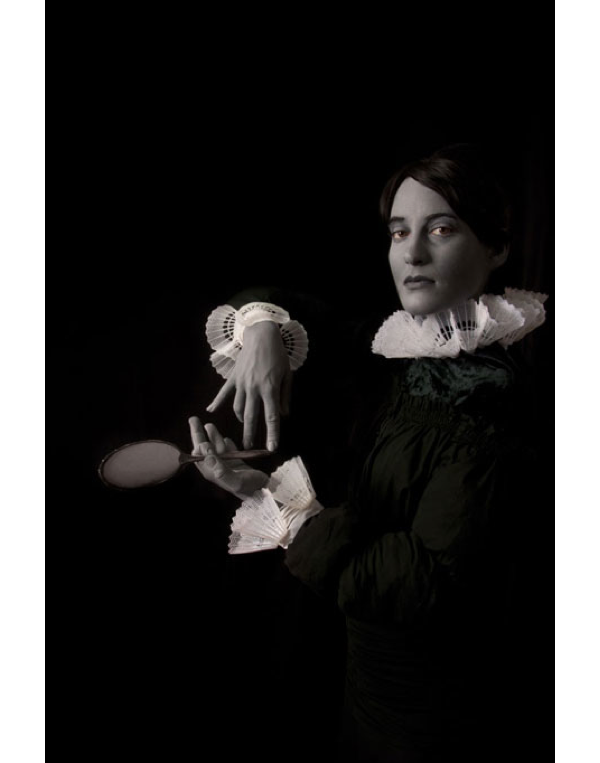
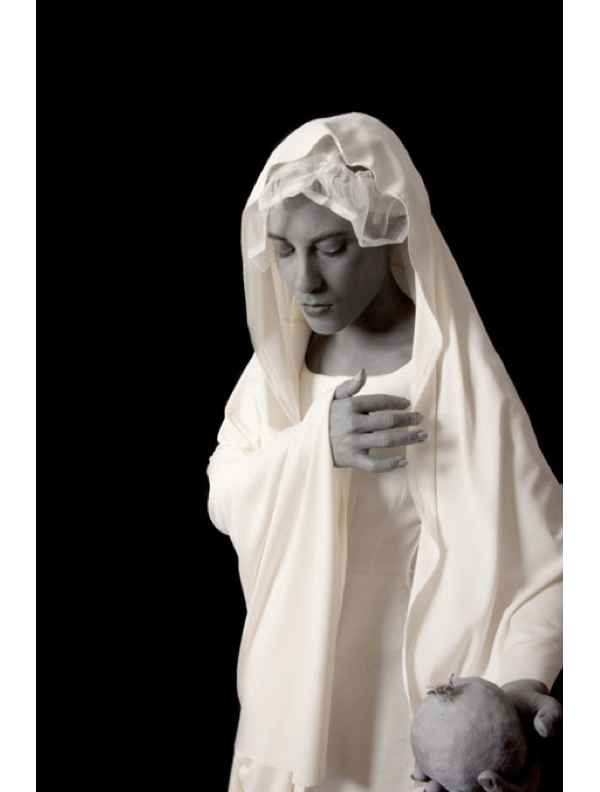
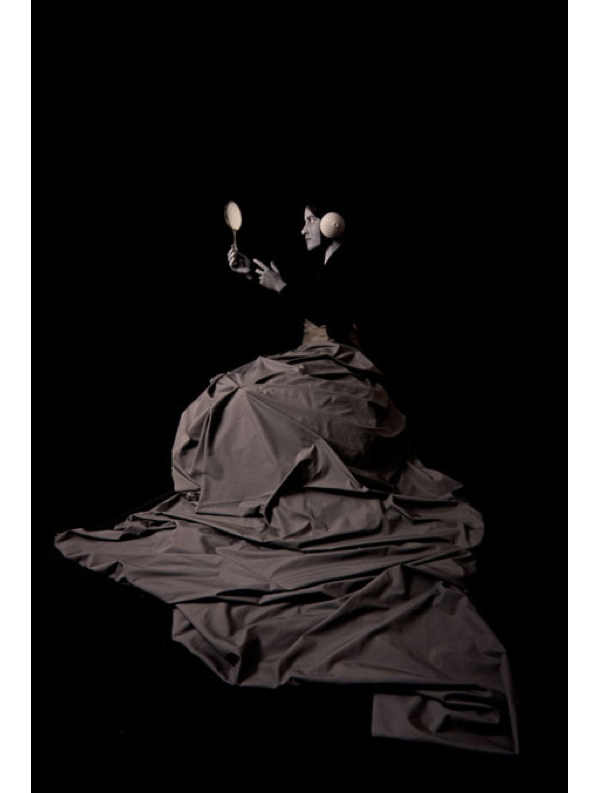
With this history, you might understand why the first time I encountered photography as it’s meant to be encountered I was astonished—giddy with delight and absolutely staunch in my opulent opinion regarding the photographic arts. In this vein, I was delighted to discover Adam De Neige, a young Franco – Iranian artist who has rendered elegant colored photographs of black and white models, referencing with great lucidity and lightheartedness, the old masters.

The conceptual twist of the oxymoronic colored black and white photographs comes off as a sort of tongue in cheek—and while this is embedded in the work and is reinforced by De Neiges use of common present day objects, like the badminton shuttle cock that composes the ladies dust ruffle, the photographs have a historically ubiquitous quality.  The narrative is self compiling and acquiesces the viewer to pause as the brain goes through a rapid neuro-firing and mis-firing of all the art and world history and photographic techniques knowledge he or she might have stored.  All said, the series is a well wrought set of photographs that accomplish quite a lot with a simple, well executed idea that satisfies aesthetic beauty and artistic cleverness.

Adam is studying in Academy of Fine Arts in Vienna – in Amelie Von Wullfen’s Class for Figurative Painting and Mathias Herrmann’s Class for Photography.

Share

Geometria Impura

Pedro Motta, arquipélago 2 , 2010 and Rodrigo Borges, Estratégia da aranha, 2008/2010

Like most countries, much of Brazilian art seems to be located in and produced by artists living in the largest urban centers, São Paulo and Rio de Janeiro. Geometria Impura, a traveling show from Belo Horizonte aims to shorten the distance from satellites to center. Centro de Arte Hélio Oiticica in Rio de Janeiro is the latest exhibition stop, which was inaugurated in Belo Horizonte and previously exhibited in Recife and Salvador. The exhibition is tied together with frayed threads referencing the Brazilian Constructivist history, which appears to have a stronghold in Belo Horizonte where the exhibition artists are based. Looking to a modernist movement that sought to present universal ideas through geometrical abstraction, it is the poetic fissures, contaminations, and deviations to the abstraction of the works that drags the modern into a contemporary space.

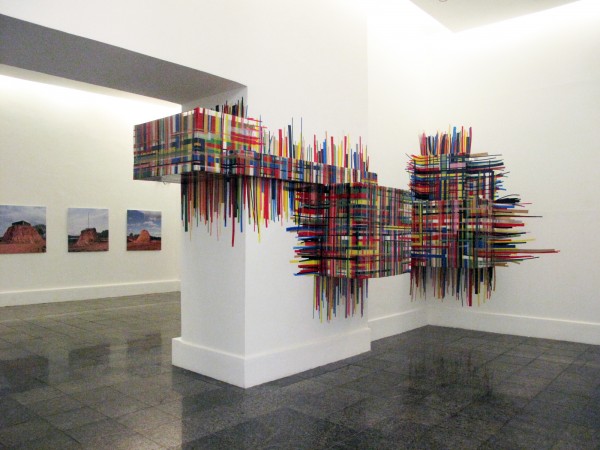
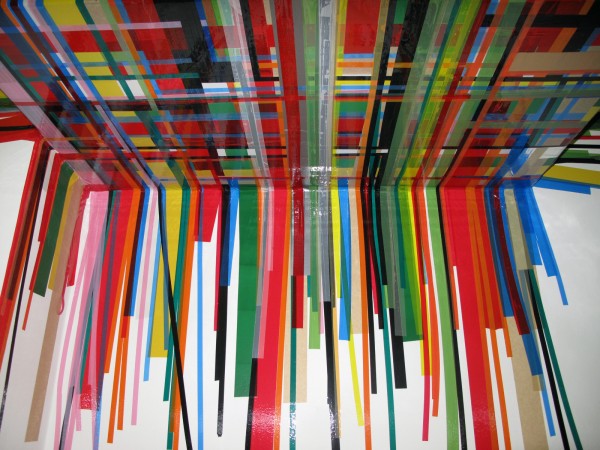
Rodrigo Borges, Estratégia da aranha, 2008-2010

Some highlights of the exhibition include Rodrigo Borges’ Estratégia da aranha (Strategy of the spider), which makes use of common and industrial materials (a legacy of the constructivists) – cardboard boxes and colored adhesive tape create a vivid and rough geometric explosion into the architectural space of the gallery.

Pedro Motta, arquipélago 2, 2010

Pedro Motta’s arquipélago 2 (archipelago 2), a series of photographs of man-made “islands” are, perhaps, the most “impure” artworks in the show. A typology of found, industrially created sculptures recall the photographic work of Hilla and Bernd Becher. These humorous monuments to practicality and human progress acted upon the Brazilian countryside are a significant departure from geometric abstraction.

Renato Madureira, untitled, 2010

The works of Renato Madureira are a material investigation of ruptures. Black paint drips down the white gallery wall, it’s origin is a fissure in the wall itself. Sculpturally, Madureira confuses the sensations of rigidness and flexibility as metal sheets clamped together allow the force of gravity to to act as both a means and a material in the piece.

Francisco Magalhães, Da série "Um homen olhando a paisagem", 1999/2001, Júnia Penna, Compartimento, 2006 Renato Madureira, untitled, 2010

Júnia Penna’s compartimento (compartment) reaches back to the Penetrables of Hélio Oiticica, an homage to the artist who’s significance for Brazilian art resulted in the creation of art center which houses this current exhibition. In contrast to Oiticica’s use of materials that reference the informal and make-shift qualities of favela (slum) architecture, Penna’s penetrable structure is produced from formalized, industrial materials of MDF, formica, and glass. Here, the raw and vernacular are replaced with the rigid and prefab. As Oiticica’s own work evolved from clean geometric investigations to a more performative and participatory practice, compartimento seems to by cycling back. Although this appears to occupy a space that has more affinity with the constructivist ties to European geometric purity, it may actually be a mirror to the encroaching social and architectural development. In this context, Oiticica’s PN 2 reminds us with its inscription “A Pureza e um Mito” (Purity is a Myth), to question the very definition of purity.

Geometria Impura runs from December 11th through February 27th at Centro de Arte Hélio Oiticica in Rio de Janeiro.

Share

Artur Żmijewski

Concerned with the role of the individual in society, Artur Żmijewski produces works which expose social conflicts. His manifesto, Applied Social Arts, anchors his practice in two ways – art as a valid means of knowledge production, and the use of art to address the political and the social. In comparison to the social sciences, art is seldom drawn upon as a form of knowledge. Żmijewski underscores the responsibility that art has in isolating itself to the realm of the aesthetic, rendering itself disconnected from history-making and knowledge production.

Artur Żmijewski, Repetition, 2005, video, 75 min., video still, collection Van Abbemuseum, Eindhoven (photo: Foksal Gallery Foundation, Warsaw)

This ideology has informed his practice which, from the 1990s, has been characterized by a process of staging experiments as a means of inquiry into social mechanisms of power and control. Repetition (2005), produced for Poland’s Pavilion at the 51st Venice Biennale in 2005 is an often-cited example of a work exemplifying the form and themes of his practice. Żmijewski re-enacts the Stanford Prison Experiment conducted by Philip Zimbardo in 1971 to explore the psychological effects of imprisonment. Though this experiment was cut short and regulations prevented its recurrence in the scientific field, Zimbardo’s claim of man’s desire to dominate has been frequently referenced in academic and cultural realms. Through the re-enactment, Żmijewski asserts art’s ability to remove the experiment from its scientific context and constraints to explore universal human issues stemming from reality.

Democracies ( 2009 ongoing); multi channel video; courtesy the artist and Foksal Gallery Foundation, Warsaw

Democracies (2007 – ongoing) represents a shift from Żmijewski’s focus in constructing situations, while maintaining its stance on interrogating social norms. The work comprises his documentation over three years of public and collective expressions of protest, celebration and grief, from a demonstration by supporters of Polish anti-abortion laws to the live broadcast of Germany versus Turkey in the semi-final of the 2008 European Football championships. Recently presented at Tramway, Glasgow from 29 October to 12 December 2010, with sixteen screens on all four sides of the room, the viewer, when positioned in the middle was subjected to a cacophony of noises which drowned out the subtleties of the individual films, an experience which parallels the heady effects of collective demonstrations and ceremonies and their impact on individual reflection and thinking. Through his work, Żmijewski puts forth the question of whether mass expressions are indicative of democracy and at a more fundamental level, the validity of democracy as practised and fought for today.

Democracies ( 2009 ongoing); multi channel video; courtesy the artist and Foksal Gallery Foundation, Warsaw

Żmijewski will be curator of the 7th Berlin Biennale for Contemporary Art in 2012. He has initiated a call-for-proposals, requesting that artists provide their political inclination together with their submission before January 15, 2011. Though the norms within art dictate that an artist’s political position remains at a distance from the content of their work, Żmijewski asserts that politics structure our collective needs and hence, all works are political. In deliberately going against a artistic methodology of ascribing a political position to an artwork through this role as curator, there is much to anticipate in how his curatorial decisions contribute to a radically different methodology of exhibition-making.

Born in Warsaw, Poland in 1966, Żmijewski studied sculpture at the Warsaw Academy of Fine Arts under Grzegorz Kowalski who encouraged students to alter the works of their classmates, as a way to open dialogue on the production of meaning. He is a recipient of the Ordway Prize and has had solo exhibitions in MOMA, New York; Kunsthalle Basel; and BAK, Utrecht. Żmijewski is also arts editor of Krytyka Polityczna (“Political Critique” in Polish) a journal aimed at creating  an intellectual base for alternative movements and to introduce new critical discourses in Polish public debate.

Share

From the DS Archives: Tom Schmelzer

From the DS Archives reintroduces you to Tom Schmelzer, a Munich based concept artist.  He is currently showing beautiful outside my head forever at WTC Hamburg through January 15th, 2011.

This article was originally written by Rebekah Drysdale on April 30, 2008.

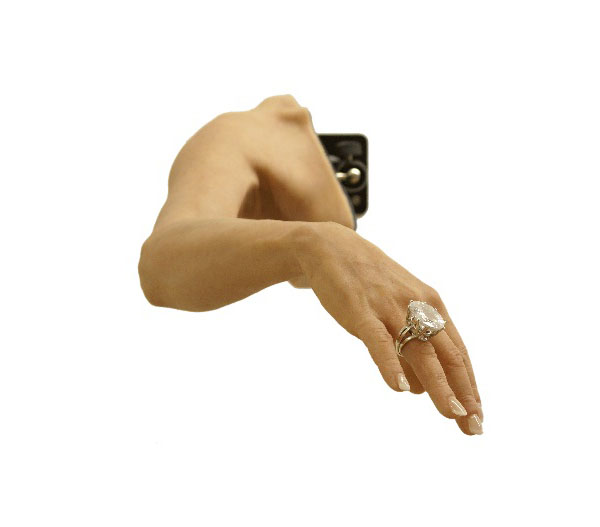
Munich-based artist Tom Schmelzer describes himself as a concept artist who uses brilliant aesthetics in his illusionary sculptures and moving objects to “make a point” to the viewer. After being drawn in by the theatricality of the object presented, the viewer soon discovers a message. These messages concern social and cultural issues such as in Show Off, an enormous engagement ring followed by a woman. In this piece, composed of silicone, silicone paint, polyurethane, 925 silver, diamond, french nails, and metal, Schmelzer addresses the cultural expectations surrounding success and its manifestations. For example, men are expected to make more money than their fathers and to purchase engagement rings for their fiancees worth approximately three month’s salary.

In a 2006 installation, Schmelzer took on the expectations of the United Nations, who at a 2005 summit declared that individual states were responsible for protecting their people from crimes against humanity, ethnic cleansing, and the like. If a state is unable to do so, the international community should step in. In Responsibility to Protect or To Whom It May Concern, Schmelzer asserts that collective action is only taken when whites are involved, when Christians are involved, when petroleum is involved, or when natural gas is involved. The installation consists of a white oil drum with Jesus figures encircling the rim of the drum, which contains petroleum and a pump to create gas bubbles. A literal but quite successful way to “make a point”. Schmelzer’s seductive sculptures immediately capture our attention, a task that is becoming increasingly difficult in the 21st century. He does this by moving past the aesthetic neutrality of previous conceptual art and reinforcing his appealing objects with sound conceptual statements.

Jozsa Gallery in Brussels is currently featuring Schmelzer’s work in their exhibition Let’s Call it A Year until May 10th. The artist has previously shown at the Riviera Gallery in New York, White Trash Contemporary in Hamburg, and Galerie Jaspers in Munich.

Share

2010 California Biennial

Today’s article is brought to you from our friends at the Huffington Post, written by James Scarborough.

Literature supplies the concept of an unreliable narrator, whose credibility one questions or otherwise doubts in the telling of a particular story. The Orange County Museum of Art‘s 2010 California Biennial, curated by Sarah C. Bancroft, suggests that the concept can be applied to art museums as well: the idea of an unreliable curator who tells a story of California art in 2010 seems appropriate here.

Brian Dick, OC Mascot

Forget the jejune nature of some of the work in the lobby and, especially, an institutional mascot-making contraption. Forget the elementary installation determined by medium, geography, and thematic groupings that you could just as easily find with a few well-chosen search terms on Google. Focus instead on the absence on any sort of unifying theme, stance, or insight the Curator might have brought to the exhibition. The Curator wrote an essay to accompany the exhibition, of which a not-useful-at-all excerpt was made available, but the catalogue won’t be published until after the show, to accommodate some of the work created during the exhibition’s run. Fair enough, to a point.

“To capture the pulse of what’s happening in California,” as the Curator states in a YouTube video, is more of a starting-, not an end-point of the show. Indeed, we’re dying to know the pulse. Is it a death-defying 197 or a moribund 35? What about temperature, for that matter? It goes without saying that the process of creating the checklist was no little task. Indeed, the Curator made 150 visits that spanned the State, visits culled down from an “incredibly large list” that she created from personal research and recommendations from colleagues, to arrive at an exhibition of work of art by 45 emerging and mid-career artists. What exists here, though, is not what one would expect from a Curator who, having spent her ten previous years in New York and who, theoretically -hopefully – would be able to offer a fresh, outsider’s perspective – as De Tocqueville did when he visited America – on the State of the Art of the art of the state.

Andy Ralph, Reclining Lawn Chair

The show seemed more administered – “wrangling disparate practices into a coherent presentation” – than curated, more passive than engaging, moreso when she democratically states her hope that the show will present something for everyone. The experience is not so much that one is looking at a distillation of discrete, individual works of art convened, with an agenda, as that the work has been installed with a feel for branding, as happens in a supermarket; which then makes you wonder if the Museum has become a Costco emporium of branded artistic commodities, practical, to be sure, but prey to the flim-flam of advertising. There’s a lot going on in each of the galleries but without any sort of curatorial impulse as to what they all mean, collectively if not individually, the experience resembles the museum equivalent of White Noise.

Dru Donovan, Untitled

In Bambi Versus Godzilla: On the Nature, Purpose, and Practice of the Movie Business, David Mamet makes a useful distinction between the circus and theatre. The circus, he writes, consists of events/tricks/performances strung together for the purpose of entertainment. You see one act, without thinking you gawk or marvel at the spectacle of the thing, and then you move on to the next act. There’s no delayed gratification because each act is separate and complete; there are no conflicts and so there are no resolutions (Just as, in another century, Marcel Duchamp said there were no solutions because there were no problems). Individual acts are sequenced; their impact is more of a sustained buzz than of an anticipated climax.

Circus acts, Mamet continues, are routined, which he defines as “optimally ordering the arbitrary,” which describes this exhibition to a tee. Drama, he writes, offers “the enjoyment of the postponement of enjoyment.” The experience of drama is one of fulfillment, because the conflicts the protagonist faces have been resolved; because we identify with the protagonist, his success or failure is our success or failure. The only identification we make here is with a Curator who describes her “voyage of discovery” without mentioning what she saw once she got there. If she got there.

Luke Butler, Landing Party II

That’s what this Biennial feels like, a circus. In setting and atmosphere, work and installation, the place feels festive, brimming with spectacle but not, I hasten to add, the potential for speculation. Most revealing – or, depending on your point of view, most damning – is the text-piece that you can’t see upon entrance because it’s over the door, and so you see it upon exit: “So, what are we going to do?” As in, “Well, that was fun, let’s go bowling.” It’s not necessarily a bad thing, the Museum as circus, the Curator as ringleader. The Museum as venue for mindless down-time, sure, why not? The implications of such a view, however, are a little more troubling.

By not articulating something qualitative about California art in 2010, this Biennial issues no challenge to the viewers and so it doesn’t answer one. Taken at face value, the exhibition comes across as glib. More worrisome, does it suggest the prospect of the deflation of the moral authority of art and the museums that exhibit it or does it reflect what is already the case?

Share

Mystery Spot

L.A. Expanded: Notes from the West Coast
A weekly column by Catherine Wagley


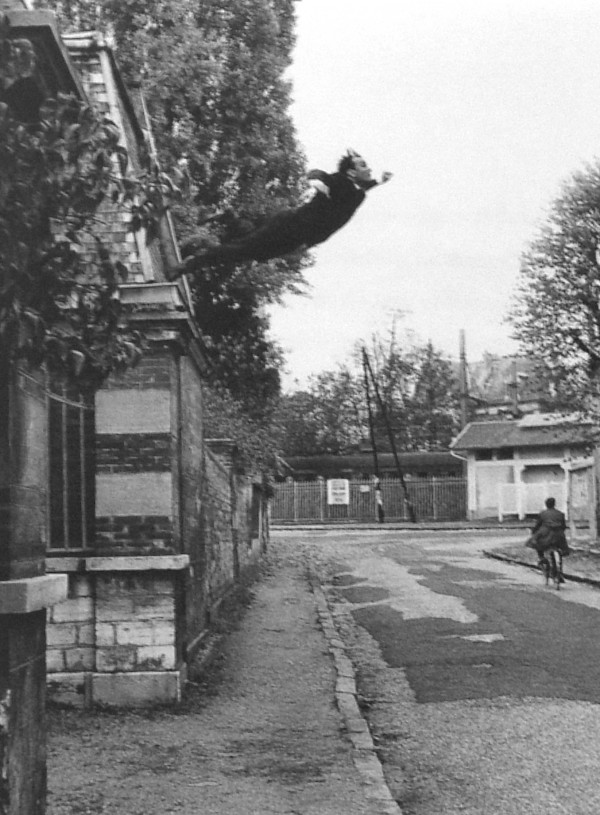
Yves Klein, "Leap into the Void," 1960.

Yves Klein, "Leap into the Void," 1960.

Pierre Restany, the critic who co-coined the term Nouveau Réalisme, was supposed to be there for Yves Klein’s first Leap into the Void. Weeks earlier, Klein had told Restany “he was going to do something very ‘important.’” He was “going to give a practical demonstration of levitation,” and he wanted Restany to be the official witness. It’s just that, on the scheduled day, Restany was late in getting to gallerist Colette Allendy’s house, which was the designated site of the leap. When he arrived, he found Klein limping around “in a kind of mystical ecstasy” as if he’d just accomplished something otherworldly.

No one seems quite sure why Klein went ahead with the leap before his witness arrived. But without someone with Restany’s art world clout to vouch for him, few believed he’d actually leapt upward and outward with only pavement below. People called it impossible. But it wasn’t impossible at all, said Klein’s fellow Judo expert Bernadette Allain years later: “It would be expected of someone at his level of training to know how to recover and fall.” Allain never spoke up during Klein’s lifetime, and, to the artists and gallerists in Klein’s circle, the leap seemed absurd.

“Yves was one who did not feel at home in the world of facts,” wrote critic Thomas McEvilley in 2003. Or maybe he just didn’t understand fact in the way other people did. In the essay Truth Becomes Reality, his own loose musing on what makes something convincing, Klein said, “Great beauty is only a reality when it contains intelligently mixed into it, ‘genuine bad taste,’ ‘irritating and intentional artificiality,’ with just a dash of dishonesty.”

Julian Hoeber, "Demon Hill," Mixed media installation, 2010. Courtesy of the artist and Blum & Poe, Los Angeles. Installation at the Hammer Museum, Los Angeles. Photo: Heather Rasmussen.

Julian Hoeber’s Demon Hill, a large-scale installation on the Hammer Museum’s second floor balcony, has a dash of dishonesty and a bit of artifice. But, as with Klein’s Leap, its not meant to deceive; it’s just meant to offer an experience that seems fleetingly supernatural even though it doesn’t actually defy the laws of nature.

Demon Hill was inspired by a “mystery spot” Hoeber visited on his cross-country move to L.A. (an experience he describes in a video on the Hammer’s site). He entered a tilted shack called the “Cosmos,” and gravity seemed to stop working. After visiting a few more mystery spots, Hoeber determined that the Cosmos and shacks like it are standard boxes that have been tipped at a compound bevel; when inside, your brain gets the wrong cues about what’s horizontal and what’s vertical, making it difficult, if not impossible, to keep your grip on gravity.

Julian Hoeber, "Demon Hill," Mixed media installation, 2010. Courtesy of the artist and Blum & Poe, Los Angeles. Installation at the Hammer Museum, Los Angeles. Photo: Heather Rasmussen.

Hoeber has left the structural skeleton of his own mystery spot exposed in a way that recalls a Michael Asher installation (if Asher dabbled in the psychedelic). The wood is raw and almost golden given the effect of the fluorescent lights inside. It has a minimal, gorgeous austerity, except that it also feels haphazard in a roadside attraction sort of way–it seems like a risky thing for a museum to let its visitors into.

A sign outside the entrance warns of possible nausea and, once I’d climbed in, I wasn’t sure I’d ever be able to get out. I was with a friend, and an older, professorial couple wandered around with us. We kept shooting each other commiserating looks, and encouraging each other to take the next step. The attendant outside called in once or twice to make sure we were okay.  As with Klein’s Leap, having witnesses with you for Demon Hill may be necessary; otherwise, later on, you might not believe your own memory.   Risky or not, the whole experience felt great: trippy, smart, otherworldly, and also totally unpretentious–the antidote of a Turrell skyspace.

What made Leap into the Void so good was that it was dangerous in a way that wasn’t pristine at all, but unpredictable and not-quite rational. It also veered toward carny-style theatrics. Nonetheless, it made you think about transcendence and beauty and what’s real. Hoeber’s sculpture does that too, and those who can should pay it a visit. Demon Hill remains on view through January 23.

Note: the Klein story told above comes, in large part, from McEvilley’s lengthy essay,  Yves Klein: Conquistador of the Void, from Yves Klein: A Retrospective, 1928-1962, published by the Institute for the Arts, Rice University, Houston, in association with The Arts Publisher, Inc., New York.

Share