Fan Mail: Michal Sosinski

DailyServing.com selects two notable artists each month from the submissions we receive to be featured in our series, Fan Mail. For a chance to have your work appear below, with an article written by one of the DailyServing contributors, please submit a link to your website to info@dailyserving.com, subject: Fan Mail. You could be the next artist in the series! (We will try to contact chosen artists prior to publication, but please be sure to check the site everyday!)

It was a poorly regulated attitude that provided the incentive for my voluntary meetings with the school therapist, and I was enjoying it. The woman I met with was lovely and we talked about a variety of things that made me feel lighter and full of clarity.  However, one day we came to a serious philosophical and emotional showdown.  “Why don’t you use these?” she asked, pushing a tray full of paints, blank sheets of watercolor paper and markers towards me on the coffee table.  I freaked and became absolutely paralyzed.  I think I even stuttered: “Oh! Oh oh no no no noooooo.”  It became clear that much like other aspects of the creative process, emotional expression isn’t something you necessarily pull out of a hat like some vociferously poignant white rabbit.

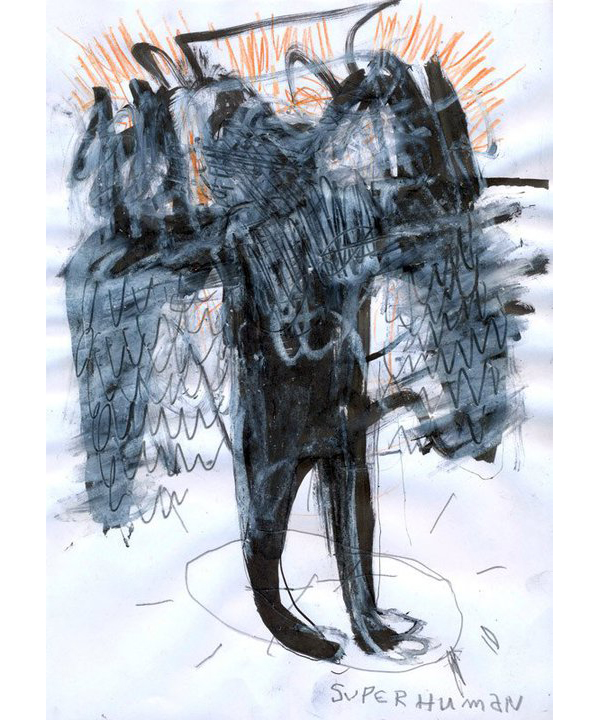
"Evil vs. Evil"

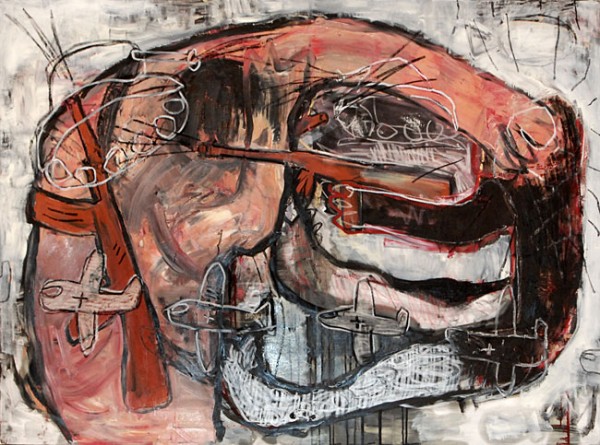
However, Michal Sosinski is one of those people who are able to distill emotion and narrative into 100 proof kick-you-on-your-ass expressive painting. While the chaotic and painful essence of the work is not new, it certainly seems genuine, with motifs ranging from the political to the personal to the philosophical. Reminiscent of the immediacy and angst found in many works from Jean-Michel Basquiat to German Expressionism, Sosinski’s paintings are an amalgamation of internal emotion and external expression, the result of which is often disconcerting.

In many of the paintings, one may have a hard time gleaning the specifics. However, the particulars don’t really matter as the thematic content is cross cultural and highly narrative, albeit seemingly personal. Formally, the works are energized and expressive. You can almost see the hand moving across the painting at extremely high speeds. The aggressive mark making and unsettling palate are strangely pleasing and constantly reinforce the emotive content—which ultimately is what its all about.

Sosinski was born in 1985 in Gdansk, Poland.  He is a painter and graphic designer and is part of Krecha Group from Gdansk. The group publishes an independent magazine Krecha.

Share

Master of Puppets – Philippe Parreno at the Serpentine Gallery

Upon entering Philippe Parreno’s exhibition at the Serpentine Gallery, for thirty minutes, you the viewer, are forced to relinquish control. Every movement you make has been carefully orchestrated by the artist – where you walk, what you see, the time spent in each room, what is visible of the world around…

Philippe Parreno, The Boy From Mars, 2003. Installation view, Serpentine Gallery, London. Courtesy of Serpentine Gallery. Photo: Gautier Deblonde.

Four rooms, four videos. But no real choice. The videos do not run simultaneously, but play out as a carefully timed, highly theatrical, sequence of events. Entering the exhibition you must locate the space that is active, determined by the fateful timing of your arrival, as the others simply lie dormant in waiting. And the metaphorical curtain rises upon the first video…

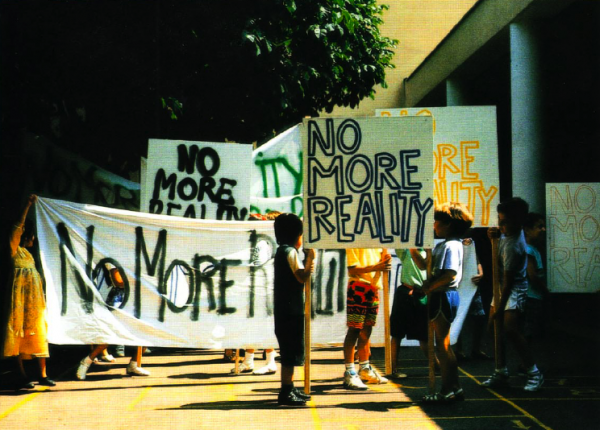
Philippe Parreno, No More Reality, la manifestation, 1991. Film Still. Courtesy of the Artist.

Act I – Cue No More Reality, la manifestation, the earliest work of Parreno’s in the exhibition. A captured moment of  a group of young children staging a demonstration in a schoolyard in Nice. Their fight? A refusal of reality. However, it is doubtful they fully understand the words they chant. The film ends, the lights come on and their voices fade away. In an adjacent room, the lights dim and the blinds close – inviting you in to witness the next show…

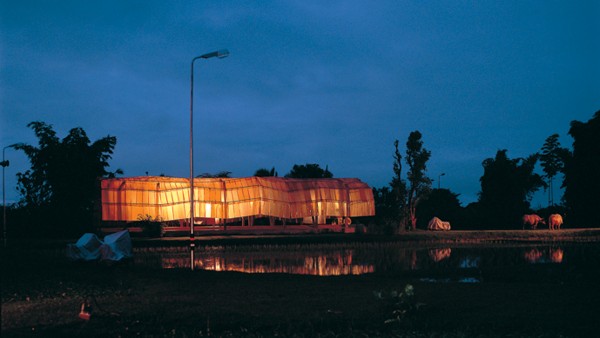
Philippe Parreno, The Boy From Mars, 2003. Film still. Courtesy of the Serpentine Gallery.

Act II – The Boy From Mars – A poetic portrait of an architectural structure that was built for the sole purpose of being filmed. A film and a building inseparably joined at birth. One cannot exist without the other. Each exists in service of the other.

The haunting score sung by Devendra Banhart continues after the film ends and the light come up, as the disembodied voice moves into the next room enticing you to follow….

Philippe Parreno, June 8, 1968, 2009. Film still. Courtesy of Pilar Corrias Ltd and the Artist.

Act III - Witness a portrait shot from the point of view of the dead. June 8, 1968 re-enacts the journey Senator Robert Kennedy’s body took to Washington through the eyes of those on board the train, as they gaze into those along the tracks who stare back.

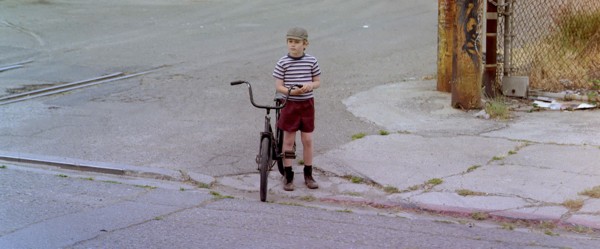
Philippe Parreno, InvisibleBoy, 2010. Film still. Courtesy of Air de Paris, Centre National des Arts Plastiques and the Artist.

Act VI – Parreno’s latest film, InvisibleBoy, powerfully combines fantasy and fiction in a portrait of a young Chinese immigrant boy, whose fears and anxieties are manifested in the creatures scratched upon the surface of the film. A world populated by monsters who hide in dark places and stalk the streets at night.

Philippe Parreno, InvisibleBoy, 2010. Film still. Courtesy of Air de Paris, Centre National des Arts Plastiques and the Artist.

Lacking language, the film reaches its crescendo with a dramatic score – and abruptly ends. With heightened awareness and a buzzing energy in the room, the curtain rises on the massive windows that cover the East end of the gallery to reveal the expansive greenery of London’s Hyde Park – the setting for Parreno’s drama.

A chanting begins to rise once again, leading back to No More Reality, and the cycle continues on.

The theatrical stage has been set and we take our places as the puppets within it – jarred between reality and representation, inside and outside, pulled from one room to the next.

There is no choice as to what order to watch the videos in, or how much of them to see. Parreno brilliantly ensures that you watch each video from beginning to end, in the order he has prescribed – the only choice he has left up to you is when you want to leave…

Share

Best of 2010
Lari Pittman at Regen Projects

Whew. For DailyServing, 2010 was a full year — 365 days of arts coverage from our 25 writers around the world, three new week-long series, our new weekly column, L.A. Expanded, and great new interviews with some of the world’s most high profile artists. For this last week of the year, our writers have selected their favorites for you to revisit.

But, we want to hear from you! Send us your favorite articles to info@dailyserving.com this week, and tell us why you love it. If chosen, your selected post and your comment will also publish as part of our Best of 2010.

Julie Henson selected Catlin Moore‘s article on Lari Pittman’s recent exhibition at Regen Projects.

Lari Pittman is a gardener. Particularly fond of succulents, he maintains precisely manicured rows of cacti that borrow from a methodical landscape sensibility, a rational formation he claims “pushes back” against the chaos of nature. A composite of Columbian and American Southern heritage, Pittman is fluent in the duality of cultivated life. He understands that mortality is the only fixed variable in our otherwise unique existence, that micromanaging our realities affords us a sense of archive in the face of impermanence. His proficiency in composed ephemerality thus manifests itself in one hell of a cactus garden, not to mention two staggering concurrent exhibitions currently on view at Regen Projects in Los Angeles, CA.

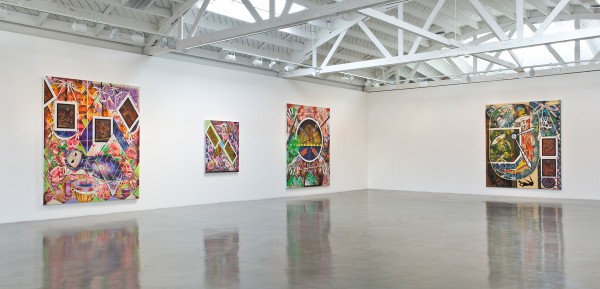
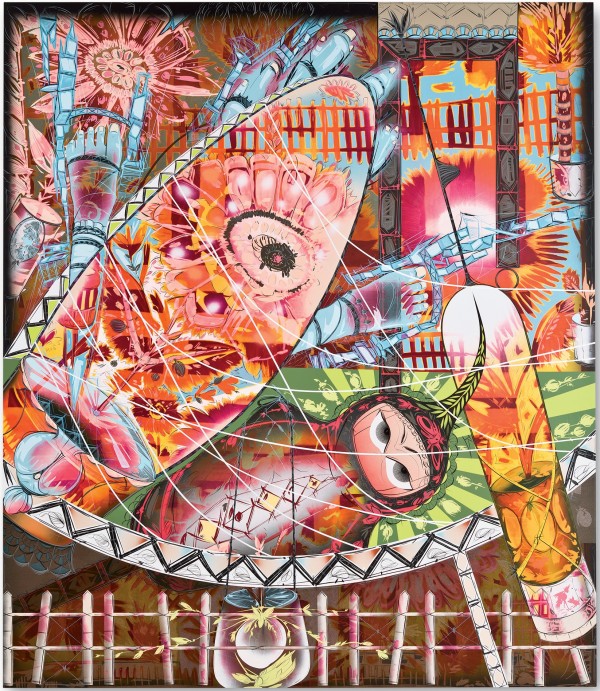
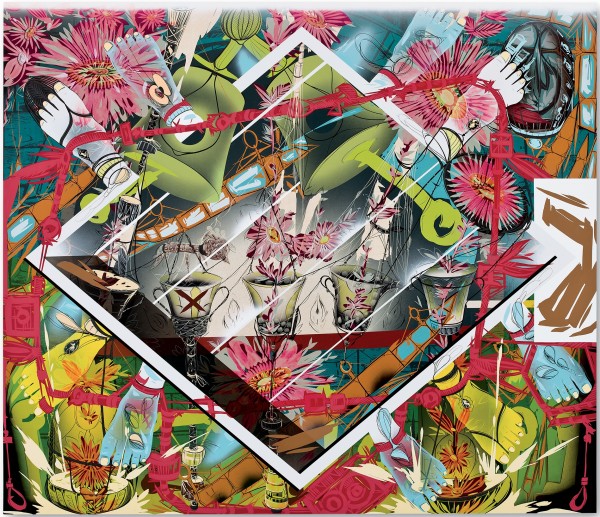
In the ten studio-fresh works that comprise Pittman’s New Paintings at the gallery’s secondary location (Regen Projects II), there is a painstaking compression of the opulent and familiar. A purposefully cluttered fullness that conjures a likeness to Grandma’s armoire, the canvases are rife with nostalgic ornaments and exotic trifles alike. Potted flowers and picket fences indicative of quiet Americana intertwine with flamboyant nesting dolls and henna-stained feet, affording a visual legibility unspecific to any one demographic.

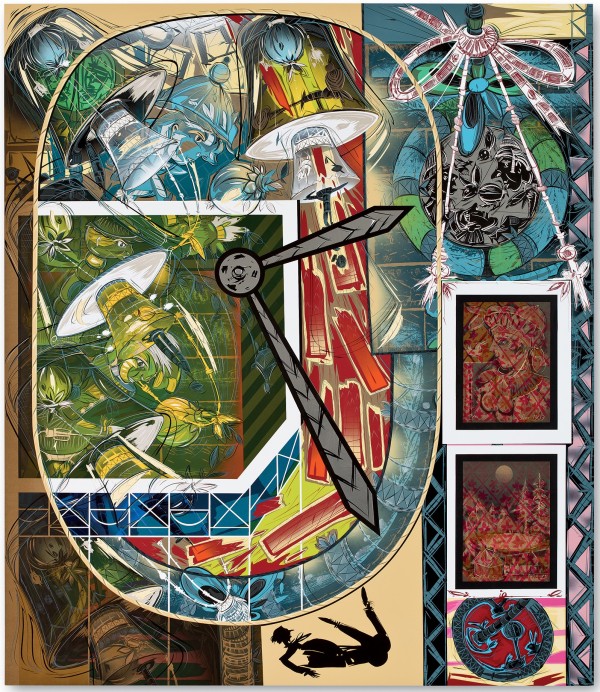
While initially jarring in their vibrant pandemonium, Pittman’s paintings unearth a system of carefully meditated codes – a series of optical cryptograms that ruminate on the magnificence of hybridity and its modern ubiquity. Pittman celebrates plurality, and through his seemingly paradoxical menagerie of figures, abstractions, silhouettes and patterns he achieves an unanticipated harmony between disparate practices and imagery. Meticulous embellishment reminiscent of early 20th-century decorative arts coexists with cartoonishly provocative characters, forging a relationship that is both comical and wistful in its imaginative meandering. Given Pittman’s sensitivity to the trajectory of life – as echoed through the repeated use of clocks and the (literal) hands of time – it seems only natural to acknowledge our habitual reliance on humor and sentimentality in navigating our own humanity.

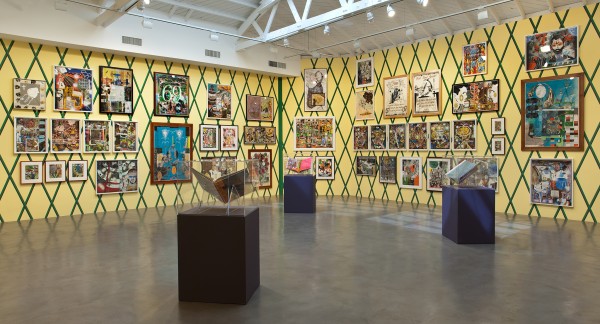
Just a crosswalk away from Pittman’s current paintings, Regen Projects I houses Orangerie, a curated repository of the artist’s renderings dating 1980 – 2010. The gallery features 108 works on paper suspended salon-style on bold yellow and green latticed walls, a cheeky allusion to the exhibition’s namesake. Acting as excerpts from Pittman’s larger topography, these pieces chart the exploration of identity, faith, sexuality and ritual through intricate pop-cultural and autobiographical signifiers.

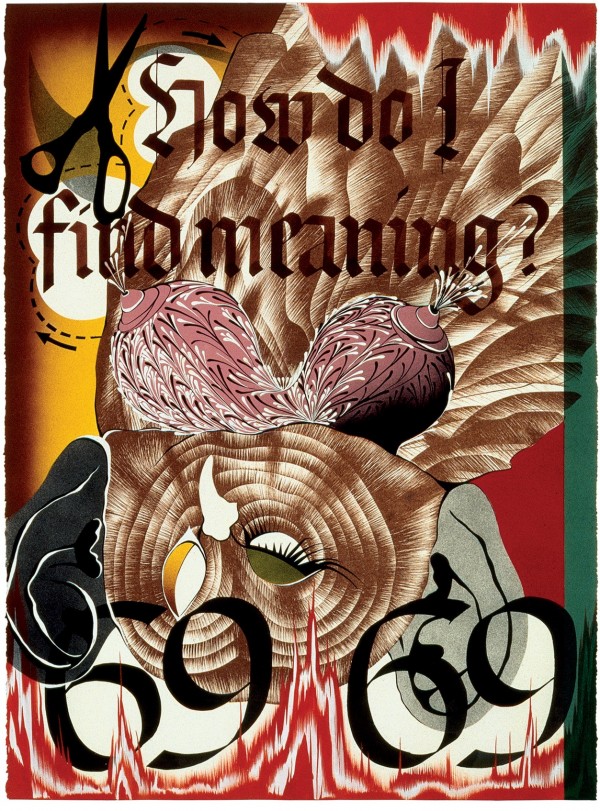
Formative seeds to the artist’s opus, the earlier works probe foundational elements to those in New Paintings. The snappy text of period advertisements is often ensconced in erotically charged sketches proposing weighty inquiries like “How do I find meaning?” or “Why was I born?” in the place of hollow solicitations.

Conversely, some later works operate as narrative flowcharts to a constructed concept of self, as various phrases and labels snake between anthropomorphic contours and diagrams. Acting as a conservatory for Pittman’s most delicate and earnest ventures, this Orangerie is appropriately ripe with the rigorous labor of his oeuvre – its fruit alluringly complex and bittersweet.

Share

Best of 2010
Use and Abuse

Whew. For DailyServing, 2010 was a full year — 365 days of arts coverage from our 25 writers around the world, three new week-long series, our new weekly column, L.A. Expanded, and great new interviews with some of the world’s most high profile artists. For this last week of the year, our writers have selected their favorites for you to revisit.

But, we want to hear from you! Send us your favorite articles to info@dailyserving.com this week, and tell us why you love it. If chosen, your selected post and your comment will also publish as part of our Best of 2010.

Seth Curcio selected Julie Henson‘s article from the week long series, Rise of Rebellion.

Nan Goldin. Joana with Valerie and Reine in the Mirror, L'Hotel des Beaux Arts, Paris, 1999.

Today on DS, we look at the desire and longing for rebellion embedded in the work of Nan Goldin, Larry Clark, Dash Snow and Ryan McGinley. Check out how the acts captured in these artists’ work become an icon for a generation desperate for a more rebellious lifestyle.

Thinking back to the days of being a rebellious teenager make me want to run the other direction. There is nothing worse than revisiting the angst and discomfort of adolescence – my mild rebellious behavior and general dislike of the world around me. Rebellious acts always seem mediocre and immature to me these days, despite living a very 20-something lifestyle. But there have always been those artists that so tactfully ride the line between a perfectly composed yet rebellious life that I inherently envy. I find it fascinating to watch the career of artists who successfully make work that is both personal and universal, unruly and conforming, attractive and disgusting – who document their own outsider world and show our distance to it.

Dash Snow. "TBT", 2008. Photograph - Digital C Print 40 x 60 inches (101.6 x 151.8 cm) + frame Edition of 3 + 2AP. Courtesy of Peres Projects.

This rebel has long been the muse of the artist. And when I consider the muse, Nan Goldin and Larry Clark‘s use and abuse of the rebellious lifestyle become both personal document and cultural reality, while assuming the roll of Art Historical mainstay in the category of the documentary photograph. But Dash Snow, a true example of both insider and outsider, straddled this relationship and found a way to make the chaos of his life appear both seductive and desirable. A hero of punk culture, Snow’s rebellious history and lifestyle was the subject and an embodiment of his work – both personal anthem and documentation. Snow sold his own context, using his life as a guarantee of credibility and reality to the outside world, by choosing to participate in the contemporary art system, yet his product was a life through the photographic document.

Both “genius” and tortured soul, Snow’s lifestyle was muse and product- and ultimately it was his rebellious lifestyle that brought him to an early death. Ryan McGinley equally rides this ambiguous line, to the point that I can’t decide if his work is rebellious or utopian. There is something about the idealized reality in his work that harks back to the personal documentation of Clark and Goldin, but successfully sells his own contemporary youthful lifestyle.

Ryan McGinley, Coley (Injured), 2007

The act of rebellion doesn’t always lead you in the opposing path of the system or lifestyles that it moves against. And, often the very thought or association of rebellion becomes so desirable to the masses because it appears to be simply out of their grasp. All of these artists have successfully depicted their own rebellious lifestyle and have offered this spirit back to a complacent public that longs for the moment to give up the boredom that fills their normal lives and grab onto the freedom that is falsely associated with rebellion.

Share

Best of 2010
Rachel Khedoori

Whew. For DailyServing, 2010 was a full year — 365 days of arts coverage from our 25 writers around the world, three new week-long series, our new weekly column, L.A. Expanded, and great new interviews with some of the world’s most high profile artists. For this last week of the year, our writers have selected their favorites for you to revisit.

But, we want to hear from you! Send us your favorite articles to info@dailyserving.com this week, and tell us why you love it. If chosen, your selected post and your comment will also publish as part of our Best of 2010.

This article by Kelly Nosari was chosen by Nicole Powell.

Untitled (Iraq Book Project) 2008-2010. Installation view, Hauser & Wirth London, 2010. © Rachel Khedoori. Courtesy the artist and Hauser & Wirth. Photo: Peter Mallet.

Artist Rachel Khedoori explores encounters with space and their psychological implications. According to the Venice Biennale’s Making Worlds catalog, Khedoori’s art practice ‘invites viewers to see hidden or forgotten spaces’ – spaces that are ‘generated by the limits of memory’. In Cave Model, presented at that show, Khedoori referenced Plato’s Cave Myth and cited it as a source of inspiration. Yet her art practice deviates from this allegory by not seeking to escape ‘the cave’ and thereby gain philosophical clarity. Instead, Khedoori directs us towards the untenable shadows that more often define the human condition.

Khedoori experiments with ambiguous spaces through a diverse practice that includes installation, sculpture and film. The artist’s current solo exhibition of new and recent work at Hauser & Wirth in London is remarkable for the artist’s foray into documentation. The Iraq Book Project, an ongoing documentary piece, was first shown at The Box in Los Angeles in 2009. It is comprised of online news articles dating to the start of the Iraq War – 18 March 2003. Sourced from around the world, the articles are retrieved using the search terms ‘Iraq’, ‘Iraqi’ or ‘Baghdad’. They are then translated into English, compiled and presented in a series of large books arranged chronologically. The articles are printed in a uniform, seamless manner and each is demarcated by title, date and source. These large books are arranged in the main gallery space at Hauser & Wirth on tables along with stools for gallery visitors to interact with the work. Khedoori’s Iraq Book Project is an on-going effort that is updated continuously. Its conclusion will depend upon the length of the war.

Khedoori is certainly not alone in responding to the Iraq War, but has typically eschewed such content in her work. While The Iraq Book Project is somewhat of a departure, it can also be viewed as a repositioning of Khedoori’s engagement with space. In this work, Khedoori locates information within the digital realm and extracts it. This process allows viewers to explore the changing face of and attitudes towards the war. It also stores information as a part of our collective memory that would otherwise be dispersed and largely be forgotten. Khedoori preserves war coverage and places it within the physical world. She chooses book form, which is a lasting and traditional mode of recording and passing on knowledge.

Untitled (Iraq Book Project) 2008-2010. Installation view, Hauser & Wirth London, 2010. © Rachel Khedoori. Courtesy the Artist and Hauser & Wirth. Photo: Peter Mallet.

A film installation and a photographic series are found upstairs in the American Room of the gallery. Film is an important medium for the artist, who has returned to it throughout her career. The photographic series is set in a natural Australian landscape at 5.00 am, while the film is set 12 hours later at 5.00 pm. For the film installation, Khedoori returns to the device of the mirror to manipulate the moving image. The film is projected onto a screen that meets a mirror at a 90 degree angle – causing the looped footage to appear to continually separate from itself as it plays. The Hauser & Wirth gallery points out that the affect is much like a Rorschach ink blot test. Yet, in this instance it is set in landscape and in motion. This work allows the gallery visitor to encounter ambiguous, psychologically-tinged space.

Rachel Khedoori’s work has shown internationally since the mid-1990s. In 2001, the artist’s high-profile solo exhibition at Kunsthalle Basel, Switzerland brought her work increased international attention. Subsequently, Khedoori has taken part in several noteworthy group exhibitions. In 2008, the artist was included in the traveling exhibition Visual Tactics or how pictures emerge, which opened at Museum für Gegenwartskunst in Seigen, Germany. Khedoori’s work received a lot of attention in 2009 when she took part in the Venice Biennale‘s Fare Mondi/Making Worlds exhibition and Paul McCarthy’s Low Life Slow Life: Part 2 at the CCA Wattis Institute in San Francisco.

Born in Sydney, Australia, Rachel Khedoori is the identical twin sister of fellow artist Toba Khedoori. She currently lives and works in Los Angeles CA and is represented by Hauser & Wirth and David Zwirner in New York. Khedoori received her BFA from the San Francisco Art Institute in 1988 and her MFA from the University of California in Los Angeles in 1994.

Untitled, 2010 (Film, 3:33 minutes). Installation view, Hauser & Wirth London, 2010.© Rachel Khedoori. Courtesy the artist and Hauser & Wirth. Photo: Peter Mallet.

Rachel Khedoori concludes at Hauser & Wirth in London on 31 July. It marks the artist’s first solo exhibition in the UK’s capital city.

Share

Best of 2010
@ MOMA

Whew. For DailyServing, 2010 was a full year — 365 days of arts coverage from our 25 writers around the world, three new week-long series, our new weekly column, L.A. Expanded, and great new interviews with some of the world’s most high profile artists. For this last week of the year, our writers have selected their favorites for you to revisit.

But, we want to hear from you! Send us your favorite articles to info@dailyserving.com this week, and tell us why you love it. If chosen, your selected post and your comment will also publish as part of our Best of 2010.

This article by Allison Gibson was chosen by Rebekah Drysdale.

Ray Tomlinson. @. 1971. Here displayed in ITC American Typewriter Medium, the closest approximation to the character used by a Model 33 Teletype in the early 1970s. Courtesy MoMA.

Days ago, the Museum of Modern Art‘s Department of Architecture and Design announced their acquisition of a new work into the collection. The piece is one that we of the age of email and Twitter know well—the @ symbol. Since the announcement, the Internet has been abuzz with the news, mostly because its implications reach far beyond the art and design world. It’s so familiar to us all. It’s either momentous or silly, depending on your personal view, but it can’t be denied that the acquisition marks a poignant point in the history of art, in that “It relies on the assumption that physical possession of an object as a requirement for an acquisition is no longer necessary,” as was stated by MoMA Department of Architecture and Design Senior Curator, Paola Antonelli, in her essay on the matter of the acquisition published on March 22, 2010 by MoMA.

In her essay, Antonelli explains the history of the @, and how it came to be valued as a piece important enough for the permanent collection at MoMA. Though the symbol “dates back to the sixth or seventh century,” it’s Ray Tomilson—creator of the first email system in 1971—who elevated it “to [be a] defining symbol of the computer age,” according to Antonelli. She goes on to defend the symbol as a design, saying, “Tomlinson performed a powerful act of design that not only forever changed the @ sign’s significance and function, but which also has become an important part of our identity in relationship and communication with others,” and that “His (unintended) role as a designer must be acknowledged and celebrated by the one collection—MoMA’s—that has always celebrated elegance, economy, intellectual transparency, and a sense of the possible future directions that are embedded in the arts of our time, the essence of modern.”

What do you think about the acquisition? You can always comment below, email us at info@dailyserving.com, or let us know on Twitter: @DAILYSERVING. (Get it? Basically you can’t escape the symbol, which is now a precious work of art. Something to consider when crafting your responses.)

Share

Best of 2010
Women of California Coolness and Sunday Boys

Whew. For DailyServing, 2010 was a full year — 365 days of arts coverage from our 25 writers around the world, three new week-long series, our new weekly column, L.A. Expanded, and great new interviews with some of the world’s most high profile artists. For this last week of the year, our writers have selected their favorites for you to revisit.

But, we want to hear from you! Send us your favorite articles to info@dailyserving.com this week, and tell us why you love it. If chosen, your selected post and your comment will also publish as part of our Best of 2010.

John Pyper couldn’t decide on a favorite pick. “As for the fav writing of the year, it’s between two from the weekly column L.A. Expanded: Notes from the West Coast, by Catherine Wagley: Women of California Coolness and Sunday Boys. The pair talk to each other.”

Frank J. Thomas, photograph of Irving Blum, John Coplans, and Shirley Nielson Hopps. Courtesy Pasadena Museum of California Art.

Back when L.A. art was in its adolescence, critic Peter Plagens asked painter John Altoon why being an artist couldn’t just be about making work:

I used to say, “John, what about the artist who just goes into his studio, paints paintings and tries to make them the best that he can? What about an artist that just does that?” He said, “[Ed] Kienholz goes out at night in his pick up truck and tries to find them and run them down.” Meaning, if you’re a real guy it’s all about that power structure.

Real artists, of course, were not just guys, but guys with balls who knew how to strut.

Vivian Rowan, who entered L.A.’s machismo-filled scene as gallerist Irving Blum’s assistant and left as artist Craig Kauffman’s ex-wife, has a theory about the group’s maximal mannishness: “They didn’t have much control—over their careers, their lives. But they could control what was immediately around them, and boy did they.” And what did the women do? “They serviced the men, it was as simple as that,” says Shirley Nielson Blum in The Cool School, a documentary about L.A.’s earliest art studs. She continues, eyes watering vaguely, “They put up with it, and they cheered, and they cried. They cooked.”

Nielson Blum, an art historian with a delicately smart face, wrinkles in just the right places and hair that’s a golden sort of white, is a careful talker. Her voice, and the polished observations it offers, provide much of the narrative cohesion for the 2003 documentary. She never talks about herself, but nearly every time she appears, a slightly different name is at the bottom of the screen. She is Shirley Nielson, the art history student who becomes Shirley Nielson Hopps, the wife of acclaimed and eccentric curator/gallerist Walter Hopps. Sometimes, she is referred to as just Shirley Hopps, no maiden name. When she leaves Hopps for his ex-partner Blum, her name actually changes on-screen from Shirley Hopps to Shirley Blum. At the end of the film, she’s Shirley Nielson Blum, with a clarifying subtitle: “Ex-wife of Walter Hopps and Irving Blum.” She has lived through the man-centric period of L.A. art and effectively divorced herself from it. This makes her a vested but resigned expert, regal like a former diplomat.
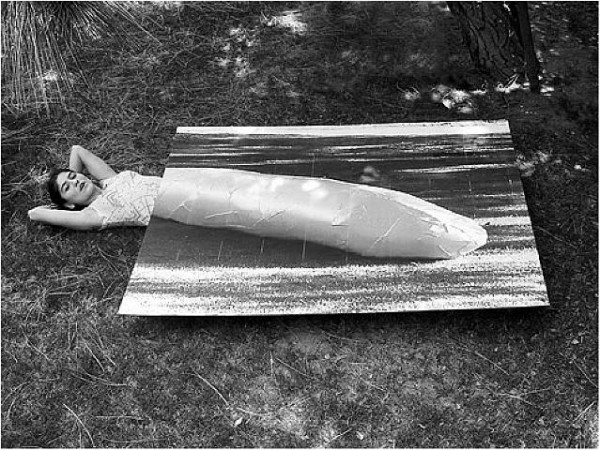
Carlee Fernandez, "Self-Portrait As Franz West's Sculpture," C-Print, 2006. Courtesy the artist.

Much of the work I have most wanted to think about lately has been made by L.A. women and has a deeply aware coolness that reminds me of Nielson Blum. It also has a surface-conscious breeziness that seems to both channel and re-imagine the mood of the early Cool School.

Stanya Kahn’s It’s Cool, I’m Good, which I have praised in this column before, displays a breeziness that’s broken down and almost numb. Currently on view at the California Biennial, the video shows a bandaged, slightly androgynous body moving through the California landscape, sitting by the beach, driving through open space or down main city streets, eating at hot dog stands, loitering in Beverly Hills. All those elements that made L.A. an ideal home for Light and Space appear, and while It’s Cool, I’m Good is narrative video, it has the attitude of a Ken Price ceramic–sun-soaked, goofy, globular, yet precise–coupled with a darker subjectivity that makes California cool seem like a coping mechanism rather than a birthright.

Carlee Fernandez also has work in the Biennial, an installation/performance called Life After Death in which her own body lies roguishly, playing dead beside a taxidermy leopard, a gun, a Davy-Crockett-worthy jacket, and other paraphernalia reminiscent of a colonial explorer. In the past, Fernandez has photographed herself in the guise of men she admires–Franz West, Charles Bukowski, Werner Herzog, her father–and the casualness with which she inhabits these male idols exposes masculinity as performance while indulging in frank and genuine tribute.

Stanya Kahn, "It's Cool, I'm Good," Video Still, 2010. Courtesy Susanne Vielmetter Los Angeles Projects.

This last September, Fernandez’s ACME exhibition, World According to Xavier, treated motherhood with refreshing distance. It included hybridized and exotic taxidermy animals, along with a few videos in which Fernandez and infant Xavier roll around in linked but divided Franz-West-style cocoons. She gave her son what struck me as a generous gift, treating him with the same critical admiration she’d awarded male icons, and presenting her world and his as attached, co-dependent but always separate.

Then there’s Rachel Lachowicz’s muscular and clean-edged exhibition at Shoshana Wayne, the material of which is as synthetically sleek as anything used by her Cool School predecessors; Amanda Ross Ho at Cherry and Martin, whose characteristic slanginess has been tightened, making her work seem “cool” in a composed and but still stereotypically sprawling L.A. way; and Alexandra Grant, now in the Artist’s Museum at MOCA and the California Biennial, whose recent paintings have been sunnier, more dumb-fisted and, again, Ken-Price-like in their globular gracefulness.
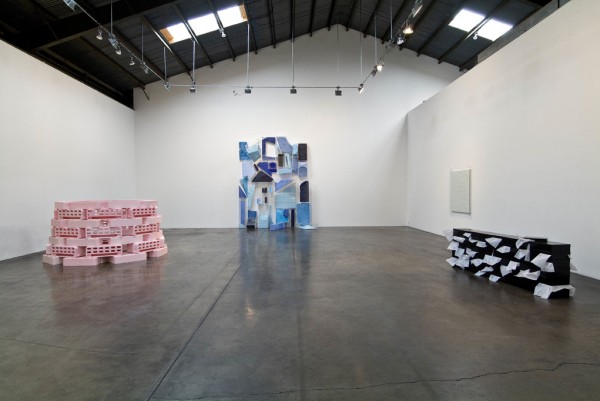
     Rachel Lachowicz, Installation View, 2010. Courtesy Shoshana Wayne Gallery.

Rachel Lachowicz, Installation View, 2010. Courtesy Shoshana Wayne Gallery.

At the end of The Cool School, Shirley Nielson Blum has the last word:

The great sadness as I look back on it now, is that in that little space, in that space of time, . . . there were major beautiful works to be seen by anybody. You could walk in, you could get close to them, you could stay as long as you wanted. . . . Most people walked by, and that was sad.

I like to think that the California women, the ones making the smartest work right now, walked in and got close (not literally but essentially, since most were born either during or well after The Cool School’s prime), and figured out how to take the beauty they saw and recapitulate it, so that it became less exclusive and less brutish, but kept its cool.

______________________________________________________________________________

L.A. Expanded: Notes from the West Coast
A weekly column by Catherine Wagley

Andy Warhol, Dennis Hopper, Screen Tests Reel #4, 1964-65.

I spent Sunday looking at boys. It began at LACMA, where I saw Catherine Opie’s quarterbacks, linebackers and surfers followed by Thomas Eakins’s rowers, wrestlers and athletic but stationary nudes. It continued at the Egyptian Theater, with ten of Andy Warhol’s four-minute screen tests: Buffy Phelps with delicate, defiant eyes and blondish curls; John Giorno of Sleep, darker and rougher than Buffy; Kip “Bima” Stagg, equally dark but not as rough; Dennis Hopper, twenty-eight but looking younger; Hopper again, still near twenty-eight, but suit-clad and looking older; Gregory Battock with Clark Gable jauntiness; Richard Schmidt and Paul Winterbottom; Kenneth King and Richard Markowitz, who, along with Giorno and Hopper, would appear in the compilation The Thirteen Most Beautiful Boys.

Because Warhol’s tests are meditative and slow, I lost myself in their static silence, and didn’t think about gender until the reel played out. “They were all men, weren’t they?” I said to the friend sitting next to me. He’d noticed before I had.
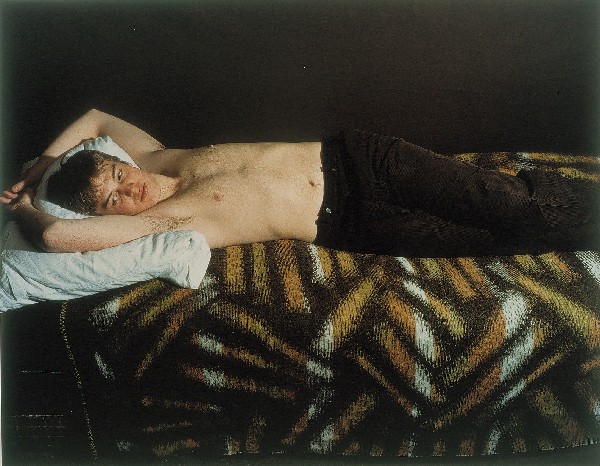
Collier Schorr, "Jens F.," 2005.

Three weeks ago, when Catherine Opie’s unprovocatively titled Figure and Landscape opened, Opie talked about her work in LACMA’s Bing Theater. She mentioned comparisons often made between her sports photographs and the work of Collier Schorr, which depicts, among other things, young male bodies posing and sparring. “Collier wants to be her boys,” said Opie. “I don’t . . . I’m not interested in seeing my butch body through them.” What she’s interested in is bearing witness, and she’s been witnessing a precariously in-between generation, some of which has gone to Iraq, some of which has died.

Being versus bearing is not so simple a distinction, of course–Opie’s boys, as poet-critic Eileen Myles has pointed out, tend to adopt the Opie expression, which resembles a “scary duh.” Even so, it’s possible Schorr wants to be her boys while Opie wants to be aware of her boys; certainly, Eakins wanted to be with his boys while Warhol wanted to collect them.
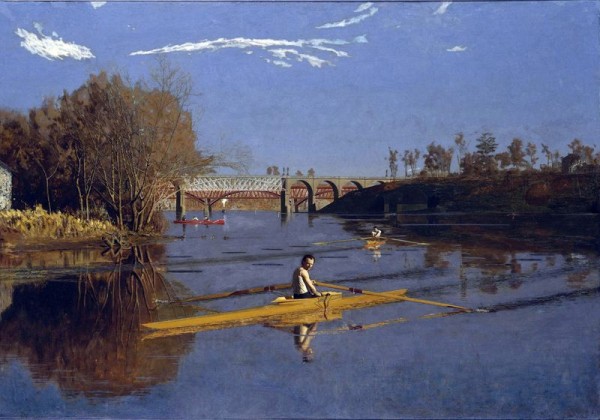
 Thomas Eakins,"The Champion Single Sculls," 1871. Courtesy LACMA.

Thomas Eakins,"The Champion Single Sculls," 1871. Courtesy LACMA.

It’s Warhol and Schorr who most prominently prefer male subjects. Warhol’s Screen Test Reel #5 includes only two women and, like Reel #4, Reel #6 is an exclusive boy’s club. Schorr, when asked why she doesn’t photograph girls, has said she does; she just uses boys to do it. But the strange, sports-focused mannishness of the paired Opie-Eakins exhibitions is even stranger in light of both artists’ genuine interest in women. Opie’s girl-only Girlfriends series showed at Gladstone Gallery in New York last year, and Eakins consistently included women in his work, and even in his controversies. It was his uninhibited disrobing in front of female students and his insistence on the removal of a male model’s “loin cloth” during a drawing session women attended, not his obsession with his “beloved” (as one wall label reads) young men, that forced him to resign from the Pennsylvania Academy of the Fine Arts in 1886.
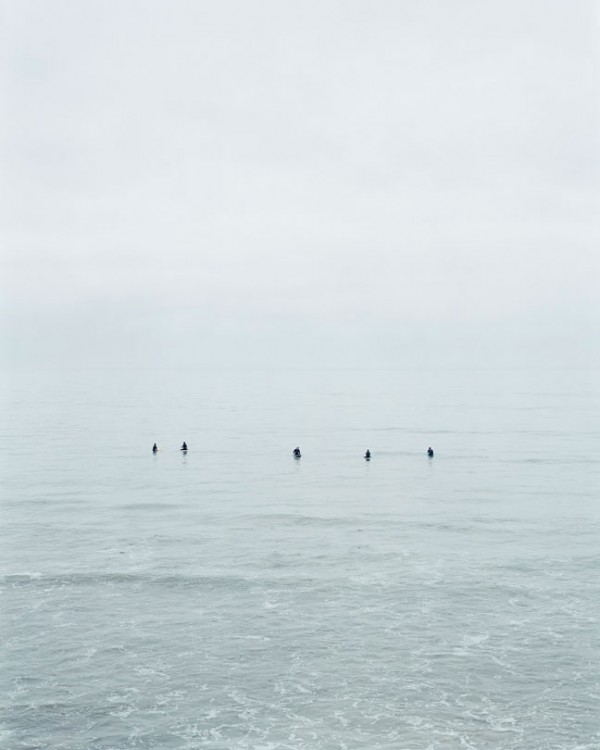
Catherine Opie, "Untitled #10 (Surfers)," 2003. Courtesy Regen Projects.

In Manly Pursuits and Figure and Landscape, Eakins and Opie, both realists, show themselves to be exquisite technicians with a virtuosic, if predictable, eye for poetic composition. In Eakins’s The Champion Single Sculls, a burnt sienna scull cuts smoothly across royal blue water and its inhabitant looks elegantly, if illogically, casual as he turns to look back. In Opie’s portraits, skin, eyes, pose, gaze, the position of the football helmet, have all been carefully considered; royal blue makes frequent appearances in her work as well. But both artists render the trappings of a conventional masculinity and gender-play to which neither quite belong–to which no one quite belongs–and it’s the work that revels in inaction that seems most gaping and honest.

A room at the back of Figure and Landscape features only surfing images, and, though Opie has made striking portraits of surfers she’s shadowed, none of those portraits are included here. Instead, there’s just expansive gray rectangles in which far-off bodies float, largely unmoving, waiting for a chance to resume their sport. They’re certainly skilled surfers; everyone Opie photographs seems to be good at what they do. They’re also like little pawns or bobbing black buoys. They don’t look volitional but they do look comfortable; like the artist who made them, they’re virtuosic and yet awkward precisely because they’re virtuosic.


Share