True Grit: Michaela Eichwald at Reena Spaulings

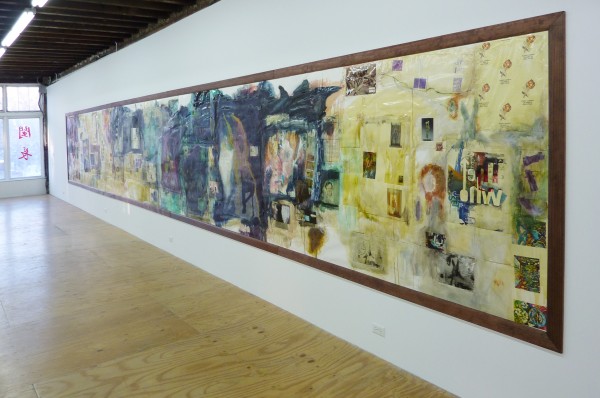
Michaela Eichwald, Pofalla, (willst Du mir jetzt komplett den Garaus machen?) 2010.

It’s not that Michaela Eichwald doesn’t give a crap about her paintings; she just beats the shit out of them. It’s part of a lengthy weathering process that imbues them with the perfect balance of attraction and repulsion.  Before they get to the gallery, they’ve been stepped on, left out in the rain, randomly stained, and often chemically altered. Eichwald decimates boring oil painting clichés (think “fat over lean”) by glopping oil, acrylic and varnish seemingly at random. Yet, despite their abject quality, her work feels uniquely intimate. She stakes a claim somewhere between the automated work of, say, Wade Guyton and the ubiquitous “special moments” abstraction crowd that seems destined to follow the Nozkowski/Tuttle/De Keyser rules in perpetuity.

Thankfully, there’s more than enough personality on view here to keep Eichwald away from the ugly-on-purpose thing. Pofalla, (willst Du mir jetzt komplett den Garaus machen?) is downright epic.  Spanning the entire length of the gallery, it includes photos, posters, packaging, tribal imagery, personal notes, geometric forms, splats of paint and tons of lacquer. The overall effect is like a Rauchenbergian run-on sentence—Eichwald seems to be spilling and organizing her guts right on the paper. And like Rauschenberg, she understands when to let the material do the talking. The yellowed lacquer also performs a rather tawdry version of Sigmar Polke’s experiments with alchemy.

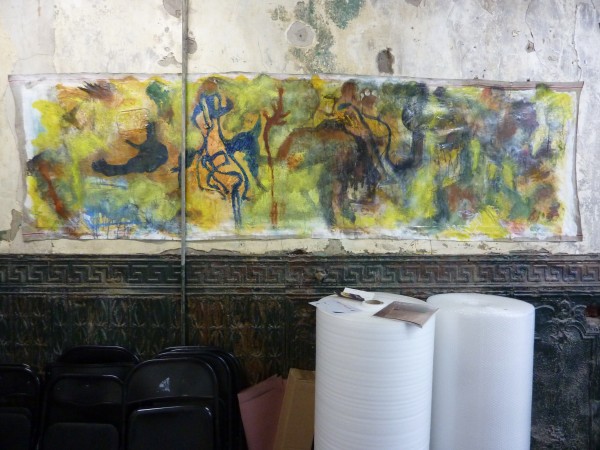
Michaela Eichwald, Auer Dult, leidinde Mangel, 2010.

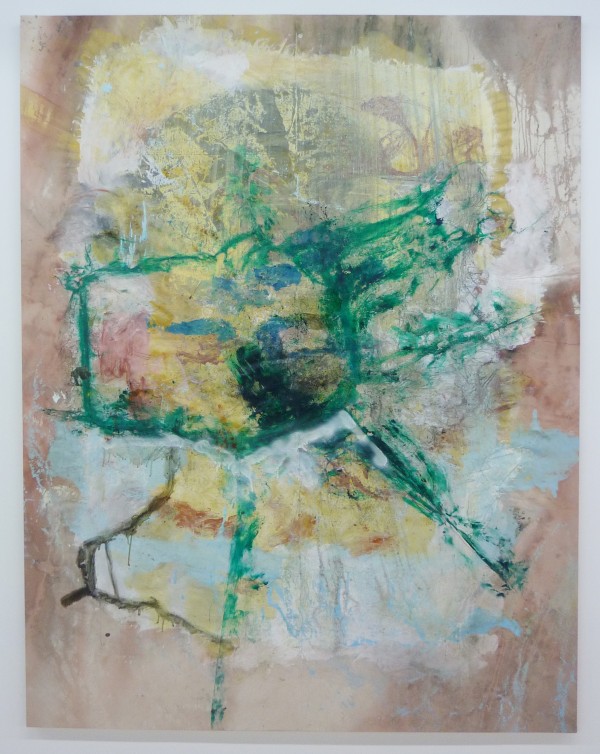
Unlocking and then encasing both personal and universal mysteries, Eichwald’s work has an authenticity that feels organically unforced.  She combines cave painting motifs with silhouettes in Auer Dult, leidende Mangel, referring to the centuries-old market and folk festival in Munich. Installed behind a pipe in the well-worn “bar” area of the gallery, the unstretched painting has both a nomadic and site-specific feel. The Three Cravings, the most straight ahead painting in the show, could almost pass for a roughed-up riff on U.S. abstraction, like an Amy Sillman painting stripped down to its essence.

Michaela Eichwald, The Three Cravings, 2010.

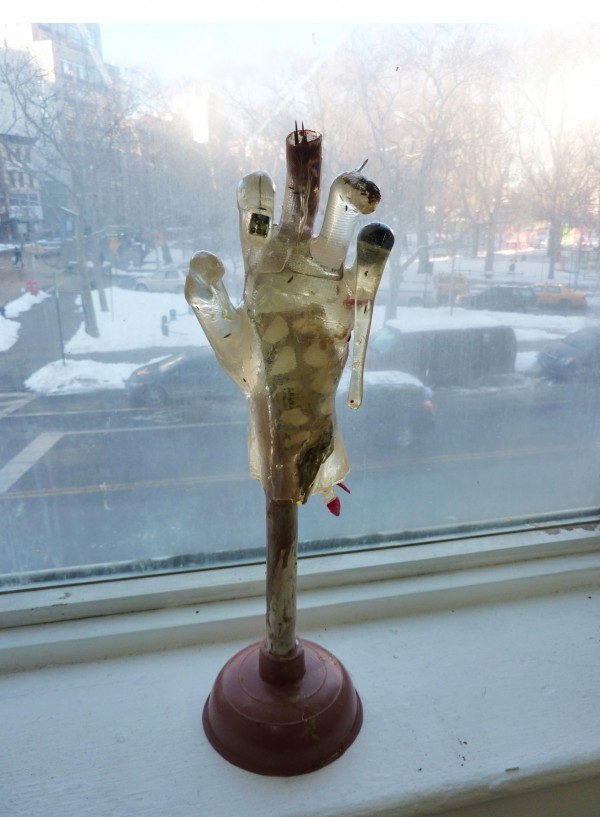
Eichwald’s powers seem extra concentrated in Peinliche Verhörung mit Tortor (Hand), a horrifying cast resin sculpture of a hand resting on a small plunger. I’ve never been so drawn to something as utterly untouchable as this. The hand oozes and drips and tiny nails stick out of its mangled fingers. A spent gum packet is encased inside, and random bits of trash and dirt float about. Installed on a windowsill, this terrifying talisman becomes oddly beautiful as the sooty light from the Lower East Side shines through it.

Michaela Eichwald, Peinliche Verhörung mit Tortor (Hand), 2010.

Overall, there’s an almost teenage sense of vitality in Eichwald’s work, a tendency that is unfortunately forced out of artists while they are in grad school. Because of this, the show might not live up to the bullshit standards of a typical Chelsea affair (after a while you start to pick apart her repetitive palette, and the dependence on lacquer can be a bit much), but I like to see an artist who believes so strongly in the power of physical presence. As grimy as her work might look, Eichwald seems to be coming from a place that is surprisingly pure.

Share

Physical Center

Guest Projects, Andrews Road, London. Image courtesy of Shonibare Studio and Guest Projects.

Yinka Shonibare’s Guest Projects on Andrews Road in London is an inconspicuous space persistently aswarm with creative energy and excitement. Conceived as a ‘laboratory of ideas; a testing ground for new thoughts and actions,’ Shonibare studio invites the submission of exhibition proposals – three of which are chosen yearly to be exhibited in the space.

This year, launching the new season of exhibitions at Guest Projects is Physical Center – a two-month long programme of performances, screenings, exhibitions and lectures, organised by a collective of artists and curators from Britain and America.

The common conceptual thread tying the programme together? An emphasis on the physical nature of the body, or more specifically, new and emerging concepts in physicality.

But before we can discover the new, we must begin at a beginning…

Entering Guest Projects on the opening night of Physical Center was very much a flashback to decades past – instantaneous transportation to an era known to many only through photographs. A buzzing ‘Happening’ that would make Allan Kaprow beam.

Juliana Cequeira Leite, Re-Discovering the Origins of Sculpture, 2011. Performance in Progress. Image courtesy of the Artist and Guest Projects.

No audience, no performers – in this space everyone is implicated as a part of the work. Chaos, chance, random collective activity – overriding aspirations that can’t help but be read as utopian.

Orchestrated by the artist Juliana Cequeira Leite, Re-Discovering the Origins of Sculpture supplied the material and the space – and as people entered in they were invited to create and construct with complete freedom. Starting slowly and escalating to feverish speed, participants fabricated a motley of creations – and in this swarm of frantic activity a modern day Merzbau was erected.

Juliana Cequeira Leite, Re-Discovering the Origins of Sculpture, 2011. Image courtesy of the Artist and Guest Projects.

All without words. Not necessarily by choice, but by necessity.

Juliana Cequeira Leite, Re-Discovering the Origins of Sculpture, 2011. Image courtesy of the Artist and Guest Projects.

The continuous, rhythmic activity was presided over by the experimental music of Teeth of the Sea, completely overwhelming and infiltrating the space as well as the individual psyche. Tones resonated and sounds echoed in a deafening way, spilling out into the street and across the canal.

The sheer decibel level of auditory activity made verbal communication impossible. Everyone was forced to work together without a reliance on words – returning instead to pre-linguistic communication techniques. Physical gestures, bodily contact and facial expressions used to convey needs and desires. Physicality used to convey psychology.

From these primordial origins, Physical Center will spin out over the next two months to explore diverse notions of physicality. Ed Fornieles will explore the embodiment of foreign identities through the re-enactment of an all-encompassing American college party, Francesca Steele will push the physical and psychological boundaries of the body through her bodybuilding routine and Professor Kevin Warwick will explore the trans-human reality in his cybernetic lecture on the union of the body and technology.

There is much more to come – this has only just begun.

Juliana Cequeira Leite, Re-Discovering the Origins of Sculpture, 2011. Image courtesy of the Artist and Guest Projects.

Physical Centre will undoubtedly raise a diversity of issues in it’s exploration of embodiment – and we will just have to wait and see what new concepts of physicality will possibly emerge from this ambitious programme.

Share

From the DS Archives: Sanford Biggers Moon Medicine

On this Sunday from the DS Archives, reacquaint yourself the work of Sanford Biggers. This article was originally written by Allison Gibson on March 11, 2010.

Sanford Biggers, Seen, 2009, Video still, Digital C-print, 30 x 40 in. Courtesy the Artist and Michael Klein Arts, New York

Currently on view at Santa Barbara Contemporary Arts Forum is a solo presentation of new work by internationally renowned, New York-based artist, Sanford Biggers. The work on view in the exhibition, entitled Moon Medicine, encompasses the breadth of Biggers’ practice. As he tells the SBCAF, “It is a thematic, multi-disciplinary exploration of past themes and new themes meant to broaden and complicate our read on American history.” In a recent video-recorded conversation between Biggers and CAF executive director, Miki Garcia, Biggers discusses his avoidance of artistic labels, such as “post black.” These labels are not rejected by the artist for the sake of radicalism but, rather, because he says that no matter how you mean it to sound, a label is always “predicated on there being an other.” Biggers further explains that he rejects labels even in his discussion of artistic medium, saying he’s “not interested in being a sculptor [or] a performance artist…I just make things.” Of his process, he says, “The more confused I am while making a piece now, the more successful it is to me regardless of what it ends up looking like.”

The recurring imagery of mandalas in Biggers’ work reflects a strong interest in Buddhism, the exploration of which is found in his past and current work. Biggers gained interest in the Buddhist tradition while living in Japan and traveling all over Asia years ago. Of the work he made upon returning to the US from Asia, Biggers says it became autobiographical in part—in the sense that he “fused some of what [he] had been studying and researching in terms of Buddhism, but also bringing in some things from my childhood, growing up in Los Angeles, and being a B-boy.”

Sanford Biggers, Constellation, 2009, Steel, Plexiglas, LED’s, Zoopoxy, cotton quilt, original printed cotton tile. Dimensions variable, Installation at Harvard University. Courtesy the Artist and Michael Klein Arts, New York, NY.

Biggers is a master of alluding labels, as we’ve learned, and the “elliptical” nature of his work (as Garcia refers to it), creates an open-ended dialog that spans a range of subjects from religious practices, to themes of racial tensions in the American South, to pop culture iconography. Moon Medicine will be on view through May 2, 2010.

Sanford Biggers lives and works in new York. He earned his BA at Morehouse College, Atlanta, GA and his MFA at The School of the Art Institute of Chicago, IL. He has exhibited extensively both nationally and internationally, including at Mary Goldman Gallery, Los Angeles; Tate Modern, London; Okinawa Museum, Okinawa, Japan; The Studio Museum in Harlem, New York; and the 2002 Whitney Biennial, Whitney Museum of American Art, New York.

Share

Testimony of Simplicity: Jason Kalogiros at UnoSolo

A pinhole camera is a primitive, often homemade photographic apparatus composed of a darkened chamber, in which light sensitive film or photographic paper is inserted and then exposed via a tiny “pinhole” puncture in the wall of the compartment. It is “Photography 101″ at its most basic. San Francisco based artist, Jason Kalogiros constructed his from an Old Fashioned Quaker Oats container, featuring the familiar face of the pleased “Quaker” man on its exterior. He created two apertures in the can, positioned directly in the eyes of the Quaker Oats figure, cleverly drawing a connection between the medium of photography and our own visual perception.

Jason Kalogiros. Double Sunset no. 3, 2007; analog c-print; 16 x 20 in. Courtesy of the UnoSolo.

Testimony of Simplicity, on view at Unosolo Project Room in Milan chronicles Kalogiros’s use of his twin pinhole camera to reconsider iconic pictorial subjects. On exhibit are a suite of photographs of sunsets shot with the device, as well as a number of images of figures in landscapes, and something of a self-portrait, a photo of the Quaker Oats camera most likely captured as a reflection in the mirror.

Jason Kalogiros. Installation shot of all 12 double sunsets. Courtesy of UnoSolo.

Confronted with Kalogiros’s Double Sunset series, arguably the most prominent pieces in the show, I am struck by a pair of glowing eyes piercing through the serene canvas of a darkened sky as two suns descend over a horizon. The sunset, honored subject of many a snapshot elicits a contemplation of the photographic process itself, as we imagine these orbs of light seeping in through the exterior of the Quaker Oats apparatus, via its “eyeballs,” into a darkened interior to create their lucid impression.

Reciprocally, the resonance between the photographic process and human vision is disrupted by the doubling of the picture. The image contains its own copy. It is so obviously recognizable as a sunset and not a sunset in the same moment. Here, seeing isn’t believing. Accuracy of representation has been an issue at stake in photography since its inception. By cloning the image upon itself, Kalogiros reveals an ambivalence toward the medium’s evidentiary claim. Replication becomes a tool for both affirming and denying the veracity of the photographic subject.

Jason Kalogiros. In the Same Place no.7 (Bernal Hill), 2010; analog c-print., 4 x 5 in. Courtesy of UnoSolo.

These contentions of representation and repetition, this vacillation between authenticity and imitation embodied in much of contemporary photography, reaches its crescendo with another piece featured in the show. This photograph, which at 4 x 5 inches is much smaller than the sunsets and characteristically blurry, appears to describe two people, one on either side of a divided frame, each holding a poster-size likeness of his/her counterpart. A copy of a copy. An inverted double. Presumably, the process for making this particular photo, as well as the other portrait pieces in the show, was a bit different from that for the sunsets, as it is impossible for the two halves of this image to have been exposed simultaneously. Questions of timing arise. Which model was exposed first? Which is the underived representation and which its simulacrum? The two converge at once. Here, Kalogiros has created a unique moment of trickery in which the original document is bound up with its facsimile in its own tiny hall of mirrors.

Testimony of Simplicity is on view at Unosolo Project Room in Milan, Italy, through January 29, 2011.

Share

The Self-Discipline Artist

L.A. Expanded: Notes from the West Coast
A weekly column by Catherine Wagley

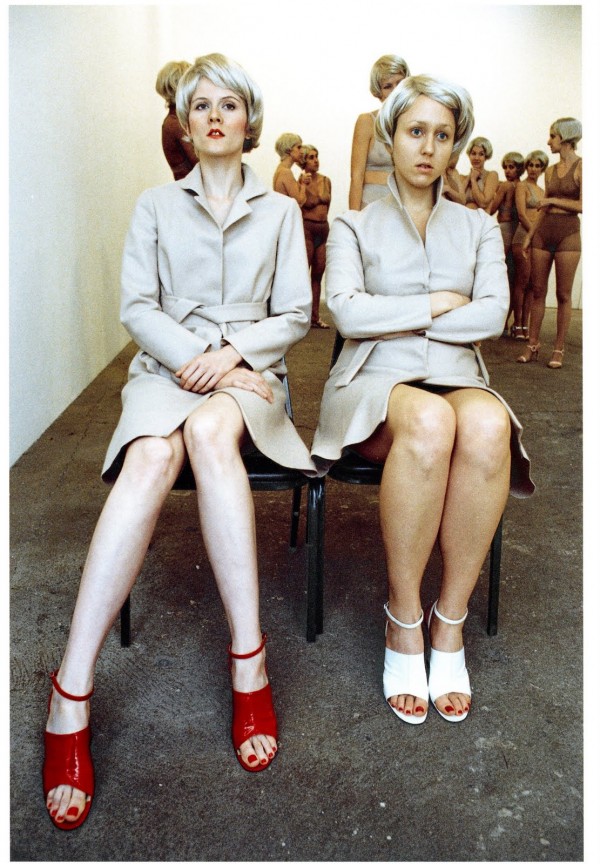
Vanessa Beecroft, VB16, 1996.

Maybe it’s an American thing, a hanger-on Puritan fetish, but I can think of few qualities more seductive than discipline. It seems like the quickest path to perfection, and as much as I purport to accept—even celebrate—“idiosyncrasy,” “peculiarity,” “limitation,” they’re all consolation prizes, the realities you force yourself to love once you realize that features as smoothly angular Grace Jones’ are improbable and that no one can maintain as dogged a schedule as Olivia Dunham does in Fox’s Fringe. Perfection, it turns out, exists to push its opposite into stark relief.

Because of its discipline, Vanessa Beecroft’s work appeals to me in spite of myself. The artist, notorious for indulging in prefab beauty and unwarily participating in a legacy of objectification, uses hired, carefully selected bodies as her subjects. She dresses them in lingerie and heels, often shaves them thoroughly and has them pose in front of audiences for ungodly periods of time. Often, they get so tired they can no longer stand. In the best scenarios, Beecroft’s manicured models bring to fore the ugliness of wanting too much of yourself and watching yourself fail to achieve it. In the worst, they suck the individuality out of bodies, turning them into minions controlled not by beauty, but by an artist’s vacant desire for it. In either scenario, the work is perversely resolute.

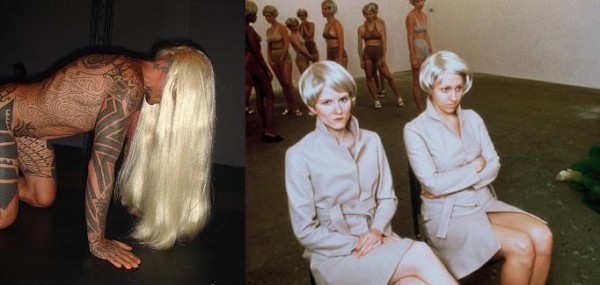
Three of Beecroft’s performance stills currently hang in MoCA’s The Artists’ Museum, a sprawling exhibition that pools together contemporary artists from the museum’s collection. The stills are sort of crammed in a corner–you encounter them as soon as you exit Doug Aitken’s over-produced video installation–and the camera’s cool, journalistic gaze undercuts any Helmut Newton style glamor the performances might have had in person. A 1998 photograph from VB 35 (each performance is numbered sequentially) at the Guggenheim depicts women in black lingerie standing staggered in an austere gallery;  a still from VB 11 hones in on the cherubic but comatose face of one performer; and a still from VB 16 shows two fake blonds in neutral jackets sitting in front of an army of girls  in flesh-toned underwear.

Ron Athey, "Self-Obliteration," 2003; Vanessa Beecroft, from VB 16, 1996.

The most interesting thing about these three images is the company they keep. Across the hall from the Beecroft corner, is the Ron Athey alcove, a small square space receding into the wall. It features performance stills and props from Athey’s Self-Obliteration and Solar Anus projects, more kinetic than the VB images but equally neurotic. If Beecroft works in the extreme discipline of making yourself perfect, Athey works in the equally extreme discipline of pulling yourself out of your own body. And if Beecroft strives for an ideal, Athey strives to break out of one. “Open wounds seep, or sprinkle, or tinkle the blood,” Athey has written, “without which, the body would be waxen, the golden light over-saturated and brassy, a dis-intoxicant.”

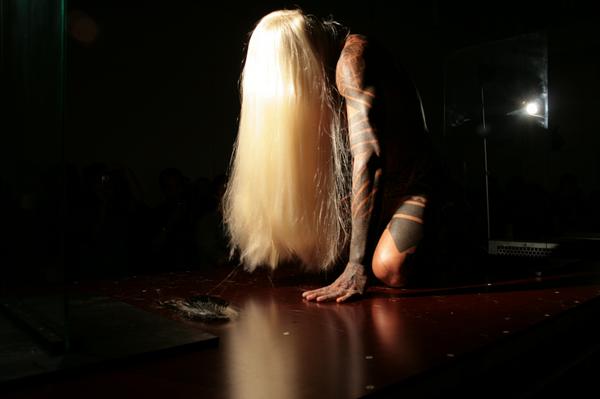
Ron Athey, Performance Still, "Self-Obliteration #1: Ecstatic," 2008.

The Self-Obliteration series, an experiment in self-torture, involved “ecstatic” performances. In one, Athey appeared on stage, vigorously brushing long blond hair that fell down over his naked body. It was only when he removed the hair, held onto his bald head by surgical pins, that viewers realized just how much pain he’d been inflicting on himself.

Around 2003, Vanessa Beecroft purportedly shaved off her hair (though I’ve been unable to find any documentation of this). “I watched a few too many Holocaust films,” she told The New Yorker’s Judith Thurman. Nothing screams stoicism like self-inflicted baldness. It bucks nature, and bucking nature requires self-discipline, something Beecroft and Athey both thrive on. In that one corridor of the MoCA show, the two artists seem to be in the midst of  an accidental collaboration, something unlikely to occur in reality (their fundamental interests and audiences are too different). Athey’s toxic body counteract Beecroft’s sterilized, posed ones, and I imagine the blood that pours out of Athey splashing across the hallway and startling the VB women out of their plastic poses.

Share

ASCII History of Moving Images

Today’s article is from our friends at Art Practical, where Mathew Harrison Tedford discusses the History of Moving Images via a collection of Vuk Ćosić’s 1998 détourned film clips, on display on the UC Berkeley Art Museum and Pacific Film Archive (BAM/PFA) NetArt online gallery.

Deep Throat, 1998; video still. Courtesy of the Artist.

The flickering green blowjob is both radical and passé. The alphanumeric pixels depict an ambiguously famous sex scene. It is neither obscene nor safe for work. The video is part of ASCII History of Moving Images, a collection of Vuk Ćosić’s 1998 détourned film clips, on display on the UC Berkeley Art Museum and Pacific Film Archive (BAM/PFA) NetArt online gallery. The scene in question is a clip from the classic 1972 porno Deep Throat, also both radical and passé. Ćosić converts the film data into ASCII, the standard computer code that dates back to 1968. The minimal green-on-black motif recalls a Geocities aesthetic, and watching the videos nurtures an uncomfortable nostalgia for the dark ages of the World Wide Web—the mid 1990s. By dint of the rapid transformation of the web, Ćosić’s videos seem more aged than a work of Nam June Paik or even the Lumière brothers.

Ćosić was member of a cadre that brought digital art out of this dark age. In fact, the museum’s NetArt itself derives its name from a Ćosić neologism: the term’s almost mythical genesis story relays that in December 1995, the artist received a distorted e-mail message in which the only discernable text was the phrase “net.art.”1 Soon after, Ćosić organized a gathering of European digital artists in Trieste, Italy, dubbed “net.art per se.”2 With this symposium on the nature and philosophy of net.art, Ćosić helped launch a quiet, if accidental, revolution.

To continue reading this article, visit ArtPractical.com.

Share

PROGENY II: ON ART, FAMILY, RACE, and CULTURE

Deborah Willis and Hank Willis Thomas, Sometimes I See Myself In You, 2008. Courtesy of the Harvey B. Gantt Center for African-American Arts and Culture.

From October 8th, 2010 through January 23rd 2011, The Harvey B. Gantt Center for African-American Arts and Culture in Charlotte, North Carolina, presents an exhibition by two creative duos of mother and son artists entitled Progeny Two: Deb Willis and Hank Willis Thomas and Fo Wilson and Dayo. This exhibition is an exploration of the creative process per se and the context of social and cultural issues that may effect this process. The creative processes for artists vary, of course, in accordance with the predispositions, inclinations, insights, and experiences of the individuals themselves and their respective worldviews, cultural interactions, and social intuitions. However, when artists have powerful relationships with each other, this creative mixture can result in extraordinary, unanticipated results that offer insights into aspects of human experience often camouflaged in our day-to-day interactions.

The Gantt Center’s Progeny Two exhibition offers a surprising collection of collaborative works generated by both creative mothers and their artistic sons: one pair is award-winning photographer and archivist, Deborah Willis and her son, noted photographer, Hank Willis Thomas, and the other is sculptor-furniture designer/conceptual artist, Fo Wilson and her son, film and video director Dayo (Dayo Harewood). In the differing media employed by any artist, used to translate ideas into objects or experiences, what we as audiences may be shown as well as what we may not be shown may be equally powerful factors relevant to the shaping of our responses. In Progeny Two, the mother-son duos are engaged in a interaction with what I reference here as “present absences.” In particular, Deborah Willis and Hank Willis Thomas engage with the concepts stemming from the supposed writings of William Lynch, a notorious, fictional, 18th century professional “slave breaker.” However, the appearance of the letter established the association of the character William Lynch with the topic of the practices and social processes determining a predisposition to psychological self-destruction among African-descended peoples forcibly subsumed into Euro-centrist cultures.

Fo Wilson and Dayo, Sarah's Lament, 2008. Courtesy of the Harvey B. Gantt Center for African-American Arts and Culture.

Fo Wilson, in her turn, works with her progeny, Dayo, in a discourse with the memory of Sarah Baartman, the legendary so-called “Hottentot Venus”, a South African Khoikhoi woman literally killed by race-based and racist curiosity.[1]

The personal narrative of both single working African-American artist-intellectual-mothers shares the feature of successful sons, who have matured in a culture that may be construed as inherently hostile to them, their African ancestry, and their social status. Ideas of family, survival, the roles of mothers as well as fathers, of generative and creative life, and of memory are the themes explored by this exhibition; these themes are of vital importance to contemporary discussions of American cultural development and on-going issues of cultural identity, the structuring of what is and what is not included in historical narratives, and even the importance and need for preserving ethno-centrist cultural institutions such as the Gantt Center itself.

Fo Wilson, Hottentot Not!, 2008. Courtesy of the Harvey B. Gantt Center for African-American Arts and Culture.

The exhibition title addresses the fact that two sons, literally two “progeny” work with their mothers to bring to the fore issues of contemporary American experience, which have their roots in certain cultural preoccupations stemming from the confusing, inherited traditions and myths of slavery. Willis and Willis-Thomas provide interesting commentary on capitalist praxis, folk knowledge, and the complications shaping our sense of personal identity, social relationships, and popular cultural interpretations of history. Fo Wilson and Dayo concentrate on the problems of the objectification and commodification particularly of the female body, and more specifically the legacy of curiosity concerning the body of the African female (and that of her progeny) as an exotic, or unusual type.

The principal collaborative piece in the exhibition presented by Fo Wilson and Dayo is the multimedia work entitled Sara’s Lament in which Wilson has created a fictive letter creatively written in the artist’s interpretation of the voice of Sara Baartmann, a South African woman transported to Europe for exhibition to a curious public. Wilson/in-the- guise-of-Baartman writes to implore contemporary late 20th and early 21st century African and African-American women to desist from any active complicity in purveying the objectification and commodification of their bodies as tools of capitalist exploitation. Perhaps ironically, Wilson’s son, Dayo is a director of contemporary, commercial music videos and films, precisely those media most often used to abusive ends and destructive purpose with regard to affecting construction of internalized representations the feminine body-imagery. Examples of such videos are provided on small screen images which include passages extrapolated from the highly sexualized music video idiom, including the “infamous” L’il Kim (Kimberly Denise Jones ) video, “How Many Licks?”, a lascivious musical homage to the act of cunnilingus and both a celebration of feminine sexual freedom and a boasting narrative of irresponsible sexual activity.

Fo Wilson and Dayo, Sarah's Lament, 2008. Courtesy of the Harvey B. Gantt Center for African-American Arts and Culture.

Wilson’s fictive Baartman letter directly addresses the assumed degradation of the female body and mind by the commercialization of strongly sexualized content for public consumption. Wilson’s concern appears to be for expression of the concepts of beauty and desire, and the potential for social abuse deriving from a destructive, sexualized gaze, specifically at the female body. Sara Baartmann was a victim of this sexualized gaze and an implied analogy is established to suggest that she is in some sense “like” L’il Kim, who is shown in the video as undergoing a mechanized process (a metaphor for a series of invasive plastic surgeries that Kimberly Jones actually underwent, having her body completely reconstructed in accordance with the sexualized aesthetic preoccupations of the late 20th, early 21st century), both women are presented as “victims” of capitalist exploitation and its destructiveness. Of course the choices made by L’il Kim in the tradition of Josephine Baker, who also engaged in a self-imposed exploitation of sexualized and racially structured cultural myths for personal profit, exploiting her would-be exploiters, and the injustice fostered off onto Sara Baartman, who had nothing like the possibilities of choice offered to Baker and Jones, are quite radically different in character, and these intriguing issues raised by the works in the exhibition are precisely what ought to be discussed by a larger public.

Related to the mixed media work of Sara’s Lament is a furniture installation placed at the center of the gallery. A letter dated 1815, providing information on Sara Baartmann is suspended above the table. The table is a visual representation of both the idea and action of support, and is also shown as a signifier of a utilitarian object, in spite of its pleasing aesthetic dimensions, and it thus offers an implicit analogy with the female body. Indeed, the table is intended to symbolize the physical presence of Sara Baartman as a beautiful “object” of observation, even contemplation and insidiously, an object of “use”.

Hank Willis Thomas, Branded, 2008.

Other especially evocative works with in the exhibition include Hank Willis Thomas’ Branded Series, specifically the semi-sculptural triptych of three simulated credit cards, embedded in thick plastic, and set up-right on their lower edge, alluding to the contemporary “enslavement” of the American public by consumerism and debt. In the first credit-card image, Willis-Thomas uses his own name on an artfully fabricated American Express Card imitation, bearing a date of 1619 and entitled Afro-American Express, showing images of slave ships. The 1619 date references the early documentation of legalized slavery in the Virginia colony of the Americas; in addition, a Discover Card dated 1492 and issued to Cristobal Colon, the Spanish form of the name of the Italian explorer, Christoforo Colombo, or in English, Christopher Columbus, whose mention alludes to the search for gold and religious converts that fueled the initial phases of the capitalist enterprise that would eventually lead to the extension of the Euro-centrist model of human slavery into the new world. The third simulated card in this series is the Chase Master Card with a date of 1712, and bearing the name of William Lynch. However, the card shows images of the authentic types of slave restraints, including shackles, constraining bits, and collars that were an essential part of the true methodology employed in a process centered on degrading, coercing, and forcing enslaved persons into submission to the will of “masters” for the financial gain of the latter. Again, myth, fiction, fabrication, fact, and truth overlap in a manner consistent with the reality of American (and “African-American”) experience.

Willis offers compelling feminist critique in a photographic sequence entitled, A Good Man, with images shown as if taken from a proof sheet and numbered 34A -36A. The first image, presented with an explanatory legend beneath it in 34A suggests a woman taking a space from a “good man” (an allusion to talented women being perceived as “taking” jobs away from equally or less qualified males?), and is a self portrait of Willis, shown as if conjuring a pregnancy. 35Aa bears the legend, “you took the space from a good man,” and shows the hands of a male placed upon the impregnated abdomen of the photographer herself, the face and body of the male figure are never shown.

Deborah Willis, The Mother Wit, 2008.

A compelling poetic directness is achieved in the simple digitized morphing shown in the large photograph, Sometimes I See Myself in You, in which, depending upon whether the viewer does a “classical” Western reading, from left to right, or a more atypical reading, from right to left, we see the image of son morphing into mother (left to right) or of mother morphing into son (right to left) with a combined image of the features of the two as a single individual placed centrally (a visual realization of the collaborative action of mother and son and an allusion to the collaborative fusing of father and mother).

In a final series of photographs produced jointly by Deborah Willis and Hank Thomas entitled Words to Live By, combined with The Mother Wit Series, the aphoristic wisdom of the ages is provided beneath images of the lower halves of a wide variety of ethnically diverse representations of faces accompanying gem-like folk insights such as “ Better no man than the wrong man…” or “Amor de lejos, amor de pendejos…”, translatable as “Long distance love, fool’s love..”, or “Honey, if you don’t know what you’re talking about, listen and keep your mouth shut!…”, or the ever-wise “You can’t carve rotten wood!…”, and “If it don’t start right, it won’t end right!…” offer the kind of folk-lore laden, old-wives-tales information a traditional mother might offer her child.

Deborah Willis and Hank Willis Thomas, Words to Live By, 2008.

The exhibition as a whole aggressively addresses the challenges to personal integrity interrogated by the illusion of a spurious claim of absolute power of one human being over another, explored in this context with reference to the inhumanity and the horrors of slavery. This combined with the myths, facts, folklore, and mother-wit concerning the truth of falsity of a narrative positing claims either of the absolute dominance of one group over another, or the powerless dependence of one group victimized by another and the intrinsic difficulties of an exploitative systematic capitalism that placed profitability over people are the issues these artists intend for us to respond to, reflect upon, assess and discuss.

The exhibition presents multiple levels of allusion and investigates uncomfortable, complex, emotionally charged areas of the American cultural narrative with a clearly sympathetic interpretation of the socio-cultural extensions stemming from the diverse narratives of the African diaspora. True exploitation, like the fictive cruelty of William Lynch, even within the African and African-American communities, continues to impact the generation of an American cultural narrative in our own time. Further, Fo Wilson and Dayo present a discursive approach to the tragedy of Sara Baartman’s story which underscores the countless tales of cruelty and the perversely inconsiderate, anti-humanism of the extensions and aftermath of a race-based slave system. The persistence of the issues alluded to in the exhibition merits conversations around this show about mothers and sons (and by extensions fathers and daughters and our entire community as a human family). We are all implied by the content and are thus complicit in the social cruelty and ignorance the artists allude to using creativity, humor, and most importantly, with an evident love for and desire to transform society through their works. If one convert is any indication, then I confess I found out a great deal about myself and the need to investigate the history, myths, legends, lies and facts of our shared culture. Of equal importance with what is shown in the exhibition are the necessary conversations that it must inspire concerning our awareness of the complicated phenomenon of the “presence of absence”.

Writer and critic Frank Martin is a member of the Association Internationale des Critiques d’Art (AICA) and a periodic contributor to DailyServing.com.


Share