Walead Beshty at Regen Projects

Courtesy Regen Projects, Los Angeles. Photo credit: Brian Forrest

In a former life, Walead Beshty may have rubbed elbows with Patti Smith. Flaunting her contemptuous disregard for the cautionary advice of her peers, Smith famously denounced words as mere “rules and regulations” in her rendition of Van Morrison’s “Gloria.” In one unruly, titillating performance, Smith flipped the good ol’ boys’ fraternity of rock and roll on its ear by lampooning the muffled sexism of the music industry, exposing the frivolous laws that command its economy. In other words, let’s not shy away from the fact that sex sells in this game, kiddo.  Similarly, the art world has its own rulebook.  And Beshty has a shredder.

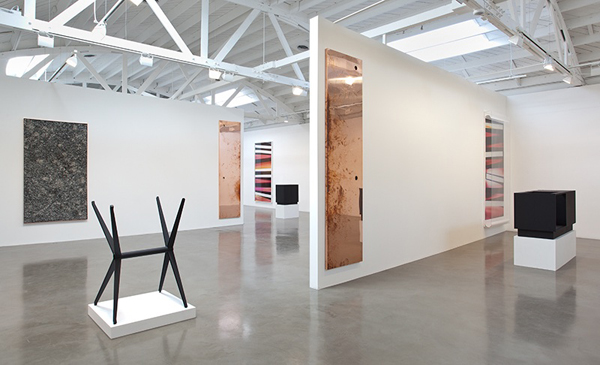
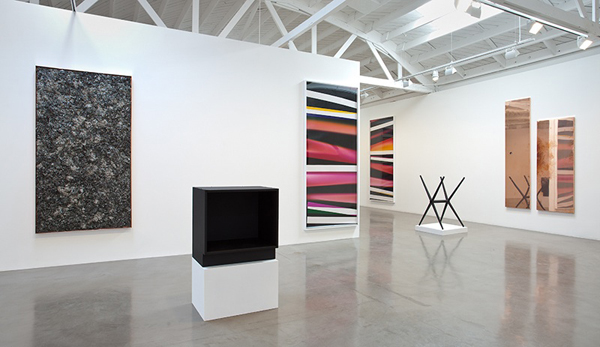
The first rule of art market is you do not talk about art market. The vernacular of commodity is strictly verboten, seductive aesthetics are ill-advised, and materiality is secondary to concept. The clandestine, operational logistics of the art world are something of an urban legend—on which Beshty shines an astute light. In a 2009 interview with BOMB Magazine, the artist acknowledged this hush-hush stigma, stating: “Any art effect people don’t like, or find alienating, is ascribed to the market. In this, and in all other aspects of art making, I think transparency is the only way to destabilize the mythologies of the art market, and of art in general.” In his current exhibition at Regen Projects (Los Angeles, CA), PROCESSCOLORFIELD, Beshty takes a wily swipe at the absurdity of the art world’s covertness with more than twenty-five new works, ranging from photograms to readymades to the mulched remains of works “unfit for exhibition.” He deftly navigates the precinct between improvisation and calculation, as well as object and material, while subverting the rules that govern each model.

With a discerning hand, Beshty manipulates the analog qualities of film in his “Black Curl” photogram series. Perhaps a tangential nod to his 2006 “Picture Made by My Hand with the Assistance of Light” works, which were the result of a roll of film’s unintentional exposure to an airport X-ray machine, Beshty’s most recent photograms hypostatize fluke relationships between photo paper and color structures into electrified bands of twilight hues.  Austere blocks of black and white border sherbet-colored ribbons of pink and orange, as if we were peeking at the garish Los Angeles sunset through a haphazard set of blinds.
Courtesy Regen Projects, Los Angeles. Photo credit: Brian Forrest

Reflecting the vibrant patterning of the photograms are Beshty’s “Copper Surrogates,” whose polished surfaces are tarnished with alarmingly prevalent fingerprints, smears and coffee mug rings. To the seasoned gallery-goer, the constellation of blemishes on the works’ surface is cause for stifled panic, as art-viewing policy is built upon a longstanding empire of “Don’t Touch.” This is Beshty’s guerrilla erosion of one of art’s most fortified rules.  Literally used as workspace for the duration of a prior exhibition, the sullied copper counters display traces of conversations past, meetings adjourned and infrastructures built—empirical evidence that alludes to the presence of the industry, the gallerist and the collector.

Finally, in a tongue-in-cheek intimation of the sway of institutions, Beshty’s “Selected Works” reframe the notion of artistic failure, unearthing the unseen practice behind the tradition of curating and contextualization. Shredding his self-declared “unsuccessful works,” Beshty turned the refused scraps and slivers of photos and paintings into reconstituted mulch, displaying the literal and conceptual debris of exploratory authorship in an unconventionally candid manifestation. In his forthright acknowledgement of the tensions between the material and the visual, as well as between posturing and actuality, Beshty bends the rules with dexterous maneuvering and a covert smidge of sensory seduction. The art market never saw it coming.

PROCESSCOLORFIELD is on view through May 14, 2011.

Share

Architecture of Visibility – Cinthia Marcelle and Nicolás Robbio

The notion of visibility often has a reaction that incites the magnetic forces of attraction or repulsion. The impulse to highlight or hide visual indications of ideologies is at the core of the separate solo shows of artists Cinthia Marcelle and Nicolás Robbio. Although billed as two separate exhibitions in the admittedly large Galeria Vermelho, it’s quite impossible to resist conceptual association of the two shows. Marcelle’s project makes visible societal structures that are complicated, messy, and hard to visualize while Robbio pulls apart the precise visual symbology of power codes.

Cinthia Marcelle, Confronto, 2005

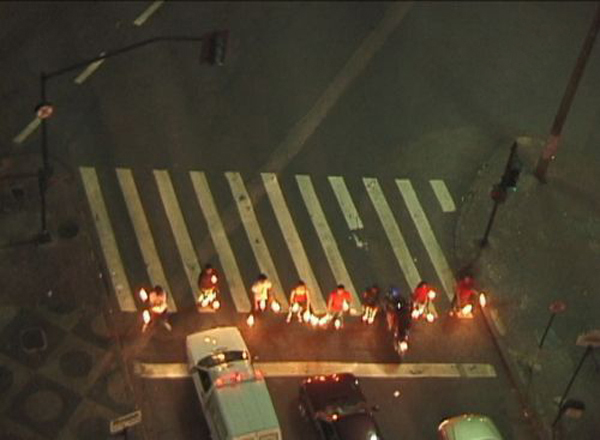
The notion of financial crisis is at the crux of Marcelle’s work; her photographs, video, and sculptures reveal an invented residue of economic structures. Marcelle has become known for her video works which make visible the circuits of economics and social structures through performative actions or vehicles that create, or are based on, a geometrical form. These futile and subtly absurd enactments produce a contradictory sense of becoming through their repetition of form. It is from this video work that Marcelle recently won the significant 2010 Pinchuk Art Centre’s Future Generation Art Prize.

Cinthia Marcelle, Economia, 2011

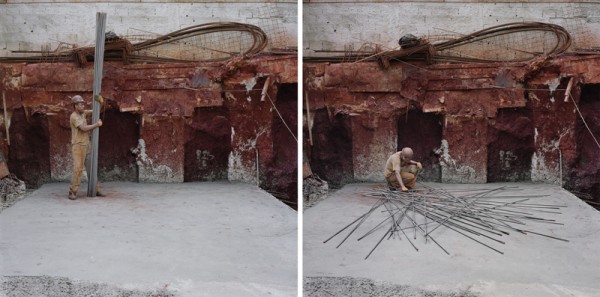
The installation, Zero de Conduta expands this project with sculpture and photography. Economia, is a sculptural form suspended between the first and second levels of the gallery, a visual manifestation of the invisible air currents that flow through the space. The most poignant works in the show are the photographic diptychs on the second level of the gallery; these formally staged images of poetic acts have a gravity that Economia is unable to capture in its frozen metal ribbons.

Cinthia Marcelle, O Cosmopolita, 2011, courtesy Galeria Vermelho

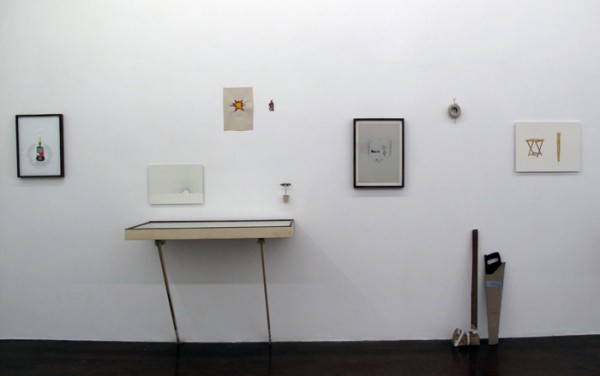
Nestled upstairs in an exhibition space, Robbio’s installation Bandeira em Branco Não É Bandeira Branca recalls display techniques of a poorly funded museum. His source materials are insignia found within the architecture of Recife, Brazil.

Nicolás Ribbio, untitled, 2011

The antiquated practice of heraldry as a means to identify status and authority has evolved into an ornamentation whose visibility is absorbed by the city. Robbio takes the visual cues of a system deeply rooted in the symbology of power, deconstructs them, and develops a new idiosyncratic visual system of drawings and objects. Ribbio has created an artistic practice that takes existing structures and subverts their framework to build new systems, enabling possibility within rigidness. Isolating and disrupting these emblematic signs uncloaks a repertoire of signifiers of masculinity turned on their head, depraved of power, and transformed into curious, wry gestures.

Nicolas Ribbio, untitled, 2011, courtesy Galeria Vermelho

The neighboring shows generate an architecture of structures in a constant state of scaffolding and crumbling, an edifice that sways between construction and deconstruction.

Zero de Conduta and Bandeira em Branco Não É Bandeira Branca will run through May 21st at Galeria Vermelho in São Paulo, Brazil.

Share

Fan Mail: Stephanie Liner

For this edition of Fan Mail, Stephanie Liner has been selected from a group of worthy submissions.  If you would like to be considered, please submit to info@dailyserving.com a link to your website with ‘Fan Mail’ in the subject line.  Two artists are featured each month – the next one could be you!

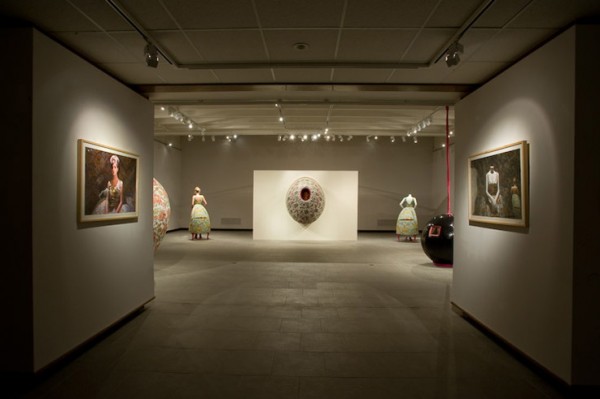
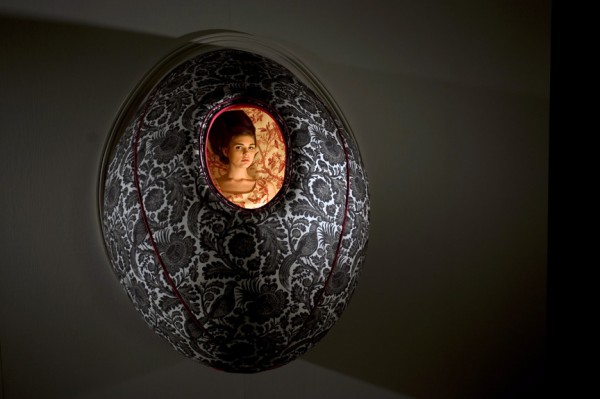
Looking at Stephanie Liner’s Orbs, I immediately think of the panoramic sugar egg that had a place in the Easter baskets of my childhood.  Both are egg-shaped and feature a window opening into an interior vignette.  In fact, the panoramic egg is a product of the Victorian age as is the Queen Anne style, which is a source of inspiration for the artist.  Yet there the similarities end, for while decorative, Liner’s life-sized Orbs are created with a decidedly more subversive intention.

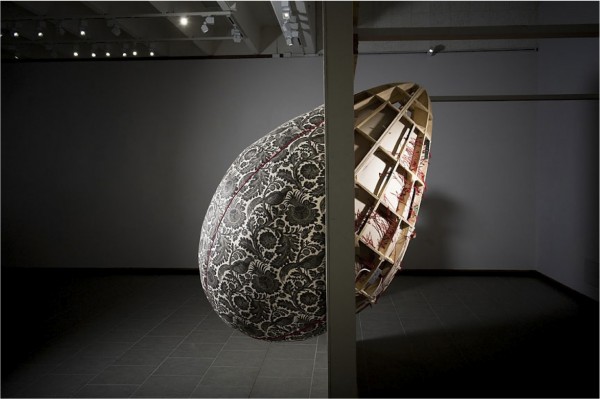
Liner is inspired by interiors of the historic southern United States and, in particular, the Queen Anne style – elements of which she believes contain latent meaning about the societies that created them.  The aforementioned Orb, a part of her Momentos of a Doomed Construct series, is defined by decorative and corporeal elements much like Liner’s entire practice.  Constructed of plywood and typically covered in a floral textile skin, Liner’s Orbs are occupied by a seated, self-contained female figure with billowing skirts.  In another part of the series, the artist connects the female form to furniture in a more literal way.  The figure stands with hands on hips to combine with a sculptural element set on cabriole legs in mimic of a Queen Anne wing-back chair.  Through each piece, Liner seeks to create a crafts-based visual language to address historic gender roles that she believes are perpetuated today.

The physicality of Liner’s work and its real world subject matter lends itself easily to performance, which typically accompanies her installations.  The 2009 performance for Memories of a Doomed Construct exhibit at the University of Wisconsin at Oshkosh gallery encouraged interaction between visitor and model.  Peering into an Orb, the viewer was met with the stare of a live female model from within – creating an uncomfortable, voyeuristic experience.  Carefully staged moments of gazing and objectification are intended to make us think critically about gender.

Liner holds a Master of Arts and a Master of Fine Arts from the University of Wisconsin at Madison as well as a Bachelor of Arts from the College of Design at North Carolina State University.  Look for Liner’s Mementos of a Doomed Construct in Out of Fashion, a group show debuting this November at the Southeastern Center for Contemporary Art that will address ‘the histories of fashion as vessels of time, nature and memory’.  In July 2012, Liner’s work will join 40 Under 40 at the Renwick Gallery for decorative arts and crafts in the Smithsonian American Art Museum.

Share

From the DS Archives: Yayoi Kusama

This Sunday, From the DS Archives brings you avant-garde Japanese artist, Yayoi Kusama, who has recent paintings and sculptures up now through May 7th at Gagosian Gallery in Rome. A significant retrospective of the artist opens at the Reina Sofia, Madrid on May 10th; the exhibition will then travel to the Centre Pompidou, Paris; Tate Modern, London; and the Whitney Museum of American Art, New York through 2012.

This article was originally written by Rebekah Drysdale on April 27, 2009.

yayoi kusama.jpg

Gagosian Gallery is presenting two major exhibitions in New York and Beverly Hills to celebrate Yayoi Kusama‘s eightieth year. The artist, born in Japan in 1929, started painting with polka dots and nets as motifs around the age of ten. She moved to the United States in 1957, where she showed large scale paintings, soft sculptures, and environmental installations using electric lights and mirrors. From 1998-1999, a major retrospective opened at theLos Angeles County Museum of Art and traveled to the Museum of Modern Art in New York, the Walker Art Center in Minneapolis, and the Museum of Contemporary Art in Tokyo.

The exhibition in New York, which opened on April 16th, features a large yellow pumpkin sculpture with black spots in a specifically designed space at the front of the gallery. This piece is based on a similar work Kusama showed at the Japanese pavilion at the Venice Biennale in 1993 – a mirrored room filled with pumpkin sculptures in which the artist resided in color-coordinated attire. The pumpkin, made of fiberglass and reinforced plastic, represents a type of self portrait or alter ego for the artist, whose compulsive covering of surfaces and infinite repetition of dots, patterns, and forms is characteristic of her entire body of work.

kusama installation.jpg

For the back of the gallery, Kusama has constructed a hypnotic optical environment, Aftermath of Obliteration of Eternity (2009), featuring the infinite interactions between lights, mirrors, and water. Viewers step into a dark chamber that is softly lit by several gleaming golden lights, closing the door behind them. Standing on a platform surrounded by water, the viewer is reflected in this “infinity room” by walls of mirrors. This experiential encounter with oneself represents the artist’s “preoccupation with mortality, as well as with enlightenment, solitude, nothingness, and the mysteries of the physical and metaphysical universe,” as stated in the press release.

The exhibition in California will open on May 30th and last until July 17th. The exhibition in New York will remain at the gallery’s location on West 24th Street until June 27th.

Yayoi Kusama currently lives and works in Tokyo, Japan.

Share

In the Shadow of Things: Leonie Hampton at Forma

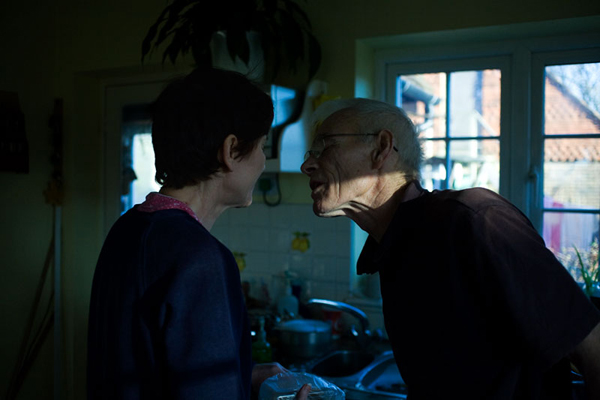
Leonie Hampton, In the Shadow of Things, photograph, 2011, courtesy of the artist

Vernacular photography tells us our story. It shows us who we are and who we want to be. Open any photo album, and you’re confronted with cultural clichés played out to illustrate an ideal of family, success, happiness. No surprise these are the moments we choose to memorialize. These amateur-ish snapshots create an archive of moments of imagined joy; they stop time at the instances when we are happiest (or at least when we are aping happiness) and then catalog those pictured felicities as memories.

Leonie Hampton’s autobiographical photography, In the Shadow of Things, on view at Forma in Milan, draws deeply from this vernacular aesthetic. Her work reveals both the intense emotions interweaving a familial unit and the mundane context from which they arise. At times poignant, funny, or simply peculiar, Hampton presents a narrative tour of her cultural environment. According to the texts accompanying the show, that narrative revolves around her mother’s obsessive-compulsive, hoarding tendencies. But, more importantly, these photos describe a young photographer coming to terms with her own identity within this unit, struggling to understand her nature, her decisions and impulses against the cultural backdrop of home.

Leonie Hampton, In the Shadow of Things, photograph, 2011, courtesy of the artist

Most suggestive of this inquiry is the inclusion of a collection of family snapshots, chronologically ordered, The Christmas Tree Series. The artist captions these images in pencil, directly on the wall, giving a brief description of the theme—amateur group portrait in front of the Christmas tree—leaving blank spaces where the years’ photos have gone missing. In one, the caption states the Christmas tree was salvaged from the trash heap, and indeed the ‘tree’ in the picture is now only a naked branch, having lost its needles. The subjects, Leonie and her siblings, are similarly threadbare, wearing shorts and t-shirts, asserting that this year the photograph was snapped sometime, perhaps a lengthy period, after the winter holiday. This is a tribe clinging to a tradition that it has outgrown, a group bound by duty if not hope, re-enacting the story of a happy family at Christmastime, preserved once again for its ongoing archive.

Leonie Hampton, In the Shadow of Things, photograph, 2011, courtesy of the artist

In the images shot by Hampton herself, the impulse to preserve an ideal of the family is clear as well, but in a way, less choreographed, less rigid. These candid photos reveal the concerns, sensibilities, and banalities of these people’s lives, pictures of a changing home, a changing dynamic. They present the evidence of a bent toward preserving and archiving the household, presumably the symptoms of Hampton’s mother. At each turn, they manifest the vision of the artist, also documenting, accumulating, cataloging, as she understands her relationships with these characters and as she settles her own identity as one of the story’s collecting protagonists herself.

Share

Jukebox Histories

L.A. Expanded: Notes from the West Coast
A weekly column by Catherine Wagley

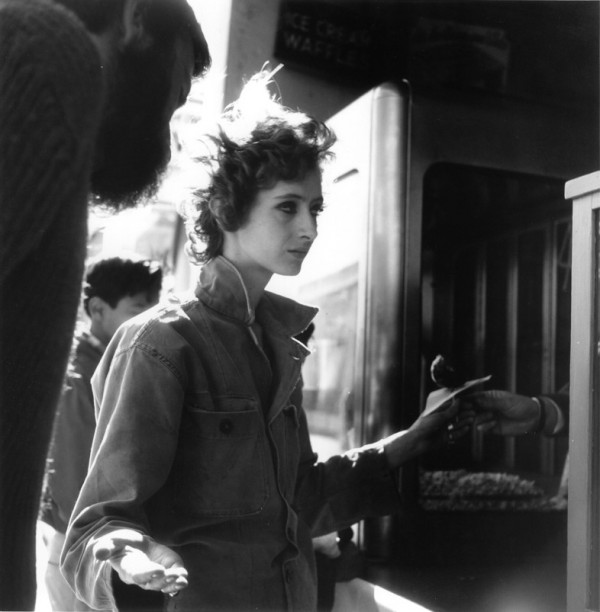
Charles Brittin, "Shirley Berman at the Ocean Park Pier," 1956.

Last night, at a bar beneath a Motel 8 on Sunset and Western, a friend and I got sucked into a great, mammoth of a Jukebox that’s quirky selection reminded us of a history short enough that our lives had overlapped with much of it, but long enough that many of the bands and artists on its sometimes hand-written leafs had receded so far back into memory we had to dig to pull them out—the Violent Femmes, for instance. Was that really the name of the band that gave Clare Danes’ precious “I’m free” moment in My So Called Life its infectious tempo?

Two Jukebox-like exhibitions are open in L.A. right now—one by a late artist who quietly lived through Venice Beach’s era of Beats, and another by an artist who’s lost himself in punk’s knotty trajectory by channeling a man whose whole life was colorful and loud, whether he meant it to be or not. Both are rich with real and fantastic historical gems, some as thrilling to [re]experience as the Violent Femmes and others a bit more ominous.

Charles Brittin (1928 – 2011) came to L.A. from Iowa at the end of the 1940s. Brittin fell in with Wallace Berman, the pensive artist who shunned the gallery world after an anonymous tip prompted police to raid his first-ever exhibition in search of pornography, and his crew of meditative, anti-establishment friends. The pictures Britton took of this group are among the best in West & South at Michael Kohn Gallery, a show that’s more encyclopedic than thematic, pairing Britton’s images of the California scene with his iconic photographs of the Civil Rights movement. The Venice pics are good because, unlike the gripping, clearly weighty photos of protests and demonstrations, they get at the quirky moments that make history seem like the pastiche of idiosyncrasies that it really is. A portrait of Wallace Berman’s wispy wife Shirley hangs right by the gallery’s front entrance and also graces the cover of the exhibition catalog. Shirley’s upturned hands glow in the Venice Beach sun, her eyes cross slightly, and she looks like an unsuspecting Joan of Arc who’s just been possessed by the spirit, her unruly hair flying up toward heaven.

Steven Bankhead, “Sex: A Monument to Malcolm McLaren,” 2011. Courtesy Emma Gray Headquarters, Los Angeles.

If unruly hair indicates inspiration, it would explain the success of Malcolm McLaren—manager to the Sex Pistols, among other sundry trades—and his complicated on-and-off partner, Vivienne Westwood. Both had short, curly locks that seemed to take on a life of their own, regardless of how carefully curated the rest of their physiques may have been. Artist Steven Bankhead has tackled the McLaren mystique in his current exhibition at Emma Gray Headquarters in Culver City. And the result is strangely subtle. Even the big, pink “SEX” sign—the gallery had to remove it from its exterior wall due to a neighborhood complaint—that echoes signage McLaren hung outside his London shop feels more adorable than aggressive. Bankhead has covered the walls of Emma Gray’s main space with large print-outs of a London cityscape that depict industrial mayhem in such a perfectly controlled, choreagraphed manner that they feel like what might have resulted if Fellini had rewritten 8 1/2 and set  it during Britain’s Industrial Revolution.

In the gallery’s office, Bankhead has installed a few balloon-ish pop paintings, much lighter in palette than the  black-and-white paper walls, but equally controlled. The paintings mimic those McLaren when still a young aspiring artist, before he’d become entwined with the Sex Pistols and early punk. They’re pink, yellow, orange and blue clouds against flat white or black backgrounds, Warholian and tenderly optimistic.

Vivienne Westwood and Malcolm Mclaren sitting in the Sex Shop, 1976.

Three years before McLaren died ( in 2010, a year ago almost exactly), he gave an interview to the Telegraph in which he described how he felt after becoming a teenage father in the early 70s to Westwood’s baby (she’d apparently spent the money he gave her for an abortion on a cashmere twinset). “I went into depression for a while, then decided to make myself a blue lamé suit, copying Elvis,” he explained, and he got Vivienne to help him. “That was the big change. I realised she was a gifted seamstress,” McLaren added, as if it was then, over the blue lamé meant to free him from his own version of post-partum despondency, that he discovered the fashion icon Vivienne would become.

Steven Bankhead’s light, pop paintings feel like that blue lamé, fun shapes that, if read into, tell a rich, weird story about how culture gets made.

Share

Between the miniature and the gigantic: Ilit Azoulay

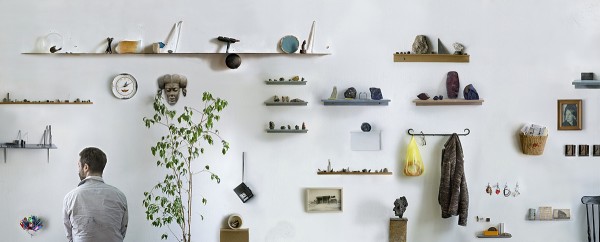
The Keys, 2010, 150 x 370 cm

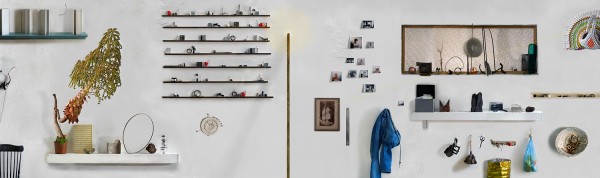
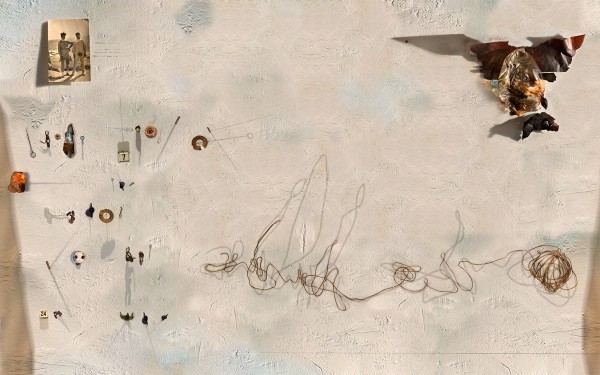
Stitching together digital, sculptural and natural ephemera, Israeli artist Ilit Azoulay makes photographs that hover between the miniature and the gigantic. She gathers small abstract accretions of wire, plastic, shells or stone that have been cast aside, left in the shadowed hollows of street corners and alleyways. These finds are organized along with old pictures into groupings that follow the loose grids of shelves, boxes and files. At this stage, the work resembles a mad Cartesian impulse to make order out of disorder, creating an archive of objects endowed with an aura, despite their seeming inconsequence.

Tree for too one, 2010 (detail)

As Azoulay painstakingly photographs each image and its ground, this archaeology of knowledge is fueled by an archive fever that goes beyond the mere physicality of order. Each object, each scrap of torn weathered paper, and each discrete portion of the ground on which they sit is documented, resized and pieced together to create a new landscape in which scale and perspective are modified into an aggregate of visual information.

Tree for too one, 2010, 150 x 500 cm

Like other contemporary artists such as Daniel Lefcourt, Leslie Hewitt, and Ruth Van Beek, Azoulay’s predilection is toward using photography as a method to unpack the performative qualities of an archive. In this sense, the photograph foregrounds its potential to act as both a document and as a picture of the structure through which these documents are understood. We are lulled into a belief of fact while constantly jolted awake, reminding ourselves that these facts are constructed pieces of a larger story.

Telegram 24, 2010, 100 x 160 cm

Azoulay, who recently received her MFA from the Bezalel Academy in Tel Aviv, at once affirms and denies any easily essentialized connections between the archiving impulse and her national identity. Israel is a country that recognizes the deep relationship between archaeology and national memory, as a result there is a modernist shrine in Jerusalem that houses the dead sea scrolls. Archive fever also drives the volumes of holocaust survivor testimonies at Yad Vashem. But because of the everyday materials that seem to have no overt historical value or political symbology, Azloulay leans more on the transnational impulse to picture an archive of the everyday. Her work is a picture of a picture, an image of an idea that resists framing, because it is a frame itself.

Azoulay’s upcoming exhibition at Andrea Meislin Gallery in New York City opens June 23, 2011.

Share