Ulla von Brandenburg

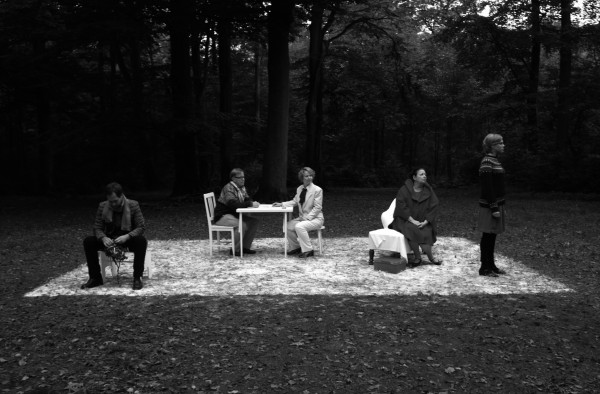
Ulla von Brandenburg, Chorspiel, 2010. Black and white video on a blue-ray DVD, audio 10 min 35 sec. Courtesy of the artist and art: concept, Paris

‘Neue Alte Welt’ (New Old World), an exhibition of Ulla von Brandenburg’s recent works, is on view at The Common Guild, Glasgow till 21 May 2011. Presented across two levels, the exhibition proceeds as a journey where one seems to travel from the perspective of an audience and performer, before entering the backstage.

The first room features Chorspiel, a black and white film set in a field amidst a forest, where a family of three generations encounters a wanderer. The weight of the scene unfolds across three acts in this operatic production, written and composed by von Brandenburg, with a Greek chorus of fifteen singers echoing and voicing the characters’ psychological states and proffering a predicament to the audience concerning the characters’ circumstances and uncertain future.  References to Ingmar Bergman shape our reading of this predicament as an existential one, tinged with longing and anticipation, and amplified by the unrevealed contents of the box that the wanderer bears.
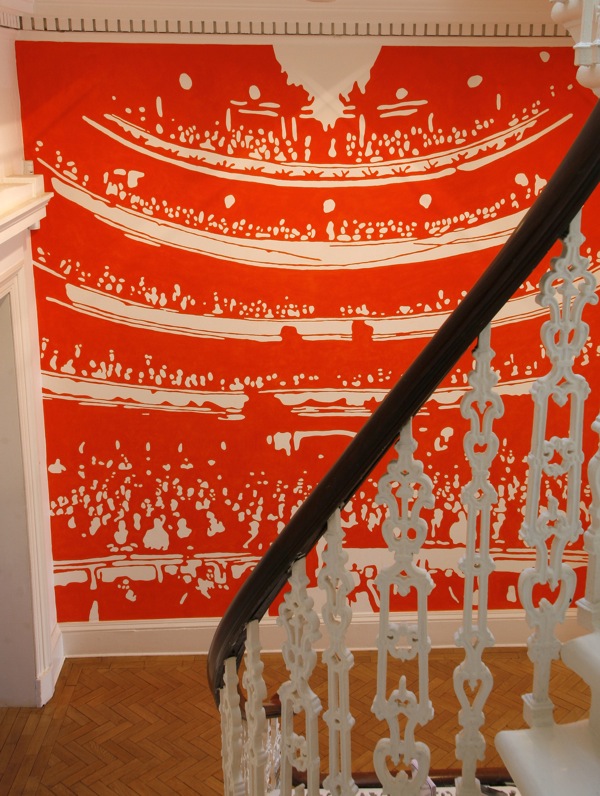
Ulla von Brandenburg, Theatre, 2011. Wall painting, Dimensions variable. Installation at The Common Guild, Glasgow. Courtesy of the artist and art: concept, Paris. Photo by Kendall Koppe

The emotions and distance vis-à-vis the actors on screen take a turn on exiting the room, where we encounter a floor-to-ceiling painting depicting a grand hall filled with audiences. Ascending the circular stairway creates the sense of being thrust onto a stage with the spotlight reflected in an orange hue, accompanied by the strains of Chorspiel which seem to now function as the orchestra for Theatre.
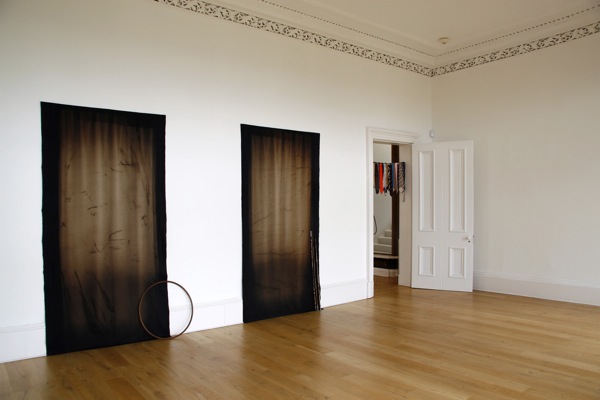
L-R: Mephisto 2010, Sunburnt fabric, small wooden hoop, 255 x 150 cm; Angel 2010, Sunburnt fabric, fishing-rod in three parts, 255 x 150 cm; Krawatten, abgeschnitten, 2010, Cut-up ties, Dimensions variable. All works by Ulla von Brandenburg, Installation at The Common Guild, Glasgow, Courtesy of the artist and art: concept, Paris. Photo by Kendall Koppe

The performance ceases upon entering the second room, past Krawatten, abgeschimitten, a drape composed of colorful ties affixed to a doorframe, demarcating another realm. The objects here assume evocative material traces of Chorspiel, from Schachtel (box) recalling the mysterious box brought by the wanderer, and the shining sun as sung by the wanderer, having an enduring effect on Angel and Mephisto. Though the associations with Chorspiel linger, the features of these objects, including their folds, patterns and etchings, distinguish them as props with a life of their own, possessing their own histories and awaiting further deployment.
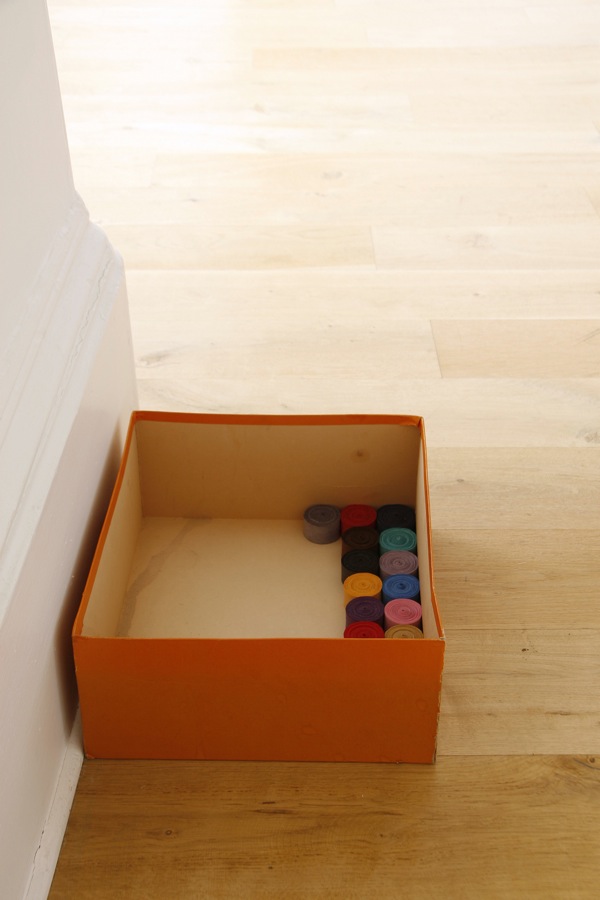
Ulla von Brandenburg, Schachtel, 2010 (box). Cardboard box rolled-up ribbons. Installation at The Common Guild, Glasgow. Courtesy of the artist and art: concept, Paris. Photo by Kendall Koppe

Though working through the histories and formalities of theatre, von Brandenburg’s works venture beyond notions about the theatricality of life. In this new old world, history becomes the filter for one to live in the present; a journey of apprehension, hope, glory and contemplation.

Share

ArtStars*: The Hunt for Gilbert & George

Today’s video is from our friends at ArtStars*, a traveling show about the contemporary art world, out to uncover the 7 Unsolved Mysteries of the Art World — one art scene, one country at a time. In this video, host, Nadja Sayej, stawks famed artist duo Gilbert and George as she asks them the rules of the art world. And, they deliver. Don’t miss ArtStars* two year anniversary episode.

Share

Get Your Ass To Mars: Takeshi Murata at Ratio 3

The title for Takeshi Murata’s current show—Get Your Ass To Mars—is a command, stolen from Arnold Schwarzenegger’s Hauser/Quaid character in Total Recall, based on Philip K. Dick’s “We Can Remember It For You Wholesale.” For the Hauser/Quaid character, what awaits him on Mars is textbook Dick: a conspiracy based on money and greed; instability in memory and identity, or in discerning reality; plus our own straight-up hedonism. And like it or not, with his new show at Ratio 3, Murata asks us to consider many of the same issues. The good news is—as much as I love Philip K. Dick—Murata does all this and keeps a sense of humor.

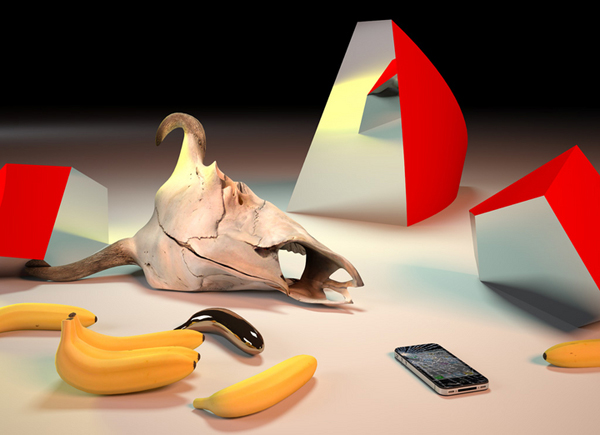
Takeshi Murata, Golden Banana (2011). Pigment print. Image courtesy of Ratio 3.

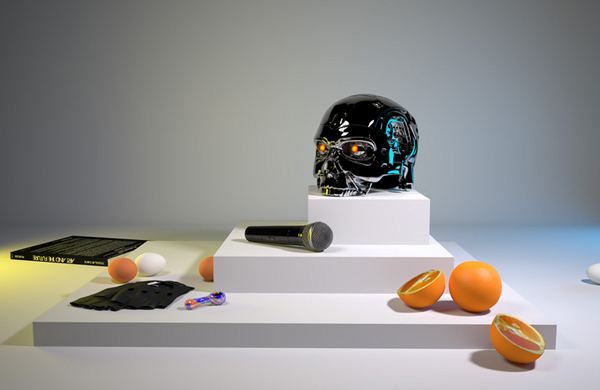
With Get Your Ass To Mars (2010-2011), a set of nine, exquisitely-rendered still lives, Murata references the 16th-century tradition of vanitas painting, a type of 16th-century still life that features skulls, fruit, dead animals, and other perishable or ephemeral items that evoke death, or the fleeting experience of life. The name itself means “emptiness,” implying that all earthly experience is empty compared to what lies beyond. The paintings were also an excuse for the artist to test his or her skill, and the objects depicted were often overripe, or had a perfection of form rarely found in the items they were modeled on.

Takeshi Murata, Art and the Future (2011). Pigment print. Image courtesty of Ratio 3.

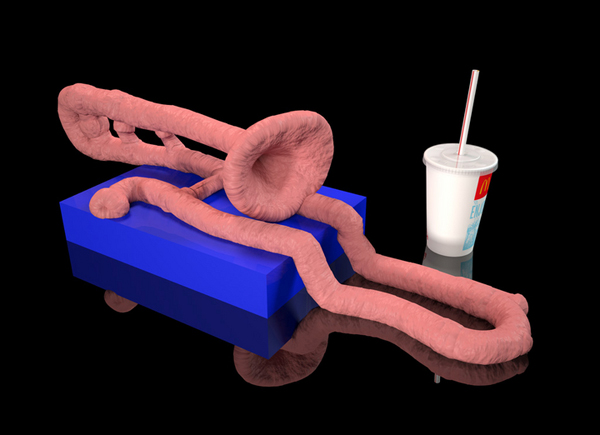
Murata’s pieces continue these themes, evincing a too-perfect-to-be-in-the-world lushness. More importantly, they evoke the tension of a three-dimensional space that reveals itself over and over to be a void.  Despite their photorealistic appearance, the works were made in Cinema 4D. Murata isn’t trying to deceive his viewers into believing the objects in these still lives actually exist. Rather, even as he shows off his technique, he is careful to include less precise—even crude—details. In Golden Banana (2011), for example, the texture of the skull’s horns is unreal on close examination, and the flaccid trombone in Gumbone and Coke (2011) has the opposite problem: it’s velvety, fleshy texture is hyper-real, and thus equally unbelievable. Murata also plays with the vanitas formula by using not only skulls, fruit, eggs, and instruments, but also bronzed fruit, coffee cups, books, videotapes and other pop culture paraphernalia.

Takeshi Murata, Gumbone and Coke (2011). Pigment print. Image courtesy of Ratio 3.

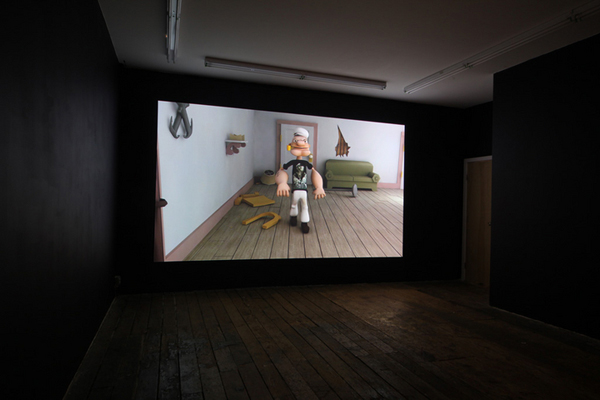
As complicated, coded and beautiful as the images of Get Your Ass To Mars are, they are one-liners compared to Murata’s video, I, Popeye (2010), which was first displayed in New York at the New Museum in 2010. Times are rough for our spinach-guzzling friend. He is not the Bluto-bashing cartoon hero of our childhood, or that of our parents’. Somehow—like his audience and the animation techniques with which he’s rendered—he’s matured. This Popeye is emotionally grizzled, like an addict who’s been sober for years but fails to see the point in the emptiness that surrounds him.

Takeshi Murata, installation view of I, Popeye (2010). Image courtesy of Ratio 3.

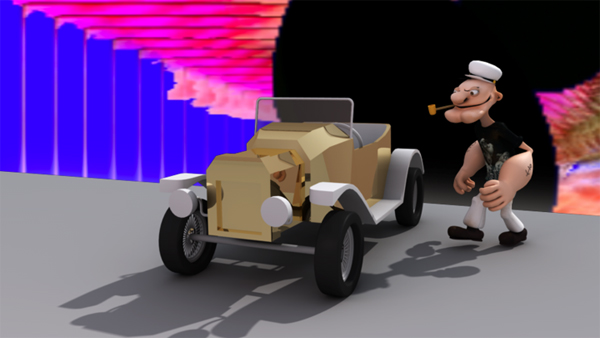
Everything in the film starts out gray:  the landscape, the spinach factory where Popeye works, the smoke billowing from the smokestacks, and even the sky. A bleary-eyed Popeye stands at a gray conveyor belt, pushing a green rectangular button. With every push, a stream of spinach squirts into a gray can, and a mechanical arm stamps a lid down. He falls asleep at the conveyor belt and wakes up from a brightly-colored, hallucinatory dream in an overflow of metal cans and a shower of sparks. He gets sacked, of course; walks out of the factory; arrives home; and heaves himself on the couch, only to be served an eviction notice by Wimpy.  Finally, after one last spinach-fueled rampage, Popeye commits suicide and drives off into his video game inspired afterlife in a shiny Model T, to the tune of Rush’s Tom Sawyer (“a modern-day warrior, mean mean stride”).

Takeshi Murata, video still from I, Popeye (2010). Image courtesy of Ratio 3.

Aside from this afterlife, which involves fluorescent green smoke, the film is spare.  Similar shapes show up throughout—the doorknob in his apartment and the tombstones in the town cemetery are all polygonal, for instance. Popeye’s bulging forearms never wobble and his jaw is the squarest and firmest I’ve ever seen it.  He’s even wearing a t-shirt with his caricature on it, featuring an airbrushed and winking Popeye, the cocky scrapper we’re all used to.

Takeshi Murata, video still from I, Popeye (2010). Image courtesy of Ratio 3.

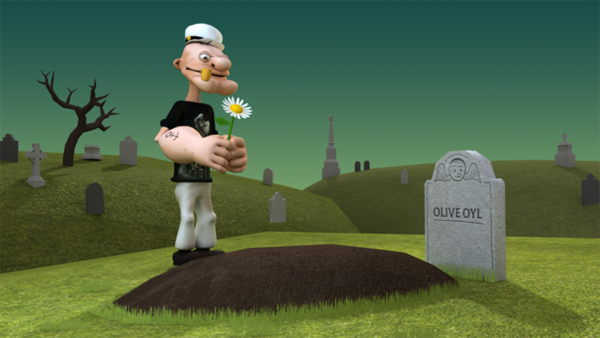
Murata’s genius is that he manages to keep the video’s trajectory both poignant and humorous.  He portrays Popeye as a much more nuanced character than we’ve ever seen. For example, Popeye meets Wimpy’s eyes for a long time after the eviction notice is handed over. The staring contest ends when Wimpy gives up, tips his hat to Popeye, and scuttles off, after which Popeye makes two final trips: one to a graveyard where he lays daisies on the graves of Olive Oyl and Swee’pea, and the other to visit Bluto in a hospital, where he’s lying comatose.  The only sound is a respirator. Popeye sits with Bluto for a while.  For a split second, he even turns to Bluto like he has something to say, but then turns away again.

Takeshi Murata, video still from I, Popeye (2010). Image courtesy of Ratio 3.

Get Your Ass To Mars and I, Popeye challenge us to reconsider how two-dimensional objects and characters, or even such ephemeralities as memory and life itself, can be “rendered,” or made three-dimensional. As long as psychology is involved, this transformation will always be about more than trompe l’oeil effects.

Get Your Ass To Mars is on view at Ratio 3 in San Francisco through June 11, 2011.

Share

From the DS Archives: Julia Fullerton-Batten

This Sunday, From the DS Archives reminds us of London-based photographer Julia Fullerton-Batten. Fullerton-Batten is currently included in the group survey Heroines, a comprehensive exhibition focused on depictions of strong female protagonists in work from the Renaissance to present-day, at the Museo Thyssen-Bornemisza in Madrid through June 5th.

This article was originally written by Julie Henson on September 23, 2008.

julia-fullerton-batten-09-23-08.jpg

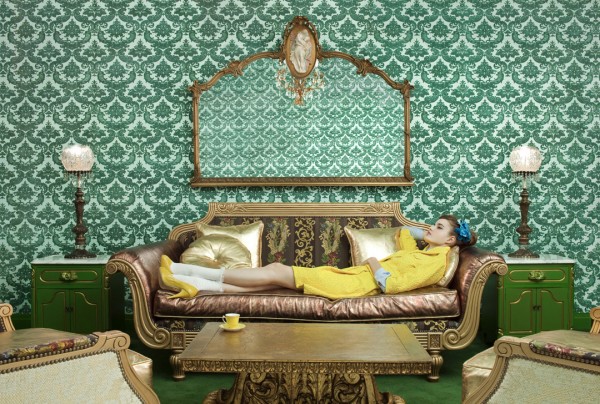
On September 13th, Julia Fullerton-Batten opened her first American solo show titled In Between at the Randall Scott Gallery in Washington, D.C. This London based photographer has been gaining recognition over the past two years for her photographic series, which depict the struggle of adolescence. Julia Fullerton-Batten uses intense set design and photographs girls who are not professional models to enhance the uncomfortable and awkward teenage experience. In her previous body of work, Teenage Stories, the artist focuses on images of young girls in a miniature world. Her work addresses the emotional transition of young girls, focusing on the duality of childhood fantasy and the responsibility of adult life. Fullerton-Batten creates intense images representative of the emotional physical changes of teenage girls, portraying loneliness and awkwardness combined with playfulness and whimsy.

Fullerton-Batten was born in Germany, graduated from the Berkshire College of Art and Design and currently lives and works in London. She has recently shown with the Shanghi Museum of Contemporary Art, the Gallery Caprice Horn in Berlin, theMarlborough Gallery in New York, the National Portrait Gallery in London. See more of her work in recent issues of Juxtapoz Magazine.

Share

Fan Mail: Aaron Ruell

For this edition of Fan Mail, Aaron Ruell has been selected from a group of worthy submissions.  If you would like to be considered, please submit to info@dailyserving.com a link to your website with ‘Fan Mail’ in the subject line.  Two artists are featured each month – the next one could be you!


Art and popular culture have long been fluid constructs – a truism evidenced in Aaron Ruell‘s multi-faceted career.  In addition to his photographic practice, Ruell works concurrently in popular film, in advertising and also in directing commercials.  He may not consider himself an actor, but is widely known for his role as Kip in cult-favorite Napoleon Dynamite (2004).  Ruell’s diverse interests no doubt have some influence on his photographic practice, but he nonetheless approaches it as a separate entity and a ‘precious’ means of exercising complete creative freedom.


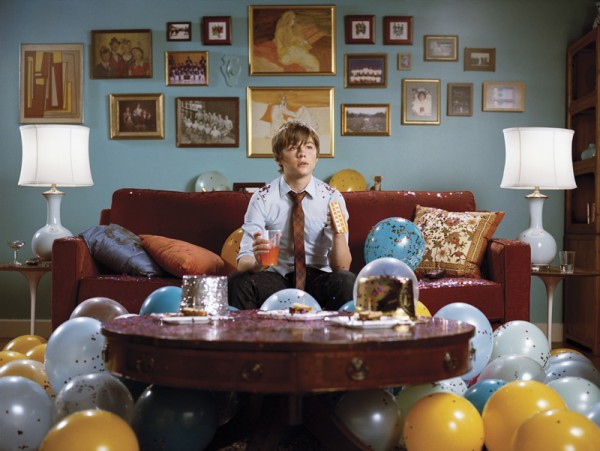
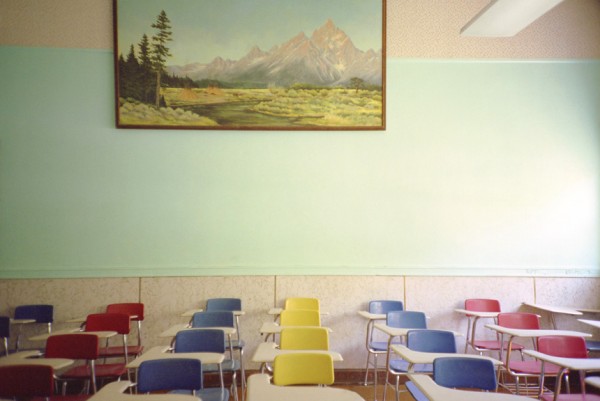
Aaron Ruell’s hyperreal photographs are currently featured in a solo exhibition at Martine Chaisson Gallery in New Orleans.  The images, shot over the past five years with a Hasselblad 500, an H2 and a Canon 5D, feature a cross section of his photographic portraits and environments inspired by everyday observation.  The artist may wander upon subject matter at times, yet he freely admits that he leaves little to chance in a practice ranging from documenting found locations to photographing purpose built and designed sets.  This meticulous approach facilitates a descriptive formal interplay between elements such as saturated color and form, making the smallest details visible.  In this way, Ruell engages the viewer with subtle narrative – imbuing his images with a retro cinematic quality.  Environment shots such as Class or China Wall read like vacant film sets or fragments of an untold story.


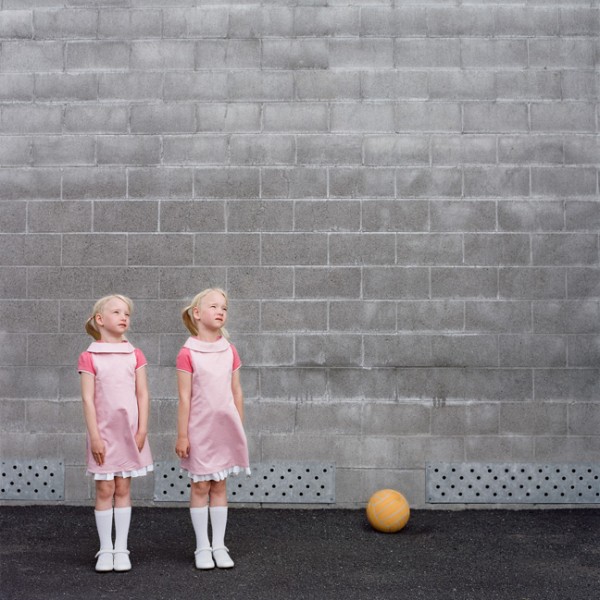
The importance of setting in Ruell’s work means that even his portraits are conceived of as a gestalt.  Like a director, he casts subjects to fill roles defined by a preexisting concept.  The human presence is ultimately treated as one of many instructive props in vignettes of an imagined life.  These quiet scenes filled with self-contained subjects manage to evoke an element of the strange.  Twins, for instance, recalls a similar Diane Arbus image.  Both are slightly unsettling in their rigid poses and identical doubling.  However, Ruell steps back, situating the twins within a visual context of his own design.

Ruell has a multitude of projects currently in the works, including a feature film and two photographic series.  Listen for him beginning January 2012 as he voices Kip in the upcoming animated Napoleon Dynamite television series.

His work remains on view at Martine Chaisson Gallery in New Orleans through June 1st.

Share

I Could Become a Million Things, But Not That

L.A. Expanded: Notes from the West Coast
A weekly column by Catherine Wagley

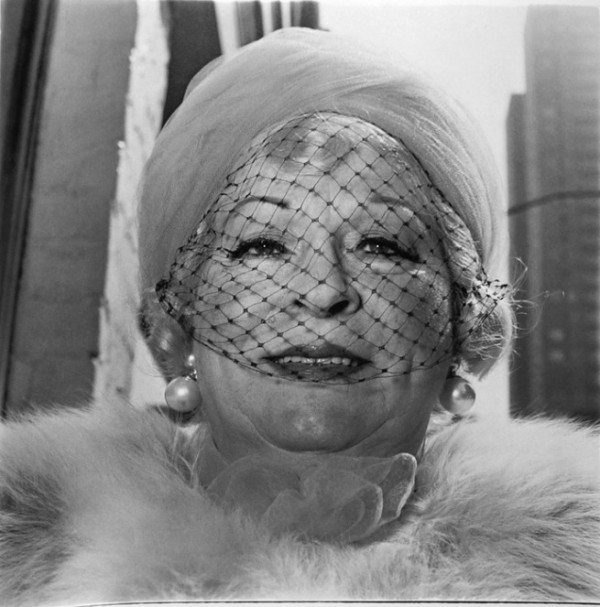
Diane Arbus, "Woman with Veil on Fifth Avenue, N.Y.C," 1968. © The Estate of Diane Arbus.

“Giving a camera to Diane Arbus is like putting a live grenade in the hands of a child,” Norman Mailer infamously remarked in 1971, less than one year before Arbus died and over nine years after she snapped a photo of a scrawny blond boy who actually did have grenade in hand. Whether Mailer, cavalier to a fault, meant to or not, his quip infantilized Arbus’ savvy, as has much of the opining and homage surrounding her photographic oeuvre in year past. On the cover of the catalogue for her recent retrospective, titled Revelations, you see her face, a hazy and grainy dark-eyed phantom, lurking behind two of her more stoic photographs. In Fur, the “imaginary” movie portrait by Steven Shainberg, you see Arbus, played by Nicole Kidman, as a weak-willed dreamy creative easily seduced by the world’s eccentrics.

Over the three decades since her painstaking suicide (barbiturates and wrist slitting), too much mystique has grown up around the obsessive strangeness of Arbus’s work and she has become, in some ways, as a dark an artist-figure as Sylvia Plath—a tortured soul, claimed Patricia Bosworth’s unauthorized 1984 biography. But  unlike Plath, who wrote of feeling terrified of herself and “incapable of more knowledge,” Arbus would throw herself fully into what scared her. “What’s important to know is that you never know; you’re always sort of feeling your way,” she said, and felt her way deftly.

"Diane Arbus: People and Other Singularities," 2011, Installation View, Gagosian Gallery, Beverly Hills. Photograph: the Douglas M. Parker Studio.

You won’t find much that’s new or unexpected in People and Other Singularities, the current exhibition of Arbus’ work on view at Gagosian’s Beverly Hills gallery. The show more or less functions like a retrospective, featuring the iconic photos of aging divas, eccentrics and freaks of nature, among them the famous image of the Jewish giant or the nudist colonies. But from the moment you walk in, you’ll be on an adventure that has less to do with soul-probing and more to do with pushing open the bubble of person-hood. “Do other people exist in the same way I do?” Arbus seems to ask over and over again. “It’s so hard to believe that’s true.”1

The first image you see when you enter the gallery—that mawkishly endearing shot of a grinning,, double-chinned lady in tulle hat and black netted veil—confronts you, aggressively, with its bodiliness. Yet it also has an infectious, quixotic tenderness. Often, that’s what Arbus provides: a body with physical quirks and features so overt they can’t be overlooked, yet a quiet relatability courses through underneath. It’s there in her portrait of the Roselle twins, the debutante Brenda Diana Duff Frazier, or the not quite Barbie-like women trying for the title of Miss Venice Beach. Arbus could climb into a community completely without faking belonging; always, she was looking in on something that wasn’t her.

Diane Arbus, "A young man and his pregnant wife in Washington Square Park, NY," 1965. © The Estate of Diane Arbus.

One summer, she spent her time working in Washington Square Park:

And there were these territories staked out. There were young hippie junkies down one row, lesbians down another—really tough, amazingly hardcore lesbians—and in the middle were winos. They were like the first echelon, and the girls who came from the Bronx to become hippies would have to sleep with the winos to get to sit on the other part with the junkie hippies. It was really remarkable and I found it very scary. I mean, I could become a million things, but I could never become that.

“[When I see] great art,” said novelist Zadie Smith, “when I read a great piece of fiction, what I’m being confronted with is exactly what is radically not me, a consciousness of the world that is so far from my own, it’s a shock.” Arbus shocked in that way, and, right now, in an era where obsession with identity politics, self-discovery and radical self-assertion (Cosey Fanni Tutti’s vagina photographs or Vito Acconci’s masturbation under the stairs play up the “I” of experience in a way that seems far less potent right now, in the era of youtube, file-sharing and self-exposure opportunities galore) has begun to seem stale, her work feels more poignantly, exquisitely relevant than ever. Whatever her personal demons, Arbus understood that other people were the whole point.

1. The above quote–“Do other people exist the way I do?”–also comes from Zadie Smith’s 2006 interview with Michael Silverblatt.

Share

Open Engagement: Art + Social Practice

Fritz Haeg lecture, photo by John Muse

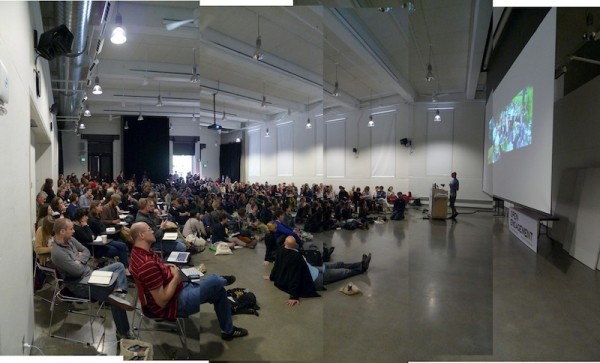
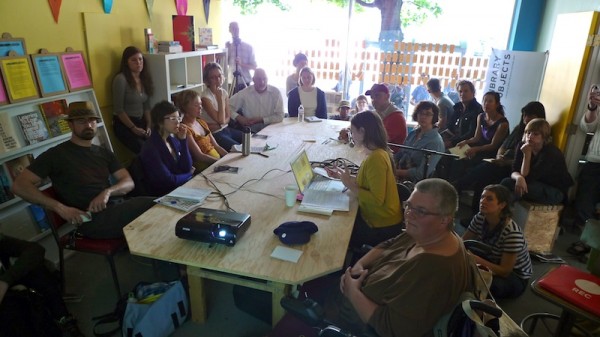
Last week the Open Engagement Conference gathered artists, critics, curators and one museum director to discuss an emergent field, Art and Social Practice. It was organized by Portland State University’s Art and Social Practice faculty Jen Delos Reyes and Harrell Fletcher along with their MFA students. This is the third iteration of the conference and it featured Julie Ault, Fritz Haeg, and Pablo Helguera – all of whom work across platforms such as art, architecture, education, curatorial practice and publication.

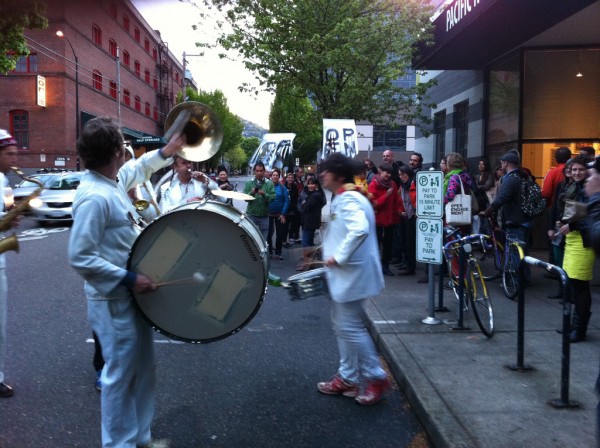
The structure of the conference included lectures by these artists as well as panels that addressed the relationships between Social Practice projects and museums and educational institutions with social practice programs such as CCA, PSU, OTIS, MICA, and UCSC. There were also a number of breakout sessions, performances and exhibitions.

Open Engagement, Elyse Mallouk presentation on "Landfill" photo by John Muse

Elyse Mallouk presentation on "Landfill" photo by John Muse

One early breakout session was a presentation by Elyse Mallouk, a CCA visual and critical studies MA student, on Landfill – a new project designed to archive the ephemeral detritus of Social Practice projects. The website emphasizes posters, pamphlets, maps and objects that were used in projects by artists such as Jeremy Deller, Santiago Sierra, and Superflex. One issue brought up in the discussion about this project was how to address the tension between fetishizing objects around ephemeral projects and treating ephemera in terms of their materiality and aesthetics. Another was about PLAND (Practice Art Through Necessary Dislocation). This project, run by three women who have worked as curators, artists and writers, is an off-the-grid residency program in Taos, NM. Their mission is to produce “open-ended experimental projects that facilitate sustainability, collaboration, and hyper-local engagement.”

Open Engagement, Photo by Jason Sturgill

The Museum summit included discussions about Social Practice projects at the Walker Art Center, the Hammer Museum, The National Gallery of Victoria, the Portland Art Museum and the University of California Berkeley Art Museum and Pacific Film Archive. Larry Rinder, the director of the Berkeley Art Museum, noted that he wished that more museum directors were there to discuss the issues around Social Practice. One reason for the importance of this was drawn out in the discussion, where there was often a clear tension between curatorial and education departments when it comes to projects that don’t focus on objects. One potential problematic was the tendency for Social Practice projects to serve as merely peripheral or interpretive events that exist in a decorative manner, around what is perceived to be the primary programs of the museum.

Rick Lowe, Fritz Haeg, Harrel Fletcher, Julie Ault, photo by John Muse

Rick Lowe, Fritz Haeg, Harrel Fletcher, Julie Ault, photo by John Muse

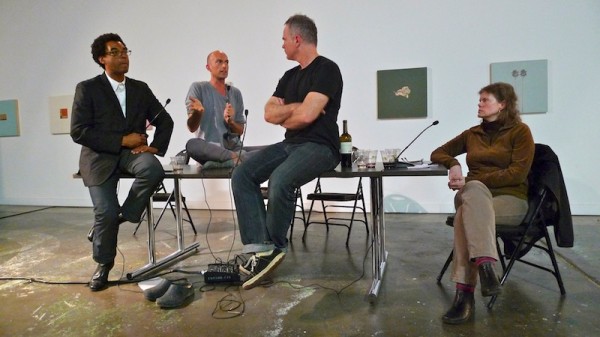
The artists’ lectures and their final panel discussion revealed some lingering questions that were only touched upon by the conference. What is the relationship between Social Practice and other art practices that have long historical and theoretical trajectories such as conceptualism, performance, institutional critique and the wide range of artistic engagements with art and politics? What is the relationship between the mostly American examples presented and other global models of socially motivated art practices? And finally, is there an aesthetic to Social Practice projects that involves groups of people gathering around and doing something?  As one community organizer from the Queens Museum of Art pointed out – maybe these will serve as the basis for next year’s conference.

Share