Venice Biennale: Hajnal Németh at the Hungarian Pavilion

Hajnal Németh: CRASH - Passive Interview, installation view, 2011.

Memory is deeply connected to the senses, far beyond the linear nature of storytelling. Words are often the farthest from the real “truth” of a scenario, leaving space for memory and imagination to take place. Sight and sound, smell and touch fill in the gaps that words cannot describe, and it is at this brink that Hajnal Németh’s installation CRASH – Passive Interview rests. Exhibited in the Hungarian Pavilion this year at the 54th Venice Biennale, Németh’s installation molds perception and memory through a simple event, adding layers of sensory experience to narrative.

CRASH – Passive Interview is loosely based on a recounted story of a car accident, slowed down to every minute detail. Entering the space, I was instantly filled with sensations of drama and pain erupting from the lifesize crushed car in the center of a large gallery. Sounds of an experimental opera encapsulate the room, while an extreme red light blankets not only the destroyed car but everyone in the space. Here, narrative relies solely on the emotive power of music and light, leaving the story to unfold as the space continues. The car rests as a relic of the story unfolding through the various sensory effects — transitioned from its objecthood by the light and sound into an almost uncanny filmic space.  The speed at which the narrative becomes clear mimics the sensation of experiencing a traumatic event, each detail is slowly understood.

Hajnal Németh: CRASH - Passive Interview, installation view, 2011.

In the center of the pavilion lies a space filled with stands for sheet music, providing visual access to the sensation of opera performances. The extreme, aggressive light from the destroyed car transitions into stage light, changing the sensory encounter from a largely cinematic experience into a performative relationship between the narrative and the event. Each stand holds the libretto, allowing one to follow the story through text. This text provides the first direct, although still disjointed, connection between sensory experience and narrative — unfolding the details of the crash that are simultaneously filling the space through audio and visual means.

Hajnal Németh: CRASH - Passive Interview, video still, 2011, camera: István Imreh.

In the last room, all parts of the narrative are brought together through a video of two singers performing the opera.  Although there is never a climax or revelation of the actual event, the elements of story, time, and sensory experience come together through the video. Here, CRASH – Passive Interview returns to the cinematic space of the room with the car, but removes the drama provided through the visual overload. This is the first time that Hajnal Németh provides the viewer with a picture of the event, even though it is through the image of the performers themselves.

In each gallery space, CRASH – Passive Interview turns the relationship between narrative and the senses on its head, leaving one with a disjointed story filled with perceptive and visceral sensations without concrete pictures. For an event as grandiose and dramatically visual as the Biennale, Hajnal Németh’s project for the Hungarian Pavilion offers a reminder that memory and consciousness go far beyond the pictorial field.

Share

Venice Biennale: Thomas Hirschhorn at the Swiss Pavilion

Image Courtesy of Contemporary Art Daily

Navigating through Venice in the off season can be challenging, but trying to move through hot, narrow streets and massive crowds of people during the Venice Biennale is completely dizzying. Illuminations, the 54th Venice Biennale, was the largest and most comprehensive to date with 89 national participants alongside 37 collateral events arranged by international organizations and institutions.  As usual, the exhibition spread liberally over Venice’s Arsenale and Giardini as well as in satellite locations throughout the city.

Image Courtesy of the Artist

After spending my first morning fighting my way to the Giardini, I stumbled my way into my first international pavilion, Crystal of Resistance by Thomas Hirschhorn representing Switzerland. This initial occurrence seemed all to appropriate, considering like Venice itself, the work is dense with cultural information and fully engaged in a cycle of production and consumption. In true Hirschhorn fashion, the all-encompassing and transformative installation feels strangely distant from the outside world, yet remains fully composed of materials of the western culture just beyond the doors. Bonded by packing tape, the various selection of tvs, chairs, printed images and video, toy dolls, aluminum foil, cotton swabs, bottles, and buckets (among countless other objects) are transformed through a second stage of mass-production. Perhaps the only material that doesn’t directly reference globalism and commodity culture are the thousands of crystals that are scattered throughout the installation, providing the heavy social context with the transformative “powers” of healing and beauty. Scale dramatically shifts between the craft-like plastic crystals to the oversized shapes made of plastic sheeting, fluorescent lighting, and wood, taking one all-encompassing installation from macro to micro with each step.

Image Courtesy of the Artist

Here, Hirschhorn maintains his emphasis on the excesses of contemporary life found in physical materials and visuals information, yet creates his own biological universe, giving form and weight to largely invisible processes. Plastic chairs and tvs carry their own cultural history while simultaneously becoming soil for the crystallized flora and fauna dispersed through the environment. Packing tape grows up the side of aluminum foil structures, and vines of photos drape between fluorescent lighting branches. Hirschhorn has imbued his installation with a life system that carries his references to consumer culture and economic chaos, offering the viewer an accelerated experience fueled on notions of the absurd and proliferated by discarded items of commerce.

Share

Counter-invasion: Stephanie Syjuco at Catharine Clark

Stephanie Syjuco, Raiders: International Booty, Bountiful Harvest (Selections from the A____ A__ M______) (2011). Archival Epson photo prints mounted on laser-cut wood, hardware, platforms, and crates. Dimensions variable. Image courtesy Catharine Clark Gallery.

Over a lifetime of visiting museums, you learn that all souvenirs have a price point, from the dollar-fifty commemorative postcard to the pieces in the collection itself.  These prized mementos, selected, brought home, catalogued and displayed, represent the collector’s forays to classical or far-flung sites. My favorite disruption to this cycle is a hall of life-sized plaster casts of classical Greek and Roman architecture at the Carnegie Museum in Pittsburgh, which allows visitors to tour bits and pieces of many separate sites simultaneously, leaving the original buildings intact. Stephanie Syjuco’s solo exhibition, RAIDERS, at Catherine Clark Gallery, offers the same historical jumble, along with questions about access, reproduction and the institutional stewardship of cultural objects.

Stephanie Syjuco, Phantoms (FREE TEXT: You Say Illegal, I Say Legitimate) (2011). Large-format black and white xerox poster. 48 x 36 inches. Image courtesy Catharine Clark Gallery.

Syjuco’s recent ShadowShop (2010) project at SFMOMA invited artists to set up shop in the exhibition galleries, bypassing traditional routes to a museum show and earning 100% of the sales. With RAIDERS, Syjuco looks to objects already ensconced in historical canons: traditional Asian ceramics and Joseph Conrad’s Heart of Darkness.  While her subjects represent ways that Western culture has viewed other societies as dark territory to be explored or invaded, this is the most obvious and least interesting part of the show, or would be without the noise of commerce surrounding the work. Syjuco’s reaction to this post-colonial booty: conduct a counter-invasion of her own that points to contemporary economic models tied to museums, shopping, illegal downloads, and copyright.

Stephanie Syjuco, Phantoms (h__rt _f d__kn_ss) (2011). Mixed media installation. Dimensions variable. Image courtesy Catharine Clark Gallery.

For the show’s titular piece, Raiders: International Booty, Bountiful Harvest (2011), Syjuco has downloaded, printed, and mounted life-size images of Asian vessels from public art databases onto wood backings, like an army of paper dolls.  Placing them on wooden crates and shelves, Syjuco sometimes sorts the vessels by shape, sometimes by color.  The photographic perspective varies from piece to piece, some veering off at a steep angle and others pixilated from enlargement. These quirks become important if you view artwork with an eye to what is unique, but unlike the original vessels, these sculptures are copies, in editions of three.  Also unlike the originals, they are for sale.

Stephanie Syjuco, Raiders (2011). Installation view. Mixed media. Image courtesy Catharine Clark Gallery.

For those who want a souvenir they don’t have to pay for, Syjuco has printed large posters in the style of street flyers.  Visitors ripped away most of the tabs during the opening, but the posters are an unlimited edition and their collector may reproduce them ad infinitum.  These posters, each announcing the URL of a source for a free download of a text, introduce Phantoms (2011), an array of downloaded and bound copies of Joseph Conrad’s Heart of Darkness.

Stephanie Syjuco, Phantom (Vase with Hundred Flowers) (2011). From RAIDERS, Souvenir Postcard Set (2011). Image courtesy Catharine Clark Gallery.

With Raiders, Syjuco highlights the silent authority of the museum collection, pointing to the forces that enshrine these vessels as a particular type of cultural heritage.  In conjunction with Phantoms, however, Syjuco turns the question of acquisitiveness back on her audience.  By offering freely-accessed items for sale, Syjuco’s project asks us to decide what we’d like to do: buy a souvenir or pirate one.

Stephanie Syjuco’s RAIDERS is at Catharine Clark Gallery in San Francisco through July 16, 2011.

Share

From the DS Archives: Spencer Finch

This Sunday, From the DS Archives invites you to check out a recent commission by American artist, Spencer Finch. Finch is one of the 19 international artists selected to create a commission for the Folkestone Triennial, opening June 25th and just an hour away from London by train. For his commission, titled The Colour of Water, Finch observed the varying tone and color of the English Channel over many weeks in order to create a palette of colors that reflect the water’s ever-changing appearance. One hundred flags were dyed with these colors and each day, an observer will select a flag to hoist above the town that most closely resembles the current color of the sea.

This article was originally written by Benjamin Bellas on April 18, 2009.

SpencerFinch2.jpg

On view at Rhona Hoffman Gallery is Light, Time, Chemistry, an exhibition of work by Spencer Finch. In this exhibition, Finch references both phenomenology and the psychology of perception, capturing and re-contextualizing fleeting and ephemeral elements from our surroundings. Among the many works exhibited is Periscope, a photographic device composed of mirrors and ventilation ducts that extends from inside the gallery to the outside and allows visitors to view the changing sky. The periscope was used to expose a cyanotype directly on the wall of the gallery, creating a hazy blue image from a two-day exposure of the Chicago sky.

Also on display is Finch’s installation Shadow, Sculpture of Centaur, Tuileries (after Atget), a component of a larger body of work entitled Shadows (After Atget). In this work, Finch captures the ephemeral phenomenon of shadows, focusing specifically on re-creating light from locations of Eugene Atget’s photographs of Paris. Employing a fluorescent tube lamp covered with colored filters of Isaac Newton’s spectrum, the light functions as a reverse prism, emitting the very polychrome grey light of the Parisian shadows photographed by Atget almost one hundred years ago.

SpencerFinch1.jpg

Spencer Finch was born in New Haven, Connecticut, and lives and works in Brooklyn, NY. He studied at Rhode Island School of DesignHamilton College in New York and Doshisha University in Kyoto. Finch had a major solo exhibitionWhat Time Is It On The Sun? at MASS MoCA, Massachusetts in 2007, which was accompanied by a monograph with essays by Susan Cross and Daniel Birnbaum. The artist will be a participant in the upcoming 53rd Venice Biennale this June.

Share

Interview with Glenn Adamson

Today’s interview is from our friends at Art Practical, where Bean Gilsdorf gets a chance to chat with Glenn Adamson, deputy head of research and head of Graduate Studies at the Victoria and Albert Museum, where he leads a graduate program in the History of Design.

Jean Paul Goude. Maternity dress for Grace Jones, 1979.

My interest in Glenn Adamson’s work began in 2006 with his essay “Handy-Crafts: A Doctrine,” which is included in the anthology What Makes a Great Exhibition? In this essay, Adamson posed a question that was to become an encapsulation of his practice as a historian and curator: “When the climate is so militantly hostile to an intelligent handling of craft, how is a curator who is interested in craft to navigate the shoals?” His answer is disarmingly simple: “treat craft as a subject, not a category.”1

Over the past decade, Adamson has been one of the few to investigate and re-envision craft from this wholly new position. He followed “Handy-Crafts” with the 2007 Thinking Through Craft, which argues that the supplementary status of craft is its very strength and that its position in the margin of art allows it space from which to provide a critique. Recognizing the absence of any standard for basic craft education, Adamson edited The Craft Reader in 2010, providing a foundational-level education in materiality, objecthood, and labor through the inclusion of essays by Karl Marx, William Morris, Annie Albers, and Lucy Lippard. I sat down with Adamson on April 1, 2011, just before he gave the keynote speech at the “Craft Forward” symposium hosted by the California College of the Arts in San Francisco.

Jayme Odgers and April Greiman. Cover, Wet Magazine (the Magazine for Gourmet Bathers), 1979.

Bean Gilsdorf: You’re putting together a show at the Victoria and Albert Museum (V&A) in London on postmodernism, and I wonder if you could start by defining that term, because it’s so contentious.2

Glenn Adamson: The definition that we’ve been using—or the application of the term that we’ve been using—is that postmodernism is the proliferation of responses to the collapse of the modernist project. Rather than defining it positively, we’ve defined it as a phase of thinking and practice that occurs because the sometimes utopian or progressive practices and certainty of modernism—best known in architecture, but known in the other arts as well—collapses and you have something in its wake. That’s postmodernism. It’s very much a relational term, and it’s essentially based on the idea of freedom and difference. Modernism is like a transparent window, and it pretends to show you the world clearly, and postmodernism is like a shattered mirror, so it reflects yourself at yourself, but in fragments. It doesn’t necessarily pretend to truly show you anything; it’s simply a reflection of your own situation. That’s the long version; the short version is that postmodernism is what happens after modernism dies. What’s interesting, of course, is that modernism was revived in the 1990s. To some extent, it didn’t ever go away, because you always had modernist holdouts, but modernism again became the dominant style, and then you arguably have a kind of hybridization of various modernist and postmodernist motifs and approaches. But in any case, we’re thinking about postmodernism in the ’70s and ’80s, in that reactive, destructive way.

BG: In your previous craft projects and in your interest in craft, I am interested in your application of the term friction—where you identify a sense of working against something. Is that how you came to the idea of doing this project on postmodernism?

GA: The museum leadership pitched the idea to my cocurator Jane Pavitt and me, but it immediately appealed for exactly the reason you’re saying. I help edit The Journal of Modern Craft, which places modernism and craft in opposition. I’ve always thought of craft as something that is both produced by modernity and contests it. Postmodernism is the same thing, except with a very different structure.

Martine Bedin. Super Lamp, 1981. Photo: Christie's Images, Ltd.

BG: Do you tend to think in poles of opposition?

GA: Dialectically. It’s always about exposing a false opposition, or seeing how an opposition works, sometimes to create a synthesis and sometimes, possibly, to create further fragmentation as well. Marx thought that a real dialectic was one that was resolved. So he would say that if there was no possibility of resolution, you weren’t looking at a dialectic. But I think of opposition in postmodern terms, as leading to further fragmentation, or a rhizomatic, infinite cascade.

Read the rest of the interview here.

Share

Most Beautiful Boy

L.A. Expanded: Notes from the West Coast
A weekly column by Catherine Wagley

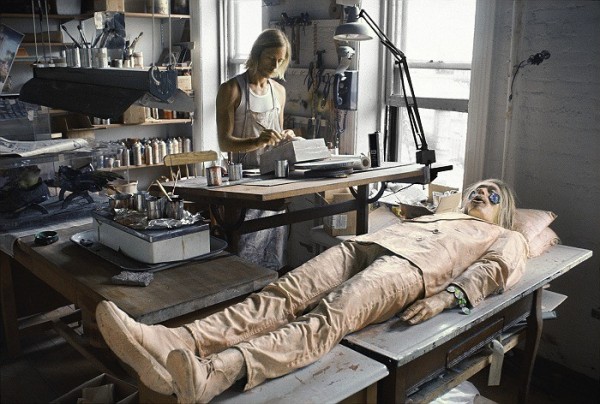
Peter Hujar. Thek at his work table in Oakleyville, Fire Island, 1967 (reproduced from the original color slide). ©1987 The Peter Hujar Archive LLC; courtesy Matthew Marks Gallery, New York.

Sometimes, an artist strikes a chord with his contemporaries, and affection for him ripples through culture more distinctly and effusively than anything he’s actually made.  Paul Thek was that kind of artist, perhaps better suited to being a muse than to having one. Homages began coming his way before he’d cleared thirty-five and,  lucky for us, this means countless, compelling bits of him course through the arts and ideas left over from recent decades.

Even before you enter Paul Thek: Diver, the artist’s first-ever museum retrospective, you’ll see a photograph of Thek, blond, big-eyed, wearing a wife beater, surrounded by the eccentric trappings of his trade. Taken by Thek’s then-lover, photographer Peter Hujar, the image radiates deeply shared admiration—born George, Thek took the name “Paul” so that he and Hujar could move through the world as the ecclesiastical “Peter and Paul.” Then, in the foyer before the first main gallery,  you’ll see a screen test of Thek, even younger, with short hair that made him more boyish and less willowy then he later became, excerpted from Andy Warhol’s 13 Most Beautiful Boys. Though the show makes no explicit reference to Thek homages by Mike Kelley, David Wojnarowiz or virtuoso critic Susan Sontag, by the time you’ve wandered through, you’ll have a sense of what charmed them. Everything he made, whether memorable in itself or not, felt drenched in a moment, even though Thek routinely rejected the minimalism and pop sleekness that dominated his era.

"Paul Thek: Diver, A Retrospective." Installation view at the Hammer Museum, Los Angeles. May 22 – August 28, 2011. Photography by Brian Forrest.

"Paul Thek: Diver, A Retrospective." Installation view at the Hammer Museum, Los Angeles. May 22 – August 28, 2011. Photography by Brian Forrest.

Paul Thek: Diver arrived at The Hammer Museum via The Whitney late in May, the love-worn project of Whitney curators Elisabeth Sussman and Sondra Gilman and Lynn Zelevansky of the Carnegie Museum.  The exhibition includes two decades of work: gory but still-vibrant flesh sculptures (“meat pieces”), wax effigies, whimsical installations and notoriously “bad” paintings. Its layout, roughly chronological, follows the nomadic artist to his various international destinations. There are rooms dedicated to his early life in New York, his time at a foundry in Italy, time in Paris and Scandinavia, and, finally, his return to NYC. Each phase is particular, though all throughout, stories of loss or near-loss accompany his sometimes exquisite, frequently haphazard objects.

Thek was expelled from a Rome foundry when it went bankrupt in the late 70s, and he lost a portion of The Personal Effects of the Pied Piper, small, seemingly charred bronze sculptures of items that could have populated a campsite. Dwarf Parade Table, a long dining table held up by dwarfs he  learned to make from a craftsman of garden statuary, was installed as part of documenta 5 in Lucerne. Three years later, a curator from the Kunstmuseum Luzern asked for permission “to drop all wooden material” from Thek’s work—the museum just couldn’t store it any more. The parade table survived in whole, others not.

Paul Thek working on The Tomb in his studio, circa 1966. Photo © Peter Hujar

In the early 80s, when Thek was back in the states for good, he received a call that a piece he’d made in 1967, The Tomb, had been sent back from Europe, where it had been on exhibit. A wax cast of himself, dead with two psychedelic plates on his cheeks, the piece had been dubbed The Death of a Hippie, though Thek said it never had to do with hippiness. He didn’t pick it up, and it remains, in the words of curator Richard Flood, “one of the great, lost works in American art.”

But such  loss seems a small tragedy for Thek, whose bodies of art were always more instinctively diverse and immediate then tightly directed toward posterity.  In fact, in moving through the Hammer show, the works that have survived appear to have done so by accident, because Thek left them somewhere safe, or happened to craft them out of more or less indestructible material.

“Think of the sheer multiplication of works of art available to every one of us, superadded to the conflicting tastes and odors and sights of the urban environment that bombard our senses,” wrote Susan Sontag in her 1964 essay, Against Interpretation, dedicated to and likely inspired by Thek (a year after his 1988 death, of AIDS, she would dedicate AIDS and its Metaphors to him as well). “All the conditions of modern life–its material plenitude, its sheer crowdedness–conjoin to dull our sensory faculties.” At the Hammer, Thek is present en mass, but he’s best in his specificity, experienced one piece, one phase at a time–not because the pieces are singularly fantastic in themselves, but because each was meant to exist in its own time, and each had its own quirks and inspirations.

Share

Margie Livingston: The Archaeology of Practice

Study for Spiral Block #2, 2010 Acrylic 5.75 x 6 x 6 inches Photo: Richard Nicol

There is a well-worn narrative of twentieth century painting that goes like this: From Cezanne to Picasso to Pollock, the illusionistic space of painting flattened more and more until the picture plane and the surface created by the paint itself became the primary subject matter, eliminating images altogether in favor of abstraction. While this teleology has some merit, the purity of the story is incomplete. When Linda Benglis began pouring polyurethane on her studio floor, creating a sculptural object, paint itself began to function as a readymade. Linda Besemer then recognized abstraction as a metaphor, working with it in terms of its figure/ground relationships. The figure of paint, once removed from the ground of the canvas used the world – including the architecture and institution of the museum as well as the social relations of its public –as its ground.

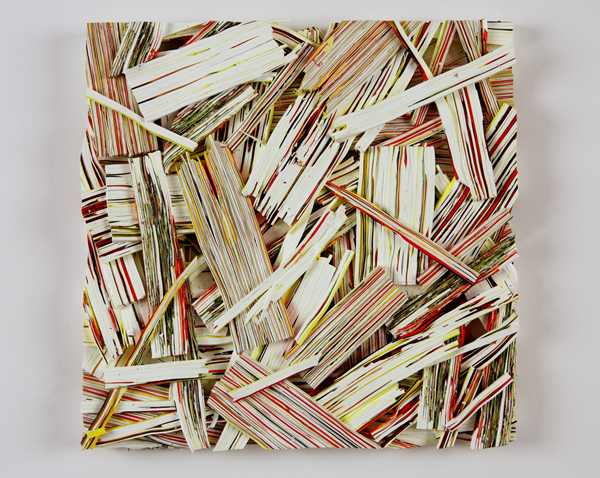
Study for Waferboard, trimmed, 2010 Acrylic 8 x 8 x 0.75 inches Photo: Richard Nicol

Margie Livingston’s work participates directly in this narrative, creating hybrid objects that shift back and forth between sculpture and painting as well as abstraction and representation. After making paintings on canvas for many years, Livingston began pouring paint, layering it, then cutting it and breaking it apart in order to construct objects that are images of their own making. But while these works are abstract, they begin to resemble other objects like wooden blocks, stone, or waferboard. In this sense she breaks two cardinal rules of modernist painting by making works that are images of other things while at the same time telling a story. But the images depict raw materials that have the potential for making other artworks and the story that she tells is modern art history itself. So these works become objects that at once enact pious devotion and heretical rebellion – rooted in both process and conceptual reference.

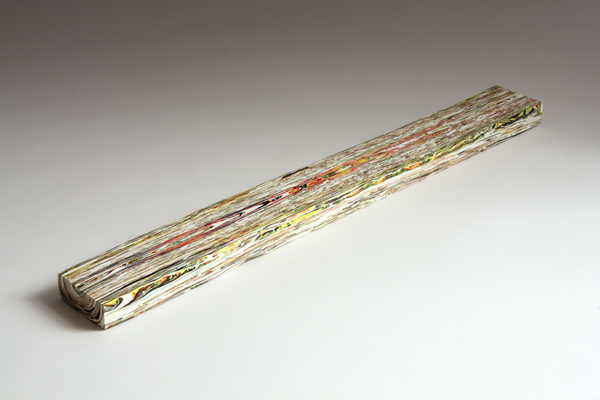
Study for 2x4, 2010, Acrylic 1 1/8 x 2.75 x 24.75 inches Photo: Richard Nicol

Her logs of paint begin with about a dozen sheets, each one made with two gallons of paint. They are laminated together then milled and cut into 2 x 4 pieces of lumber, much in the same way that wooden beams are made.  This gesture marks an apparent turn away from a sublime notion of nature, replacing it with artifice. By making a plank of wood out of plastic paint, Livingston also points to the role of mechanized production in the timber industry. In this sense, she participates in a contemporary sublime of plastic beauty, leaving behind the Romantic attachment to nature’s mythic truths. Our conception of the natural and a truth of origin is just as much of a cultural construction as a milled log made of plastic paint. Maybe these faux natural objects remind us of the environmental threats of our time. But that does not preclude them from being objects of wonder and beauty.

Waferboard, 2010, Acrylic 30 x 22 inches Photo: Richard Nicol

Seattle-based artist Margie Livingston is represented by Greg Kucera Gallery. She has exhibited her work at Luis De Jesus Gallery in Los Angeles, Richard Levy Gallery in Santa Fe and will be included in an upcoming exhibition at LACE (Los Angeles Contemporary Exhibitions).

Share