Under Destruction I & II

Today’s article is from our friends at Art Practical, where Christine Wong Yap discusses the group shows Under Deconstruction I & II at the Swiss Institute. Under Deconstruction III is open through August 7th.

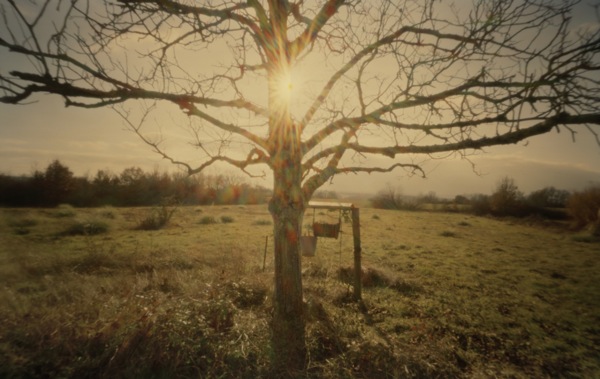
Nina Canell. Perpetuum Mobile (40kg), 2009-2010; water bucket, steel, hydrophone, mist-machine, amplifier, cable and 40 kg cement; dimensions variable. Courtesy of the Artist and Konrad Fischer Galerie, Berlin/Düsseldorf.

What if we thought of the substance of art not as media, but as matter? Matter exists continuously, whereas media must be elevated to the status of an art object. In turn, by making art, artists are performing manipulations, not transformations. The process shifts from an alchemical to a quotidian one.

The works in Under Destruction I and II inspired that thought experiment by presenting creation and destruction as interdependent—and sometimes as the same. The well-curated exhibition features cerebral, oft-kinetic sculptures, installations, and media projects dating from the past twenty-three years. It’s a welcome introduction to contemporary European, American, and Latin American artists and their open-ended works that provides little resolution and much room for interpretation.

A group exhibition originating at Museum Tinguely in Basel, Under Destruction appears in New York in three consecutive and heterogeneous chapters, all at the Swiss Institute. Under Destruction I was a quiet, poetic prelude featuring understated sculptural works made with commonplace objects. Nina Canell’s Perpetuum Mobile (40kg) (2009–2010) is an elegant example. A bowl of water sits on the ground next to a paper sack of cement. Activated by sonic vibrations, the water is frothed to a fantastical mist, which solidifies the adjacent building material imperceptibly.

Seductive illusion has little pull in this show—forms result from materials and processes. Nina Beier and Marie Lund’s History Makes a Young Man Old (2011) is a crystal ball that was rolled to the gallery from its place of purchase in a site-specific performance. The marks of experience obscure the clarity for which the material is valued; it’s not much to look at, and that is the point. In Monica Bonvincini’s White (2003), a cube of cracked safety glass houses an armature of neon tubes, interchanging structure and surface. Pavel Büchler’s Modern Paintings (1999–2000) is a series of abstract paintings collaged from found paintings that have been cut up and put through a washer.

Liz Larner. Corner Basher, 1988; steel, stainless steel and electric motor with speed control mechanism, 10 feet high. Courtesy of the Artist and Galerie Michael Janssen, Berlin.

Two single-camera media works hint at the active destruction in the next chapter. Micheal Sailstorfer’s Untitled (Bulb) (2010) shows a light bulb fracturing on impact. Originally shot in high-speed HD video and then transferred to 16mm film, it literalizes the high compliment that digital images can achieve film quality. Alex Hubbard’s Cinépolis (2007) adopts an action painting–like procedure for video, in which a projection screen is destroyed in service as a canvas for blowtorched Mylar balloons, tar, and feathers.

Everything the first isn’t, the second chapter is: noisy, spectacular, and physically stressful. Under Destruction II is a dissonant factory of counter-production. The influence of Jean Tinguely’s kinetic machines is acute. Visitors control the speed of a wrecking ball that demolishes the gallery walls in

Liz Larner’s Corner Basher (1988). Whacking the sheetrock at low speeds is pleasantly subversive. But at the highest setting, it whips around with the frightening velocity of a trebuchet, and the centrifugal force threatens to topple the machine. I felt a palpable breech of safety; Larner had created a scenario that cast my limits in high relief.

Read More…

Share

Video, an Art, a History 1965 – 2010

Bruce Nauman, Going Around the Corner Piece, 1970, © Coll. Centre Pompidou. Photo: Georges Meguerditchian

In the self-explanatory show entitled Video, an Art, a History 1965 – 2010, the history and evolution of the video art genre are recounted through 50 video works and installations, drawn from the collections of both the Singapore Art Museum and Centre Pompidou. Having developed in tandem with the apparatus of television and the analogue and then digital video cameras, video art’s reconfiguration of the politics of image-making and its ability to place the spectator as an indispensable agent in a work’s existence are significant tenets on which the exhibition is established. The infinitely widening scope and scale for the production and interpretation of (moving) images, the mode of their dissemination, and the documentation of performances (technical or otherwise), pose several key but general questions around which the works are grouped.

The pertinence of such questions however, falters in the collaborative effort that has shown up more differences than similarities. Reconciling the inventory of the Singapore Art Museum with the Centre Pompidou’s reveals the tentative forays into the processes of historicisation that are only beginning to develop in Southeast Asia and the inevitable rift in the standpoints of Western art and Southeast Asian art history. The Pompidou’s international collection stretches back 4 decades to the genesis of video art; the Singapore Art Museum’s inventory spans approximately a decade that really began with the Asian Financial Crisis (1997-8) and is focused on works produced in the surrounding geographical region. The wider ramifications of this collaboration go beyond an overwhelming inventory imbalance and the expanded visual vocabulary that video technology provides; indeed the emerging ideological differences become apparent when speculative comparison – the attempt at a comparative video-art history, should it even exist – inevitably sets in.

Pipilotti Rist, A la belle étoile (Under the Sky), 2007, © Coll. Centre Pompidou. Photo: Georges Meguerditchian.

The seeming futile effort of historicising video art in this instance, is thus mitigated by several thematic (and loosely chronological) focuses that ground the show: television critique, the representations of self, the documentation of performance, installation in space, landscape as metaphor, video-as fiction and the deconstruction of narratives.

If early efforts by video pioneers such as Nam June Paik, Bruce Nauman and David Hall took the definition of an art object beyond its conventional parameters as a static entity produced for visual consumption, perhaps the greatest strength of video art triumphed in this show is the unprecedented potential of experiential interactivity between artist, installation and spectator. Peter Campus’ Interface (1972) invites the viewer to superimpose their reflection onto their projected image after which they simultaneously face 2 images of themselves – one of the video image and their reflection on the glass screen. The inherent sense of ego coupled with a measure of curiosity is a potent brew, particularly when facets of the multi-layered self are revealed in art. Like the literary Doppelgänger (the ghostly and sinister double), artists’ early efforts recognised the potential of video art in exploring the loss of existential reference in which the traditionally held view of the consecrated sense of self is destabilised. In Bruce Nauman’s Going around the Corner Piece (1972), the surveillance set-up is symmetrical and simple: perched in the corners in a white square-room are closed-circuit cameras and small TV monitors that capture visitor movements going around the corner of the enclosed space. The spectator’s image disappears from view as he/she rounds a corner; speeding up in an attempt to play catch-up with one’s image results in a unsuccessful tail-chasing endeavour – which is probably the glorious core and yet most vexing part of this work.

Peter Campus, Interface, 1972.

Departing from the investigative preoccupation with the apparatus and the monolithic hold that television had, video art had, by the 1980s, begun deconstructive strategies of memory and narratives, debunking on its way, stereotypes of sexuality, ethnicity and gender perpetuated by the very same mode. Nam June Paik’s semi-documentary Guadalcanal Requiem (1979) explores the subjectivity of memory through the deconstruction and subsequent reconstruction of narratives, in a film that coalesces history, time, cultural memory and mythology on the site of one of World War II’s most devastating battles in the Solomon Islands. Surrealistic images of archival footage, interviews, Charlotte Moorman’s fragmented cello performances come together like a scratchy Hitchcock–Buñuel/Dali crossover. The haunting collage is often fraught with poignant tension and a sense of the macabre: interviewees with singular (or paltry) memories picking up where some have left off; Moorman playing a cello with a long palm leaf against a thunderous horizon, and at another time, performs concealed in a body bag.

Guadalcanal Requiem, Nam June Paik, 1979, © Nam June Paik Estate video still Courtesy Electronic Arts Intermix (EIA) New York

A deconstructive approach to the moving image seemed to be video art’s trajectory from the 1990s into the early 21st century, incorporating new developments of photo processing, digital editing and image layering in contemporary visual culture. Swiss conceptual artist Pipilotti Rist’s A la belle étoile (2007) moves between micro- and macrocosms on horizontal and vertical surfaces. As suggested by curator Christine Van Assche, such works operate on removing depth of field, redefining in the process, the spectator’s own rapport with space.

Despite the influence of the commercial mainstream, video art has nevertheless, retained its earlier forms: the performance documentary, mixed-media texts, or even the visual portrait. Such forms seem conceivably better suited to the preoccupation with art’s social purpose and its context of production that remain dominant traits in Asian-produced videos; perhaps most similar to the historical Western notions where art was produced within corresponding socio-political backgrounds. Just as Gustav Courbet’s post-romanticism was a rejection of academic and bourgeois juste milieu, much of Southeast Asian works are filled with the rhetoric of social change in which media artists show no desire to be unbound from their local cultural matrices. By continuing to invoke ties to tradition, incredibly varied configurations (or even fragments) of history that appear in Asian works at best, seem to read as disjointed narratives to the viewer unschooled in the intricacies of China’s tumultuous last few decades.
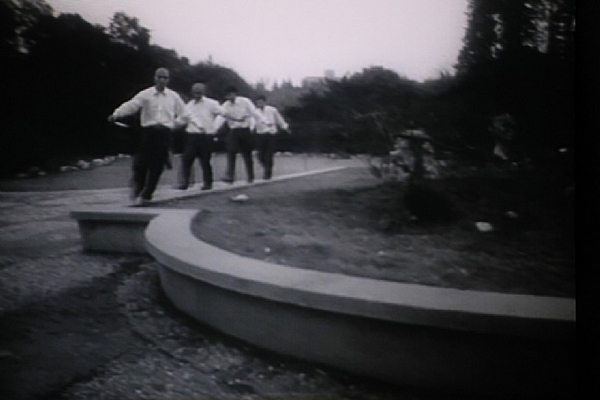
Yang Fudong, Backyard - Hey! Sun is rising, 2001.

Yang Fudong’s Backyard – Hey! Sun is Rising (2001) follows the Keatonesque slapstick antics of four young men enacting military rituals and traipsing around with swords, questioning the meaning of rituals in the wake of social changes. A richer meaning however, could be gleaned from Yang’s work if considered in the light of the communism’s wane, as well as in the historical traditions of Zen, martial arts and the aesthetic disciplines of poetry, painting and calligraphy – all of which are mirrored in aesthetic form and content in his videos. Like Yang’s disoriented characters who seem to seek penance in an environment marked by repression, The Propeller Group’s Uh… (2007) confronts Vietnam’s youth culture’s adaptations to the changing socio-cultural and political landscape through the symbolic use of graffiti, and the disorder and spontaneity it represents – the antithesis of Vietnam’s ordered socialist state.
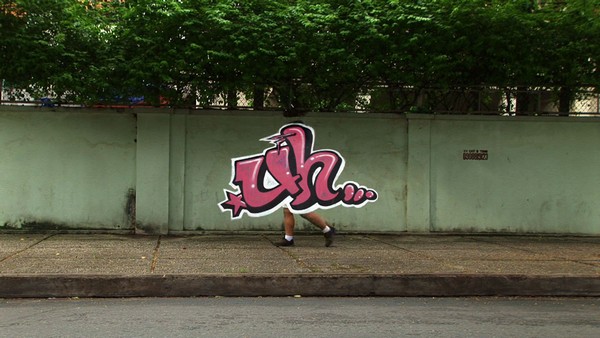
Uh..., The Propeller Group, 2007, Singapore Art Museum Collection

Manet's Luncheon on the Grass and the Thai farmers, Araya Rasdjarmrearnsook, Two Planets series, 2008, Singapore Art Museum collection

While Western artists like Pierre Huyghe and Issac Julien integrated mixed media installations with the spectacular and immersive experience of cinema, Asian filmmakers also tended to persist with the use of narrative (and at times, the meta-narrative) as a didactic strategy. In Araya Rasdjarmrearnsook’s The Two Planets Series (2008), Thai farmers – groups of people blithely oblivious to the cultural or economic baggage associated with canonical works of Western art history – talk about several cornerstones of modern European painting. Their discussions of Manet’s The Luncheon on the Grass (1863), van Gogh’s The Siesta (1889-90) and Millet’s The Gleaners (1857) are artlessly literal, context-less and extremely humourous, with the constant comical tendency to drift towards off-topic situations. Straddling the diverse worlds of rural farming and art history, Rasdjarmrearnsook raises questions of socio-cultural context, the parameters of interpretation and appreciation, but stops short of suggesting that our efforts in basting together a coherent narrative and interpretation of art are vain but significant detractors from the lost pleasure of looking.

********

Video, an Art, a History 1965 – 2010 is presented by the Singapore Art Museum and the Centre Pompidou, and runs through 18 September 2011.


Share

Artstars*: John Waters at the Venice Biennale

Today’s video is from our friends at ArtStars*, a traveling show about the contemporary art world, out to uncover the 7 Unsolved Mysteries of the Art World — one art scene, one country at a time. In this video, host, Nadja Sayej, catches American filmmaker John Waters at the Venice Biennale 2011 to ask him about that piece of art he made called “Contemporary art hates you.”

Share

For A Long Time at Roberts & Tilton

Marina Abramovic, Rhythm 10 (1973). Black-and-white photograph and letterpress text panel. Image courtesy Roberts & Tilton Gallery.

In The Body in Pain: The Making and Unmaking of the World, scholar Elaine Scarry describes the inability of language to interpret and express physical pain: “By its very nature, pain resists, even destroys the language that grapples with it.” But what of the capacity of visual art to interpret and translate this bodily experience? “For a Long Time”, on view now at Roberts & Tilton in Culver City, attempts to answer this question by showcasing visual work that grapples with physical endurance and its effects. The result, though ambitious in scope, is a little too conventional.

For A Long Time, installation view. Image courtesy of Roberts & Tilton Gallery.

“For A Long Time” takes its cues from a long lineage: in 1974, an assistant nailed Chris Burden to a Volkswagen Beetle for his performance piece Trans-fixed; in 1989, Matthew Barney jumped for hours on a small trampoline in Drawing Restraint 6; and, in 1997, Francis Alÿs pushed a solid block of ice through the streets of Mexico City for seven hours until it melted in The Paradox of Praxis I. Several among the show’s artists—Marina Abramović, Vito Acconci, and Hamish Fulton—have made a lifelong practice of using their own bodies as raw material. Abramović’s Rhythm 10 (1973), for example, depicts the artist kneeling piously before a series of neatly arranged knives; in a smaller, neighboring frame, a descriptive text written by Abramović reveals that her performance will consist of cutting herself with each knife. In A Machine For Living (1981),Vito Acconci, the self-described “godfather of transgression and pioneer of performance art,” pairs charcoal drawings and photo-documentation of himself swinging his body around a hulking, nonfunctional sculpture. The work is strong but predictable, and the show benefits from the presence of a few younger artists, such as Whitney Hubbs and Erica Love, who diversify the group.

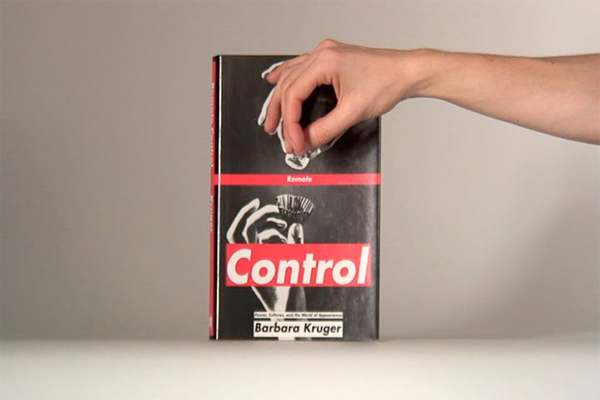
Erica Love, Remote Control (2009). Video still. Image courtesy of Roberts & Tilton Gallery.

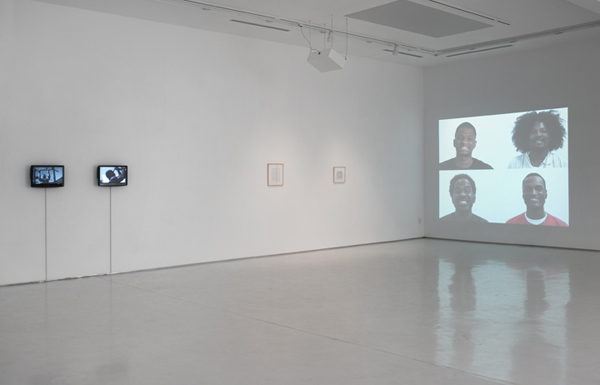
“For A Long Time” is at its best not when it considers pain and physical endurance at large, but rather when its artists seize upon the moment of breakdown, the threshold between having control and becoming unhinged. In their respective video pieces, Smile (2001) and Remote Control (2009), Kehinde Wiley and Erica Love achieve this unnerving quality. Wiley, famous for his heroic, realist paintings of Titian-esque, young African-American men, has made a multi-channel video picturing four African-American men, each attempting to hold a smile while facing the camera. As time wears on, their smiles turn to strange grimaces, their cheek muscles twitching in discomfort. In her single channel video, Love holds Barbara Kruger’s book, Remote Control (1993), her hand in the same pinched position as the appropriated image on the cover.  Love holds this positions until she can no longer bear it, and, after thirty-seven minutes and twenty-six seconds, drops her unsteady hand.

Kehinde Wiley, Smile (2001). Installation view of video. Image courtesy of Roberts & Tilton Gallery.

The show’s intentions are worthy, but the work and its curation is too tidy, failing to push into new territory or offer anything unexpected. The human body is still as enduring and even dangerous an agent as it was forty years ago. Yet after an era of art practices that bravely tested its limits and terms, we need new propositions.

Share

From the DS Archives: Stefano Arienti

This Sunday, From the DS Archives presents anew the work of Italian artist Stefano Arienti who works with found images and printed materials in the tradition of Arte Povera. Arienti is presently a part of the project Terre Vulnerabili at Hangar Bicocca in Milan, a series of four exhibitions exploring the concept of vulnerability through site-specific works or works redesigned specifically for the space.

This article was originally written by Alice Savorelli on September 17, 2009.

Arienti1.jpg

Curated by Filippo Trevisani, Stefano Arienti’s exhibition “Arte In-Percettibile” at the Palazzo Ducale in Mantua (Septemebr 9, 2009 – January 6, 2010) is a survey of around 15 installation works, some of which were conceived specifically for this show. Arranged to establish a close relationship, and interaction between works and viewers, the exhibition mirrors the challenging process of research and experimentation that is typical of Arienti’s eclectic production. The artist’s work is characterized by the use of everyday materials found in our surroundings. In fact, wandering through the show, it is inevitable to detect the unexpected energy and charm of apparently simple and ordinary found objects. He certainly owes a lot to arte povera and its fascination with materials that are humble, impoverished, and often organic such as natural stone pebbles, glass pebbles, old magazines and newspapers. Placing a large emphasis on paper, Arieti transforms it, recycles it, plays with its texture, and analyzes its properties. Ignoring formal limitations, he takes paper, he cuts it, bends it, de-constructs it.

Through his meticulous manipulation of a variety of materials, Arienti confers the most common resources a poetic dimension, as well as exploring and questioning the art-making process and the manner in which art is intended and perceived. Arienti’s passion and obsession is to collect the most diverse materials and objects and create subtle and seductive treasures, deliberately investigating the relationship between art and life.

Stefano Arienti was born in Asola (Mantua) in 1961 and lives and works in Milan. He has been working with the contemporary art gallery Studio Guenzani in Milan since the end of the 1980s. Since then, he has shown his works extensively in Italy and internationally, in both group and solo shows. In 2005, a major retrospective of Arienti’s work was held at the Fondazione Sandretto Re Rebaudengo in Turin. He has also been featured in the Milano Europa 2000 exhibition in 2000, the XLIV Venice Biennale in 1990, the Instanbul Biennale in 1992, and the Rome Quadrenniale in 1996.

Share

Playgrounds of War

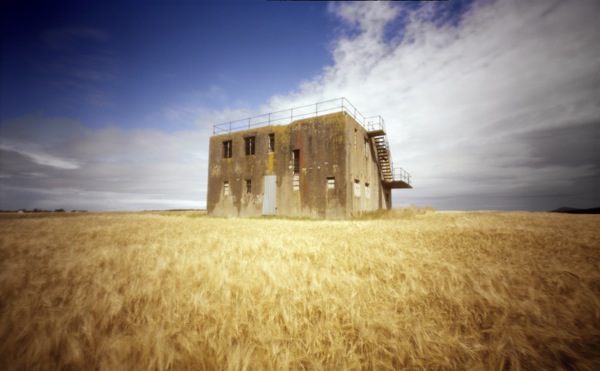
Gina Glover, Dallachy, Scotland WW1 Control Tower. Image copyright of Gina Glover.

Playgrounds of War is an exhibition of photographs by Gina Glover on the memories and detritus of military bases, on view at Street Level Photoworks in Glasgow till 7 August 2011.

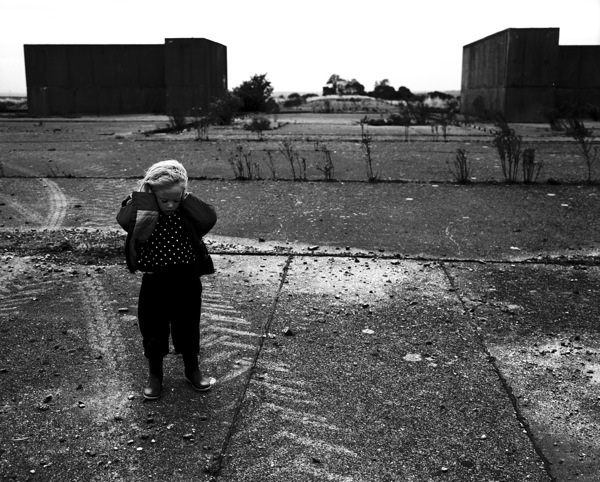
Gina Glover, Harrington, Jessica's Playground. Image copyright of Gina Glover.

Since the early 1980s, Glover has travelled in search of abandoned military bases. Glover developed the Playgrounds of War series from photographs of Harrington, a former World War II airbase in England, which was later allocated to the United States Air Forces. Harrington resides in Glover’s personal history as a place where she had picnics as a child in the 1950s, and was then oblivious to its military associations. Jessica’s Playground, taken in the 1980s, revives this moment of innocence amidst a site constructed for acts of destruction, with Glover’s daughter photographed playing amidst the concrete structures left standing as memorials to its history.

Gina Glover, France, Drop Zone. Image copyright of Gina Glover.

Harrington becomes a metaphorical base for Glover’s own physical and photographic exploration of the aesthetics of past wars, and a point to revisit the shifting zones of confrontation and alliances. During World War II, Harrington was the base for the delivery of supplies to resistance forces in enemy-occupied territories. France, Drop Zone marks a point in the south of France that received supplies from Harrington. With her first series of Harrington photographed in black and white, Glover has since chosen to shoot in colour using a pinhole camera without a viewfinder. With the subjection to long exposures and layering of light, the eventual photographs capture a field of depth and concentration of light that speak to the effects of the natural elements on these sites.

Gina Glover, Estonia, Soviet nuclear submarine training centre Paldiski. Image copyright of Gina Glover.

In the late 1950s, Harrington resumed its military function, where Thor missiles were placed and pointed at the Soviet states during the Cold War. Glover ventures into a former Soviet submarine nuclear training facility to explore the conflict from the other side. In contrast to the other photographs, this is a scene from within, where the fading of the light green wall, peeling paint and broken fixtures are left as debris of the hive of activity that could have occurred at this center of command. While the individual photographs possess a melancholy and muteness in the eroded, uninhabited and derelict sites, the exhibition’s spatial display of the photographs according to the geographical zones of military activity recall the set of confrontations that embed these sites.

A co-founder and director of the Photofusion Photography Centre, London, Glover’s recent exhibitions include Liminal World at Hooper’s Gallery, London in 2010, and was an artist-in-residence at Guy’s Hospital and Northwick Park Hospital in 2008. Her work on the Baltics will be on view at the Palais des Beaux-Arts, Brussels later this year.

Share

Miles Davis’ Wives

L.A. Expanded: Notes from the West Coast
A weekly column by Catherine Wagley

George Condo, "Untitled #12, More Sketches Of Spain For Miltes Davis," 1991, Etching and Aquatint, 33 1/2 x 46 1/2 inches (plate), 38 x 52 inches (sheet), Edition of 40. Courtesy Jack Rutberg Gallery.

Miles Davis wasn’t interested in Flamenco dancers or their music. Maybe it was too frilly, too foreign, too feminine to enter his orbit. Whatever the reason, Frances Taylor, the first Mrs. Miles Davis, set out to change his mind. She’d been to Barcelona and fallen for the sexy Spanish sounds and wanted Miles to fall too. Finally, around 1958, she coerced him into seeing the Roberto Iglesias company in New York. Immediately after, he dashed to the Colony Record store and bought up every Flamenco album they had. The next day, he called his longtime right hand, Gil Evans, and the two started in on what would become Sketches of Spain, an album some lambasted as light fare and others swooned over.

Painter George Condo must have swooned. He came of age alongside Basquiat and Keith Haring and recently designed the risque, quaintly crude covers for Kanye West’s album My Beautiful Dark Twisted Fantasy,  but it’s Davis he listened to growing up. His first big-deal painting, exhibited at the 1987 Whitney Biennial and later bought by Eli Broad, was a colorful opus called Dancing to Miles. In 1991, he created a series of etchings in response to Sketches of Spain. Through September 3rd, you can see them at Jack Rutberg Gallery in mid-city L.A.

George Condo, "Dancing to Miles," 1985-86, oil on canvas, 110¼ by 137¾ inches. The Broad Art Foundation, Santa Monica, CA.

In Condo’s Sketches of Spain, the unfettered id of neo-expressionism merges with an early Cubist angularity. Freedom joins the fantastic, and the etchings delight in eccentric mark-making. Their marks often converge to form feminine figures, as in Untitled #7, an image as frenetically daunting as any of de Kooning’s women. Other times, the marks create illustrative caricatures—in Untitled #2, a curly haired, nude floozy holds her nose and pinches her nipple while an prim bystander looks on. At first glance, the etchings are funny, slightly schizo Picasso wannabes. “It’s about coexistence with the artist’s you respect,” Condo has said; he just wants to fit in. But that name, Miles Davis, appears on the wall labels and image lists, and the persona of the cool, dark trailblazer who never quite did fit in pulls the etchings out of dreamy nostalgia and into a specific historical trajectory. Suddenly, Condo’s blond-ish, flat female figures become grating. They feel frustratingly disconnected from the relational complexity surrounding Sketches of Spain and Davis’ other mid-career masterpieces.

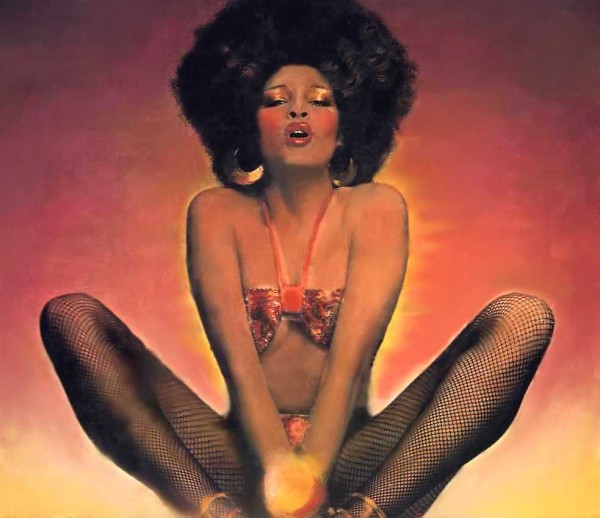
Miles Davis' second wife, Betty Davis, on the cover of "Nasty Gal," an album recorded in 1975.

There’s a story about Davis, recently divorced, seeing Frances at an art opening and pretending she was still his wife. That way, he could comment on her ass without sounding as brutish. Still, despite all the chauvinistic mythology surrounding the jazz great, his women were strong and savvy. There were the type to trick him into falling for Flamenco or finding funk.

I suspect one of Davis’ wives would have liked Condo’s paintings immensely. She gravitated toward primitive sexiness, and had penchant for making whimsy guttural. Twenty years Miles’ junior, Betty Mabry’s marriage to him lasted only a year and in the decade following their divorce, she would produce heated, breathily aggressive singles like the Anti-Love Song and Nasty Girl. If she poured some of her energy into Condo’s Miles homages, the result would be as unfettered and emotive as the images already are, but the women would be a little fuller, a little smarter and take a lot more ownership over the sleek musical landscape that resulted when Davis let Flamenco into his heart.

Share