The Eye Comes First

L.A. Expanded: Notes from the West Coast
A weekly column by Catherine Wagley

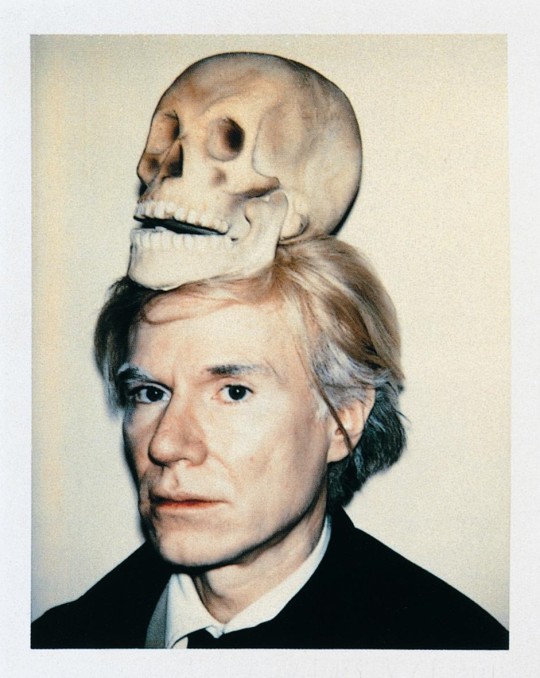
Andy Warhol, "Self-portrait with Skull," 1977.

The first time I saw Andy Warhol, I thought he looked eccentric and ascetic, like a cross between Charles Manson, Gandhi and the Pope. I was in grade school, and Warhol, all in white, pale-skinned and wispy haired, was staring up from the pages of a late ‘80s edition of Chronicle of America. The text next to the image, a brief obituary, probably said a “gangrenous gallbladder” contributed to Warhol’s death, but “gangrene” is all I remembered. Like tuberculosis or typhoid fever, it seemed an antiquated, horribly sacrificial way to die and thus enhanced the ascetic quality I’d already associated with the artist. The second image in the obit was of one of Warhol’s soup cans. While I didn’t understand the can until years later, that’s how Andy impressed himself on me: wispy spirituality next to a crisply rendered, oversized Campbell’s can. From the start, my experience of the pop art star was intensely visual.

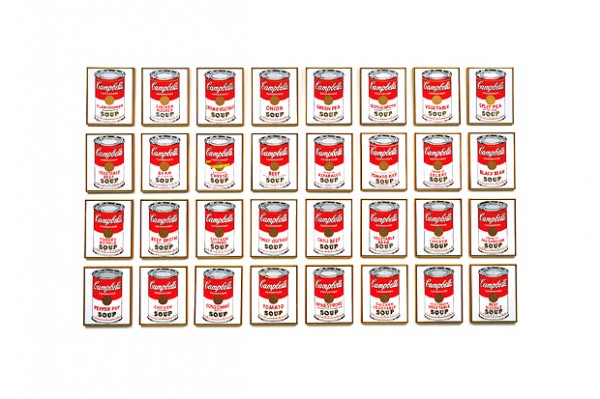
Though Warhol’s soup cans now belong to the Museum of Modern Art in New York, they debuted at Ferus Gallery in L.A. in 1962 and they’ve returned to this city for their 49th anniversary. For the next three months, you can see all 32 at the Museum of Contemporary Art, Los Angeles.

Like many, I have come to take the soup cans for granted. They have their critically carved out place as, to borrow from critic Gary Indiana, “the first shots” of a visual revolution that didn’t aim to “rescue American banalities from banality but to give banality itself value.” But  talk of banalities, consumerism and pop has undercut how visually striking the things themselves are.

Andy Warhol's Campbells Soup Cans, exhibited at MOCA Los Angeles.

The cans struck Ferus dealer Irving Blum hard when he visited Warhol’s New York studio in 1961 and offered the artist his first-ever solo show. Still, when the series debuted at Ferus, the paintings took some getting used to. “The gallery next door put soup cans in its window and said, ‘buy them here they’re cheaper,'” said art historian Shirley Nielson Blum. A few L.A. collectors knew a good thing, however. In an oft retold piece of L.A. lore, four or five soup cans sold for $100.00 each, then Blum asked for the paintings back. “Andy wants to keep them all together,” he explained, and Blum himself continued to own them into the ‘90s, by which time they’d grown in worth to $10 Million. Scam or not, the paintings do fare best as a group. Hung on MOCA’s walls, they’re perfectly spaced and immaculate, like colored product placement in a black and white Bergman film—wholly unforgettable.

Ferus often gets disproportionate credit for starting the ball rolling for contemporary art in this city, but other galleries played key roles, too. One, Nicholas Wilder Gallery, started out across the street from Ferus. Because Nick Wilder was the first to give Cy Twombly, who died last week, a solo show here in L.A., he’s been on my mind. In a treasure-filled interview he gave the Smithsonian Archive of Art in 1988, the year before he died, Wilder described the difficulty of getting people to just look.

David Hockney, "Portrait of Nick Wilder," 1966.

He told interviewer Ruth Bowman he fell into art because he “was just curious about how you arrived at the visual experience that you were going to be stuck with.” But some collectors wanted words and explanations to validate art for them:

What you usually did, depending on the person, is you tried to break down their resistance to seeing. You tried to disencumber them. . . .

So you show them how the Morris Louis was painted or how Ron Davis arrived at the plastics or you did an analogy. You said, “Oh, gee, we’re looking at a [Hans] Hofmann now. I have to tell you my Hofmann experience. . .”

. . . If you could get them interested, usually––this is hindsight––on the level you were interested, all of a sudden you had a convert and you could sell them paintings.

Said Wilder, “the eye precedes the idea. It’s just that simple.”

Share

Perth

To enter the cell is to be transformed

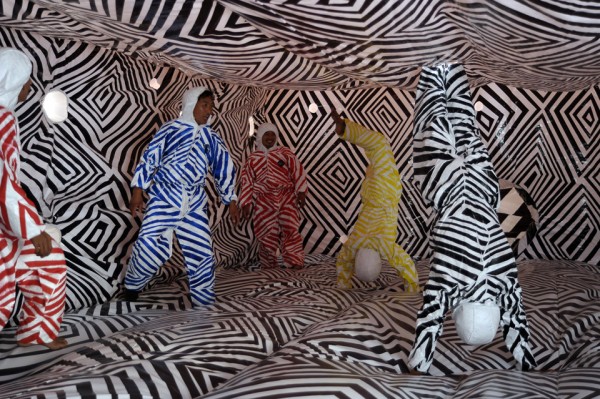
Brook Andrew, The Cell, vinyl with fan blower, 300 x 12500 x 600 cm. Courtesy of the artist, Sherman Contemporary Art Foundation and Tolarno Galleries. Photo: Roger D'Souza

Before I enter the gallery space I hear the roar of the fan blower. Once inside, I encounter an enormous inflated cube emblazoned with red and white stripes, like a circus tent. I join the line of punters and wait obediently, reading the didactic gallery signage. Eventually, it’s my turn: I’m handed a hooded jumpsuit with a red geometric print. They instruct me to remove my shoes and any sharp objects I might be carrying.

Barefoot and zipped up to the throat, I get on all fours and crawl through a tunnel into the space within the inflatable. The diamond geometric pattern of my uniform inscribes every surface within this soft room. The light is different in here, shaded, and all sound is muted. It’s quite hallucinogenic; a young boy wearing a black version of the suit dives onto the floor and laughs, “look: I’m invisible!” Watching him bounce and somersault makes me feel faintly foolish, the cautious adult; I bound gingerly around the space a few times before deciding to evacuate.

Brook Andrew, The Cell, vinyl with fan blower, 300 x 12500 x 600 cm. Courtesy of the artist, Sherman Contemporary Art Foundation and Tolarno Galleries. Photo: Roger D'Souza

Giggling, unsure of my footing on solid ground, and having read the statement about the work I wondered if it was really an effective statement about enclosure, asylum and genocide. Surely it was a bit too much fun. But to look for a straightforward reading of Brook Andrew’s The Cell is to miss the layered nature of the work, the way in which it insinuates and resonates rather than bludgeon its viewer with a specific message. Indeed, such instability of meaning is part of a strategy through which Andrew critiques the impulse towards empirical certainty that has shaped the history of Western politics, philosophy and science. Ambiguity unsettles this position.

In a practice spanning video, print, neon and installation, Andrew’s work addresses notions of race, history, power and loss. These themes have particular potency within Australia, where the legacies of colonial history continue to be deeply felt and the processing of asylum seekers has become a highly politicized issue. Like his recent work Jumping Castle War Memorial (2010), The Cell paradoxically adopts the frenzied aesthetics of the fun park within a commemoration of loss. With this work, Andrew responds to the histories of loss, asylum and genocide that belong to many in Australia. He states, “The Cell is a monument to such stories. It’s a quiet space for contemplation, disorientation and spectacle”.

To enter The Cell is to encounter a series of contradictions. Its title is evocative of imprisonment and terrorism as well as the foundation of biological life. By donning the anonymous regulation-issue suit, the viewer assumes a performative role, and yet the experience of The Cell is predominantly sensory. The space is simultaneously intimate and alienating, delightful and threatening. Dominating every facet of the work is the ubiquitous diamond pattern, evoking pop minimalism and circus tent alike, however this motif is derived from patterns traditional to Andrew’s Wiradjuri heritage. This psychedelic installation recalls histories of loss and survival and offers a utopian, shared space to facilitate reflection. Indeed, to enter the cell is to be transformed.

Brook Andrew: The Cell is showing at Perth Institute of Contemporary Arts 9 July – 21 August 2011

Share

Marco Breuer: Line of Sight

Left: Spin (C-818), 2008. Chromgenic paper, exposed/embossed/abraded. 10 13/16 x 8 1/2 inches. Center: Untitled (Study for Tremors), 2000. Silver gelatin paper, burned. 18 x 14 inches. Right: Untitled (E-30), 2005. Cyanotype on Fabriano paper, exposed. 13 1/16 x 9 3/4 inches. All images © Marco Breuer and courtesy of Von Lintel Gallery, New York.

As part of our ongoing partnership with Art Practical, Daily Serving is republishing Brian Andrews article Marco Breuer: Line of Sight, featuring work on view now at the de Young Museum in San Francisco.

Installation of Marco Breuer: Line of Sight from FAMSF on Vimeo.

In 2005 when the de Young museum opened their new Herzog & de Meuron‑designed facility in Golden Gate Park, the museum endeavored to update their engagement with contemporary art practices. Most visibly, five large-scale works were commissioned from blue chip artists to be featured at the building’s opening celebration, including an immense print by Gerhard Richter, a meditation stupa by James Turrell, a glass installation by Kiki Smith, an outdoor sculpture and crack in the landscaping by Andy Goldsworthy, and a series of paintings by Ed Ruscha. Less sensational but potentially more impactful, the de Young also initiated their Collection Connections program with a series of work by local photographer Catherine Wagner. The program debuted with the objective of integrating contemporary practices with the de Young’s eclectic general collection holdings by asking artists to create a body of work both inspired by and displayed with objects from the de Young’s permanent collection. Marco Breuer: Line of Sight is the latest installment in this program.

Read the full article at Art Practical.

Share

An Interview with Zoe Crosher

Zoe Crosher’s haunting photographs—showcasing spots where both fictional and non-fictional characters disappearedhave been on display for the last month at Las Cienegas Projects in Los Angeles.  The show closes July 16th.  Crosher recently sat down with DS writer Carmen Winant to talk about the project and her work in general.

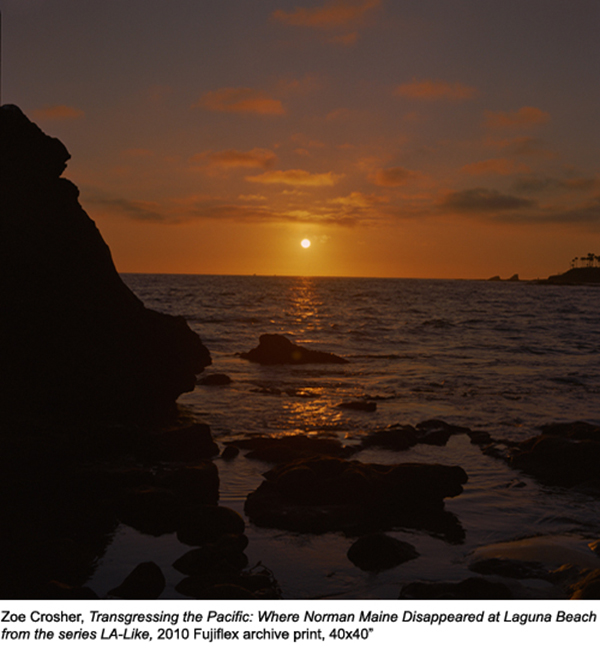
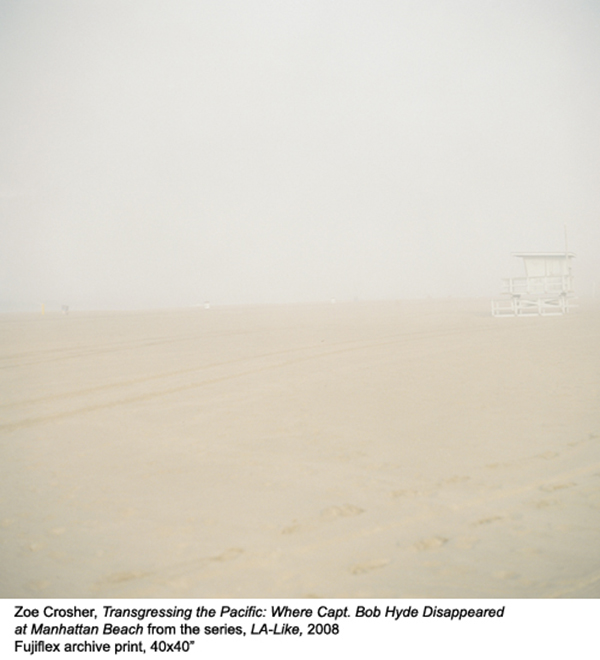
Carmen Winant: Hi Zoe! Thanks for agreeing to talk with us.  In your latest series, LA-Like: Transgressing the Pacific, you photograph real and fictional sites of disappearances into the Pacific Ocean. With descriptive titles like Where Natalie Wood Disappeared off Catalina Island, there is no distinction made between historical figures and invented ones. For instance, you document the Marina Del Rey site where the Beach Boys’ Dennis Wilson really died in 1983, alongside the location where John Voight’s character drowns himself in the 1978 film Coming Home. Can you address the choice to include real and unreal figures in the series?

Zoe Crosher: Yes. My practice deals with photograph as a tool of fiction of documentary. I have long been interested in thinking through the ways that memory operates through photographs on the basis of the stories that we ourselves write. Also, Los Angeles has a unique and specific relationship to fiction—truth and imagination are easily conflated here—so I am particularly interested how I can use documentary photography to the same end. Ultimately, no matter how adept we have become in reading photographs, there is still the traditional assumption of an overarching “truth” in our approach to documentary work, which I hope to complicate.
CW: I’m drawn to this notion of departures, of heading west to find one’s destiny—and when that cannot hold, even further west—into the ocean’s depths, as the case may be. There is something so tragic and poetic about the idea that the border of the coast cannot hold you. I saw that you wrote about the conundrum of Manifest Destiny: “the endless promise for once you reach that unreachable place, and then you have arrived, there is no where to go anymore.” There is something so fundamentally lonely about that. Can you address this idea of containment, of reaching forever farther, even if it means one’s own demise?

ZC: All my work certainly has a darker backdrop, a kind of impossibility of knowing, but I never look at the work as being lonely. It has cathartic potential, perhaps. And it certainly is concerned with trauma. Joan Didion addresses this sense of Manifest Destiny so well in her books and essays, as a schism between a promise of something and what it actually may turn out to be.

The lore of moving west—what happens when you hit the border or reach the shore, when you can’t push any further—this is a very loaded threshold. Even Lewis and Clark couldn’t believe it when they hit the Pacific, as if the continent should in fact be never-ending, endlessly unfolding. If you live in LA, a frequent question is, “Where are you from?” It implies, of course, that no one is really from here, that the city holds those that sought it out.
CW: You use a medium format camera, which I tend to think of as a nostalgic and self-contained format.

ZC: I’ve always shot with a square format. The square complicates presumed ways of looking. When I started photography seriously in college, I was immediately trying to interrupt what was presumed “real.” For this project I used a Bronica camera, and a tripod and a flash when shooting at night. I only shot film. The final photos are printed on Fujiflex paper, which has a very glossy, reflective surface. In the gallery they are hung fairly low, creating a sense of falling into the water.
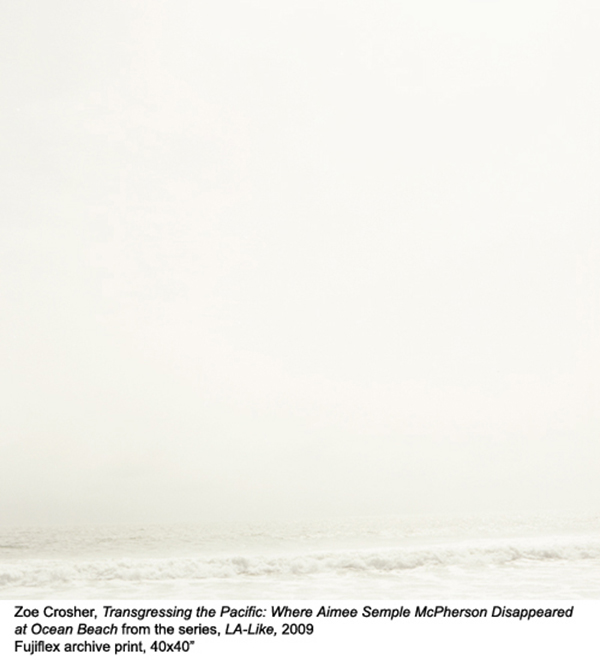
CW: How much research went into uncovering the spots where these people disappeared? Or are these locations their own fictions?

ZC: The research took many forms. I had a great intern working with me—Jason Underhill—and together we did newspaper research, looked at police reports, and watched the movies over and over. We found three different articles about Natalie Wood’s death in the Pacific in 1981, but only one mentioned that she was wearing a red down jacket. These selective details are exactly what I am interested in, how we choose to selectively document the past. Some of these places no longer exist; Aimee Semple McPherson faked her own disappearance at the Ocean Park pier, which was halfway between Venice and Santa Monica, and is no longer standing. The final scene for the film Coming Home was in Manhattan Beach, but it was a fantastic goose chase to find the spot, which I originally believed to be in San Diego. There were other issues: The Long Goodbye was shot on Robert Altman’s private property at Malibu Colony, and so on.

Ultimately, this is the point. It was a project that relied on and tested the mimicry of my own memory. History is all estimations, which is effectively a major component of my work.
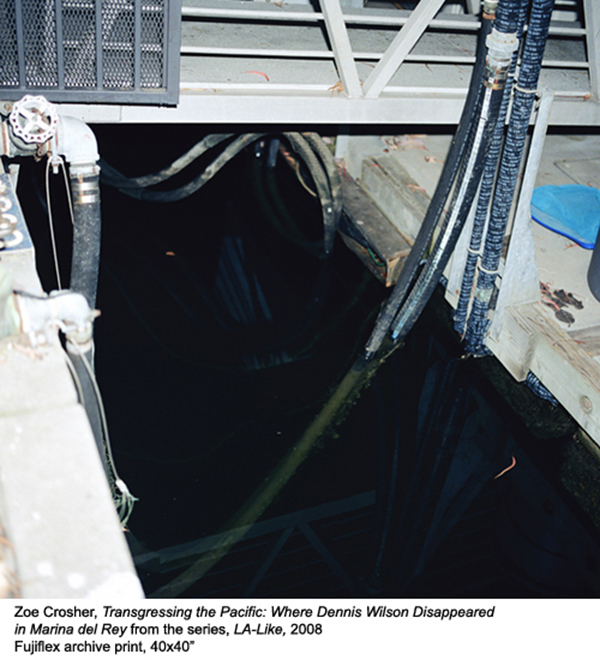
CW: My next question is about the paradox of marking the SPOT of a disappearance. It strikes me that the idea of being “disappeared” implies that the person vanishes without a trace…do you feel that in some way marking the location lends a certain gravity, much like a gravestone might, to an otherwise mythical action?

ZC: I don’t think it detracts from the disappearances themselves, which, as I mentioned, are still very much my interpretation. I am inspired by crime scene photography, but I can only photograph the moment of crossing, not its finality.

There is something to be said for marking that which refuses be marked. I have been trying to figure out a way to photograph the Santa Ana winds. This idea is so interesting to me—not the expectation of failure, but the expectation of impossibility.

The truth is that everything—every body and every event—is located in space. This process of insisting on a moment that did happen and has a physical reality, the insistence of being a witness, is very important to my practice.
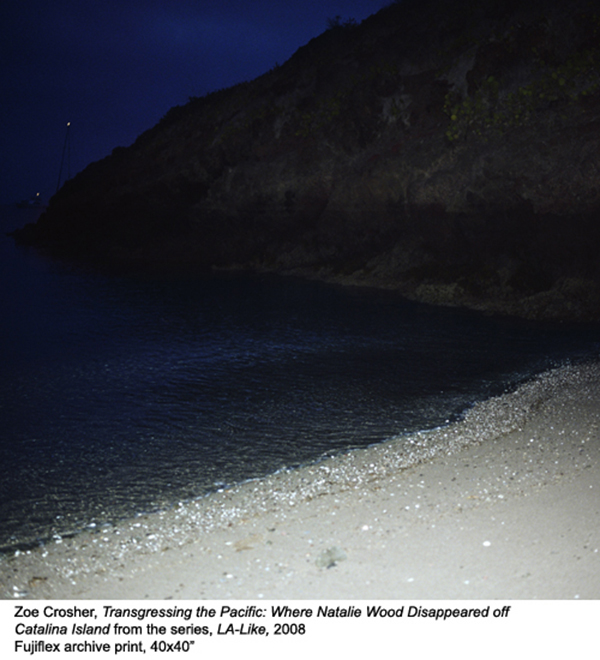
CW: I am interested in discussing this series in light of some of your other LA-Like series, specifically, LA-Like: The Pools I Shot Series and the Michelle duBois project. They both seem tied to place and perception, and the qualities of surface. Can you discuss the relationship between them, perhaps beginning with your interest in water? And, in regards to the duBois series, a kind of desperation to document oneself for consumption by others, and in doing so, creating a kind of vacuum of self?

ZC: Again, all of the work is concerned with testing the limits and constructs of the documentary. The Michelle duBois project is ultimately about the possibility of not knowing oneself—she pretends to be so many versions of herself, taking thousands of photos, all in which she emulates a different persona. She is creating her own kind of destiny in a way, a life constructed on impossible fantasy.

LA-Like: The Pools I Shot is a kind of mapping; LA is, of course, tied up with the history of water. I wanted to merge the poetics and the medium. I took pictures of the sun reflecting in pools, and slightly burned the photographic paper in the printing process.
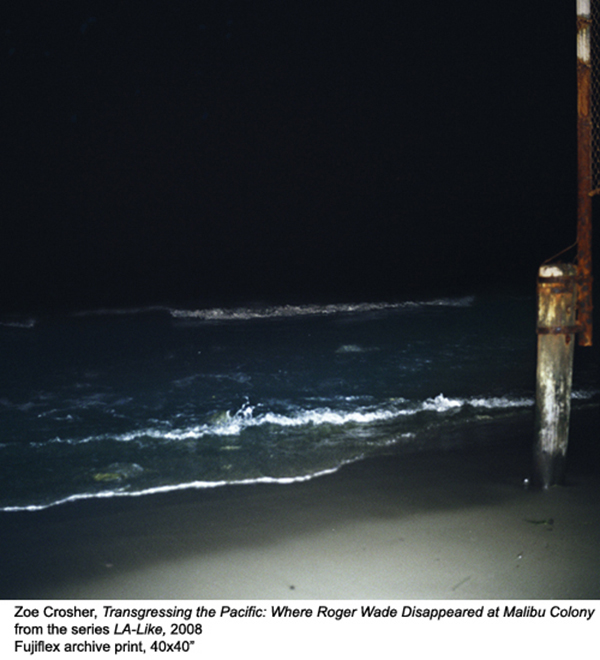
CW: I noticed that the press release for your show includes a quote from Joan Didion’s Slouching Towards Bethlehem. This struck me as a really apt literary source for your work, as Didion so persuasively investigated the profound emptiness and power of celebrity. I was also reminded of her looking at your swimming pool series, specifically her line from The White Album: “A pool is, for many of us in the West, a symbol not of affluence but of order, of control over the uncontrollable. A pool is water, made available and useful, and is, as such, infinitely soothing to the western eye”. And beyond that, Didion’s interest in probing the qualities of mourning, or grappling with disappearance. Have you read much by her? Cinema has obviously influenced your work, but does literature do the same?

ZC: I have read almost every book Joan Didion has every written, and I consider her a great influence on my work. Didion did for writing what I am interested in doing for photography. She collapsed fiction and documentary, confusing the terms of reception and context to great effect. She was a journalist who questioned the very structure of journalism, which ultimately was inextricable for her own reportage. I am working on a book of the entire LA-Like series, and I would love for her to write the introduction.

Didion also encapsulates a version of 1960s California. She’s about my dad’s age, and they both attended Berkeley. So, her work also resonates personally with me; it feels familiar. Didion describes a California that I remember as a child but that no longer exists. Or at least, I think it existed.


Share

From the DS Archives: Any Ever

This Sunday, From the DS Archives features video and installation artist Ryan Trecartin. In a 2010 installment our weekly column L.A. Expanded, Catherine Wagley discussed the artist’s exhibition Any Ever, which was on view at MOCA in Los Angeles. Through September 11th 2011, the exhibition is making its NYC premiere at MoMA PS1 in New York City.

L.A. Expanded: Notes from the West Coast
A weekly column by Catherine Wagley

Kalup Linzy, Conversations wit de Churen III: Da Young and Da Mess, 2005. Performance documentation. Courtesy the artist and Taxter and Spengemann, New York.

Because I don’t believe that big and bright equals beautiful, I am not a fan of West Hollywood’s Pacific Design Center. A mammoth, reflective blue box that towers over the otherwise low-to-the-ground Melrose Avenue architecture, the PDC has more than its share of empty retail space. Inside, it often feels like a manicured ghost town. I voted for its simulated destruction last fall when artist Gustavo Artigas staged his Vote for Demolition project, which asked Angelinos to select the city’s least attractive building. Artigas virtually razed the winner, which turned out to be the Kodak Theater because, apparently, not everyone sees the world the way I do.

Despite my PDC resentment, I am fond of MoCA‘s mini Pacific Design Center, a quiet beige cube that stands in the shadow of its big blue neighbor. It seems like an almost-joke—a Mecca of materialism’s carefully sized nod to the arts. Usually, design-related exhibitions that run in this MoCA satellite, like Las Vegas Studio and Folly–The View from Nowhere, cater to the curious without undermining the over-fabricated sterility of the whole PDC complex. But this past month, the MoCA mini-me has suddenly become a theater for outlandish projects that turn “over-fabricated” into a race toward synthetic delirium.

On June 24, during the invitation-only event Soap at MoCA, General Hospital filmed an episode starring James Franco. Franco played a demented artist, MoCA played the site of his opening, and artist Kalup Linzy performed in drag. Wearing a wig with bangs and a red and black floral print dress, Linzy recited the lyrics to Mad World while Franco yelled, “Don’t kill me! I know where the baby is!”, and then fell from a balcony to his fictional death. Linzy, accustomed to the drama of soap, wasn’t phased.

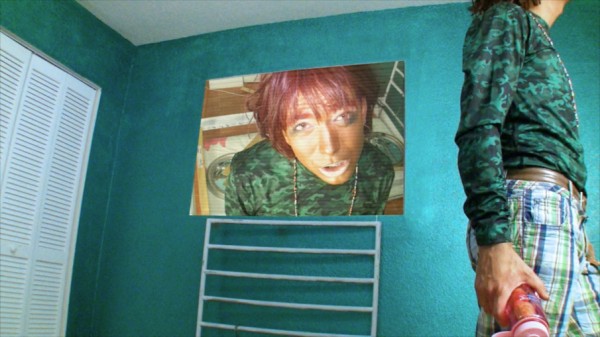
Ryan Trecartin, "Sibling Topics (Section A)," Video Still, 2009.

Ryan Trecartin, "Sibling Topics (Section A)," Video Still, 2009.

In his own soap, All My Churun (2003), a distraught, big-haired, striped-skirted woman (most women in Linzy’s films aren’t actually women) talks about the memorial service she’s planning for a murdered love named “Jo-Jo.” “Girl, you need to stop,” says her sister over the phone. “She needs to stop,” says her brother over the phone. Her mother and grandmother, also talking over the phone, act as if a memorial service for a dead man is the most flamboyantly frivolous thing a person could have.

Video artist Ryan Trecartin uses phones as liberally as Linzy, though his rarely have cords and sometimes they’re just pinkies and thumbs extended in the “call me” gesture. Phones turn life into a series of affected soliloquies and now that Trecartin has commandeered MoCA for Any Ever, a show that opened two weeks after the museum performed for General Hospital, soliloquies have become lurid and omnipresent. “You won’t recognize the PDC once you enter,” Trecartin’s New York gallerist Elizabeth Dee told the LA Times.

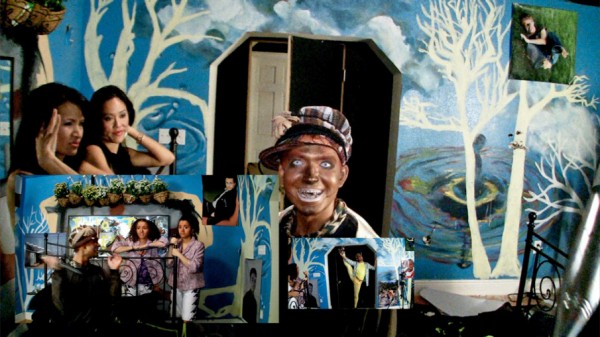
The downstairs bookstore has become a dark gallery. Cluttered with brand new benches, space heaters and superfluous metal chains, it looks like a graveyard for un-bought patio furniture. Trecartin’s Trill-ogy Comp (2009)—note the “trill”—screens on the wall opposite the entrance. Comp consists of three videos, all of them loosely related. K-CorealInc.K (section a) follows a group of all-blond white collar workers called the “Koreas”; Sibling Topics (section a) follows four quadruplet sisters, all played by Trecartin. P.opular Sky (section ish) is a bit of everything. Upstairs, in a bedroom, office space, faux-stadium and family room–each with nick-free Ikea-style furniture–four videos from the R’Search Wait’S series play out. But following storylines is precarious. As Trecartin pointed out in a recent lecture, “Consequence can just pop out of nowhere and cause can have no effect.”

Ryan Trecartin, "P.opular S.ky (section ish)," 2009.

Everyone wears some form of garish make-up, women play men acting like women, or men play women posing as men dressed as women. The physical gets slippery. With rare exception, characters use winy, effeminate teenage voices and speak confrontationally. No one is melancholic, though plenty are restless. All wear brightly colored clothes that match their bronzed, painted faces and, since Trecartin is an obsessive editor, the brash, sashaying footage has no non-orchestrated lulls. Soliloquies–there’s never really dialogue, even when characters purport to address each other–use language in a way that feels almost-but-not-quite familiar:

“She hates diversity and women. She’d probably shoot me if she saw my very extreme breast reduction that I love.” “Put your breasts back on.” “I never had any.”

“How will I make drive to find you when I’m in automation?”

“Cut my hair shorter. I like that kind of person.”

“Put on your comfort pants and say things in nice voice because.”

“I can go on and on but I won’t. I can go on and on but I won’t. I can go on and on but I won’t.”

About thirty minutes in, Any Ever begins to feel like a dream that’s apolotical, political, apathetic, aggressive and increasingly fluorescent. It becomes exhausting and disorienting, enough so to make me want to hate it. And this means it’s perfect.

Note: Critic Jennifer Doyle recently wrote more extensively about James Franco and Kalup Linzy for Frieze Magazine. Read her essay here.

Share

Heaven Is A Place Where Nothing Ever Happens

In the aftermath of the manic, dizzying opening of the Venice Biennale, it is refreshing to see an alternate possibility for an international exhibition on the coast of England – a project, that much like it’s place, embodies the understated, the poetic and the site-specific – a welcome breathe of fresh air in contrast to the global displays of power battling it out at the site of the Giardini.

Folkestone is one of those seaside towns that is both idyllic and sleepy – the kind of place you run away from London to in order to escape the chaos and urban imprisonment. With the coast of France visible on a clear day, it is becoming a place of refuge for many of the artistic community who eagerly embrace the one hour commute to London for a bit of serene escapism. But this somnolent town is stirring – the Folkestone Triennial is reinvigorating the town with a perceptive, engaging and meaningful project – an ambitious public programme aspiring to reach far beyond geographical boundaries.

Curated by Andrea Schlieker, the Folkestone Triennial, unlike many overshadowed peripheral exhibitions, attracts internationally renowned artists who respond in a perceptive way to the unique geographic and demographic qualities of the area. With permanent works and temporary installations, the Folkestone Triennial animates the town, engaging with both the fleeting international audience passing through and the permanent local community.

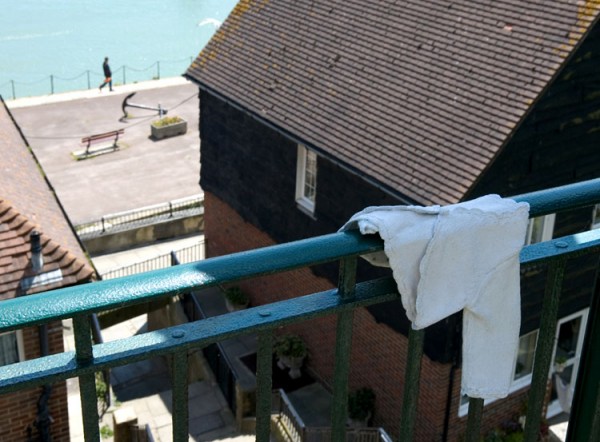
Tracey Emin, 'Jacket' from 'Baby Things,' 2008. Photo © Thierry Bal.

The inaugural Triennial in 2008 brought together 22 works by significant artists, including Christian Boltanski’s sound installation of letters of First World War servicemen being read as one sat upon a bench at the site where these men were shipped off to battle, staring out into the sea, and Tracey Emin’s work ‘Baby Things’ – a spattering of bronze-cast baby clothes strewn across the city paying homage to the vast number of teenage mothers that inhabit these seaside towns such as Folkestone, and Margate, Emin’s notorious hometown. With the permanence of many of these works, including Emin’s infantile clothing collection, an alfresco accumulation of works many institutions would dream is being built.

The Folkestone Triennial, now in its second edition, has expanded beyond the regional specificity of its first incarnation to wider international interests. Looking beyond it’s shores, ‘A Million Miles From Home’ explores migration, borders, displacement and transnational identity. These themes extend across a post-globalised world, yet remain particularly pertinent to this place – a seaside town which exists on the periphery between nations, within Britain, a country with a diverse, multicultural reality.

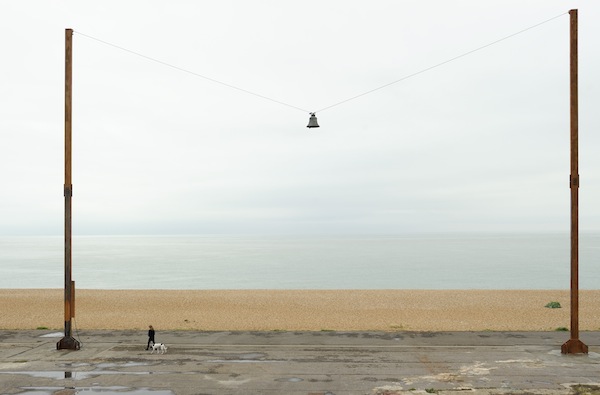
AK Dolven, 'Out of Tune,' 2011. Photograph: Thierry Bal.

Amongst the 19 newly commissioned works is Norwegian-born artist, A K Dolven’s ‘Out of Tune’ – a reclaimed sixteenth-century church bell that had been decommissioned for having an impure tone – it lacked the conformity and clarity required by the institution. Standing high above the horizon on the beach, the lone bell invites the viewer to ring it, crying out over the town and across the sea. The bell has been freed from the constraints of a tower and given a new home, however it remains isolated and forced to stand on its own – a poetic metaphor for the reality of migration, as displaced individuals forever negotiate geographical and cultural differences.

CAMP ‘The Country of the Blind, and Other Stories,’ 2011. Film Still Copyright of the Artists. Photograph Thierry Bal.

The inspiration for Bombay-based collective CAMP’s video work is the HG Wells title ‘The Country of the Blind and Other Stories’ questioning if, in the country of the blind, the one-eyed man can indeed be king. Asking local volunteers at the National Coastwatch Institution to film the sea with a telescope, CAMP enacts the politics of the panopticon gaze and procedures of control. Looking outwards from the ivory tower, fishing boats, ships and sailboats were recorded by individuals acting as part of an omnipotent power. With the fluidity of the sea containing the border where two nations meet here, it is the one-eyed telescopic gaze looking out to the horizon that maintains the pretence of power and control.

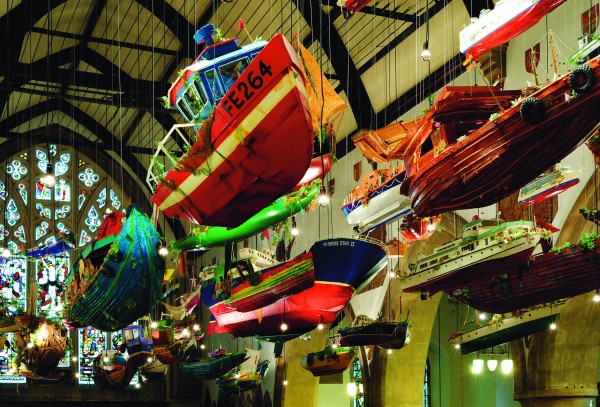
Hew Locke, 'For Those in Peril On The Sea,' 2001. Photograph Thierry Bal.

While the gaze controls the borders at sea, the boat represents the possibility of transgression. Hew Locke’s work ‘For Those in Peril on the Sea’ consists of nearly 100 model ships installed in the oldest church in Folkstone, which were collected from around the world, as well as fabricated in Locke’s studio from his trademark cheap, colourful plastic materials. The boat here stands as a symbol of migration, transnational locality and heterotopias – it represents the possibility for escape and the dissolution of borders in international waters. However, with over-saturated media images and stories of tsunamis, pirates and oil spills ever-present, attention has also be drawn to the vulnerabilities and dangers of this non-place. The ship may represent autonomy but it is also the space susceptible to the perils of the sea.

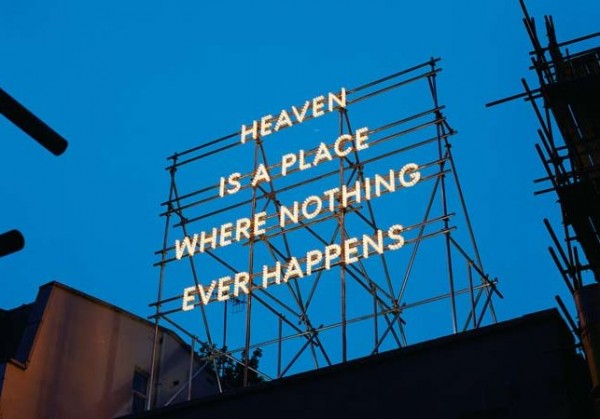
Overlooking the town is Nathan Coley’s illuminated sign reading ‘Heaven Is A Place Where Nothing Ever Happens’ – and while this seaside town may be a place of respite from the chaos of urban centres, and heaven to some, it is no longer that place where nothing happens. The Triennial is developing a formidable platform for contemporary art that engages with international concerns while remaining connected to local geography, history and culture – by no means an easy feat. I applaud you – and I personally thank you for giving me a excuse to dip my feet in the salty sea and get a bit of fresh air in my lungs.

Nathan Coley, 'Heaven is a Place Where Nothing Ever Happens,' 2008. Image courtesy of the Artist, Folkestone Triennial and Creative Foundation. Photo © Thierry Bal.

Share

The Butt, and the Photograph

L.A. Expanded: Notes from the West Coast
A weekly column by Catherine Wagley

Roe Ethridge, "Butts," 2010 Chromogenic print 3 parts: 51 3/8 x 34 7/8 inches each (130.5 x 88.6 cm) Ed. of 5. Courtesy Gagosian Gallery.

Rarely do I smell cigarettes in public these days. If they smoke at all, people close to me tend to bring out lighters only on occasions involving heavy drinking.  This shift is a surprising testament to common sense.  Occasionally, it seems, we can do what’s best for us.

Of course, that common sense has yet to spread to all nooks and crannies. Twice last week, for instance, I was asked, “do you mind if I smoke?” I hardly ever mind. I’m young enough that the cultural mystique of smoking never overpowered the glare of the Surgeon General’s warnings, but cigarettes still smell like a social life to me. Growing up, I equated their scent with a world beyond the one I shared with my parents, also both non-smokers. My grandparents all smoked, as did an aunt, an uncle and a great aunt, who kept at it well past 90. Imprinted in my memory are the first strong women I admired, all with cigarettes in hand: Virginia Woolf, contemplative and cavalier with her long-stemmed cigarette holder, looked fragile otherwise, and Katharine Hepburn, smoking while dangling her legs over an armchair, was cool and in charge.

That heedless smoking hearkens back to a golden, mid-century moment (Mad Men, anyone?) has been said before.  And I’m not interested in that breed of nostalgia. What I am interested in is why cigarettes, whether in human hands or not, remain such a constant subject for contemporary photographers.

Paul Graham, from "New Europe," 1986-92.

Paul Graham, from "New Europe," 1986-92.

Photographer Roe Ethridge’s current exhibition, Le Luxe BHGG, at Gagosian Gallery in Beverly Hills includes a triptych of cigarette butts all jumbled together in a pile of ashes on stone slabs. Le Luxe features the artist’s characteristic pairings of like and unlike imagery—essayist Eileen Myles might call it “browser art”, a simple recording of “stuff a hand or an eye might alight on.” A tall, porcelain-skinned blond stands in a sunset-colored, one-piece swimsuit, and a battered concrete pourer fills a whole frame; Abercrombie and Fitch-style sexiness meets the sensuality of weathered industrialism. This show is more a record of seductive moods and styles than anything else.

Then there are the cigarette photos. At first, the butts look discarded, but Ethridge has arranged them specifically, placing the stone slabs on strangely delicate black grates. The photographs pay tribute to nostalgia and leisure but approach tribute-making flippantly enough to keep their cool.

Within the first few decades of the 20th century, cigarettes had established a constant, casual presence in photographs. In shots by Brassai or Lee Friedlander, you see them hanging loosely between someone’s fingers. Or, sometimes, they’d add flair, like when Noel Coward wore a suit, stood in the desert and regally wielded a cigarette for Loomis Dean’s iconic 1955 shot. Through the 1960s and ‘70s, cigarettes remained a vice present in photojournalism and fine art alike, shared by hippies, soldiers and grandfathers.

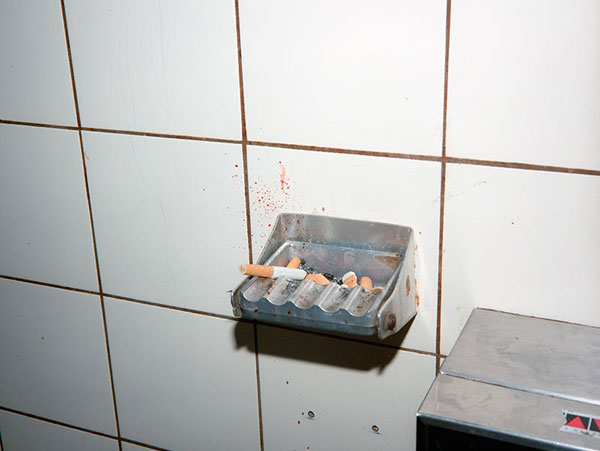
In the late 1970s and ‘80s, following the slew of public health campaigns and Nixon’s banning of cigarette ads on TV, cigarettes in photographs began to look more indulgent, more punk. Shirtless boys lit them in bed for Nan Goldin and, later, Wolfgang Tillmans. Finally, in the 1990s, we saw cigarettes sitting all by themselves, laid out in installations by artist Jack Pierson, or abandoned in a public restroom in a photograph by Paul Graham.

Roe Ethridge, "Apple and cigarettes," 2004/2006, Chromogenic prin,t 41 x 32-3/4 inches. Ed. of 5. Courtesy Gagosian.

These shifts in art weren’t a direct reaction to tobacco’s growing menace, of course. They had more to do with a growing aversion to presenting “a whole story.” Better to pick apart the image and zoom in on its elements than to act like a camera gives you privileged insight into the human condition. When I was in high school, I painted a portrait of my grandfather based on a photo. He sat in a pink-winged armchair, wearing plaid and holding a cigarette. He died only weeks after I finished it, of complications from emphysema, and I brought the painting when we drove cross-country to his funeral. No one wanted it around; the cigarette jumped out at my grandmother, aunts and uncles right away, though I had simply painted him that way because that’s how he was. Omitting the cigarette seemed dishonest.

Images like those by Roe Ethridge, that let burnt butts stand alone, don’t feel honest or dishonest. Symbols of cultural indulgence, they’ve abstracted themselves from imminent consequences and turned the trappings of human behavior into pure style.  This makes them more disarming and unnerving than any photo of Katharine Hepburn or Noel Coward blowing smoke rings could ever be.

Share