Unweaving the Rainbow: An Interview with Mike Womack

Colorado-based artist Mike Womack’s show Spectres, Phantoms, and Poltergeists opened at the Chelsea gallery ZieherSmith on September 15.  DailyServing’s Carmen Winant had a chance to catch up with him this weekend to chat about his practice and the new work.
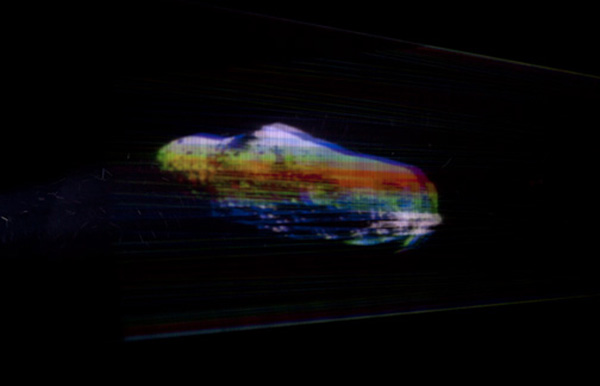
Mike Womack, "Spectres (Asteroid Ida)," 2011 c-print, 20 X 30 inches. Photo courtesy ZieherSmith.

Carmen Winant: What is your background in fine arts? Are you trained in sculpture and is that how you would define your practice?

Mike Womack: I’m trained as a painter. In fact, I didn’t start making objects until after graduate school at Pratt. And I currently teach at the University of Colorado in the painting and drawing department. So, I would say: using the vernacular of painting, I make sculpture, installation art, and work within digital media. Above all, I am interested in creating the circumstances and contexts to look at images.

CW: The work seems to engage a certain tenderness, or even magic, with the modern machine and its capabilities.  I think the darkness of the gallery and the sound of the motor add to this romance. Can you speak a little bit about your interest in using motorized systems in your work, or I should say, as the subject of your work?

MW: My interests in creating mechanized imagery are definitely sentimental. I have been accused of being a willful romantic, and I must admit, that is really dead on. I’m fascinated with how technology constitutes imagery. I am idealistic – I want to fall for ideas, to be romanced by them in spite of knowing better. But there is a unavoidable complication within the interplay of technology and phenomenology of media; I am at once in awe of technology, and at the same time made to feel curious and suspicious of it. In this way, I am of two minds: I look at my iPhone and think it’s a miracle. But in the same moment, I want to take it apart, interrogate and look at it from multiple perspectives – to understand, technologically and philosophically, just how we have evolved to this point.
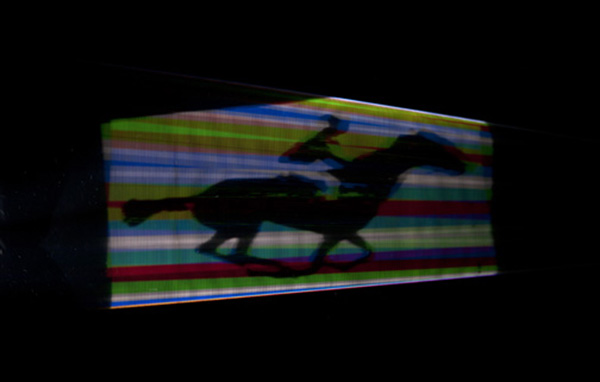
Mike Womack, "Spectres (Muybridge 1)," 2011 c-print, 17 X 28 inches. Photo courtesy of ZieherSmith.

Another example of this divide can also be found in the exploded diagram of how to construct an IKEA couch. You don’t need to know much to understand its mechanics. But suddenly there is a shift into a vastly different kind of technology that surrounds us, like, for instance, electrons moving though silicon products (like a vacuum tube), which rapidly becomes harder to grasp.  There is a kind of slippage between the late industrial revolution’s innovations and forms in building to the digital age. The space between the two is my interest; I usually have one foot in the mechanized world – making things with prescribed naivety – and one foot in trying to tackle more complex things and how they function.

CW: The ways that your work often makes kinetic energy visible through light strikes me as really photographic – which is partially why I asked you about your training and background. Your choice to use Eadweard Muybridge images in the Spectre series also made me more curious about your interest in referencing photography.

MW: I am less interested in the history of photography and more interested in the where the camera aligns and misaligns itself with how we see. I don’t take photographs for my work, but I will often look through the camera lens to see how the values will translate, and how the camera unravels light and creates aberrations.

For the Spectre series, I used black and white moving images to make them into the opposite: color stills. This was really the reason I went back to the very first “moving” image (which never had color to begin with) to attempt to reconstitute the image by applying contemporary filters to it, to both unravel and enhance it. I was also drawn to the early Muybridge images as they were taken with late industrial era technologies, which I keep returning to, and which reference a certain nostalgia.

Installation Shot from Mike Womack's Spectres, Phantoms and Poltergeists. Photo courtesy of ZieherSmith.

CW: Have you read John Keats‘ assertion that Isaac Newton was ‘unweaving the rainbow’ in his studies to understand light? In Lamia, Keats wrote, “Philosophy will clip an angel’s wings.” Your own work literally unravels the RGB matrix.  Do you relate to Keats’ idea? A fundamental conflict between art and science in experiencing the world?

MW: The final stanza in Walt Whitman’s volume Leaves of Grass speaks to this polemic: “The spectacle of looking at a morning glory at my window satisfies me more than the metaphysics of books.” I’m interested in Whitman for this reason, and have investigated him in this show. I’m fascinated by these conflictual approaches in seeing; of course, there is beauty in knowledge, but must we unravel every natural mystery, and do we dilute them in the process?

To return to Whitman: my piece Threshold at the front of the show is very much about this considered, complicated act of looking. Whitman was a humanist, an advocate for tearing down intellectualism in the arts in favor of a phenomenological experience of the nature world.  Looking, for Whitman, was chief over ideas. The piece is comprised of a bluestone taken from the stoop in front of Whitman’s former Brooklyn home displayed simply on a low, wooden table; it has been transformed into a piece of art by its displacement. In becoming conceptual art, Threshold questions and undermines Whitman’s very principles, demonstrative of a kind of contained, internal conflict that runs throughout the show.

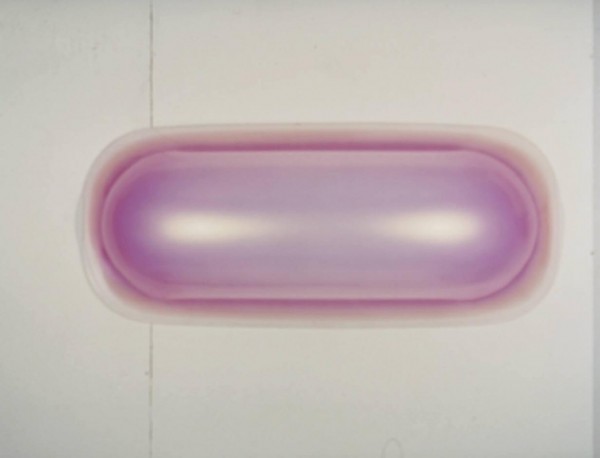
The blue screen piece is a good example of this, too. It is meant to emulate the blue screen of a television set that isn’t getting reception (static no longer exists, as there is now no transmission). In addition to creating a surface of both transmitted and reflected light, I also wanted to reference monochromatic painting. I made the piece on aluminum and then coated the paint with industrial grade reflective beads, used on top of the painted road dividers to cause a reflection when hit with head beams. The result is a halo-inducing color field stuck somewhere between Yves Klein blue and Derek Jarman’s 1993 monochromatic film “Blue”.  In making this giant, undulating sculpture, I am caught in this struggle between the experience of looking – both suspicious of, and appreciative toward, its potential.

This is the hardest I’ve ever made my viewers look at my work, the nearest to abstraction, the least demonstrative. Ultimately, everything in that show is about the act of looking.

Spectres, Phantoms, and Poltergeists is on display at ZieherSmith from September 15 through October 15.

Share

From the DS Archives: Tauba Auerbach

Today from the DS archives we bring you the digital op-art and often dreamily graphic Tauba Auerbach. Auerbach’s show at Glen Horrowitz Bookseller’s East Hampton Gallery closes tomorrow so hurry over! If you miss it worry not, she will be speaking at this year’s New York Art Book Fair held at PS1 in Queens.

This article was originally posted on September 8, 2009 by Rebekah Drysdale.

tauba auerbach4.jpg

Deitch Projects in New York City is currently showing Tauba Auerbach‘s Here and Now/And Nowhere, an exhibition which explores the collision of two conflicting states. The title (purposely composed as an anagram) reflects the artist’s fascination with the origins of language, both verbal language and the symbols used in written language. The multimedia show includes paintings, photographic works, sculpture, and a musical instrument, all investigating the space between order and randomness.

The exhibition showcases five bodies of work: Crumple Paintings, Static Photographs, Fold Paintings, a sculpture that is situated half inside and half outside of the gallery, and the central work of the show, the Auerglass. The Crumple Paintings require the viewer to stand far away from the work to perceive the illusion of crumples, created by large Ben Day dots. The Fold Paintings, painted on raw canvas with an industrial paint sprayer, are a series of incrementally sized fold paintings, which represent the conversion of a previous three-dimensional state to two-dimensionality.

tauba auerbach-install1.jpg

The Auerglass, designed by the artist and her friend Cameron Mesirow of the band Glasser, is a two-person wooden pump organ. The instrument requires two people to play, as one must pump in order for the other to play and vice versa. The Auerglass was played at the opening on September 3rd, and will be played as a prelude to a Glasser performance at 8pm on September 11th. During the exhibition, it will be played daily at 5pm from Tuesday through Saturday.

Auerbach was born in San Francisco and received her B.A. in Visual Arts from Stanford University in 2003. She has had solo exhibitions at the Wattis Institute for Contemporary Arts and Jack Hanley Gallery in San Francisco, and was included in the New Museum‘s Younger than Jesus this year in New York. She published Tauba Auerbach-How to Spell the Alphabet with Deitch Projects in 2006.

Here and Now/And Nowhere will remain at Deitch Projects at 18 Wooster Street until October 17th.

Share

Bring on the Dwarves: Social Practice and Protest in Poland

Dwarves, videos, homemade t-shirts and cardboard tanks: this is what you’ll find in Happenings Against Communism by the Orange Alternative at the Galeria Miedzynarodowego Centrum Kultury in Krakow.  It’s a multi-roomed tour of Polish protest in the 1980s, the retrospective of a social practice movement that swept an entire country.  Although the tone of the exhibition is playfully iconoclastic—that’s the whole point—I often found myself moved nearly to tears by the many video works scattered throughout the space.  It’s not often that art changes the world, but when it does it is extremely poignant and inspiring.

An uncredited photograph from the exhibition Pomaranczowa Alternatywa Happeningiem w Komunizm (Happening Against Communism by the Orange Alternative) at the Galeria Miedzynarodowego Centrum Kultury.

Some background: various political and economic factors plunged Poland into a period of deep decline around 1980, and on December 12, 1980 martial law was declared.  Both an immense buildup of Soviet military at the borders and the arrest of union members and intellectuals precipitated an economic sanction by the US and other nations.  Rapidly, Poland became a nation of fear and scarcity.  Working with the influences of the Surrealist and Dada movements, “Major” Waldemar Fydrych decided to take matters into his own hands.  As a former art history student at the University of Wroclaw, Fydrych had co-organized the Independent Students Union and a massive peace march as well as cooperatively publishing a student newspaper called Orange Alternative, so he was no stranger to both art and politics.  When he saw all the patches of white paint the government was using to cover anti-regime graffiti, he had an idea that eventually shaped itself into a revolution.  His goal was to protest the brutality and militarism of the regime without replacing one dogma for another by shouting political slogans or creating formal hierarchical structures.  From the moment he picked up a brush, Poland became a site for the absurd pushing against the militaristic.  Enter the dwarf.

An installation view of one room from the exhibition. The television in the corner plays a looped excerpt from Maria Zmara-Koczanowicz's "Majer or the Revolution of Dwarves." Photo: Bean Gilsdorf

The exhibition is dense with information, but it is presented in a charming and accessible fashion.  Most rooms include recreated ephemera from the many happenings, including flyers, t-shirts, banners, and costumes.  However, the videos are often the most engrossing because they include first-hand accounts and original films that documented the era.  Majer or the Revolution of Dwarves, directed by Maria Zmarz-Koczanowicz in 1989, includes interviews and police/journalist footage of some of the key players and happenings across Poland.

Another room of the exhibition. Photo: Bean Gilsdorf

The absurdity and low comedy of the events and actions shines brightly across the decades, even in subtitled translation.  One video excerpt recounts a happening entitled Who’s Afraid of Toilet Paper? A man describes the action of giving away (extremely scarce) free toilet paper on the street, gleefully telling passersby to take two rolls, and he reenacts the recipients’ stunned and joyful surprise.  At another happening, protesters lampooned the military by dressing as soldiers and marching in the streets while carrying paper rifles or riding “tanks” made of bicycles and cardboard.  They chanted, “Nothing gives you fun like a machine gun!” and “Less condoms, more military exercises!”  It was silly, a caricature that turned a funhouse mirror to the brutally stark life lived under constant military and police presence.

A DIY dwarf photobooth with side-panel instructions from the exhibition. Photo: Bean Gilsdorf

The most affecting moments occur when the camera catches more than tomfoolery, when the frightening reality of 1980s Poland is glimpsed.  One video shows an apartment full of young people dressing in costumes in preparation for a protest.  A sunny young man adjusts his straw halo for the camera and says, “Wouldn’t it be a pity if they pulled us all in?” and the camera cuts to a view through the apartment window where a military vehicle sits waiting at the curb. Despite his broad smile, the flash of fear in the man’s eyes tells everything: what he risks, and how he feels about it.  Everything is at stake, he could lose it all in the time it takes to be put into the back of a van.  The tension is palpable, his bravery immense. It is precisely this sense of courage and conviction—and of the menace shimmering darkly just beneath the surface of ridiculous hijinks—that gives this exhibition its profundity and force.  One of the leaflets I read before exiting the gallery contained a final thought connecting this historical overview to our present situation: “Is the Orange Alternative spent after 30 years?  In the late 1980s Major Fydrych declared: the Orange Alternative will cease to exist when people no longer need it. So far it does still exist.”

Share

Two Sides of Plastic Pop

L.A. Expanded: Notes from the West Coast
A weekly column by Catherine Wagley

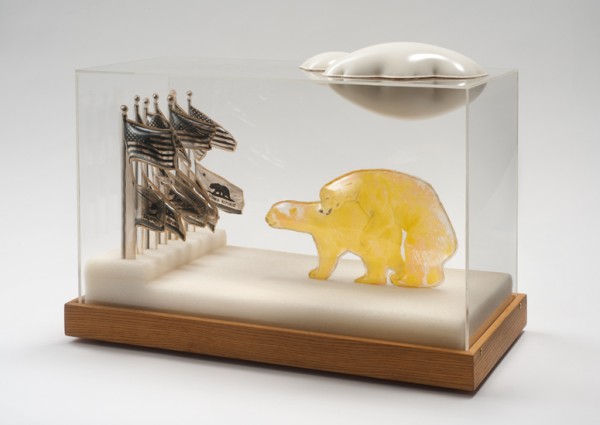
Carl Cheng, "U.N. of C.," 1967, Film, molded plastic, Styrofoam and Plexiglas, 15 x 20.75 x 9 in

Artist Craig Kauffman had been living in Europe and was on his way home to L.A. in the early 1960s when he stopped in New York and saw the work of former friend and neighbor, Billy Al Bengston, on view at Martha Jackson Gallery. Bengston, one of L.A. cool motorcycle-savvy surfer artists had been an abstract painter at the end of the 1950s, as had Kauffman. But now, his canvases were lacquered, spray-painted and shining. That’s what I need to be doing, Kauffman decided, and, when he returned to the Sunshine state, Bengston helped him out, teaching him to spray paint on glass and plastic.[1] It was when Kauffman discovered vacuum-formed plastic, however, that his work really hit its stride. He started using the same technologies the aerospace industry used to make its curved plastic plane windows, creating sleek, clean plastic wall reliefs that he called plastic “erotics.” They had the newness of industry innovations and the lightheartedness of pop.

Craig Kauffman, "Untitled," 1968

Craig Kauffman, "Untitled," 1968.

Because, for me, vacuum forms have more or less become synonymous with Kauffman and cleanness, I was thrilled to discover a different take on molded plastic at Cherry and Martin gallery in Culver City last weekend. Cherry and Martin’s current exhibition, Photography into Sculpture, restages a seminal exhibition that initially occurred in 1970 at MoMA, then traveled across the country. Curated by photo historian Peter Bunnell, the original show put its finger on the pulse of a trend: 3-D photography. Bringing L.A.-based artists and photo-conceptualists together with Vancouver-based photographers, Bunnell showed images that had been re-embodied, so that the flat, condensed space of the picture plane  no longer “depicted” but became multi-sided, dense and object-like.

Carl Cheng, "Sculpture for Stereo Viewers," 1968, Film, molded plastic, wood and Plexiglas, 16.5 x 18 x 8 in

Photographers, it turns out, were tuned into plastics, too. But their take didn’t optimistically celebrate the finish fetish of industrial production. Instead, by using molded plastic to “inflate” formerly flat camera imagery, artists like Carl Cheng and Michael Stone made photographs feel overstuffed in a sort of messy way. In U.N. of C., Cheng’s humping  yellow bears and top-heavy waving U.S. and California state flags are visual comedy: regionalism is blown-up like a flimsy toy, and the vacuum-forms that looked so imperturbable when Kauffman used them, here look like cartoons. That the L.A. Look–which critic Peter Plagens defined in terms of “permanence,” “technical expertise,” and “preciousness (when polished)”–had a more complicated, less polished underside isn’t news, but it’s great to see in the flesh nonetheless, because it drives home the point that no aesthetic trend, not even one toward pristine plastic, is incorruptible.

[1] Hunter Drohojowska-Philp gives this account in her new book Rebels in Paradise.

Share

BISCHOFF SOREN BLACK on the other side of the Bay

Across the San Francisco Bay, Oakland can often seem like entirely different world compared to “The City.” There is a general air of anything goes, as you wander down the streets filled with people from all walks of life. Punks, hipsters, young, cool professionals who used to be vegan anarchists before they had kids and got a real job, all contribute to the truly unique nature of the deceptively vast city of Oakland. Because of its particularly diverse inhabitants, our diamond in the rough promotes a kind of raw creativity that can result in artistic voices that ring true.

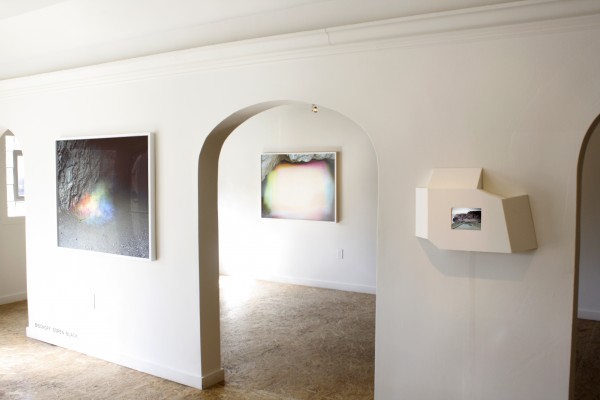
Bischoff Soren Black installation image, 2011. Image courtesy of Johansson Projects

The current exhibit at Johansson Projects is how Oakland often seems; vibrant, mysterious and disorienting, with an underlying hum of recognition. The title of the show, BISCHOFF SOREN BLACK, when said aloud sounds like it could be part of a chant or spell, or the name of some mythical creature, when it is simply the last names of the three featured artists, Brice Bischoff, Tabitha Soren and Ellen Black. The works of all three artists combine to create a narrative of time, space, humanity and chaos.

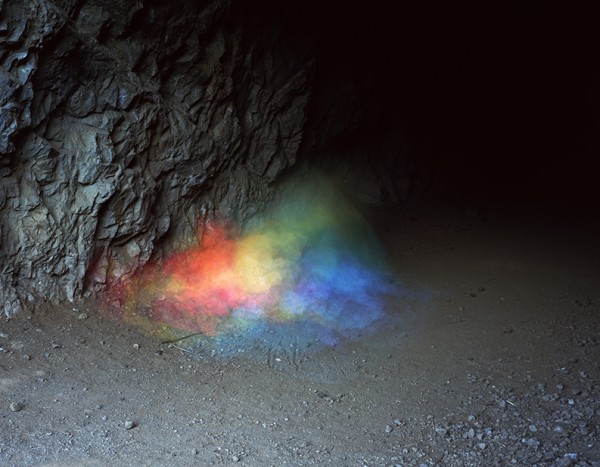
Brice Bischoff, Bronson Cave VI, c-print, 2011

Upon first entering the gallery, you’re confronted with the contrast of Ellen Black’s stark, abstract geometric sculptures housing small video screens, and the dreamy cave interiors created by Brice Bischoff, that look like he was somehow able to get a whole rainbow to sit (relatively) still long enough to release the shutter of his camera. The caves filled with the unintelligible blurs use the magical capabilities of photography to illuminate and emphasize the mystical, contrasting qualities of caves and the light that fills them. The depth of each location anthropomorphizes the earth’s occupants before living creatures evolved – giving  life to the elements.

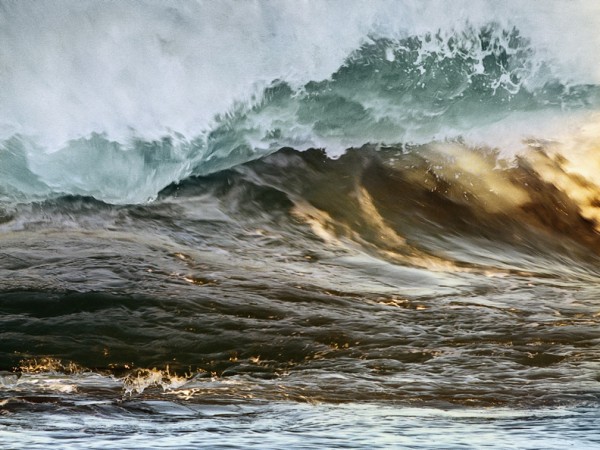
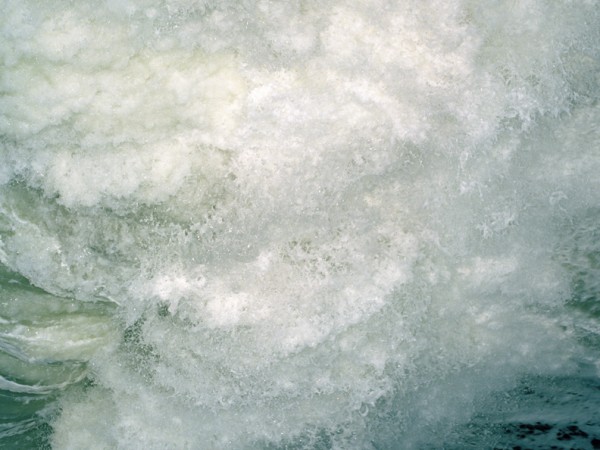
Tabitha Soren, Panic Beach 15759-3, pigment print, 2011

This quiet, pre-human interaction between earth, fire, water and air crashes into the violent un-worldliness of Tabitha Soren’s photographs. By inverting the images, Soren presents us with a tumultuous world that brings to mind the primordial soup from which we all came. With water crashing everywhere, it is sometimes hard to firmly orient oneself on the ground, causing the same kind of uneasiness one feels when stepping off a boat after being on the water for hours.

Tabitha Soren, Panic Beach 06734-20, pigment print, 2011

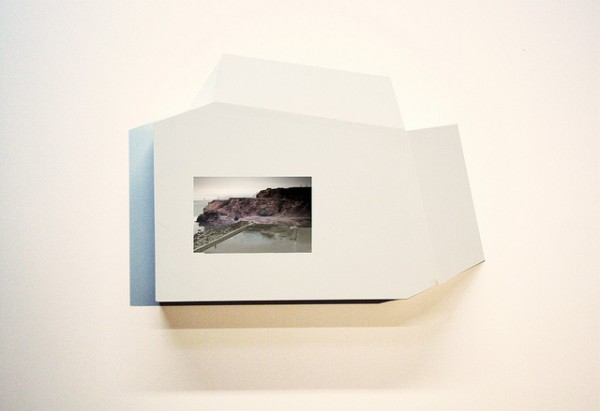
As soon as you feel like you’re finally getting a grasp of what is going on, Ellen Black’s video installations throw you back into the abstract. The white containers that hold her tiny video screens are more like quantum cubes than “boxes,” with edges and corners jutting out as if an unexpecting polygon was frozen while in transformation from one shape to another. The video pieces reflect their containers’ fluctuating desolation, with bleak beach scenes layered on top of other geographic scenes that break through the video’s digital deterioration, while miniature silhouetted figures wander with no apparent purpose across the landscape, some may be playing or drowning in the surf.

Ellen Black, Last Summer, single channel video, 2011

The experience of viewing the exhibition is one of quiet turmoil in contrast with the inherent beauty of the natural world. Like watching a video of a forest fire with the sound off, you know that something destructive is happening, but you know it will lead to regeneration. And of course there’s no denying how beautifully mesmerizing it is.

BISCHOFF SOREN BLACK will be on view at Johansson Projects until October 15, 2011.

Share

Art Spin at the new 99

A walk along Toronto’s west Queen West these days is a journey through a neighbourhood still in the throes of gentrification. With a thriving gallery scene now fully entrenched, the condos are going up, taking shape amidst the soaring cranes and massive construction pits. A little jaunt south of the main drag, a newly-renovated 99 Sudbury now holds a fitness club and event spaces, as well as a commercial gallery—a newly-minted 6,000 square-foot white cube. The inaugural exhibition, which opened on August 25th, is a whimsical group show curated by Art Spin, their second annual show, and something of a coda to their regular contemporary art bicycle tours.

James Gauvreau, Really Long Lake (installation view), wood and video, courtesy 99 Gallery, photo: Jesse Milne

Though the show consciously avoids a thematic framework, the individual works (by a dozen Ontarians), gain a certain coherence here—not only in relation to each other, but to the relatively majestic space they occupy—it would be possible, you feel, wandering through the gallery, to make a bicycle tour of the exhibition itself, and the breathing room is crucial to the larger energy fields many of the pieces project.

Gareth Lichty, Enclosure, construction fencing, courtesy 99 Gallery, Photo: Jesse Milne

But it’s the relationship to the neighbourhood that’s most compelling, to me at least, as raw, industrial materials, some of which seem like they could have been scavenged from nearby construction zones, are here creatively re-purposed inside the gallery.

The room is anchored by James Gauvreau’s Really Long Lake, which narrows to the top of the 17-foot ceiling and incorporates a projection and a mirrored floor—a kind of meditative, rustic, fun-house.

James Gauvreau, Really Long Lake (interior), wood and video, courtesy 99 Gallery

It’s flanked by new work by Gareth Lichty, who turns vibrant orange construction fencing into minimalist vessels, and by Hamilton collective TH&B’s Transmission, an industrial radio tower topped by quietly sonic satellite dishes overgrown, seemingly organically, by a hive of burrs—a worthy follow-up to 2008’s Swarm, which generates a similar sense of electric energy and an underlying, pervasive anxiety.

TH&B, Transmission, burrs, radio tower, cable, satellite dishes, found objects, courtesy 99 Gallery, Photo: Jesse Milne

Surrounding wall-mounted works reinforce the sense of intensive craftsmanship and renewed interest in the art object’s meticulous construction. On the far wall, Markus Heckmann’s Reg Ex flashes neon lines that evoke the light works of Dan Flavin, but are here formed by whitewashed 2x4s mounted in vertical lines and generative animation, displacing the source of light as an external projection.

Vanessa Maltese, Wall Grid No. 2 (Studio Sculptures), wood and acrylic paint, courtesy 99 Gallery, Photo: Jesse Milne

On the other side of the room, the tiny, perfectly formed pieces of sculpted wood that make up Vanessa Maltese’s Wall Grid No.2 (Studio Sculptures) are a geometric counterbalance, revisiting modernist forms in the gem-like, obsessive shape of miniatures. With a similarly pared down aesthetic, Sarah Elizabeth McCaw’s suite of works pair texts like “I am not 100 percent sure we can do this” and “Everything is going to be all right” with wooden models reminiscent of broken wall clocks, with simple moving parts: completely mesmerizing exercises in futility.

Sarah Elizabeth McCaw, I Am Not 100 Percent Sure We Can Do This, wood, acrylic and motor, courtesy 99 Gallery, Photo: Jesse Milne

The first and last piece you see in the space is a panoramic painting by Toronto-based Gillian Iles, Eden is Tempting but Not to be Trusted, a vibrant canvas that foretells and reflects the restless imagination and sense of absurdity in the room.

It’s worth a spin.

Gillian Iles, Eden is Tempting but Not to be Trusted, oil, acrylic and pastel on canvas, courtesy 99 Gallery, Photo: Jesse Milne

With additional work by Wrik Mead, Keith Bently, Tom Ngo and Scott Eunson. Art Spin’s Second Annual Exhibition at 99 Gallery is on view Tuesday to Saturday, noon to five, until September 24th.

Share

Swoon at the ICA, Boston

I am as free as nature first made man,
Ere the base laws of servitude began,
When wild in woods the noble savage ran.

– John Dryden, The Conquest of Granada, 1672

At this point, everyone knows that street artists leave completely unexpected artworks that don’t last long but that are often more absorbing than the works we usually get to see in museums. Because of the ambitious and courageous nature of illegally staking your claim to expression, translating the fresh thoughts and passion of street art into the sedate world of the white cube has always been near impossible.

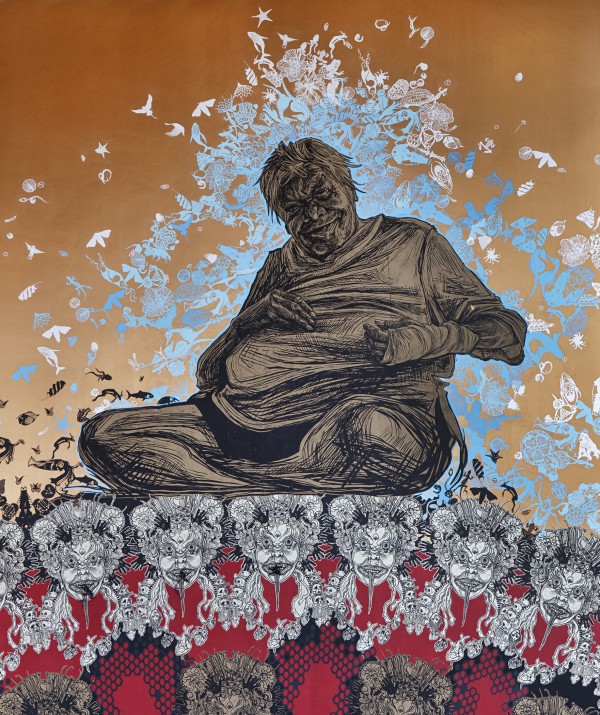
Swoon, Anthropocene Extinction (detail), 2011, Courtesy of the artist, Photo: John Kennard

To me, Swoon has always been aware of this. She stands out as having an inherent understanding that “street art” in the modern art market involves that translation. She has unabashedly kept her work from being simple objects; slick, archival consumables that works within the limits set forth by collectors and institutions. To use an analogy, she wants to produce the symbolic rawness of the Andre the Giant sticker, not the corporate efficiency of the Obey brand.

Swoon has been commissioned to create “Anthropocene Extinction” for the Boston ICA‘s fifth installation of the Sandra and Gerald Fineberg Art Wall (on view through Dec 30, 2011). Her work is a sermon built from international symbols of humanity’s relationship to planet Earth. It’s an alluring mural of cut paper and relief prints with an umbilical cord of cut paper party-streamers running to a bamboo sculpture that lives next to the museum’s giant glass elevator. It enlivens the space like no other Fineberg Art Wall installation. The work shows off her skills with lines and drawing, her ability to control color, and the quality of her printing techniques.

Swoon, Anthropocene Extinction, 2011. Photo: Geoff Hargadon for Brooklyn Street Art.

The rhythm and composition of the individual prints/paper cuts is exceedingly regular and controlled. The mural is a hodgepodge of stuff with no given proportion. It’s a scalable image capable of being resized for almost any application. The bamboo sculpture takes after Asian scaffolding. It seems like a pagoda, but has what looks like wedding cakes on it and a beehive surrounded by butterflies at the top. No matter how attractive it is, I’m not sure what it’s supposed to represent or how it relates to the mural.

Swoon’s message relies on the myth of the noble savage. Ms. Bennett, the last living nomad personifies a blameless innocent, a buddha sitting on top of a string of Tibetan deity masks, surrounded by animal totems that represent the extinction in the work’s title. Why Ms. Bennett is 20 times larger than the animals, I’m not sure. It certainly encourages the reading that the animals are less significant than the human. It also seems very Victorian to send out an artists to bring back the last living nomad to a museum setting.

Swoon, Anthropocene Extinction, 2011. Photo: Black Rainbow Extraordinaire Magazine.

Not that it makes it less of a work, but this installation has nothing to do with street art. It uses wheatpaste, but is that all it takes to be a street artist? The work as exhibited is a printstallation; a hybrid format (of installation made from or about prints) that has been a part of the print community for years. Do street artists get shipping budgets and 9 days with a crew of 5 plus an equal amount of student assistants to put up their work? To insist that this is a street art piece implies that her work is so unexplainable and independent from the norm of contemporary art that she’s some kind of freak outsider. She is an artist. An artist who still leaves jewels for people to find on the street, but an artwork in a museum does not parallel the relationship between artwork and street.

Share