Betye Saar at Roberts and Tilton

Betye Saar, "Red Time," 2011. Installation view. Image courtesy of Roberts and Tilton Gallery.

For the moment, the beating heart of Los Angeles’s Pacific Standard Time is Betye Saar’s installation Red Time, 2011, at Roberts and Tilton.  Saar has transformed the middle room of the gallery into a shrine for past, present, and future, painting Roberts and Tilton’s interior room a bright red and allowing a variety of her customary assemblage works to act as friends and neighbors to each other, despite where they were collected from or when they were made.  In fact, one of the most striking things about Red Time is the position it takes on memory and history.  While Saar has divided Red Time into three separate sections–“In the Beginning,” “Migration and Transformation,” and “Beyond Memory”–she has also unified them through her use of a singular, strong background color and their enclosure in one small room.

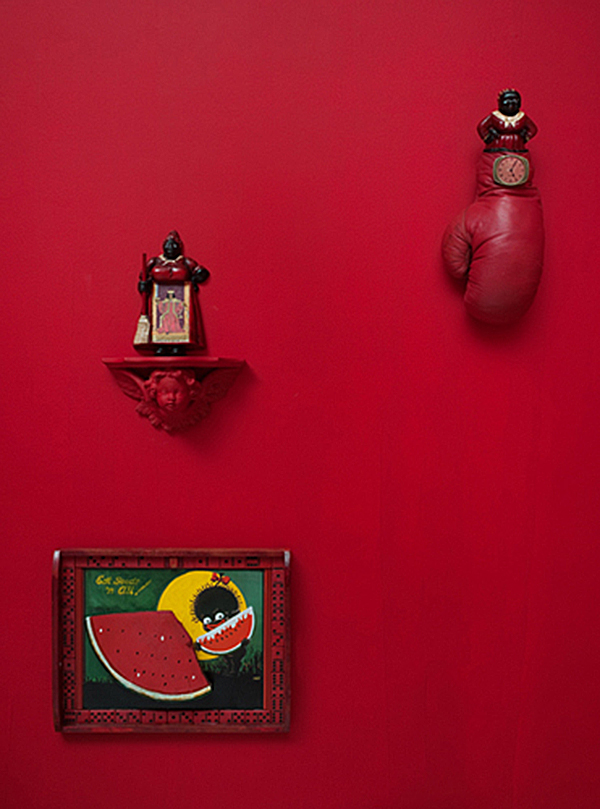
Betye Saar, "There Will Be Blood," 2011. Mixed media assemblage. 22.25 x 22.25 in (56.5 x 56.5 cm). Image courtesy of Roberts and Tilton Gallery.
Betye Saar, "Red Time," 2011. Installation View. Image courtesy of Roberts and Tilton Gallery.

Saar first rose to prominence in the 1960s as a Joseph Cornell-inspired assemblage artist who insistently tackled issues of race and history, and these issues remain central, both figuratively and literally.  Many of the pieces that make up the “Migration and Transformation” section of Red Time, which occupies the wall opposite the room’s entrance, are radical détournements of Aunt Jemimah and Uncle Tom figures, a technique that Saar may have been the first to utilize and perfect.  In fact, it is the juxtaposition of the pleasing formal rhythms, the coziness of the physical space, and the chilling historical narratives referenced by pieces such as There Will Be Blood, 2011, To the Manor Born, 2011, and Is Jim Crow Really Dead, 1972, that drives the work.

Betye Saar, "To the Manor Born," 2011. Mixed media assemblage. 11.5 x 20.5 x 2.25 in (29.2 x 52.1 x 5.7 cm). Image courtesy of Roberts and Tilton Gallery.
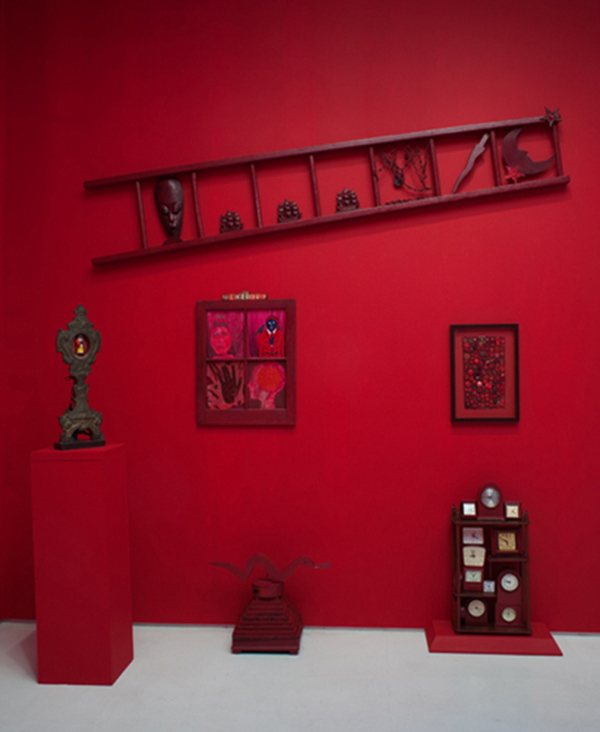
Betye Saar, "Red Time," 2011. Installation View. Image courtesy of Roberts and Tilton Gallery.

Among the works that Saar felt absolutely needed to be present in the installation is Red Ascension, 2011, a wooden ladder hung toward the top of the wall in “Beyond Memory.”  Nestled amongst the rungs are wooden sculptures that tell a familiar story:  an African mask, several wooden ships, chains, and a crescent moon and star.  The ladder points viewers to the wall that is both the first and last in the exhibit, the wall to which their backs are turned for the majority of time they are in the room.  It is the wall with the entry and exit door, on which a series of masks hang, looking back at the viewers with all manners of expression.  Red Time is not solely a time of despair or anger.  It is also a time of rebirth and open-ended questioning.

Share

From the DS Archives: Johannes Kahrs

In honor of the beginning of Autumn, today from the DS Archives we bring you the sobering mystery of Johannes Kahrs. Kahrs’ second solo exhibition at Luhring Augustine is on view until October 22, 2011.

The following article was originally published by Julie Henson on February 16, 2010.

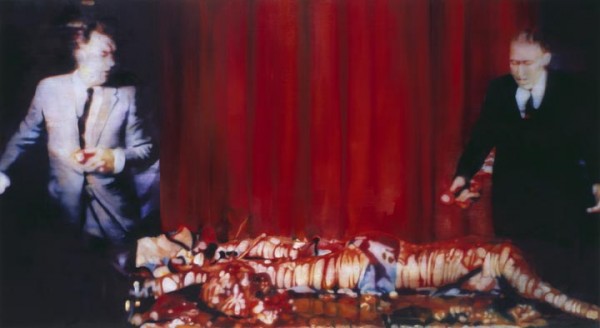
I have to admit, there is nothing more impressive to me than a well executed painting, and spending some time with the work of Johannes Kahrs has done nothing but revive this fascination. Living somewhere between film, modern news media and history painting, Kahrs’ work seamlessly merges the beauty and tradition of painting and portraiture with banal yet grotesque objectivity, seducing the viewer into a reductive, saturated palate only to confront them with an aggressive yet all too familiar imagery. Choosing images generally experienced through second hand sources of information, Kahrs infuses his paintings and drawings with the drama of film, creating a sense of constant motion and closeness within a still and fragmented plane. Claiming imagery typically referenced through our daily interaction with media sources, Kahrs builds on the diversity of photographic images infused with the seductive palette of artists such as Richter and Tuymans, but invests them with a grotesque, bodily relationship to the viewer seen in the work of Jenny Saville. Kahr’s dark and alluring palette creates an ominous sensation surrounding his shrouded, anonymous figures that instantly builds a narrative within his intentionally extracted context. Kahrs’ film-like color references the emotive palette seen in work such as Luc Tuymans’ Gaskamer, but builds another narrative context that remains familiar but unidentifiable.

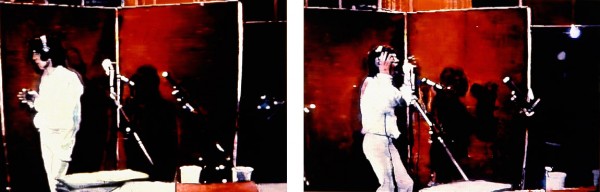
Nevertheless, it is his hybridization of media that keeps me coming back to his work. The sensation of moving film, rather than a captured photograph, comes not just from rendering from video stills, but showing sequences of images with a subtle shift in time. Kahrs employs a blurring and shifting of images, but also blurs the identity of his subjects, contributing to his seamless combination of the banal and the grotesque. This obscuring of subjects to a point of abstraction, allowing faces to melt off the subjects like those of Francis Bacon’s portraits, elevates while disguising the identity of the mundane, drawing on our cultural over saturation and disconnection from the physicality of violence. Further complicating his role in creating the image, Kahrs paintings and drawings are often shown behind glass, emphasizing the viewer’s separation from the work and further masking the artist’s hand. This masking and obscuring of time combined with the multiple references to media builds more questions than answers, giving someone a place to investigate and question both the history of painting and its relationship to modern life.

Kahrs recent exhibitions have included solo shows with Luhring Augustine in New York and GAMeC in Bergamo, Italy, in addition to several group shows at the Phoenix Art Museum, the SFMOMA and Museu Serralves in Porto, Portugal. Kahrs currently lives and works in Berlin.

Share

Gary Rough

A Premonition of the Future, 2011; used and new books, reclaimed timber; dimensions variable. Courtesy of Sorcha Dallas

Gary Rough’s solo show, ‘Monday, Tuesday, Wednesday, etc. …’ was developed during a residency of five weeks in the galleries of Sorcha Dallas, Glasgow.

A Premonition of the Future, 2011 (detail); used and new books; reclaimed timber; dimensions variable. Courtesy of Sorcha Dallas

In the first gallery, copies of George Orwell’s ‘1984’ sit on shelves, lining the upper perimeter of the gallery. An installation of Rough’s ongoing attempt to acquire one thousand, nine hundred and eighty-four copies of ‘1984’ that are either used or gifts, the ominously titled work A Premonition of the Future carries with it the text’s dystopian notions of censorship and suppressed freedom.  On one hand, the described attempt represents a feat of encountering and collecting the literal and symbolic meanings of the text as it passes through the hands of others. Viewers are presented with a state in-between that speaks of potential, and a sampling of book covers reflecting the proliferation of the text across various publishing and distribution channels over time. On the other hand, the sparseness of the installation and its out-of-reach display alludes to a quest that cannot be attained, contrasting with the narrated ambition.

Top: Untitled, 2011; emulsion on wall; dimensions variable. Bottom (Left to Right): Failed Pattern (Left), 2011; Failed Pattern (Wrong), 2011; Failed Pattern (Right), 2011. All drawings framed pen on paper; 63.4 x 50.8 x 3.5 cm. Courtesy of Sorcha Dallas

The curious admixture of endeavor and futility is strongly apparent in the second gallery, displaying three pen drawings from an ongoing Failed Pattern series where deliberate errors are created that distort the regularity of harlequin patterns. These drawings are distinguished through titles that play with the sense of both space and failure, and dialogue with a lone pen drawing, Failed Pattern (Away from Here) that is hung in the office of Sorcha Dallas as part of the exhibition. The exercise in creating intentional failed patterns is paralleled along corners of the gallery walls that appear to be painted at the same height of the shelves of A Premonition of the Future, creating a visual continuation across both galleries. While the cumulative effect of the distortions in the pen drawings creates curvatures and a slightly optical effect; the use of paint for the patterns of the wall make room for the mistakes to be demonstrated through drips and cracks, presenting a sense of beauty that arises from exercises in failure.

Top: Untitled, 2011; emulsion on wall; dimensions variable. Bottom: Failed Pattern (Left), 2011; framed pen on paper; 63.4 x 50.8 x 3.5 cm. Courtesy of Sorcha Dallas

Across both galleries, the installation and drawings compel one to think of the ways that narratives and practices of effort and failure act as recurring patterns in the rhythm of life one encounters on Monday, Tuesday, Wednesday, etc. …

Born in Glasgow, Rough (b.1972) is now based in New York, and has presented solo exhibitions at Inverleith House, Edinburgh; PS. 1 MoMA, New York; McCaffrey Fine Art, NY, and Yvon Lambert, Paris.

Share

Too Many Mountains

L.A. Expanded: Notes from the West Coast
A weekly column by Catherine Wagley

Joel Kyak, "Pine Woods Municipal Band Tryouts," Corner diptych, 2011. Courtesy Francois Ghebaly Gallery

As a kid, I lived in a Seattle suburb for a year. We could see Mt. Baker out the living room window – the whole, majestic mountain was right there, nearly always in plain view. Before that, my family had lived in Chicago and Minneapolis, where there are hills and “bluffs” but no real mountains. When I told the other kids this, that I’d come from a place without mountains, most thought I was pulling one over. I remember, when the dad of one disbelieving six-year-old got transferred to  Minnesota, thinking, “now he’ll see.”

Probably, I’d seen mountains in picture books before I had Mt. Baker constantly in my line of site, but even if I hadn’t, I wouldn’t have doubted the existence mountains. But I guess  it’s easier to believe in what you haven’t seen than to believe that, somewhere else, what you have seen doesn’t exist.

Joel Kyak, 2011. Courtesy Francois Ghebaly Gallery.

Joel Kyack, 2011. Courtesy Francois Ghebaly Gallery

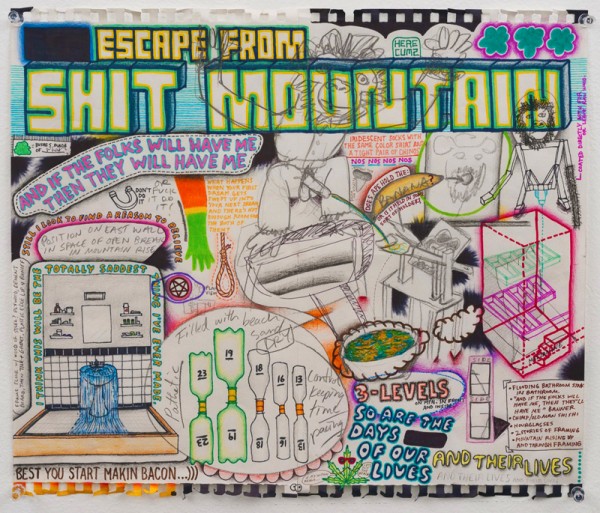
You don’t have to believe in mountains to appreciate Joel Kyack’s new show at Francois Ghebaly Gallery; you just have to believe that other people do.  The show riffs on the metaphorical weightiness we ascribe to time—time is regeneration, the source of change, the source of continuity, finite and yet seemingly never-ending, fast-moving and yet slow enough to have lasted forever—and it’s the idea of the big, tall mountain that stands in for that weightiness. This all sounds serious, but it’s actually not. Mostly, Escape to Shit Mountain, which has the irreverence of a Mike Kelley installation without any of the self-deprecation, is farcical, colorful and fun.

Five big, diorama-like tableaux on panels lean against the gallery walls. Two sets of these are diptychs including Pine Woods Municipal Band Tryouts, which you’ll notice first because it’s making a tooting noise. On the left panel in the diptych, you’ll see the stump of a tree sticking out of a terrain of cartoon rocks and plants, some painted flat onto the wood some protruding, sculpted out of what I assume to be foam. The tree trunk has arms—very poorly defined ones—and it’s playing a trumpet. Drips of brown paint slide down the panel, which has also been spattered with spots of painted snow.The panel beside it has a similar terrain, and the figure of a man in plaid is seen planting a tree. His skinny sculpted knees rest on a bit of scaffolding and he has a trumpet coming out of his butt. So the emblems of age and regeneration are both blowing their own horns.

Joel Kyak, "Good Things Come (To Those Who Wait?)," corner diptych, 2011, wood, hardware cloth, newspaper, acrylic paint, spray paint, sand, artificial plants, astroturf, foam, tin cans, fake crow, cardboard tube, zip ties, rocks, artificial limbs, 6 feet x 5 feet x 4 feet each. Courtesy Francois Ghebaly Gallery

Then there’s Snowblind, the snowy mountainside tableau with a kitchen sink (nothing but) that streams continually black water growing up out of it, and Good Things Come (To Those Who Wait?), another leaning diptych in which the grave stones of two people laid to rest on a mini golf course communicate via tin-can telephone. The stones—they have arms, of course—exude contentedness. Being dead in a golf course must not be so bad. A kiddie pool fountain with fake primates standing over it and a few pop bottle hourglasses filled with Pacific Ocean sand drive home the point that time is finite and that it’s not. In other words, they don’t drive home much of a point at all. Which is why I liked Kyack’s show the night I first saw it, during a mess of Culver City and Santa Monica openings, many of which focused on history more directly, by actually  showing historical work.

Pacific Standard Time (PST), L.A. art’s Getty-backed six-month celebration of it’s own 1945-1980 history and something I’ve probably mentioned in this column too many times already, means an unprecedented number of institutions and galleries are making a plug for the city’s historical provenance. There’s a mountain of “historical art” to see, and to shrug off it’s important, would be to shrug off L.A.’s claim to fame. Apparently, Kyack’s Shit Mountain is officially part of PST (though galleries didn’t receive funding), and that’s part of the fun, because the show, completely made up of new work, seems to be saying, “History? It’s everywhere; in fact, it’s as widespread as B.S.”  And work with a sense of humor is fun to look at, whether it’s from 1949, 1971, or today.

Share

Locked Room Scenario

Like other missed opportunities, there are always certain exhibitions that you regret not seeing – the ones you mean to visit, plan to visit, even try to go and visit – but something gets in the way. Many are forgotten, but in some cases, the in absentia can continue to haunt for years.

Locked Room Scenario scratches at these open wounds of regret. As an exhibition, it insists upon being actively pursued, but its carefully crafted content is designed to fail to fulfil – leaving you with the feeling that you have just missed out and arrived to the exclusive party just a bit too late.

Commissioned by Artangel, British artist Ryan Gander’s latest project, and largest to date, occupies an abandoned building in East London. After making an appointment, and mapping out the obscure building, you are pointed towards an open door and told to go inside.

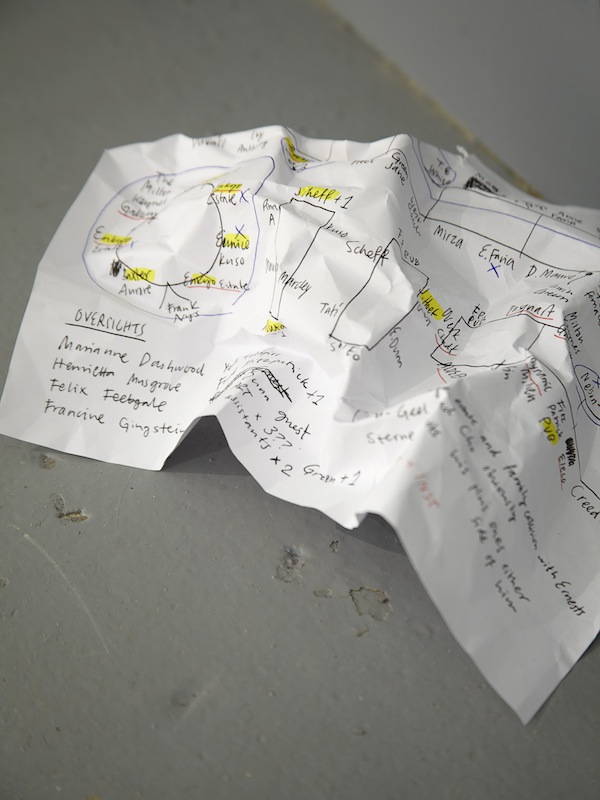
Ryan Gander, Locked Room Scenario, 2011. Image courtesy of the artist and Artangel.

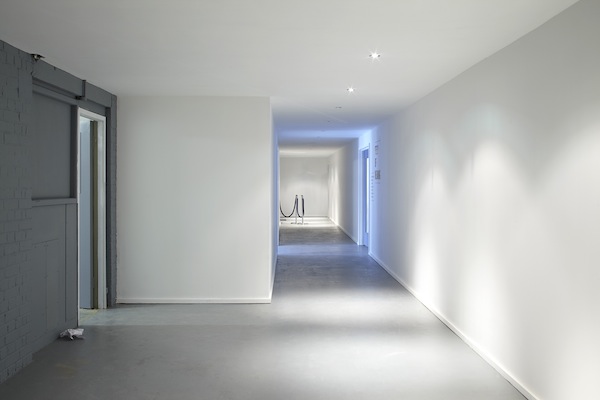
Locating anything in the near-empty warehouse involves a bit of anti-intuitive exploration. Lit rooms are locked tight. Barriers are partially in place. Doors leading to dark corridors are amongst the few open – and if you push on through the labyrinth, you eventually find something – although it isn’t exactly what you expected. Uncertainty and issues of accessibility permeate the entire space and experience of it.

Like much of Gander’s work, Locked Room Scenario is a puzzle, and you must piece together the narrative from the clues left behind.

Ryan Gander, Locked Room Scenario, 2011. Image courtesy of the artist and Artangel.

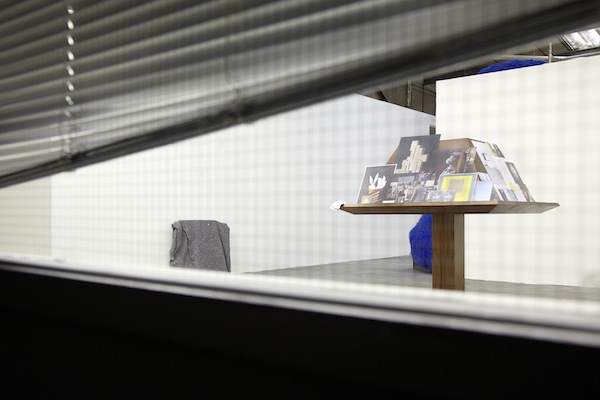
Boxes of press releases and postcards, abandoned and partially de-installed artworks, guestbooks, furniture and scraps of paper surrounding a previous exhibition Field of Meaning by the Kimberling Gallery are strewn throughout the space. Through half closed blinds you can glimpse obstructed views of the work remaining of the ‘Blue Conceptualists’. All we can see is fragments of sculptures, blurry slide projections and reflections of video screens – the denial of full access is frustratingly unfulfilling.

Ryan Gander, Locked Room Scenario, 2011. Image courtesy of the artist and Artangel.

Of course, the exhibition, the gallery and the artists have only ever been found in this particular state. The entire story has been scripted by Gander for this project, and it plays on the human desire for full disclosure – we want to know everything, even when there is nothing else to know – and at this point truths in the narrative construction begins to break down and blur.

As we know, fiction has a funny way of working itself into memory, and Locked Room Scenario quite accurately demonstrates how knowledge can be built. Within, and beyond, this warehouse in the East End, fact and fiction meet to blur the lines of reality. Everything surrounding the experience ends up being called into question – It was only after leaving that I realised the strange message sent to my mobile that morning (the number cheekily requested upon appointment booking), which I assumed was simply a wrong number and couldn’t be bothered to respond to, was actually a part of this extended script – a message from one of the members of the Blue Conceptualists:

‘I’ll wait for you in the Wenlock 10 mins before. Spencer A.’

Share

Perth

Tarryn Gill and Pilar Mata Dupont: Stadium

Tarryn Gill and Pilar Mata Dupont 2009, Under Blue Skies, In Golden Sunlight, All Spectators Have Eyes Riveted on Gallant No.306, Giclée Print on aluminum 95 x 180 cm, courtesy of the artists and Goddard de Fiddes

Stadium, the ten-year retrospective of collaborative duo Tarryn Gill and Pilar Mata Dupont at Perth Institute of Contemporary Art, looks back on a body of work that investigates connections between nationalism, aesthetics and performance. While Gill and Mata Dupont primarily focus on Australian nationalism, their work has its genesis in the global cultural shifts – in particular the increasingly ring-wing politics – that occurred in the wake of the September 11 attacks.

Gill and Mata Dupont’s intensely ironic work has interrogated dominant icons of Australian identity, probing the characterization of Australian identity as masculine, native-born and white. In presenting serialized and ritualized celebrations of Australia’s ‘golden age’, the artists’ aesthetic of glamor and pageantry points to the constructed and mythologized nature of national identity. They reveal that official Australian identity has been formed by its exclusions, a point which they emphasize by drawing aesthetic parallels between Australia and the propaganda of totalitarian and fascist regimes.

Their Heart of Gold Projects (2004-2008) restage images and themes derived from 20th century propaganda, passed through a filter of Hollywood musicals, glamor photography, competitive calisthenics and kitsch Australiana. At its most fundamental level, this body of work asserts that aesthetics and ideology are inextricably entwined. The series also responds to the widespread marginalization of women in heroic histories of nation. The story of Australia that’s celebrated is conspicuously masculine, populated by heroic types conquering an inhospitable landscape. Gill and Mata Dupont’s work recasts women in the role of these heroes; however, the cross-dressing, pirouetting, high camp antics of their heroines are far removed from the realities of the frontier and the battleground, pointing to the dangers of citing the past to garner support for the politics of the present.

Tarryn Gill and Pilar Mata Dupont 2011, Ever Higher, Performance, Photograph by James Hensby, Courtesy the artists and Goddard de Fiddes

Drawing on Mata Dupont’s family heritage, recent work has reflected on Argentina’s ‘dirty wars’ of the 1970s and 80s. Their 2010 video work Gymnasium took inspiration from the work of Leni Riefenstahl to depict an acerbic celebration of Australian sportsmanship and nation, while their new site-specific performance Ever Higher sees a lone aerialist commanding a troupe of cheerleaders with eerily familiar phrases such as “Teamwork will set you free,” and “Blood and Honor! We are gonna…win!”

Gill and Mata Dupont’s practice over the past ten years has satirized and disarmed nationalism, but there continues to be a degree of discomfort in their work. Their devoted irony is central to the ambivalence of the work, which, for some, reads as sincere. However, the artists’ resistance to offering a clear moral stance in their work is actually key to its success as parody—because, for all its deceptive innocence, the work is indeed seductive, like all successful propaganda.

Share

America’s Southwest in Amsterdam.

REMIND ME TO REMIND ME, 2011. Concrete, sand. 41.8 x 100.5 x 129.5 cm. Courtesy of the gallery.

Anya Gallaccio’s current exhibition ‘highway’ at Annet Gelink Gallery in Amsterdam, is a graceful expression of a personal journey through the life and career of this leading British artist. Widely known for the ephemeral nature of her chosen materials, Gallaccio typically emphasizes notions of permanence, time, and decay. Yet, in her fourth show with Annet Gelink Gallery a preference for transient organic material has been transformed into the opposing and unexpected material of stone.

‘highway’ is based on the transatlantic journey of one boulder that Gallaccio alienated from it’s original environment while on a road trip through the arid landscapes of America’s Southwest. The stone now appears as three corresponding sculptural forms together with a series of otherworldly black and white photographs at its new home in the distant and unfamiliar environment of lively Amsterdam.

At first, the beautifully simple and minimal content of the exhibition mirrors the wide-open and peaceful environment of America’s Southwestern landscape.  However, on closer reflection one begins to consider the complex emotions experienced while taking a road trip through an unfamiliar land. The first sculpture is in fact in negative, where the boulder has been cast in concrete, and the mould is displayed with the red sands of the Southwest dusted over and into each crevasse. This work brought to mind Roden Crater by the great artist James Turrell, who’s ethereal works appear to be in the thoughts of Gallaccio while she negotiated her relationship with this foreign and unforgiving landscape.

RHYMES OF GOODBYE, 2011. Rock, broken car wind screen. Rock: 100 x 70 x 47 cm (at widest points). Courtesy of the gallery.

The second sculpture is the original stone, blanketed with a broken car windscreen found buried in the desert. In contrast to the mysticism of the first work, the second sculpture is more closely associated to the classic notion of the all American road trip. Time, music and hallucinogens all came to mind, transporting the viewer to the passenger seat of Gallaccio’s car. What would be on the radio? Deep Purple perhaps, or maybe Led Zepplin…to this visitor there was clearly an underlying psychedelic, 1970’s California feeling to the works, which was most prominent in the few black and white photographs. Gallaccio created microscopic close-ups of dirt she collected during the road trip, that once printed, looked to be alien landscapes, images more closely associated with the Hubble telescope than to the vast lands of the Southwest.

YOUR KINGDOM TO DUST, 2011. Archival pigment print on rag paper. 27.2 x 20.3 cm. Courtesy of the gallery.

“ I wanted to make landscapes with an epic sense of scale, or a strangeness, like planets, and remote unexpected worlds from these tiny particles, normally overlooked, literally under our feet.”

Eventually moving to the back of the space, there is situated a bronze cast of the boulder, reflecting a psychological landscape that Gallaccio has poetically intertwined into the physical nature of the material. The bronze boulder expresses a preference for unconventional natural materials in an exhibition setting, while cleverly incorporating the traditional sculptural medium of bronze, who’s historic application opposes commonly held ideas associated with Gallaccio’s work.

FOREVER CHANGES, 2011. Bronze. 100 x 70 x 47 cm (at widest points). Courtesy of the gallery.

Not only does Anya Gallaccio convey a passage through the Southwest landscape, she also reflects a journey in herself, where ‘highway’ communicates the sense of navigating work and life to new grounds, constructing exciting paths filled with the unknown.

Share