World Disclosers: Medusa’s Mirror at Pro Arts Gallery

Carmen Papalia, "Blind Field Shuttle--Mildred's Lane," 2011. Digital Print, 11" X 17." Photo by Kristin Rochelle Lanz.

Some philosophy holds that the fundamental role of human beings is to be “world disclosers.”  Medusa’s Mirror: Fears, Spells, and Other Transfixed Positions, a small yet conceptually powerful show at Oakland’s Pro Arts Gallery, demonstrates this principle via the visual arts.  The exhibit, curated by Amanda Cachia, is expansive in at least two important ways. First, the objects on view include both traditional and new media.  Even fashion, often omitted, is interestingly addressed.  The second inclusion is the more significant one: the makers of the work are all disabled people who have made disability their subject.

Some of you, I know, have just gone on to read another review.  Haven’t we had thirty years of identity politics?  Yes, indeed we have.  And some of it, as the critic Robert Hughes loved to point out, was narrow and preachy.  But hold on a minute.  The voices of “Medusa” are not “victimized voices.”  You’ll find enough canon-stretching and humor here to make a trip (or this article) worth your time.

True, this work is not heavy on visual appeal.  During my two-plus hours in the gallery, several visitors came and went rapidly, neglecting even the wall text.  But unlike the norm over the past three decades, there are sufficient enough making skills and aesthetic value present to capture the interest of a beholder longer than the standard, three-second gallery goer’s glance.  Slow and patient viewing is rewarded by encounters that permit seeing disabled people, our shared social world, and even ourselves differently.

Read More »

Share

From the DS Archives: George Jenne

Today from the DS Archives we bring George Jenne’s exhibition, Don’t Look Now at Civilian Art Projects, Washington DC. Jenne is currently in the group show, Pan’s Pipes, with Ryan Hill and Erick Jackson at Civilian Art Projects, on view until October 22, 2011.

This article was originally posted on January 21, 2010 by Rebekah Drysdale:

Courtesy of the artist and Civilian Art Projects

Civilian Art Projects in Washington, D.C. is currently presenting Don’t Look Now, a multimedia exhibition by Brooklyn-based artist George Jenne. Don’t Look Now consists of manipulated movie posters, sculpture, and graphite drawings, all reflecting the artist’s interest in the horror movie genre. Jenne sees a correlation between the unease and trauma delivered by such films and the unsettling experience of early adolescence. The artist states in the press release, “For me, there is a strong connection between the act of warning or revealing and the portentous atmosphere of pre-pubescence, thus a strong connection between the abject, mutated form of the monster, and a person’s tenuously pristine state of mind during early adolescence.”

Read More »

Share

Fan Mail: Maysey Craddock

For this edition of Fan Mail, Memphis-based artist Maysey Craddock has been selected from a group of worthy submissions. If you would like to be considered, please submit to info@dailyserving.com a link to your website with ‘Fan Mail’ in the subject line. Two artists are featured each month—the next one could be you!

Maysey Craddock. "Rupture (ashes and light)." 2011. Gouache and thread on found paper. 38.5 x 51.5 inches. Courtesy of the artist.

Maysey Craddock’s paintings are, without a doubt, immediately engaging.  Her bright, playful use of color in tandem with the distinctive textural quality of the paper she works with catches the eye straightaway. But one cannot genuinely understand the significance of Craddock’s new paintings without considering her surroundings in Memphis.

Located in an old medicine factory in downtown Memphis, Craddock’s studio is situated amidst empty warehouses, vacant parking lots and crumbling, desolate sidewalks. Her paintings nod to the industrial decline of this town, a subject that reflects her continued interest in the ever-evolving use of landscape and the traces of experience that remain in the absence of use. She explains, “[f]or 15 years, my work has referenced objects and spaces that continue their slow transformation after someone turns away…the crumbling structure with flowering vines pushing through, the drape and sway of a fence that separates nothing from nothingness, the silhouette of disuse.”

Read More »

Share

Functional-Conceptual

L.A. Expanded: Notes from the West Coast
A weekly column by Catherine Wagley

Andrea Zittel, Installation view, Regen Projects II, Los Angeles, September 16 - October 29, 2011. Courtesy the artist and Regen Projects, Los Angeles. Photo by Brian Forrest.

Junior year of college, I made a plaster carrying case for my favorite coffee mug. The mug wasn’t mine. At least not legitimately. I’d borrowed it from a guy who ran a Vegan co-op, and loved it too much to give back. It was extra-tall, square-shaped—who has a mug with four corners?—and a mauve color that receded into a sandy beige near the top. I used it every morning and often carried it, with coffee in it, around campus. The case, which would have to be heavy, was my attempt at functional-conceptual artmaking. Carrying it around would make life more awkward and difficult while making it emphatically clear that I was living, sort of like Alexander McQueen’s Armadillo shoes or Anna Sew Hoy’s portable womblike mirrors. Then I broke the mug while casting it and, for me, that was the end of functional-conceptual.

The first time I saw artist-designer Andrea Zittel’s work, most of it a honed, polished take on functional objects, it reminded me of my cup. Seasonal outfits designed for Zittel’s frame, a portable living unit or a trailer that she refurbished to take a trip in, all these were insular projects that, if they broke, would mostly matter to her. It took me a while to realize Zittel’s appeal is that her things don’t break. They’re not outrageous—no Leigh Bowery-style headpieces, no Frank Gehry flourishes. She uses earth tones and minimal designs more conventional than Donald Judd’s, and her objects are solid, made by and for someone who wants things in order and under control.

You don’t expect solid and under control to be breathtaking, which is why Lay of my Land, Zittel’s current project at Regen Projects II, surprises. It consists of multiple steel-framed land-parcels covered with white hydrocal topography. The parcels have been pushed together to replicate Zittel’s 35-acre desert complex in Joshua Tree. On the walls around My Land hang brownish Wallsprawl wallpaper, made out of repeated photographs of places where wide-open desert meets urban sprawl. As usual, it’s all very orderly. Even if it’s meant to depict westward expansion, you wouldn’t even have to know the wallpaper strings together concentric landscapes to appreciate the gridded, calculated symmetry it imposes on the gallery. It makes the topography in the middle seem more like an earthy piece of avant-garde  furniture than a whole swath of desert land.

Read More »

Share

Scarlett Hooft Graafland / Soft Horizons

Performance, installation, and a camera.

Polar bear From the series: Iglooik / uit de serie: Iglooik, Canada, 2007 Courtesy Michael Hoppen, London / Londen Courtesy Vous Etes Ici, Amsterdam © Scarlett Hooft Graafland

It is on a rare occasion that I attend an exhibition and struggle to walk away from what is hanging on the walls, even with the allure of many excellent pubs outside. Scarlett Hooft Graafland’s Soft Horizons at the beautiful location of the Museum Huis Voor Fotografie Marseille in Amsterdam, stopped me in my tracks with a rich array of majestic landscapes and quirky installations, all captured in flawless photographs that have an underlining delicate humor. Creating the perfect recipe for an exhibition that is without doubt worthy of a visit.

Graaflands photography navigates the viewer through a wide array of places: in China, Bolivia, Northern Canada and Iceland. Each location capturing notions of reflection, peace and sincerity.  Even when the places are poles apart, Graffland teases out commonalities, exploring the effects of changing modern landscapes against the cultural and social traditions of the native inhabitants.

Read More »

Share

Elad Lassry: Stop Staring At Me

Moving through decadence, desire and its eventual dissolution, the rigorous visual rhetoric of Israeli-born American artist Elad Lassry has infiltrated the White Cube. Known for his distinctive and unapologetic style, Lassry’s particular brand of kitsch, using a strict 11.5 x 14.5 inch photographic format complete with coordinated frame, could easily be brushed aside as a hybrid Californian pop-minimalism. But if you allow subject to give way to surface, there is far more to the brilliant colours and quaint figures featured than meets the eye.

Elad Lassry, Devon Rex, 2011, C-print, painted frame, 14 1/2 x 11 1/2 x 1 1/2 in. © the artist. Photo: Fredrik Nilsen. Courtesy White Cube.

Lassry has made a name for himself with a portfolio of images that draw strongly on the language of media and advertising. These flawlessly framed pictures with meticulous attention to detail appear to be pristinely placed products. On its electric green backdrop – like an outdated family portrait studio shoot having an acidic flashback – Lassry’s Devon Rex, is an image of perfection in colour, composition and lighting. Every distinctive curl in the feline’s coat is on display, every whisker discernible. Lassry’s works have a strong sense of presence, but it is not the subject matter that make this so, even when the subject is as distinctive as this unique breed of cat. Person, animal, object – what it is doesn’t really matter. With endless repetition – same format, similar composition, perhaps a varied color – what it becomes about is the surface, and the picture as object.

Read More »

Share

Daniel Baird at Hungryman Gallery

So you know that scene in that crime drama TV show when one character hands another character a photograph? It’s a snapshot of a suspect or perhaps the victim in a compromising position. But you don’t get to see the photo, you only see the expression on the characters’ faces as they look at it. Or maybe it’s that scene in that movie where the guys open a briefcase, the contents of which are obviously very important but remain a mystery, and all we see is the reflection of golden light off the actors’ faces as they gaze into the briefcase in wonder. Well, it’s like that.

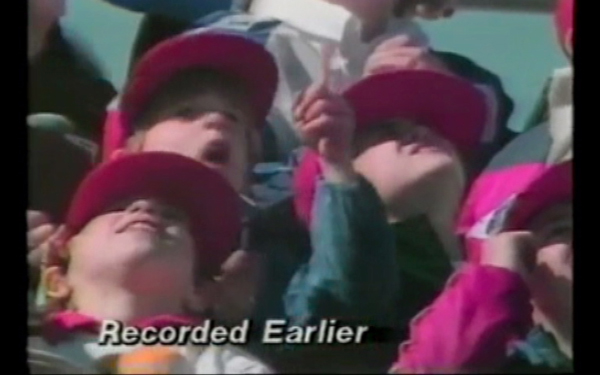
Daniel Baird’s video piece, “And Ever,” images a crowd of people looking up at the sky in awe. The tape is clearly found footage, as the characters’ fashions are obviously dated, 1980’s. We observe the group, standing on risers, watching a spectacle up above them. Their expressions are of reverence and giddy excitement as the camera pans through the masses, from one face to another in groups of 5-6 people at a time, a boyscout troop, an older couple. Something big and amazing is happening.

Daniel Baird, still from "And Ever", video, 2011, courtesy of the artist.

And then as they wait, eyes to the sky in anticipation, the emotions on their faces transform gradually into concern and confusion. Yes, something big is happening here, but it isn’t what we expected to occur. People cry and cover their mouths, or they look away, some collapse in despair. Something big happened indeed. And finally the crowd begins to disperse, some in bewilderment, some in tears, some evidently just speechless.

We never catch a glimpse of the disaster itself, only the players’ reactions to it. Though this viewer certainly has a hunch about the nature of the tragedy (the Challenger explosion, maybe?), it remains a subtlety. The real action is the human drama. The spectacle of the unknown catastrophe becomes the spectacle of the varied human responses to it. We empathize with these affectations, even to the point of wondering how we might perform in such a situation. What’s a normal human reaction to tragedy?

Read More »

Share