New Histories and Epic Tales:
Better a Live Ass than a Dead Lion at Eli Ridgway Gallery

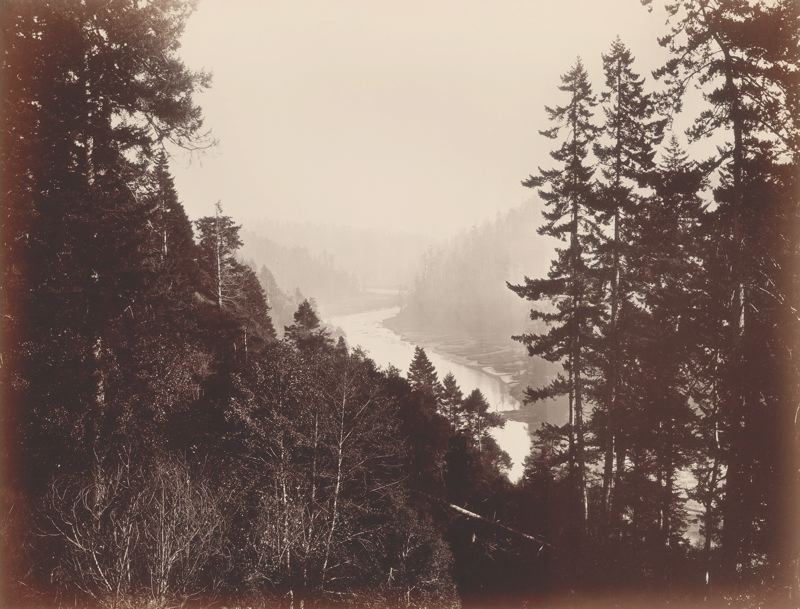
Carleton E. Watkins. Mendocino River, From the Rancherie, Mendocino County, California, c. 1863/68. Albumen silver print from wet-collodion glass negative.

Standing on a hillside gazing into the Pacific Ocean, one can’t help but to be overwhelmed by the beauty and ruggedness of the landscape. Rolling hills, steep cliffs, and thick forests bring to mind epic stories of western expansion and the conquering spirit of those who have traveled here, a spirit currently under investigation at Eli Ridgway Gallery. Better a Live Ass than a Dead Lion brings together a group of San Francisco artists that restlessly explore our romance with both narrative and landscape alike, weaving together stories and dreams of uncharted lands and undiscovered peoples. The love for exploration needs no real truth here; each work presents a small part of a tale bound together by the love of the land.

Elisheva Biernoff. Inheritance, 2010. 80 slides of endangered wilderness areas projected onto mist from a humidifier housed in a plywood and fabric enclosure.

When entering the room that houses Elisheva Biernoff’s Inheritance, 2010, one’s eyes instantly begin to play tricks. Picturesque waterfalls and mountains go in and out of focus. Images dissolve and reconstruct themselves against a backdrop of fog, flashing in and out rhythmically with the subtle sound of a the slide projector. Just as 19th-century photographer Carlton Watkin’s images create mythic space, Inheritance reinterprets fabricated lands at the edge of our perception. Encased in fog, the images rest on the verge of becoming clear, allowing memory to fill in where our vision can’t.

Read More »

Share

From the DS Archives: Taryn Simon

This week from the DS Archives we bring you Contraband, Taryn Simon’s 2010 exhibition at Gagosian, Beverly Hills. Simons’ new series, A Living Man Declared Dead and Other Chapters is on view at the Tate Modern until January 2, 2012.

This article was originally posted by Seth Curcio on September 29, 2010:

Through the process of documenting America’s foundation through both mythology and quotidian objects, photographer Taryn Simon reflects on the heart of national identity by capturing that which is often obscured. Her recent series An American Index of the Hidden and Unfamiliar (2007), investigates objects and scenes that are often literally and metaphorically out of visual reach by the average citizen in the United States.

For this series, the artist photographed a wide range of subjects such as nuclear waste encapsulation and storage facilities to a recreational site for death row prisoners. An American Index of the Hidden and Unfamiliar, is the culmination of a four year project and demonstrates the lengths that the artist will go to photograph her desired subject.

Read More »

Share

Jaap Pieters at Spectacle

How art can reveal the truth is a debate that will never end. Depending on who you ask, fidelity has been correlated with formal abstraction’s ability to reveal raw feelings, the eye’s capability to expose ontic faithfulness, or sometimes the artworks function in the social or political spheres. Some artists try to reveal truth, wherever they see it. Often unwilling to limit what makes truth, they trust their base instincts and aim themselves at the things that they think are genuine, trusting we will see the honest moment that they see.

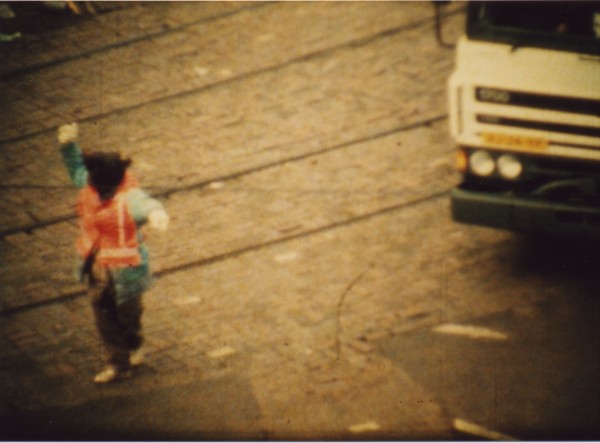
Jimmy

Jaap Pieters, who is touring America for the first time with his silent 8mm films (he will be accompanied by electro-acoustic performances most nights), seems like one of the last types. He began to release his films in an art context during the mid 90’s. The first assortment of works filmed the street outside of his apartment in Amsterdam. He captured fleeting moments outside his window, asking questions about seeing and watching. He consciously captured homeless and drunks as they danced, bummed cigarettes, and staged mini-dramas for an invisible audience.

Read More »

Share

The Lived-in Look

L.A. Expanded: Notes from the West Coast
A weekly column by Catherine Wagley

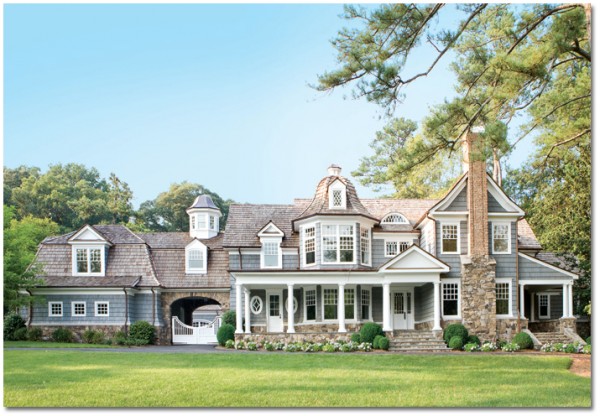
2009 Atlanta Christmas House

The 2009 Christmas House in Atlanta.

Over Thanksgivings, which my sister and I spent with our aunt and grandmother in Atlanta, all of us used to go to the Atlanta Christmas House. It’s always a big, newly renovated or newly built Victorian-style mansion in which everything is up-to-date and in its place. A local designer has decorated and furnished each room, and this means rooms don’t necessarily make sense together—you could cross a hallway and go from Ikea-style modernism to shabby chic.

My sister, then a Harvard student who joked about being in college for her Mrs. degree (“when I marry into money”), loved the house. She never meant it about the Mrs. thing, but there was something perfectly appealing to her about this big, sleekly assembled house. She liked it’s newness and scale; it connoted comfort and freedom from want (she’s in Thailand now, braving the floods—a far cry from Atlanta posh). I remember we couldn’t find her once, and saw her wandering outside, toward the gazebo as if in a daze.

Because she loved it so much, I tried not to say how much I hated the Christmas House. It was impossible for me to imagine living in those pre-made rooms that had never been lived in—even the artbooks on the table were the wrong kind; lots of Taschen and oversized Phaidon, the type you can find at most any urban Barnes and Nobles.

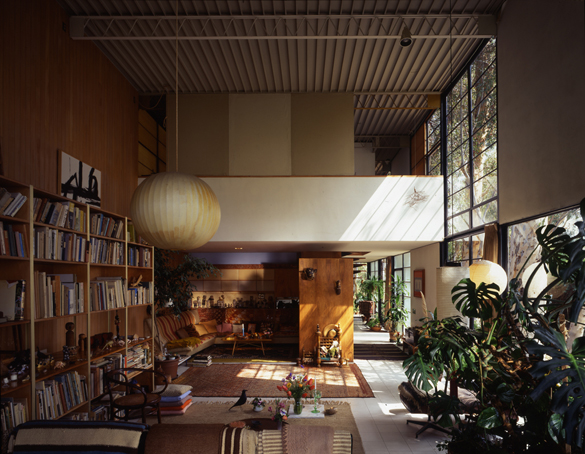
Charles and Ray Eames' living room, looking slightly tidier than it does at LACMA

These days, I don’t even like the historical tours of turn-of-the-19th-century mansions, owned by former moguls or just well-to-do families. As a kid, I’d go through them and fantasize about living in that time, sleeping in those canopied beds, changing behind one of those decorative screens. But now? Most of those houses, like the Campbell mansion in Spokane or the Swan House in Atlanta, feel like they’ve been left with just enough character to evoke “how-they-lived-then,” and stripped of most idiosyncrasy.

Read More »

Share

Eindhoven – The City as a Muse.

When contemplating the city of Eindhoven, in the south of the Netherlands, one’s mind typically reaches for the successful football team, PSV Eindhoven or the international product giants, Philips. A city more closely associated to manufacture and design rather than to the expressive and conceptual world of contemporary art. Therefore, it was a welcome surprise to visit the Van Abbemuseum, and view the current exhibition ‘For Eindhoven’ – The City as Muse’ curated by Annie Fletcher. The exhibition presents 14 artists personal interactions with the city and museum, where characteristic qualities of industrial production, or classical examples of mid-20th-century town planning reflect in the development of a creative process.

Jan Dibbets, "The Shortest Day at the Van Abbemuseum, 1970". Image courtesy of the gallery.

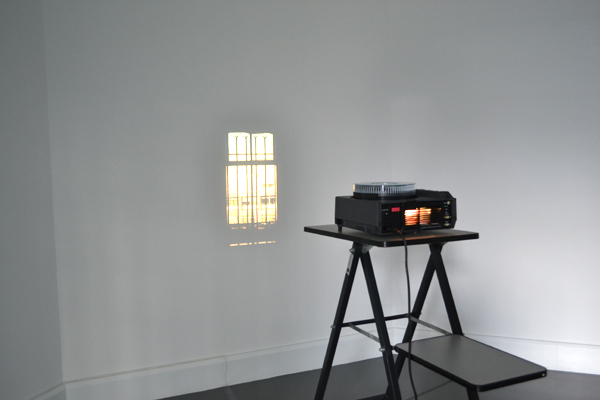
One stunning example is Jan Dibbets work, The Shortest Day at the Van Abbemuseum, 1970. Here Dibbets displays the work in the same place it was created. He photographed the incoming light into the exhibition space on the shortest day of the year in 1970.  A shot was taken every six minutes from sunrise to sunset. The focus adjustment and the position of the camera remain unchanged allowing the natural course of time and light to become clearly visible. Each element of this piece interacts with each other, from the current window being reflected in the photographs taken 41 years ago, to the outside light shining onto the archaic slide projector with the old dim light bulb. Here Jan Dibbet subtly communicates the powerful exchange between the making of art and the importance of place. Furthermore, the bold decision of the museum to return to this work in 2011 is a wonderful expression of the layering of time and change, not only by the exhibit, but also as a reflection of the circular evolution that occurs within the history of art.

Read More »

Share

Eye of the Messenger

Iwan Effendi, The Crane Song, 2011, Acrylic on canvas, 100cm x 150cm. Image Courtesy of Yavuz Fine Art.

The joy and plight of many contemporary, Western-centric cultural practices today is the recognition that artistic shouldering of the collective burden of history does not necessarily attribute any value to the work. At worst, it is unfashionable and counter-productive to contemporary discourse; at best, it provides a vague notion of plurality and diversity that benefits a particular portion of the arts patronage. On the contrary, contemporary Asian art’s transformative power and value in the region, almost always lie in the recollection of the memories of post-war political independence, the marvel at socio-economic progress and sorrows of rapid industrialization.

In 1965, Indonesia found itself once again at a political crossroads after having endured an extended period of political instability since securing independence from Dutch colonial rule. In the twilight of President Sukarno’s rule in 1965 marked by bitter ideological conflict and political polarization, a coup at the end of September triggered a widespread wave of violence that brought General Suharto to office for over 3 decades. Generations removed from these events after 5 decades, the suppression of dissident artistic voices in the Suharto’s iron-fisted rule mean that contemporary Indonesian artists have only in recent years, begun their cathartic response to the trauma.

Eye of the Messenger by Iwan Effendi at the Yavuz Fine Art Gallery is such a response, interrogating the construction of Indonesian history in political upheaval of the 1960s and ultimately acknowledges that the socio-cultural and political discourses surrounding these years are cultivated, cultured and fabricated. As Walter Benjamin wrote, the craft of storytelling, does not aim to convey the pure essence of the thing, like information or a report, [but instead] sinks the thing into the life of the storyteller, in order to bring it out of him again. Similarly, a desire to contribute his own gesture of political resistance and social commentary underlies Effendi’s surrealistic images through a combination of word-and-image binary that is part-storytelling, part-myth and part-reality.

Iwan Effendi, Long Lost Memories, 2011, Acrylic on canvas, 70.5cm x 150cm. Image Courtesy of Yavuz Fine Art.

Iwan Effendi, The Bird Who Feeds The Fish, 2011, Acrylic on canvas, 70.5cm x 150cm. Image Courtesy of Yavuz Fine Art.

“Here I tell you, my friends,” Effendi writes in his catalogue, “a story where history was buried.” A large green tree with all-seeing eyes dominates Treasure Hunt (2011); The Crane Song (2011) is a diptych of opposing colours of blue and orange tones composed of a man who wears eyes as his cloak; Long Lost Memories (2011) is a piece of bulbous objects, bird eggs and birds that peer disconcertingly into nothingness. “But thank god, our eyes can’t lie,” Effendi further remarks. Ocularity and perception feature prominently in his canvases; the physical eye, and by extension, the visual experience, is used as a cautionary metaphor because of its ability to fall prey to yet simultaneously, resist manipulations.
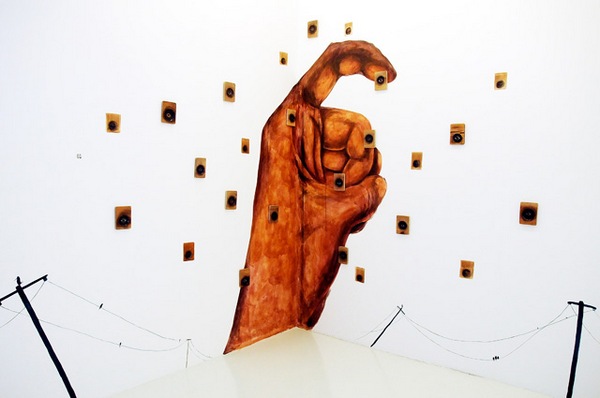
Iwan Effendi, Eye of the Messenger 2011, Installation View. Image Courtesy of Yavuz Fine Art.

The works in Eye of the Messenger are ironic and multi-layered: dismembered, colourful body parts float in the dimensional space of the canvasses and are tacked onto each other. They can’t be contained by the boundaries of canvas, spilling out of the seams and onto the surrounding white walls. Unlike the luminous simplicity and crack-quality of flat-faced satiric drawings that invite ridicule and laughter, Effendi’s cartoonish works cry out like multiple voices in a Greek tragedy clamouring to claim their own truth. In this context of use, reception and exchange, Effendi’s works accrue a varied interpretive history of – and perhaps even grant absolution to –those who have found finally regained their silenced voices.

***

Eye of the Messenger is on show at the Yavuz Fine Art Gallery until 13 November 2011.

Share

Exhibition #4: Wrap your arms around me

I have always had a soft spot for the Museum of Everything – it was their self-prophetic name and bizarre doodles that first won me over, and the witty banter of their newsletter that has sustained the affair since. With last year’s always numbered, never titled, Exhibition #3 featuring a funhouse of circus-cum-taxidermy as curated by Sir Peter Blake, it was with great anticipation that I waited to see what Exhibition #4 would bring.

No cross-dressing acrobatics and water-heaving neighbours to be found this year however – not a bell or whistle or horn or cowbell in sight. Dare I say the Museum of Everything may have grown up and settled down?

Judith Scott, installation view at Exhibition #4, The Museum of Everything, 2011. Image courtesy of the Museum of Everything. Photograph by the author.

This year, the self-proclaimed space for ‘the untrained, unknown and unintentional creators of our modern world’ (the term ‘Outsider Art’ is the one thing that has not found a welcome home here) presented a quiet, emotive show featuring the extraordinary work of Judith Scott, impeccably installed and stunningly lit in the empty warehouse space above the luxurious Selfridges, graduating from an exploding cabinet of curiosities to a museum quality show worthy of the name.

Judith Scott, installation view at Exhibition #4, The Museum of Everything, 2011. Image courtesy of the Museum of Everything. Photograph by the author.

Scott’s obsessively constructed fibre and cloth works hang in the space like abandoned bodies. Exposed, their insides are turned out, with hundreds of metres of yarn and fabric wrapped, tied and consumed. Hours of labour and pain emanate from them.

While there is always a certain danger in relying too heavily on biography – a constraint many women artists have felt over the years – Scott’s work is enriched by contextualisation, or at least better understood. Scott was uneducated, misunderstood and segregated for most of her life, confined by institutionalisation until the age of thirty-five when her twin sister fought to release her. She was deaf, mute and born with Down’s syndrome. She began making sculpture in her 40s.

Read More »

Share