Perpetuum Mobile

Monika Fryčová, Perpetuum Mobile, 2011. Image: Kling og Bang gallery.

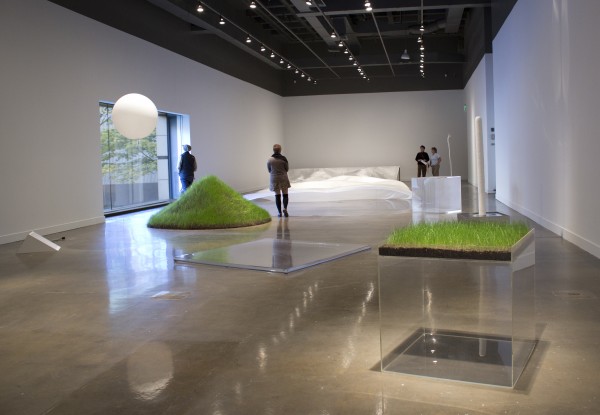
Monika Fryčová’s show Perpetuum Mobile at the Kling og Bang Gallery propositions that the relationship between the visible and invisible is constantly in motion and ephemeral.

Locked behind the socialist borders in then-Czechoslovakia, stories of local culture were the only narratives that Fryčová heard. Like many artists who were restless for new physical activity and renewed visions after the fall of the Iron Curtain, Fryčová became in her own words, a traveller who charted her own routes and made her own narratives without maps or guides. Consequentially, Fryčová’s works are highly improvised, and dependent on the indeterminacy and spontaneity of human interactions.

Read More »

Share

#Hashtags: We are the 99%

Viral Thoughts on Politics, Arts, and Culture

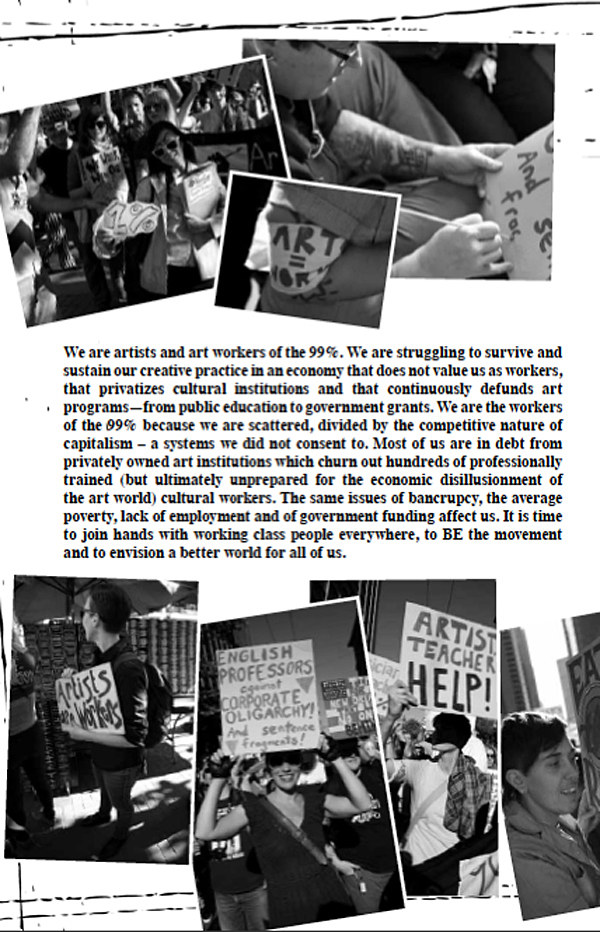
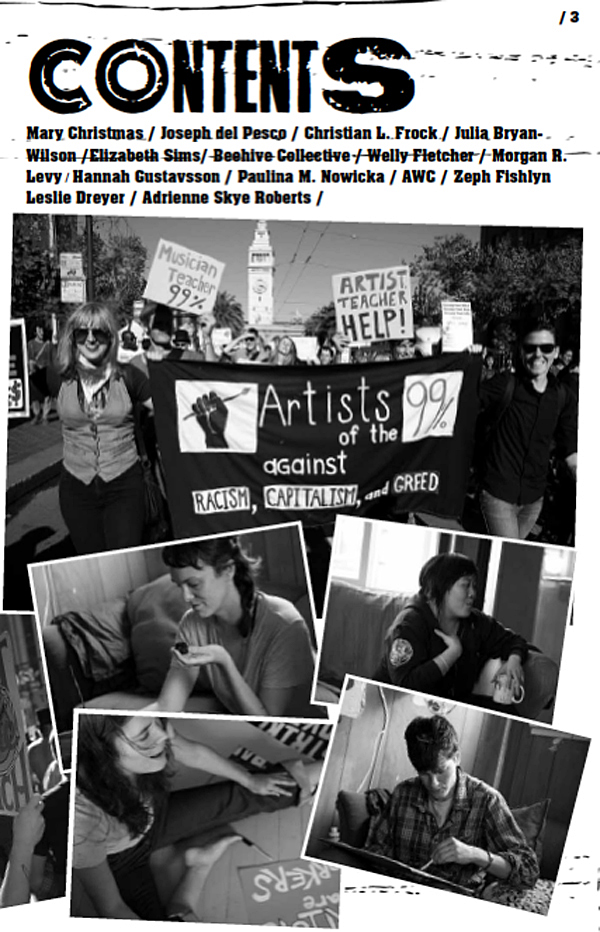
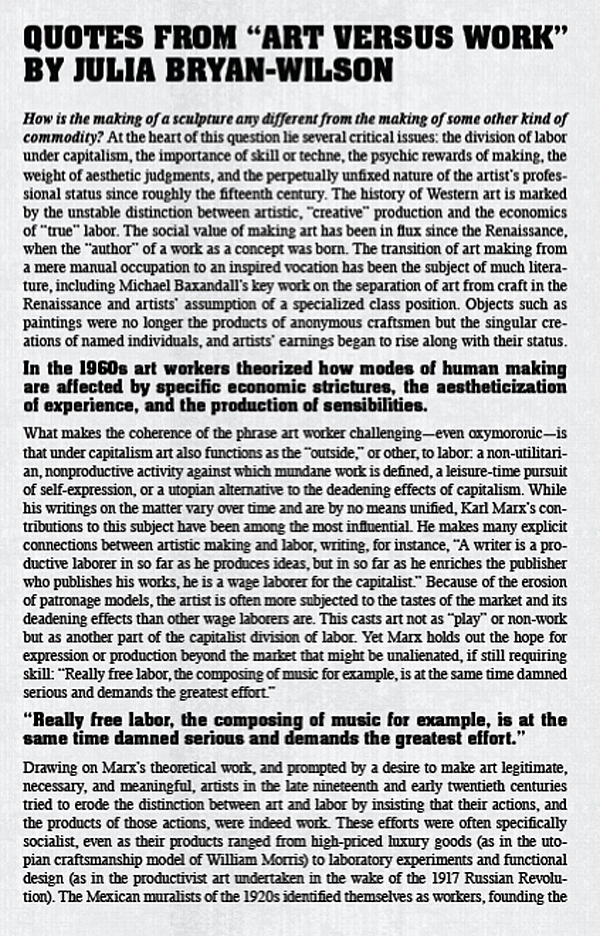
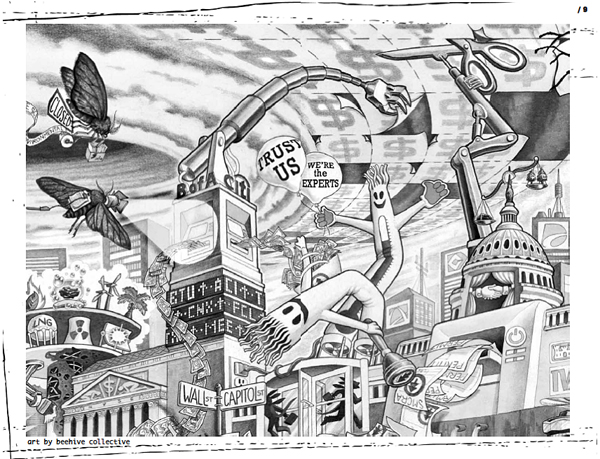
For the last few months, #Hashtags has had one thing on its mind — #occupy.  We, too, are part of the 99%. Today, we’re happy to feature Artist Bloc No. 1, a zine devoted to discussing the role of art workers and the Occupy movement.  Organized by a group of Bay Area artists, scholars and writers, including Christian L. Frock, Julia Bryan Wilson, and Adrienne Skye Roberts, Artist Bloc No. 1 asks “what are the stakes [of artists and art workers] in the discourse around economics, labor, and access to cultural resources?”  We’ve got the first ten pages posted, download the rest at occupationzine, or at Visible Alternative.com.

#Hashtags provides a platform for longer reconsiderations of artworks and art practices outside of the review format and in new contexts. Please send queries and/or ideas for future to hashtags@dailyserving.com.


Share

A California State of Mind, Circa 1970

Eleanor Antin, “100 Boots,” 1971-73.

Alright, I’ll say it. A show that features conceptual art circa 1970 threatens to be dry. At the outset, you know you’ll be getting mostly documentation: photographic, video, film, and paper. Beyond the ordinary wall text, there will probably be artists’ statements explaining what was done while you weren’t looking. The typewriter, the mimeograph, and the camera will act as not-so-silent partners to the artists’ projects. “State of Mind: New California Art Circa 1970” at the Orange County Museum of Art doesn’t escape these confines, but ends up offering you just a little bit more.

Bruce Nauman, “Studies for Holograms (Pinched Lips; Pulled Lower Lip; Pulled Neck; Pulled Cheeks; and Squeezed Lips),” 1970.

The show is divided into categories like “Mapping the Land,” “Politics,” “Public and Private Space,” and “Language and Wordplay.” As with previous shows I’ve seen at OCMA, these divisions hinder the overall experience. I found myself wishing that the curators had stuck to working chronologically or geographically, simply because most of the works are more interesting when viewed across categories, instead of in isolation. Bruce Nauman and Bonnie Sherk, for instance, would have made interesting counterpoints to each other; “State of Mind” includes Nauman’s Thighing (1967), Studies for Holograms (Pinched Lips; Pulled Lower Lip; Pulled Neck; Pulled Cheeks; and Squeezed Lips) (1970), and Walking in an Exaggerated Manner around the Perimeter of a Square (1967-68), to name a few, which pair nicely with Sherk’s Sitting Still series, where the artist photographs herself sitting in public locations usually used for passing through, like the Golden Gate Bridge or the corner of Mission and 20th in San Francisco.

Read More »

Share

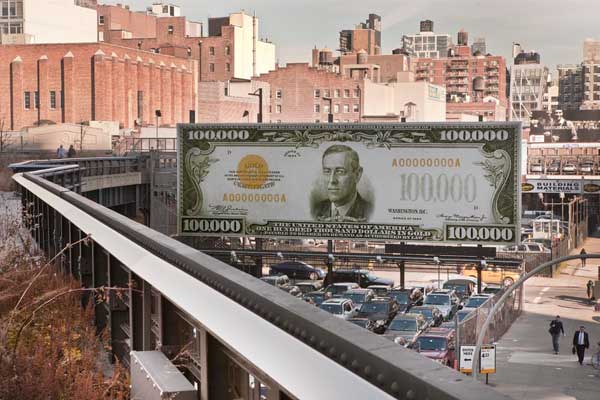
Bigger is better: The first $100,000 that John Baldessari ever made.

Today’s post is brought to you by our friends at Huffington Post Arts. Read below to learn about John Baldessari’s new public work in New York City.

It’s no big shocker that we are not at our finest economic hour, but John Baldessari may have stumbled upon a solution to our money woes. All this time we have been trying to make more money, when maybe we should have focused on making bigger money.

Just look at Baldessari’s new installation towering over 18th Street in New York, an $100,000 bill board entitled ‘The First $100,000 I Ever Made.’ At 25-by-75-feet, this grand-scale gravy is big enough for everyone to enjoy, in some capacity at least.

The $100,000 dollar bill was issued in a previous attempt to assuage financial hardships during the Great Depression when 42,000 were circulated. Today they are illegal, though some have been kept in the Smithsonian Museum and Federal Reserve. But big problems need big solutions! Bring back those bills and supersize them, please.

Baldessari is known for his conceptual work toying with the relationship between narrative, language and image in art. What is he saying here? Are we in a Greater Depression? Is this the final equation of art and capital? Or was the whole ‘bill board’ pun just too good to pass up? What do you think?

Share

The Problem Frank Lloyd Wright Didn’t Have

L.A. Expanded: Notes from the West Coast
A weekly column by Catherine Wagley

I wrote the below in 2008, for a design blog, D/visible, that has since gone into hibernation. But I’ve been thinking about the same ideas this week — essence and monumentality — and wanted to revisit.

William Cordova, "The House that Frank Lloyd Wright built 4 Fred Hampton and Mark Clark," 2006 (installation view)

“It may have escaped your attention,” says Elizabeth Costello, the title character in a 2003 novel by J.M. Coetzee, “but I slipped in, a moment ago, a word that should have made you prick up your ears. I spoke about my essence and being true to my essence.” Costello, an aging writer, has dropped the bait. She has invited the other writers, artists and scholars in the room to squirm and argue, to ask how she even knows she has any “true essence.” If they do ask, however, she won’t be able to answer because she’s not sure she knows who she is.

Artists, architects, writers—people who craft objects and narratives—have spent much of the last forty years questioning what they don’t know. It’s an exhausting, endless cycle. If you don’t know who you are, how can you understand the world around you? If you don’t understand the world, is it irresponsible to fabricate a new object or tell a new story? How will you know that what you’ve made has improved, not tainted, its environment? Pertinent as these questions are, it would be nice if they would stop stymieing artists, keeping them from doing what they want to do, which is make art.

Read More »

Share

Miami Art Fairs 2011

The December art fairs in Miami are always a blurred craze of viewing art and people, fascinating and often horrifying. This year, as in years past, DailyServing sent a few writers to Miami to look for the most interesting projects among the fairs, local galleries, and outdoor exhibitions and events. We came back with a mix of work that includes the recent wave of mirror art, design projects from Design Miami, and perhaps some of the more interesting painting to grace the public walls of Wynwood. While nothing can give you a comprehensive view of the Miami art fairs – not even attending the exhibitions –  DailyServing contributors Rebekah Drysdale and Carmen Winant share their opinions of a handful of the highlights from 2011.

By Rebekah Drysdale:

Design Miami, Elisa Strozyk & Sebastian Neeb, Miami 2011. Photo by Alexander Tamargo/Getty Images.

At the entry of the Design Miami tent, an impromptu atelier welcomed visitors to the installation performance created by Elisa Strozyk and Sebastian Neeb. Fendi, the Italian luxury fashion house, provided the opportunity for these artists to showcase their work. Fendi also provided the leather that was woven into the 18th century furniture on display.

The simple workspace was surrounded by decorative objects and antique furnishings which the artists had modified using the materials at hand. Strozyk’s sewing machine seemed to be a very early model, reinforcing an awareness of the historic continuity of methods, techniques, and materials in noble crafts. Strozyk and Neeb’s collaboration achieved an elegant, subtle exhibit.

Retna: Wynwood Walls, Miami 2011

Retna‘s distinct, over-sized calligraphy graced numerous surfaces throughout Miami. His mural at Wynwood Walls was poignant and precise. The L.A. artist (real name Marquis Lewis) began painting murals in the mid-1990s and has since had many highly acclaimed gallery exhibitions, most notably his 2010 exhibition at New Image Art.

Visually influenced by writing from around the world, Retna invented his own alphabet. His calligraphy recalls Old English and Arabic scripts, drawn with an oversized brush as if with a nib. The artist encourages viewers to interpret their meaning and clarified in a recent interview, “They all say something.” Retna’s installations transcend the street artist vs. gallery exhibition debate. His imagery and symbolism are eloquent and exacting.

Read More »

Share

Otto Piene and Hans Haacke at MIT

You walk in to a darkish room where ever-changing shapes move like a school of fish across the walls. After your eyes adjust, you find that the there are two benches sitting among six sculptures that are producing the schools of fish and that the fish are made out of nothing but light beams. These sculptures are metal. Simple geometry (sphere, cube, etc). The room is quiet and calming. Everyone who has been here talks about the unexpected smiles that slip onto their cynical faces, and it happens to you too.

Installation view Otto Piene: Lichtballett. Photo: Gunter Thorn. All photos courtesy MIT List Visual Arts Center

To understand what is going on here, you have to look back to the 1960’s, which may have been the high point of art at MIT. During the sixties, arts funding was partially used as a counterbalance to the political consequences from the institute’s complicated and financially fertile military industrial connections. The Center for Advanced Visual Studies (CAVS) was founded in 1967 by Gyorgy Kepes and immediately went about funding exhibitions and visits for some very interesting artists. With the available capital, an unavoidable optimism of postwar boom, and a complete lack of habits (good or bad) Kepes attempted to foster “media geared to all sensory modalities; incorporation of natural processes, such as cloud play, water flow, and the cyclical variations of light and weather; [and] acceptance of the participation of ‘spectators’ in such a way that art becomes a confluence.” (pdf)

Two of the first artists who were invited to visit MIT were Otto Piene and Hans Haacke (as well as Stan VanDerBeek). Piene was in the first round of fellows (meaning he was in residency for a year), and would succeed Kepes as director in 1968. Haacke was invited for a solo show at MIT in 1967. The body of work both presented consisted of systems, those very cloud/water/lights that Kepes hoped to present as art media.

Installation view: Hans Haacke, 1967.

Read More »

Share